FUNDAMENTALS OF GAME
PLAY
Game Character Design Development
Instructor:
Sayed Ahmed
B.Sc. Eng. in CSc. & Eng.
M.Sc. in CSc.
Consultant
Just E.T.C Tech. Inc.
sayed@justEtc.net
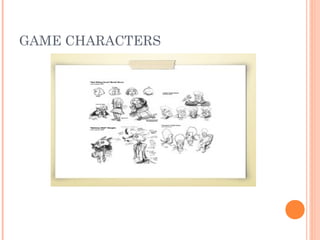
GAME CHARACTERS
INTRODUCTION
 Introduction
Characters, and hence character design is an
important part of telling stories or evoking
an emotional response
The characters we play with and interact
with
 make us believe the game world
Heroes, villains, innocents in distress, and
bystanders
without these characters the game will be
an empty shell
TOPICS
 How to design compelling and believable
characters
 Characteristics of the avatar character
 Player Designed
 Built-in
 Gender specific character design
 Common game stereotypes that you should avoid
 Attributes associated with the character
 Visual
 Behavioral
 Audible
 Use these attributes to design your own character
TOPICS
 Design Strategy
 Art driven
 Story Driven
 Importance of good audio design for your characters
GOALS OF CHARACTER DESIGN
 Game Play of many games center around the
characters
 All of the following types of games use characters
to entertain
 Action (fighting, platform)
 Adventure Games
 Action Adventure hybrids
 Role Playing
 Players usually feel for well designed characters
to
 Identify with
 Care about
 Heroes to cheer about….villains to boo
GOALS OF CHARACTER DESIGN
 Best games include characters that are neither
heroes nor villains
 Appeal of the character is important
 Not necessarily have to be attractive in conventional sense
 But everything should fit to define him/her, and the role
 Disharmonious elements can be used to introduce humor
 http://www.mariowiki.com/Conker_%28series%29
 Characters should have a personality and it should not be
broken
 An evil ghost character should not feel sorry for babies
 Avatar characters have an extra burden
 The player should associate him with the avatar
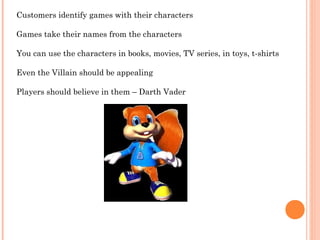
Customers identify games with their characters
Games take their names from the characters
You can use the characters in books, movies, TV series, in toys, t-shirts
Even the Villain should be appealing
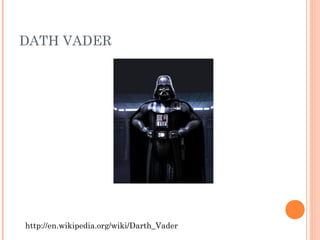
Players should believe in them – Darth Vader
DATH VADER
http://en.wikipedia.org/wiki/Darth_Vader
RELATIONSHIP BETWEEN PLAYER AND
AVATAR
 The game character that acts as the protagonist of the
player
 Most action and action adventure games provide only
one Avatar
 Role playing games –
 the player may be associated with multiple characters.
 However, if there is a key character whose death leads to
defeat then he is the Avatar
 Avatar may be the most displayed character
 May need most animation
 The animation should be smoothest for the avatar
 don’t annoy the player (it’s him)
 Movements must be attractive
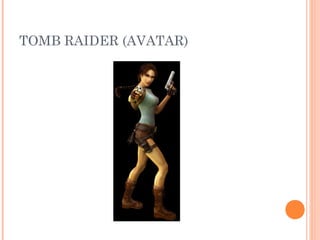
TOMB RAIDER (AVATAR)
PLAYER DESIGNED AVATARS
 Most games predefine the Avatar
 In some games esp. multiplayer role playing
games
 the games allow the players to create their own
Avatars
 Define: Sex, body type, hair, eye, color, strength, dexterity
 For example: Lord of the Rings
 In such cases, as a designer you do not create the
avatars but you give tools to create
 The more and better tool you can provide to define the
physical as well as personality attributes – the more players
will like it
 http://www.youtube.com/watch?v=TxfO9_pQhCg
SPECIFIC AND NON-SPECIFIC
AVATARS
 Non-specific
 Myst
 http://www.youtube.com/watch?v=cIRtutbSwak
 Not defined by the designer
 No visual appearance
 No defined personality
 Designers did not specify about them
 Half life
 http://www.youtube.com/watch?v=gKg3TUPQ8Sg
SPECIFIC AND NON-SPECIFIC
AVATARS
 Designers found non-specific to be limiting
 They wanted to give some personality and visual
appearance of the Avatar
 Modern games
 use detailed characters with
 Histories
 Personalities
 Of their own
 Partially characterized – games with less or
without stories
 The avatar – sort of cartoon
 http://www.youtube.com/watch?v=Olug8C2-hfo
 Many avatars in action games
SPECIFIC AND NON-SPECIFIC
AVATARS
 Also depends how the player controls them
 As a guide
 Be them
 But do not care about their feelings as they are partially
defined
MALE AND FEMALE CHARACTERS
 It is believed that male players will not want to
play female characters
 Tomb Raider – Lara Croft:
 Later found as long as the actions are men like – men don’t
mind
 Females are usually ok to play with male avatars
 However, females at one point get tired
 and want to play with female avatars and with feminism
activities
 Females don’t like
 Blood Rayne: http://www.youtube.com/watch?v=f_96uIcT34I
 http://en.wikipedia.org/wiki/BloodRayne
 Silent hill
MALE AND FEMALE CHARACTERS
 Males do not associate them with avatars
 Females do
 Women tend to see avatars as an extension to
their own personality
 You may want to give more options to define and
express
 You may have more male or female avatars and
provide different story lines
 Costly and complicated to implement
HOW TO DESIGN YOUR AVATAR
CHARACTER
 Think how you want the player to relate him to
the avatar
 Non specific?
 Partially specific? Players sees but knows a little
about – no inner life
 Fully specified avatar
 Separate from the player, an individual with a personality
of his own – psychological and visual detail – how much will
he talk
 More talk…more intelligent (may vary culture to culture)
 Gordon freeman never talks (player)
 Mario Lara croft don’t talk much (representatives of the
player)
 April Ryan talks a lot (a person on his own right)
HOW TO DESIGN YOUR AVATAR
CHARACTER
 http://www.google.ca/imgres?
imgurl=http://bestgamewallpapers.com/files/drea
mfall-the-longest-journey/april-
ryan.jpg&imgrefurl=http://bestgamewallpapers.c
om/dreamfall-the-longest-journey/april-
ryan&h=1024&w=1280&sz=194&tbnid=MFtAq5
EYAjPi2M:&tbnh=120&tbnw=150&prev=/images
%3Fq%3Dapril
%2Bryan&zoom=1&q=april+ryan&hl=en&usg=_
_x-
WTegObe2ZM5OvnHob0GgpbA5M=&sa=X&ei=1
pcmTaLGH4ymnwf37Zy_AQ&ved=0CDMQ9QE
wAw
HOW TO DESIGN YOUR AVATAR
CHARACTER
 Think how the player will control the avatar
 Direct/indirect
 Indirect:
 Is distinctly someone else with a mind of his own
 Direct
 A puppet
 Find the right balance
 Create avatars that players like with bravery,
intelligence
 Worst: avatar with qualities that the players
actively dislike
HOW TO DESIGN YOUR AVATAR
CHARACTER
 Final Fantasy Viii
 Bad avatar
 Designers like to create semi specific characters
 Zelda series
VISUAL APPEARANCES
 Aside from nonspecific avatar based games, you
need to display the avatar
 The way the characters look like has an
enormous effect on the player
 Art Driven
 Cartoon Like. Define characters by defining the
visual appearance, works well if the personality of
the character is not complex, does not change much,
good for other media
 Story driven
 Visual and behavioral design techniques
CHARACTER PHYSICAL TYPES
 Humanoids, Non-humanoids, and Hybrids
 Voice or animated objects
 Cartoon like Qualities
 Cool
 Never get too upset, rebellious attitude towards authority, wit
than body force. Ratchet & clank. Game actions fast and
focused
 Tough
 Exemplify physical aggression. Usually male except Lara croft.
Exaggerated height and bulk. Large expansive gestures
 Ryu from street fighter
 Cute
 Portions with human or animal babies. Large eyes oversized
head surrounded body, dress with colors. Jumping wide gaps,
climbing long ropes, firing large weapons
 Goofy
 Odd proportions and funny looking
CHARACTER PHYSICAL TYPES
 Cartoon characters vary across cultures
 Japan: large eyes tiny mouths
 Americans find European cartoons to be ugly
 Hyper sexualized Characters
 Exaggerating the sexual attributes of Men and
Women to make them more sexually appealing at
least to the teenagers
 Male: extra broad chest, and shoulders, huge
muscles, prominent jaws, oversized hands and feet
 Kratos, God of War Games
 Lara Croft, Tomb Raider hyper sexualized women
CLOTHING, WEAPONS, SYMBOLIC OBJECTS, AND
NAMES
 Set clothing to set him/her apart
 Do not add too many distinctive visual features
 Two or three are enough
 You can give your characters distinct names as
well
COLOR PALETTE
 Lara Croft – tealed colored shirt
 Superman wears red
 Batman black
 Choose your palette to reflect your character’s
attitude and emotional temperament
SIDEKICKS
 A tough hero may travel with a cute sidekick
 To provide some variety
 Also, comic relief
 Allow you to give the player additional moves and
actions
 would not fit in a single character
 Extend the emotional range of the game
 Provide the hero with valuable information – that he
may not be able to get anyway…
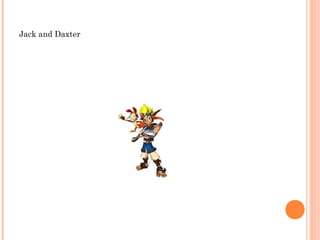
 Jack and Daxter
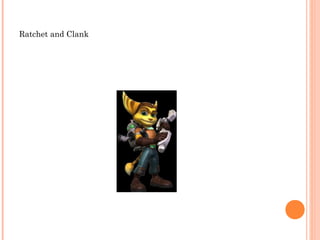
 Ratchet and Clank
 Legend of Zelda, ocarina of time
Jack and Daxter
Ratchet and Clank
ADDITIONAL VISUAL DESIGN
RESOURCES
 GIMP
 Inkscape – editing vector graphics
 Blender – 3D Modeling Tool
 Unreal
 Maya
 Photoshop
CHARACTER DEPTH
 How the characters look has a significant effect on the
player
 The look conveys a lot of information about him
 However, the look only cannot convey all information
 The look cannot define
 how he will act in different situations,
what will be her general behavior,
 how will he interact with the core mechanics of the game
 Hence, you have to add personality to the character
 Story driven character design is helpful here
 Here you define the personality first then you go to
design/draw the character – so the character fits well
 SSX Tricky – snowboarding game
 Can make friends, chose friends and enemies – affect the game
play a lot
CHARACTER DEPTH
 Interaction among players is interesting
 and thought to be well crafted
ROLE ATTRIBUTES AND VALUES
 Every character plays a role
 The moment a character comes into the scene the
player wants to know about him….
 voice and appearance can be ok for minor
characters
 Major characters need richer personalities
 To design them
 List many questions
 Answer them
 Create character background form for each
character
ROLE ATTRIBUTES AND VALUES
 Attributes
 Where was the character born
 Family life as a kid
 His education
 His job
 His finances
 Favorite food
 Worst thing
 How does he treat friends
 Try to imagine how he will behave in a variety of
situations
ROLE ATTRIBUTES AND VALUES
 Then think how they will manifest themselves into
the game story
 Say if a character is a little dishonest but not a villain
– how will you propagate this to the players
 Show rather than tell
 But how?
 Players like interaction – not to sit idle and watch the
character
 Appearance, language, behavior
 Appearance and language quickly defines a character but
can create stereotypes
 Establishing through behavior takes long
 You must give the player the opportunity to observe the
characters’ actions.
ATTRIBUTES
 Status Attributes
 Changes Continually
 Hit points/health (Dungeon and Dragon)
 Characterization Attributes
 Constitution: the character's overall degree of hardness and
resistance to change
 Does not change much
 Recent Games
 Model social relationships and emotional states
 Sims – simulating the behavior of people living in a suburban
neighborhood
 Defined some characterization attributes called Sims
 Some status attributes like hunger, comfort hygiene
 Conflicting Sims won’t get along
 Game
 Direct them to perform the activities
 Happiness level increase or decrease
CHARACTER DIMENSIONALITY
 Two dimensional characters
 Movies, books
 Not very interesting
 Does not grow or change
 Doesn’t feel fully human
 Character Classification
 0 to 3 dimensional
 Discussed in light of the Lord of the Ring
 Zero Dimensional:
 Display only discrete emotional states
 Emotional states never moves smoothly
 No concept of mixed feelings
 Orcs : hate and fear – only two emotions
 Make the characters look like comics
 Bugs bunny, Sylvester, change instantly from one extreme
to another
ONE DIMENSIONAL
 Only one variable to characterize a changing
feeling
 Largely fixed
 Dwarf Gimli
 Hostile and suspicious to elves
 Later grows respects
TWO DIMENSIONAL
 Are described by multiple variables that express
their impulses
 Those impulses do not conflict
 Orthogonal – no emotional ambiguity
 Denethor – strong emotions – pride, contempt,
despair
 Never faces moral dilemma
 Duty and tradition trump all other
considerations
THREE DIMENSIONAL
 Multiple emotional states that can produce
conflicting impulses
 Distresses and confuses them
 Cause them to behave inconsistently
 Froodo, gollam
 April Ryan, longest journey
 Three dimensional are welcomed
 Makes game industry more of an art form
CHARACTER GROWTH
 If the game is not just about being episodes
 But
 Aspires to be more than a simple adventure
 Seeks to have a meaningful story
 Then characters must grow
 Types of Growth
 Action Games
 New moves and new power ups
 Mental state does not change
 Adventure Games
 Allow both personal and emotional growth
 Role Playing Games
 See character growth as a major challenge
 Offer several dimension of growth
 Personal
 Skill – magic weapon
 -
HOW TO PROVIDE CHARACTER
GROWTH
 Decide which characters will grow
 How they will grow
 Physically – easy – abilities power
 intellectually, morally, emotionally
 How will you implement?
 Change in the numeric or symbolic attributes
 Change in the plot of the story
 How the growth will affect the game play
 How will you present it to the player
OPTIONS
 Display numbers in the screen
 Change character appearance
 Chang the action available
 Change to mature language and behavior
CHARACTER ARCHETYPES
 Archetypes play a standard role in a story
 They are not necessarily individual character
 A single character can play multiple roles
 Carefully think about which ones to use in your
games and when to use them
CHARACTER ARCHETYPES
 Hero
 Center of the story
 Players avatar
 Has one or more outer problems
 Hero can also have an inner problem (flaw or dark
 secret)
 Story tells how hero overcomes these
 Stories are about conflict and how to resolve it
 Player must identify with the hero
 Hero’s goals must become the players goals
 Hero can be an anti-hero
 Hero can be a team of individuals
 E.g. in RPG games
 The players plays one or multiple of them
CHARACTER ARCHETYPES
 Mentor
 Guides the hero/player
 Wise man,
 supernatural aid,
 inner voice, ...
 Sometimes the mentor can give bad advise
 Hero/player must decide what is the good advise
CHARACTER ARCHETYPES
 Higher self
 The way the hero wants to be
 Object of the game can be to become this (although
not explicitly)
 Threshold guardian
 Prevents progress of the hero until he has proven his
worth
 Doubt in the hero’s mind
 Warnings by a mentor
 End of level boss
CHARACTER ARCHETYPES
 Allies
 Those that help the hero
 Shadow
 The main enemy that must be defeated
 The ultimate evil
 Does not have to be a character
 Sometimes more important than the hero
 Can be very present or hidden until the end
CHARACTER ARCHETYPES
 Shape shifter
 Changes form/role in the story
 For example, ally becomes a shadow, or mentor
becomes a shadow
 Often important for the plot twist
CHARACTER ARCHETYPES
 Trickster
 Neutral character that creates mischief
 Can be a sidekick
 Adds some comic relief
 Can take the form of
 puzzles in games
CHARACTER ARCHETYPES
 Herald
 Propels story in a different direction
 Can be a simple message
 Angle (Mother)
 Heals the hero
 Father
 Gives good advise and stimulates the hero
CHARACTER ARCHETYPES
 Within the next couple of minutes
 Read the story again
 Find the characters that represent the following
archetypes
 Hero
 Allies
 Herald
 Shadow
 Threshold Guardian
 Mother
AUDIO DESIGN
 Character design also involves
 Sound effects
 Language
 The sounds a character makes tell us something
about her personality
 Sound – injury death
 Sound design- psychological expectation
 Deep : slow and strong
 High sound: light and fast
 Should match with visual texture
 Mismatch to create funny situation
AUDIO DESIGN
 Music composition
 Keep music, sound effects, dialogs (spoken or
narration) in separate files
 Music and sound effect should have separate
volume control
 Keep them separate
VOICE AND LANGUAGE
 The way a character speaks conveys a lot of information about
him/her
 Vocabulary:
 Indicates age, social class, level of education
 Teenage slang, don’t read much – no strong vocabulary,
 Accent
 Place of origin
 Social class
 City people and country people talk differently
 Accent = intelligence
 Dumb redneck
 Dumb negro
 Delivery
 Speed and tone
 Try to steer clear of stereotypes – speed and tone use them to express
anxiety, suspicion, emotional state: hostile, cynical, guarded, and so on
 Vocal Quirks
 Define characters’ education, intelligence, and interests
 Star craft which draws on a variety of American Accents to
create several different types of characters
REFERENCES
 Fundamentals of Game Design, 2nd Edition,
Ernest Adams, Prentice Hall, 2006, ISBN-10:
0131687476. ISBN-13: 978-0131687479
 http://computer.justetc.net

Character design

  • 1.
    FUNDAMENTALS OF GAME PLAY GameCharacter Design Development Instructor: Sayed Ahmed B.Sc. Eng. in CSc. & Eng. M.Sc. in CSc. Consultant Just E.T.C Tech. Inc. sayed@justEtc.net
  • 2.
  • 3.
    INTRODUCTION  Introduction Characters, andhence character design is an important part of telling stories or evoking an emotional response The characters we play with and interact with  make us believe the game world Heroes, villains, innocents in distress, and bystanders without these characters the game will be an empty shell
  • 4.
    TOPICS  How todesign compelling and believable characters  Characteristics of the avatar character  Player Designed  Built-in  Gender specific character design  Common game stereotypes that you should avoid  Attributes associated with the character  Visual  Behavioral  Audible  Use these attributes to design your own character
  • 5.
    TOPICS  Design Strategy Art driven  Story Driven  Importance of good audio design for your characters
  • 6.
    GOALS OF CHARACTERDESIGN  Game Play of many games center around the characters  All of the following types of games use characters to entertain  Action (fighting, platform)  Adventure Games  Action Adventure hybrids  Role Playing  Players usually feel for well designed characters to  Identify with  Care about  Heroes to cheer about….villains to boo
  • 7.
    GOALS OF CHARACTERDESIGN  Best games include characters that are neither heroes nor villains  Appeal of the character is important  Not necessarily have to be attractive in conventional sense  But everything should fit to define him/her, and the role  Disharmonious elements can be used to introduce humor  http://www.mariowiki.com/Conker_%28series%29  Characters should have a personality and it should not be broken  An evil ghost character should not feel sorry for babies  Avatar characters have an extra burden  The player should associate him with the avatar
  • 8.
    Customers identify gameswith their characters Games take their names from the characters You can use the characters in books, movies, TV series, in toys, t-shirts Even the Villain should be appealing Players should believe in them – Darth Vader
  • 9.
  • 10.
    RELATIONSHIP BETWEEN PLAYERAND AVATAR  The game character that acts as the protagonist of the player  Most action and action adventure games provide only one Avatar  Role playing games –  the player may be associated with multiple characters.  However, if there is a key character whose death leads to defeat then he is the Avatar  Avatar may be the most displayed character  May need most animation  The animation should be smoothest for the avatar  don’t annoy the player (it’s him)  Movements must be attractive
  • 11.
  • 12.
    PLAYER DESIGNED AVATARS Most games predefine the Avatar  In some games esp. multiplayer role playing games  the games allow the players to create their own Avatars  Define: Sex, body type, hair, eye, color, strength, dexterity  For example: Lord of the Rings  In such cases, as a designer you do not create the avatars but you give tools to create  The more and better tool you can provide to define the physical as well as personality attributes – the more players will like it  http://www.youtube.com/watch?v=TxfO9_pQhCg
  • 13.
    SPECIFIC AND NON-SPECIFIC AVATARS Non-specific  Myst  http://www.youtube.com/watch?v=cIRtutbSwak  Not defined by the designer  No visual appearance  No defined personality  Designers did not specify about them  Half life  http://www.youtube.com/watch?v=gKg3TUPQ8Sg
  • 14.
    SPECIFIC AND NON-SPECIFIC AVATARS Designers found non-specific to be limiting  They wanted to give some personality and visual appearance of the Avatar  Modern games  use detailed characters with  Histories  Personalities  Of their own  Partially characterized – games with less or without stories  The avatar – sort of cartoon  http://www.youtube.com/watch?v=Olug8C2-hfo  Many avatars in action games
  • 15.
    SPECIFIC AND NON-SPECIFIC AVATARS Also depends how the player controls them  As a guide  Be them  But do not care about their feelings as they are partially defined
  • 16.
    MALE AND FEMALECHARACTERS  It is believed that male players will not want to play female characters  Tomb Raider – Lara Croft:  Later found as long as the actions are men like – men don’t mind  Females are usually ok to play with male avatars  However, females at one point get tired  and want to play with female avatars and with feminism activities  Females don’t like  Blood Rayne: http://www.youtube.com/watch?v=f_96uIcT34I  http://en.wikipedia.org/wiki/BloodRayne  Silent hill
  • 17.
    MALE AND FEMALECHARACTERS  Males do not associate them with avatars  Females do  Women tend to see avatars as an extension to their own personality  You may want to give more options to define and express  You may have more male or female avatars and provide different story lines  Costly and complicated to implement
  • 18.
    HOW TO DESIGNYOUR AVATAR CHARACTER  Think how you want the player to relate him to the avatar  Non specific?  Partially specific? Players sees but knows a little about – no inner life  Fully specified avatar  Separate from the player, an individual with a personality of his own – psychological and visual detail – how much will he talk  More talk…more intelligent (may vary culture to culture)  Gordon freeman never talks (player)  Mario Lara croft don’t talk much (representatives of the player)  April Ryan talks a lot (a person on his own right)
  • 19.
    HOW TO DESIGNYOUR AVATAR CHARACTER  http://www.google.ca/imgres? imgurl=http://bestgamewallpapers.com/files/drea mfall-the-longest-journey/april- ryan.jpg&imgrefurl=http://bestgamewallpapers.c om/dreamfall-the-longest-journey/april- ryan&h=1024&w=1280&sz=194&tbnid=MFtAq5 EYAjPi2M:&tbnh=120&tbnw=150&prev=/images %3Fq%3Dapril %2Bryan&zoom=1&q=april+ryan&hl=en&usg=_ _x- WTegObe2ZM5OvnHob0GgpbA5M=&sa=X&ei=1 pcmTaLGH4ymnwf37Zy_AQ&ved=0CDMQ9QE wAw
  • 20.
    HOW TO DESIGNYOUR AVATAR CHARACTER  Think how the player will control the avatar  Direct/indirect  Indirect:  Is distinctly someone else with a mind of his own  Direct  A puppet  Find the right balance  Create avatars that players like with bravery, intelligence  Worst: avatar with qualities that the players actively dislike
  • 21.
    HOW TO DESIGNYOUR AVATAR CHARACTER  Final Fantasy Viii  Bad avatar  Designers like to create semi specific characters  Zelda series
  • 22.
    VISUAL APPEARANCES  Asidefrom nonspecific avatar based games, you need to display the avatar  The way the characters look like has an enormous effect on the player  Art Driven  Cartoon Like. Define characters by defining the visual appearance, works well if the personality of the character is not complex, does not change much, good for other media  Story driven  Visual and behavioral design techniques
  • 23.
    CHARACTER PHYSICAL TYPES Humanoids, Non-humanoids, and Hybrids  Voice or animated objects  Cartoon like Qualities  Cool  Never get too upset, rebellious attitude towards authority, wit than body force. Ratchet & clank. Game actions fast and focused  Tough  Exemplify physical aggression. Usually male except Lara croft. Exaggerated height and bulk. Large expansive gestures  Ryu from street fighter  Cute  Portions with human or animal babies. Large eyes oversized head surrounded body, dress with colors. Jumping wide gaps, climbing long ropes, firing large weapons  Goofy  Odd proportions and funny looking
  • 24.
    CHARACTER PHYSICAL TYPES Cartoon characters vary across cultures  Japan: large eyes tiny mouths  Americans find European cartoons to be ugly  Hyper sexualized Characters  Exaggerating the sexual attributes of Men and Women to make them more sexually appealing at least to the teenagers  Male: extra broad chest, and shoulders, huge muscles, prominent jaws, oversized hands and feet  Kratos, God of War Games  Lara Croft, Tomb Raider hyper sexualized women
  • 25.
    CLOTHING, WEAPONS, SYMBOLICOBJECTS, AND NAMES  Set clothing to set him/her apart  Do not add too many distinctive visual features  Two or three are enough  You can give your characters distinct names as well
  • 26.
    COLOR PALETTE  LaraCroft – tealed colored shirt  Superman wears red  Batman black  Choose your palette to reflect your character’s attitude and emotional temperament
  • 27.
    SIDEKICKS  A toughhero may travel with a cute sidekick  To provide some variety  Also, comic relief  Allow you to give the player additional moves and actions  would not fit in a single character  Extend the emotional range of the game  Provide the hero with valuable information – that he may not be able to get anyway…  Jack and Daxter  Ratchet and Clank  Legend of Zelda, ocarina of time
  • 28.
  • 29.
  • 30.
    ADDITIONAL VISUAL DESIGN RESOURCES GIMP  Inkscape – editing vector graphics  Blender – 3D Modeling Tool  Unreal  Maya  Photoshop
  • 31.
    CHARACTER DEPTH  Howthe characters look has a significant effect on the player  The look conveys a lot of information about him  However, the look only cannot convey all information  The look cannot define  how he will act in different situations, what will be her general behavior,  how will he interact with the core mechanics of the game  Hence, you have to add personality to the character  Story driven character design is helpful here  Here you define the personality first then you go to design/draw the character – so the character fits well  SSX Tricky – snowboarding game  Can make friends, chose friends and enemies – affect the game play a lot
  • 32.
    CHARACTER DEPTH  Interactionamong players is interesting  and thought to be well crafted
  • 33.
    ROLE ATTRIBUTES ANDVALUES  Every character plays a role  The moment a character comes into the scene the player wants to know about him….  voice and appearance can be ok for minor characters  Major characters need richer personalities  To design them  List many questions  Answer them  Create character background form for each character
  • 34.
    ROLE ATTRIBUTES ANDVALUES  Attributes  Where was the character born  Family life as a kid  His education  His job  His finances  Favorite food  Worst thing  How does he treat friends  Try to imagine how he will behave in a variety of situations
  • 35.
    ROLE ATTRIBUTES ANDVALUES  Then think how they will manifest themselves into the game story  Say if a character is a little dishonest but not a villain – how will you propagate this to the players  Show rather than tell  But how?  Players like interaction – not to sit idle and watch the character  Appearance, language, behavior  Appearance and language quickly defines a character but can create stereotypes  Establishing through behavior takes long  You must give the player the opportunity to observe the characters’ actions.
  • 36.
    ATTRIBUTES  Status Attributes Changes Continually  Hit points/health (Dungeon and Dragon)  Characterization Attributes  Constitution: the character's overall degree of hardness and resistance to change  Does not change much  Recent Games  Model social relationships and emotional states  Sims – simulating the behavior of people living in a suburban neighborhood  Defined some characterization attributes called Sims  Some status attributes like hunger, comfort hygiene  Conflicting Sims won’t get along  Game  Direct them to perform the activities  Happiness level increase or decrease
  • 37.
    CHARACTER DIMENSIONALITY  Twodimensional characters  Movies, books  Not very interesting  Does not grow or change  Doesn’t feel fully human  Character Classification  0 to 3 dimensional  Discussed in light of the Lord of the Ring  Zero Dimensional:  Display only discrete emotional states  Emotional states never moves smoothly  No concept of mixed feelings  Orcs : hate and fear – only two emotions  Make the characters look like comics  Bugs bunny, Sylvester, change instantly from one extreme to another
  • 38.
    ONE DIMENSIONAL  Onlyone variable to characterize a changing feeling  Largely fixed  Dwarf Gimli  Hostile and suspicious to elves  Later grows respects
  • 39.
    TWO DIMENSIONAL  Aredescribed by multiple variables that express their impulses  Those impulses do not conflict  Orthogonal – no emotional ambiguity  Denethor – strong emotions – pride, contempt, despair  Never faces moral dilemma  Duty and tradition trump all other considerations
  • 40.
    THREE DIMENSIONAL  Multipleemotional states that can produce conflicting impulses  Distresses and confuses them  Cause them to behave inconsistently  Froodo, gollam  April Ryan, longest journey  Three dimensional are welcomed  Makes game industry more of an art form
  • 41.
    CHARACTER GROWTH  Ifthe game is not just about being episodes  But  Aspires to be more than a simple adventure  Seeks to have a meaningful story  Then characters must grow  Types of Growth  Action Games  New moves and new power ups  Mental state does not change  Adventure Games  Allow both personal and emotional growth  Role Playing Games  See character growth as a major challenge  Offer several dimension of growth  Personal  Skill – magic weapon  -
  • 42.
    HOW TO PROVIDECHARACTER GROWTH  Decide which characters will grow  How they will grow  Physically – easy – abilities power  intellectually, morally, emotionally  How will you implement?  Change in the numeric or symbolic attributes  Change in the plot of the story  How the growth will affect the game play  How will you present it to the player
  • 43.
    OPTIONS  Display numbersin the screen  Change character appearance  Chang the action available  Change to mature language and behavior
  • 44.
    CHARACTER ARCHETYPES  Archetypesplay a standard role in a story  They are not necessarily individual character  A single character can play multiple roles  Carefully think about which ones to use in your games and when to use them
  • 45.
    CHARACTER ARCHETYPES  Hero Center of the story  Players avatar  Has one or more outer problems  Hero can also have an inner problem (flaw or dark  secret)  Story tells how hero overcomes these  Stories are about conflict and how to resolve it  Player must identify with the hero  Hero’s goals must become the players goals  Hero can be an anti-hero  Hero can be a team of individuals  E.g. in RPG games  The players plays one or multiple of them
  • 46.
    CHARACTER ARCHETYPES  Mentor Guides the hero/player  Wise man,  supernatural aid,  inner voice, ...  Sometimes the mentor can give bad advise  Hero/player must decide what is the good advise
  • 47.
    CHARACTER ARCHETYPES  Higherself  The way the hero wants to be  Object of the game can be to become this (although not explicitly)  Threshold guardian  Prevents progress of the hero until he has proven his worth  Doubt in the hero’s mind  Warnings by a mentor  End of level boss
  • 48.
    CHARACTER ARCHETYPES  Allies Those that help the hero  Shadow  The main enemy that must be defeated  The ultimate evil  Does not have to be a character  Sometimes more important than the hero  Can be very present or hidden until the end
  • 49.
    CHARACTER ARCHETYPES  Shapeshifter  Changes form/role in the story  For example, ally becomes a shadow, or mentor becomes a shadow  Often important for the plot twist
  • 50.
    CHARACTER ARCHETYPES  Trickster Neutral character that creates mischief  Can be a sidekick  Adds some comic relief  Can take the form of  puzzles in games
  • 51.
    CHARACTER ARCHETYPES  Herald Propels story in a different direction  Can be a simple message  Angle (Mother)  Heals the hero  Father  Gives good advise and stimulates the hero
  • 52.
    CHARACTER ARCHETYPES  Withinthe next couple of minutes  Read the story again  Find the characters that represent the following archetypes  Hero  Allies  Herald  Shadow  Threshold Guardian  Mother
  • 53.
    AUDIO DESIGN  Characterdesign also involves  Sound effects  Language  The sounds a character makes tell us something about her personality  Sound – injury death  Sound design- psychological expectation  Deep : slow and strong  High sound: light and fast  Should match with visual texture  Mismatch to create funny situation
  • 54.
    AUDIO DESIGN  Musiccomposition  Keep music, sound effects, dialogs (spoken or narration) in separate files  Music and sound effect should have separate volume control  Keep them separate
  • 55.
    VOICE AND LANGUAGE The way a character speaks conveys a lot of information about him/her  Vocabulary:  Indicates age, social class, level of education  Teenage slang, don’t read much – no strong vocabulary,  Accent  Place of origin  Social class  City people and country people talk differently  Accent = intelligence  Dumb redneck  Dumb negro  Delivery  Speed and tone  Try to steer clear of stereotypes – speed and tone use them to express anxiety, suspicion, emotional state: hostile, cynical, guarded, and so on  Vocal Quirks  Define characters’ education, intelligence, and interests  Star craft which draws on a variety of American Accents to create several different types of characters
  • 56.
    REFERENCES  Fundamentals ofGame Design, 2nd Edition, Ernest Adams, Prentice Hall, 2006, ISBN-10: 0131687476. ISBN-13: 978-0131687479  http://computer.justetc.net