Unit 3
Communication
Styles
1. Passive
2. Aggressive
3. Assertive
4. Passive-Aggressive
5. Analytical
6. Functional
7. Intuitive
8. Personal
Objectives
1. Examine the definition of the word
communication.
2. Analyze 8 different communication styles.
3. Discover which styles are your own.
4. Think about what effective communication
looks like.
What does Communication mean?
● a process by which information is exchanged
between individuals through a common
system of symbols, signs, or behavior.
● Verbal communication- spoken words used to
explain information and exhange ideas.
● Non-verbal communication- the use of body
language to express ideas.
Verbal Communication
● Communication by saying words
● to use (a language) for conversing or
communicating
● Using your voice to talk to another
person
● 5-7 percent of all communication come
from what is said
Non-verbal Communication
● Behavior and elements of speech aside from the words themselves that
transmit meaning.
● includes pitch, speed, tone and volume of voice, gestures and facial
expressions
● body posture, stance, and proximity to the listener, eye movements and
contact, and dress and appearance.
● Research suggests that only 5 percent effect is produced by the spoken word
● 45 percent by the tone, inflexion, and other elements of voice,
● 50 percent by body language, movements, eye contact, etc.
Source: http://www.businessdictionary.com/definition/non-verbal-communication.html
Passive
● Passive people allow others to “pass” over
their thoughts and feelings
● Passive communicators allow things to be said
to them that make them feel uncomfortable
● Passive communicators do not speak up out
of fear that they will seem hard to get along
with
Aggressive
● Aggressive communicators focus on
expressing their own needs and ideas with
little attention paid to other people
● Aggressive communicators seem combative,
disrespectful or rude
● Aggressive communication does not allow a
positive exchange of ideas
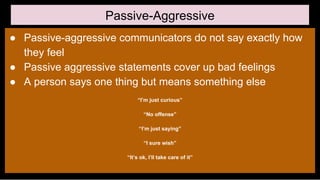
Passive-Aggressive
● Passive-aggressive communicators do not say exactly how
they feel
● Passive aggressive statements cover up bad feelings
● A person says one thing but means something else
“I’m just curious”
“No offense”
“I’m just saying”
“I sure wish”
“It’s ok, I’ll take care of it”
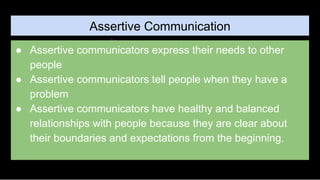
Assertive Communication
● Assertive communicators express their needs to other
people
● Assertive communicators tell people when they have a
problem
● Assertive communicators have healthy and balanced
relationships with people because they are clear about
their boundaries and expectations from the beginning.
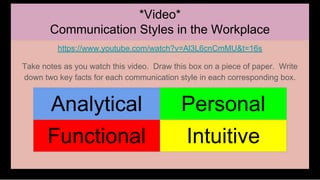
*Video*
Communication Styles in the Workplace
https://www.youtube.com/watch?v=Al3L6cnCmMU&t=16s
Take notes as you watch this video. Draw this box on a piece of paper. Write
down two key facts for each communication style in each corresponding box.
Analytical Personal
Functional Intuitive
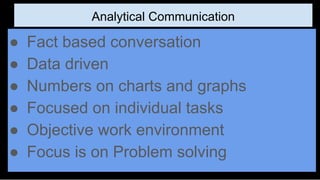
Analytical Communication
● Fact based conversation
● Data driven
● Numbers on charts and graphs
● Focused on individual tasks
● Objective work environment
● Focus is on Problem solving
Functional Communication
● Uses gestures
● Sign language
● Use of the body to point
● Step by step process
● Use of words and few numbers
● Long winded conversation
● Focus on details, trees instead of the forest
Personal Communication
● Emotional language
● Relationship Focused
● Building rapport is key
● Diplomatic language is important
● Paying attention to non-verbal cues and
listening is key
Intuitive
● Looks at the big picture (the forest
instead of the trees)
● Moves quickly to the conclusion
● Communication could be confusing
● Ideas are not presented in an orderly
fashion
Essay Question
Which communication style do you identify with the
most? Explain why you chose that one. Write 5 to
10 sentences to explain. Use atleast 1 of these
key words.
Passive Aggressive Assertive
Verbal Non Verbal Communication
Video
Take notes and answer this two part question.
What are 4 things you can do to be more assertive?
Why is being assertive important?
https://www.youtube.com/watch?v=4Kudo7aIpFA
Four tips
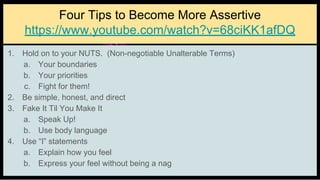
Four Tips to Become More Assertive
https://www.youtube.com/watch?v=68ciKK1afDQ
1. Hold on to your NUTS. (Non-negotiable Unalterable Terms)
a. Your boundaries
b. Your priorities
c. Fight for them!
2. Be simple, honest, and direct
3. Fake It Til You Make It
a. Speak Up!
b. Use body language
4. Use “I” statements
a. Explain how you feel
b. Express your feel without being a nag
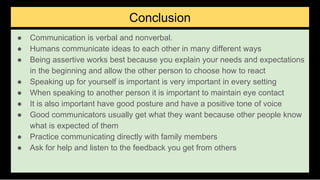
Conclusion
● Communication is verbal and nonverbal.
● Humans communicate ideas to each other in many different ways
● Being assertive works best because you explain your needs and expectations
in the beginning and allow the other person to choose how to react
● Speaking up for yourself is important is very important in every setting
● When speaking to another person it is important to maintain eye contact
● It is also important have good posture and have a positive tone of voice
● Good communicators usually get what they want because other people know
what is expected of them
● Practice communicating directly with family members
● Ask for help and listen to the feedback you get from others

Communication styles

  • 1.
    Unit 3 Communication Styles 1. Passive 2.Aggressive 3. Assertive 4. Passive-Aggressive 5. Analytical 6. Functional 7. Intuitive 8. Personal
  • 2.
    Objectives 1. Examine thedefinition of the word communication. 2. Analyze 8 different communication styles. 3. Discover which styles are your own. 4. Think about what effective communication looks like.
  • 3.
    What does Communicationmean? ● a process by which information is exchanged between individuals through a common system of symbols, signs, or behavior. ● Verbal communication- spoken words used to explain information and exhange ideas. ● Non-verbal communication- the use of body language to express ideas.
  • 4.
    Verbal Communication ● Communicationby saying words ● to use (a language) for conversing or communicating ● Using your voice to talk to another person ● 5-7 percent of all communication come from what is said
  • 5.
    Non-verbal Communication ● Behaviorand elements of speech aside from the words themselves that transmit meaning. ● includes pitch, speed, tone and volume of voice, gestures and facial expressions ● body posture, stance, and proximity to the listener, eye movements and contact, and dress and appearance. ● Research suggests that only 5 percent effect is produced by the spoken word ● 45 percent by the tone, inflexion, and other elements of voice, ● 50 percent by body language, movements, eye contact, etc. Source: http://www.businessdictionary.com/definition/non-verbal-communication.html
  • 6.
    Passive ● Passive peopleallow others to “pass” over their thoughts and feelings ● Passive communicators allow things to be said to them that make them feel uncomfortable ● Passive communicators do not speak up out of fear that they will seem hard to get along with
  • 7.
    Aggressive ● Aggressive communicatorsfocus on expressing their own needs and ideas with little attention paid to other people ● Aggressive communicators seem combative, disrespectful or rude ● Aggressive communication does not allow a positive exchange of ideas
  • 8.
    Passive-Aggressive ● Passive-aggressive communicatorsdo not say exactly how they feel ● Passive aggressive statements cover up bad feelings ● A person says one thing but means something else “I’m just curious” “No offense” “I’m just saying” “I sure wish” “It’s ok, I’ll take care of it”
  • 9.
    Assertive Communication ● Assertivecommunicators express their needs to other people ● Assertive communicators tell people when they have a problem ● Assertive communicators have healthy and balanced relationships with people because they are clear about their boundaries and expectations from the beginning.
  • 10.
    *Video* Communication Styles inthe Workplace https://www.youtube.com/watch?v=Al3L6cnCmMU&t=16s Take notes as you watch this video. Draw this box on a piece of paper. Write down two key facts for each communication style in each corresponding box. Analytical Personal Functional Intuitive
  • 11.
    Analytical Communication ● Factbased conversation ● Data driven ● Numbers on charts and graphs ● Focused on individual tasks ● Objective work environment ● Focus is on Problem solving
  • 12.
    Functional Communication ● Usesgestures ● Sign language ● Use of the body to point ● Step by step process ● Use of words and few numbers ● Long winded conversation ● Focus on details, trees instead of the forest
  • 13.
    Personal Communication ● Emotionallanguage ● Relationship Focused ● Building rapport is key ● Diplomatic language is important ● Paying attention to non-verbal cues and listening is key
  • 14.
    Intuitive ● Looks atthe big picture (the forest instead of the trees) ● Moves quickly to the conclusion ● Communication could be confusing ● Ideas are not presented in an orderly fashion
  • 15.
    Essay Question Which communicationstyle do you identify with the most? Explain why you chose that one. Write 5 to 10 sentences to explain. Use atleast 1 of these key words. Passive Aggressive Assertive Verbal Non Verbal Communication
  • 16.
    Video Take notes andanswer this two part question. What are 4 things you can do to be more assertive? Why is being assertive important? https://www.youtube.com/watch?v=4Kudo7aIpFA Four tips
  • 17.
    Four Tips toBecome More Assertive https://www.youtube.com/watch?v=68ciKK1afDQ 1. Hold on to your NUTS. (Non-negotiable Unalterable Terms) a. Your boundaries b. Your priorities c. Fight for them! 2. Be simple, honest, and direct 3. Fake It Til You Make It a. Speak Up! b. Use body language 4. Use “I” statements a. Explain how you feel b. Express your feel without being a nag
  • 18.
    Conclusion ● Communication isverbal and nonverbal. ● Humans communicate ideas to each other in many different ways ● Being assertive works best because you explain your needs and expectations in the beginning and allow the other person to choose how to react ● Speaking up for yourself is important is very important in every setting ● When speaking to another person it is important to maintain eye contact ● It is also important have good posture and have a positive tone of voice ● Good communicators usually get what they want because other people know what is expected of them ● Practice communicating directly with family members ● Ask for help and listen to the feedback you get from others