


POWER SYSTEM
ANALYSIS
CHAPTER NO # 4
FAULT LOCATION ON POWER SYSTEM
NETWORKS
• If a fault occurs on any section of a power system network it is likely that the intermediate
effect will be to interrupt, the supply to a section of the consumers
• It may be possible to restore the supply by using alternative routes in the network, but this
may in turn mean that the circuit involved become overloaded , resulting in these, too,
becoming faulty.
• It is important that any faults which do arise be located and repaired as quickly as possible
and various techniques have been adopted for this purpose
Fault Resistance
• Under normal conditions there will be a finite resistance between the conductors of a distribution
system & between each conductor and earth due to the fact that the system insulation will not be
perfect, also the current will flow to the earth under working conditions.
• When a fault occurs on the system this insulation resistance will be substantially reduced to such a
value that will permit the flow of large current earth, & in order to locate the position of the fault,
some means of measuring the value of this resistance may be necessary
• It also follows that if this resistance can be monitored continuously , or at least at frequent
intervals, any gradual reduction observed may show that system insulation is beginning to
deteriorate and a fault is about to develop, while a sudden large reduction will indicate that a fault
actually occured
The Murray Loop Test
• Common method to locate a fault to earth
• Requires a presence of a sound conductor between the terminations of the faulty cable, the
faulty conductor being connected to the sound cable at the end remote from that at which the
test is to be made
• The ends of the sound and faulty cables, A and B are then connected at the testing end as
part of a Wheatstone’s bridge
• A Galvanometer with the usual key is connected across AM and a d.c. source is used to supply
the bridge, one end of this source being earthed and therefore in electrical contact with the
fault.
• At balance Resistance of cable between A and F = P
Resistance of cable AD and DF Q
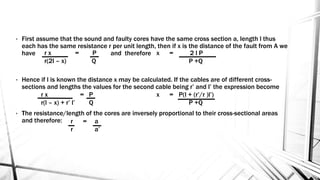
• First assume that the sound and faulty cores have the same cross section a, length l thus
each has the same resistance r per unit length, then if x is the distance of the fault from A we
have and therefore
• Hence if l is known the distance x may be calculated. If the cables are of different cross-
sections and lengths the values for the second cable being r’ and l’ the expression become
• The resistance/length of the cores are inversely proportional to their cross-sectional areas
and therefore:
r x = P
r(2l – x) Q
r x = P
r(l – x) + r’ l’ Q
x = P(l + (r’/r )l’)
P +Q
r = a
r a’
x = 2 l P
P +Q
Fault Localising Bridge
• In order to avoid the necessity for any calculation direct-reading bridges have been developed; one
such being the Raphael bridge
Biavier and Earth Overlap Tests
Voltage Drop Tests
Open Circuits Faults
Induction Method
Location of Overhead Line Faults
• Overhead line faults usually take the form of a broken conductor or a damaged insulator, and since
both of these effects may be observed from the ground the general procedure in the past has been
to send our squad of men to walk along the length of a line and inspect it visually
• For a high voltage line of between 80 -160 km in length which is not common in Britain, the time to
carry out its inspection can be very lengthy and for these cases an improved technique has been
developed which shows that if a voltage pulse travels along a line it will proceed at a definite speed
depending on the line parameters and will be reflected at discontinuities in the line
• This principle is utilized by connecting a pulse generator to the line after a fault has occurred and
transmitting pulse along the line. These are reflected back from the fault to the sending end. The
time taken for this transmission to the fault and back is measured and, knowing the pulse velocity,
this is used to calculate the distance of the fault from the testing end
• This method is not capable of high accuracy but it serves to locate the fault to within a few span
lengths, the actual position then being found by visual inspection as before

Chapter#4

  • 1.
  • 2.
    CHAPTER NO #4 FAULT LOCATION ON POWER SYSTEM NETWORKS
  • 3.
    • If afault occurs on any section of a power system network it is likely that the intermediate effect will be to interrupt, the supply to a section of the consumers • It may be possible to restore the supply by using alternative routes in the network, but this may in turn mean that the circuit involved become overloaded , resulting in these, too, becoming faulty. • It is important that any faults which do arise be located and repaired as quickly as possible and various techniques have been adopted for this purpose
  • 4.
    Fault Resistance • Undernormal conditions there will be a finite resistance between the conductors of a distribution system & between each conductor and earth due to the fact that the system insulation will not be perfect, also the current will flow to the earth under working conditions. • When a fault occurs on the system this insulation resistance will be substantially reduced to such a value that will permit the flow of large current earth, & in order to locate the position of the fault, some means of measuring the value of this resistance may be necessary • It also follows that if this resistance can be monitored continuously , or at least at frequent intervals, any gradual reduction observed may show that system insulation is beginning to deteriorate and a fault is about to develop, while a sudden large reduction will indicate that a fault actually occured
  • 5.
    The Murray LoopTest • Common method to locate a fault to earth • Requires a presence of a sound conductor between the terminations of the faulty cable, the faulty conductor being connected to the sound cable at the end remote from that at which the test is to be made • The ends of the sound and faulty cables, A and B are then connected at the testing end as part of a Wheatstone’s bridge • A Galvanometer with the usual key is connected across AM and a d.c. source is used to supply the bridge, one end of this source being earthed and therefore in electrical contact with the fault. • At balance Resistance of cable between A and F = P Resistance of cable AD and DF Q
  • 6.
    • First assumethat the sound and faulty cores have the same cross section a, length l thus each has the same resistance r per unit length, then if x is the distance of the fault from A we have and therefore • Hence if l is known the distance x may be calculated. If the cables are of different cross- sections and lengths the values for the second cable being r’ and l’ the expression become • The resistance/length of the cores are inversely proportional to their cross-sectional areas and therefore: r x = P r(2l – x) Q r x = P r(l – x) + r’ l’ Q x = P(l + (r’/r )l’) P +Q r = a r a’ x = 2 l P P +Q
  • 7.
    Fault Localising Bridge •In order to avoid the necessity for any calculation direct-reading bridges have been developed; one such being the Raphael bridge
  • 8.
    Biavier and EarthOverlap Tests
  • 9.
  • 10.
  • 11.
  • 12.
    Location of OverheadLine Faults • Overhead line faults usually take the form of a broken conductor or a damaged insulator, and since both of these effects may be observed from the ground the general procedure in the past has been to send our squad of men to walk along the length of a line and inspect it visually • For a high voltage line of between 80 -160 km in length which is not common in Britain, the time to carry out its inspection can be very lengthy and for these cases an improved technique has been developed which shows that if a voltage pulse travels along a line it will proceed at a definite speed depending on the line parameters and will be reflected at discontinuities in the line • This principle is utilized by connecting a pulse generator to the line after a fault has occurred and transmitting pulse along the line. These are reflected back from the fault to the sending end. The time taken for this transmission to the fault and back is measured and, knowing the pulse velocity, this is used to calculate the distance of the fault from the testing end • This method is not capable of high accuracy but it serves to locate the fault to within a few span lengths, the actual position then being found by visual inspection as before

Editor's Notes

  • #4 FOR HELP VISIT : http://electrical4u.com/blavier-test-murray-loop-test-varley-loop-test/