2014

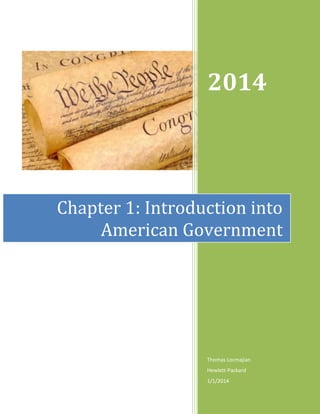
Chapter 1: Introduction into
American Government

Thomas Locmajian
Hewlett-Packard
1/1/2014
Ideas behind the forms of Government
The origins of America’s government can be traced back some 200-300 years.
The new colonists in the Americas as they began to settle along the cost and develop colonies, ports, and
cities, would take ideas from the Enlightenment Period.
In the case of the Pilgrims in Massachusetts, some groups were escaping prosecution in England.
Many of the laws that would come to be created stemmed from the ideas of equal treatment for all men.
The need for an ordered social system, or government.
The idea of limited government, that is, that government should not be all-powerful.
The concept of representative government—a government that serves the will of the people
Three types of American Colonies




The royal colonies were ruled directly by the English monarchy.
The King granted land to people in North America, who then formed proprietary colonies.
The charter colonies were mostly self-governed, and their charters were granted to the colonists.

British Colonial Practices




Until the mid-1700s, the colonies were allowed a great deal of freedom in their governments by the English
monarchy.
In 1760, King George III imposed new taxes and laws on the colonists.
The colonists would eventually: form a confederation, propose an annual congress, and began to rebel for
independence.

Earliest forms of government




Mayflower Compact
 Colonist on the Mayflower signed the Compact agreeing to help aid in the common good of all the
people.
 They agreed to create laws and follow the laws.
 This form of government was basically a classical liberalism.
Virginia Colony
 Known for its rocky start in which the colony experienced times of hardship, but thanks to James
Smith, Jamestown developed a “No work, no food” policy and soon prospered.

Origins of Colonial Unity
Early Attempts



In 1643, several New England settlements formed the New England Confederation.
A confederation is a joining of several groups for a common purpose.
The Albany Plan



In 1754, Benjamin Franklin proposed the Albany Plan of Union, in which an annual congress of delegates
(representatives) from each of the 13 colonies would be formed.


Would inspire some of the basis for the future Articles of Confederation.

Problems with the British









During the mid-1700’s, the British would begin to impose unfair laws such as taxes to the American colonists.
Most of the taxes would be in an effort to create revenue to fuel the British military campaigns in Canada or
abroad.
The Intolerable Acts were a set of laws put forth by British colonial rulers that imposed unfair treatment of the
American colonies OR imposed heavy taxes upon the colonists, or goods they purchased.
Stamp Act of 1765
 Required printed documents to be produced on stamped paper and carry a Revenue (tax) stamp.
Townshend Acts of 1768
 Acts that lead to further Taxation
Quartering Act of 1765
 An act created by Thomas Gage, commander-in-chief of the British in America. Used the act to allow
soldiers to stay in the houses of colonists.
Tea Act of 1773
 An act to help the struggling British Easy India company survive, as well as to support the Townshend
duties.
 Also attempted to cut down on smuggling tea into the Americas.

"No taxation without representation"





A Quote from the 1750’s and 1760’s in which many colonists felt they were not directly represented in the
distant British Parliament.
Any laws that were passed that were aimed at taxing them were illegal under the English Bill of Rights, 1689.
This slogan, along with the idea of fair treatment and equal representation would become further basis for
laws in the new future government.
Intolerable Acts angered many Americans and would be one of the primary factors for Independence

The Continental Congress (The first and second)
First Continental Congress



The colonists sent a Declaration of Rights to King George III.
The delegates urged each of the colonies to refuse all trade with England until British tax and trade regulations
were repealed, or recalled
Second Continental Congress




In 1775, each of the 13 colonies sent representatives to this gathering in Philadelphia.
The Second Continental Congress served as the first government of the United States from 1776 to 1781.

American Independence:



On July 4, 1776, the Second Continental Congress adopted the Declaration of Independence.
Between 1776 and 1777, most of the States adopted constitutions instead of charters.
Popular Sovereignty -The principle of popular sovereignty was the basis for every new State constitution. That
principle says that government can exist and function only with the consent of the governed. The people hold power
and the people are sovereign.
Limited Government- The concept of limited government was a major feature of each State constitution. The powers
delegated to government were granted reluctantly and hedged with many restrictions.
Civil Rights and Liberties- In every State it was made clear that the sovereign people held certain rights that the
government must respect at all times. Seven of the new constitutions contained a bill of rights, setting out the
“unalienable rights” held by the people.
Separation of Powers and Checks and Balances- The powers granted to the new State governments were purposely
divided among three branches: executive, legislative, and judicial. Each branch was given powers with which to check
(restrain the actions of) the other branches of the government.
Articles of Confederation:









First attempt at a federal government system in the colonies
Approved November 15, 1777
Est. “a firm league of friendship” between the states
Needed the ratification of the 13 states
March 1, 1781 Second Continental Congress declared the Articles effective
Powers of Congress
 Make war and peace
 Send and receive ambassadors
 Make treaties
 Borrow money
 Set up a money system
 Est. post offices
 Build a navy
 Raise an army by asking the states for troops
 Fix uniform standards of weights and measures
 Settle disputes among the states
States Obligations:
 Pledge to obey the Articles and Acts of the Congress
 Provide the funds and troops requested by the congress
 Treat citizens of other states fairly and equally
 Give full faith and credit to public acts, records, and judicial proceedings
 Submit disputes to congress for settlement
 Allow open travel and trade b/w and among states
 Primarily responsible for protecting life and property
 Accountable for promoting the general welfare of the people

After the War: The 1780's








Revolutionary War ended on October 19, 1781
Signed the Treaty of Paris
With Peace comes hardships
 Economic problems
 Political problems
 Problems a result of the weaknesses of AofC
Problems included:
 Central government who could not act
 States entering into treaties
 States taxing on goods and banning trade
 Debts, public and private were unpaid
Shay’s Rebellion
 Farmers were losing their land
 Shut down courts
 Led and attack on Federal arsenal
 Mass. State legislature eases the burden of debtors

The NEED for a Strong, Central Government becomes crucial




Two states meet to discuss Trade issues
 Maryland and Virginia
 Meet at Mount Vernon
The meeting was so successful that the Virginia General Assembly requested a meeting of all thirteen States,
which eventually became the Constitutional Convention in Philadelphia.

The Constitutional Convention held in Philadelphia



Mid-February of 1787
Seven states name delegates
 Delaware, Georgia, New Hampshire, New Jersey, North Carolina, Pennsylvania, and Virginia

Constitutional Convention: Held in Philadelphia
Leaders who attended: James Madison, co-author of the Articles of Confederation, Alexander Hamilton who
favored a strong central government, and George Washington who was the successful leader of the Continental Army.
Organization:






Meet summer of 1787 in Philadelphia
Elected George Washington as president of the convention
One vote per State on all matters
Majority of votes needed to pass proposals
Worked in Secrecy

Father of the Constitution


James Madison:


 Kept detail records of the convention
 Conventions Floor leader
 Contributed more to the constitution than any other
Full body settled all questions

Two Plans: Virginia and New Jersey
Virginia Plan:


It called for a bicameral legislature, in which the number of representatives in each house would depend on
the population of the state.

NJ Plan:
 It called for a unicameral legislature, in which every state received one vote.
Both Plans:
 Both Plans called for a strong national government with three branches
The Great Compromise:
 It provided a bicameral Congress
 House of representatives- Each state is represented according to its population (Satisfied the VA Plan)
 Senate- Each state has 2 senators (satisfied the NJ Plan)
 Both houses must pass every law
Three-Fifths Compromise:
 Should slaves be counted?
 Split North Vs South
 All "free persons" will be counted; 3/5 of all other persons
 Southerners could count slaves but had to pay taxes on them.
The Commerce and Slave Trade Compromises
 Congress = power to regulate foreign and interstate trade
 Scared southerners
 Congress: forbidden the power to tax the export of goods from any state
 Could not act on the slave trade for 20 years
Influences on the New Constitution




The Framers were familiar with the political writings of their time
 Jean Jacques Rousseau (Social Contract Theory)
 John Locke (Two Treaties of Government).
They also were seasoned by
 The Second Continental Congress,
 The Articles of Confederation and
 Experiences with their own State governments.

Reactions to the New Constitution


When the Constitution was complete, the Framers’ opinions of their work varied. Some were disappointed,
like George Mason of Virginia, who opposed the Constitution until his death in 1792.


Most agreed with Ben Franklin’s thoughts when he said,
“From such an assembly [of fallible men] can a perfect production be expected? It…astonishes me, Sir, to find
this system approaching so near to perfection as it does…”

Ratifying the Constitution




Federalists
 Articles of Confederation were weak
 argued for the ratification of the Constitution.
 James Madison
 Alexander Hamilton
Anti-Federalists
 objected to the Constitution for including the strong central government
 the lack of a bill of rights.
 Patrick Henry, John Hancock, Samuel Adams

The Constitution is Ratified:




Nine States ratified the Constitution by June 21, 1788, but the new government needed the ratification of the
large States of New York and Virginia.
Great debates were held in both States, with Virginia ratifying the Constitution June 25, 1788.
New York’s ratification was hard fought. Supporters of the Constitution published a series of essays known as
The Federalist.

Inaugurating the Government



The new Congress met for the first time on March 4, 1789.
Congress finally attained a quorum (majority) on April 6 and counted the electoral votes. Congress found that
George Washington had been unanimously elected President. He was inaugurated on April 30.

Government notes chapter 1 intro

  • 1.
    2014 Chapter 1: Introductioninto American Government Thomas Locmajian Hewlett-Packard 1/1/2014
  • 2.
    Ideas behind theforms of Government The origins of America’s government can be traced back some 200-300 years. The new colonists in the Americas as they began to settle along the cost and develop colonies, ports, and cities, would take ideas from the Enlightenment Period. In the case of the Pilgrims in Massachusetts, some groups were escaping prosecution in England. Many of the laws that would come to be created stemmed from the ideas of equal treatment for all men. The need for an ordered social system, or government. The idea of limited government, that is, that government should not be all-powerful. The concept of representative government—a government that serves the will of the people Three types of American Colonies    The royal colonies were ruled directly by the English monarchy. The King granted land to people in North America, who then formed proprietary colonies. The charter colonies were mostly self-governed, and their charters were granted to the colonists. British Colonial Practices    Until the mid-1700s, the colonies were allowed a great deal of freedom in their governments by the English monarchy. In 1760, King George III imposed new taxes and laws on the colonists. The colonists would eventually: form a confederation, propose an annual congress, and began to rebel for independence. Earliest forms of government   Mayflower Compact  Colonist on the Mayflower signed the Compact agreeing to help aid in the common good of all the people.  They agreed to create laws and follow the laws.  This form of government was basically a classical liberalism. Virginia Colony  Known for its rocky start in which the colony experienced times of hardship, but thanks to James Smith, Jamestown developed a “No work, no food” policy and soon prospered. Origins of Colonial Unity Early Attempts   In 1643, several New England settlements formed the New England Confederation. A confederation is a joining of several groups for a common purpose. The Albany Plan  In 1754, Benjamin Franklin proposed the Albany Plan of Union, in which an annual congress of delegates (representatives) from each of the 13 colonies would be formed.
  • 3.
     Would inspire someof the basis for the future Articles of Confederation. Problems with the British        During the mid-1700’s, the British would begin to impose unfair laws such as taxes to the American colonists. Most of the taxes would be in an effort to create revenue to fuel the British military campaigns in Canada or abroad. The Intolerable Acts were a set of laws put forth by British colonial rulers that imposed unfair treatment of the American colonies OR imposed heavy taxes upon the colonists, or goods they purchased. Stamp Act of 1765  Required printed documents to be produced on stamped paper and carry a Revenue (tax) stamp. Townshend Acts of 1768  Acts that lead to further Taxation Quartering Act of 1765  An act created by Thomas Gage, commander-in-chief of the British in America. Used the act to allow soldiers to stay in the houses of colonists. Tea Act of 1773  An act to help the struggling British Easy India company survive, as well as to support the Townshend duties.  Also attempted to cut down on smuggling tea into the Americas. "No taxation without representation"     A Quote from the 1750’s and 1760’s in which many colonists felt they were not directly represented in the distant British Parliament. Any laws that were passed that were aimed at taxing them were illegal under the English Bill of Rights, 1689. This slogan, along with the idea of fair treatment and equal representation would become further basis for laws in the new future government. Intolerable Acts angered many Americans and would be one of the primary factors for Independence The Continental Congress (The first and second) First Continental Congress   The colonists sent a Declaration of Rights to King George III. The delegates urged each of the colonies to refuse all trade with England until British tax and trade regulations were repealed, or recalled Second Continental Congress   In 1775, each of the 13 colonies sent representatives to this gathering in Philadelphia. The Second Continental Congress served as the first government of the United States from 1776 to 1781. American Independence:   On July 4, 1776, the Second Continental Congress adopted the Declaration of Independence. Between 1776 and 1777, most of the States adopted constitutions instead of charters.
  • 4.
    Popular Sovereignty -Theprinciple of popular sovereignty was the basis for every new State constitution. That principle says that government can exist and function only with the consent of the governed. The people hold power and the people are sovereign. Limited Government- The concept of limited government was a major feature of each State constitution. The powers delegated to government were granted reluctantly and hedged with many restrictions. Civil Rights and Liberties- In every State it was made clear that the sovereign people held certain rights that the government must respect at all times. Seven of the new constitutions contained a bill of rights, setting out the “unalienable rights” held by the people. Separation of Powers and Checks and Balances- The powers granted to the new State governments were purposely divided among three branches: executive, legislative, and judicial. Each branch was given powers with which to check (restrain the actions of) the other branches of the government. Articles of Confederation:        First attempt at a federal government system in the colonies Approved November 15, 1777 Est. “a firm league of friendship” between the states Needed the ratification of the 13 states March 1, 1781 Second Continental Congress declared the Articles effective Powers of Congress  Make war and peace  Send and receive ambassadors  Make treaties  Borrow money  Set up a money system  Est. post offices  Build a navy  Raise an army by asking the states for troops  Fix uniform standards of weights and measures  Settle disputes among the states States Obligations:  Pledge to obey the Articles and Acts of the Congress  Provide the funds and troops requested by the congress  Treat citizens of other states fairly and equally  Give full faith and credit to public acts, records, and judicial proceedings  Submit disputes to congress for settlement  Allow open travel and trade b/w and among states  Primarily responsible for protecting life and property  Accountable for promoting the general welfare of the people After the War: The 1780's
  • 5.
         Revolutionary War endedon October 19, 1781 Signed the Treaty of Paris With Peace comes hardships  Economic problems  Political problems  Problems a result of the weaknesses of AofC Problems included:  Central government who could not act  States entering into treaties  States taxing on goods and banning trade  Debts, public and private were unpaid Shay’s Rebellion  Farmers were losing their land  Shut down courts  Led and attack on Federal arsenal  Mass. State legislature eases the burden of debtors The NEED for a Strong, Central Government becomes crucial   Two states meet to discuss Trade issues  Maryland and Virginia  Meet at Mount Vernon The meeting was so successful that the Virginia General Assembly requested a meeting of all thirteen States, which eventually became the Constitutional Convention in Philadelphia. The Constitutional Convention held in Philadelphia   Mid-February of 1787 Seven states name delegates  Delaware, Georgia, New Hampshire, New Jersey, North Carolina, Pennsylvania, and Virginia Constitutional Convention: Held in Philadelphia Leaders who attended: James Madison, co-author of the Articles of Confederation, Alexander Hamilton who favored a strong central government, and George Washington who was the successful leader of the Continental Army. Organization:      Meet summer of 1787 in Philadelphia Elected George Washington as president of the convention One vote per State on all matters Majority of votes needed to pass proposals Worked in Secrecy Father of the Constitution  James Madison:
  • 6.
      Kept detailrecords of the convention  Conventions Floor leader  Contributed more to the constitution than any other Full body settled all questions Two Plans: Virginia and New Jersey Virginia Plan:  It called for a bicameral legislature, in which the number of representatives in each house would depend on the population of the state. NJ Plan:  It called for a unicameral legislature, in which every state received one vote. Both Plans:  Both Plans called for a strong national government with three branches The Great Compromise:  It provided a bicameral Congress  House of representatives- Each state is represented according to its population (Satisfied the VA Plan)  Senate- Each state has 2 senators (satisfied the NJ Plan)  Both houses must pass every law Three-Fifths Compromise:  Should slaves be counted?  Split North Vs South  All "free persons" will be counted; 3/5 of all other persons  Southerners could count slaves but had to pay taxes on them. The Commerce and Slave Trade Compromises  Congress = power to regulate foreign and interstate trade  Scared southerners  Congress: forbidden the power to tax the export of goods from any state  Could not act on the slave trade for 20 years Influences on the New Constitution   The Framers were familiar with the political writings of their time  Jean Jacques Rousseau (Social Contract Theory)  John Locke (Two Treaties of Government). They also were seasoned by  The Second Continental Congress,  The Articles of Confederation and  Experiences with their own State governments. Reactions to the New Constitution  When the Constitution was complete, the Framers’ opinions of their work varied. Some were disappointed, like George Mason of Virginia, who opposed the Constitution until his death in 1792.
  • 7.
     Most agreed withBen Franklin’s thoughts when he said, “From such an assembly [of fallible men] can a perfect production be expected? It…astonishes me, Sir, to find this system approaching so near to perfection as it does…” Ratifying the Constitution   Federalists  Articles of Confederation were weak  argued for the ratification of the Constitution.  James Madison  Alexander Hamilton Anti-Federalists  objected to the Constitution for including the strong central government  the lack of a bill of rights.  Patrick Henry, John Hancock, Samuel Adams The Constitution is Ratified:    Nine States ratified the Constitution by June 21, 1788, but the new government needed the ratification of the large States of New York and Virginia. Great debates were held in both States, with Virginia ratifying the Constitution June 25, 1788. New York’s ratification was hard fought. Supporters of the Constitution published a series of essays known as The Federalist. Inaugurating the Government   The new Congress met for the first time on March 4, 1789. Congress finally attained a quorum (majority) on April 6 and counted the electoral votes. Congress found that George Washington had been unanimously elected President. He was inaugurated on April 30.