Chapter 5 Changes in the West 1865-1890
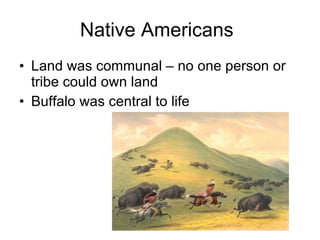
Native Americans Land was communal – no one person or tribe could own land Buffalo was central to life
All parts of Buffalo were used
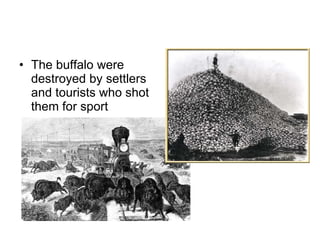
The buffalo were destroyed by settlers and tourists who shot them for sport
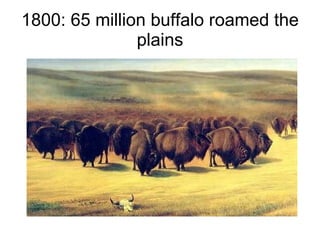
1800: 65 million buffalo roamed the plains
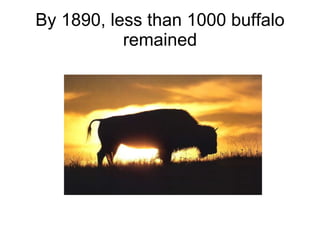
By 1890, less than 1000 buffalo remained
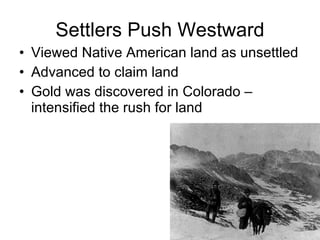
Settlers Push Westward Viewed Native American land as unsettled Advanced to claim land Gold was discovered in Colorado – intensified the rush for land
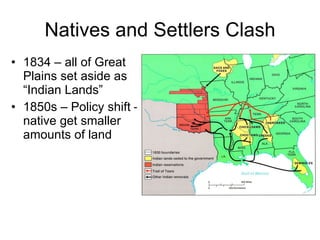
Natives and Settlers Clash 1834 – all of Great Plains set aside as “Indian Lands” 1850s – Policy shift – native get smaller amounts of land
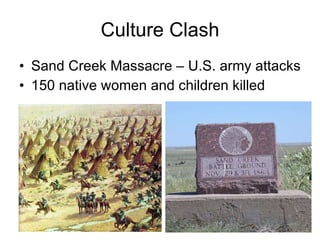
Culture Clash Sand Creek Massacre – U.S. army attacks 150 native women and children killed
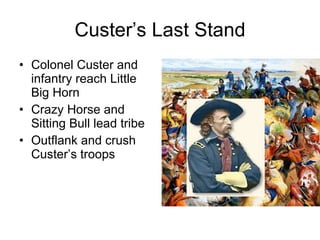
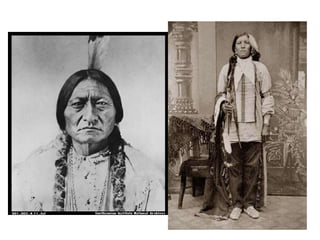
Custer’s Last Stand Colonel Custer and infantry reach Little Big Horn Crazy Horse and Sitting Bull lead tribe Outflank and crush Custer’s troops
 
 
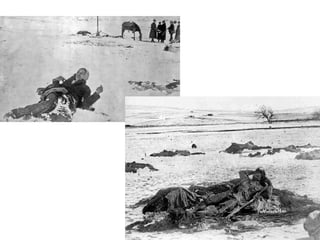
Battle of Wounded Knee December 1890- 7 th  Cavalry (Custer’s old regiment) rounded up 350 Sioux and took them to Wounded Knee, SD 7 th  Cavalry slaughtered 350 unarmed Natives The corpses were left to freeze
 
Assimilation
Dawe’s Act 1887 Attempted to assimilate natives Would break up reservations and introduce natives into American life – farming, etc By 1932 2/3rds of the land committed to Natives had been taken
Growing Demand for beef After the Civil war the demand for beef rose sharply Urbanization and the rise of the railroad contributed to this Chicago Union Stock Yards
Chisholm Trail Thousands of cattle driven from Texas to Kansas Abilene, KS – place where trail met the railroads
The End of the Open Range Overgrazing, bad weather, and the invention of barbed wire led to the end of the cattle drive
Settling on the Great Plains Homestead Act – federal land policy Gave 160 free acres to any “head of household” Had to live on and farm land for 5 years
Exodusters African Americans – moved from South to Kansas Took advantage of land deals
Oklahoma Sooners In a less than a day 2 millions acres of government land being given away was claimed by settlers Some took possession of the land before the government officially declared it open – thus Oklahoma became known as the “Sooner State”
Hardships Droughts, floods, fires, blizzards, locust plagues, bandits No neighbors nearby
Soddies Homes were built from the land itself Dug out of the sides of ravines or hills If land was flat made homes out of dirt
Despite these hardships, the number of people living west of the Mississippi grew from 1% of the nations population to 30% by 1900
Increased Technology Helped Farmers 1837- John Deere steel plow – slice through heavy soil 1847 – reaper – invented by Cyrus McCormick
Age of the Railroads More people moved west and the railroads were born Government gave land grants to the railroads to help it grow
Transcontinental Railroad Completed in 1890 with help from Chinese workers
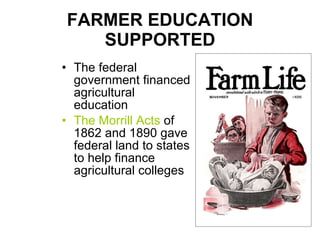
FARMER EDUCATION SUPPORTED The federal government financed agricultural education The Morrill Acts  of 1862 and 1890 gave federal land to states to help finance agricultural colleges
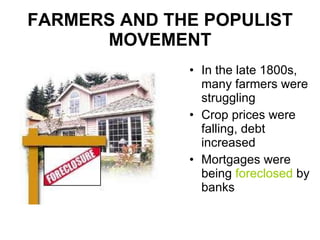
FARMERS AND THE POPULIST MOVEMENT In the late 1800s, many farmers were struggling Crop prices were falling, debt increased Mortgages were being  foreclosed  by banks
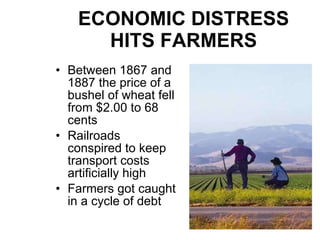
ECONOMIC DISTRESS HITS FARMERS Between 1867 and 1887 the price of a bushel of wheat fell from $2.00 to 68 cents Railroads conspired to keep transport costs artificially high Farmers got caught in a cycle of debt
FARMERS ORGANIZE FOR CHANGE 1867 – Oliver Hudson Kelley started the  Grange  By 1870, the Grange spent most of their time fighting the railroads Soon the Grange and other Farmer Alliances numbered over 4 million members
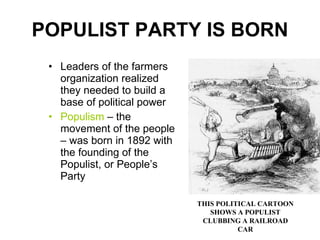
POPULIST PARTY IS BORN Leaders of the farmers organization realized they needed to build a base of political power Populism  – the movement of the people – was born in 1892 with the founding of the Populist, or People’s Party  THIS POLITICAL CARTOON SHOWS A POPULIST CLUBBING A RAILROAD CAR
POPULIST REFORMS economic  reforms- increase of money supply (gold and silver standard), a rise in crop prices, lower taxes, a federal loan program political  reforms-  direct election of senators, single terms for presidents Populists also called for an  8-hour  workday and reduced immigration
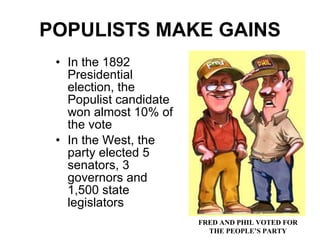
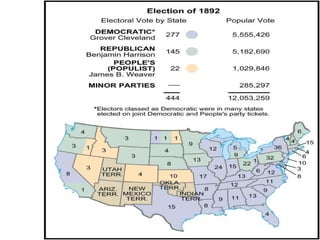
POPULISTS MAKE GAINS In the 1892 Presidential election, the Populist candidate won almost 10% of the vote In the West, the party elected 5 senators, 3 governors and 1,500 state legislators FRED AND PHIL VOTED FOR THE PEOPLE’S PARTY
 
SILVER OR GOLD? The central issue of the  1896  Presidential campaign was which metal would be the basis of the nation’s monetary system Bimetallism  (those who favored using both) vs. those that favored the  Gold Standards  alone
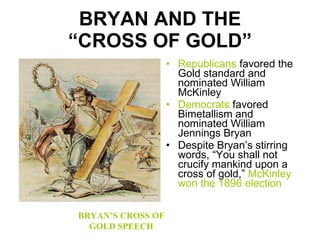
BRYAN AND THE “CROSS OF GOLD” Republicans  favored the Gold standard and nominated William McKinley Democrats  favored Bimetallism and nominated William Jennings Bryan Despite Bryan’s stirring words, “You shall not crucify mankind upon a cross of gold,”  McKinley won the 1896 election BRYAN’S CROSS OF GOLD SPEECH
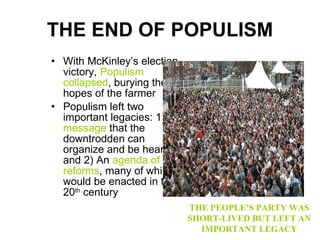
THE END OF POPULISM With McKinley’s election victory,  Populism collapsed , burying the hopes of the farmer Populism left two important legacies: 1)  A message  that the downtrodden can organize and be heard and 2) An  agenda of reforms , many of which would be enacted in the 20 th  century THE PEOPLE’S PARTY WAS SHORT-LIVED BUT LEFT AN IMPORTANT LEGACY

Chapter 5

  • 1.
    Chapter 5 Changesin the West 1865-1890
  • 2.
    Native Americans Landwas communal – no one person or tribe could own land Buffalo was central to life
  • 3.
    All parts ofBuffalo were used
  • 4.
    The buffalo weredestroyed by settlers and tourists who shot them for sport
  • 5.
    1800: 65 millionbuffalo roamed the plains
  • 6.
    By 1890, lessthan 1000 buffalo remained
  • 7.
    Settlers Push WestwardViewed Native American land as unsettled Advanced to claim land Gold was discovered in Colorado – intensified the rush for land
  • 8.
    Natives and SettlersClash 1834 – all of Great Plains set aside as “Indian Lands” 1850s – Policy shift – native get smaller amounts of land
  • 9.
    Culture Clash SandCreek Massacre – U.S. army attacks 150 native women and children killed
  • 10.
    Custer’s Last StandColonel Custer and infantry reach Little Big Horn Crazy Horse and Sitting Bull lead tribe Outflank and crush Custer’s troops
  • 11.
  • 12.
  • 13.
    Battle of WoundedKnee December 1890- 7 th Cavalry (Custer’s old regiment) rounded up 350 Sioux and took them to Wounded Knee, SD 7 th Cavalry slaughtered 350 unarmed Natives The corpses were left to freeze
  • 14.
  • 15.
  • 16.
    Dawe’s Act 1887Attempted to assimilate natives Would break up reservations and introduce natives into American life – farming, etc By 1932 2/3rds of the land committed to Natives had been taken
  • 17.
    Growing Demand forbeef After the Civil war the demand for beef rose sharply Urbanization and the rise of the railroad contributed to this Chicago Union Stock Yards
  • 18.
    Chisholm Trail Thousandsof cattle driven from Texas to Kansas Abilene, KS – place where trail met the railroads
  • 19.
    The End ofthe Open Range Overgrazing, bad weather, and the invention of barbed wire led to the end of the cattle drive
  • 20.
    Settling on theGreat Plains Homestead Act – federal land policy Gave 160 free acres to any “head of household” Had to live on and farm land for 5 years
  • 21.
    Exodusters African Americans– moved from South to Kansas Took advantage of land deals
  • 22.
    Oklahoma Sooners Ina less than a day 2 millions acres of government land being given away was claimed by settlers Some took possession of the land before the government officially declared it open – thus Oklahoma became known as the “Sooner State”
  • 23.
    Hardships Droughts, floods,fires, blizzards, locust plagues, bandits No neighbors nearby
  • 24.
    Soddies Homes werebuilt from the land itself Dug out of the sides of ravines or hills If land was flat made homes out of dirt
  • 25.
    Despite these hardships,the number of people living west of the Mississippi grew from 1% of the nations population to 30% by 1900
  • 26.
    Increased Technology HelpedFarmers 1837- John Deere steel plow – slice through heavy soil 1847 – reaper – invented by Cyrus McCormick
  • 27.
    Age of theRailroads More people moved west and the railroads were born Government gave land grants to the railroads to help it grow
  • 28.
    Transcontinental Railroad Completedin 1890 with help from Chinese workers
  • 29.
    FARMER EDUCATION SUPPORTEDThe federal government financed agricultural education The Morrill Acts of 1862 and 1890 gave federal land to states to help finance agricultural colleges
  • 30.
    FARMERS AND THEPOPULIST MOVEMENT In the late 1800s, many farmers were struggling Crop prices were falling, debt increased Mortgages were being foreclosed by banks
  • 31.
    ECONOMIC DISTRESS HITSFARMERS Between 1867 and 1887 the price of a bushel of wheat fell from $2.00 to 68 cents Railroads conspired to keep transport costs artificially high Farmers got caught in a cycle of debt
  • 32.
    FARMERS ORGANIZE FORCHANGE 1867 – Oliver Hudson Kelley started the Grange By 1870, the Grange spent most of their time fighting the railroads Soon the Grange and other Farmer Alliances numbered over 4 million members
  • 33.
    POPULIST PARTY ISBORN Leaders of the farmers organization realized they needed to build a base of political power Populism – the movement of the people – was born in 1892 with the founding of the Populist, or People’s Party THIS POLITICAL CARTOON SHOWS A POPULIST CLUBBING A RAILROAD CAR
  • 34.
    POPULIST REFORMS economic reforms- increase of money supply (gold and silver standard), a rise in crop prices, lower taxes, a federal loan program political reforms- direct election of senators, single terms for presidents Populists also called for an 8-hour workday and reduced immigration
  • 35.
    POPULISTS MAKE GAINSIn the 1892 Presidential election, the Populist candidate won almost 10% of the vote In the West, the party elected 5 senators, 3 governors and 1,500 state legislators FRED AND PHIL VOTED FOR THE PEOPLE’S PARTY
  • 36.
  • 37.
    SILVER OR GOLD?The central issue of the 1896 Presidential campaign was which metal would be the basis of the nation’s monetary system Bimetallism (those who favored using both) vs. those that favored the Gold Standards alone
  • 38.
    BRYAN AND THE“CROSS OF GOLD” Republicans favored the Gold standard and nominated William McKinley Democrats favored Bimetallism and nominated William Jennings Bryan Despite Bryan’s stirring words, “You shall not crucify mankind upon a cross of gold,” McKinley won the 1896 election BRYAN’S CROSS OF GOLD SPEECH
  • 39.
    THE END OFPOPULISM With McKinley’s election victory, Populism collapsed , burying the hopes of the farmer Populism left two important legacies: 1) A message that the downtrodden can organize and be heard and 2) An agenda of reforms , many of which would be enacted in the 20 th century THE PEOPLE’S PARTY WAS SHORT-LIVED BUT LEFT AN IMPORTANT LEGACY