Chapter 15 Effective Staffing
Objectives Upon completion of this chapter, the reader should be able to:  Calculate full-time equivalents (FTEs) needed to staff a typical inpatient nursing unit Analyze the impact of patient volume and work intensity on the demand for nursing care Discuss appropriate units of service used to measure nursing need by unit type
Objectives Critique organizational, regulatory, staff, and patient dynamics underlying development of a staffing plan Analyze scheduling issues that impact the matching of nursing resources to patient needs Compare and contrast models of care delivery and their impact on patient outcomes
Determination of Staffing Needs Patient census was historically used to determine staffing needs Has proven to be inaccurate, since patient care needs vary greatly Better matching of patient needs to nursing resources is now an important financial quest in health care institutions
Core Concepts Full-time equivalent (FTE) is a measure of the work commitment of an employee who works 5 days a week or 40 hours per week for 52 weeks per year; some agencies consider 36 hours (three 12-hour shifts)  full time FTE hours are a total of all paid time
Core Concepts Productive hours Hours worked and available for patient care Nonproductive hours Benefit time such as vacation, sick time, and education time Direct care Time spent with hands-on care to patients Indirect care Time spent with activities that support patient care
Units of Service A variety of volume measures used to reflect different types of patient encounters as indicators of nursing workload Used in budget negotiations to project nursing needs of patients and to assure adequate resources for safe patient care
Nursing Hours per Patient Day (NHPPD) A standard measure that quantifies the nursing time available to each patient by available nursing staff NHPPD reflects only productive nursing time available based on: Midnight census Past unit needs Expected practice trends National benchmarks Budget negotiations
Patient Classification Systems   Patient classification system (PCS)  A measurement  tool used to determine the nursing workload for a specific patient or group of patients over a specific period of time  Patient acuity The measure of nursing workload that is generated for each patient
Patient Classification Systems Nurse intensity A measure of the amount and complexity of nursing care needed by a patient Patient turnover A measure reflecting patient admission, transfer, and discharge
Factor Classification Systems   Use units of measure that equate to nursing time Attempt to capture assessment, planning, intervention, and evaluation of patient outcomes along with written documentation processes Are the most popular type of classification system
Factor Classification Systems   Advantages Data readily available for day-to-day operations Provide information against which one can justify changes in staffing requirements Disadvantages Create an ongoing workload for the nurse in classifying patients every day Problems with “classification creep” Do not capture patient needs for psychosocial, environmental, and health management support Calculate nursing time based on a “typical” nurse
Prototype Systems   Allocate nursing time to large patient groups based on an average of similar patients  Advantage Reduction of work for the nurse by not classifying patients daily Disadvantages No ongoing measure of the actual nursing work required by individual patients No ongoing data to monitor the accuracy of the preassigned nursing care requirements
Utilization of  Classification System Data   Can be utilized by staff and managers for planning nursing care over the next 24 hours Essential for preparing month-end justification for variances in staff utilization Used to cost out nursing services for specific patient populations and global patient types Information useful in negotiating payment rates with third-party payers  Used in preparing the budget
Considerations in  Developing a Staffing Plan Benchmarking A tool used to compare productivity across facilities to establish performance goals Does not always reflect quality of care indicators that can link quality patient care outcomes to productivity measures Can be helpful in establishing a starting point for a staffing pattern
Considerations in  Developing a Staffing Plan Regulatory requirements One controversial issue is nurse staffing levels Mandated nurse staffing plans are enacted by law The Joint Commission does not regulate staffing levels Does assess staffing effectiveness Requires organizations to monitor four of twenty-one specified indicators
Considerations in  Developing a Staffing Plan Skill mix The percentage of RN staff to other direct care staff Should vary according to the care that is required and the care delivery model utilized Staff support The supports in place for the operation of the unit or department (a systematic process to deliver medications, patient transport services, secretarial services, etc.)
Establishing a Staffing Plan Articulates how many and what kind of staff are needed by shift and day to staff a unit or department Two ways of development Determine the ratio of staff to patients; nursing hours and total FTEs are then calculated Determine the nursing care hours needed for a specific patient or patients and then generating the staff-to-patient ratio needed to provide the care
Inpatient Unit  An inpatient unit is a hospital unit that is able to provide care to patients 24 hours a day, 7 days a week Using data from all your sources, you can build a staffing pattern that will meet the needs of the patients, the staff, and the organization   Average daily census The total numbers of patients at census time, usually midnight, over a period of time, e.g., weekly, monthly or yearly, and dividing by the number of days in the time period
Determining the FTEs  Needed to Staff an Episodic Unit   Episodic care units Units that see patients for defined episodes of care  Examples are dialysis and ambulatory care units  Start with an assessment of the hours of care required by the patients Add FTEs to cover days off and benefit time
Scheduling   Scheduling of staff is the responsibility of the nurse manager  The manager must ensure that the schedule places the appropriate staff on each day and shift for safe, effective care
Considerations for Staffing The patient type and acuity The higher the patient acuity, the more consistent the staffing needs are across shifts The experience of the staff Novice nurses take longer to accomplish the same task than an experienced nurse An experienced RN can handle more workload and higher acuity patients Good staffing requires putting the patient first
Scheduling   Volume Patient volume numbers reviewed for peaks and valleys in the census and patient acuity Scheduling adjustments are necessary Experience and capability of staff Different degrees of knowledge, experience, and critical thinking skills Number of inexperienced staff (add hours) Number of experienced staff Need for staff with special skills
Shift Variations Traditional staffing patterns Generally 8-hour shifts Start times may vary by organization or nursing unit  Shift variations occur to meet the needs of patients and the staff 12-hour shifts Weekend programs 
Concerns for Scheduling Impact on patient care Possible disruption of continuity of care Weekend staff should be familiar with patients and recent care events  Financial implications Weekend programs are more expensive than traditional staffing patterns They are a recruitment and retention tool for nursing leadership
Self-Scheduling A process in which unit staff take leadership in creating and monitoring the work schedule while working within defined guidelines Increasing staff control over their schedule is a major factor in nurse job satisfaction and retention Has been associated with sick time usage
Implementing Self-Scheduling Form a committee made up of unit staff who report to the manager Define the roles  and responsibilities of each committee member Establish generic boundaries regarding fairness, fiscal responsibility, evaluation of the self-scheduling process, and the approval process Educate the staff
Evaluation of  Staffing Effectiveness Patient outcomes and nurse staffing Studies have found consistent significant relationships between nurse staffing and some patient outcomes Certain outcomes are affected negatively when nurse staffing or skill mix is inadequate
Evaluation of  Staffing Effectiveness Nurse staffing and nurse outcomes Effect of staffing on nurse performance should also be considered Track staff’s perception of staffing adequacy Provide ability for staff to communicate concerns in written and verbal form Track recommended staffing versus actual staffing
Models of Care Delivery   Care delivery models Organize the work of caring for patients The decision for which care delivery model is used is based on the needs of the patients and availability of competent staff Managers have the responsibility to implement models and evaluate the outcomes in their areas
Total Patient Care   Total patient care The nurse is responsible for the total care for his or her patient assignment for the shift he or she is working
Total Patient Care Advantages Consistency of one individual caring for patients an entire shift Enables development of patient and family trust Provides a higher number of RN hours of care than other models The nurse has more opportunity to monitor progress of the patient
Total Patient Care Disadvantages Utilizes a high number of RN staffing More costly than other models
Functional Nursing   Divides nursing work into functional roles that are then assigned to one of the team members In this model, each care provider is responsible for specific duties or tasks Technical rather than professional nursing care often results Decision making usually at the level of the charge nurse
Functional Nursing   Advantages Care can be delivered to a large number of patients Uses other types of health care workers when there is a shortage of RNs  Disadvantages Lack of continuity of care Patient may feel that care is disjointed
Team Nursing   A care delivery model that assigns staff to teams that are then responsible for a group of patients A unit is divided into two or more teams, each led by a registered nurse The team leader supervises and coordinates all of the care provided by those on the team  Care is divided into the simplest components and then assigned to the care provider with the appropriate level of skills
Team Nursing   Modular nursing delivery system A kind of team nursing that divides a geographic space into modules of patients, with each module having a team of staff led by an RN to care for them Useful with decentralized nursing stations
Team Nursing   Advantages Maximizes the role of the registered nurse Nurse is able to get work done through others  Disadvantages Patients often receive fragmented, depersonalized care Communication is complex Shared responsibility and accountability can cause confusion and lack of accountability
Primary Nursing   Clearly delineates the responsibility and accountability of the RN  Places the RN as the primary provider of care to patients Patients are assigned a primary nurse The primary nurse is responsible for developing with the patient a plan of care Other nurses caring for the patient follow this plan of care Patients are assigned to their primary nurse regardless of geographic location
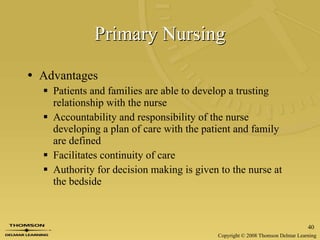
Primary Nursing Advantages Patients and families are able to develop a trusting relationship with the nurse Accountability and responsibility of the nurse developing a plan of care with the patient and family are defined Facilitates continuity of care Authority for decision making is given to the nurse at the bedside
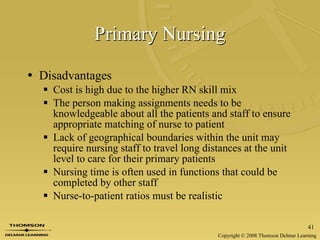
Primary Nursing Disadvantages Cost is high due to the higher RN skill mix The person making assignments needs to be knowledgeable about all the patients and staff to ensure appropriate matching of nurse to patient Lack of geographical boundaries within the unit may require nursing staff to travel long distances at the unit level to care for their primary patients Nursing time is often used in functions that could be completed by other staff Nurse-to-patient ratios must be realistic
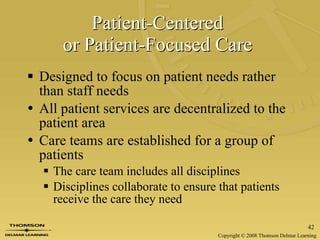
Patient-Centered  or Patient-Focused Care   Designed to focus on patient needs rather than staff needs All patient services are decentralized to the patient area Care teams are established for a group of patients The care team includes all disciplines  Disciplines collaborate to ensure that patients receive the care they need
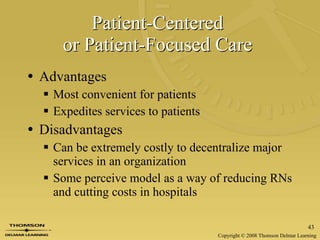
Patient-Centered  or Patient-Focused Care   Advantages Most convenient for patients Expedites services to patients  Disadvantages Can be extremely costly to decentralize major services in an organization Some perceive model as a way of reducing RNs and cutting costs in hospitals
Patient Care Redesign   Initiative that developed in the 1990s to redesign how patient care was delivered  Motivated by need to reduce costs Goals are to make care more patient-centered and not caregiver-centered Reduces the number of caregivers a patient has to interface with, thus increasing patient satisfaction
Care Delivery  Management Tools   Work flow analysis A tool used to determine what activities are value- added   Determines how to streamline or eliminate those activities that do not contribute to improved patient outcomes Value-added The customer is willing to pay for this activity Activity must be done right the first time Activity must somehow change the product or service in some desirable manner
Care Delivery  Management Tools   In diagnosis-related groups (DRGs) the national average length of stay (LOS) for a specific patient type was used to determine payment for that grouping of patients Hospitals looked to reduce LOS and reduce hospital costs Clinical pathways and case management surfaced as significant strategies
Clinical Pathways   Clinical pathways Care management tools that outline the expected clinical course and outcomes for a specific patient type  Should be evidence-based Pathways include expected outcomes specified for each day of care Patient progress is measured against the expected outcomes
Clinical Pathways   Advantages Very instructive to new staff Save a significant amount of time in the process of care In most cases, improved care and shortened lengths of stay for the population on the pathway are the results Allow for data collection of variances to the pathway
Clinical Pathways   Disadvantages Some physicians perceive pathways to be cookbook medicine and are reluctant to participate in their development Development requires a significant amount of work to gain consensus from the various disciplines on the expected plan of care Pathways are less effective for patient populations that are nonstandard, since they are constantly being modified to reflect individual patient needs
Case Management   A strategy to improve patient care and reduce hospital costs through coordination of care Typically a case manager: Is responsible for coordinating care and establishing goals from preadmission through discharge Evaluates the patient’s outcomes daily and compares them to the predicted outcomes articulated in the clinical pathway Works with all the disciplines to facilitate care
Case Management   In other models, the case management function is provided by the staff nurse at the bedside The case manager also collects data on patient variances from the clinical pathway  Shares this data with the responsible physicians and other disciplines that participate in the clinical pathway This data is then used to explore opportunities for improvement in the pathway or in hospital systems

Chapter15

  • 1.
  • 2.
    Objectives Upon completionof this chapter, the reader should be able to:  Calculate full-time equivalents (FTEs) needed to staff a typical inpatient nursing unit Analyze the impact of patient volume and work intensity on the demand for nursing care Discuss appropriate units of service used to measure nursing need by unit type
  • 3.
    Objectives Critique organizational,regulatory, staff, and patient dynamics underlying development of a staffing plan Analyze scheduling issues that impact the matching of nursing resources to patient needs Compare and contrast models of care delivery and their impact on patient outcomes
  • 4.
    Determination of StaffingNeeds Patient census was historically used to determine staffing needs Has proven to be inaccurate, since patient care needs vary greatly Better matching of patient needs to nursing resources is now an important financial quest in health care institutions
  • 5.
    Core Concepts Full-timeequivalent (FTE) is a measure of the work commitment of an employee who works 5 days a week or 40 hours per week for 52 weeks per year; some agencies consider 36 hours (three 12-hour shifts) full time FTE hours are a total of all paid time
  • 6.
    Core Concepts Productivehours Hours worked and available for patient care Nonproductive hours Benefit time such as vacation, sick time, and education time Direct care Time spent with hands-on care to patients Indirect care Time spent with activities that support patient care
  • 7.
    Units of ServiceA variety of volume measures used to reflect different types of patient encounters as indicators of nursing workload Used in budget negotiations to project nursing needs of patients and to assure adequate resources for safe patient care
  • 8.
    Nursing Hours perPatient Day (NHPPD) A standard measure that quantifies the nursing time available to each patient by available nursing staff NHPPD reflects only productive nursing time available based on: Midnight census Past unit needs Expected practice trends National benchmarks Budget negotiations
  • 9.
    Patient Classification Systems Patient classification system (PCS) A measurement tool used to determine the nursing workload for a specific patient or group of patients over a specific period of time  Patient acuity The measure of nursing workload that is generated for each patient
  • 10.
    Patient Classification SystemsNurse intensity A measure of the amount and complexity of nursing care needed by a patient Patient turnover A measure reflecting patient admission, transfer, and discharge
  • 11.
    Factor Classification Systems Use units of measure that equate to nursing time Attempt to capture assessment, planning, intervention, and evaluation of patient outcomes along with written documentation processes Are the most popular type of classification system
  • 12.
    Factor Classification Systems Advantages Data readily available for day-to-day operations Provide information against which one can justify changes in staffing requirements Disadvantages Create an ongoing workload for the nurse in classifying patients every day Problems with “classification creep” Do not capture patient needs for psychosocial, environmental, and health management support Calculate nursing time based on a “typical” nurse
  • 13.
    Prototype Systems Allocate nursing time to large patient groups based on an average of similar patients  Advantage Reduction of work for the nurse by not classifying patients daily Disadvantages No ongoing measure of the actual nursing work required by individual patients No ongoing data to monitor the accuracy of the preassigned nursing care requirements
  • 14.
    Utilization of Classification System Data Can be utilized by staff and managers for planning nursing care over the next 24 hours Essential for preparing month-end justification for variances in staff utilization Used to cost out nursing services for specific patient populations and global patient types Information useful in negotiating payment rates with third-party payers Used in preparing the budget
  • 15.
    Considerations in Developing a Staffing Plan Benchmarking A tool used to compare productivity across facilities to establish performance goals Does not always reflect quality of care indicators that can link quality patient care outcomes to productivity measures Can be helpful in establishing a starting point for a staffing pattern
  • 16.
    Considerations in Developing a Staffing Plan Regulatory requirements One controversial issue is nurse staffing levels Mandated nurse staffing plans are enacted by law The Joint Commission does not regulate staffing levels Does assess staffing effectiveness Requires organizations to monitor four of twenty-one specified indicators
  • 17.
    Considerations in Developing a Staffing Plan Skill mix The percentage of RN staff to other direct care staff Should vary according to the care that is required and the care delivery model utilized Staff support The supports in place for the operation of the unit or department (a systematic process to deliver medications, patient transport services, secretarial services, etc.)
  • 18.
    Establishing a StaffingPlan Articulates how many and what kind of staff are needed by shift and day to staff a unit or department Two ways of development Determine the ratio of staff to patients; nursing hours and total FTEs are then calculated Determine the nursing care hours needed for a specific patient or patients and then generating the staff-to-patient ratio needed to provide the care
  • 19.
    Inpatient Unit An inpatient unit is a hospital unit that is able to provide care to patients 24 hours a day, 7 days a week Using data from all your sources, you can build a staffing pattern that will meet the needs of the patients, the staff, and the organization   Average daily census The total numbers of patients at census time, usually midnight, over a period of time, e.g., weekly, monthly or yearly, and dividing by the number of days in the time period
  • 20.
    Determining the FTEs Needed to Staff an Episodic Unit Episodic care units Units that see patients for defined episodes of care Examples are dialysis and ambulatory care units Start with an assessment of the hours of care required by the patients Add FTEs to cover days off and benefit time
  • 21.
    Scheduling Scheduling of staff is the responsibility of the nurse manager The manager must ensure that the schedule places the appropriate staff on each day and shift for safe, effective care
  • 22.
    Considerations for StaffingThe patient type and acuity The higher the patient acuity, the more consistent the staffing needs are across shifts The experience of the staff Novice nurses take longer to accomplish the same task than an experienced nurse An experienced RN can handle more workload and higher acuity patients Good staffing requires putting the patient first
  • 23.
    Scheduling Volume Patient volume numbers reviewed for peaks and valleys in the census and patient acuity Scheduling adjustments are necessary Experience and capability of staff Different degrees of knowledge, experience, and critical thinking skills Number of inexperienced staff (add hours) Number of experienced staff Need for staff with special skills
  • 24.
    Shift Variations Traditionalstaffing patterns Generally 8-hour shifts Start times may vary by organization or nursing unit  Shift variations occur to meet the needs of patients and the staff 12-hour shifts Weekend programs 
  • 25.
    Concerns for SchedulingImpact on patient care Possible disruption of continuity of care Weekend staff should be familiar with patients and recent care events  Financial implications Weekend programs are more expensive than traditional staffing patterns They are a recruitment and retention tool for nursing leadership
  • 26.
    Self-Scheduling A processin which unit staff take leadership in creating and monitoring the work schedule while working within defined guidelines Increasing staff control over their schedule is a major factor in nurse job satisfaction and retention Has been associated with sick time usage
  • 27.
    Implementing Self-Scheduling Forma committee made up of unit staff who report to the manager Define the roles and responsibilities of each committee member Establish generic boundaries regarding fairness, fiscal responsibility, evaluation of the self-scheduling process, and the approval process Educate the staff
  • 28.
    Evaluation of Staffing Effectiveness Patient outcomes and nurse staffing Studies have found consistent significant relationships between nurse staffing and some patient outcomes Certain outcomes are affected negatively when nurse staffing or skill mix is inadequate
  • 29.
    Evaluation of Staffing Effectiveness Nurse staffing and nurse outcomes Effect of staffing on nurse performance should also be considered Track staff’s perception of staffing adequacy Provide ability for staff to communicate concerns in written and verbal form Track recommended staffing versus actual staffing
  • 30.
    Models of CareDelivery Care delivery models Organize the work of caring for patients The decision for which care delivery model is used is based on the needs of the patients and availability of competent staff Managers have the responsibility to implement models and evaluate the outcomes in their areas
  • 31.
    Total Patient Care Total patient care The nurse is responsible for the total care for his or her patient assignment for the shift he or she is working
  • 32.
    Total Patient CareAdvantages Consistency of one individual caring for patients an entire shift Enables development of patient and family trust Provides a higher number of RN hours of care than other models The nurse has more opportunity to monitor progress of the patient
  • 33.
    Total Patient CareDisadvantages Utilizes a high number of RN staffing More costly than other models
  • 34.
    Functional Nursing Divides nursing work into functional roles that are then assigned to one of the team members In this model, each care provider is responsible for specific duties or tasks Technical rather than professional nursing care often results Decision making usually at the level of the charge nurse
  • 35.
    Functional Nursing Advantages Care can be delivered to a large number of patients Uses other types of health care workers when there is a shortage of RNs  Disadvantages Lack of continuity of care Patient may feel that care is disjointed
  • 36.
    Team Nursing A care delivery model that assigns staff to teams that are then responsible for a group of patients A unit is divided into two or more teams, each led by a registered nurse The team leader supervises and coordinates all of the care provided by those on the team Care is divided into the simplest components and then assigned to the care provider with the appropriate level of skills
  • 37.
    Team Nursing Modular nursing delivery system A kind of team nursing that divides a geographic space into modules of patients, with each module having a team of staff led by an RN to care for them Useful with decentralized nursing stations
  • 38.
    Team Nursing Advantages Maximizes the role of the registered nurse Nurse is able to get work done through others  Disadvantages Patients often receive fragmented, depersonalized care Communication is complex Shared responsibility and accountability can cause confusion and lack of accountability
  • 39.
    Primary Nursing Clearly delineates the responsibility and accountability of the RN Places the RN as the primary provider of care to patients Patients are assigned a primary nurse The primary nurse is responsible for developing with the patient a plan of care Other nurses caring for the patient follow this plan of care Patients are assigned to their primary nurse regardless of geographic location
  • 40.
    Primary Nursing AdvantagesPatients and families are able to develop a trusting relationship with the nurse Accountability and responsibility of the nurse developing a plan of care with the patient and family are defined Facilitates continuity of care Authority for decision making is given to the nurse at the bedside
  • 41.
    Primary Nursing DisadvantagesCost is high due to the higher RN skill mix The person making assignments needs to be knowledgeable about all the patients and staff to ensure appropriate matching of nurse to patient Lack of geographical boundaries within the unit may require nursing staff to travel long distances at the unit level to care for their primary patients Nursing time is often used in functions that could be completed by other staff Nurse-to-patient ratios must be realistic
  • 42.
    Patient-Centered orPatient-Focused Care Designed to focus on patient needs rather than staff needs All patient services are decentralized to the patient area Care teams are established for a group of patients The care team includes all disciplines Disciplines collaborate to ensure that patients receive the care they need
  • 43.
    Patient-Centered orPatient-Focused Care Advantages Most convenient for patients Expedites services to patients  Disadvantages Can be extremely costly to decentralize major services in an organization Some perceive model as a way of reducing RNs and cutting costs in hospitals
  • 44.
    Patient Care Redesign Initiative that developed in the 1990s to redesign how patient care was delivered  Motivated by need to reduce costs Goals are to make care more patient-centered and not caregiver-centered Reduces the number of caregivers a patient has to interface with, thus increasing patient satisfaction
  • 45.
    Care Delivery Management Tools Work flow analysis A tool used to determine what activities are value- added  Determines how to streamline or eliminate those activities that do not contribute to improved patient outcomes Value-added The customer is willing to pay for this activity Activity must be done right the first time Activity must somehow change the product or service in some desirable manner
  • 46.
    Care Delivery Management Tools In diagnosis-related groups (DRGs) the national average length of stay (LOS) for a specific patient type was used to determine payment for that grouping of patients Hospitals looked to reduce LOS and reduce hospital costs Clinical pathways and case management surfaced as significant strategies
  • 47.
    Clinical Pathways Clinical pathways Care management tools that outline the expected clinical course and outcomes for a specific patient type Should be evidence-based Pathways include expected outcomes specified for each day of care Patient progress is measured against the expected outcomes
  • 48.
    Clinical Pathways Advantages Very instructive to new staff Save a significant amount of time in the process of care In most cases, improved care and shortened lengths of stay for the population on the pathway are the results Allow for data collection of variances to the pathway
  • 49.
    Clinical Pathways Disadvantages Some physicians perceive pathways to be cookbook medicine and are reluctant to participate in their development Development requires a significant amount of work to gain consensus from the various disciplines on the expected plan of care Pathways are less effective for patient populations that are nonstandard, since they are constantly being modified to reflect individual patient needs
  • 50.
    Case Management A strategy to improve patient care and reduce hospital costs through coordination of care Typically a case manager: Is responsible for coordinating care and establishing goals from preadmission through discharge Evaluates the patient’s outcomes daily and compares them to the predicted outcomes articulated in the clinical pathway Works with all the disciplines to facilitate care
  • 51.
    Case Management In other models, the case management function is provided by the staff nurse at the bedside The case manager also collects data on patient variances from the clinical pathway Shares this data with the responsible physicians and other disciplines that participate in the clinical pathway This data is then used to explore opportunities for improvement in the pathway or in hospital systems