MONAL PARMAR.
M.SC. NURSING
Nursingmanagement
METHOD
OF
ASSIGNMENTS
METHOD OF ASSIGNMENTS
• Assignment in the clinical field is the nursing service.
Nursing is a part of organization in the clinical set up.
• Assignment is the clinical field in a division of labour.
• Nursing staff feel sense of belongings, importance and it gives
opportunity for self expression and individual growth and the
professional growth.
Definition of Assignment:
Objectives of the Assignments:

• To provide the patient with the best possible nursing care.
• To plan assignments which are interesting to nurses and
stimulating to their professional growth.
• To provide a well – rounded educational growth.
• Achieving good ward management.
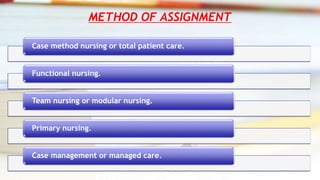
METHOD OF ASSIGNMENT
Case method nursing or total patient care.
Functional nursing.
Team nursing or modular nursing.
Primary nursing.
Case management or managed care.
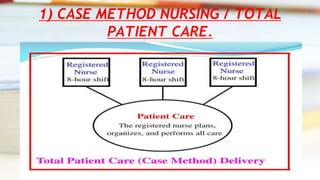
1) CASE METHOD NURSING / TOTAL
PATIENT CARE.
It is the oldest mode of organizing patient care.
In this method, nurse assumes total responsibility for
meeting all the needs of assigned patients during their time
on duty.
It involves the assignment of one or more clients to a nurse
for a specific period of time, such as shift.
One nurse is responsible for planning, organizing and
delivery of care to a particular patient or group during
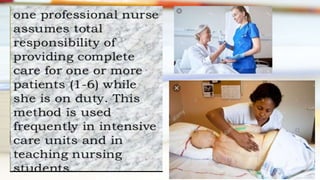
●In this method a nurse is expected to provide
complete nursing care to the patient including:
– Nursing care,
– Treatment
– Administrating medication,
– Checking diet and
– Other miscellaneous activities.
– Even though the case method is one of the earliest methods
of nursing care delivery, it is still widely used in hospitals
and in home health agencies.
– Students most frequently learn within this model, private
duty nurses practice with this design, and specialty units,
such as ICU, ICCU etc most often use this model.
– Case method nursing provides nurses with autonomy and
responsibility.
– Assigning patient is simple and direct and does not require
the planning .
– The lines of authority and accountability are clear.
– The patient theoretically receives holistic and unfragmented
care during the nurses’ time on duty.
Merits/ advantages
• The nurse can see better and attend to the total needs of client
• Co ordination of all aspects of care is the main responsibility of
the nurse; which include
• Physical,
• Emotional,
• Teaching and all other aspects related to it.
• Continuity of care can be facilitated with care.
• Client/ nurse interaction/ rapport can be developed.
• Client may feel more secure.
• Educational needs of the clients can be closely
monitored.
• Family and friends become better known by nurse
and get more involved in the care of the client.
• Work load can be equally divided.
Demerits/ disadvantages
• cost – effectiveness must be considered.
• It is difficult for nurses to use this method to become
involved in long – term planning and evaluation of care.
• when the nurse is inadequately trained or prepared to
provide total care to the patient
• not helpful In improving skill.
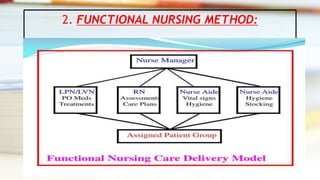
2. FUNCTIONAL NURSING METHOD:
• These relatively unskilled workers were trained to do
some simple tasks and gain proficiency by repetition.
Persons were assigned to complete certain tasks
rather than care of specific patients,
e.g.
• checking blood pressure,
• administrating medication,
• changing lines and bathing patients.
• The available staffs on a unit for a particular period of
time are assigned selected functions such as vital signs,
treatments, medications.
• All the responsibilities of the unit are assigned to selected
people in accordance with their expertise. The only person
who has complete responsibility of the client is the head
nurse or nurse acting in that role.
Merits/ advantages
• The person can be particularly skilled in performing
assigned tasks, it can be efficient and economical.
• Best utilization of a person’s aptitudes, experience and
desires.
• Required less equipment.
• Saves time.
• Development of technical skills.
– It is easy to organize the work of the unit and staff.
– Major advantage of this method is its efficiency,
tasks are completely quickly, with little confusion
regarding responsibility,
– e.g. in many areas such as operating room, labour
room; etc the functional nursing works well and is
still very much in evidence.
Demerits/ disadvantages
• Staff may become bored
• have little motivation to develop self and others, work
may become monotonous.
• Care givers may feel unchallengable
• Client may tend to feel insecure.
• It is difficult to establish client priorities and
operationally the care plan reflecting same.
3) TEAM NURSING OR MODULAR NURSING
METHOD:
An registered nurse leads a group of health care
personnel in providing care for a group of 10-20 patients
during the shift.
Team leader distribute the work among subordinates &
keep a stick watch.
 these duties are distribute by team leader according to
need of the pt.
– The key concept is a group that works together towards a
common goal, providing qualified comprehensive nursing
care.
– In team nursing personnel collaborated in providing care
to a group of patients under the direction of a
professional nurse.
– Actually the team nursing involves decentralization of a
nursing unit and professional head nurses authority, in
which the unit divided into teams.
– Each team composed of team leader, team members and
patients. Staff and clients are usually divided evenly,
often written unit proximity such as wing of floor.
– Assignments are according to the capabilities of the
members.
– Comprehensive care of the client is the responsibility of
the entire team, but it led by the team leader who
should be a registered nurse
– In team nursing team leader or the head nurse is responsible
for knowing the condition and needs of all the patients
assigned to the team and planning individual care.
– The team leader duties very depending on the patient’s
needs and workload.
– These duties may include assisting team members, giving
direct personal care to patients, teaching and coordinating
patient care activities.
Merits/ advantages
• Division of labour allows members the opportunity to develop
leadership skills.
• Every team member has the opportunity to learn from and each
colleagues.
• There is verity in the daily assignments.
• Nursing care hours are usually cost –effective.
• The client is able to identify personnel who are responsible for
his care.
• All care is directed by a registered nurse.
• Continuity care is facilities.
• Barriers between professional and non-professional workers
can be minimize through the group efforts.
• Every one has the opportunity to contribute to the care plan.
Demerits/ disadvantages
• Establishing the team concept takes time, effort and
constancy of personnel.
• Unstable staffing patterns make team nursing
difficult.
• The team leader must have complex skills
and knowledge.
i.e. communication,
leadership organization,
nursing care,
motivation and other skills.
• Team nursing is usually associated with democratic
leadership.
• Team nursing allows each member to contribute their
own special expertise or skills.
• Team leader should use their knowledge about each
member’s abilities when making patient assignments.
4) PRIMARY NURSING METHOD.
• Focus is on pt not on task.
• It involves total nursing care, directed by a nurse on a 24 hours
basis as long as the client is under care.
• The primary nurse is essentially, on call all the time and
arranged coverage when away.
• Only register nurse provide care.
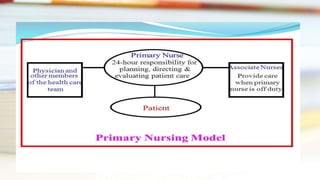
• Actually the primary nurse assumes 24 hours responsibility for
planning the care of one or more patients from start of
treatment to discharge.
• During working hours the primary nurse provides total direct
care for that patient, when the primary nurse is not on duty,
care is provided by other junior nurses who follow the care plan
established by the primary nurse.
Merits/ advantages
• There is opportunity for the nurse to see the client and
family as one system.
• Nursing accountability, responsibility and independence
are increased.
• The nurse is able to use a wide range of skills,
knowledge and expertise.
• This method produce creativity.
• The scene is set for increased trust and satisfaction by
the client and nurse.
Demerits/ disadvantages
• The nurse may be isolated from colleagues.
• There is little for group planning of client care.
• Nurses must be mature and independently
competent.
• It may be cost effective.
• Staffing pattern may necessities a heavy client load.
• An inadequately prepared or educated primary nurse
may be incapable of co-coordinating a
multidisciplinary team or identifying complex patient
needs and condition changes.
5. PROGRESSIVE PATIENT/
( CASE MANAGEMENT )
Progressive client care is a method in which
client care areas or units provide various levels of
care
a) intensive care
b) intermediate
d) Self care unit.
e) Long term care
1. INTENSIVE CARE:
• The purpose of intensive care is life saving.
• Basically all health care practices are designed to
observe and preserve the vital functions of respiration,
circulation, elimination, life saving equipment, drugs
and supplies and made available for immediate use of
all times.
2.INTERMEDIATE CARE:
• from intensive care unit the patient are transferred to intermediate
care unit when they no longer needs close attention by medical or
nursing personnel.
• Here patient have continuity of care which they were receiving In
intensive care unit.
• Emergency care and frequent observations are merely needed, They
are able to meet their own need to some extent
3. SELF CARE:
• Patient who have recovered from critically ill diseases, or
those who are admitted for investigation or therapeutic
services are seen in this unit.
• Most of the patients in self care unit are ambulatory.
• Examples of patients in self care unit are post coronary
patient who learn progressive physical activity under
supervision, diabetic client who requires frequent lab test,.
4. LONG TERM CARE:
• These units are assigned to patients who are substantially
disabled by the effect of disease.
• For the patients, period of convalescence will be long one and
they require a course of restorative or rehabilitative treatment
of considerable duration.
• The patient in this unit will be partially or totally dependent on
nursing care to carry out their activities of daily living.
5. HOME CARE:
• These patients are out patient programme. Home
care is benefited by those patients who are
ambulatory and do not require hospitalization if
adequate educations is given, the family members
and patient himself can help home care programme.
Merits/ advantages
• Efficient use of personnel and equipment.
• Clients are in the best place to receive the care they
require.
• Use of nursing skills and expertise are maximized due
to different of each unit.
• Clients are moved towards self care, independence is
fostered where indicated.
• Efficient use and placement of equipment is possible.
Demerits/ disadvantages
• There may be discomfort to clients who are moved
often.
• Continuity care is difficult, even though possible.
• Long term nurse/ client relationships are difficult to
arrange.
• Great emphasis is placed on comprehensive, written
care plan.
• There is often times difficulty in meeting
administrative need of the organization, staffing,
evaluation and accreditation.
Methods of Assignment

Methods of Assignment

  • 1.
  • 2.
    METHOD OF ASSIGNMENTS •Assignment in the clinical field is the nursing service. Nursing is a part of organization in the clinical set up. • Assignment is the clinical field in a division of labour. • Nursing staff feel sense of belongings, importance and it gives opportunity for self expression and individual growth and the professional growth.
  • 3.
  • 4.
    Objectives of theAssignments:  • To provide the patient with the best possible nursing care. • To plan assignments which are interesting to nurses and stimulating to their professional growth. • To provide a well – rounded educational growth. • Achieving good ward management.
  • 5.
    METHOD OF ASSIGNMENT Casemethod nursing or total patient care. Functional nursing. Team nursing or modular nursing. Primary nursing. Case management or managed care.
  • 6.
    1) CASE METHODNURSING / TOTAL PATIENT CARE.
  • 7.
    It is theoldest mode of organizing patient care. In this method, nurse assumes total responsibility for meeting all the needs of assigned patients during their time on duty. It involves the assignment of one or more clients to a nurse for a specific period of time, such as shift. One nurse is responsible for planning, organizing and delivery of care to a particular patient or group during
  • 9.
    ●In this methoda nurse is expected to provide complete nursing care to the patient including: – Nursing care, – Treatment – Administrating medication, – Checking diet and – Other miscellaneous activities.
  • 10.
    – Even thoughthe case method is one of the earliest methods of nursing care delivery, it is still widely used in hospitals and in home health agencies. – Students most frequently learn within this model, private duty nurses practice with this design, and specialty units, such as ICU, ICCU etc most often use this model.
  • 11.
    – Case methodnursing provides nurses with autonomy and responsibility. – Assigning patient is simple and direct and does not require the planning . – The lines of authority and accountability are clear. – The patient theoretically receives holistic and unfragmented care during the nurses’ time on duty.
  • 12.
    Merits/ advantages • Thenurse can see better and attend to the total needs of client • Co ordination of all aspects of care is the main responsibility of the nurse; which include • Physical, • Emotional, • Teaching and all other aspects related to it.
  • 13.
    • Continuity ofcare can be facilitated with care. • Client/ nurse interaction/ rapport can be developed. • Client may feel more secure. • Educational needs of the clients can be closely monitored. • Family and friends become better known by nurse and get more involved in the care of the client. • Work load can be equally divided.
  • 14.
    Demerits/ disadvantages • cost– effectiveness must be considered. • It is difficult for nurses to use this method to become involved in long – term planning and evaluation of care. • when the nurse is inadequately trained or prepared to provide total care to the patient • not helpful In improving skill.
  • 15.
  • 16.
    • These relativelyunskilled workers were trained to do some simple tasks and gain proficiency by repetition. Persons were assigned to complete certain tasks rather than care of specific patients, e.g. • checking blood pressure, • administrating medication, • changing lines and bathing patients.
  • 17.
    • The availablestaffs on a unit for a particular period of time are assigned selected functions such as vital signs, treatments, medications. • All the responsibilities of the unit are assigned to selected people in accordance with their expertise. The only person who has complete responsibility of the client is the head nurse or nurse acting in that role.
  • 18.
    Merits/ advantages • Theperson can be particularly skilled in performing assigned tasks, it can be efficient and economical. • Best utilization of a person’s aptitudes, experience and desires. • Required less equipment. • Saves time. • Development of technical skills.
  • 19.
    – It iseasy to organize the work of the unit and staff. – Major advantage of this method is its efficiency, tasks are completely quickly, with little confusion regarding responsibility, – e.g. in many areas such as operating room, labour room; etc the functional nursing works well and is still very much in evidence.
  • 20.
    Demerits/ disadvantages • Staffmay become bored • have little motivation to develop self and others, work may become monotonous. • Care givers may feel unchallengable • Client may tend to feel insecure. • It is difficult to establish client priorities and operationally the care plan reflecting same.
  • 21.
    3) TEAM NURSINGOR MODULAR NURSING METHOD: An registered nurse leads a group of health care personnel in providing care for a group of 10-20 patients during the shift. Team leader distribute the work among subordinates & keep a stick watch.  these duties are distribute by team leader according to need of the pt.
  • 22.
    – The keyconcept is a group that works together towards a common goal, providing qualified comprehensive nursing care. – In team nursing personnel collaborated in providing care to a group of patients under the direction of a professional nurse. – Actually the team nursing involves decentralization of a nursing unit and professional head nurses authority, in which the unit divided into teams.
  • 23.
    – Each teamcomposed of team leader, team members and patients. Staff and clients are usually divided evenly, often written unit proximity such as wing of floor. – Assignments are according to the capabilities of the members. – Comprehensive care of the client is the responsibility of the entire team, but it led by the team leader who should be a registered nurse
  • 24.
    – In teamnursing team leader or the head nurse is responsible for knowing the condition and needs of all the patients assigned to the team and planning individual care. – The team leader duties very depending on the patient’s needs and workload. – These duties may include assisting team members, giving direct personal care to patients, teaching and coordinating patient care activities.
  • 25.
    Merits/ advantages • Divisionof labour allows members the opportunity to develop leadership skills. • Every team member has the opportunity to learn from and each colleagues. • There is verity in the daily assignments. • Nursing care hours are usually cost –effective.
  • 26.
    • The clientis able to identify personnel who are responsible for his care. • All care is directed by a registered nurse. • Continuity care is facilities. • Barriers between professional and non-professional workers can be minimize through the group efforts. • Every one has the opportunity to contribute to the care plan.
  • 27.
    Demerits/ disadvantages • Establishingthe team concept takes time, effort and constancy of personnel. • Unstable staffing patterns make team nursing difficult.
  • 28.
    • The teamleader must have complex skills and knowledge. i.e. communication, leadership organization, nursing care, motivation and other skills.
  • 29.
    • Team nursingis usually associated with democratic leadership. • Team nursing allows each member to contribute their own special expertise or skills. • Team leader should use their knowledge about each member’s abilities when making patient assignments.
  • 30.
    4) PRIMARY NURSINGMETHOD. • Focus is on pt not on task. • It involves total nursing care, directed by a nurse on a 24 hours basis as long as the client is under care. • The primary nurse is essentially, on call all the time and arranged coverage when away. • Only register nurse provide care.
  • 32.
    • Actually theprimary nurse assumes 24 hours responsibility for planning the care of one or more patients from start of treatment to discharge. • During working hours the primary nurse provides total direct care for that patient, when the primary nurse is not on duty, care is provided by other junior nurses who follow the care plan established by the primary nurse.
  • 33.
    Merits/ advantages • Thereis opportunity for the nurse to see the client and family as one system. • Nursing accountability, responsibility and independence are increased. • The nurse is able to use a wide range of skills, knowledge and expertise. • This method produce creativity. • The scene is set for increased trust and satisfaction by the client and nurse.
  • 34.
    Demerits/ disadvantages • Thenurse may be isolated from colleagues. • There is little for group planning of client care. • Nurses must be mature and independently competent. • It may be cost effective. • Staffing pattern may necessities a heavy client load. • An inadequately prepared or educated primary nurse may be incapable of co-coordinating a multidisciplinary team or identifying complex patient needs and condition changes.
  • 35.
    5. PROGRESSIVE PATIENT/ (CASE MANAGEMENT )
  • 36.
    Progressive client careis a method in which client care areas or units provide various levels of care a) intensive care b) intermediate d) Self care unit. e) Long term care
  • 37.
    1. INTENSIVE CARE: •The purpose of intensive care is life saving. • Basically all health care practices are designed to observe and preserve the vital functions of respiration, circulation, elimination, life saving equipment, drugs and supplies and made available for immediate use of all times.
  • 38.
    2.INTERMEDIATE CARE: • fromintensive care unit the patient are transferred to intermediate care unit when they no longer needs close attention by medical or nursing personnel. • Here patient have continuity of care which they were receiving In intensive care unit. • Emergency care and frequent observations are merely needed, They are able to meet their own need to some extent
  • 39.
    3. SELF CARE: •Patient who have recovered from critically ill diseases, or those who are admitted for investigation or therapeutic services are seen in this unit. • Most of the patients in self care unit are ambulatory. • Examples of patients in self care unit are post coronary patient who learn progressive physical activity under supervision, diabetic client who requires frequent lab test,.
  • 40.
    4. LONG TERMCARE: • These units are assigned to patients who are substantially disabled by the effect of disease. • For the patients, period of convalescence will be long one and they require a course of restorative or rehabilitative treatment of considerable duration. • The patient in this unit will be partially or totally dependent on nursing care to carry out their activities of daily living.
  • 41.
    5. HOME CARE: •These patients are out patient programme. Home care is benefited by those patients who are ambulatory and do not require hospitalization if adequate educations is given, the family members and patient himself can help home care programme.
  • 42.
    Merits/ advantages • Efficientuse of personnel and equipment. • Clients are in the best place to receive the care they require. • Use of nursing skills and expertise are maximized due to different of each unit. • Clients are moved towards self care, independence is fostered where indicated. • Efficient use and placement of equipment is possible.
  • 43.
    Demerits/ disadvantages • Theremay be discomfort to clients who are moved often. • Continuity care is difficult, even though possible. • Long term nurse/ client relationships are difficult to arrange. • Great emphasis is placed on comprehensive, written care plan. • There is often times difficulty in meeting administrative need of the organization, staffing, evaluation and accreditation.