WEL-COME
Introduction
Staffing is a selection, training, motivating and
retaining of a personnel in the organization. Nurse
staffing is a constant challenge for health care
facilities. Before the selection of the employees, one
has to make analysis of the particular job, which is
required in the organization, then comes the
selection of personnel
DEFINITION
1.“ According to the definition by Dr. Green,
"staff is the process of identifying work
requirements within an organization;
determining the number of people and the
skills necessary to do the work; and
recruiting, selecting and promoting the
qualified candidates”
2. Selecting and training individuals for specific
job functions, and charging them with the
associated responsibilities.
3.Staffing is the process by which an organization
creates a pool of applicants and makes a choice
from that pool to provide the right person at the
right place at the right time to increase the
organizational effectiveness.
Purpose
The purpose of all staffing activities
is to provide each nursing unit with
an appropriate and acceptable
number of workers in each category
to perform the nursing tasks
required.
Too few or an improper mixture of
nursing personnel will adversely
affect the quality and quantity of
work performed.
Such situation can lead to high rates
of absenteeism and staffs turn-over
resulting in low morale and
dissatisfaction.
Philosophyof staffing in nursing
•To match employees’ knowledge and skills to patient care needs
in a manner that optimizes job satisfaction and care quality.
• Technical and humanistic care needs of critically ill patients are
so complex that all aspects of that care should be provided by
professional nurses.
•Health teaching and rehabilitation needs of chronically ill
patients are so complex that direct care for chronically ill patients
should be provided by professional and technical nurse.
• To determine the number of personnel in each category to be
assigned to care for patients of each type( such as coronary care,
renal failure, chronic arthritis, paraplegia, cancer etc).
•To implement the plan in all units should be developed centrally
by the nursing heads and staff of the hospital.
•Details such as shift- start time, number of staffs assigned on
holidays, and number of employees assigned to each shift can be
modified to accommodate the units’ workload and workflow.
OBJECTIVES
•Provide an all professional nurse staff in
critical care units, operating rooms, labor and
emergency room.
•Provide sufficient staff to permit a 1:1 nurse-
patient ratio for each shift in every critical
care unit.
•Staff the general medical, surgical, obstetrics
and gynecology, pediatric and psychiatric units
to achieve a 2:1 professional- practical nurse
ratio.
•Provide sufficient nursing staff in general,
medical, surgical, obstetrics and gynecology,
pediatric and psychiatric units to permit a 1:5
nurse patient ratio on a day and afternoon
shifts and 1:10 nurse- patient ratio on night
shift.
•Involve the heads of the nursing staffs and all
nursing personnel in designing the department’s
overall staffing program.
•Design a staffing plan that specifies how many nursing personnel in each
classification will be assigned to each nursing unit for each shift and how vacation
and holiday time will be requested and scheduled.
•Hold each head nurse responsible for translating the department’s master staffing
plan to sequential eight weeks time schedules for personnel assigned to her/ his
unit.
•Post time schedules for all personnel at least eight weeks in advance.
•Empower the head nurse to adjust work schedules for unit nursing personnel to
remedy any staff excess or deficiency caused by census fluctuation or employee
absence.
•Inform each nursing employee that requests for specific vacation or holiday time
will be honored within the limits imposed by patient care and labor contract
requirements.
•Reward employees for long term service by granting individuals special time
requests on the basis of seniority.
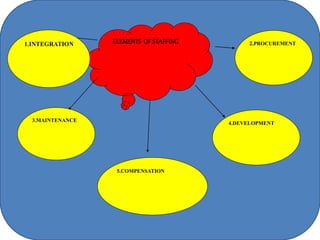
ELEMENTS OF STAFFING
3.MAINTENANCE
5.COMPENSATION
4.DEVELOPMENT
2.PROCUREMENT1.INTEGRATION
1) INTEGRATION : It involves developing a sense of belonging to the enterpr
essential to motivate employees towards the accomplishment of organisationa
Discipline and labour relations are important elements of integration.
2) PROCUREMENT : Employment of proper nurses and personnel is the first fun
staffing. This involves:
 Manpower planning : It is the process of determining current & future manpow
in terms of number & quality of personnel.
 Recruitment : It implies locating sources of acceptable candidates.
 Selection : It involves choice of right type of people from the available candidates
 Placement : It means assigning specific jobs to the selected candidates.
3)MAINTENANCE: It involves provision of such facilities and services that are req
maintain the physical and mental health of employees.
4)DEVELOPMENT : It involves orientation, training and counselling of personnel
essential for adjusting the newly hired employees in organisation improving the kn
and skills of personnel & preparing the employees for additional responsibility
5) COMPENSATION : It involves job evaluation , performance appraisal, promo
These all are essential for determination of relative worth of different jobs
organisation, evaluation of employees.
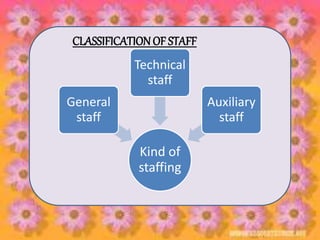
CLASSIFICATION OF STAFF
Kind of
staffing
General
staff
Technical
staff
Auxiliary
staff
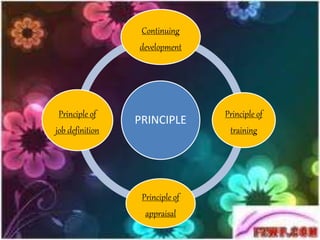
PRINCIPLE
Continuing
development
Principle of
training
Principle of
appraisal
Principle of
job definition
STAFFINGPROCESS
•Human resource/manpower
planning
•Recruitment
•Interviewing
• Selection
•Placement
•Training (to improve job
skills)
•Development (to educate
people beyond the
requirements of their present
position
•Promotion
•Transfers and separations.
•Appraisal
• Remuneration and rewards
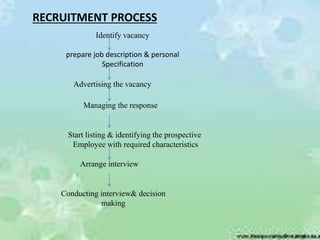
Advertising the vacancy
Identify vacancy
prepare job description & personal
Specification
Managing the response
Start listing & identifying the prospective
Employee with required characteristics
Arrange interview
Conducting interview& decision
making
RECRUITMENT PROCESS
p
Policy is the predetermined and accepted course
thoughts and actions established as a guide towards
accepted goals and objective .
personnel policy is one of the policies in the organization
which lay down the decision making criteria in the line
with overall purpose in the area of manpower
management.
The above statements give the following things about
personnel policies
•This is a predetermined course of rules or actions
•Policies guide the performance of objectives
•Policies provide the standard or ground for the decision
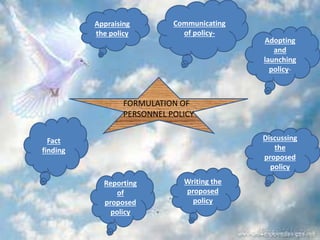
Staffing policy
Fact
finding
Reporting
of
proposed
policy
Discussing
the
proposed
policy
Appraising
the policy
Adopting
and
launching
policy-
Communicating
of policy-
Writing the
proposed
policy
FORMULATION OF
PERSONNEL POLICY
Factors Affecting Staffing
1. The type, philosophy, objectives of the hospital and the nursing service.
2. The population served or kind of patients served whether pay or charity.
3. The number of patients and severity of their illness-knowledge and ability of
nursing personnel are matched with the actual care needs of patients
4. Availability and characteristics of the nursing staff, including education,
level of preparation, mix of personnel, number and position.
5. Administrative policies such as rotation, weekends, and holiday off-duties.
6.Flucation of- the workload connected workload with human beings is never
constant. human needs are varied at varied stressful situation, pathology and
at any stage of life cycle.
6.Standards of care desired which should be available and clearly spelled out.
7. Layout of various nursing units and resources available within the
department such as adequate equipment, supplies, and materials
8. Budget including the amount allotted to salaries, fringe benefits, supplies,
materials and equipment.
9.Professional activities and priorities in non patient
activities like involvement in professional organizations,
formal educational development, participation in research
and staff development.
10. Expected hours of work per annum of each employee.
This is influenced by 40 hour week law.
11 Patterns of work schedule-traditional 5 days per week, 8
hours per day; 4 days a week, ten hours per day and three
days off; or 3 ½ days of 12 hours per day and 3 ½ days off
per week.
Planning for Staffing and Acting to Resolve Current
Nursing Shortage.
9
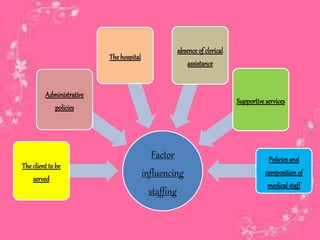
Factor
influencing
staffing
The clientto be
served
Administrative
policies
The hospital
absenceof clerical
assistance
Supportiveservices
Policiesand
compositionof
medical staff
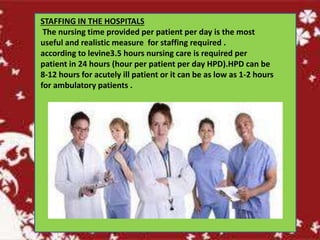
STAFFING IN THE HOSPITALS
The nursing time provided per patient per day is the most
useful and realistic measure for staffing required .
according to levine3.5 hours nursing care is required per
patient in 24 hours (hour per patient per day HPD).HPD can be
8-12 hours for acutely ill patient or it can be as low as 1-2 hours
for ambulatory patients .
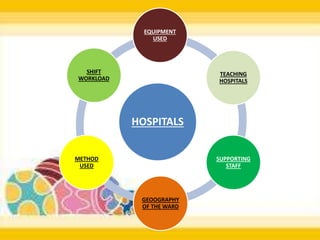
HOSPITALS
EQUIPMENT
USED
TEACHING
HOSPITALS
SUPPORTING
STAFF
GEOOGRAPHY
OF THE WARD
METHOD
USED
SHIFT
WORKLOAD
STAFFINGIN THE COMMUNITYHEALTHSETTING
Staffing of nursing personnel including general nurses ,
midwives , besides public health nurses, health visitors ,
auxiliary nurse midwives , ANM and female health worker
in the community dependent on geographical area and
state of health of people of the area assigned , i.e.
distance covered , number of households, number of
children below five years, number of couples in
reproductive age literacy rate of women folk , civil
amenities and safe drinking water available besides the
morbidity and mortality patterns.
STAFFING IN EDUCATION SET-UP
Staffing of colleges of nursing at university
level and schools of nursing at hospitals level
with handful of nurse teachers for clinical
and public health nursing practice much is to
be desired.
Due to lack of trained nurse teachers
majority of classes are taken by doctors or
other non nurses
STAFFING IN ADMINISTRATIVE SET –UP
HOSPITALS
Most of the hospitals have the
chief nurse but not in an
executive position . She acts more
like a middle level manager and
she may be assisted by one , two
or eight assistants to look after a
hospital of 750 , 1000, 1200 beds.
In one hospitals, out of 539
trained nurses only one has junior
grade I posts , one grade II post
and 82 grade III posts.
Dissatisfaction of nurses at all
levels.
COMMUNITY At district level there no chief
nursing officer ,senior nursing officer or
nursing officer but district public health
nurse or district health visitors who has
neither direct control of health assistants and
female health workers or direct access to
direct access to her state nurse.
She is surrounded by many chief and senior
medical officers and many other officials at
district level that she can hardly breath.
STATE LEVEL Staffing of nursing
personnel at state level to plan education,
manpower and it’s employment consist
only one nurse either superintendent of
nursing service or assistant director nursing
or deputy director nursing. She has no
direct access to workers at the sub centers.
majority of state have no second nurse at
the state level.
CENTRAL LEVEL
The chief nurse is called nursing advisor under the
deputy director general in DGHS. nursing advisor
has nursing officer to assist her . deputy nursing
advisor under an assistant commissioner training in
rural division of the ministry of health and family
welfare deputy nursing advisor has no assistance of
another nurse. So far planning of nursing for such
a vast country ,the staffing of nursing at the centre
is the nursing advisor ,deputy nursing advisor and
one nursing officer.
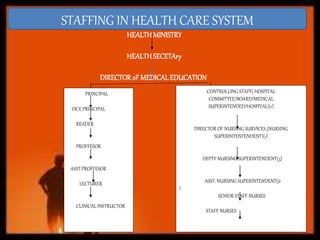
PRINCIPAL
VICE PRINCIPAL
READER
PROFFESOR
ASST.PROFFESOR
LECTURER
CLINICAL INSTRUCTOR
CONTROLLING STAFF( HOSPITAL
COMMITTEE/BOARD/MEDICAL
SUPERINTENDED/HOSPITAL)(1)
DIRECTOR OF NURSING SURVICES (NURSING
SUPERINTENTENDENT)(1)
DEPTY NURSING SUPERINTENDENT(3)
ASST. NURSING SUPERINTENDENT(6
)
SENIOR STAFF NURSES
STAFF NURSES
HEALTH MINISTER(HS)
HEALTHMINISTRY
HEALTHSECETAry
DIRECTORoF MEDICALEDUCATION
STAFFING IN HEALTH CARE SYSTEM
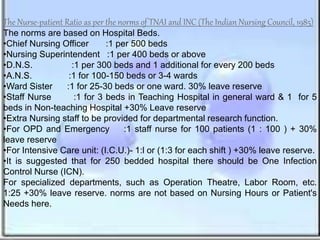
The Nurse-patient Ratio as per the norms of TNAI and INC (The Indian Nursing Council, 1985)
The norms are based on Hospital Beds.
•Chief Nursing Officer :1 per 500 beds
•Nursing Superintendent :1 per 400 beds or above
•D.N.S. :1 per 300 beds and 1 additional for every 200 beds
•A.N.S. :1 for 100-150 beds or 3-4 wards
•Ward Sister :1 for 25-30 beds or one ward. 30% leave reserve
•Staff Nurse :1 for 3 beds in Teaching Hospital in general ward & 1 for 5
beds in Non-teaching Hospital +30% Leave reserve
•Extra Nursing staff to be provided for departmental research function.
•For OPD and Emergency :1 staff nurse for 100 patients (1 : 100 ) + 30%
leave reserve
•For Intensive Care unit: (I.C.U.)- 1:l or (1:3 for each shift ) +30% leave reserve.
•It is suggested that for 250 bedded hospital there should be One Infection
Control Nurse (ICN).
For specialized departments, such as Operation Theatre, Labor Room, etc.
1:25 +30% leave reserve. norms are not based on Nursing Hours or Patient's
Needs here.
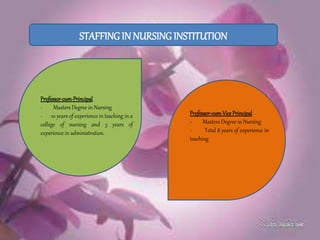
Professor-cum-Principal
- Masters Degree in Nursing
- 10 years of experience in teaching in a
college of nursing and 3 years of
experience in administration.
Professor-cum-Vice Principal
- Masters Degree in Nursing
- Total 8 years of experience in
teaching
STAFFING IN NURSING INSTITUTION
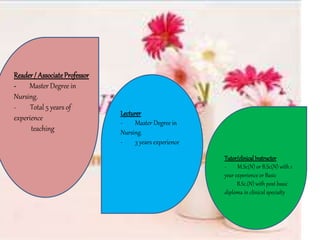
Reader/ AssociateProfessor
- Master Degree in
Nursing.
- Total 5 years of
experience
teaching
Lecturer
- Master Degree in
Nursing.
- 3 years experience
Tutor/clinicalInstructor
- M.Sc(N) or B.Sc(N) with 1
year experience or Basic
B.Sc.(N) with post basic
diploma in clinical specialty
0
DUTIES OF PRINCIPAL
COLLEGE OF NURSING
ADMINISTRATION
ORGANISING
CONTROLLING
DIRECTING
CO-ORDINATING
INSTRUCTION
GUIDING
DUTIES OF VICE
PRINCIPAL/
PROFESSOR
INSTRUCTION
HELPING THE
LEARNER
EVALUATING
RECORDING AND
REPORTING
COUNSELLING
ADMINISTRATION
GUIDANCE
RESEARCH
INSTRUCTION
GUIDANCEAND
COUNCELLING
RESEARCH
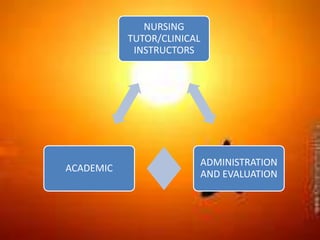
DUTIES OF
LECTURER
NURSING
TUTOR/CLINICAL
INSTRUCTORS
ADMINISTRATION
AND EVALUATION
ACADEMIC
ROLEAND FUNCTION OF ADMINISTRATOR/MANAGERIN STAFFINGAND SHEDULING
ROLE
He or she
•Identifies creative and flexible staffing methods to meet the needs of patients ,
staff and the organization.
•Is knowledgeable regarding contemporary methods of scheduling and staffing.
•Assumes a responsibility towards staffing that builds trust and encourages team
approach.
•Periodically examines the unit standard of productivity to determine if changes
are need.
•Is alert to extraneous factors that impact on staffing.
•Is ethically accountable to patients and employees for adequate safe staffing.
FUNCTIONS
•Provides adequate staffing to meet patient care needs according to philosophy of
the organizations
•Schedules staff in a fiscals responsible manner.
•Develops fair and uniform scheduling policies and communicates these clearly to all
staff.
•Ascertains that scheduling policies are not in violation of local and national labor
laws, organizational policies or union contracts
•Assumes accountability for quality and fiscal control of staffing.
•evaluate scheduling and staffing procedures and policies on a regular basis.
BACKGROUND DATA: research has been conducted examining the effect of
inadequate nurse staffing on costs and patient outcomes.
OBJECTIVE: The objective of this study was to evaluate the effect of
inadequate nurse staffing on costs and the patient outcomes of
patient falls, medication errors, wound infections, and urinary tract
infections.
METHODS: A descriptive co relational study was conducted in all of the
19 teaching hospitals in Ontario, Canada. The sample comprised
hospitals and adult medical, surgical, and obstetric inpatients within
those hospitals.
RESULTS: The lower the proportion of professional nursing staff
employed on a unit, the higher the number of medication errors and
wound infections. The less experienced the nurse, the higher the
number of wound infections. Nurse staffing models that included a
lower proportion of professional nursing staff in the mix used more
nursing hours in this study.
CONCLUSIONS: The results of this study suggest that a lower proportion of
professional nurses in the on medical and surgical units in Ontario
teaching hospitals are associated with higher rates of medication
errors and wound infections..
RESEARCH STUDY
Doubts AND
QUARIES
Thank you
Staffing and Budgetting

Staffing and Budgetting

  • 1.
  • 2.
    Introduction Staffing is aselection, training, motivating and retaining of a personnel in the organization. Nurse staffing is a constant challenge for health care facilities. Before the selection of the employees, one has to make analysis of the particular job, which is required in the organization, then comes the selection of personnel
  • 3.
    DEFINITION 1.“ According tothe definition by Dr. Green, "staff is the process of identifying work requirements within an organization; determining the number of people and the skills necessary to do the work; and recruiting, selecting and promoting the qualified candidates” 2. Selecting and training individuals for specific job functions, and charging them with the associated responsibilities. 3.Staffing is the process by which an organization creates a pool of applicants and makes a choice from that pool to provide the right person at the right place at the right time to increase the organizational effectiveness.
  • 4.
    Purpose The purpose ofall staffing activities is to provide each nursing unit with an appropriate and acceptable number of workers in each category to perform the nursing tasks required. Too few or an improper mixture of nursing personnel will adversely affect the quality and quantity of work performed. Such situation can lead to high rates of absenteeism and staffs turn-over resulting in low morale and dissatisfaction.
  • 5.
    Philosophyof staffing innursing •To match employees’ knowledge and skills to patient care needs in a manner that optimizes job satisfaction and care quality. • Technical and humanistic care needs of critically ill patients are so complex that all aspects of that care should be provided by professional nurses. •Health teaching and rehabilitation needs of chronically ill patients are so complex that direct care for chronically ill patients should be provided by professional and technical nurse. • To determine the number of personnel in each category to be assigned to care for patients of each type( such as coronary care, renal failure, chronic arthritis, paraplegia, cancer etc). •To implement the plan in all units should be developed centrally by the nursing heads and staff of the hospital. •Details such as shift- start time, number of staffs assigned on holidays, and number of employees assigned to each shift can be modified to accommodate the units’ workload and workflow.
  • 6.
    OBJECTIVES •Provide an allprofessional nurse staff in critical care units, operating rooms, labor and emergency room. •Provide sufficient staff to permit a 1:1 nurse- patient ratio for each shift in every critical care unit. •Staff the general medical, surgical, obstetrics and gynecology, pediatric and psychiatric units to achieve a 2:1 professional- practical nurse ratio. •Provide sufficient nursing staff in general, medical, surgical, obstetrics and gynecology, pediatric and psychiatric units to permit a 1:5 nurse patient ratio on a day and afternoon shifts and 1:10 nurse- patient ratio on night shift. •Involve the heads of the nursing staffs and all nursing personnel in designing the department’s overall staffing program.
  • 7.
    •Design a staffingplan that specifies how many nursing personnel in each classification will be assigned to each nursing unit for each shift and how vacation and holiday time will be requested and scheduled. •Hold each head nurse responsible for translating the department’s master staffing plan to sequential eight weeks time schedules for personnel assigned to her/ his unit. •Post time schedules for all personnel at least eight weeks in advance. •Empower the head nurse to adjust work schedules for unit nursing personnel to remedy any staff excess or deficiency caused by census fluctuation or employee absence. •Inform each nursing employee that requests for specific vacation or holiday time will be honored within the limits imposed by patient care and labor contract requirements. •Reward employees for long term service by granting individuals special time requests on the basis of seniority.
  • 8.
  • 9.
    1) INTEGRATION :It involves developing a sense of belonging to the enterpr essential to motivate employees towards the accomplishment of organisationa Discipline and labour relations are important elements of integration. 2) PROCUREMENT : Employment of proper nurses and personnel is the first fun staffing. This involves:  Manpower planning : It is the process of determining current & future manpow in terms of number & quality of personnel.  Recruitment : It implies locating sources of acceptable candidates.  Selection : It involves choice of right type of people from the available candidates  Placement : It means assigning specific jobs to the selected candidates. 3)MAINTENANCE: It involves provision of such facilities and services that are req maintain the physical and mental health of employees. 4)DEVELOPMENT : It involves orientation, training and counselling of personnel essential for adjusting the newly hired employees in organisation improving the kn and skills of personnel & preparing the employees for additional responsibility 5) COMPENSATION : It involves job evaluation , performance appraisal, promo These all are essential for determination of relative worth of different jobs organisation, evaluation of employees.
  • 10.
    CLASSIFICATION OF STAFF Kindof staffing General staff Technical staff Auxiliary staff
  • 11.
  • 12.
    STAFFINGPROCESS •Human resource/manpower planning •Recruitment •Interviewing • Selection •Placement •Training(to improve job skills) •Development (to educate people beyond the requirements of their present position •Promotion •Transfers and separations. •Appraisal • Remuneration and rewards
  • 13.
    Advertising the vacancy Identifyvacancy prepare job description & personal Specification Managing the response Start listing & identifying the prospective Employee with required characteristics Arrange interview Conducting interview& decision making RECRUITMENT PROCESS
  • 14.
    p Policy is thepredetermined and accepted course thoughts and actions established as a guide towards accepted goals and objective . personnel policy is one of the policies in the organization which lay down the decision making criteria in the line with overall purpose in the area of manpower management. The above statements give the following things about personnel policies •This is a predetermined course of rules or actions •Policies guide the performance of objectives •Policies provide the standard or ground for the decision Staffing policy
  • 15.
  • 16.
    Factors Affecting Staffing 1.The type, philosophy, objectives of the hospital and the nursing service. 2. The population served or kind of patients served whether pay or charity. 3. The number of patients and severity of their illness-knowledge and ability of nursing personnel are matched with the actual care needs of patients 4. Availability and characteristics of the nursing staff, including education, level of preparation, mix of personnel, number and position. 5. Administrative policies such as rotation, weekends, and holiday off-duties. 6.Flucation of- the workload connected workload with human beings is never constant. human needs are varied at varied stressful situation, pathology and at any stage of life cycle. 6.Standards of care desired which should be available and clearly spelled out. 7. Layout of various nursing units and resources available within the department such as adequate equipment, supplies, and materials 8. Budget including the amount allotted to salaries, fringe benefits, supplies, materials and equipment.
  • 17.
    9.Professional activities andpriorities in non patient activities like involvement in professional organizations, formal educational development, participation in research and staff development. 10. Expected hours of work per annum of each employee. This is influenced by 40 hour week law. 11 Patterns of work schedule-traditional 5 days per week, 8 hours per day; 4 days a week, ten hours per day and three days off; or 3 ½ days of 12 hours per day and 3 ½ days off per week. Planning for Staffing and Acting to Resolve Current Nursing Shortage.
  • 18.
    9 Factor influencing staffing The clientto be served Administrative policies Thehospital absenceof clerical assistance Supportiveservices Policiesand compositionof medical staff
  • 19.
    STAFFING IN THEHOSPITALS The nursing time provided per patient per day is the most useful and realistic measure for staffing required . according to levine3.5 hours nursing care is required per patient in 24 hours (hour per patient per day HPD).HPD can be 8-12 hours for acutely ill patient or it can be as low as 1-2 hours for ambulatory patients .
  • 20.
  • 21.
    STAFFINGIN THE COMMUNITYHEALTHSETTING Staffingof nursing personnel including general nurses , midwives , besides public health nurses, health visitors , auxiliary nurse midwives , ANM and female health worker in the community dependent on geographical area and state of health of people of the area assigned , i.e. distance covered , number of households, number of children below five years, number of couples in reproductive age literacy rate of women folk , civil amenities and safe drinking water available besides the morbidity and mortality patterns.
  • 22.
    STAFFING IN EDUCATIONSET-UP Staffing of colleges of nursing at university level and schools of nursing at hospitals level with handful of nurse teachers for clinical and public health nursing practice much is to be desired. Due to lack of trained nurse teachers majority of classes are taken by doctors or other non nurses
  • 23.
    STAFFING IN ADMINISTRATIVESET –UP HOSPITALS Most of the hospitals have the chief nurse but not in an executive position . She acts more like a middle level manager and she may be assisted by one , two or eight assistants to look after a hospital of 750 , 1000, 1200 beds. In one hospitals, out of 539 trained nurses only one has junior grade I posts , one grade II post and 82 grade III posts. Dissatisfaction of nurses at all levels.
  • 24.
    COMMUNITY At districtlevel there no chief nursing officer ,senior nursing officer or nursing officer but district public health nurse or district health visitors who has neither direct control of health assistants and female health workers or direct access to direct access to her state nurse. She is surrounded by many chief and senior medical officers and many other officials at district level that she can hardly breath.
  • 25.
    STATE LEVEL Staffingof nursing personnel at state level to plan education, manpower and it’s employment consist only one nurse either superintendent of nursing service or assistant director nursing or deputy director nursing. She has no direct access to workers at the sub centers. majority of state have no second nurse at the state level.
  • 26.
    CENTRAL LEVEL The chiefnurse is called nursing advisor under the deputy director general in DGHS. nursing advisor has nursing officer to assist her . deputy nursing advisor under an assistant commissioner training in rural division of the ministry of health and family welfare deputy nursing advisor has no assistance of another nurse. So far planning of nursing for such a vast country ,the staffing of nursing at the centre is the nursing advisor ,deputy nursing advisor and one nursing officer.
  • 27.
    PRINCIPAL VICE PRINCIPAL READER PROFFESOR ASST.PROFFESOR LECTURER CLINICAL INSTRUCTOR CONTROLLINGSTAFF( HOSPITAL COMMITTEE/BOARD/MEDICAL SUPERINTENDED/HOSPITAL)(1) DIRECTOR OF NURSING SURVICES (NURSING SUPERINTENTENDENT)(1) DEPTY NURSING SUPERINTENDENT(3) ASST. NURSING SUPERINTENDENT(6 ) SENIOR STAFF NURSES STAFF NURSES HEALTH MINISTER(HS) HEALTHMINISTRY HEALTHSECETAry DIRECTORoF MEDICALEDUCATION STAFFING IN HEALTH CARE SYSTEM
  • 28.
    The Nurse-patient Ratioas per the norms of TNAI and INC (The Indian Nursing Council, 1985) The norms are based on Hospital Beds. •Chief Nursing Officer :1 per 500 beds •Nursing Superintendent :1 per 400 beds or above •D.N.S. :1 per 300 beds and 1 additional for every 200 beds •A.N.S. :1 for 100-150 beds or 3-4 wards •Ward Sister :1 for 25-30 beds or one ward. 30% leave reserve •Staff Nurse :1 for 3 beds in Teaching Hospital in general ward & 1 for 5 beds in Non-teaching Hospital +30% Leave reserve •Extra Nursing staff to be provided for departmental research function. •For OPD and Emergency :1 staff nurse for 100 patients (1 : 100 ) + 30% leave reserve •For Intensive Care unit: (I.C.U.)- 1:l or (1:3 for each shift ) +30% leave reserve. •It is suggested that for 250 bedded hospital there should be One Infection Control Nurse (ICN). For specialized departments, such as Operation Theatre, Labor Room, etc. 1:25 +30% leave reserve. norms are not based on Nursing Hours or Patient's Needs here.
  • 29.
    Professor-cum-Principal - Masters Degreein Nursing - 10 years of experience in teaching in a college of nursing and 3 years of experience in administration. Professor-cum-Vice Principal - Masters Degree in Nursing - Total 8 years of experience in teaching STAFFING IN NURSING INSTITUTION
  • 30.
    Reader/ AssociateProfessor - MasterDegree in Nursing. - Total 5 years of experience teaching Lecturer - Master Degree in Nursing. - 3 years experience Tutor/clinicalInstructor - M.Sc(N) or B.Sc(N) with 1 year experience or Basic B.Sc.(N) with post basic diploma in clinical specialty
  • 31.
    0 DUTIES OF PRINCIPAL COLLEGEOF NURSING ADMINISTRATION ORGANISING CONTROLLING DIRECTING CO-ORDINATING INSTRUCTION GUIDING
  • 32.
    DUTIES OF VICE PRINCIPAL/ PROFESSOR INSTRUCTION HELPINGTHE LEARNER EVALUATING RECORDING AND REPORTING COUNSELLING ADMINISTRATION GUIDANCE RESEARCH
  • 33.
  • 34.
  • 35.
    ROLEAND FUNCTION OFADMINISTRATOR/MANAGERIN STAFFINGAND SHEDULING ROLE He or she •Identifies creative and flexible staffing methods to meet the needs of patients , staff and the organization. •Is knowledgeable regarding contemporary methods of scheduling and staffing. •Assumes a responsibility towards staffing that builds trust and encourages team approach. •Periodically examines the unit standard of productivity to determine if changes are need. •Is alert to extraneous factors that impact on staffing. •Is ethically accountable to patients and employees for adequate safe staffing. FUNCTIONS •Provides adequate staffing to meet patient care needs according to philosophy of the organizations •Schedules staff in a fiscals responsible manner. •Develops fair and uniform scheduling policies and communicates these clearly to all staff. •Ascertains that scheduling policies are not in violation of local and national labor laws, organizational policies or union contracts •Assumes accountability for quality and fiscal control of staffing. •evaluate scheduling and staffing procedures and policies on a regular basis.
  • 36.
    BACKGROUND DATA: researchhas been conducted examining the effect of inadequate nurse staffing on costs and patient outcomes. OBJECTIVE: The objective of this study was to evaluate the effect of inadequate nurse staffing on costs and the patient outcomes of patient falls, medication errors, wound infections, and urinary tract infections. METHODS: A descriptive co relational study was conducted in all of the 19 teaching hospitals in Ontario, Canada. The sample comprised hospitals and adult medical, surgical, and obstetric inpatients within those hospitals. RESULTS: The lower the proportion of professional nursing staff employed on a unit, the higher the number of medication errors and wound infections. The less experienced the nurse, the higher the number of wound infections. Nurse staffing models that included a lower proportion of professional nursing staff in the mix used more nursing hours in this study. CONCLUSIONS: The results of this study suggest that a lower proportion of professional nurses in the on medical and surgical units in Ontario teaching hospitals are associated with higher rates of medication errors and wound infections.. RESEARCH STUDY


  • 37.
  • 38.