Chapter 1
Introductio
n to
Information
Technology
Learning Objectives
• why organization should invest in IT based solution;
• should organizations invest in networking and
  processing capacity ahead of applications needs, or be
  driven by the current business;
• what level of IT solutions organizations should
  implement;
• major changes that needs to be addressed in terms of
  organization and management;
• different level of activities being performed by various
  level of managers and their information solutions
  needs.
• the latest trends in Information Technology.
Why organization should invest in IT
         based solution?
• Because the business is changing; competition
  is changing; and technology is changing.
• Because of emergence of:
  – Globalisation, Liberalisation and Privatisation
  – Business Process Outsourcing
  – Knowledge Process Outsourcing
  – Digital Economy & Knowledge Economy
  – Organization Level Transformation
Why organization should invest in IT
          based solution?
• Information technology can help all kinds of
  businesses improve the efficiency and effectiveness
  of their business processes, managerial decision
  making, and workgroup collaboration, thus
  strengthening their competitive positions in a
  rapidly changing marketplace.
• Internet-based systems have become a necessary
  ingredient for business success in today’s dynamic
  global environment.

• Information technologies are playing an expanding
  role in business.
What is Information Technology?
• Information Technology can be defined as
  collection of computer hardware, software,
  databases, networking and telecommunication
  devices that helps the organisation to manage
  the business process more effectively and
  efficiently.
• In simple terms one may say, any technological
  device that helps the organisation in managing its
  processes more effectively and efficiently
  qualifies to be part of IT.
Digital Economy
• Digital Economy is defined as economy based
  on Information Technologies including
  computers, internet, intranets, and extranets.
• Allows management of Digitally-enabled
  relationships with Customers, Suppliers and
  Employees.
Data, Information & Knowledge
• Data is a collection of raw facts and figures. Data is an
  element of a transaction. Any transaction facts collected
  about the lifestyle of credit card customers, or point of
  sales or demographics and geographic are some of the
  examples of data.
• Information is a collection of data (facts & figures) arranged
  in more meaningful manner, which helps in decision
  making.
• Knowledge is defined as the experience and expertise
  acquired by an individual. Knowledge can also be defined
  as level of understanding in interpreting the information
  available for effective decision making purpose.
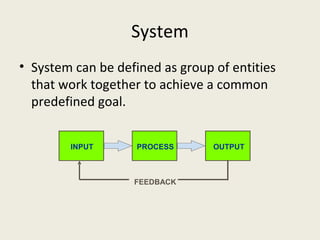
System
• System can be defined as group of entities
  that work together to achieve a common
  predefined goal.


        INPUT       PROCESS      OUTPUT


                   FEEDBACK
Information System
• Information system is a set of procedures that
  collects, process, store and disseminate
  information to support decision making.
• Information systems always have a pre-
  defined boundary and operate in an
  environment which includes other systems
  and also players like customers, suppliers and
  government departments etc.
Information Technology vs.
           Information System.
• Information Technology is a means to
  Information System or they are similar to heart
  and soul relationship.
• Information technology provides effective and
  efficient means of storing, processing and
  disseminating information.
• Information Systems provides best practices to
  manage business processes. To learn about
  information systems, one needs to understand
  the organisation, management and technology.
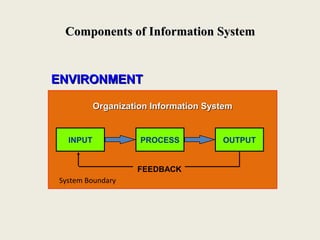
Components of Information System


ENVIRONMENT

          Organization Information System


  INPUT             PROCESS           OUTPUT


                   FEEDBACK
System Boundary
Major Characteristics of Information
                 Systems
• Intrinsic
• Accessibility
• Contextual
• Representation
• Information system needs to be economical to
  develop and maintain
• Information system needs to flexible and
  adaptable
Uses of Information
•   Identification
•   Collection
•   Controlling
•   Measuring and
•   Decision Making
Organizational Structure
• Organizations are structured in a many ways, which is
  dependant on their objectives and culture.
• The structure of an organization will determine the
  manner in which it operates and it’s performance.
• Structure allows the responsibilities for different
  functions and processes to be clearly allocated to
  different departments and employees.
• Organizational structures are created in such a way
  that it aims at maximizing the efficiency and success of
  the Organization.
• Common organization structures that exist are:
  Hierarchical, Flat and Matrix.
Functions of Management
•   Management is creative problem solving which can be accomplished
    through four functions of management: planning, organizing, directing
    and controlling.
•   Planning: Planning is the ongoing process of developing the organizational
    goals and objectives and determining how they will be accomplished.
•   Organizing: Organizing also means to establish the internal organizational
    structure of the organization. The focus is on division, coordination, and
    control of tasks and the flow of information within the organization.
•   Directing: Directing also means to influence staff behavior through
    motivation, communication, group dynamics, leadership and discipline.
•   Controlling: It is a multi stage process which includes establishing
    performance standards based on the firm's objectives; evaluating and
    reporting actual job performance; comparing the two, and taking
    corrective or preventive action as necessary.
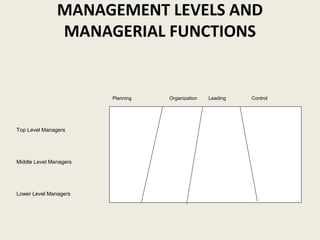
MANAGEMENT LEVELS AND
               MANAGERIAL FUNCTIONS


                        Planning   Organization   Leading   Control


Top Level Managers


Middle Level Managers


Lower Level Managers
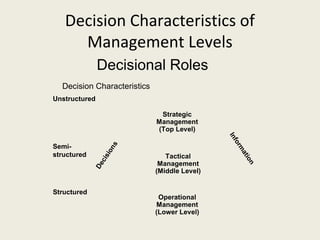
Decision Characteristics of
     Management Levels
               Decisional Roles
  Decision Characteristics
Unstructured

                              Strategic
                             Management
                             (Top Level)


                                              In
                                               orf
Semi-
                   n s


                                                 m
                io


structured


                                                  at
                                Tactical
               cis


                                                     io
                              Management


                                                     n
             De


                             (Middle Level)


Structured
                              Operational
                             Management
                             (Lower Level)
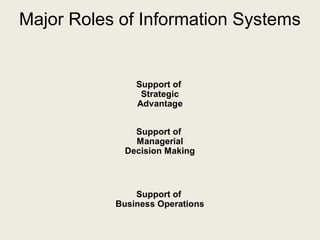
Major Roles of Information Systems


               Support of
                Strategic
               Advantage


               Support of
               Managerial
             Decision Making


               Support of
           Business Operations
Types of Information Systems
•   Transaction Processing System (TPS)
•   Management Information System (MIS)
•   Office Automation System (OAS)
•   Decision Support System (DSS)
•   Executive Support System (ESS) and
•   Expert Systems (ES)
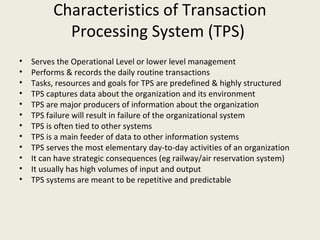
Characteristics of Transaction
            Processing System (TPS)
•   Serves the Operational Level or lower level management
•   Performs & records the daily routine transactions
•   Tasks, resources and goals for TPS are predefined & highly structured
•   TPS captures data about the organization and its environment
•   TPS are major producers of information about the organization
•   TPS failure will result in failure of the organizational system
•   TPS is often tied to other systems
•   TPS is a main feeder of data to other information systems
•   TPS serves the most elementary day-to-day activities of an organization
•   It can have strategic consequences (eg railway/air reservation system)
•   It usually has high volumes of input and output
•   TPS systems are meant to be repetitive and predictable
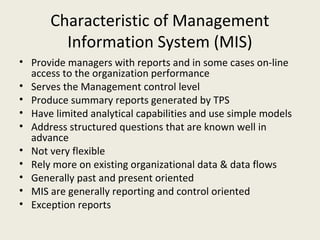
Characteristic of Management
        Information System (MIS)
• Provide managers with reports and in some cases on-line
  access to the organization performance
• Serves the Management control level
• Produce summary reports generated by TPS
• Have limited analytical capabilities and use simple models
• Address structured questions that are known well in
  advance
• Not very flexible
• Rely more on existing organizational data & data flows
• Generally past and present oriented
• MIS are generally reporting and control oriented
• Exception reports
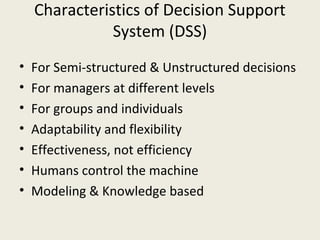
Characteristics of Decision Support
               System (DSS)
•   For Semi-structured & Unstructured decisions
•   For managers at different levels
•   For groups and individuals
•   Adaptability and flexibility
•   Effectiveness, not efficiency
•   Humans control the machine
•   Modeling & Knowledge based
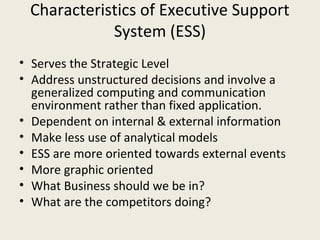
Characteristics of Executive Support
            System (ESS)
• Serves the Strategic Level
• Address unstructured decisions and involve a
  generalized computing and communication
  environment rather than fixed application.
• Dependent on internal & external information
• Make less use of analytical models
• ESS are more oriented towards external events
• More graphic oriented
• What Business should we be in?
• What are the competitors doing?
Office Automation Systems (OAS)
• Office Automation Systems (OAS) are information
  system solutions that try to improve the productivity
  of employees of an organization.
• OAS objective is to create the technology driven
  environment in an organization and it provides
  individuals effective ways to process personal and
  organisational data, perform calculations, and create
  documents.
• They are used for increasing productivity and reducing
  paper work by processing major work electronically.
  Communication systems and groupware concepts
  facilitate implementation of OAS.
Expert Systems (ES)
• Expert System (ES) are computer system or
  program that uses artificial intelligence
  techniques to solve problems that ordinarily
  require a knowledgeable human.
• Expert Systems help to guide users to find
  solutions to problems that would otherwise need
  expert advice.
• Expert Systems are useful in diagnosing,
  monitoring, selecting, designing, predicting and
  training.
Information Technology Trends
•   Information technologies are becoming the dominant force in our culture.
     –   Worldwide Internet Use Continues to Expand
     –   e-Business is Here to Stay
     –   Websites are a Necessary Function of Business
     –   Wireless Communication will Increase Significantly
     –   Technically Trained People will be in Demand Worldwide
•   Information technologies will continue to transform the way we live and work.
     –   IT is Transforming How We Conduct Business
     –   IT is Changing How We Manufacture
     –   IT is Changing the Role of Consumers
     –   IT is Changing How We Travel and Move Goods
     –   IT is Transforming How Our Governments Operate
•   The pace of change will accelerate.
     – Nano-technology is the Next New Frontier
     – Requirement for Service Oriented Architecture
     – Strong Security systems like Biometric
Summary
•   Information Technology has become integral part of life.
•   Organization started investing in technology to remain competitive, individual started learning about
    technology for their survival.
•   Information Technology can be simply defined as collection of computing and communication tools
    that help organization to manage it business processes better.
•   Major reasons, why organizations started looking at IT based solutions includes, change in methods
    the way we do businesses; global competition; global opportunities; introduction of concepts like
    business process outsourcing; emergence of digital economy; shift towards knowledge based
    economy; change in organization structure; and setting of virtual organization.
•   Information play an important role in any business, it acts as glue to an organisational process.
•   Information is always derived from Data, which is a collection of raw facts and figures.
•   Information is a processed meaningful data that helps in decision making.
•   Knowledge is a skill required to interpret the information and System is a group of entities that work
    together to achieve organisational goals.
•   Information System, which is important component of complete technology solution, can be defined
    as a set of procedures that collects, process, store and disseminate information to support decision
    making.
•   Major characteristics that Information Systems needs to have include – Intrinsic, Accessibility,
    Contextual, Representation, Flexible, Adaptable, and Economical.
•   Organizations use Information Systems to manage its business activities and achieve business goals.
    While implementing IS solutions for an organization it is important to understand the Organizational
    and Management structures. An organization is a collection of people and other resources that work
    together to achieve organizational goal. Organizations are similar to systems with inputs, processes
    and outputs.
Summary
•   Organizational structure determines how it operates.
•   Organization structures are created on the basis of their objectives and culture. The common
    structures are: Hierarchical, Flat and Matrix.
•   Organizational Culture is important to understand how business processes are being managed by the
    organisation. The different kinds of cultures being followed by different organisation include –
    Power, Role, and Task cultures. Most common among these is the Role culture, which splits the
    organization into various functions and the role is assigned within a function.
•   Management function needs to be understood wherever human efforts are involved. Typically, most
    organizations are divided into three management levels: top-level, middle-level and lower-level.
•   The key function that these managers perform at various levels are Planning, Organizing, Directing,
    and Controlling.
•   Top-level managers take decision affecting entire organisation like policy formulation, middle-level
    managers define action plan as per the formulated policies and the lower-level act as per the defined
    action plan.
•   There are six kinds of information systems which are used by different organisations at different
    levels. These systems are Transaction Processing System (TPS) meant for lower-level managers,
    Management Information Systems (MIS) meant for middle-level managers, Office Automation
    System (OAS) helps in bringing IT culture in an organisation by introducing Office support systems,
    Decision Support System (DSS) meant for senior-middle level executive for semi and un-structured
    kind of decisions, Executive Support System (ESS) meant for top-level executives for strategic
    decisions and Expert System (ES) are application specific intelligent systems.
•   The most important challenge being faced by many organizations is to understand how to integrate
    these always changing technologies into their business. Technology is evolving faster than the needs
    of businesses, finding the right application in the current business is the key challenge.

Chapter1

  • 1.
  • 2.
    Learning Objectives • whyorganization should invest in IT based solution; • should organizations invest in networking and processing capacity ahead of applications needs, or be driven by the current business; • what level of IT solutions organizations should implement; • major changes that needs to be addressed in terms of organization and management; • different level of activities being performed by various level of managers and their information solutions needs. • the latest trends in Information Technology.
  • 3.
    Why organization shouldinvest in IT based solution? • Because the business is changing; competition is changing; and technology is changing. • Because of emergence of: – Globalisation, Liberalisation and Privatisation – Business Process Outsourcing – Knowledge Process Outsourcing – Digital Economy & Knowledge Economy – Organization Level Transformation
  • 4.
    Why organization shouldinvest in IT based solution? • Information technology can help all kinds of businesses improve the efficiency and effectiveness of their business processes, managerial decision making, and workgroup collaboration, thus strengthening their competitive positions in a rapidly changing marketplace. • Internet-based systems have become a necessary ingredient for business success in today’s dynamic global environment. • Information technologies are playing an expanding role in business.
  • 5.
    What is InformationTechnology? • Information Technology can be defined as collection of computer hardware, software, databases, networking and telecommunication devices that helps the organisation to manage the business process more effectively and efficiently. • In simple terms one may say, any technological device that helps the organisation in managing its processes more effectively and efficiently qualifies to be part of IT.
  • 6.
    Digital Economy • DigitalEconomy is defined as economy based on Information Technologies including computers, internet, intranets, and extranets. • Allows management of Digitally-enabled relationships with Customers, Suppliers and Employees.
  • 7.
    Data, Information &Knowledge • Data is a collection of raw facts and figures. Data is an element of a transaction. Any transaction facts collected about the lifestyle of credit card customers, or point of sales or demographics and geographic are some of the examples of data. • Information is a collection of data (facts & figures) arranged in more meaningful manner, which helps in decision making. • Knowledge is defined as the experience and expertise acquired by an individual. Knowledge can also be defined as level of understanding in interpreting the information available for effective decision making purpose.
  • 8.
    System • System canbe defined as group of entities that work together to achieve a common predefined goal. INPUT PROCESS OUTPUT FEEDBACK
  • 9.
    Information System • Informationsystem is a set of procedures that collects, process, store and disseminate information to support decision making. • Information systems always have a pre- defined boundary and operate in an environment which includes other systems and also players like customers, suppliers and government departments etc.
  • 10.
    Information Technology vs. Information System. • Information Technology is a means to Information System or they are similar to heart and soul relationship. • Information technology provides effective and efficient means of storing, processing and disseminating information. • Information Systems provides best practices to manage business processes. To learn about information systems, one needs to understand the organisation, management and technology.
  • 11.
    Components of InformationSystem ENVIRONMENT Organization Information System INPUT PROCESS OUTPUT FEEDBACK System Boundary
  • 12.
    Major Characteristics ofInformation Systems • Intrinsic • Accessibility • Contextual • Representation • Information system needs to be economical to develop and maintain • Information system needs to flexible and adaptable
  • 13.
    Uses of Information • Identification • Collection • Controlling • Measuring and • Decision Making
  • 14.
    Organizational Structure • Organizationsare structured in a many ways, which is dependant on their objectives and culture. • The structure of an organization will determine the manner in which it operates and it’s performance. • Structure allows the responsibilities for different functions and processes to be clearly allocated to different departments and employees. • Organizational structures are created in such a way that it aims at maximizing the efficiency and success of the Organization. • Common organization structures that exist are: Hierarchical, Flat and Matrix.
  • 15.
    Functions of Management • Management is creative problem solving which can be accomplished through four functions of management: planning, organizing, directing and controlling. • Planning: Planning is the ongoing process of developing the organizational goals and objectives and determining how they will be accomplished. • Organizing: Organizing also means to establish the internal organizational structure of the organization. The focus is on division, coordination, and control of tasks and the flow of information within the organization. • Directing: Directing also means to influence staff behavior through motivation, communication, group dynamics, leadership and discipline. • Controlling: It is a multi stage process which includes establishing performance standards based on the firm's objectives; evaluating and reporting actual job performance; comparing the two, and taking corrective or preventive action as necessary.
  • 16.
    MANAGEMENT LEVELS AND MANAGERIAL FUNCTIONS Planning Organization Leading Control Top Level Managers Middle Level Managers Lower Level Managers
  • 17.
    Decision Characteristics of Management Levels Decisional Roles Decision Characteristics Unstructured Strategic Management (Top Level) In orf Semi- n s m io structured at Tactical cis io Management n De (Middle Level) Structured Operational Management (Lower Level)
  • 18.
    Major Roles ofInformation Systems Support of Strategic Advantage Support of Managerial Decision Making Support of Business Operations
  • 19.
    Types of InformationSystems • Transaction Processing System (TPS) • Management Information System (MIS) • Office Automation System (OAS) • Decision Support System (DSS) • Executive Support System (ESS) and • Expert Systems (ES)
  • 20.
    Characteristics of Transaction Processing System (TPS) • Serves the Operational Level or lower level management • Performs & records the daily routine transactions • Tasks, resources and goals for TPS are predefined & highly structured • TPS captures data about the organization and its environment • TPS are major producers of information about the organization • TPS failure will result in failure of the organizational system • TPS is often tied to other systems • TPS is a main feeder of data to other information systems • TPS serves the most elementary day-to-day activities of an organization • It can have strategic consequences (eg railway/air reservation system) • It usually has high volumes of input and output • TPS systems are meant to be repetitive and predictable
  • 21.
    Characteristic of Management Information System (MIS) • Provide managers with reports and in some cases on-line access to the organization performance • Serves the Management control level • Produce summary reports generated by TPS • Have limited analytical capabilities and use simple models • Address structured questions that are known well in advance • Not very flexible • Rely more on existing organizational data & data flows • Generally past and present oriented • MIS are generally reporting and control oriented • Exception reports
  • 22.
    Characteristics of DecisionSupport System (DSS) • For Semi-structured & Unstructured decisions • For managers at different levels • For groups and individuals • Adaptability and flexibility • Effectiveness, not efficiency • Humans control the machine • Modeling & Knowledge based
  • 23.
    Characteristics of ExecutiveSupport System (ESS) • Serves the Strategic Level • Address unstructured decisions and involve a generalized computing and communication environment rather than fixed application. • Dependent on internal & external information • Make less use of analytical models • ESS are more oriented towards external events • More graphic oriented • What Business should we be in? • What are the competitors doing?
  • 24.
    Office Automation Systems(OAS) • Office Automation Systems (OAS) are information system solutions that try to improve the productivity of employees of an organization. • OAS objective is to create the technology driven environment in an organization and it provides individuals effective ways to process personal and organisational data, perform calculations, and create documents. • They are used for increasing productivity and reducing paper work by processing major work electronically. Communication systems and groupware concepts facilitate implementation of OAS.
  • 25.
    Expert Systems (ES) •Expert System (ES) are computer system or program that uses artificial intelligence techniques to solve problems that ordinarily require a knowledgeable human. • Expert Systems help to guide users to find solutions to problems that would otherwise need expert advice. • Expert Systems are useful in diagnosing, monitoring, selecting, designing, predicting and training.
  • 26.
    Information Technology Trends • Information technologies are becoming the dominant force in our culture. – Worldwide Internet Use Continues to Expand – e-Business is Here to Stay – Websites are a Necessary Function of Business – Wireless Communication will Increase Significantly – Technically Trained People will be in Demand Worldwide • Information technologies will continue to transform the way we live and work. – IT is Transforming How We Conduct Business – IT is Changing How We Manufacture – IT is Changing the Role of Consumers – IT is Changing How We Travel and Move Goods – IT is Transforming How Our Governments Operate • The pace of change will accelerate. – Nano-technology is the Next New Frontier – Requirement for Service Oriented Architecture – Strong Security systems like Biometric
  • 27.
    Summary • Information Technology has become integral part of life. • Organization started investing in technology to remain competitive, individual started learning about technology for their survival. • Information Technology can be simply defined as collection of computing and communication tools that help organization to manage it business processes better. • Major reasons, why organizations started looking at IT based solutions includes, change in methods the way we do businesses; global competition; global opportunities; introduction of concepts like business process outsourcing; emergence of digital economy; shift towards knowledge based economy; change in organization structure; and setting of virtual organization. • Information play an important role in any business, it acts as glue to an organisational process. • Information is always derived from Data, which is a collection of raw facts and figures. • Information is a processed meaningful data that helps in decision making. • Knowledge is a skill required to interpret the information and System is a group of entities that work together to achieve organisational goals. • Information System, which is important component of complete technology solution, can be defined as a set of procedures that collects, process, store and disseminate information to support decision making. • Major characteristics that Information Systems needs to have include – Intrinsic, Accessibility, Contextual, Representation, Flexible, Adaptable, and Economical. • Organizations use Information Systems to manage its business activities and achieve business goals. While implementing IS solutions for an organization it is important to understand the Organizational and Management structures. An organization is a collection of people and other resources that work together to achieve organizational goal. Organizations are similar to systems with inputs, processes and outputs.
  • 28.
    Summary • Organizational structure determines how it operates. • Organization structures are created on the basis of their objectives and culture. The common structures are: Hierarchical, Flat and Matrix. • Organizational Culture is important to understand how business processes are being managed by the organisation. The different kinds of cultures being followed by different organisation include – Power, Role, and Task cultures. Most common among these is the Role culture, which splits the organization into various functions and the role is assigned within a function. • Management function needs to be understood wherever human efforts are involved. Typically, most organizations are divided into three management levels: top-level, middle-level and lower-level. • The key function that these managers perform at various levels are Planning, Organizing, Directing, and Controlling. • Top-level managers take decision affecting entire organisation like policy formulation, middle-level managers define action plan as per the formulated policies and the lower-level act as per the defined action plan. • There are six kinds of information systems which are used by different organisations at different levels. These systems are Transaction Processing System (TPS) meant for lower-level managers, Management Information Systems (MIS) meant for middle-level managers, Office Automation System (OAS) helps in bringing IT culture in an organisation by introducing Office support systems, Decision Support System (DSS) meant for senior-middle level executive for semi and un-structured kind of decisions, Executive Support System (ESS) meant for top-level executives for strategic decisions and Expert System (ES) are application specific intelligent systems. • The most important challenge being faced by many organizations is to understand how to integrate these always changing technologies into their business. Technology is evolving faster than the needs of businesses, finding the right application in the current business is the key challenge.