MANAGEMENT INFORMATION SYSTEM
Data and information Data Raw facts or Observation Meaningless Time Independent Machine Efficient General Purpose Information Informative value Time dependent Human efficient Specific Based on previous knowledge
The Transformation: From Data to Wisdom Data  is transformed into  information   Resources used to organize data into categories Examples include monthly reports, regional summaries, etc. Information  is transformed into  knowledge Knowledge is understanding patterns, rules and contexts. Knowledge  is transformed into  wisdom Collective and individual experience in applying knowledge to solve a problem Wisdom is where, when and how to apply knowledge
What is a System?
A System
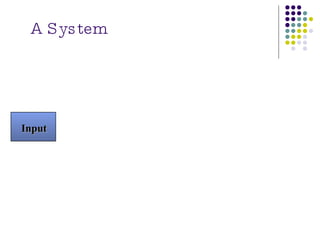
A System Input
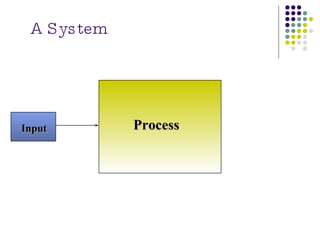
A System Input Process
A System Input Output Process
A System Input Output Process feedback
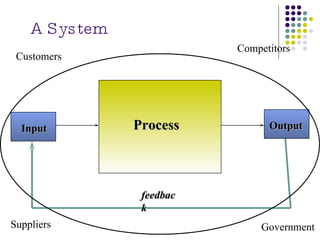
A System Input Output Process feedback Customers Competitors Suppliers Government
SYSTEM A system is an orderly grouping of interdependent components linked together according to a plan to achieve a specific objective.
Elements(Components) of system Input Processor Outputs Control-  guides the system Feedback-  control in a dynamic system is achieved by feedback Environment -  super system Boundaries and Interface
Types of Systems Conceptual and Empirical Natural and Manufactured Social, People-Machine and Machine Closed and Open Systems Adaptive and Non-adaptive Deterministic and Probabilistic Systems. Permanent and Temporary System. Stationary and Non-stationary System. Subsystems and super systems.
What is an Information System? a set of interrelated components that collect (or retrieve) process store distribute information in order to support decision   making coordination   and   control
Information System An information system is an organized  combination of people, hardware, software,  communications network, and data resources  that collects, transforms, and disseminates  in an organization.
Role of Information System Support of business operation Support of Managerial Decision making Support of Strategic competitive advantage
Components of Information System  Input Processor Output People Hardware(physical devices) Software (information processing instructions) Data  Network (communication channels)
Activities of Information System Input of data resources Processing of data into information Output of Information Products Storage of Data Resources Control of System Performance
Types of Information System Operational support system Transaction Processing system Process control systems Office automation system Management support system Management Information Systems Decision Support Systems Executive Information Systems Expert Systems
Transaction Processing System Transaction processing systems functions at the operational level of an organization. Examples of transaction processing systems include order tracking, order processing, machine control, plant scheduling,  and compensation.
Management Information System A management Information System is An integrated user-machine system For providing information To support the operations, management, analysis, and decision-making functions In an organization The system utilizes Computer Hardware and Software Manual Procedures Models for analysis, planning, control and decision making and A database
Characteristics of MIS Management Information System Support Structured and Semi-structured Decision at the operational and management control levels. They are also useful for planning purpose of senior management staff.  Management Information Systems are generally reporting and control oriented. They are designed to report on existing operation and therefore to help provide day- to day control of operations.  MIS rely on existing corporate data and data flows.  MIS have little analytical capability.  MIS generally aid in decision making using past and present data.  MIS are relatively inflexible.  MIS have internal rather than an external orientation.  Information requirements are known and stable.  MIS require a lengthy analysis and design process.
Levels and Functions within an Organization Levels Operational Management Strategic Functions Sales and Marketing Manufacturing and Production Finance and Accounting Human Resources
Management Management is the art of getting things done through and with the people in formally organized groups. Managerial functions Planning Organizing Staffing Directing Controlling
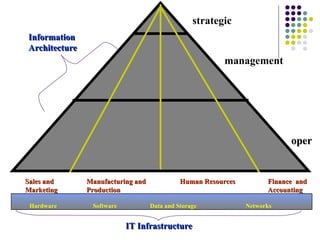
Organization structure strategic management oper Sales and Marketing Manufacturing and Production Human Resources Finance  and Accounting
strategic management oper Sales and Marketing Manufacturing and Production Human Resources Finance  and Accounting Hardware Software Data and Storage Networks IT Infrastructure Information Architecture
Information required at different management levels  9-
Levels of Management Decision Making Strategic management Executives develop organizational goals, strategies, policies, and objectives  As part of a strategic planning process Tactical management Managers and business professionals in self-directed teams  Develop short- and medium-range plans, schedules and budgets  Specify the policies, procedures and business objectives for their subunits 9-
Levels of Management Decision Making Operational management Managers or members of self-directed teams  Develop short-range plans such as weekly production schedules 9-
Content of a Long range Plan Where are we? Where do we want to go? How do we get there? When will it be done? Who will do it? How much will it cost?
Information Quality Information products whose characteristics, attributes, or qualities make the information more valuable  Information has 3 dimensions: Time Content Form 9-
Attributes of Information Quality 9-
Level of the System Operational-level systems Keep track of elementary activities and transactions Sales, receipts, payroll, etc. Purpose is to answer routine questions and track flow of transactions
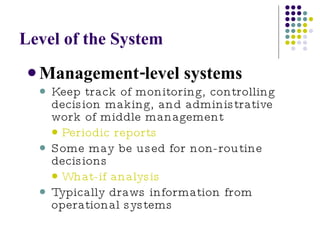
Level of the System Management-level systems Keep track of monitoring, controlling decision making, and administrative work of middle management Periodic reports Some may be used for non-routine decisions What-if analysis Typically draws information from operational systems
Level of System Strategic-level systems Assist senior management in making long-term decisions Typically non-routine, unstructured decision making activities
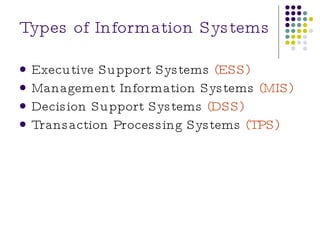
Types of Information Systems Executive Support Systems  (ESS) Management Information Systems  (MIS) Decision Support Systems  (DSS) Transaction Processing Systems  (TPS)
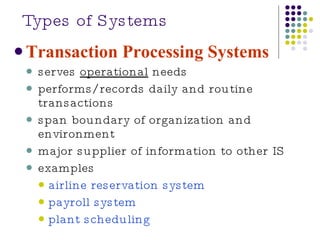
Types of Systems Transaction Processing Systems serves  operational  needs performs/records daily and routine transactions span boundary of organization and environment major supplier of information to other IS examples airline reservation system payroll system plant scheduling
Types of Systems (contd.) Management Information Systems serves activities of planning, controlling   and decision-making at the management level usually take form of performance reports (such as exception or summary reports) limited analytical ability often (mistakenly) equated with IS
Decision Support Systems DSS Provide interactive information support to managers and business professionals during the decision-making process Use: Analytical models Specialized databases A decision maker’s own insights and judgments Interactive computer-based modeling To support semi structured business decisions 9-
Executive Information Systems EIS Combine many features of MIS and DSS Provide top executives with immediate and easy access to information About the  factors that are critical to accomplishing an organization’s strategic objectives ( Critical success factors ) So popular, expanded to managers, analysts and other knowledge workers 9-
Knowledge Management Systems The use of information technology to help gather, organize, and share business knowledge within an organization Enterprise Knowledge Portals EIPs that are the entry to corporate intranets that serve as knowledge management systems 9-
Expert Systems ES A  knowledge-based information system  (KBIS) that uses its knowledge about a specific, complex application to act as an expert consultant to end users KBIS  is a system that adds a knowledge base to the other components on an IS  9-
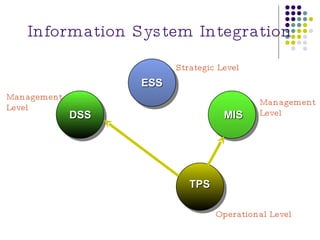
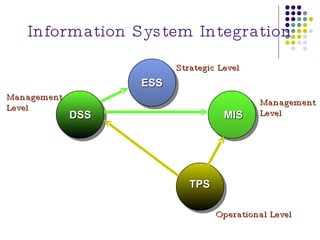
Information System Integration Management  Level Strategic Level Operational Level Management  Level
Information System Integration Management  Level Strategic Level Operational Level Management  Level TPS
Information System Integration Management  Level Strategic Level Operational Level Management  Level TPS MIS DSS
Information System Integration Management  Level Strategic Level Operational Level Management  Level TPS MIS DSS ESS
System Approach to Problem Solving Define the problem Design the solution Develop alternate solution Select the solution Implement the solution Monitor and evaluate the results
Information for competitive Advantage
Organizational Change Automation Rationalization of procedures Business process reengineering Paradigm shifts
Business Process Reengineering “ The  fundamental  rethinking and  radical   redesign of business  processes  to achieve  dramatic   improvements in critical, contemporary measures of  performance, such as cost, quality, service, and speed.”

Mis Mac

  • 1.
  • 2.
    Data and informationData Raw facts or Observation Meaningless Time Independent Machine Efficient General Purpose Information Informative value Time dependent Human efficient Specific Based on previous knowledge
  • 3.
    The Transformation: FromData to Wisdom Data is transformed into information Resources used to organize data into categories Examples include monthly reports, regional summaries, etc. Information is transformed into knowledge Knowledge is understanding patterns, rules and contexts. Knowledge is transformed into wisdom Collective and individual experience in applying knowledge to solve a problem Wisdom is where, when and how to apply knowledge
  • 4.
    What is aSystem?
  • 5.
  • 6.
  • 7.
  • 8.
    A System InputOutput Process
  • 9.
    A System InputOutput Process feedback
  • 10.
    A System InputOutput Process feedback Customers Competitors Suppliers Government
  • 11.
    SYSTEM A systemis an orderly grouping of interdependent components linked together according to a plan to achieve a specific objective.
  • 12.
    Elements(Components) of systemInput Processor Outputs Control- guides the system Feedback- control in a dynamic system is achieved by feedback Environment - super system Boundaries and Interface
  • 13.
    Types of SystemsConceptual and Empirical Natural and Manufactured Social, People-Machine and Machine Closed and Open Systems Adaptive and Non-adaptive Deterministic and Probabilistic Systems. Permanent and Temporary System. Stationary and Non-stationary System. Subsystems and super systems.
  • 14.
    What is anInformation System? a set of interrelated components that collect (or retrieve) process store distribute information in order to support decision making coordination and control
  • 15.
    Information System Aninformation system is an organized combination of people, hardware, software, communications network, and data resources that collects, transforms, and disseminates in an organization.
  • 16.
    Role of InformationSystem Support of business operation Support of Managerial Decision making Support of Strategic competitive advantage
  • 17.
    Components of InformationSystem Input Processor Output People Hardware(physical devices) Software (information processing instructions) Data Network (communication channels)
  • 18.
    Activities of InformationSystem Input of data resources Processing of data into information Output of Information Products Storage of Data Resources Control of System Performance
  • 19.
    Types of InformationSystem Operational support system Transaction Processing system Process control systems Office automation system Management support system Management Information Systems Decision Support Systems Executive Information Systems Expert Systems
  • 20.
    Transaction Processing SystemTransaction processing systems functions at the operational level of an organization. Examples of transaction processing systems include order tracking, order processing, machine control, plant scheduling, and compensation.
  • 21.
    Management Information SystemA management Information System is An integrated user-machine system For providing information To support the operations, management, analysis, and decision-making functions In an organization The system utilizes Computer Hardware and Software Manual Procedures Models for analysis, planning, control and decision making and A database
  • 22.
    Characteristics of MISManagement Information System Support Structured and Semi-structured Decision at the operational and management control levels. They are also useful for planning purpose of senior management staff. Management Information Systems are generally reporting and control oriented. They are designed to report on existing operation and therefore to help provide day- to day control of operations. MIS rely on existing corporate data and data flows. MIS have little analytical capability. MIS generally aid in decision making using past and present data. MIS are relatively inflexible. MIS have internal rather than an external orientation. Information requirements are known and stable. MIS require a lengthy analysis and design process.
  • 23.
    Levels and Functionswithin an Organization Levels Operational Management Strategic Functions Sales and Marketing Manufacturing and Production Finance and Accounting Human Resources
  • 24.
    Management Management isthe art of getting things done through and with the people in formally organized groups. Managerial functions Planning Organizing Staffing Directing Controlling
  • 25.
    Organization structure strategicmanagement oper Sales and Marketing Manufacturing and Production Human Resources Finance and Accounting
  • 26.
    strategic management operSales and Marketing Manufacturing and Production Human Resources Finance and Accounting Hardware Software Data and Storage Networks IT Infrastructure Information Architecture
  • 27.
    Information required atdifferent management levels 9-
  • 28.
    Levels of ManagementDecision Making Strategic management Executives develop organizational goals, strategies, policies, and objectives As part of a strategic planning process Tactical management Managers and business professionals in self-directed teams Develop short- and medium-range plans, schedules and budgets Specify the policies, procedures and business objectives for their subunits 9-
  • 29.
    Levels of ManagementDecision Making Operational management Managers or members of self-directed teams Develop short-range plans such as weekly production schedules 9-
  • 30.
    Content of aLong range Plan Where are we? Where do we want to go? How do we get there? When will it be done? Who will do it? How much will it cost?
  • 31.
    Information Quality Informationproducts whose characteristics, attributes, or qualities make the information more valuable Information has 3 dimensions: Time Content Form 9-
  • 32.
  • 33.
    Level of theSystem Operational-level systems Keep track of elementary activities and transactions Sales, receipts, payroll, etc. Purpose is to answer routine questions and track flow of transactions
  • 34.
    Level of theSystem Management-level systems Keep track of monitoring, controlling decision making, and administrative work of middle management Periodic reports Some may be used for non-routine decisions What-if analysis Typically draws information from operational systems
  • 35.
    Level of SystemStrategic-level systems Assist senior management in making long-term decisions Typically non-routine, unstructured decision making activities
  • 36.
    Types of InformationSystems Executive Support Systems (ESS) Management Information Systems (MIS) Decision Support Systems (DSS) Transaction Processing Systems (TPS)
  • 37.
    Types of SystemsTransaction Processing Systems serves operational needs performs/records daily and routine transactions span boundary of organization and environment major supplier of information to other IS examples airline reservation system payroll system plant scheduling
  • 38.
    Types of Systems(contd.) Management Information Systems serves activities of planning, controlling and decision-making at the management level usually take form of performance reports (such as exception or summary reports) limited analytical ability often (mistakenly) equated with IS
  • 39.
    Decision Support SystemsDSS Provide interactive information support to managers and business professionals during the decision-making process Use: Analytical models Specialized databases A decision maker’s own insights and judgments Interactive computer-based modeling To support semi structured business decisions 9-
  • 40.
    Executive Information SystemsEIS Combine many features of MIS and DSS Provide top executives with immediate and easy access to information About the factors that are critical to accomplishing an organization’s strategic objectives ( Critical success factors ) So popular, expanded to managers, analysts and other knowledge workers 9-
  • 41.
    Knowledge Management SystemsThe use of information technology to help gather, organize, and share business knowledge within an organization Enterprise Knowledge Portals EIPs that are the entry to corporate intranets that serve as knowledge management systems 9-
  • 42.
    Expert Systems ESA knowledge-based information system (KBIS) that uses its knowledge about a specific, complex application to act as an expert consultant to end users KBIS is a system that adds a knowledge base to the other components on an IS 9-
  • 43.
    Information System IntegrationManagement Level Strategic Level Operational Level Management Level
  • 44.
    Information System IntegrationManagement Level Strategic Level Operational Level Management Level TPS
  • 45.
    Information System IntegrationManagement Level Strategic Level Operational Level Management Level TPS MIS DSS
  • 46.
    Information System IntegrationManagement Level Strategic Level Operational Level Management Level TPS MIS DSS ESS
  • 47.
    Information System IntegrationManagement Level Strategic Level Operational Level Management Level TPS MIS DSS ESS
  • 48.
    Information System IntegrationManagement Level Strategic Level Operational Level Management Level TPS MIS DSS ESS
  • 49.
    Information System IntegrationManagement Level Strategic Level Operational Level Management Level TPS MIS DSS ESS
  • 50.
    System Approach toProblem Solving Define the problem Design the solution Develop alternate solution Select the solution Implement the solution Monitor and evaluate the results
  • 51.
  • 52.
    Organizational Change AutomationRationalization of procedures Business process reengineering Paradigm shifts
  • 53.
    Business Process Reengineering“ The fundamental rethinking and radical redesign of business processes to achieve dramatic improvements in critical, contemporary measures of performance, such as cost, quality, service, and speed.”