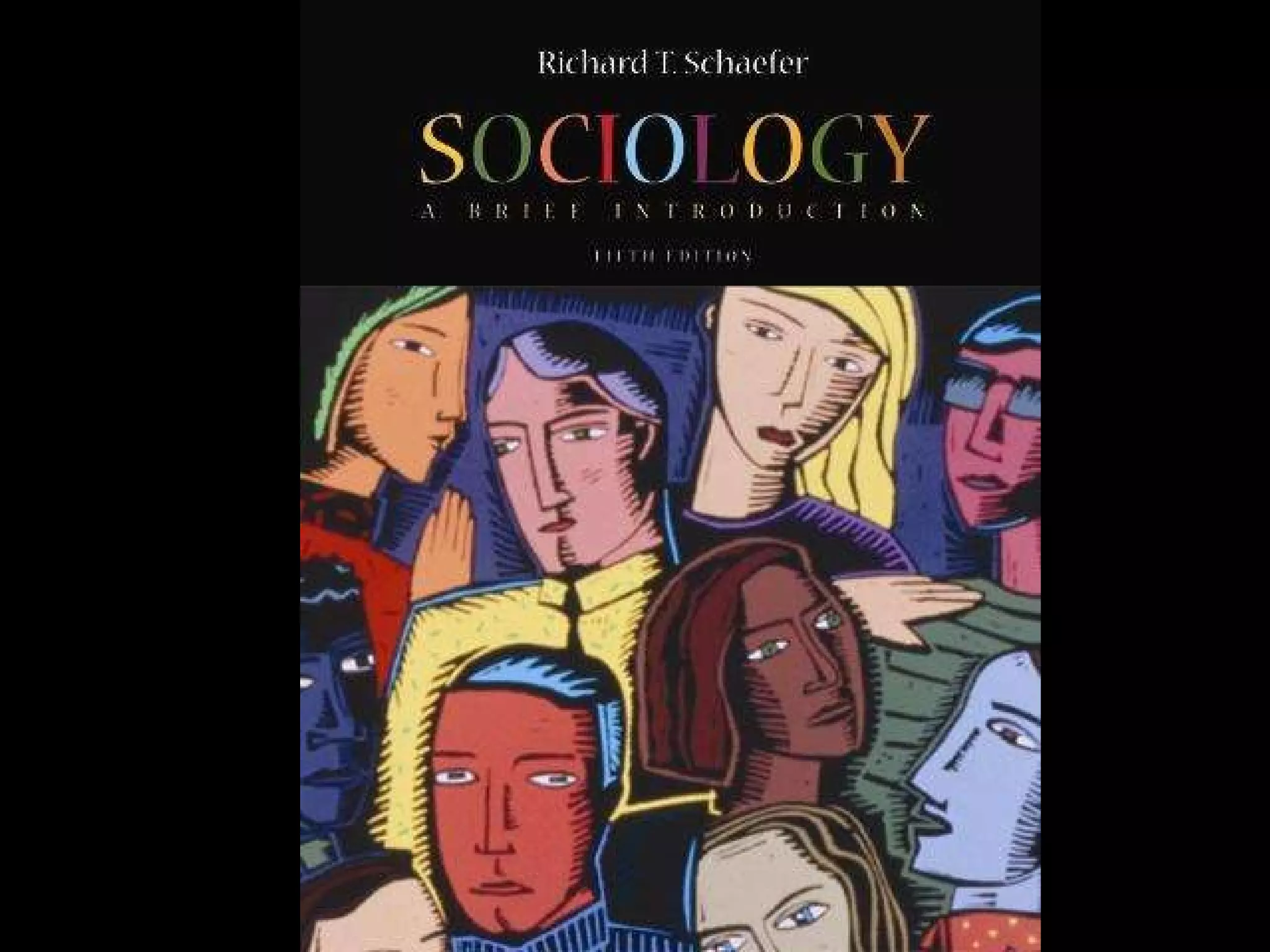
8 DEVIANCE AND SOCIAL CONTROL
Chapter Outline Social Control Deviance Crime Social Policy and Social Control: The Death Penalty in the United States and Worldwide
Social Control Social Control  refers to the techniques and strategies for preventing deviant human behavior in any society. Sanctions  are penalties and  rewards for conduct concerning a social norm.
Social Control Conformity and Obedience Conformity  is defined as going along with peers who have no special right to direct our behavior. Obedience  is defined as compliance with higher authorities in an hierarchical structure.
Social Control Conformity and Obedience Conformity to Prejudice --Research demonstrates that people may conform to attitudes and behavior of peers even when it means expressing intolerance towards others.
Social Control Informal and Formal Social Control Informal Social Control --Informal social control is used casually to enforce norms. --Informal social control includes: smiles laughter ridicule raising an eyebrow
Social Control Law and Society Some norms are so important to a society that they are formalized into laws controlling people’s behaviors. Laws are governmental social control and are created in response to perceived social needs for formal social control.
Social Control Law and Society Control Theory --Our bonds to members of society lead us to conform to society’s norms. --We are bonded through: family friends peers
Deviance What is Deviance? Deviance --Deviance is behavior that violates the standards of conduct or expectations of a group or society. --Examples of deviants: alcoholics  gamblers  mentally ill
Deviance What is Deviance? Sociologically, we are all deviant from time to time. Each of us violates common social norms in certain situations. Deviance involves the violation of group norms which may or may not be formalized into law.
Deviance What is Deviance? Standards of deviance vary from one group (subculture) to another. Deviance varies over time. Deviance is subjective, subject to social definitions.
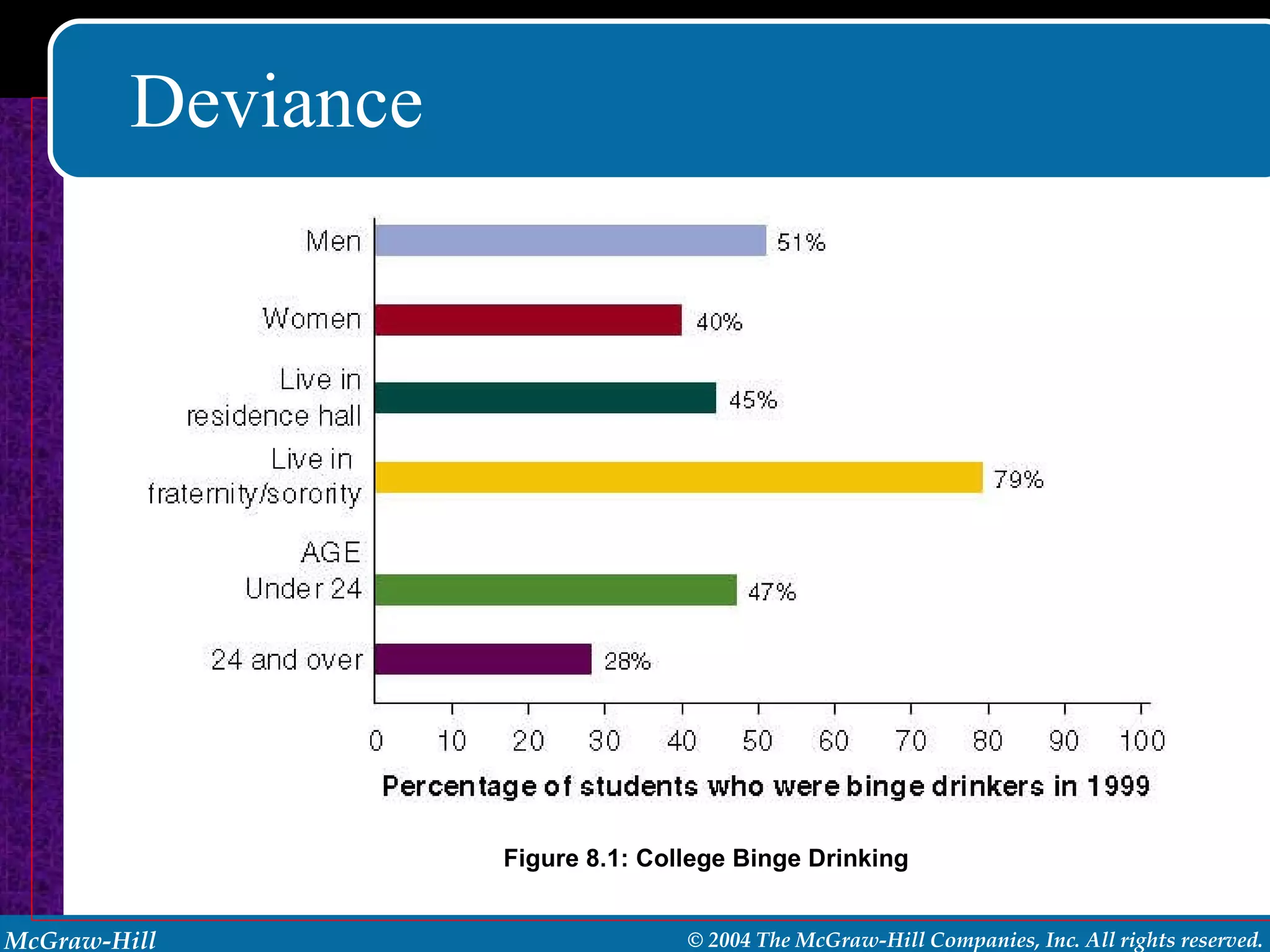
Deviance Figure 8.1: College Binge Drinking
Deviance What is Deviance? Deviance and Social Stigma --The term  stigma  describes the labels society uses to devalue members of certain social groups. --Once members are assigned deviant roles, they have trouble presenting positive images to others.
Deviance What is Deviance? Deviance and Technology --Technological innovations can redefine social interactions and standards of behavior related to them. These innovations include: pagers voice mail internet cell phones
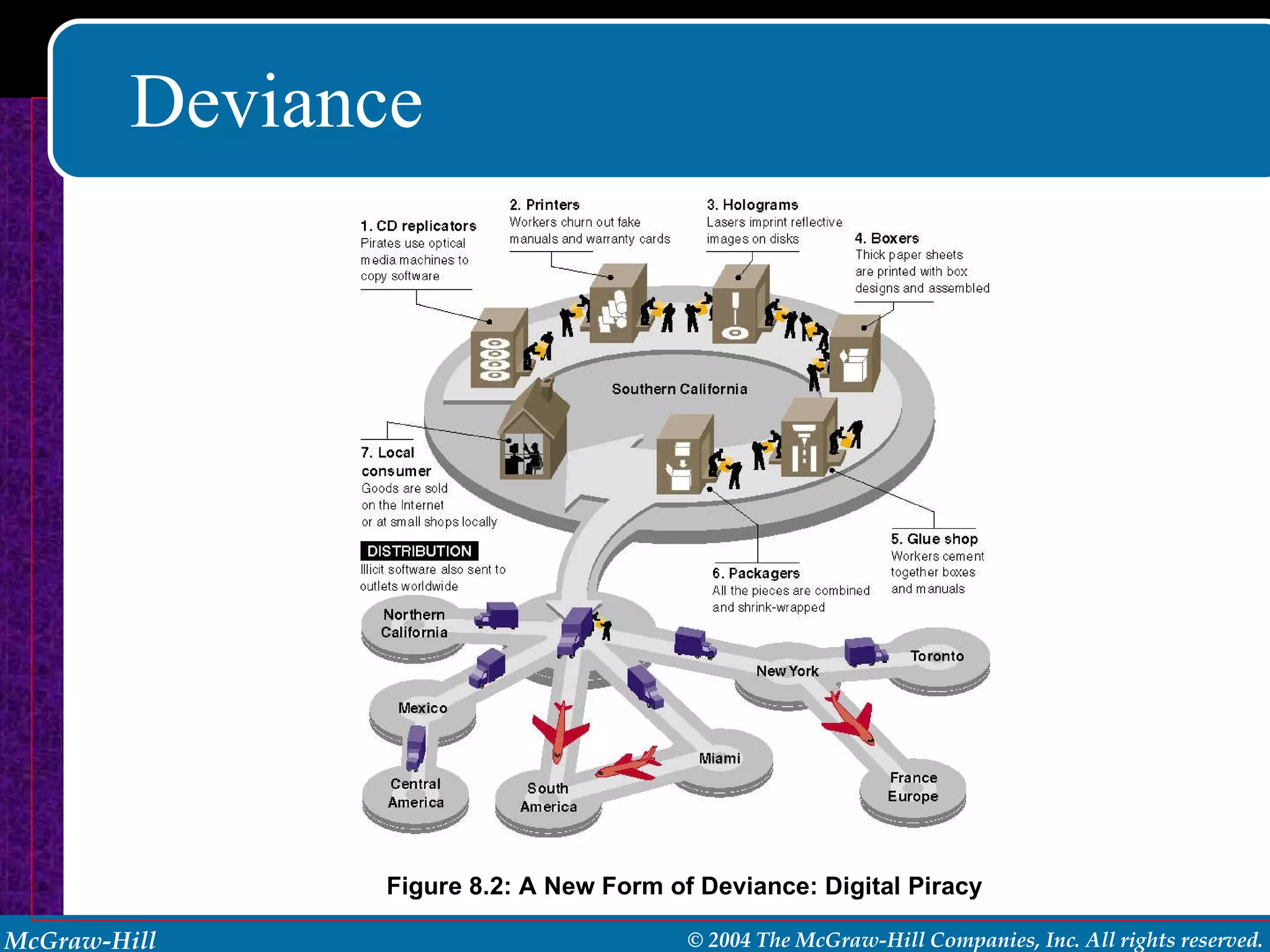
Deviance Figure 8.2: A New Form of Deviance: Digital Piracy
Deviance Explaining Deviance Functionalist Perspective --Deviance is a part of human existence and has positive and negative consequences for society. --Durkheim introduced the term  anomie,  defined as a state of normlessness that occurs during periods of profound social change.
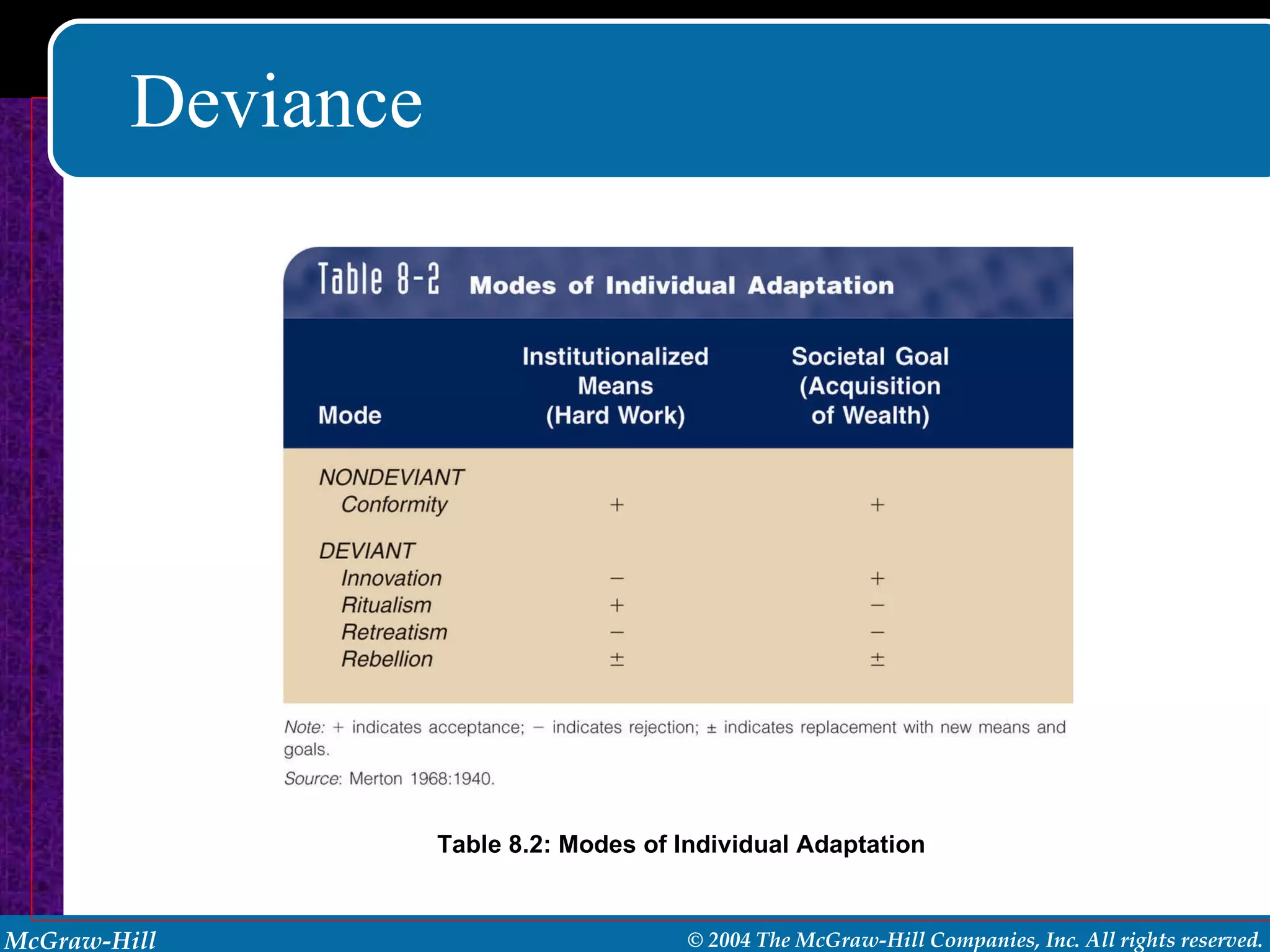
Deviance Explaining Deviance Functionalist Perspective (continued) --Merton examined how people adapted to the acceptance or rejection of a society’s goals. Merton’s  Anomie Theory of Deviance  examines how people conform to or deviate from cultural expectations.
Deviance Table 8.2: Modes of Individual Adaptation
Deviance Explaining Deviance Interactionist Perspective --Focuses on everyday behavior and why or how a person comes to commit a deviant act. The  cultural transmission theory  holds that one learns criminal behavior through interactions with others. --The  routine activities theory  holds that criminal victimization is increased when motivated offenders and suitable targets converge.
Deviance Explaining Deviance Interactionist Perspective (continued) -- Labeling theory  attempts to explain why certain people are viewed as deviants while others are not and emphasizes how a person comes to be labeled as deviant and to accept this label.
Deviance Explaining Deviance Interactionist Perspective (continued) -- Conflict theory  holds that people with power protect their own interests and define deviance to suit their own needs. --Conflict theory  contends the criminal justice system of the U.S. treats people differently on the basis of their racial, ethnic, or social class background.
Deviance Explaining Deviance Feminist Perspective  -- Feminist perspective  contends that when it comes to crime and to deviance in general, society tends to treat women in stereotypical fashion. --Feminist perspective  emphasizes that deviance, including crime, tends to flow from economic relationships.
Crime Crime  is defined as a violation of criminal law for which some governmental authority applies formal penalties.
Crime Types of Crime Professional Crime:  Crime pursued as a person’s day-to-day occupation.  Organized Crime:  The work of a group that regulates relations between various criminal enterprises.
Crime Types of Crime White Collar and Technology-Based Crime : Illegal acts committed in the course of business activities, often by affluent people. Victimless Crimes : The willing exchange among adults of widely desired, but illegal, goods and services.
Crime Crime Statistics Crime statistics are not as accurate as social scientists would like. Reported crime is very high in the United States and is regarded as a major social problem. Violent crimes have declined significantly nationwide following many years of increases.
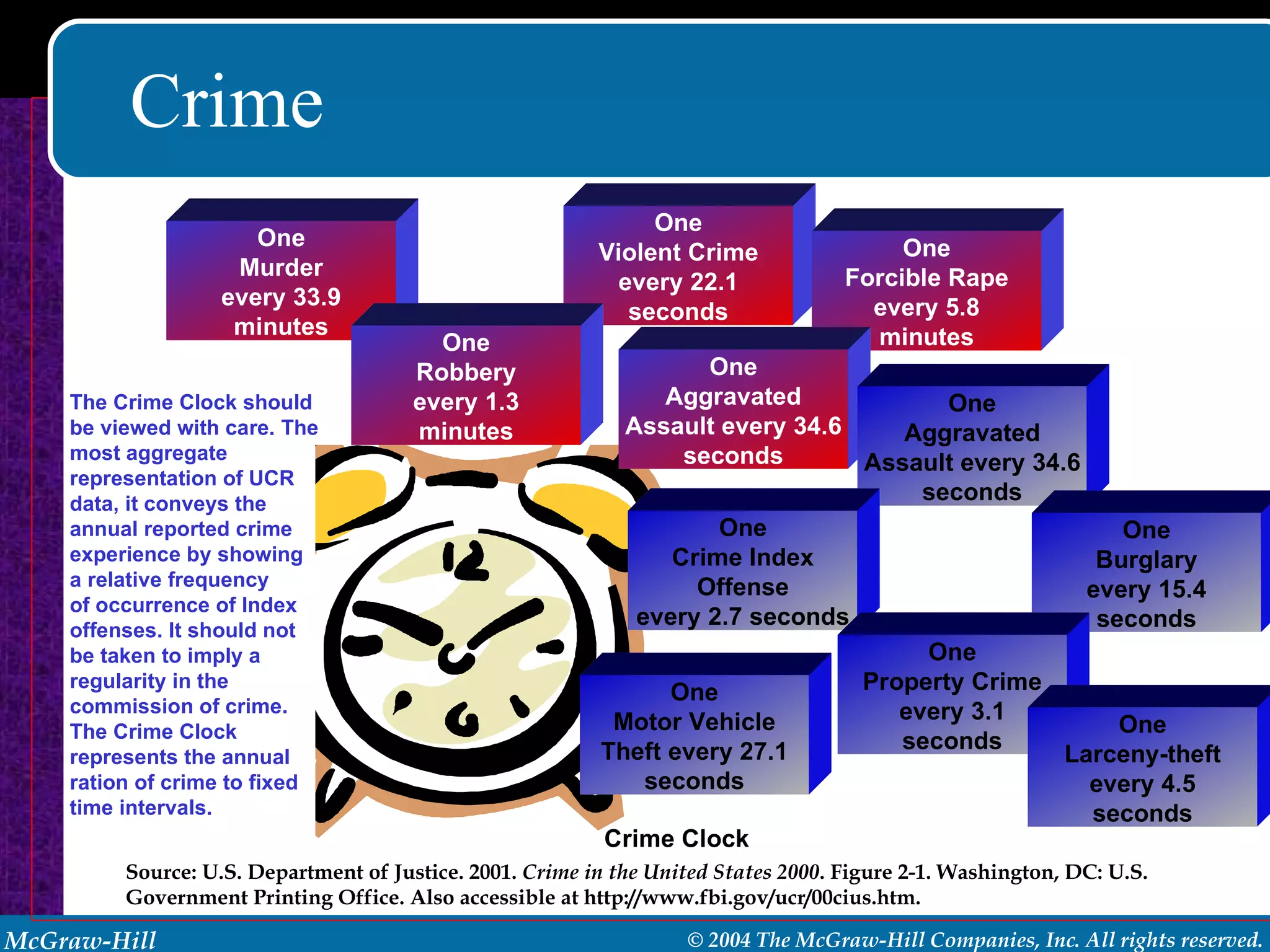
Crime Crime Clock  Source: U.S. Department of Justice. 2001.  Crime in the United States 2000 . Figure 2-1. Washington, DC: U.S. Government Printing Office. Also accessible at http://www.fbi.gov/ucr/00cius.htm. One Murder every 33.9 minutes One Violent Crime every 22.1 seconds One Robbery every 1.3 minutes One Forcible Rape every 5.8 minutes One Aggravated Assault every 34.6 seconds One Aggravated Assault every 34.6 seconds One Crime Index Offense every 2.7 seconds One Burglary every 15.4 seconds One Motor Vehicle Theft every 27.1 seconds One Property Crime every 3.1 seconds One Larceny-theft every 4.5 seconds The Crime Clock should be viewed with care. The most aggregate representation of UCR data, it conveys the annual reported crime experience by showing a relative frequency of occurrence of Index offenses. It should not be taken to imply a regularity in the  commission of crime. The Crime Clock  represents the annual ration of crime to fixed time intervals.
Crime
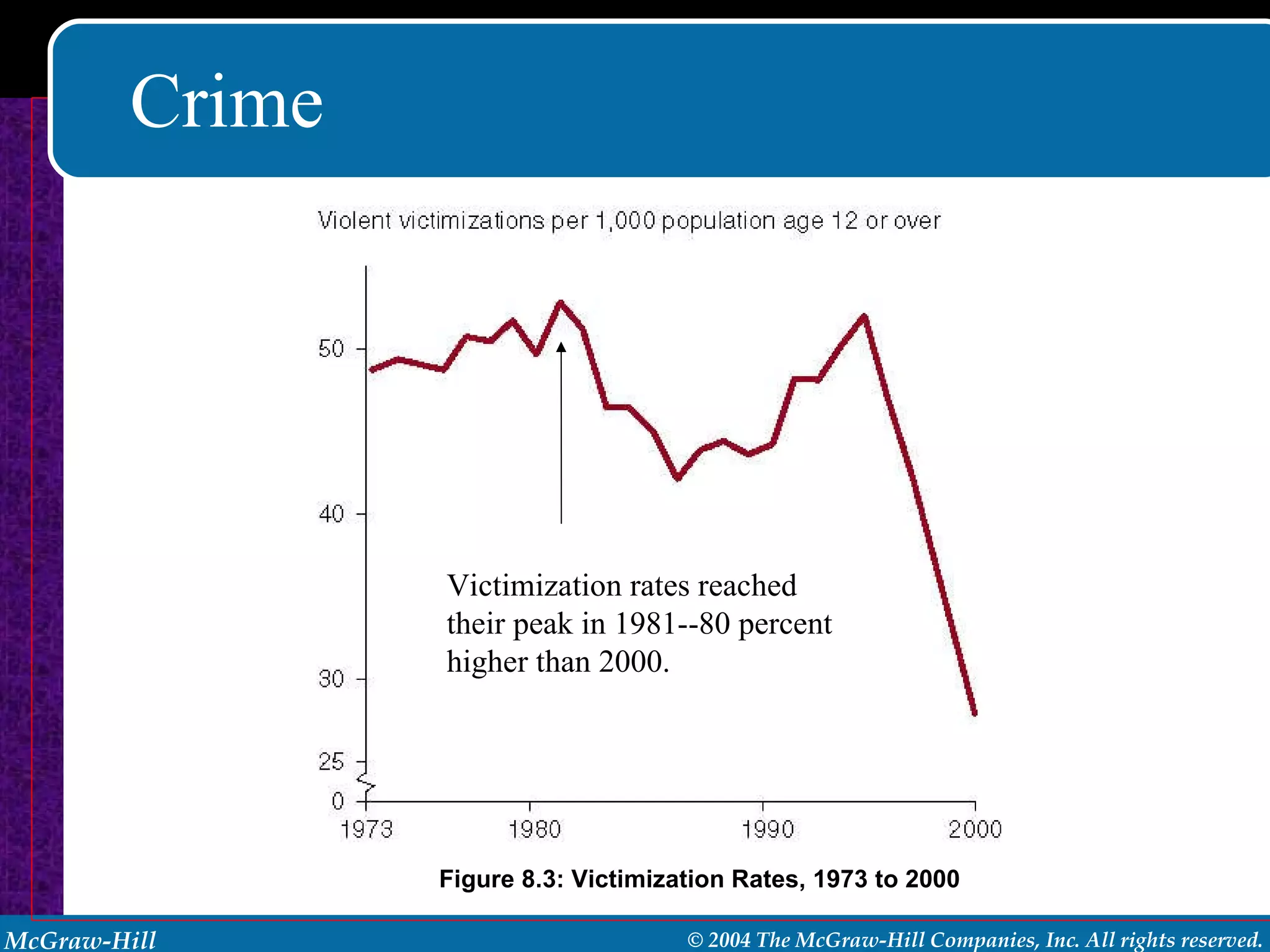
Crime Figure 8.3: Victimization Rates, 1973 to 2000 Victimization rates reached their peak in 1981--80 percent higher than 2000.
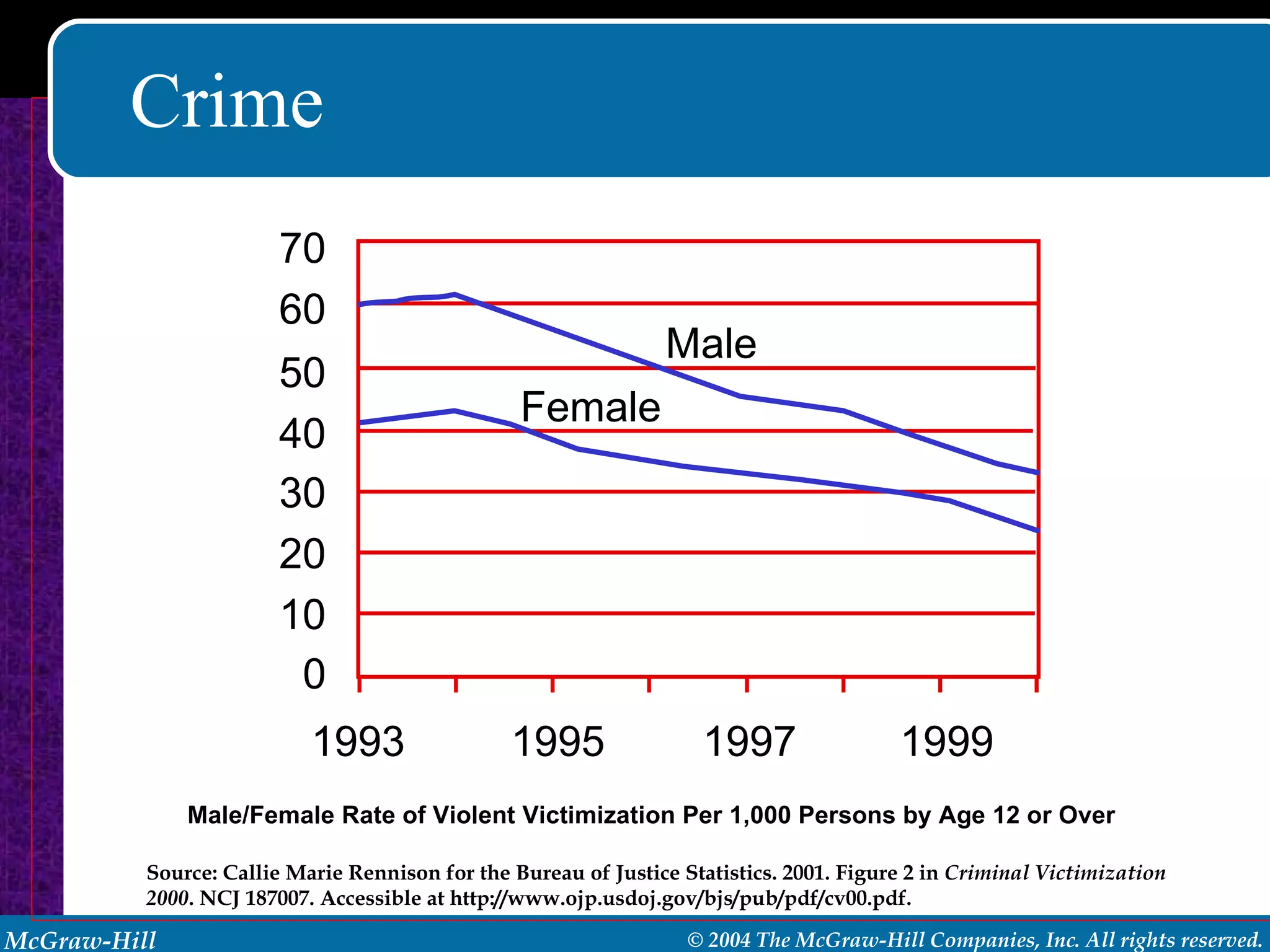
Crime Male/Female Rate of Violent Victimization Per 1,000 Persons by Age 12 or Over  Source: Callie Marie Rennison for the Bureau of Justice Statistics. 2001. Figure 2 in  Criminal Victimization 2000 . NCJ 187007. Accessible at http://www.ojp.usdoj.gov/bjs/pub/pdf/cv00.pdf. 1993 1995 1997 1999 0 10 20 30 40 50 60 70 Female Male
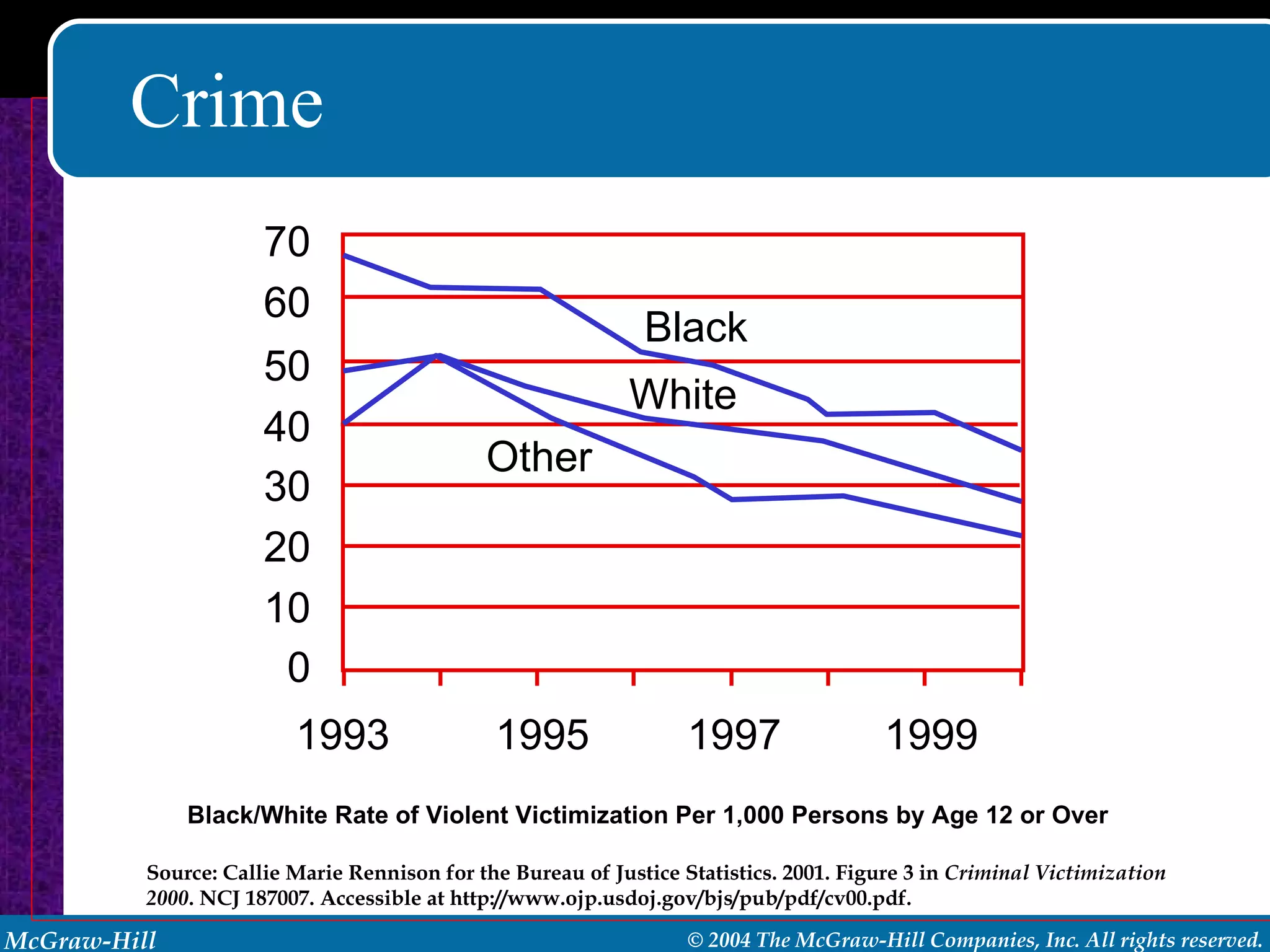
Crime Black/White Rate of Violent Victimization Per 1,000 Persons by Age 12 or Over  Source: Callie Marie Rennison for the Bureau of Justice Statistics. 2001. Figure 3 in  Criminal Victimization 2000 . NCJ 187007. Accessible at http://www.ojp.usdoj.gov/bjs/pub/pdf/cv00.pdf. 1993 1995 1997 1999 0 10 20 30 40 50 60 70 White Black Other
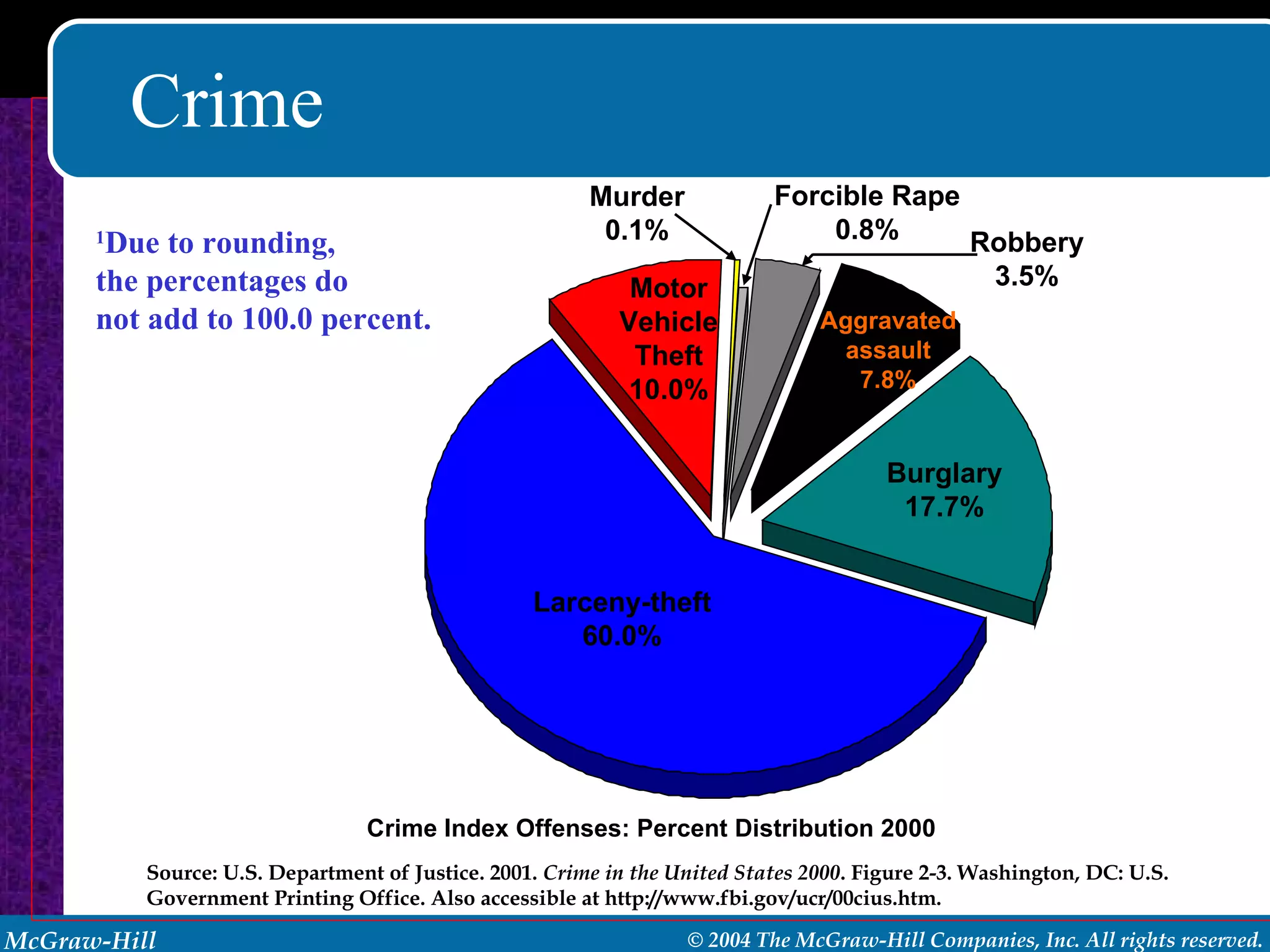
Crime Crime Index Offenses: Percent Distribution 2000 Source: U.S. Department of Justice. 2001.  Crime in the United States 2000 . Figure 2-3. Washington, DC: U.S. Government Printing Office. Also accessible at http://www.fbi.gov/ucr/00cius.htm. 1 Due to rounding, the percentages do not add to 100.0 percent. Larceny-theft 60.0% Burglary 17.7% Motor Vehicle Theft 10.0% Aggravated assault 7.8% Robbery 3.5% Forcible Rape 0.8% Murder 0.1%
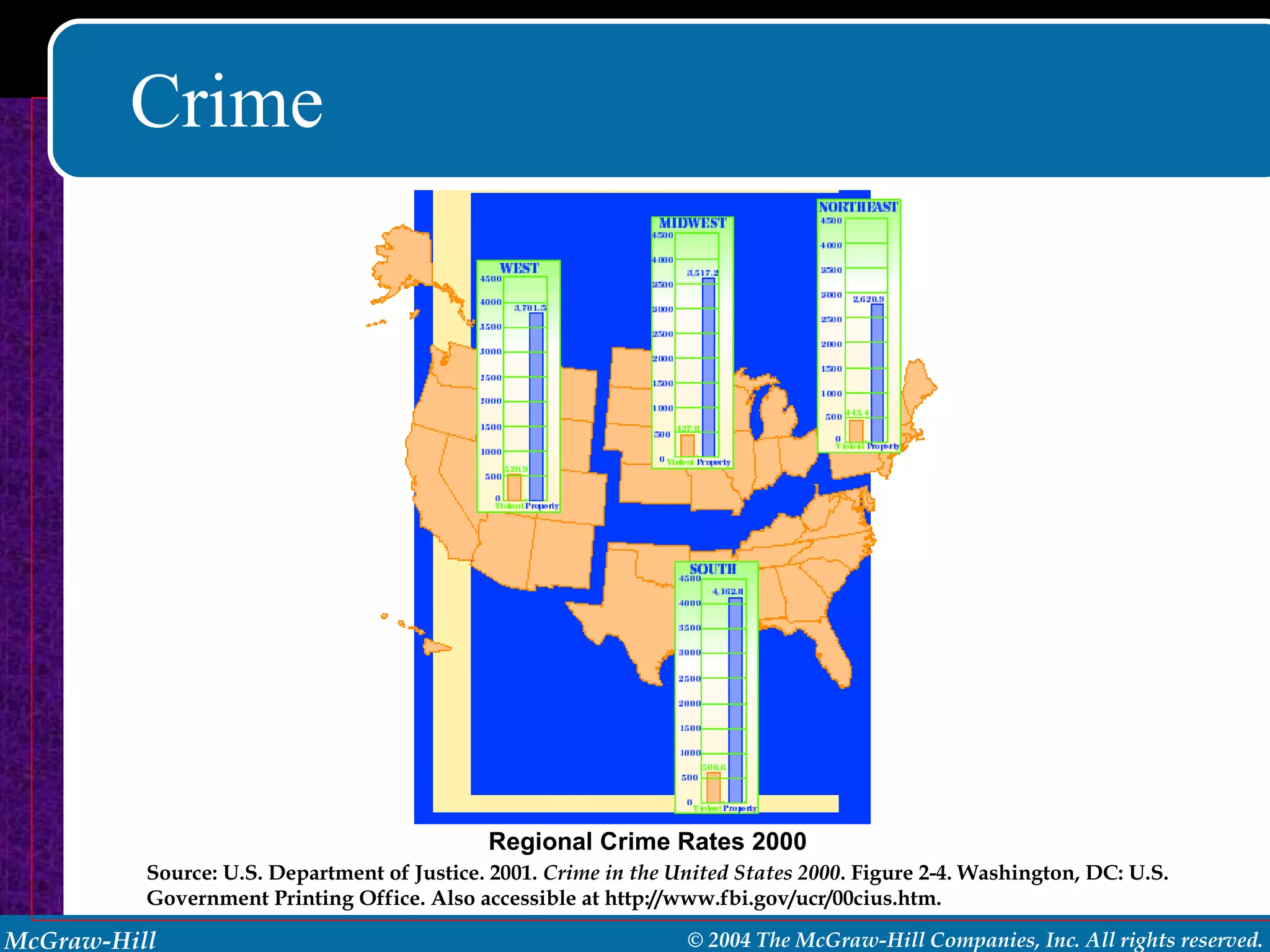
Crime Regional Crime Rates 2000  Source: U.S. Department of Justice. 2001.  Crime in the United States 2000 . Figure 2-4. Washington, DC: U.S. Government Printing Office. Also accessible at http://www.fbi.gov/ucr/00cius.htm.
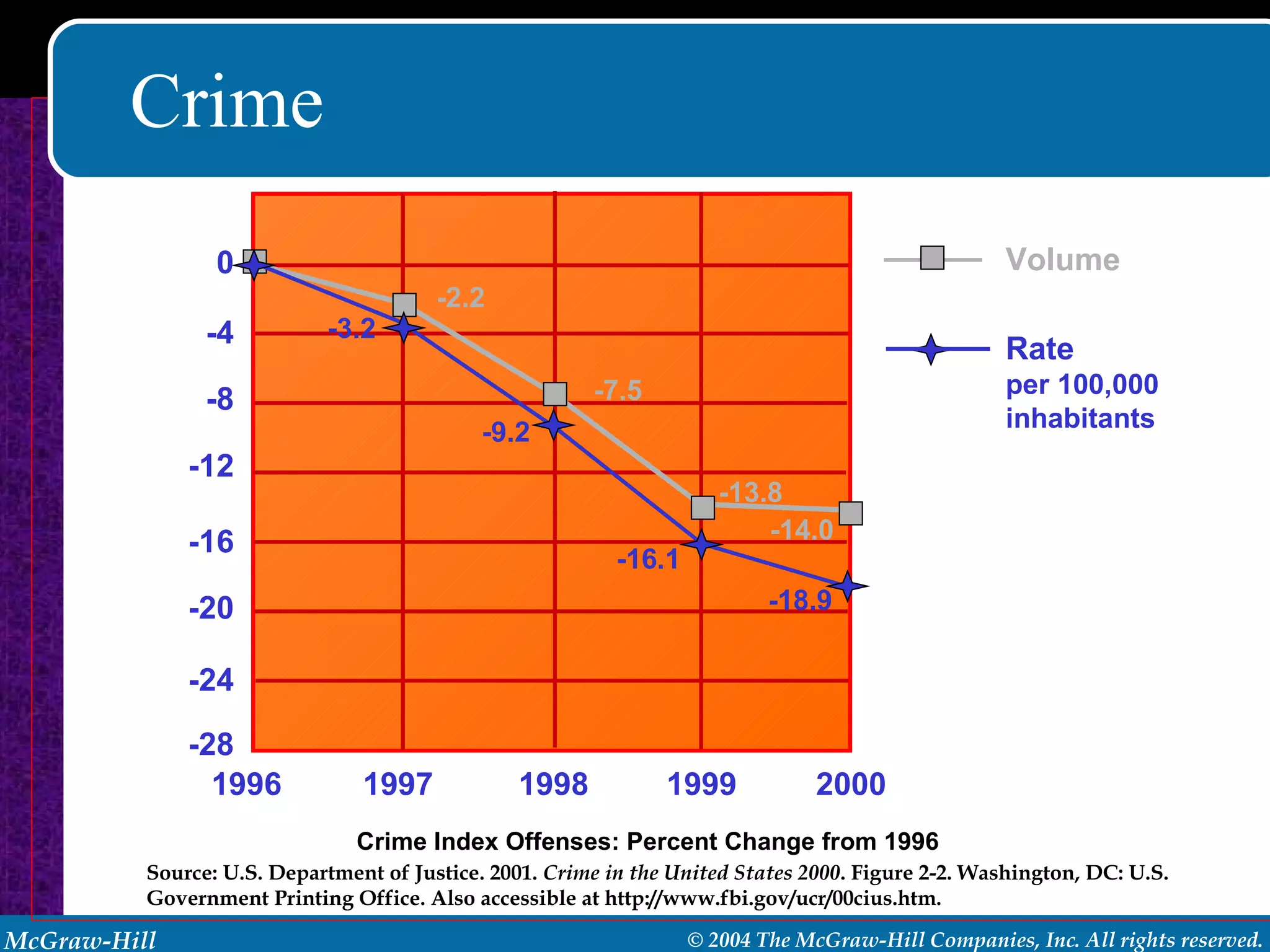
Crime Crime Index Offenses: Percent Change from 1996  Source: U.S. Department of Justice. 2001.  Crime in the United States 2000 . Figure 2-2. Washington, DC: U.S. Government Printing Office. Also accessible at http://www.fbi.gov/ucr/00cius.htm. 1996 1997 1998 1999 2000 -28 -24 -20 -16 -12 -8 -4 0 -3.2 -9.2 -16.1 -18.9 -14.0 -13.8 -7.5 -2.2 Volume Rate per 100,000 inhabitants
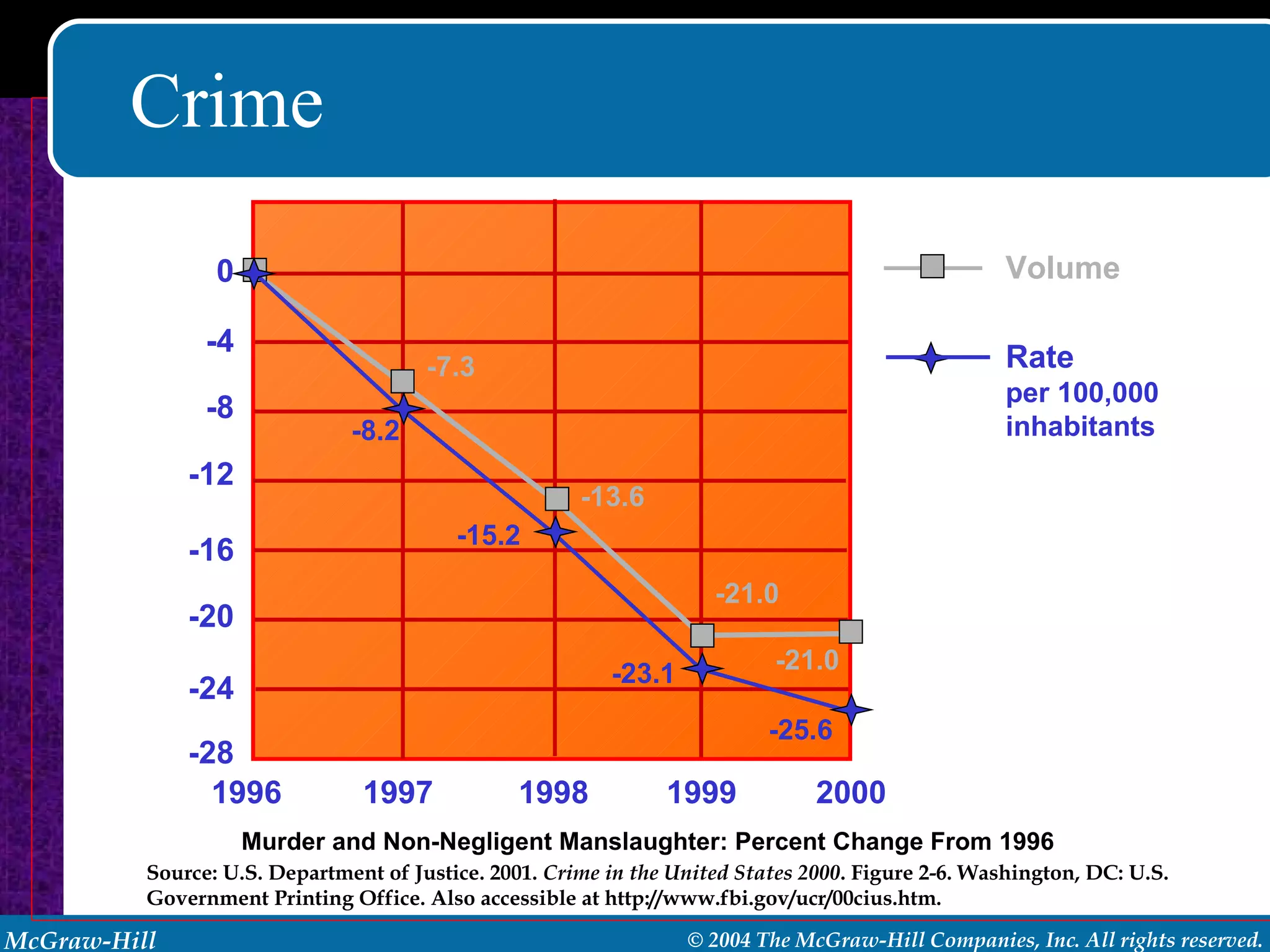
Crime Murder and Non-Negligent Manslaughter: Percent Change From 1996  Source: U.S. Department of Justice. 2001.  Crime in the United States 2000 . Figure 2-6. Washington, DC: U.S. Government Printing Office. Also accessible at http://www.fbi.gov/ucr/00cius.htm. 1996 1997 1998 1999 2000 -28 -24 -20 -16 -12 -8 -4 0 -8.2 -15.2 -23.1 -25.6 -21.0 -13.6 -7.3 Volume Rate per 100,000 inhabitants -21.0
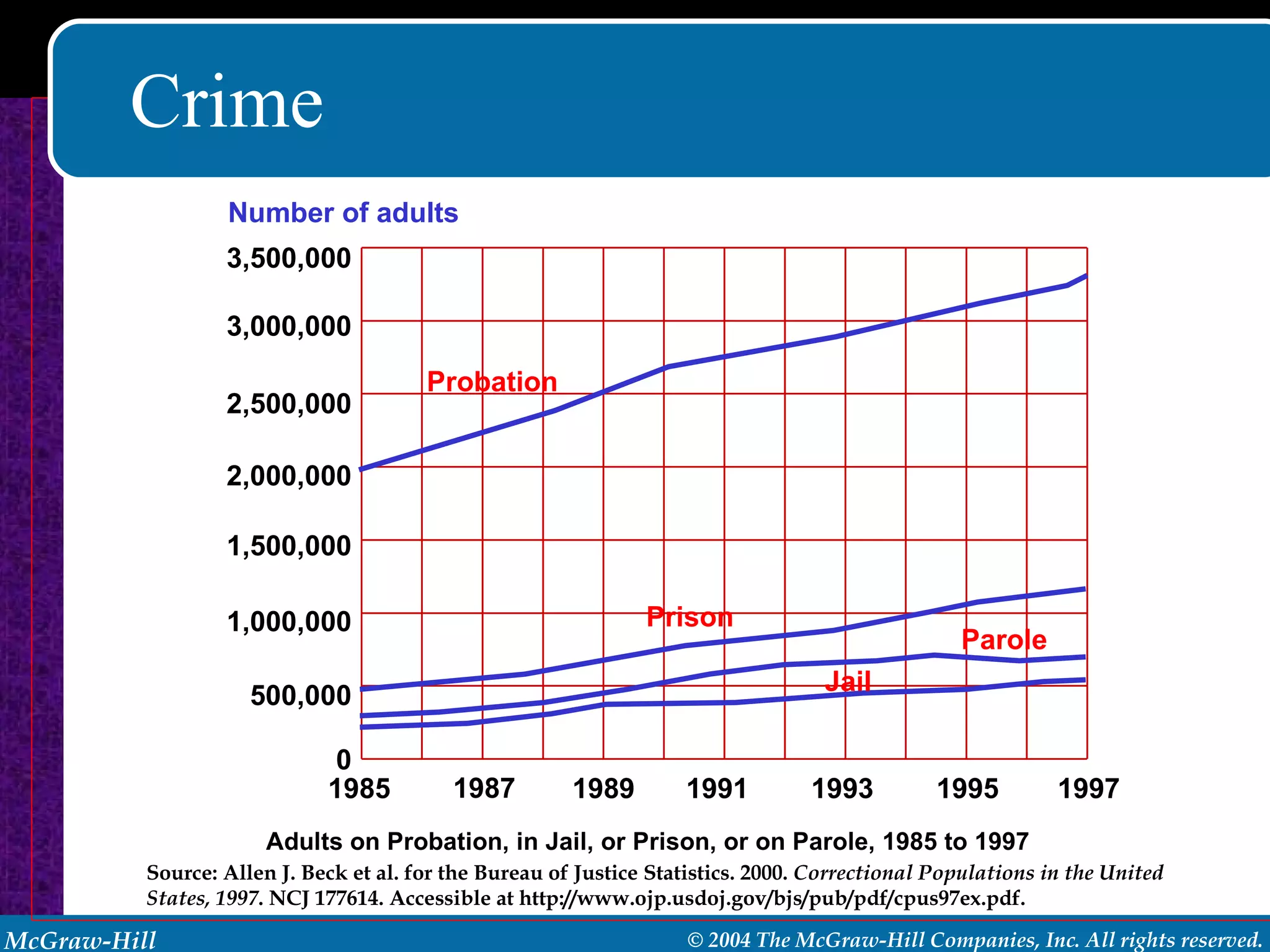
Crime Adults on Probation, in Jail, or Prison, or on Parole, 1985 to 1997  Source: Allen J. Beck et al. for the Bureau of Justice Statistics. 2000.  Correctional Populations in the United States, 1997 . NCJ 177614. Accessible at http://www.ojp.usdoj.gov/bjs/pub/pdf/cpus97ex.pdf. 1987 Number of adults 3,500,000 3,000,000 2,500,000 2,000,000 1,500,000 1,000,000 500,000 0 1985 1989 1991 1993 1995 1997 Probation Prison Parole Jail
Social Policy and Socialization The Death Penalty in the United States and Worldwide The Issue -- Historically, execution has served as a significant form of punishment for deviance. --Capital punishment was once assumed to be morally and religiously justified. --People in the United States and other countries that have the death penalty criticize capital punishment, especially when it might apply to young people convicted of murders.
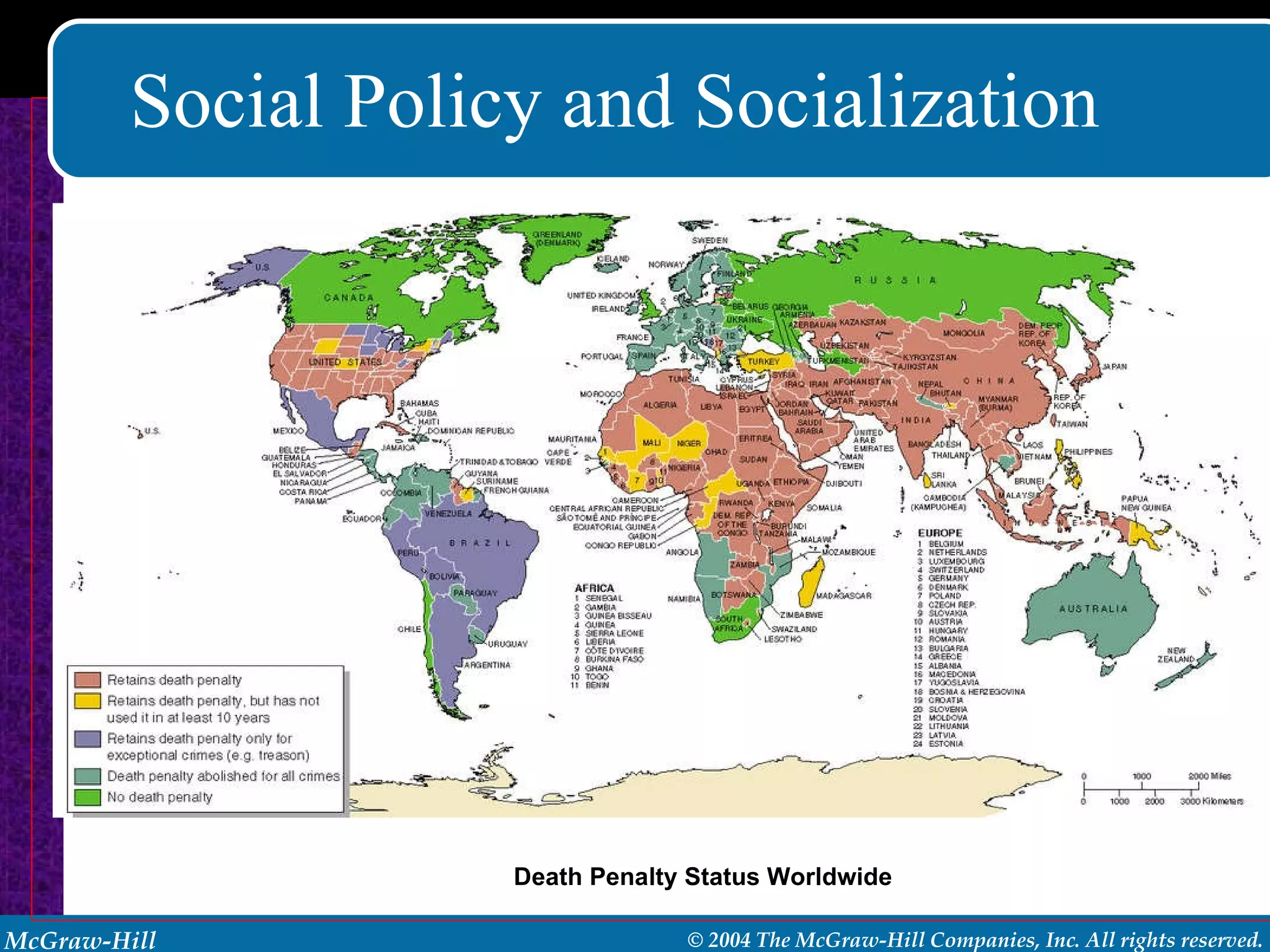
Social Policy and Socialization The Death Penalty in the United States and Worldwide The Setting -- Death penalties are not unusual anywhere in the world. --In the decade of the 1990s, more than 30 nations abolished the death penalty.  --Only three nations have introduced the death penalty since 1985. --It the United States, the Supreme Court ruled that capital punishment  was  constitutional.
Social Policy and Socialization Death Penalty Status Worldwide
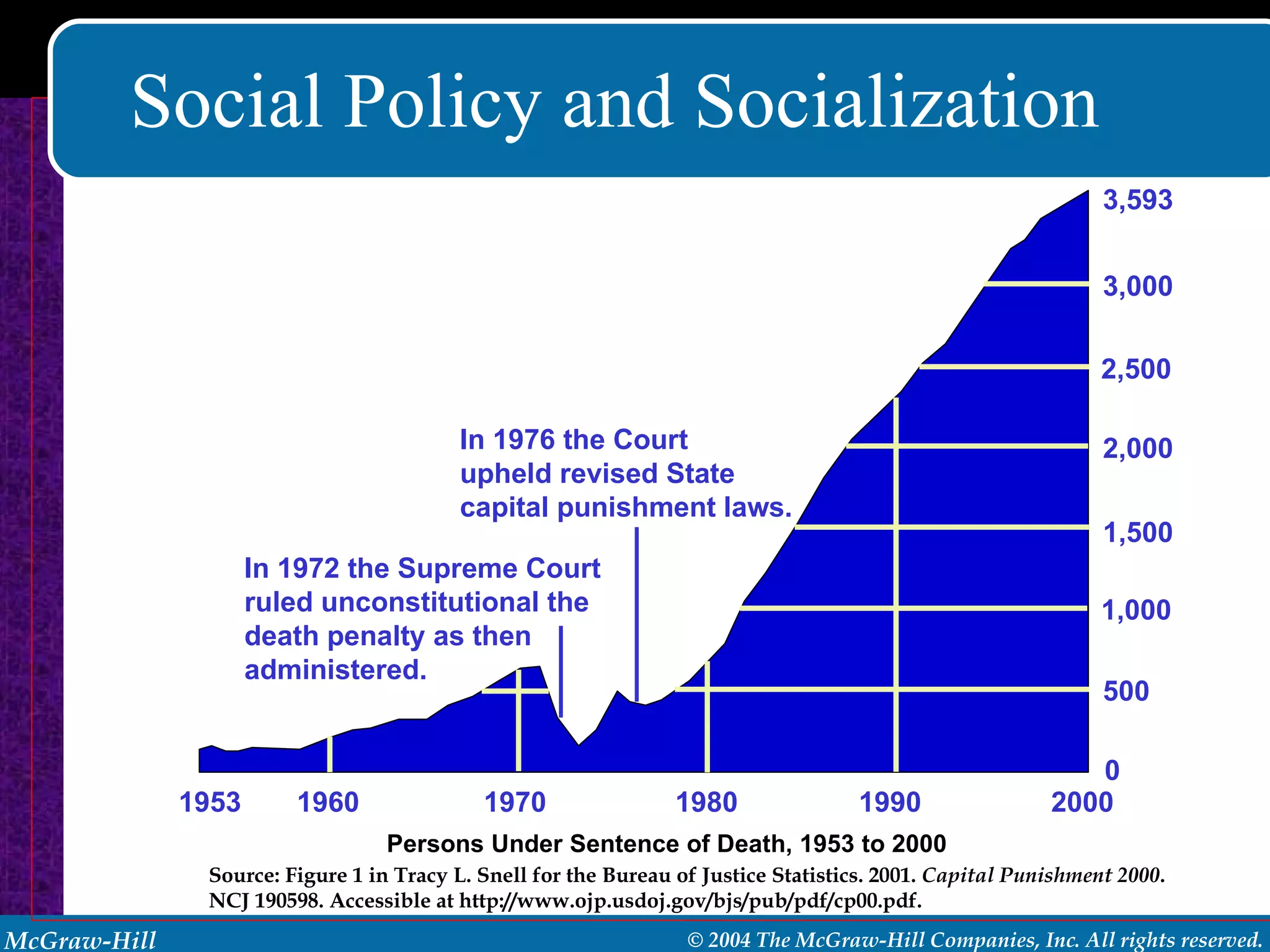
Social Policy and Socialization Persons Under Sentence of Death, 1953 to 2000 Source: Figure 1 in Tracy L. Snell for the Bureau of Justice Statistics. 2001.  Capital Punishment 2000 . NCJ 190598. Accessible at http://www.ojp.usdoj.gov/bjs/pub/pdf/cp00.pdf. 1953 1960 1970 1980 1990 2000 0 500 1,000 1,500 2,000 2,500 3,000 3,593 In 1976 the Court upheld revised State capital punishment laws. In 1972 the Supreme Court ruled unconstitutional the death penalty as then administered.
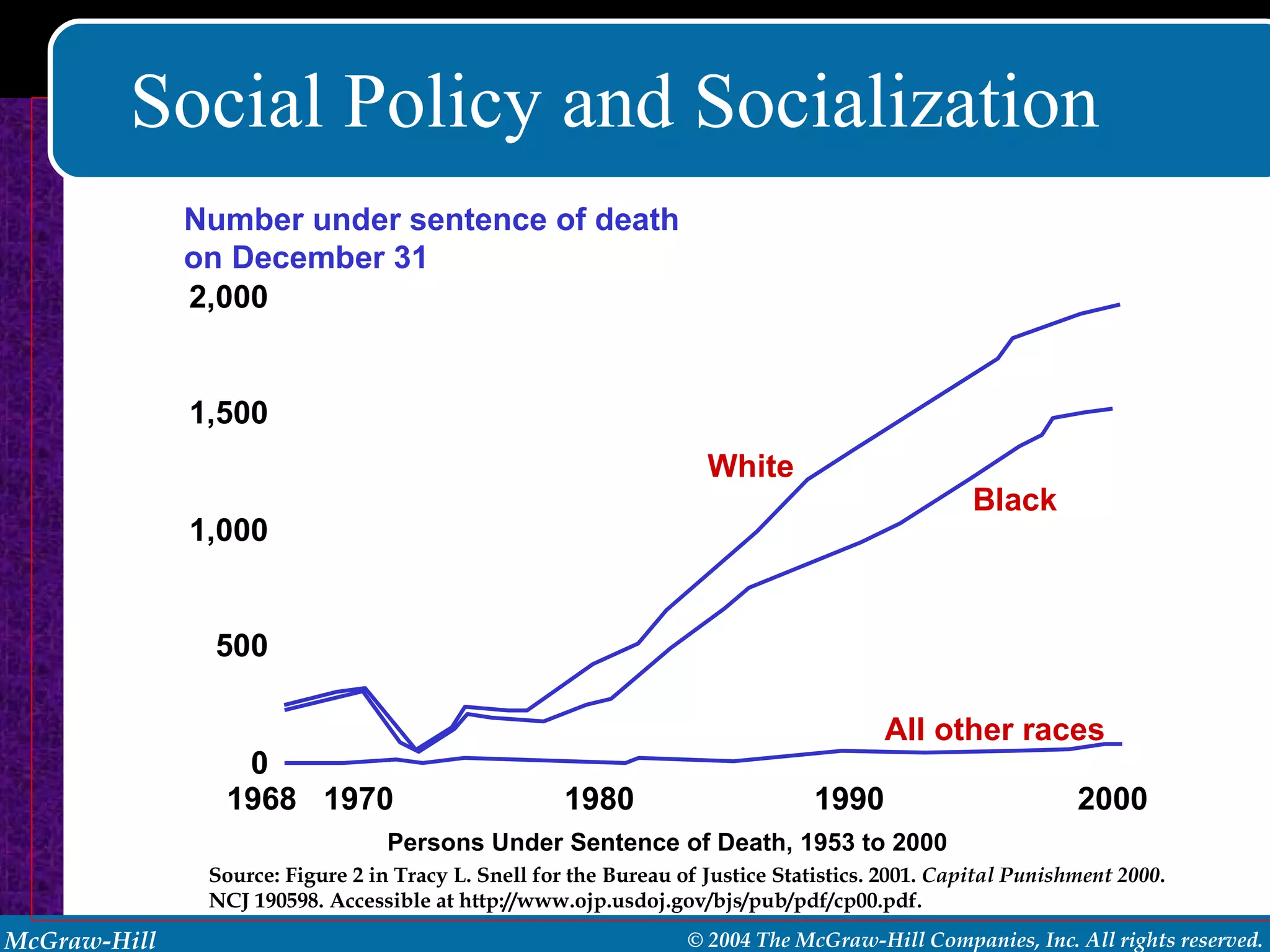
Social Policy and Socialization Source: Figure 2 in Tracy L. Snell for the Bureau of Justice Statistics. 2001.  Capital Punishment 2000 . NCJ 190598. Accessible at http://www.ojp.usdoj.gov/bjs/pub/pdf/cp00.pdf. Persons Under Sentence of Death, 1953 to 2000 1968 1970 1980 1990 2000 0 500 1,000 1,500 2,000 Number under sentence of death on December 31 White Black All other races
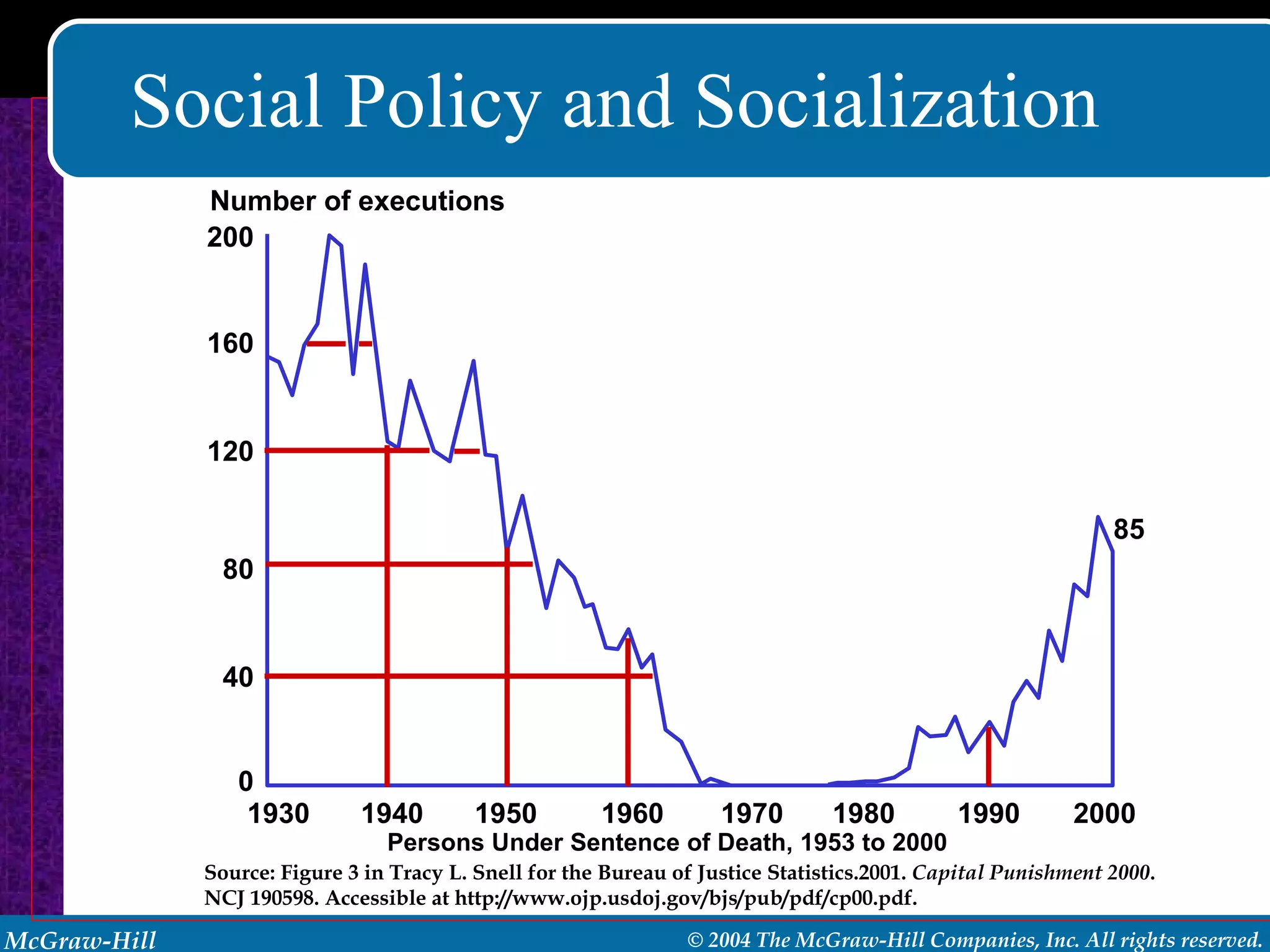
Social Policy and Socialization Source: Figure 3 in Tracy L. Snell for the Bureau of Justice Statistics.2001.  Capital Punishment 2000 . NCJ 190598. Accessible at http://www.ojp.usdoj.gov/bjs/pub/pdf/cp00.pdf. Persons Under Sentence of Death, 1953 to 2000 1930 1940 1950 1960 1970 1980 1990 2000 85 0 40 80 120 160 200 Number of executions
Social Policy and Socialization The Death Penalty in the United States and Worldwide Sociological Insights -- Functionalists hold that the death penalty will prevent at least some criminals from committing serious offenses.  --Even if the death penalty is not a deterrent, such criminals deserve to die for their crimes. --The alternative to capital punishment—life in prison—is a dysfunction because it is unnecessarily expensive.
Social Policy and Socialization The Death Penalty in the United States and Worldwide Sociological Insights -- Conflict theorists emphasize the persistence of social inequality in society today. --Poor people cannot afford the best lawyers and this unequal treatment may mean the difference between life and death. --Race discrimination may also be a factor because defendants are more likely to be sentenced to death if their victims were White rather than Black.
Social Policy and Socialization The Death Penalty in the United States and Worldwide Policy Initiatives -- How can the death sentence be handed out in a judicially fair manner? --Federal and state lawmakers continue to make more crimes punishable by death. --There is increasing international pressure on the United States to abolish the death penalty. --Capital punishment remains popular with both the general public and lawmakers in the United States.

Chapter08

  • 1.
  • 2.
    8 DEVIANCE ANDSOCIAL CONTROL
  • 3.
    Chapter Outline SocialControl Deviance Crime Social Policy and Social Control: The Death Penalty in the United States and Worldwide
  • 4.
    Social Control SocialControl refers to the techniques and strategies for preventing deviant human behavior in any society. Sanctions are penalties and rewards for conduct concerning a social norm.
  • 5.
    Social Control Conformityand Obedience Conformity is defined as going along with peers who have no special right to direct our behavior. Obedience is defined as compliance with higher authorities in an hierarchical structure.
  • 6.
    Social Control Conformityand Obedience Conformity to Prejudice --Research demonstrates that people may conform to attitudes and behavior of peers even when it means expressing intolerance towards others.
  • 7.
    Social Control Informaland Formal Social Control Informal Social Control --Informal social control is used casually to enforce norms. --Informal social control includes: smiles laughter ridicule raising an eyebrow
  • 8.
    Social Control Lawand Society Some norms are so important to a society that they are formalized into laws controlling people’s behaviors. Laws are governmental social control and are created in response to perceived social needs for formal social control.
  • 9.
    Social Control Lawand Society Control Theory --Our bonds to members of society lead us to conform to society’s norms. --We are bonded through: family friends peers
  • 10.
    Deviance What isDeviance? Deviance --Deviance is behavior that violates the standards of conduct or expectations of a group or society. --Examples of deviants: alcoholics gamblers mentally ill
  • 11.
    Deviance What isDeviance? Sociologically, we are all deviant from time to time. Each of us violates common social norms in certain situations. Deviance involves the violation of group norms which may or may not be formalized into law.
  • 12.
    Deviance What isDeviance? Standards of deviance vary from one group (subculture) to another. Deviance varies over time. Deviance is subjective, subject to social definitions.
  • 13.
    Deviance Figure 8.1:College Binge Drinking
  • 14.
    Deviance What isDeviance? Deviance and Social Stigma --The term stigma describes the labels society uses to devalue members of certain social groups. --Once members are assigned deviant roles, they have trouble presenting positive images to others.
  • 15.
    Deviance What isDeviance? Deviance and Technology --Technological innovations can redefine social interactions and standards of behavior related to them. These innovations include: pagers voice mail internet cell phones
  • 16.
    Deviance Figure 8.2:A New Form of Deviance: Digital Piracy
  • 17.
    Deviance Explaining DevianceFunctionalist Perspective --Deviance is a part of human existence and has positive and negative consequences for society. --Durkheim introduced the term anomie, defined as a state of normlessness that occurs during periods of profound social change.
  • 18.
    Deviance Explaining DevianceFunctionalist Perspective (continued) --Merton examined how people adapted to the acceptance or rejection of a society’s goals. Merton’s Anomie Theory of Deviance examines how people conform to or deviate from cultural expectations.
  • 19.
    Deviance Table 8.2:Modes of Individual Adaptation
  • 20.
    Deviance Explaining DevianceInteractionist Perspective --Focuses on everyday behavior and why or how a person comes to commit a deviant act. The cultural transmission theory holds that one learns criminal behavior through interactions with others. --The routine activities theory holds that criminal victimization is increased when motivated offenders and suitable targets converge.
  • 21.
    Deviance Explaining DevianceInteractionist Perspective (continued) -- Labeling theory attempts to explain why certain people are viewed as deviants while others are not and emphasizes how a person comes to be labeled as deviant and to accept this label.
  • 22.
    Deviance Explaining DevianceInteractionist Perspective (continued) -- Conflict theory holds that people with power protect their own interests and define deviance to suit their own needs. --Conflict theory contends the criminal justice system of the U.S. treats people differently on the basis of their racial, ethnic, or social class background.
  • 23.
    Deviance Explaining DevianceFeminist Perspective -- Feminist perspective contends that when it comes to crime and to deviance in general, society tends to treat women in stereotypical fashion. --Feminist perspective emphasizes that deviance, including crime, tends to flow from economic relationships.
  • 24.
    Crime Crime is defined as a violation of criminal law for which some governmental authority applies formal penalties.
  • 25.
    Crime Types ofCrime Professional Crime: Crime pursued as a person’s day-to-day occupation. Organized Crime: The work of a group that regulates relations between various criminal enterprises.
  • 26.
    Crime Types ofCrime White Collar and Technology-Based Crime : Illegal acts committed in the course of business activities, often by affluent people. Victimless Crimes : The willing exchange among adults of widely desired, but illegal, goods and services.
  • 27.
    Crime Crime StatisticsCrime statistics are not as accurate as social scientists would like. Reported crime is very high in the United States and is regarded as a major social problem. Violent crimes have declined significantly nationwide following many years of increases.
  • 28.
    Crime Crime Clock Source: U.S. Department of Justice. 2001. Crime in the United States 2000 . Figure 2-1. Washington, DC: U.S. Government Printing Office. Also accessible at http://www.fbi.gov/ucr/00cius.htm. One Murder every 33.9 minutes One Violent Crime every 22.1 seconds One Robbery every 1.3 minutes One Forcible Rape every 5.8 minutes One Aggravated Assault every 34.6 seconds One Aggravated Assault every 34.6 seconds One Crime Index Offense every 2.7 seconds One Burglary every 15.4 seconds One Motor Vehicle Theft every 27.1 seconds One Property Crime every 3.1 seconds One Larceny-theft every 4.5 seconds The Crime Clock should be viewed with care. The most aggregate representation of UCR data, it conveys the annual reported crime experience by showing a relative frequency of occurrence of Index offenses. It should not be taken to imply a regularity in the commission of crime. The Crime Clock represents the annual ration of crime to fixed time intervals.
  • 29.
  • 30.
    Crime Figure 8.3:Victimization Rates, 1973 to 2000 Victimization rates reached their peak in 1981--80 percent higher than 2000.
  • 31.
    Crime Male/Female Rateof Violent Victimization Per 1,000 Persons by Age 12 or Over Source: Callie Marie Rennison for the Bureau of Justice Statistics. 2001. Figure 2 in Criminal Victimization 2000 . NCJ 187007. Accessible at http://www.ojp.usdoj.gov/bjs/pub/pdf/cv00.pdf. 1993 1995 1997 1999 0 10 20 30 40 50 60 70 Female Male
  • 32.
    Crime Black/White Rateof Violent Victimization Per 1,000 Persons by Age 12 or Over Source: Callie Marie Rennison for the Bureau of Justice Statistics. 2001. Figure 3 in Criminal Victimization 2000 . NCJ 187007. Accessible at http://www.ojp.usdoj.gov/bjs/pub/pdf/cv00.pdf. 1993 1995 1997 1999 0 10 20 30 40 50 60 70 White Black Other
  • 33.
    Crime Crime IndexOffenses: Percent Distribution 2000 Source: U.S. Department of Justice. 2001. Crime in the United States 2000 . Figure 2-3. Washington, DC: U.S. Government Printing Office. Also accessible at http://www.fbi.gov/ucr/00cius.htm. 1 Due to rounding, the percentages do not add to 100.0 percent. Larceny-theft 60.0% Burglary 17.7% Motor Vehicle Theft 10.0% Aggravated assault 7.8% Robbery 3.5% Forcible Rape 0.8% Murder 0.1%
  • 34.
    Crime Regional CrimeRates 2000 Source: U.S. Department of Justice. 2001. Crime in the United States 2000 . Figure 2-4. Washington, DC: U.S. Government Printing Office. Also accessible at http://www.fbi.gov/ucr/00cius.htm.
  • 35.
    Crime Crime IndexOffenses: Percent Change from 1996 Source: U.S. Department of Justice. 2001. Crime in the United States 2000 . Figure 2-2. Washington, DC: U.S. Government Printing Office. Also accessible at http://www.fbi.gov/ucr/00cius.htm. 1996 1997 1998 1999 2000 -28 -24 -20 -16 -12 -8 -4 0 -3.2 -9.2 -16.1 -18.9 -14.0 -13.8 -7.5 -2.2 Volume Rate per 100,000 inhabitants
  • 36.
    Crime Murder andNon-Negligent Manslaughter: Percent Change From 1996 Source: U.S. Department of Justice. 2001. Crime in the United States 2000 . Figure 2-6. Washington, DC: U.S. Government Printing Office. Also accessible at http://www.fbi.gov/ucr/00cius.htm. 1996 1997 1998 1999 2000 -28 -24 -20 -16 -12 -8 -4 0 -8.2 -15.2 -23.1 -25.6 -21.0 -13.6 -7.3 Volume Rate per 100,000 inhabitants -21.0
  • 37.
    Crime Adults onProbation, in Jail, or Prison, or on Parole, 1985 to 1997 Source: Allen J. Beck et al. for the Bureau of Justice Statistics. 2000. Correctional Populations in the United States, 1997 . NCJ 177614. Accessible at http://www.ojp.usdoj.gov/bjs/pub/pdf/cpus97ex.pdf. 1987 Number of adults 3,500,000 3,000,000 2,500,000 2,000,000 1,500,000 1,000,000 500,000 0 1985 1989 1991 1993 1995 1997 Probation Prison Parole Jail
  • 38.
    Social Policy andSocialization The Death Penalty in the United States and Worldwide The Issue -- Historically, execution has served as a significant form of punishment for deviance. --Capital punishment was once assumed to be morally and religiously justified. --People in the United States and other countries that have the death penalty criticize capital punishment, especially when it might apply to young people convicted of murders.
  • 39.
    Social Policy andSocialization The Death Penalty in the United States and Worldwide The Setting -- Death penalties are not unusual anywhere in the world. --In the decade of the 1990s, more than 30 nations abolished the death penalty. --Only three nations have introduced the death penalty since 1985. --It the United States, the Supreme Court ruled that capital punishment was constitutional.
  • 40.
    Social Policy andSocialization Death Penalty Status Worldwide
  • 41.
    Social Policy andSocialization Persons Under Sentence of Death, 1953 to 2000 Source: Figure 1 in Tracy L. Snell for the Bureau of Justice Statistics. 2001. Capital Punishment 2000 . NCJ 190598. Accessible at http://www.ojp.usdoj.gov/bjs/pub/pdf/cp00.pdf. 1953 1960 1970 1980 1990 2000 0 500 1,000 1,500 2,000 2,500 3,000 3,593 In 1976 the Court upheld revised State capital punishment laws. In 1972 the Supreme Court ruled unconstitutional the death penalty as then administered.
  • 42.
    Social Policy andSocialization Source: Figure 2 in Tracy L. Snell for the Bureau of Justice Statistics. 2001. Capital Punishment 2000 . NCJ 190598. Accessible at http://www.ojp.usdoj.gov/bjs/pub/pdf/cp00.pdf. Persons Under Sentence of Death, 1953 to 2000 1968 1970 1980 1990 2000 0 500 1,000 1,500 2,000 Number under sentence of death on December 31 White Black All other races
  • 43.
    Social Policy andSocialization Source: Figure 3 in Tracy L. Snell for the Bureau of Justice Statistics.2001. Capital Punishment 2000 . NCJ 190598. Accessible at http://www.ojp.usdoj.gov/bjs/pub/pdf/cp00.pdf. Persons Under Sentence of Death, 1953 to 2000 1930 1940 1950 1960 1970 1980 1990 2000 85 0 40 80 120 160 200 Number of executions
  • 44.
    Social Policy andSocialization The Death Penalty in the United States and Worldwide Sociological Insights -- Functionalists hold that the death penalty will prevent at least some criminals from committing serious offenses. --Even if the death penalty is not a deterrent, such criminals deserve to die for their crimes. --The alternative to capital punishment—life in prison—is a dysfunction because it is unnecessarily expensive.
  • 45.
    Social Policy andSocialization The Death Penalty in the United States and Worldwide Sociological Insights -- Conflict theorists emphasize the persistence of social inequality in society today. --Poor people cannot afford the best lawyers and this unequal treatment may mean the difference between life and death. --Race discrimination may also be a factor because defendants are more likely to be sentenced to death if their victims were White rather than Black.
  • 46.
    Social Policy andSocialization The Death Penalty in the United States and Worldwide Policy Initiatives -- How can the death sentence be handed out in a judicially fair manner? --Federal and state lawmakers continue to make more crimes punishable by death. --There is increasing international pressure on the United States to abolish the death penalty. --Capital punishment remains popular with both the general public and lawmakers in the United States.