




Perspectives on 
Consumer Behavior 
© 2003 McGraw-Hill Companies, Inc., McGraw-Hill/Irwin
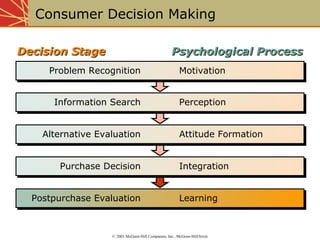
Consumer Decision Making 
DDeecciissiioonn SSttaaggee PPssyycchhoollooggiiccaall PPrroocceessss 
Problem Recognition Motivation 
Information Search Perception 
Alternative Evaluation Attitude Formation 
Purchase Decision Integration 
Postpurchase Evaluation Learning 
© 2003 McGraw-Hill Companies, Inc., McGraw-Hill/Irwin
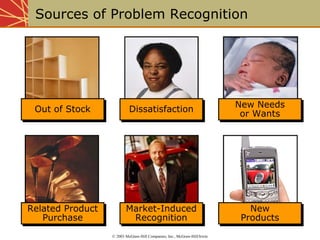
Sources of Problem Recognition 
OOuutt ooff SSttoocckk 
New Needs 
or Wants 
DDiissssaattiissffaaccttiioonn New Needs 
Market-Induced 
Recognition 
© 2003 McGraw-Hill Companies, Inc., McGraw-Hill/Irwin 
or Wants 
Related Product 
Related Product 
Purchase 
Purchase 
Market-Induced 
Recognition 
New 
Products 
New 
Products
Ads Help Consumers Recognize Problems 
*Click outside of the video screen to advance to the next slide 
© 2003 McGraw-Hill Companies, Inc., McGraw-Hill/Irwin
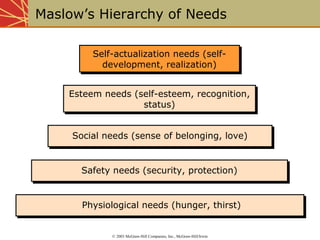
Maslow’s Hierarchy of Needs 
Self-actualization needs (self-development, 
realization) 
realization) 
Esteem needs (self-esteem, recognition, 
status) 
status) 
SSoocciiaall nneeeeddss ((sseennssee ooff bbeelloonnggiinngg,, lloovvee)) 
Safety Safety nneeeeddss ((sseeccuurriittyy,, pprrootteeccttiioonn)) 
PPhhyyssiioollooggiiccaall nneeeeddss ((hhuunnggeerr,, tthhiirrsstt)) 
© 2003 McGraw-Hill Companies, Inc., McGraw-Hill/Irwin 
SSaaffeettyy
Nurturance, Love and Belonging 
© 2003 McGraw-Hill Companies, Inc., McGraw-Hill/Irwin 
+
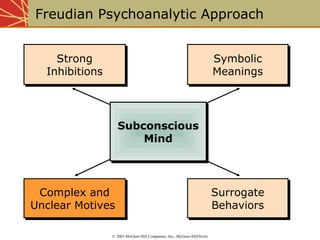
Freudian Psychoanalytic Approach 
Strong 
Inhibitions 
Strong 
Inhibitions 
Symbolic 
Meanings 
Symbolic 
Meanings 
Surrogate 
Behaviors 
Surrogate 
Behaviors 
Complex and 
Unclear Motives 
Complex and 
Unclear Motives 
Subconscious 
Subconscious 
Mind 
Mind 
© 2003 McGraw-Hill Companies, Inc., McGraw-Hill/Irwin
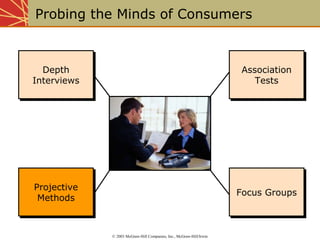
Probing the Minds of Consumers 
Depth 
Interviews 
Depth 
Interviews 
Association 
Association 
Tests 
Tests 
Projective 
Methods 
Projective FFooccuuss GGrroouuppss 
Methods 
© 2003 McGraw-Hill Companies, Inc., McGraw-Hill/Irwin
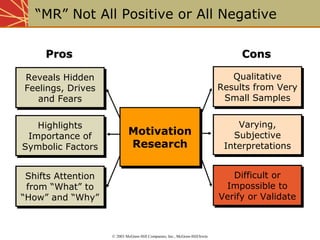
“MR” Not All Positive or All Negative 
PPrrooss CCoonnss 
Reveals Hidden 
Feelings, Drives 
Reveals Hidden 
Feelings, Drives 
and Fears 
and Fears 
Highlights 
Importance of 
Symbolic Factors 
Highlights 
Importance of 
Symbolic Factors 
Shifts Attention 
from “What” to 
“How” and “Why” 
Shifts Attention 
from “What” to 
“How” and “Why” 
Qualitative 
Qualitative 
Results from Very 
Small Samples 
Results from Very 
Small Samples 
Varying, 
Subjective 
Interpretations 
Varying, 
Subjective 
Interpretations 
Difficult or 
Impossible to 
Verify or Validate 
Difficult or 
Impossible to 
Verify or Validate 
Motivation 
Research 
Motivation 
Research 
© 2003 McGraw-Hill Companies, Inc., McGraw-Hill/Irwin
Sexy Ads May Motivate Consumers 
*Click outside of the video screen to advance to the next slide 
© 2003 McGraw-Hill Companies, Inc., McGraw-Hill/Irwin
Sexy Ads Get Noticed 
© 2003 McGraw-Hill Companies, Inc., McGraw-Hill/Irwin +
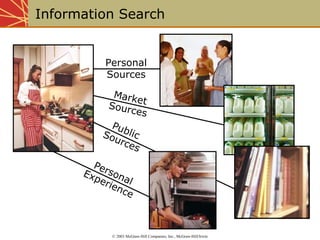
Information Search 
Personal 
Sources 
Market 
Sources 
Public 
Sources 
Personal 
Experience 
© 2003 McGraw-Hill Companies, Inc., McGraw-Hill/Irwin
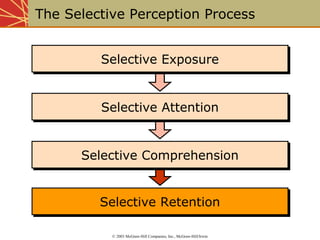
The Selective Perception Process 
SSeelleeccttiivvee EExxppoossuurree 
SSeelleeccttiivvee AAtttteennttiioonn 
SSeelleeccttiivvee CCoommpprreehheennssiioonn 
SSeelleeccttiivvee RReetteennttiioonn 
© 2003 McGraw-Hill Companies, Inc., McGraw-Hill/Irwin
Combining Color With Black-and-White 
Is Intended to Gain Attention 
© 2003 McGraw-Hill Companies, Inc., McGraw-Hill/Irwin +
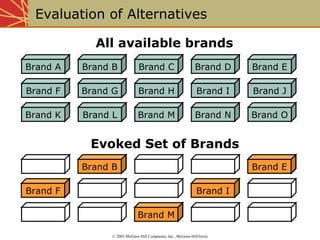
Evaluation of Alternatives 
All available brands 
Brand A Brand B Brand C Brand D Brand E 
Brand F Brand G Brand H Brand I Brand J 
Brand K Brand L Brand M Brand N Brand O 
Evoked Set of Brands 
Brand B Brand E 
Brand I 
Brand M 
© 2003 McGraw-Hill Companies, Inc., McGraw-Hill/Irwin 
Brand F
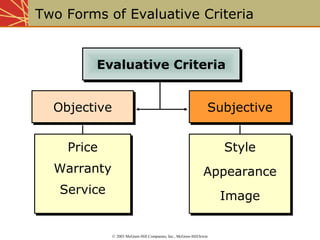
Two Forms of Evaluative Criteria 
EEvvaalluuaattiivvee CCrriitteerriiaa 
OOOObbbbjjjjeeeeccccttttiiiivvvveeee 
Price 
Warranty 
Service 
SSuubbjjeeccttiivvee 
© 2003 McGraw-Hill Companies, Inc., McGraw-Hill/Irwin 
Style 
Appearance 
Image
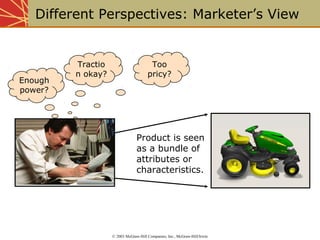
Different Perspectives: Marketer’s View 
© 2003 McGraw-Hill Companies, Inc., McGraw-Hill/Irwin 
Enough 
power? 
Tractio 
n okay? 
Too 
pricy? 
Product is seen 
as a bundle of 
attributes or 
characteristics.
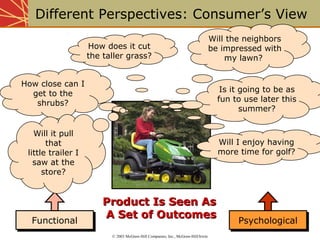
Different Perspectives: Consumer’s View 
How does it cut 
the taller grass? 
PPrroodduucctt IIss SSeeeenn AAss 
AA SSeett ooff OOuuttccoommeess 
FFFFuuuunnnnccccttttiiiioooonnnnaaaallll 
© 2003 McGraw-Hill Companies, Inc., McGraw-Hill/Irwin 
How close can I 
get to the 
shrubs? 
Will the neighbors 
be impressed with 
my lawn? 
Is it going to be as 
fun to use later this 
summer? 
Will I enjoy having 
more time for golf? 
Will it pull 
that 
little trailer I 
saw at the 
store? 
PPssyycchhoollooggiiccaall
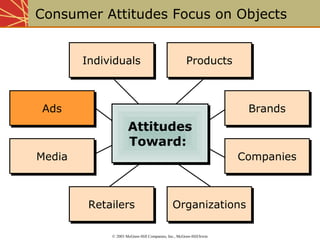
Consumer Attitudes Focus on Objects 
IInnddiivviidduuaallss PPrroodduuccttss 
BBrraannddss 
CCoommppaanniieess 
Attitudes 
Toward: 
RReettaaiilleerrss OOrrggaanniizzaattiioonnss 
AAddss 
MMMMeeeeddddiiiiaaaa 
© 2003 McGraw-Hill Companies, Inc., McGraw-Hill/Irwin
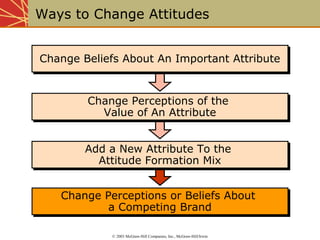
Ways to Change Attitudes 
Change Beliefs About Change Beliefs About AAnn IImmppoorrttaanntt AAttttrriibbuuttee 
CChhaannggee BBeelliieeffss AAbboouutt Change Perceptions of the 
Change Perceptions of the 
Value of An Attribute 
Add a New Attribute To the 
Attitude Formation Mix 
Change Perceptions or Beliefs About 
a Competing Brand 
a Competing Brand 
© 2003 McGraw-Hill Companies, Inc., McGraw-Hill/Irwin
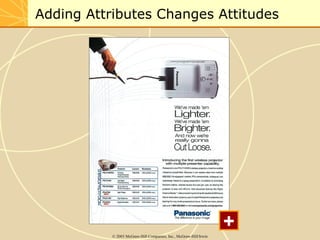
Adding Attributes Changes Attitudes 
© 2003 McGraw-Hill Companies, Inc., McGraw-Hill/Irwin 
+
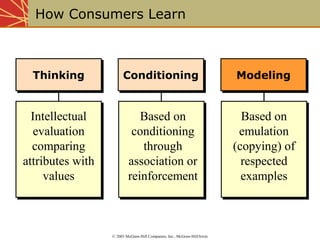
How Consumers Learn 
CCoonnddiittiioonniinngg 
Based on 
conditioning 
through 
association or 
reinforcement 
TThhiinnkkiinngg 
Intellectual 
evaluation 
comparing 
attributes with 
values 
© 2003 McGraw-Hill Companies, Inc., McGraw-Hill/Irwin 
MMooddeelliinngg 
Based on 
emulation 
(copying) of 
respected 
examples
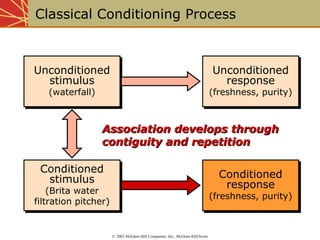
Classical Conditioning Process 
Unconditioned 
Unconditioned 
stimulus 
(waterfall) 
stimulus 
(waterfall) 
AAssssoocciiaattiioonn ddeevveellooppss tthhrroouugghh 
ccoonnttiigguuiittyy aanndd rreeppeettiittiioonn 
Conditioned 
stimulus 
(Brita water 
filtration pitcher) 
Conditioned 
stimulus 
(Brita water 
filtration pitcher) 
Unconditioned 
Unconditioned 
response 
response 
(freshness, purity) 
(freshness, purity) 
© 2003 McGraw-Hill Companies, Inc., McGraw-Hill/Irwin 
Conditioned 
response 
(freshness, purity) 
Conditioned 
response 
(freshness, purity)
Classical Conditioning for Cosmetics 
© 2003 McGraw-Hill Companies, Inc., McGraw-Hill/Irwin +
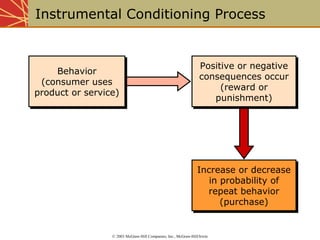
Instrumental Conditioning Process 
Positive or negative 
consequences occur 
Positive or negative 
consequences occur 
(reward or 
punishment) 
(reward or 
punishment) 
Increase or decrease 
in probability of 
repeat behavior 
in probability of 
repeat behavior 
(purchase) 
(purchase) 
(consumer uses 
product or service) 
© 2003 McGraw-Hill Companies, Inc., McGraw-Hill/Irwin 
Behavior 
Behavior 
(consumer uses 
product or service)
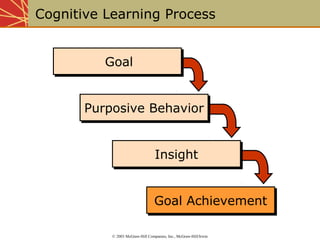
Cognitive Learning Process 
PPuurrppoossiivvee BBeehhaavviioorr 
IInnssiigghhtt 
GGooaall AAcchhiieevveemmeenntt 
GGooaall 
© 2003 McGraw-Hill Companies, Inc., McGraw-Hill/Irwin
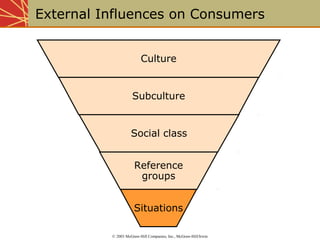
External Influences on Consumers 
Culture 
Subculture 
Social class 
Reference 
groups 
Situations 
© 2003 McGraw-Hill Companies, Inc., McGraw-Hill/Irwin
Subcultural Ads Appeal to Shared 
Beliefs, Values and Norms 
© 2003 McGraw-Hill Companies, Inc., McGraw-Hill/Irwin +

Chapter04

  • 1.
    Perspectives on ConsumerBehavior © 2003 McGraw-Hill Companies, Inc., McGraw-Hill/Irwin
  • 2.
    Consumer Decision Making DDeecciissiioonn SSttaaggee PPssyycchhoollooggiiccaall PPrroocceessss Problem Recognition Motivation Information Search Perception Alternative Evaluation Attitude Formation Purchase Decision Integration Postpurchase Evaluation Learning © 2003 McGraw-Hill Companies, Inc., McGraw-Hill/Irwin
  • 3.
    Sources of ProblemRecognition OOuutt ooff SSttoocckk New Needs or Wants DDiissssaattiissffaaccttiioonn New Needs Market-Induced Recognition © 2003 McGraw-Hill Companies, Inc., McGraw-Hill/Irwin or Wants Related Product Related Product Purchase Purchase Market-Induced Recognition New Products New Products
  • 4.
    Ads Help ConsumersRecognize Problems *Click outside of the video screen to advance to the next slide © 2003 McGraw-Hill Companies, Inc., McGraw-Hill/Irwin
  • 5.
    Maslow’s Hierarchy ofNeeds Self-actualization needs (self-development, Self-actualization needs (self-development, realization) realization) Esteem needs (self-esteem, recognition, Esteem needs (self-esteem, recognition, status) status) SSoocciiaall nneeeeddss ((sseennssee ooff bbeelloonnggiinngg,, lloovvee)) Safety Safety nneeeeddss ((sseeccuurriittyy,, pprrootteeccttiioonn)) PPhhyyssiioollooggiiccaall nneeeeddss ((hhuunnggeerr,, tthhiirrsstt)) © 2003 McGraw-Hill Companies, Inc., McGraw-Hill/Irwin SSaaffeettyy
  • 6.
    Nurturance, Love andBelonging © 2003 McGraw-Hill Companies, Inc., McGraw-Hill/Irwin +
  • 7.
    Freudian Psychoanalytic Approach Strong Inhibitions Strong Inhibitions Symbolic Meanings Symbolic Meanings Surrogate Behaviors Surrogate Behaviors Complex and Unclear Motives Complex and Unclear Motives Subconscious Subconscious Mind Mind © 2003 McGraw-Hill Companies, Inc., McGraw-Hill/Irwin
  • 8.
    Probing the Mindsof Consumers Depth Interviews Depth Interviews Association Association Tests Tests Projective Methods Projective FFooccuuss GGrroouuppss Methods © 2003 McGraw-Hill Companies, Inc., McGraw-Hill/Irwin
  • 9.
    “MR” Not AllPositive or All Negative PPrrooss CCoonnss Reveals Hidden Feelings, Drives Reveals Hidden Feelings, Drives and Fears and Fears Highlights Importance of Symbolic Factors Highlights Importance of Symbolic Factors Shifts Attention from “What” to “How” and “Why” Shifts Attention from “What” to “How” and “Why” Qualitative Qualitative Results from Very Small Samples Results from Very Small Samples Varying, Subjective Interpretations Varying, Subjective Interpretations Difficult or Impossible to Verify or Validate Difficult or Impossible to Verify or Validate Motivation Research Motivation Research © 2003 McGraw-Hill Companies, Inc., McGraw-Hill/Irwin
  • 10.
    Sexy Ads MayMotivate Consumers *Click outside of the video screen to advance to the next slide © 2003 McGraw-Hill Companies, Inc., McGraw-Hill/Irwin
  • 11.
    Sexy Ads GetNoticed © 2003 McGraw-Hill Companies, Inc., McGraw-Hill/Irwin +
  • 12.
    Information Search Personal Sources Market Sources Public Sources Personal Experience © 2003 McGraw-Hill Companies, Inc., McGraw-Hill/Irwin
  • 13.
    The Selective PerceptionProcess SSeelleeccttiivvee EExxppoossuurree SSeelleeccttiivvee AAtttteennttiioonn SSeelleeccttiivvee CCoommpprreehheennssiioonn SSeelleeccttiivvee RReetteennttiioonn © 2003 McGraw-Hill Companies, Inc., McGraw-Hill/Irwin
  • 14.
    Combining Color WithBlack-and-White Is Intended to Gain Attention © 2003 McGraw-Hill Companies, Inc., McGraw-Hill/Irwin +
  • 15.
    Evaluation of Alternatives All available brands Brand A Brand B Brand C Brand D Brand E Brand F Brand G Brand H Brand I Brand J Brand K Brand L Brand M Brand N Brand O Evoked Set of Brands Brand B Brand E Brand I Brand M © 2003 McGraw-Hill Companies, Inc., McGraw-Hill/Irwin Brand F
  • 16.
    Two Forms ofEvaluative Criteria EEvvaalluuaattiivvee CCrriitteerriiaa OOOObbbbjjjjeeeeccccttttiiiivvvveeee Price Warranty Service SSuubbjjeeccttiivvee © 2003 McGraw-Hill Companies, Inc., McGraw-Hill/Irwin Style Appearance Image
  • 17.
    Different Perspectives: Marketer’sView © 2003 McGraw-Hill Companies, Inc., McGraw-Hill/Irwin Enough power? Tractio n okay? Too pricy? Product is seen as a bundle of attributes or characteristics.
  • 18.
    Different Perspectives: Consumer’sView How does it cut the taller grass? PPrroodduucctt IIss SSeeeenn AAss AA SSeett ooff OOuuttccoommeess FFFFuuuunnnnccccttttiiiioooonnnnaaaallll © 2003 McGraw-Hill Companies, Inc., McGraw-Hill/Irwin How close can I get to the shrubs? Will the neighbors be impressed with my lawn? Is it going to be as fun to use later this summer? Will I enjoy having more time for golf? Will it pull that little trailer I saw at the store? PPssyycchhoollooggiiccaall
  • 19.
    Consumer Attitudes Focuson Objects IInnddiivviidduuaallss PPrroodduuccttss BBrraannddss CCoommppaanniieess Attitudes Toward: RReettaaiilleerrss OOrrggaanniizzaattiioonnss AAddss MMMMeeeeddddiiiiaaaa © 2003 McGraw-Hill Companies, Inc., McGraw-Hill/Irwin
  • 20.
    Ways to ChangeAttitudes Change Beliefs About Change Beliefs About AAnn IImmppoorrttaanntt AAttttrriibbuuttee CChhaannggee BBeelliieeffss AAbboouutt Change Perceptions of the Change Perceptions of the Value of An Attribute Value of An Attribute Add a New Attribute To the Add a New Attribute To the Attitude Formation Mix Attitude Formation Mix Change Perceptions or Beliefs About Change Perceptions or Beliefs About a Competing Brand a Competing Brand © 2003 McGraw-Hill Companies, Inc., McGraw-Hill/Irwin
  • 21.
    Adding Attributes ChangesAttitudes © 2003 McGraw-Hill Companies, Inc., McGraw-Hill/Irwin +
  • 22.
    How Consumers Learn CCoonnddiittiioonniinngg Based on conditioning through association or reinforcement TThhiinnkkiinngg Intellectual evaluation comparing attributes with values © 2003 McGraw-Hill Companies, Inc., McGraw-Hill/Irwin MMooddeelliinngg Based on emulation (copying) of respected examples
  • 23.
    Classical Conditioning Process Unconditioned Unconditioned stimulus (waterfall) stimulus (waterfall) AAssssoocciiaattiioonn ddeevveellooppss tthhrroouugghh ccoonnttiigguuiittyy aanndd rreeppeettiittiioonn Conditioned stimulus (Brita water filtration pitcher) Conditioned stimulus (Brita water filtration pitcher) Unconditioned Unconditioned response response (freshness, purity) (freshness, purity) © 2003 McGraw-Hill Companies, Inc., McGraw-Hill/Irwin Conditioned response (freshness, purity) Conditioned response (freshness, purity)
  • 24.
    Classical Conditioning forCosmetics © 2003 McGraw-Hill Companies, Inc., McGraw-Hill/Irwin +
  • 25.
    Instrumental Conditioning Process Positive or negative consequences occur Positive or negative consequences occur (reward or punishment) (reward or punishment) Increase or decrease Increase or decrease in probability of repeat behavior in probability of repeat behavior (purchase) (purchase) (consumer uses product or service) © 2003 McGraw-Hill Companies, Inc., McGraw-Hill/Irwin Behavior Behavior (consumer uses product or service)
  • 26.
    Cognitive Learning Process PPuurrppoossiivvee BBeehhaavviioorr IInnssiigghhtt GGooaall AAcchhiieevveemmeenntt GGooaall © 2003 McGraw-Hill Companies, Inc., McGraw-Hill/Irwin
  • 27.
    External Influences onConsumers Culture Subculture Social class Reference groups Situations © 2003 McGraw-Hill Companies, Inc., McGraw-Hill/Irwin
  • 28.
    Subcultural Ads Appealto Shared Beliefs, Values and Norms © 2003 McGraw-Hill Companies, Inc., McGraw-Hill/Irwin +

Editor's Notes

  • #3 Relation to textThis slide relates to material on p. 105 and Figure 4-1 of the text. Summary OverviewThis slide shows the stages in the consumer decision making process and the relevant internal psychological processes that relate to each stage. These stages include: Problem recognition – consumer perceives a problem or need or want and becomes motivated to solve or satisfy it Information search – search for information needed to make a decision Alternative evaluation – evaluation of various brands or alternatives under consideration Purchase decision – actual purchase of the product or service Postpurchase evaluation – compares level of performance with expectations and results in consumer becoming satisfied or dissatisfied Also included in this slide are the relevant internal psychological processes that occur at each stage of the decision process. These include: Motivation – factors that compel a consumer to take a particular action Perception – the process by which consumers receives, selects, organizes, and interprets information to create a meaningful picture of the world Attitude formation – overall feeling toward or an evaluation of an object Integration – the way product knowledge, meanings, and beliefs are combined to evaluate two or more alternatives Learning – process by which individuals acquire the purchase and consumption knowledge they apply to future related behavior Use of this slideThis slide can be used to introduce the consumer decision making process and the relevant internal psychological processes that occur during each stage of this process.
  • #4 Relation to textThis slide relates to material on pp. 107-109 of the text. Summary OverviewThe causes of problem recognition may be simple or complex and may result from changes in the consumer’s current and/or desired state. These causes can be influenced by both internal and external factors. Some of the sources of problem recognition are: Out of stock – consumers use their existing supply and it must be replenished Dissatisfaction – consumers become dissatisfied with the current state of affairs and/or product being used New needs/wants – changes in consumers’ lives often result in new needs/wants Related product purchase – other needs are stimulated by the purchase of a product Market-induced recognition – marketers attempt to encourage consumers not to be content with their current situation and try to create new needs and wants New products – innovative products are introduced and brought to the attention of consumers Use of this slideThis slide can be used to show the various sources of problem recognition. Advertisers attempt to respond to as well as influence problem recognition as this is where the consumer purchase process begins.
  • #5 Relation to textThis slide relates to pp. 108-09 where problem recognition is discussed. Summary OverviewThis slide contains a commercial for Lamkin golf grips and is an excellent example of how advertising can be used to influence problem recognition. One of the challenges facing golf grip manufacturers such as Lamkin is getting golfers to recognize that they have a problem in the form of worn out grips on their clubs and thus getting them to change the grips. Lamkin used this clever “I’m in the woods” commercial to get golfers to recognize the problems created by worn down grips and encourage them to change their grips more often. Use of this slideThis commercial can be used a part of a discussion of problem recognition and how marketers use advertising to make consumers aware of problems they might have and how their products can be used to solve them.
  • #6 Relation to textThis slide relates to material on pp.109-110 and Figure 4-2 of the text. Summary OverviewTo better understand the reasons underlying consumer purchases behavior, marketers devote considerable attention to examining motives which are factors that compel a consumer to take a particular action. One of the most popular approaches to understanding consumer motivations is based on the classical theory of human motivation by Abraham Maslow. His hierarchy of needs theory postulates five basic levels of human needs, arranged in a hierarchy based on their importance. This slide shows the five needs: Physiological, Safety and security Social needs (love and belonging) Self-esteem Self-actualization Use of this slideThis slide can be used to introduce Maslow’s hierarchy of needs. There are several points regarding this theory of motivation that should be made. Lower-level needs are an ongoing source of motivation for consumer purchase behavior It is unlikely people move through the needs hierarchy in a stair step manner. Since basic lower level needs are met in most developed countries, marketers often sell products that fill basic physiological needs by appealing to consumers’ higher level needs. Advertising can be used to show how a brand can fulfill these needs.
  • #7 Relation to textThis slide relates to material on pp 109-111 and Exhibit 4-5 of the text. Summary OverviewThis slide shows an ad for Pampers baby wipes product. Procter & Gamble is marketing this product by focusing on the love between a parent and child (social needs) in addition to the gentleness of the product. Use of slideThis slide can be used as an example of how marketers appeal to different types of needs that consumers might have through their advertising.
  • #8 Relation to textThis slide relates to material on pp. 110-11 of the text which discusses Freudian psychoanalytic theory. Summary OverviewOne approach to the study of human motivation is psychoanalytic theory which was pioneered by Sigmund Freud. This approach to motivation focuses on the deep-rooted motivations that underlie behavior and often lie in the subconscious. Some of the factors associated with psychoanalytic theory include: Strong inhibitions Symbolic meaning of products and brands Surrogate behaviors Complex and unclear motives Use of this slideThis slide can be used as part of a discussion of Freudian psychoanalytic theory and how it relates to studying motives that might influence consumer behavior.
  • #9 Relation to textThis slide relates to material on pp. 110-112 and Figure 4-3 of the text. Summary OverviewThose who attempt to relate psychoanalytic theory to consumer behavior believe consumer’s motivations for purchasing are often very complex and unclear to the casual observer and often to consumers themselves. As such, these motives can only be determined by probing the subconscious. This type of approach is called motivation research. Some of the research methods used to probe the consumers mind include: In-depth interviews – unstructured interviews where the participant is encouraged to speak freely. Designed to obtain insights into motives, ideas, and opinions. Projective techniques – projecting internal states upon external objects. Designed to gain insights into values, motives, attitude, or needs. Association tests – participant is asked to respond to the first thing that comes to mind when they are presented with a stimulus (picture, word) Focus groups – small groups brought together to discuss particular products, ideas, or issues. Use of slideThis slide can be used to show the various techniques marketers can use to probe deeply into motives that may underlie purchase decisions. Insights can often be used as a basis for advertising messages aimed at buyers’ deeply rooted feeling, hopes, aspirations, and fears. Such strategies can often be more effective than rationally based appeals.
  • #10 Relation to textThis slide relates to material on pp. 111-112 of the text which discusses motivation research. Summary OverviewThis slide outlines the pros and cons of motivation research. Advantages of motivation research include: Reveals hidden feeling, drives, and fears Highlights importance of symbolic factors Shifts attention from what and to “how” and “why” Problems associated with motivation research include: Qualitative input often comes from small samples of consumers Varying and subjective interpretations that are made by researchers It can be difficult to verify or validate finding from motivation research studies Use of slideThis slide can be used to discuss the pros and cons of motivation research. While it has its critics, motivation research can further our understanding of consumer behavior. Understanding the motives that underlie consumer purchases is valuable to the development of effective IMC programs.
  • #11 Relation to textThis slide relates to the material on pp. 110-111 of the text. Summary OverviewThis slide contains a television commercial from a campaign developed for the Las Vegas Convention & Visitor’s Authority. The tagline for this campaign is “What happens here stays here” and the ads are designed to position Las Vegas as a place “for people who like to completely let go every now and then.” The ad uses a sexual appeal by showing an attractive woman who appears to be trying to seduce a limousine driver. However, at the end of the spot she appears very business-like as she exits the limo. Use of this slideThe commercial shown in this slide can be used as an example of how marketers use Freudian psychoanalytic concepts in the development of advertising campaigns. This particular ad is designed to appeal to hedonistic motives by using a sexually suggestive message.
  • #12 Relation to textThis slide relates to material on pp. 111-112 and Exhibit 4-7 of the text. Summary OverviewThis ad is for Carolina Herrara 212 cologne for men. It is an example of the use of sexual appeals and symbols in advertising. The use of these types of appeals is very common in advertising for cosmetic products which are generally sold on the basis of image. Use of this slideThis slide can be used to show an example of an ad that uses sex appeal and symbolism in its message. The cologne industry uses sex appeals to sell their products because of the general acceptance that this approach is an effective way to create a unique image and/or brand identity for them.
  • #13 Relation to textThis slide relates to material on pp. 112-113 of the text. Summary OverviewThe second stage of the consumer decision making process is information search. Once consumers perceive a problem or need they begin to search for information needed to make a purchase decision. The various sources of information are shown on this slide. Personal sources – friends, relative, co-workers Market sources – information from advertisers, salespeople, in-store displays and the Internet Public sources – articles in magazines or newspapers Personal experience – handling, examining, or using the product Use of this slideThis slide can be used to show the various sources consumers use in the information search stage of the decision process. Determining how much and which sources of external information to use involves several factors, including the importance of the purchase decision, the effort needed to acquire information, the amount of past experience, the degree of perceived risk associated with the purchase, and the time available.
  • #14 Relation to textThis slide relates to material on pp.113-114 and Figure 4-4 of the text. Summary OverviewKnowledge of how consumers acquire and use information from external sources is important to marketers in formulating communication strategies. Perception is the process by which individuals receives, selects, organizes, and interprets information to create a meaningful picture of the world. Selectivity can occurs throughout the various stages of perception process. Selective perception may occur at the exposure, attention, comprehension, or retention stage. Selective exposure – occurs as consumers choose whether to make themselves available to information Selective attention – occurs when the consumer chooses whether to focus attention on certain stimuli while excluding others. Selective comprehension – occurs when consumers interpret information on the basis of their own attitudes, beliefs, motives, and experiences. Selective retention – occurs as consumers cannot recall all of the information they receive but may choose to retain information of particular relevance. Use of this slideThis slide can be used to discuss the selective perception process. This process is viewed as a filtering process, which is affected by both internal and external factors. The sheer number and complexity of the marketing stimuli a consumer is exposed to in any given day requires that this filtering occur. Advertisers must use various creative tactics to get their messages noticed and remembered.
  • #15 Relation to textThis slide relates to material on pp. 113-114 and Exhibit 4-9 of the text. Summary OverviewAdvertisers use a variety of creative techniques to attract the attention of consumers. This ad for Tropicana Orange Juice shows the use of the “splash of color” technique whereby a bright color is used against a black and while background to make the product stand out and thus get the attention of the consumer. Use of this slideThis slide can be used to show an example of a creative tactic used to get the attention of the consumer. Marketers often use this “splash of color” technique to make their products stand out and get noticed.
  • #16 Relation to textThis slide relates to material on pp. 114-117 of the text which discusses the alternative evaluation process. Summary OverviewAfter acquiring information during the information search stage the decision process, the consumer moves to alternative evaluation. In this stage the consumer compares the various brands or products he or she has identified as being capable of solving the consumption problem and satisfying needs. The various brands identified as purchase options to be considered during this stage are referred to as the consumer’s evoked set. The evoked set will only include a subset of all the available brands and usually only a manageable number of brands which can be compared more closely. Use of this slideThis slide can be used to discuss the alternative evaluation process and the concept of the evoked set. The goal of most advertising and promotional strategies is to increase the likelihood that a brand will be included in the consumer’s evoked set and be considered during alternative evaluation. Advertisers use top of mind awareness and reminder advertising to help get their brands included in the evoked set of consumers.
  • #17 Relation to textThis slide relates to material on pp. 116-117 of the text. Summary OverviewEvaluative criteria are the dimensions or attributes of a product or service that are used to compare different alternatives. Two types of criteria are: Objective – based on concrete attributes that are tangible and can be directly judged or experienced by the consumer such as price or warranty. Subjective – based on abstract attributes that are intangible and more subjective in nature such as style, appearance, or image of a product. Use of this slideThis slide can be used to show the type of criteria used by consumers to evaluate alternatives. It is important to note that marketers should distinguish between attributes that can be objectively assessed by a consumer such as price or fuel efficiency versus attributes that are more subjective in nature such as the styling or image of a car.
  • #18 Relation to textThis slide relates to material on pp. 116-117 of the text. Summary OverviewEvaluative criteria are usually viewed as product or service attributes. Many marketers view their products or services as a bundle of attributes. Marketers need to understand that when consumers evaluate products they view them differently and think of them in terms of the consequences or outcomes associated with using the product or service. This slide shows how a manufacturer of a riding lawn mower might view the product primarily in terms of functional attributes. Use of this slideThis slide can be used to discuss evaluative criteria and consequences and how marketers and consumers view products and services differently. This slide shows the marketer’s perspective while the next slide shows the product from the consumer’s perspective.
  • #19 Relation to textThis slide relates to material on pp. 116-117 of the text. Summary OverviewConsumers tend to think of products or services in terms of their consequences which are specific events or outcomes that consumers experience when they purchase and/or consume a product or service. The slide shows how a consumer might think about a riding lawn mower in terms of various functional and psychological consequences associated with the product. Use of this slideThis slide can be used to show how the consumer’s view of products and services differs from that of the marketer, which was shown in the previous slide. The bubbles contain different thoughts consumers might have when evaluating a riding lawn mower.
  • #20 Relation to textThis slide relates to material on pp. 117-119 of the text. Summary OverviewAttitudes are viewed as a summary construct that represents an individual’s overall feelings toward or evaluation of an object. Consumers hold attitudes toward a variety of objects that are important. Some of those objects toward which a consumer might hold an attitude include: Individuals Products Brands Companies Organizations Retailers Media Ads Use of this slideThis slide can be used as part of a discussion of consumer attitudes. They are important to marketers because they summarize a consumer’s evaluation of an object or issue and they are related to purchase behavior. An important point to make with this slide is that consumers hold attitudes toward a number of objects/issues that are important to marketers.
  • #21 Relation to textThis material relates to p.117-119 of the text which discusses multiattribute attitude models. Summary OverviewMultiattribute models help marketers understand and diagnose the underlying basis of consumer attitudes. These models provide insights into several ways marketers can influence and change consumer attitudes. Change beliefs about an important attribute – increase/change strength of that belief. Companies remind consumers of how well their brand performs on a particular attribute. Change perception of the value of an attribute – make the attribute more/less important to the consumer. Companies use advertising to make attributes on which they perform well more important to the consumer. Add a new attribute to the attitude formation mix – add new attributes to a product or service that are important to consumer and on which your brand performs well. Change perceptions or beliefs about a competing brand – influence feelings about a competitor. Comparative advertising can be used to accomplish this. Use of this slideThis slide can be used to show ways marketers can influence consumer attitudes. By understanding the beliefs that underlie consumers’ evaluations of a brand and the importance of various attributes or consequences, the marketer is better able to develop communication strategies for creating, changing, or reinforcing brand attitudes.
  • #22 Relation to textThis slide relates to material on p. 118-119 and Exhibit 4-12 of the text. Summary OverviewThis slide shows an ad for a Panasonic wireless projector. The ad is a good example of companies attempting to add a new attribute to the attitude formation mix. In this ad Panasonic is showing that they have added wireless feature to their product which makes it easier and more convenient to use. Use of this slideThis ad can be used to show an example of how a company adds a new attribute to a product as a way of influencing consumer attitudes and promotes this feature in its advertising.
  • #23 Relation to textThis slide relates to material on pp. 123-127 which discusses the consumer learning process. Summary OverviewThis slide shows the various processes through which consumer learning takes places including: Thinking or cognitive processes by which evaluation of a product occurs Conditioning whereby learning occurs through association (classical) or via reinforcement (operant) Modeling whereby learning occurs through observation of outcomes experienced by others who engage in a behavior Use of this slideThis slide can be used as part of a discussion of learning and the various ways consumers acquire information, knowledge and experience that they might apply to future behaviors.
  • #24 Relation to textThis slide relates to material on pp. 123-125 of the text which discusses the classical conditioning process. Summary OverviewThis slide shows a diagram of how the classical conditioning process might occur for a product such as a Brita water filtration pitcher system which uses a ad featuring a scene of a natural waterfall and fresh, clean water. In this example the components of classical conditioning include: Unconditioned stimulus – the waterfall Unconditioned response – the image of freshness and purity that is evoked by the waterfall Conditioned stimulus – the Brita water filtration pitcher Conditioned response – elicited response to conditioned stimulus, same response of freshness and purity that is evoked by the waterfall Association develops through contiguity or showing the Brita water filtration pitcher close in time and space with the waterfall as in the context of the ad and repetition which refers to the frequency of the association. Use of this slideThis slide can be used to introduce the concept of classical conditioning in advertising. It may be helpful to introduce this concept with a reminder of the well known example of Pavlov’s dog. This should help students organize their thoughts and understand the key concepts. Learning through classical conditioning plays an important role in marketing. Buyers can be conditioned to form favorable impressions and images of various brands through this associative learning process.
  • #25 Relation to textThis slide relates to material on p. 124 and Exhibit 4-17 of the text and provides another example of classical conditioning. Summary OverviewThis ad for Lancôme beauty products provides another example of the use of classical conditioning in advertising. In this ad Lancôme is attempting to associate its Vinefit moisturizer product with the moisture provided by grapes The unconditioned stimulus is the grapes, the unconditioned response is fresh and moist, the conditioned stimulus is the Lancôme product, and conditioned response is again fresh and moist. Use of this slideThis slide can be as an example of an advertisement that is using classical conditioning. The objective of the ad is to position the Lancôme product as fresh and moist. When the brand is presented simultaneously with the unconditioned stimulus, the brand itself becomes a conditioned stimulus that elicits the same favorable response.
  • #26 Relation to textThis slide relates to material on pp. 125-126 and Figure 4-7of the text which discusses instrumental conditioning. Summary OverviewInstrumental or operant conditioning views the consumer as an active participant for learning to occur. It is often referred to as instrumental conditioning because the individual’s response is instrumental in getting a positive reinforcement (reward) or avoiding negative reinforcement (punishment). This concept applies to marketing as companies attempt to provide their customers with products and services that satisfy their needs, thus rewarding them and reinforcing the probability of repeat purchase. Reinforcement in advertising can be seen in two ways: Ads emphasize the benefits or rewards a consumer will receive from using the product or service. Ad encourages consumers to use a particular product or brand to avoid unpleasant consequences. Use of this slide|This slide can be used to explain the concept of instrumental conditioning. Instrumental conditioning is dependent upon reinforcement. Two concepts relevant to marketers are schedules of reinforcement and shaping. Schedules of reinforcement can either be continuous or intermittent. Learning occurs most rapidly with continuous reinforcement, but the behavior is likely to cease when the reinforcement stops. Learning occurs more slowly with intermittent reinforcement, but lasts longer. Shaping is referred to as the reinforcement of successive acts that lead to a desired behavior pattern.
  • #27 Relation to textThis slide relates to pp. 126-127 and figure 4-9 of the text Summary OverviewThis slide shows the how cognitive theorists view the learning process. Cognitive learning theorists focus on mental processes such as perception, motivation, thinking, evaluation, attitude formation, integration and decision making as an important part of learning. The cognitive approach to studying learning and decision making has dominated the field of consumer behavior in recent years. This cognitive learning process is as follows: Goal- Purposive BehaviorInsight Goal Achievement Use of this slideThis slide can be used to explain the cognitive learning theory. It focuses on the more complex mental processes that underlie consumer behavior.
  • #28 Relation to textThis slide relates to material on pp. 127-131 and figure 4-10 of the text. Summary OverviewConsumers do not make purchase decisions in isolation. A number of external factors have been identified than may influence consumer decision making. This slide summarizes those influences. Culture – is the learned meanings, values, norms, and customs shared by a society. It is the broadest and most abstract influence on buyer behavior. Subcultures – are the smaller groups within cultures whose beliefs, values, norms, and patterns of behavior set them apart from the larger cultural mainstream. Subcultures can be based on age, geography, religion, and ethnicity. Social class – homogenous divisions in a society into which people sharing similar lifestyles, values, norms, interests, and behaviors can be grouped. Reference groups – a group whose presumed perspectives or values are being used by an individual as the basis for his or her judgments, opinions, and actions. It is one of the primary factors influencing our purchase decisions. Situations – the specific situation in which consumers make a purchase decision or plan to use the product or brand. Situational determinates include the usage situation, the purchase situation, and the communications situation. Use of this slideThis slide can be use to explain the external factors than affect consumers purchase decisions. Marketers consider all of these influences in developing advertising and promotional strategies.
  • #29 Relation to textThis slide relates to material on p. 128 and Exhibit -19. Summary OverviewThis slide shows an ad that is targeted to a specific subculture. Many marketers are now developing ads that target subcultures such as African Americans and Hispanics and recognize the shared beliefs, values and norms among these subcultures. Use of this slideThe ad shown in this slide can be used as an example of advertising that is designed to appeal to a specific subculture. Many marketers now recognize the importance of developing ads for specific subcultures.