





The Internet and 
Interactive Media 
Utterz, MocoSpace, 
Twango, Mosh 
1 
5 
McGraw-Hill/Irwin Copyright © 2009 by The McGraw-Hill Companies, Inc. All rights reserved.
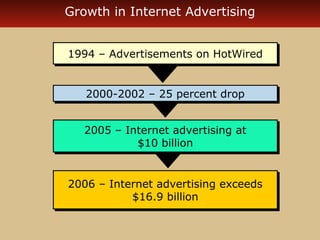
Growth in Internet Advertising 
11999944 –– AAddvveerrttiisseemmeennttss oonn HHoottWWiirreedd 
2000-2000-22000022 –– 2255 ppeerrcceenntt ddrroopp 
2005 – Internet advertising at 
$10 billion 
$10 billion 
2006 – Internet advertising exceeds 
$16.9 billion 
$16.9 billion
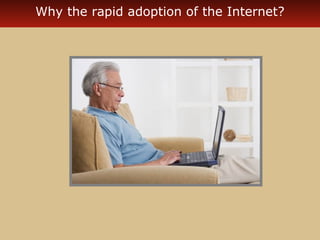
Why the rapid adoption of the Internet?
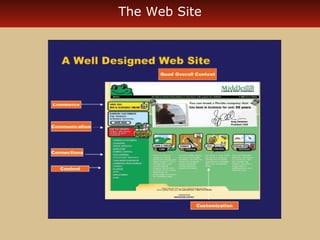
The Web Site
Huggies Goes Beyond Providing Information
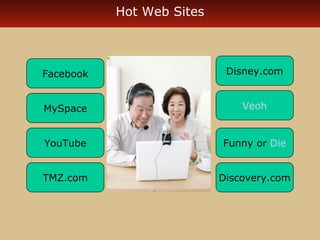
Hot Web Sites 
Facebook 
MySpace 
YouTube 
TMZ.com 
Disney.com 
Veoh 
Funny or Die 
Discovery.com
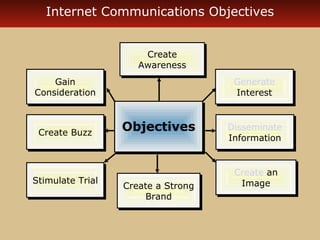
Internet Communications Objectives 
Create 
Awareness 
Create 
Awareness 
OObbjjeeccttiivveess 
Create a Strong 
Create a Strong 
Brand 
Brand 
Generate 
Interest 
Generate 
Interest 
Disseminate 
Information 
Disseminate 
Information 
Create an 
Create an 
Image 
Gain 
Gain 
Consideration 
Consideration 
CCrreeaattee BBuuzzzz 
SSttiimmuullaattee TTrriiaall Image
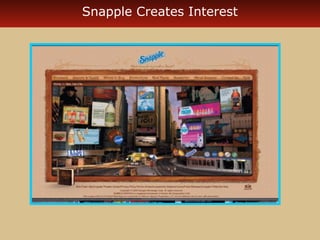
Snapple Creates Interest
Using Web Sites to Build Image
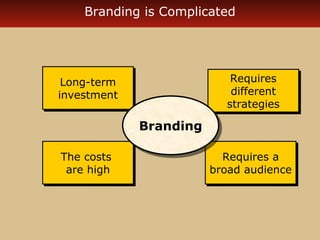
Branding is Complicated 
Requires 
different 
strategies 
Requires 
different 
strategies 
Requires a 
broad audience 
Requires a 
broad audience 
Long-term 
investment 
Long-term 
investment 
The costs 
are high 
The costs 
are high 
BBrraannddiinngg
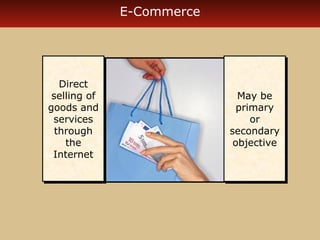
E-Commerce 
May be 
primary 
May be 
primary 
or 
or 
secondary 
objective 
secondary 
objective 
Direct 
selling of 
goods and 
services 
through 
Direct 
selling of 
goods and 
services 
through 
the 
the 
Internet 
Internet
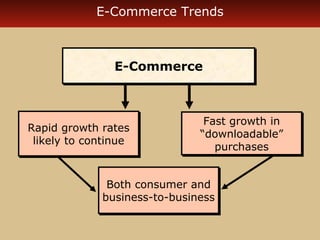
E-Commerce Trends 
EE--CCoommmmeerrccee 
Rapid growth rates 
likely to continue 
Fast growth in 
“downloadable” 
purchases 
Both consumer and 
business-to-business
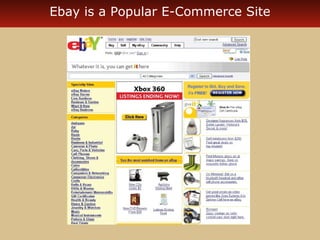
Ebay is a Popular E-Commerce Site
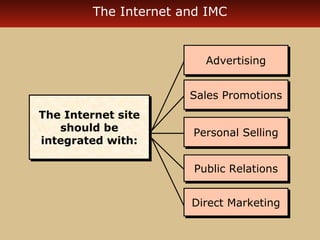
The Internet and IMC 
AAddvveerrttiissiinngg 
SSaalleess PPrroommoottiioonnss 
PPeerrssoonnaall SSeelllliinngg 
PPuubblliicc RReellaattiioonnss 
DDiirreecctt MMaarrkkeettiinngg 
The Internet site 
The Internet site 
should be 
should be 
integrated with: 
integrated with:
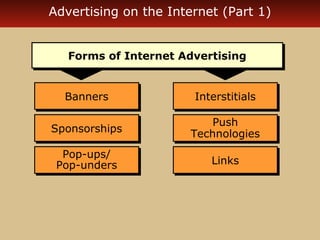
Advertising on the Internet (Part 1) 
FFoorrmmss ooff IInntteerrnneett AAddvveerrttiissiinngg 
BBaannnneerrss 
SSppoonnssoorrsshhiippss 
Pop-ups/ 
Pop-unders 
Pop-ups/ 
Pop-unders 
IInntteerrssttiittiiaallss 
Push 
Push 
Technologies 
Technologies 
LLiinnkkss
Typical Banner Ads
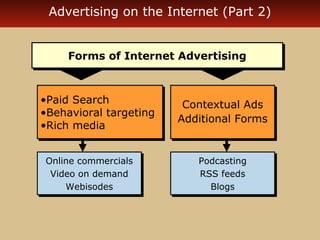
Advertising on the Internet (Part 2) 
FFoorrmmss ooff IInntteerrnneett AAddvveerrttiissiinngg 
•Paid Search 
•Behavioral targeting 
•Rich media 
•Paid Search 
•Behavioral targeting 
•Rich media 
Contextual Ads 
Additional Forms 
Contextual Ads 
Additional Forms 
Podcasting 
RSS feeds 
Podcasting 
RSS feeds 
Blogs 
Blogs 
Online commercials 
Video on demand 
Online commercials 
Video on demand 
Webisodes 
Webisodes
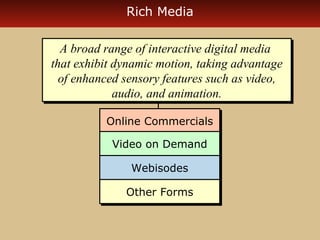
Rich Media 
A broad range of interactive digital media 
that exhibit dynamic motion, taking advantage 
of enhanced sensory features such as video, 
audio, and animation. 
OOnnlliinnee CCoommmmeerrcciiaallss 
VViiddeeoo oonn DDeemmaanndd 
WWeebbiissooddeess 
OOtthheerr FFoorrmmss
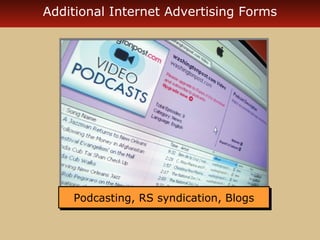
Additional Internet Advertising Forms 
Podcasting, Podcasting, RRSS ssyynnddiiccaattiioonn,, BBllooggss
Sales Promotions on Web Sites
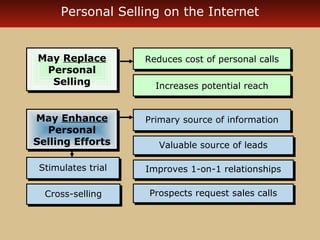
Personal Selling on the Internet 
May Replace 
Personal 
May Replace RReedduucceess ccoosstt ooff ppeerrssoonnaall ccaallllss 
Personal 
Selling 
May Enhance 
Personal 
Selling Efforts 
CCrroossss--sseelllliinngg 
IInnccrreeaasseess ppootteennttiiaall rreeaacchh 
PPrriimmaarryy ssoouurrccee ooff iinnffoorrmmaattiioonn 
VVaalluuaabbllee ssoouurrccee ooff lleeaaddss 
Selling 
May Enhance 
Personal 
Selling Efforts 
IImmpprroovveess 11--oonn--11 rreellaattiioonnsshhiippss 
PPrroossppeeccttss rreeqquueesstt ssaalleess ccaallllss 
SSttiimmuullaatteess ttrriiaall
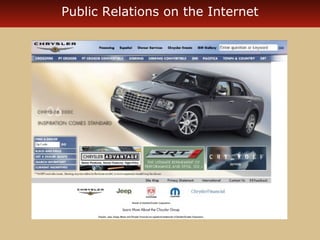
Public Relations on the Internet
Philanthropists on the Web
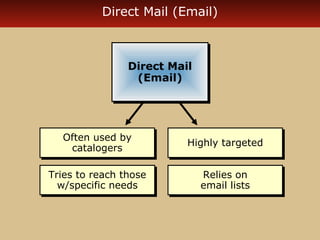
Direct Mail (Email) 
Direct Mail 
(Email) 
Direct Mail 
(Email) 
Often used by 
catalogers 
Often used by 
catalogers 
Tries to reach those 
w/specific needs 
Tries to reach those 
w/specific needs 
HHiigghhllyy ttaarrggeetteedd 
Relies on 
email lists 
Relies on 
email lists
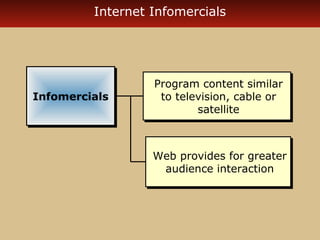
Internet Infomercials 
Program content similar 
to television, cable or 
Program content similar 
to television, cable or 
satellite 
satellite 
IInnffoommeerrcciiaallss 
Web provides for greater 
audience interaction 
Web provides for greater 
audience interaction
E-Commerce and Home Shopping
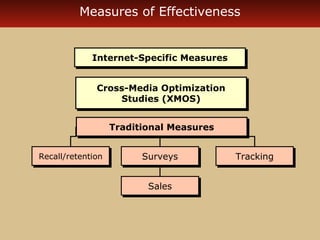
Measures of Effectiveness 
IInntteerrnneett--SSppeecciiffiicc MMeeaassuurreess 
Cross-Media Optimization 
Studies (XMOS) 
Studies (XMOS) 
TTrraaddiittiioonnaall MMeeaassuurreess 
RReeccaallll//rreetteennttiioonn SSuurrvveeyyss 
TTrraacckkiinngg 
SSaalleess
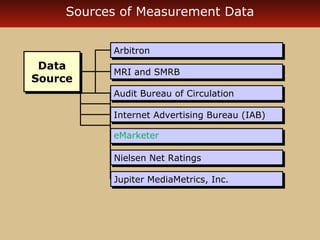
Sources of Measurement Data 
AArrbbiittrroonn 
MMRRII aanndd SSMMRRBB 
AAuuddiitt BBuurreeaauu ooff CCiirrccuullaattiioonn 
IInntteerrnneett AAddvveerrttiissiinngg BBuurreeaauu ((IIAABB)) 
eeMMaarrkkeetteerr 
NNiieellsseenn NNeett RRaattiinnggss 
JJuuppiitteerr MMeeddiiaaMMeettrriiccss,, IInncc.. 
Data 
Source 
Data 
Source
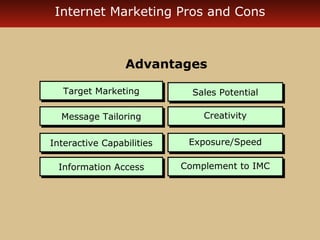
Internet Marketing Pros and Cons 
Advantages 
TTaarrggeett MMaarrkkeettiinngg 
MMeessssaaggee TTaaiilloorriinngg 
IInntteerraaccttiivvee CCaappaabbiilliittiieess 
IInnffoorrmmaattiioonn AAcccceessss 
SSaalleess PPootteennttiiaall 
CCrreeaattiivviittyy 
EExxppoossuurree//SSppeeeedd 
CCoommpplleemmeenntt ttoo IIMMCC
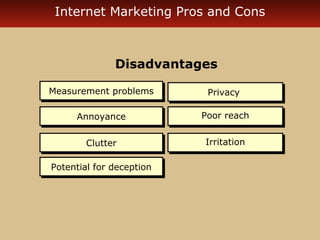
Internet Marketing Pros and Cons 
Disadvantages 
MMeeaassuurreemmeenntt pprroobblleemmss 
AAnnnnooyyaannccee 
CClluutttteerr 
PPootteennttiiaall ffoorr ddeecceeppttiioonn 
PPrriivvaaccyy 
PPoooorr rreeaacchh 
IIrrrriittaattiioonn
Test Your Knowledge 
Interactive TV, interactive CD-ROMs, kiosks, and 
interactive phones: 
A) Are viewed by businesses as breeches of 
consumer rights to privacy 
B) Can be used as contributors to an IMC 
program 
C) Cannot be linked with traditional 
advertising media 
D) Replace the Internet in most IMC programs 
E) Are not viewed as viable elements within 
a well-designed IMC program
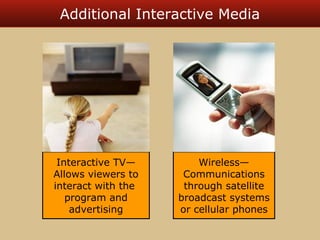
Additional Interactive Media 
Interactive TV— 
Allows viewers to 
interact with the 
program and 
advertising 
Wireless— 
Communications 
through satellite 
broadcast systems 
or cellular phones

Chapter15

  • 1.
    The Internet and Interactive Media Utterz, MocoSpace, Twango, Mosh 1 5 McGraw-Hill/Irwin Copyright © 2009 by The McGraw-Hill Companies, Inc. All rights reserved.
  • 2.
    Growth in InternetAdvertising 11999944 –– AAddvveerrttiisseemmeennttss oonn HHoottWWiirreedd 2000-2000-22000022 –– 2255 ppeerrcceenntt ddrroopp 2005 – Internet advertising at 2005 – Internet advertising at $10 billion $10 billion 2006 – Internet advertising exceeds 2006 – Internet advertising exceeds $16.9 billion $16.9 billion
  • 3.
    Why the rapidadoption of the Internet?
  • 4.
  • 5.
    Huggies Goes BeyondProviding Information
  • 6.
    Hot Web Sites Facebook MySpace YouTube TMZ.com Disney.com Veoh Funny or Die Discovery.com
  • 7.
    Internet Communications Objectives Create Awareness Create Awareness OObbjjeeccttiivveess Create a Strong Create a Strong Brand Brand Generate Interest Generate Interest Disseminate Information Disseminate Information Create an Create an Image Gain Gain Consideration Consideration CCrreeaattee BBuuzzzz SSttiimmuullaattee TTrriiaall Image
  • 8.
  • 9.
    Using Web Sitesto Build Image
  • 10.
    Branding is Complicated Requires different strategies Requires different strategies Requires a broad audience Requires a broad audience Long-term investment Long-term investment The costs are high The costs are high BBrraannddiinngg
  • 11.
    E-Commerce May be primary May be primary or or secondary objective secondary objective Direct selling of goods and services through Direct selling of goods and services through the the Internet Internet
  • 12.
    E-Commerce Trends EE--CCoommmmeerrccee Rapid growth rates likely to continue Fast growth in “downloadable” purchases Both consumer and business-to-business
  • 13.
    Ebay is aPopular E-Commerce Site
  • 14.
    The Internet andIMC AAddvveerrttiissiinngg SSaalleess PPrroommoottiioonnss PPeerrssoonnaall SSeelllliinngg PPuubblliicc RReellaattiioonnss DDiirreecctt MMaarrkkeettiinngg The Internet site The Internet site should be should be integrated with: integrated with:
  • 15.
    Advertising on theInternet (Part 1) FFoorrmmss ooff IInntteerrnneett AAddvveerrttiissiinngg BBaannnneerrss SSppoonnssoorrsshhiippss Pop-ups/ Pop-unders Pop-ups/ Pop-unders IInntteerrssttiittiiaallss Push Push Technologies Technologies LLiinnkkss
  • 16.
  • 17.
    Advertising on theInternet (Part 2) FFoorrmmss ooff IInntteerrnneett AAddvveerrttiissiinngg •Paid Search •Behavioral targeting •Rich media •Paid Search •Behavioral targeting •Rich media Contextual Ads Additional Forms Contextual Ads Additional Forms Podcasting RSS feeds Podcasting RSS feeds Blogs Blogs Online commercials Video on demand Online commercials Video on demand Webisodes Webisodes
  • 18.
    Rich Media Abroad range of interactive digital media that exhibit dynamic motion, taking advantage of enhanced sensory features such as video, audio, and animation. OOnnlliinnee CCoommmmeerrcciiaallss VViiddeeoo oonn DDeemmaanndd WWeebbiissooddeess OOtthheerr FFoorrmmss
  • 19.
    Additional Internet AdvertisingForms Podcasting, Podcasting, RRSS ssyynnddiiccaattiioonn,, BBllooggss
  • 20.
  • 21.
    Personal Selling onthe Internet May Replace Personal May Replace RReedduucceess ccoosstt ooff ppeerrssoonnaall ccaallllss Personal Selling May Enhance Personal Selling Efforts CCrroossss--sseelllliinngg IInnccrreeaasseess ppootteennttiiaall rreeaacchh PPrriimmaarryy ssoouurrccee ooff iinnffoorrmmaattiioonn VVaalluuaabbllee ssoouurrccee ooff lleeaaddss Selling May Enhance Personal Selling Efforts IImmpprroovveess 11--oonn--11 rreellaattiioonnsshhiippss PPrroossppeeccttss rreeqquueesstt ssaalleess ccaallllss SSttiimmuullaatteess ttrriiaall
  • 22.
    Public Relations onthe Internet
  • 23.
  • 24.
    Direct Mail (Email) Direct Mail (Email) Direct Mail (Email) Often used by catalogers Often used by catalogers Tries to reach those w/specific needs Tries to reach those w/specific needs HHiigghhllyy ttaarrggeetteedd Relies on email lists Relies on email lists
  • 25.
    Internet Infomercials Programcontent similar to television, cable or Program content similar to television, cable or satellite satellite IInnffoommeerrcciiaallss Web provides for greater audience interaction Web provides for greater audience interaction
  • 26.
  • 27.
    Measures of Effectiveness IInntteerrnneett--SSppeecciiffiicc MMeeaassuurreess Cross-Media Optimization Cross-Media Optimization Studies (XMOS) Studies (XMOS) TTrraaddiittiioonnaall MMeeaassuurreess RReeccaallll//rreetteennttiioonn SSuurrvveeyyss TTrraacckkiinngg SSaalleess
  • 28.
    Sources of MeasurementData AArrbbiittrroonn MMRRII aanndd SSMMRRBB AAuuddiitt BBuurreeaauu ooff CCiirrccuullaattiioonn IInntteerrnneett AAddvveerrttiissiinngg BBuurreeaauu ((IIAABB)) eeMMaarrkkeetteerr NNiieellsseenn NNeett RRaattiinnggss JJuuppiitteerr MMeeddiiaaMMeettrriiccss,, IInncc.. Data Source Data Source
  • 29.
    Internet Marketing Prosand Cons Advantages TTaarrggeett MMaarrkkeettiinngg MMeessssaaggee TTaaiilloorriinngg IInntteerraaccttiivvee CCaappaabbiilliittiieess IInnffoorrmmaattiioonn AAcccceessss SSaalleess PPootteennttiiaall CCrreeaattiivviittyy EExxppoossuurree//SSppeeeedd CCoommpplleemmeenntt ttoo IIMMCC
  • 30.
    Internet Marketing Prosand Cons Disadvantages MMeeaassuurreemmeenntt pprroobblleemmss AAnnnnooyyaannccee CClluutttteerr PPootteennttiiaall ffoorr ddeecceeppttiioonn PPrriivvaaccyy PPoooorr rreeaacchh IIrrrriittaattiioonn
  • 31.
    Test Your Knowledge Interactive TV, interactive CD-ROMs, kiosks, and interactive phones: A) Are viewed by businesses as breeches of consumer rights to privacy B) Can be used as contributors to an IMC program C) Cannot be linked with traditional advertising media D) Replace the Internet in most IMC programs E) Are not viewed as viable elements within a well-designed IMC program
  • 32.
    Additional Interactive Media Interactive TV— Allows viewers to interact with the program and advertising Wireless— Communications through satellite broadcast systems or cellular phones

Editor's Notes

  • #3 Relation to textThis slide relates to page 483 of the text. Summary OverviewThe Internet officially began with the connection of two computers in 1969, and now consists of over 1 billions users worldwide. What changed the Internet the most was development of the World Wide Web, which is the business component of the net. The first advertisements were introduced on the Web via HotWired in 1994, in the form of banner ads. Growth of the Web and Web-based advertising continued until 2000, when there was a “bust” and advertising expenditures dropped by 25 percent. As the number of users of the Net continued to rise, a new crop of advertisers came on board, including many Fortune 100 companies. By 2006, advertising expenditures had exceeded $16.2 billion, with spending projected to reach $42.0 billion by 2011. Use of this slideUse this slide to discuss the phenomenal growth of the Internet and Web-based advertising.
  • #4 Relation to textThis slide relates to pp. 483-484 of the text. Summary OverviewNo other medium, other than black-and-white television, has been adopted as rapidly as the Internet. Today an estimated 71 percent of households in North America are connected. The reasons for this phenomenon vary: The general public has a desire for information, control of that information, speed, and convenience. Businesses are looking for effective customer targeting, and more direct feedback. Technology has also contributed to adoption of the Internet by facilitating high-speed access, instituting safeguards that increased confidence in the medium, and two-way communication flow. Use of this slideUse this slide to talk about why people, both young and old, have gravitated to the Internet.
  • #5 Relation to textThis slide relates to pp. 484-485 and Exhibit 15-1 of the text. Summary OverviewThis slide summarizes factors that lead to an effective website: Good overall context Customization Content Connections Communication Commerce To attract visitors to the site and have them return to it requires a combination of creativity, effective marketing, and continual updating of the site. Use of slide This slide can be used to discuss the what is required to develop and maintain a successful website.
  • #6 Relation to textThis slide relates to pp. 484-485 and Exhibit 15-2 of the text. Summary OverviewThis slide shows how Huggies goes well beyond providing information. The site has additional objectives, such as developing a long-term relationship with parents, establishing a brand image for the products, and supporting sales. The HUGGIES Baby Network provides expectant mothers with encouragement and ideas as to how to maintain a happy and healthy pregnancy. The site also provides information to be used once the baby has been born, including how to create a nursery, games to play with the baby, and more. The site is designed to develop one-on-one relationships by offering useful information and product samples to anyone who sends in his or her name, address, and e-mail address. Use of this slide This slide can be used to demonstrate the effective use of the Internet in the IMC process.
  • #7 Relation to textThis slide relates to p. 485 and Figure 15-2. Summary OverviewAdweek magazine publishes a Web site Hot List, which lists the top sites and what makes them effective. For instance: Facebook has 16.5 million unique visitors per month who spend an average of 67 minutes on the site. MySpace attracts the 18 to 25 demographic and has over 60 million unique visitors per month. YouTube is the leading user-generated video site with over 50 million unique visitors per month. TMZ.com offers real-time Hollywood celebrity gossip. Disney.com is an innovative, interactive site for both kids and parents Veoh is a diverse virtual community of independent publishers. Funny or Die is a comedy-video Web site that combines user-generated content with original, exclusive content. Discovery.com brings viewers engaging stories and extraordinary experiences from around the world. Use of this slideUse this slide to discuss some of the most successful Web sites, and why they attract the high number of visitors that they do.
  • #8 Relation to text This slide relates to material on pp. 486-488 of the text. Summary Overview This slide shows some of the possible communications objectives sought when using the Internet, such as: Creating awareness Generating interest Disseminating information Creating an image Creating a strong brand Stimulating trial Creating buzz Gaining consideration Use of this slide This slide can be used to explain the use of the Internet for achieving communication objectives. The next slides provide examples of various companies that have effectively used their websites to achieve these objectives.
  • #9 Relation to text This slide relates to material on p. 486 and Exhibit 15-3 of the text. Summary Overview This slide shows how Snapple attempts to use the Web to generate interest in their site as well as in their product. Snapple, in its attempt to attract visitors and hold their interest, has created a fun site with many places to visit while learning about Snapple product. An information center, games, product information, sales items, and even an opportunity to personalize the site are all available. Use of this slide This slide can be used to shows how a company like Snapple can use its Web site and entertainment to help get consumers more interested in its products.
  • #10 Relation to text This slide relates to material on p. 487 and Exhibit 15-5 of the text. Summary Overview Many Web sites are designed to reflect the image a company wants to portray. This slide shows the consumer website www.akademiks.com, which is an excellent example of a website used for image building. Not all companies have been successful in creating a brand image on the Internet. Branding and image-creating strategies must be specifically adapted to this medium. Use of this slide This slide can be used as an example of a Web site that is used for image building.
  • #11 Relation to textThis slide relates to pp. 487-488. Summary OverviewBranding is a complicated process, especially on the Internet. New or less well-known brands may have to assume different strategies than those used by more established brand. The Internet, like other direct-response media, are best suited to a highly targeted audience. Branding, on the other hand, requires a broad, generic audience. Successful branding does not take place overnight. When marketers discover that the Internet will not allow them to establish their brands quickly, many return to a focus on ROI or the bottom line. Use of this slideUse this slide when discussing the time, effort, and money that is required to achieve branding online.
  • #12 Relation to text This slide relates to material on p. 488 of the text. Summary Overview This slide demonstrates another use of the Internet, which is the direct sale of goods and services. E-Commerce has become an important part of the worldwide web, both to consumers and to businesses. E-commerce may be a primary objective for a Web site-only business, but it may be a secondary objective of businesses that sell primarily through their brick-and-mortar stores. Use of this slide This slide can be used to introduce the concept of e-commerce. Most students will be familiar with the concept, but may need to be reminded that it is part of the IMC program, and e-commerce isn’t always the primary object of a Web site.
  • #13 Relation to text This slide relates to material on p. 488 of the text. Summary Overview E-commerce continues to grow at a very fast pace. Walmart.com, the online sales channel for Wal-Mart, recorded over 500 million visitors and $1.17 billion in sales in 2005, and expected a 40 percent increase in visitors in 2006. Circuit City allows customers to order online and pick up merchandise at the store. Others, including Amazon and eBay have Internet sites only. The strong growth of E-commerce is expected to continue, in both business-to-business and consumer markets. Use of this slide When used with the previous slide, this slide provides additional insight into the e-commerce aspects of the Internet. Many companies are maintaining their “brick and mortar” stores and operations but are now selling through the Internet as well.
  • #14 Relation to text This slide relates to material on p. 488 and Exhibit 15-7 of the text. Summary Overview Perhaps one of the most well known and successful e-commerce sites on the Internet is that of ebay. Essentially an online auction, eBay allows users to both sell and purchase products and services. While many online e-commerce sites are extensions of the company’s brick and mortar store, ebay is an example of an e-commerce only site. Use of this slide This slide can be used to provide an example of an e-commerce site that students are probably already familiar with. Nevertheless, it serves as an example of the potential for success in this medium.
  • #15 Relation to text This slide relates to material on pp. 488-498 of the text. Summary Overview As part of the IMC program, the Internet will be most effective when integrated with other media, including: Advertising Sales promotion Personal selling Public relations Direct marketing Research studies have shown that by integrating the Internet with other IMC components, overall communication is more effective. In addition, getting visitors to come to ones website may require effective use of other IMC program elements. Use of this slide This slide can be used to discuss how the various IMC tools should be combined with the Internet to create a more effective IMC program. The next slides discuss and provide examples of the integration with these components.
  • #16 Relation to text This slide relates to material on pp. 490-491 of the text. Summary Overview The slide shows various forms of advertising that can be done on the Internet. These include: Banners—the most common form of ads that appear on web pages, they appear as side panels, skyscrapers, or verticals Sponsorships—companies pay to sponsor a section of the site, or the sponsor provides dollars in return for name association and also provides content Pop-Ups/Pop-Unders—ads that appear underneath the Web page and become visible only when the user leaves the site Interstitials—ads that appear on the screen while you are waiting for the site’s content to download Push Technologies— technology which allows the website to “push” information to the potential customer rather than waiting for them to find it Links—a link to a different site that provides related or similar information or materials Use of this slide This slide can be used to discuss the various forms of advertising that are available to the Internet advertiser. More forms will be presented on a later slide.
  • #17 Relation to text This slide relates to material on p. 490 and Exhibit 15-8 of the text, which discusses forms of advertising on the web. Summary Overview This slide shows examples of banner ads, which encourage the viewer to click through for more information about the product. Banner ads are the most common form of advertising found on the Internet. Unfortunately, banner ads are not very effective. They have low scores on recall and click-through rates. Use of this slide This slide can be used to show one form of banner advertising. You may wish to engage students in a discussion of why they believe banner ads are ineffective.
  • #18 Relation to text This slide relates to material on pp. 491-494 of the text. Summary Overview The slide shows various forms of advertising that can be done on the Internet. These include: Paid Search—the fastest growing form of advertising on the Internet; advertisers pay only when a consumer clicks on an ad or link from a search engine page Behavioral Targeting—based on the targeting of consumers according to their web-surfing behaviors Contextual Ads—ads based on the content of the website on which they appear Rich Media—a broad range of interactive digital media that exhibit dynamic motion through video, audio, and animation Additional Forms—there are too many forms to cover here, but the most recognized are Podcasting, RSS feeds, and Blogs. Use of this slide This slide can be used to discuss various forms of advertising that are available to the Internet advertiser. Additional information on Podcasting, RSS, and blogs will follow.
  • #19 Relation to text This slide relates to material on p. 492-493 of the text. Summary Overview The increased penetration of broadband into households has increased the attention given to rich media. Three common forms of advertising are Podcasting, Really Simple Syndication (RRS), and blogs. Use of this slide This slide can be used to discuss the various types of rich media.
  • #20 Relation to text This slide relates to material on p. 493-494 of the text. Summary Overview This slide shows three additional ways to deliver advertising messages on the Internet: Podcasting, which is used to distribute radiolike files for downloading into iPods and other MP3 players Really Simple Syndication (RSS), which is a specification that uses XML to organize and format Web-based content in a standard way so that it can be distributed to multiple websites. Blogs, which consist primarily of periodic articles and other writings, normally presented in reverse chronological order. Use of this slide When used with the previous two slides, this slide provides additional insight into the various and evolving forms of Internet advertising.
  • #21 Relation to text This slide relates to material on pp. 494-495 and Exhibit 15-11 of the text. Summary Overview Companies sometimes offer contests, sweepstakes, downloadable coupons, and more to encourage visits to their sites, as well as to establish brand loyalty. This slide shows the Yahoo Web site, on which a sweepstakes and pictures of prior winners are prominently displayed. It is a good example of using sales promotions on the Internet. Use of this slide This slide can be used to provide an example of the use of sales promotion on an Internet site.
  • #22 Relation to text This slide relates to material on page 495 of the text. Summary Overview This slide summarizes various perspectives as to whether the Internet will replace or enhance personal selling as we now know it. Those who feel that the Internet will replace personal selling note that selling via the Internet reduces the high cost of personal selling and vastly increases reach. Those who propose that the Internet will enhance personal selling cite the following: Web sites have become a primary source of information Visitors become part of the potential customer base, and can be more easily qualified Improves one-on-one relationships by providing timely information to customers Stimulates trial through demonstrations or samples offered online Visitors to the site can request a personal sales call or follow-up Cross-selling is easier through the Web site In a well-designed IMC program, the Internet and personal selling are designed to complement one another. Use of this slide This slide can be used to provide an overview of the arguments as to whether the Internet will replace or enhance personal selling efforts.
  • #23 Relation to text This slide relates to material on p. 495-496 and Exhibit 15-13 of the text. Summary Overview This slide provides an example of how Chrysler uses its website for public relations efforts. Many companies now use their websites to provide information about the company, product and service information, news and events, and an archive of press releases. Use of this slide This slide can be used to provide a good example of a company using their website for public relations purposes. Students should be encouraged to visit various corporate web sites to see how they are similar and how they differ.
  • #24 Relation to text This slide relates to material on p. 496 of the text. Summary Overview This slide shows a webpage from Ben & Jerry’s, which uses its website to promote products and images as well as showcasing the causes it supports and champions such as global warming, peace, and social and environmental issues. Many philanthropic and nonprofit organizations have found the Internet to be a useful way to generate funds. Use of this slide This slide can be used to provide a good example of public relations on the Internet.
  • #25 Relation to text This slide relates to material on p. 497 of the text. Summary Overview Email is often used by catalogers and others who conduct direct marketing on the Internet. Email is highly targeted, relies heavily on lists, and attempts to reach those with specific needs. Direct mail usage on the Internet continues to increase, but has recently fallen under attack as a result of significant increases in the use of SPAM or online junk mail. Like its traditional direct mail counterpart, critics of SPAM have attempted to enact legislation to prohibit or limit its use. Use of this slide This slide can be used to provide a brief overview of the characteristics of using email for direct marketing purposes. You might initiate a discussion of similarities and dissimilarities between traditional direct mail and the electronic version.
  • #26 Relation to text This slide relates to material on page 487 of the text. Summary Overview This slide shows some of the characteristics of another direct marketing tool that is now being used on the Internet, the infomercial. Infomercials contain program content similar to that of television. At the same time, due to its interactive capabilities, the Web allows for greater audience interaction. While not as common as email, the infomercial is gaining in popularity on the Internet. Use of this slide This slide can be used show students how the Internet can also make use of other traditional forms of direct marketing.
  • #27 Relation to textThis slide relates to pp. 497-498 of the text. Summary OverviewE-commerce, or direct sales on the Internet, has exploded. Online spending for 2007 was expected to exceed $400 billion, with strong growth predicted over the next few years. In addition, up to 69 percent of those polled said they research products online, but buy through traditional outlets. That means that there is plenty of room for growth. QVC, the home-shopping TV channel, and HSN, the Home Shopping Network, have both established an online shopping site. Although not purely home-shopping sites, Amazon and eBay sell a lot of products online as well. Use of this slideUse this slide when discussing E-commerce.
  • #28 Relation to text This slide relates to material on pp. 498-500 of the text. Summary Overview This slide summarizes some of the measures of effectiveness for Internet, including: Internet-specific measures XMOS, which simultaneously measures online and offline advertising in the same campaign Traditional measures, including Recall and retention measures, to determine whether viewers remember seeing ads Surveys, which can be used to determine everything from site usage to attitudes Sales, a prime indicator of effectiveness Tracking of such things as brand awareness, ad recall, message association, and purchase intent Use of this slide This slide shows some of the ways marketers can attempt to measure the effectiveness of various aspects of their Internet strategy and consumer reaction to their web sites.
  • #29 Relation to text This slide relates to material on p. 500 of the text. Summary Overview This slide summarizes just a few of the many sources available for acquiring information about the Internet, such as Arbitron, the Audit Bureau of Circulation, and Nielsen Net Ratings. Numerous other sources are also available, as many are well-known providers of traditional marketing information. Use of this slide This slide can be used to show companies that provide information and measurement data for the Internet.
  • #30 Relation to text This slide relates to material on pp. 500-501 of the text. Summary Overview This slide summarizes the advantages of the Internet. Advantages include: Targeting capabilities Message tailoring Interactive capabilities Information access Sales potential Creativity Exposure Speed Complementing other IMC elements Use of this slide This slide can be used to explain the advantages of marketing on the Internet, including target marketing, interactive capabilities, sales potential, exposure, and speed. The Internet offers numerous advantages, but it still has limitations, which will be presented on the next slide.
  • #31 Relation to text This slide relates to material on pp. 500-501 of the text. Summary Overview This slide summarizes the disadvantages of the Internet, including: Measurement problems, such as unreliable research numbers. Annoyance with such things as slow download, having to install additional software, and navigation difficulty. Clutter. As the number of ads increases, the likelihood of your ad being noticed drops accordingly. Potential for deception. The Center for Media Education has referred to the Web as “a web of deceit” in regard to advertisers’ attempts to target children with subtle advertising messages. In addition, data collection often occurs without the consumers’ knowledge, and hacking and credit card theft are major issues. Privacy. Like their direct-marketing counterparts, Internet marketers must not impinge upon the privacy of users. Poor reach. Although Internet numbers are growing by leaps and bounds, its reach still lags behind television. Irritation. Consumers are unhappy with clutter, email SPAM, pop-ups, and pop-unders. Use of this slide This slide can be used to explain the disadvantages of marketing on the Internet.
  • #32 Ans: B
  • #33 Relation to text This slide relates to material on page 503-504 and Exhibits 15-16 and 15-17 of the text. Summary Overview There are two additional interactive media available to the marketer for use in an IMC program, interactive TV and wireless. Interactive TV, or iTV, has been available for some time, but has not caught on as expected. Wireless, while new and relatively small in regard to media billings, is catching on quickly, and offers a variety of potential uses for the marketer. Use of this slide This slide can be used to remind students that two additional interactive marketing media are available, in addition to the Internet.