CONSUMER BEHAVIOR BUAD 307 MARKETING FUNDAMENTALS
Why does Staples sell Starbucks coffee?
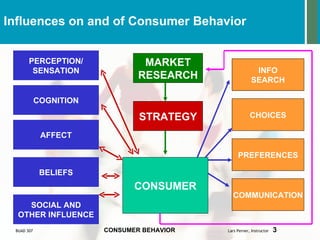
Influences on and of Consumer Behavior CONSUMER PERCEPTION/ SENSATION COGNITION AFFECT BELIEFS SOCIAL AND OTHER INFLUENCE INFO SEARCH CHOICES PREFERENCES COMMUNICATION MARKET RESEARCH STRATEGY
Learning Outcome Objectives Understand how consumer cognitive (thinking) processes and limitations, affect, beliefs, social influences, and other contextual factors influence consumer decision making, choices, and behavior Appreciate how these insights can be used to design and implement effective marketing strategies Appreciate individual and segment differences in process and outcome
True or False? If you have bad breath, you cannot smell it yourself. If you eat a balanced diet, you do not need vitamin supplements. Using a razor with five blades will reduce the likelihood of cutting yourself and will result in less skin irritation. Dell Computers tend to be of higher quality than those made by HP and Sony. Rust stains on clothes can be removed with the use of lemon juice.  Bleach actually makes these stains worse.
Questions Faced By Consumers Are veggie burgers actually healthy? What makeup should you use to get an “even” skin tone? Do I get any useful benefits from spending more than $125 on a digital camera? Should I get a “make-over?”  What am I looking for?  What should I do? Is my mechanic honest? Which tie should I wear for a job interview? Should I give my wife roses, chocolate, or software?
Consumer Problems and Recognition Consumer problem:   Discrepancy between  ideal  and  actua l state--e.g., consumer: Has insufficient hair Is hungry Has run out of ink in his or her inkjet cartridge Problems can be solved in several ways -- e.g., stress  reduction <-----  vacation, movie, hot bath, medication
CONSUMER DECISIONS: Theory and Reality in Consumer Buying INFORMATION SEARCH PROBLEM RECOGNITION EVALUATION OF ALTERNATIVES PURCHASE POSTPURCHASE EVALUATION/ BEHAVIORS Theory Complications
Approaches to Search for Problem Solutions INTERNAL EXTERNAL Memory Thinking Word of mouth, media, store visits, trial CATALOG
Options Identified and Considered UNIVERSAL SET RETRIEVED SET EVOKED SET All possible options Options that readily come to mind Options that will be considered by the consumer Note:  Retrieved and evoked sets will vary among different consumers
REMINDER For low involvement products, efforts aimed at affecting  internal  search tend to be more effective—the consumer is usually not willing to expend energy on external search. External search is more likely for higher involvement products.
Decision Making Issues Involvement level Temporary Enduring Consumer locus of control Internal External Product category complexity Consumer knowledge
Evaluation Type Compensatory:   Decision based on overall value of alternatives (good attribute can outweigh bad ones) Non-compensatory:   Absolutely must meet at least one important criterion (e.g., car must have automatic transmission) Hybrid :  Combination of the two (e.g., one non-compensatory measure, then compensatory tradeoffs on other attributes Abandoned strategy:  Consumer finds initial criteria unrealistic and proceeds to less desirable solution IMPORTANT LESS IMPORTANT
Heuristics—Low Involvement Decision Rules If either Coke or Pepsi is on sale, buy that brand; otherwise, buy Coke The larger the navels, the better the orange The larger package is likely to offer a lower unit price (not true in reality)
Attitudes―components BELIEFS AFFECT (FEELING) BEHAVIORAL INTENTIONS
Attitude Components Beliefs Can be positive, negative, or neutral May or may not be accurate May contradict other beliefs held by the other person Affect May be positive or negative May take on specific dimension (e.g., pleasure, disgust) Behavioral Intentions An individual’s plan or expectations of what he or she will do May appear inconsistent with beliefs  May not predict well what the individual will do in reality
Generating Beliefs Through Advertising Statements must be Perceived Comprehended Remembered Believed (at least in part)
Positioning Through Creating Beliefs “ It’s not delivery; it’s De Journo!” “ Wal-Mart.  Always low prices.  Always.” “ I just saved a bunch of money on my auto insurance.” “ U-um Good!” (Campbell’s Soup)
Multiattribute Models of Attitude Attitude computed as a function of multiple attributes weighted for importance: A b = attitude toward brand b W i :  weight of attribute I X i b: belief about brand b’s performance on attribute I Model assumes rationality Calculations will  not  be required on the exam.  You should know conceptually what this involves  conceptually —i.e., weighing importance and intensity of feeling.
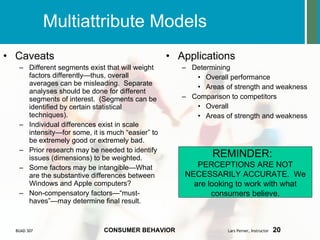
Multiattribute Models Caveats Different segments exist that will weight factors differently—thus, overall averages can be misleading.  Separate analyses should be done for different segments of interest.  (Segments can be identified by certain statistical techniques). Individual differences exist in scale intensity—for some, it is much “easier” to be extremely good or extremely bad. Prior research may be needed to identify issues (dimensions) to be weighted. Some factors may be intangible—What are the substantive differences between Windows and Apple computers? Non-compensatory factors—“must-haves”—may determine final result. Applications Determining Overall performance Areas of strength and weakness Comparison to competitors Overall Areas of strength and weakness REMINDER:  PERCEPTIONS ARE NOT NECESSARILY ACCURATE.  We are looking to work with what consumers believe.
Affect Based on past emotional associations of product emotional effect of beliefs
Attitude Characteristics Availability/accessibility Constructed vs. natural Strength
Measurement of Attitude Components Beliefs Semantic Differential Scales Good -------------------Bad Fast --------------------Slow Reliable-----------------Unreliable Feelings Likert Scales (Strongly agree … Strongly Disagree) “ This product makes me happy.”
Measurement Behavioral Intention Rating of likelihood of purchase May need projection if social desirability affects willingness to admit to product use
Attitude Change Strategies, Part I Change Affect Classical conditioning “ Pairing” the brand or product with desired stimulus—e.g., a car with a beautiful woman Attitude toward the ad A likable ad for a brand in a mundane product category—e.g., Energizer Bunny Snuggles (fabric softener) Mere exposure
Attitude Change Strategies II Change behavior (e.g., sampling) Attitudes are inferred from behavior (e.g., I buy the product    I must like it or It must be good) Change Belief Component Change existing beliefs Difficult Advertiser’s motives are suspect Change importance of attributes Add beliefs Change ideal (fashion)
Adding Beliefs (True or Not):  Examples Brushing and flossing do not reach all areas of the mouth People under stress need more vitamins Baking soda will reduce odor of refrigerators Fragmented hard drives may cause computer errors
REMINDER Changing currently held beliefs tends to be difficult—people know the marketer has an ulterior motive Adding new beliefs  that are not inconsistent with what is already believed may be more effective
One-sided vs. two sided appeals One-sided:  only saying what favors your side Two-sided:  stating your case but also admitting points favoring the other side Why is this effective?
Potential Family Life Cycle Stages YOUNG SINGLE BLENDED SINGLE  PARENT FULL NEST  I/II/III EMPTY NEST I/II OLDER SINGLE YOUNG COUPLE
Economic/Marketing Implications of Household Cycles Income tends to increase with time But children/ obligations add cost Divorce increases costs may change income distribution marriage Product demand due to singles with low expenses new couples divorced families children empty nesters  --> more income
Household Decision Making Roles/influence Information gatherers/holders Influencers Decision makers Purchasers Users
The Means-End Chain Large engine Fast acceleration Performance Feeling of power Self-esteem Aim  promotion/ positioning at higher levels of chain ! Attributes Consequences Values
Subliminal Perception:  A Diabolical Marketing Tool? Subliminal messages in ads are illegal in U.S. Some research support for modest effects Probably limited to one syllable words Complex messages can probably not be processed subliminally
Message Framing Many tradeoffs can be stated in two, mathematically equivalent ways—e.g., “ 80% lean” vs. “20% fat” $49.00 per person per night based on double occupancy
Some Consumer Behavior Issues That Will Come Up Elsewhere in the Course Demographics (segmentation) Lifestyle (segmentation) Culture/subculture (segmentation, international marketing) Diffusion of innovation (product) Attention (promotion)
Organizational Buyers Types Industrial Reseller Government and non-profit organizations Purchase types Straight rebuy Limited decision making Extended decision making Characteristics Greater involvement Bureaucracy Long term relationships Price is important but may not be the most important factor

Consumer behavior

  • 1.
    CONSUMER BEHAVIOR BUAD307 MARKETING FUNDAMENTALS
  • 2.
    Why does Staplessell Starbucks coffee?
  • 3.
    Influences on andof Consumer Behavior CONSUMER PERCEPTION/ SENSATION COGNITION AFFECT BELIEFS SOCIAL AND OTHER INFLUENCE INFO SEARCH CHOICES PREFERENCES COMMUNICATION MARKET RESEARCH STRATEGY
  • 4.
    Learning Outcome ObjectivesUnderstand how consumer cognitive (thinking) processes and limitations, affect, beliefs, social influences, and other contextual factors influence consumer decision making, choices, and behavior Appreciate how these insights can be used to design and implement effective marketing strategies Appreciate individual and segment differences in process and outcome
  • 5.
    True or False?If you have bad breath, you cannot smell it yourself. If you eat a balanced diet, you do not need vitamin supplements. Using a razor with five blades will reduce the likelihood of cutting yourself and will result in less skin irritation. Dell Computers tend to be of higher quality than those made by HP and Sony. Rust stains on clothes can be removed with the use of lemon juice. Bleach actually makes these stains worse.
  • 6.
    Questions Faced ByConsumers Are veggie burgers actually healthy? What makeup should you use to get an “even” skin tone? Do I get any useful benefits from spending more than $125 on a digital camera? Should I get a “make-over?” What am I looking for? What should I do? Is my mechanic honest? Which tie should I wear for a job interview? Should I give my wife roses, chocolate, or software?
  • 7.
    Consumer Problems andRecognition Consumer problem: Discrepancy between ideal and actua l state--e.g., consumer: Has insufficient hair Is hungry Has run out of ink in his or her inkjet cartridge Problems can be solved in several ways -- e.g., stress reduction <----- vacation, movie, hot bath, medication
  • 8.
    CONSUMER DECISIONS: Theoryand Reality in Consumer Buying INFORMATION SEARCH PROBLEM RECOGNITION EVALUATION OF ALTERNATIVES PURCHASE POSTPURCHASE EVALUATION/ BEHAVIORS Theory Complications
  • 9.
    Approaches to Searchfor Problem Solutions INTERNAL EXTERNAL Memory Thinking Word of mouth, media, store visits, trial CATALOG
  • 10.
    Options Identified andConsidered UNIVERSAL SET RETRIEVED SET EVOKED SET All possible options Options that readily come to mind Options that will be considered by the consumer Note: Retrieved and evoked sets will vary among different consumers
  • 11.
    REMINDER For lowinvolvement products, efforts aimed at affecting internal search tend to be more effective—the consumer is usually not willing to expend energy on external search. External search is more likely for higher involvement products.
  • 12.
    Decision Making IssuesInvolvement level Temporary Enduring Consumer locus of control Internal External Product category complexity Consumer knowledge
  • 13.
    Evaluation Type Compensatory: Decision based on overall value of alternatives (good attribute can outweigh bad ones) Non-compensatory: Absolutely must meet at least one important criterion (e.g., car must have automatic transmission) Hybrid : Combination of the two (e.g., one non-compensatory measure, then compensatory tradeoffs on other attributes Abandoned strategy: Consumer finds initial criteria unrealistic and proceeds to less desirable solution IMPORTANT LESS IMPORTANT
  • 14.
    Heuristics—Low Involvement DecisionRules If either Coke or Pepsi is on sale, buy that brand; otherwise, buy Coke The larger the navels, the better the orange The larger package is likely to offer a lower unit price (not true in reality)
  • 15.
    Attitudes―components BELIEFS AFFECT(FEELING) BEHAVIORAL INTENTIONS
  • 16.
    Attitude Components BeliefsCan be positive, negative, or neutral May or may not be accurate May contradict other beliefs held by the other person Affect May be positive or negative May take on specific dimension (e.g., pleasure, disgust) Behavioral Intentions An individual’s plan or expectations of what he or she will do May appear inconsistent with beliefs May not predict well what the individual will do in reality
  • 17.
    Generating Beliefs ThroughAdvertising Statements must be Perceived Comprehended Remembered Believed (at least in part)
  • 18.
    Positioning Through CreatingBeliefs “ It’s not delivery; it’s De Journo!” “ Wal-Mart. Always low prices. Always.” “ I just saved a bunch of money on my auto insurance.” “ U-um Good!” (Campbell’s Soup)
  • 19.
    Multiattribute Models ofAttitude Attitude computed as a function of multiple attributes weighted for importance: A b = attitude toward brand b W i : weight of attribute I X i b: belief about brand b’s performance on attribute I Model assumes rationality Calculations will not be required on the exam. You should know conceptually what this involves conceptually —i.e., weighing importance and intensity of feeling.
  • 20.
    Multiattribute Models CaveatsDifferent segments exist that will weight factors differently—thus, overall averages can be misleading. Separate analyses should be done for different segments of interest. (Segments can be identified by certain statistical techniques). Individual differences exist in scale intensity—for some, it is much “easier” to be extremely good or extremely bad. Prior research may be needed to identify issues (dimensions) to be weighted. Some factors may be intangible—What are the substantive differences between Windows and Apple computers? Non-compensatory factors—“must-haves”—may determine final result. Applications Determining Overall performance Areas of strength and weakness Comparison to competitors Overall Areas of strength and weakness REMINDER: PERCEPTIONS ARE NOT NECESSARILY ACCURATE. We are looking to work with what consumers believe.
  • 21.
    Affect Based onpast emotional associations of product emotional effect of beliefs
  • 22.
  • 23.
    Measurement of AttitudeComponents Beliefs Semantic Differential Scales Good -------------------Bad Fast --------------------Slow Reliable-----------------Unreliable Feelings Likert Scales (Strongly agree … Strongly Disagree) “ This product makes me happy.”
  • 24.
    Measurement Behavioral IntentionRating of likelihood of purchase May need projection if social desirability affects willingness to admit to product use
  • 25.
    Attitude Change Strategies,Part I Change Affect Classical conditioning “ Pairing” the brand or product with desired stimulus—e.g., a car with a beautiful woman Attitude toward the ad A likable ad for a brand in a mundane product category—e.g., Energizer Bunny Snuggles (fabric softener) Mere exposure
  • 26.
    Attitude Change StrategiesII Change behavior (e.g., sampling) Attitudes are inferred from behavior (e.g., I buy the product  I must like it or It must be good) Change Belief Component Change existing beliefs Difficult Advertiser’s motives are suspect Change importance of attributes Add beliefs Change ideal (fashion)
  • 27.
    Adding Beliefs (Trueor Not): Examples Brushing and flossing do not reach all areas of the mouth People under stress need more vitamins Baking soda will reduce odor of refrigerators Fragmented hard drives may cause computer errors
  • 28.
    REMINDER Changing currentlyheld beliefs tends to be difficult—people know the marketer has an ulterior motive Adding new beliefs that are not inconsistent with what is already believed may be more effective
  • 29.
    One-sided vs. twosided appeals One-sided: only saying what favors your side Two-sided: stating your case but also admitting points favoring the other side Why is this effective?
  • 30.
    Potential Family LifeCycle Stages YOUNG SINGLE BLENDED SINGLE PARENT FULL NEST I/II/III EMPTY NEST I/II OLDER SINGLE YOUNG COUPLE
  • 31.
    Economic/Marketing Implications ofHousehold Cycles Income tends to increase with time But children/ obligations add cost Divorce increases costs may change income distribution marriage Product demand due to singles with low expenses new couples divorced families children empty nesters --> more income
  • 32.
    Household Decision MakingRoles/influence Information gatherers/holders Influencers Decision makers Purchasers Users
  • 33.
    The Means-End ChainLarge engine Fast acceleration Performance Feeling of power Self-esteem Aim promotion/ positioning at higher levels of chain ! Attributes Consequences Values
  • 34.
    Subliminal Perception: A Diabolical Marketing Tool? Subliminal messages in ads are illegal in U.S. Some research support for modest effects Probably limited to one syllable words Complex messages can probably not be processed subliminally
  • 35.
    Message Framing Manytradeoffs can be stated in two, mathematically equivalent ways—e.g., “ 80% lean” vs. “20% fat” $49.00 per person per night based on double occupancy
  • 36.
    Some Consumer BehaviorIssues That Will Come Up Elsewhere in the Course Demographics (segmentation) Lifestyle (segmentation) Culture/subculture (segmentation, international marketing) Diffusion of innovation (product) Attention (promotion)
  • 37.
    Organizational Buyers TypesIndustrial Reseller Government and non-profit organizations Purchase types Straight rebuy Limited decision making Extended decision making Characteristics Greater involvement Bureaucracy Long term relationships Price is important but may not be the most important factor

Editor's Notes

  • #10 We now turn to the consumer’s search for potential solutions to the problems that he or she is facing. Search strategies can be divided into those involving internal and external search, although consumers may use both in some combination. Internal search is based on the consumer’s memory and his or her thinking processes. In the case of a motorist stranded with a blown tire, for example, he or she may remember preferred provider of replacement tires and thus go to that one. An implication of this reality is that it may pay to advertise to establish an identity among potential future consumers. For example, bail bonds people will advertise on TV to people, suggesting a solution if they, for some reason, should find themselves in jail. Similarly, Midas Mufflers and various other auto service providers attempt to create internal beliefs about the benefits of patronizing their establishments if and when the need arises. Aamco Transmissions advertises that half the half the transmissions they see do not need to be replaced, presumably implying that it is safer to take a car there than to ostensibly less skilled competitors. The marketer, however, faces some significant problems in creating this kind of awareness. First, many consumers, not readily expecting to encounter a need for the products and services in question, may have little motivation to process and store the information. Secondly, recalling the relevant information may be difficult as need arises. External search involves the consultation of outside sources, ranging from friends and acquaintances to the yellow pages and the media. (We will revisit this issue in Chapter 18, when we discuss, within the context of the diffusion of innovation, which
  • #34 15 11