Chapter 9
Conditioning and Learning
Processes
Classical Conditioning
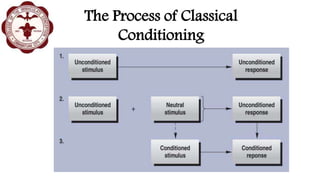
•Process by which a neutral stimulus becomes
capable of eliciting a response because it was
repeatedly paired with a stimulus that naturally
causes the response
–Unconditional stimuli
–Unconditioned response
–Conditioned response
Classical Conditioning cont.
•Process of classical conditioning
–Can be accomplished not only with unconditioned stimuli, but also with
previously conditioned stimuli
–Classically conditioned behaviors are controlled by stimuli that occur
before the behavior
•Process of classical conditioning
–The behaviors influenced by classical conditioning are assumed to be
under the control of the autonomic nervous system
–Affective responses often follow the principles of classical conditioning
Classical Conditioning cont.
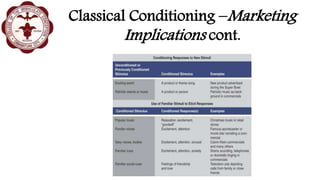
•Marketing and consumer behavior implications
–Product-related stimuli
–Closer contact
–General emotional responses as a result of stimuli
–Stimuli at or near point of purchase
•Consumer research on classical conditioning
•Classical conditioning:
–Likely to be most useful for low-involvement purchases
–Also useful for high-involvement purchases
The Process of Classical
Conditioning
Classical Conditioning –Marketing Implications
•Directs attention to the presentation of stimuli that, elicit
affect in consumers, because of previous conditioning
•Marketers may find it useful to condition responses to
stimuli
Classical Conditioning –Marketing
Implications cont.
Operant Conditioning
•Process of altering the probability of a behavior being
emitted by changing the consequences of the behavior
–Differs from classical conditioning
•Operant conditioning deals with behaviors that are usually under the
conscious control of the individual
•Operant behaviors are emitted because of consequences that occur after the
behavior
•At any given time there is a certain probability that an individual will emit a
particular behavior
•Response hierarchy
o All of the possible behaviors arranged in descending order of probability of
occurrence
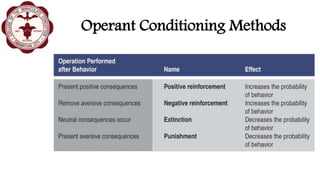
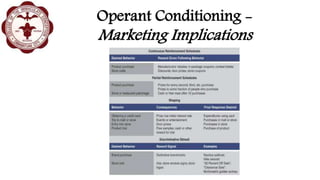
Operant Conditioning Methods
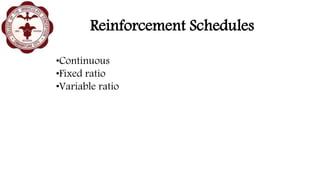
Reinforcement Schedules
•Continuous
•Fixed ratio
•Variable ratio
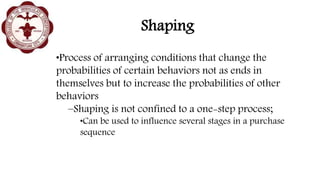
Shaping
•Process of arranging conditions that change the
probabilities of certain behaviors not as ends in
themselves but to increase the probabilities of other
behaviors
–Shaping is not confined to a one-step process;
•Can be used to influence several stages in a purchase
sequence
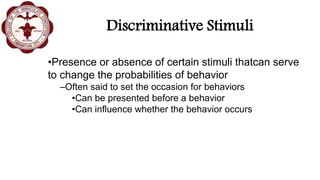
Discriminative Stimuli
•Presence or absence of certain stimuli thatcan serve
to change the probabilities of behavior
–Often said to set the occasion for behaviors
•Can be presented before a behavior
•Can influence whether the behavior occurs
Operant Conditioning -
Marketing Implications
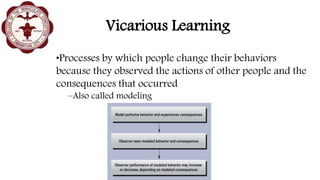
Vicarious Learning
•Processes by which people change their behaviors
because they observed the actions of other people and the
consequences that occurred
–Also called modeling
Uses of Vicarious Learning in
Marketing Strategy
•Developing new responses
•Inhibiting undesired responses
•Response facilitation
Factors Influencing Modeling
Effectiveness
•Model and modeled behavior characteristics
•Observer characteristics
•Characteristics of modeled consequences
Vicarious Learning -Marketing
Implications
•Helpful in developing information contact
behaviors
•Used to increase store contact and product
contact behaviors
•Used to influence funds access and transactions
•Used to influence consumption by demonstrating
how a product can be used safely and effectively
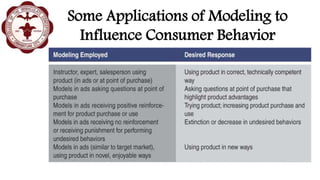
Some Applications of Modeling to
Influence Consumer Behavior
Summary
•Classical conditioning was discussed
•Examined how marketers use classical
conditioning to create favorable affect and increase
chances that consumers will perform desired
behaviors
•Operant conditioning was described
Summary cont.
•Learned about discriminative stimuli
•Examined how the consequence of behaviors are
arranged to either increase or decrease the
behaviors in the future

Chapter 9

  • 1.
    Chapter 9 Conditioning andLearning Processes
  • 2.
    Classical Conditioning •Process bywhich a neutral stimulus becomes capable of eliciting a response because it was repeatedly paired with a stimulus that naturally causes the response –Unconditional stimuli –Unconditioned response –Conditioned response
  • 3.
    Classical Conditioning cont. •Processof classical conditioning –Can be accomplished not only with unconditioned stimuli, but also with previously conditioned stimuli –Classically conditioned behaviors are controlled by stimuli that occur before the behavior •Process of classical conditioning –The behaviors influenced by classical conditioning are assumed to be under the control of the autonomic nervous system –Affective responses often follow the principles of classical conditioning
  • 4.
    Classical Conditioning cont. •Marketingand consumer behavior implications –Product-related stimuli –Closer contact –General emotional responses as a result of stimuli –Stimuli at or near point of purchase •Consumer research on classical conditioning •Classical conditioning: –Likely to be most useful for low-involvement purchases –Also useful for high-involvement purchases
  • 5.
    The Process ofClassical Conditioning
  • 6.
    Classical Conditioning –MarketingImplications •Directs attention to the presentation of stimuli that, elicit affect in consumers, because of previous conditioning •Marketers may find it useful to condition responses to stimuli
  • 7.
  • 8.
    Operant Conditioning •Process ofaltering the probability of a behavior being emitted by changing the consequences of the behavior –Differs from classical conditioning •Operant conditioning deals with behaviors that are usually under the conscious control of the individual •Operant behaviors are emitted because of consequences that occur after the behavior •At any given time there is a certain probability that an individual will emit a particular behavior •Response hierarchy o All of the possible behaviors arranged in descending order of probability of occurrence
  • 9.
  • 10.
  • 11.
    Shaping •Process of arrangingconditions that change the probabilities of certain behaviors not as ends in themselves but to increase the probabilities of other behaviors –Shaping is not confined to a one-step process; •Can be used to influence several stages in a purchase sequence
  • 12.
    Discriminative Stimuli •Presence orabsence of certain stimuli thatcan serve to change the probabilities of behavior –Often said to set the occasion for behaviors •Can be presented before a behavior •Can influence whether the behavior occurs
  • 13.
  • 14.
    Vicarious Learning •Processes bywhich people change their behaviors because they observed the actions of other people and the consequences that occurred –Also called modeling
  • 15.
    Uses of VicariousLearning in Marketing Strategy •Developing new responses •Inhibiting undesired responses •Response facilitation
  • 16.
    Factors Influencing Modeling Effectiveness •Modeland modeled behavior characteristics •Observer characteristics •Characteristics of modeled consequences
  • 17.
    Vicarious Learning -Marketing Implications •Helpfulin developing information contact behaviors •Used to increase store contact and product contact behaviors •Used to influence funds access and transactions •Used to influence consumption by demonstrating how a product can be used safely and effectively
  • 18.
    Some Applications ofModeling to Influence Consumer Behavior
  • 19.
    Summary •Classical conditioning wasdiscussed •Examined how marketers use classical conditioning to create favorable affect and increase chances that consumers will perform desired behaviors •Operant conditioning was described
  • 20.
    Summary cont. •Learned aboutdiscriminative stimuli •Examined how the consequence of behaviors are arranged to either increase or decrease the behaviors in the future