
Design
Graphic
?:
:?
Texture
VS
Patterns
Principles
Dr. Mohammed Tawfik
Textures range from the smoothest polished
mirror to the rough mountain range as seen
from an airplane. The term is often misused to
refer only to rough surfaces, but this is not
correct. All surfaces have texture.
Principles
Dr. Mohammed Tawfik
There are two types of Textures:
1- Tactile texture
2- Visual Texture
Principles
Dr. Mohammed Tawfik
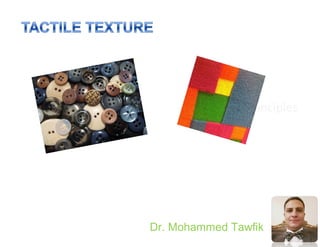
Tactile is a texture we can feel by rubbing our hand over it.
Tactile texture is the actual (3D) feel of a surface.
This is of paramount importance to three-dimensional design, but of only
moderate interest in two-dimensional design. The actual surface texture
needs to either be felt, or seen with a light raking across its surface to make
the texture visible.
Some painters add sand to their paint to make a more tactile texture.
Collages can use textured paper and other three-dimensional materials
(like string, cardboard, sandpaper, etc.) to make a tactile surface.
Principles
Dr. Mohammed Tawfik
Principles
Dr. Mohammed Tawfik
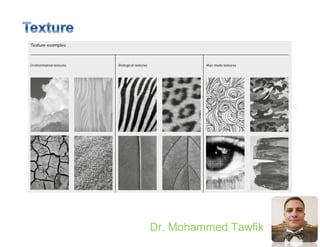
Visual texture that we can see but we can’t feel it.
Visual texture refers to the illusion of the surface texture.
 It is what tactile texture looks like (on a 2D surface).
The textures you see in a photograph are visual textures. No matter how
rough objects in the photograph look, the surface of the photograph is
smooth and flat.
Both types are important to the designer, but in 2D art, the illusion of
texture is used more than tactile texture.
Principles
Dr. Mohammed Tawfik
Principles
Dr. Mohammed Tawfik
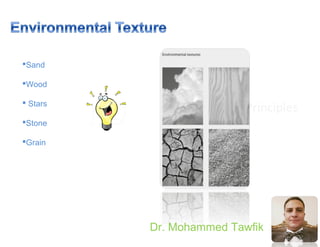
Sand
Wood
 Stars
Stone
Grain
Principles
Dr. Mohammed Tawfik
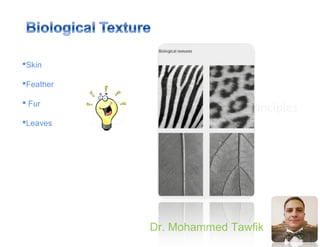
Skin
Feather
 Fur
Leaves
Principles
Dr. Mohammed Tawfik
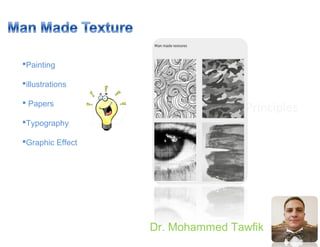
Painting
illustrations
 Papers
Typography
Graphic Effect
Principles
Dr. Mohammed Tawfik
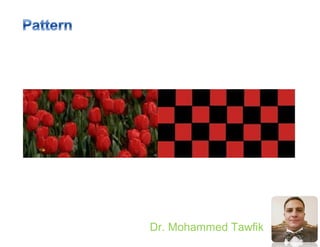
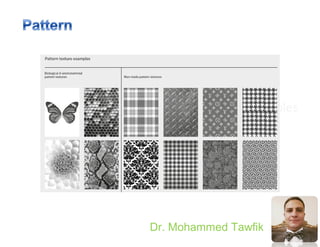
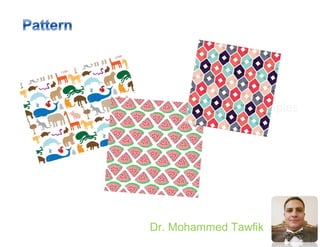
A recognizable motif regularly repeated, produces a pattern.
The pattern requires. The more regular the repetition, the stronger the
pattern.
Compare this field of flowers with a checkerboard. Both have a repeating
motif.
The most noticeable patterns occur when you see the group before the
individuals -- notice the organization first (the checkerboard).
Principles
Dr. Mohammed Tawfik
Principles
Dr. Mohammed Tawfik
Principles
Dr. Mohammed Tawfik
Principles
Dr. Mohammed Tawfik
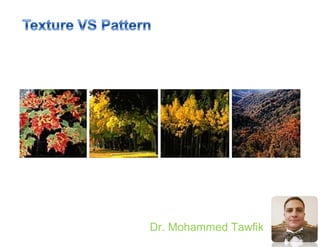
Texture and pattern are related.
 When you look closely at a tree you can see the pattern of leaves that
make it surface.
 When you back away you lose awareness of the leaves and notice the
texture the leaves are made on the tree.
 Farther away still and you can see the pattern of the trees making up the
forest and finally the texture of the forest.
 In this way pattern changes in texture as you lose sight of the individual
motifs.
 This is easy to do with natural patterns, but you have to get quite far away
from a checkerboard grid to see it as a texture.
Principles
Dr. Mohammed Tawfik
Principles
Dr. Mohammed Tawfik
Patterns are generally more noticeable than textures. This makes them
a stronger visual element for controlling attention.
Texture is random while pattern makes a structure
Patterns works well in decoration & gift wraps as it excite the visual sense
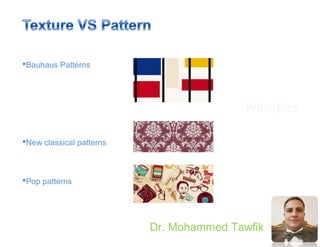
Bauhaus Patterns
New classical patterns
Pop patterns
Principles
Dr. Mohammed Tawfik
Bauhaus Patterns
New classical patterns
Pop patterns
Texture and pattern, graphic design

Texture and pattern, graphic design