PowerPoint Presentation by Charlie Cook
The University of West Alabama
t e n t h e d i t i o n
GaryGary
DesslerDessler
ChapterChapter 1010 PartPart 33 Training and DevelopmentTraining and DevelopmentAppendix
Managing CareersManaging Careers
After studying this chapter,After studying this chapter,
you should be able to:you should be able to:
1. Compare employers’ traditional and career
planning-oriented HR focuses
2. Explain the employee’s manager’s and employer’s
career development roles
3. Describe the issues to consider when making
promotion decisions
4. Describe the methods for enhancing diversity
through career management
5. Answer the question: How can career
development foster employee commitment?
10–10–22
10–3
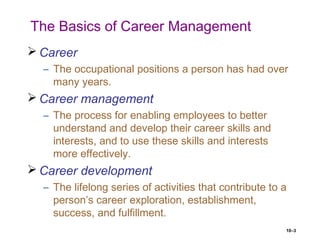
The Basics of Career Management
 Career
– The occupational positions a person has had over
many years.
 Career management
– The process for enabling employees to better
understand and develop their career skills and
interests, and to use these skills and interests
more effectively.
 Career development
– The lifelong series of activities that contribute to a
person’s career exploration, establishment,
success, and fulfillment.
10–4
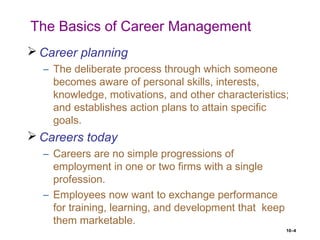
The Basics of Career Management
 Career planning
– The deliberate process through which someone
becomes aware of personal skills, interests,
knowledge, motivations, and other characteristics;
and establishes action plans to attain specific
goals.
 Careers today
– Careers are no simple progressions of
employment in one or two firms with a single
profession.
– Employees now want to exchange performance
for training, learning, and development that keep
them marketable.
10–5
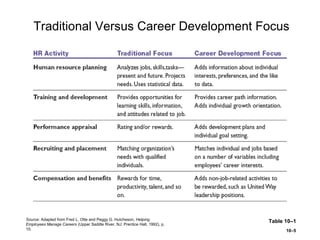
Traditional Versus Career Development Focus
Table 10–1Source: Adapted from Fred L. Otte and Peggy G. Hutcheson, Helping
Employees Manage Careers (Upper Saddle River, NJ: Prentice Hall, 1992), p.
10.
10–6
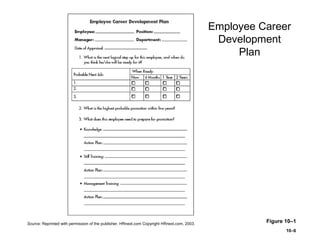
Employee Career
Development
Plan
Figure 10–1Source: Reprinted with permission of the publisher, HRnext.com Copyright HRnext.com, 2003.
10–7
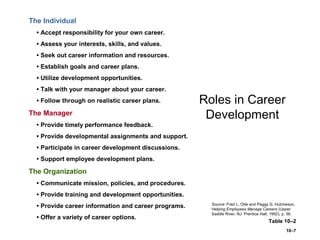
The Individual
• Accept responsibility for your own career.
• Assess your interests, skills, and values.
• Seek out career information and resources.
• Establish goals and career plans.
• Utilize development opportunities.
• Talk with your manager about your career.
• Follow through on realistic career plans.
The Manager
• Provide timely performance feedback.
• Provide developmental assignments and support.
• Participate in career development discussions.
• Support employee development plans.
The Organization
• Communicate mission, policies, and procedures.
• Provide training and development opportunities.
• Provide career information and career programs.
• Offer a variety of career options.
Roles in Career
Development
Table 10–2
Source: Fred L. Otte and Peggy G. Hutcheson,
Helping Employees Manage Careers (Upper
Saddle River, NJ: Prentice Hall, 1992), p. 56.
10–8
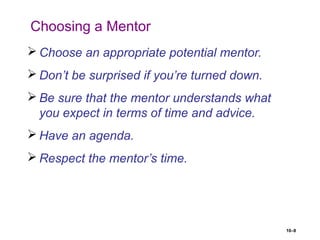
Choosing a Mentor
 Choose an appropriate potential mentor.
 Don’t be surprised if you’re turned down.
 Be sure that the mentor understands what
you expect in terms of time and advice.
 Have an agenda.
 Respect the mentor’s time.
10–9
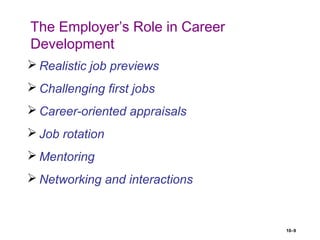
The Employer’s Role in Career
Development
 Realistic job previews
 Challenging first jobs
 Career-oriented appraisals
 Job rotation
 Mentoring
 Networking and interactions
10–10
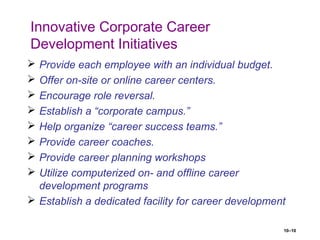
Innovative Corporate Career
Development Initiatives
 Provide each employee with an individual budget.
 Offer on-site or online career centers.
 Encourage role reversal.
 Establish a “corporate campus.”
 Help organize “career success teams.”
 Provide career coaches.
 Provide career planning workshops
 Utilize computerized on- and offline career
development programs
 Establish a dedicated facility for career development
10–11
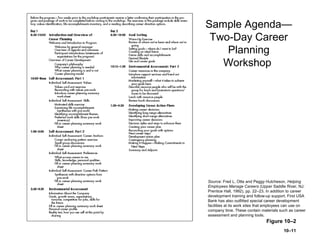
Sample Agenda—
Two-Day Career
Planning
Workshop
Figure 10–2
Source: Fred L. Otte and Peggy Hutcheson, Helping
Employees Manage Careers (Upper Saddle River, NJ:
Prentice Hall, 1992), pp. 22–23. In addition to career
development training and follow-up support, First USA
Bank has also outfitted special career development
facilities at its work sites that employees can use on
company time. These contain materials such as career
assessment and planning tools.
10–12
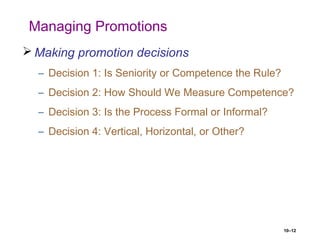
Managing Promotions
 Making promotion decisions
– Decision 1: Is Seniority or Competence the Rule?
– Decision 2: How Should We Measure Competence?
– Decision 3: Is the Process Formal or Informal?
– Decision 4: Vertical, Horizontal, or Other?
10–13
Managing Transfers
 Employees’ reasons for desiring transfers
– Personal enrichment and growth
– More interesting jobs
– Greater convenience (better hours, location)
– Greater advancement possibilities
 Employers’ reasons for transferring employees
– To vacate a position where an employee is no
longer needed.
– To fill a position where an employee is needed.
– To find a better fit for an employee within the firm.
– To boost productivity by consolidating positions.
10–14
Enhancing Diversity through Career
Management
 Sources of bias and discrimination in
promotion decisions
– Having few people of color employed in the hiring
department
– The “old-boy network” of informal friendships
– A lack of women mentors
– A lack of high-visibility assignments and
developmental experiences (glass ceiling)
– A lack of company role models for members of the
same racial or ethnic group
– Inflexible organizations and career tracks
10–15
Enhancing Women’s and Minorities’
Prospects
 Eliminate institutional barriers
 Improve networking and mentoring
 Eliminate the glass ceiling
 Institute flexible schedules and career tracks
10–16
Career Management and Employee
Commitment
 The “New Psychological Contract”
– Old contract: “Do your best and be loyal to us,
and we’ll take care of your career.”
– New contract: “Do your best for us and be loyal
to us for as long as you’re here, and we’ll provide
you with the developmental opportunities you’ll
need to move on and have a successful career.”
10–17
Career Management and Employee
Commitment
 Commitment-oriented career development
efforts
– Career development programs
• Career workshops that use vocational guidance tools
(including a computerized skills assessment program
and other career gap analysis tools) to help employees
identify career-related skills and the development needs
they possess.
– Career-oriented appraisals
• Provide the ideal occasion to link the employee’s
performance, career interests, and developmental needs
into a coherent career plan.
10–18
Retirement
 Retirement
– The point at which one gives up one’s work,
usually between the ages of 60 and 65.
 Preretirement practices
– Explanation of Social Security benefits
– Leisure time counseling
– Financial and investment counseling
– Health counseling
– Psychological counseling
– Counseling for second careers
– Counseling for second careers inside the company
10–19
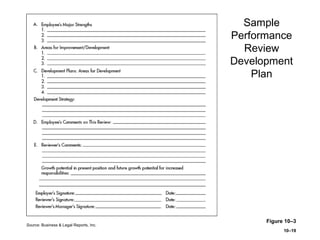
Sample
Performance
Review
Development
Plan
Figure 10–3
Source: Business & Legal Reports, Inc.
10–20
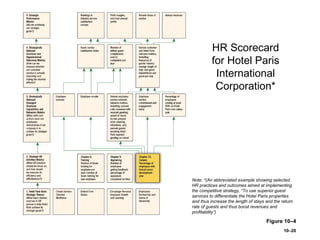
Figure 10–4
HR Scorecard
for Hotel Paris
International
Corporation*
Note: *(An abbreviated example showing selected
HR practices and outcomes aimed at implementing
the competitive strategy, “To use superior guest
services to differentiate the Hotel Paris properties
and thus increase the length of stays and the return
rate of guests and thus boost revenues and
profitability”)
10–21
Key Terms
career
career management
career development
career planning
career planning and
development
reality shock
job rotation
mentoring
promotions
transfers
retirement
preretirement counseling
career cycle
growth stage
exploration stage
establishment stage
trial substage
stabilization substage
midcareer crisis substage
maintenance stage
decline stage
career anchors
PowerPoint Presentation by Charlie Cook
The University of West Alabama
t e n t h e d i t i o n
GaryGary
DesslerDessler
ChapterChapter 1010 PartPart 33 Training and DevelopmentTraining and DevelopmentAppendix
Managing Your CareerManaging Your Career
© 2005 Prentice Hall Inc. All rights reserved. 10–23
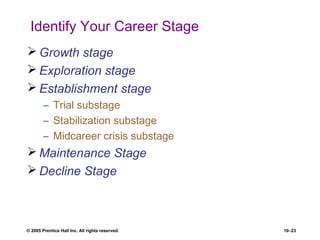
Identify Your Career Stage
 Growth stage
 Exploration stage
 Establishment stage
– Trial substage
– Stabilization substage
– Midcareer crisis substage
 Maintenance Stage
 Decline Stage
© 2005 Prentice Hall Inc. All rights reserved. 10–24
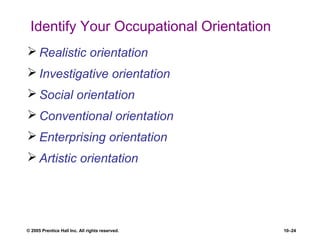
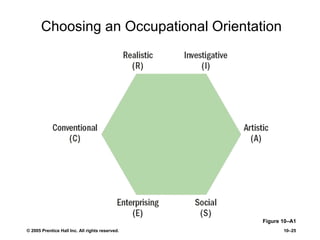
Identify Your Occupational Orientation
 Realistic orientation
 Investigative orientation
 Social orientation
 Conventional orientation
 Enterprising orientation
 Artistic orientation
© 2005 Prentice Hall Inc. All rights reserved. 10–25
Choosing an Occupational Orientation
Figure 10–A1
© 2005 Prentice Hall Inc. All rights reserved. 10–26
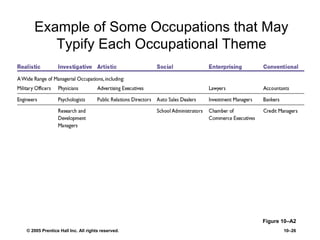
Example of Some Occupations that May
Typify Each Occupational Theme
Figure 10–A2
© 2005 Prentice Hall Inc. All rights reserved. 10–27
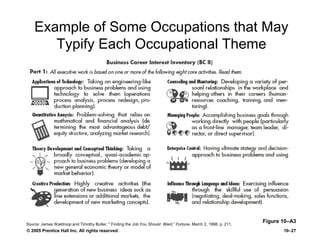
Example of Some Occupations that May
Typify Each Occupational Theme
Figure 10–A3Source: James Waldroop and Timothy Butler, " Finding the Job You Should Want,” Fortune, March 2, 1998, p. 211.
© 2005 Prentice Hall Inc. All rights reserved. 10–28
Identify Your Career Anchors
 Career anchor
– A concern or value that a person you will not give
up if a [career] choice has to be made.
 Typical career anchors
– Technical/functional competence
– Managerial competence
– Creativity
– Autonomy and independence
– Security
© 2005 Prentice Hall Inc. All rights reserved. 10–29
Finding the Right Job
 Do Your Own Local Research
 Personal Contacts
 Answering Advertisements
 Employment Agencies
 Executive Recruiters
 Career Counselors
 Executive Marketing Consultants
 Employers’ Web Sites
© 2005 Prentice Hall Inc. All rights reserved. 10–30
Writing Your Résumé
 Introductory Information
 Job Objective
 Job Scope
 Your Accomplishments
 Length
 Personal Data
 Make Your Résumé Scannable
© 2005 Prentice Hall Inc. All rights reserved. 10–31
Handling the Interview
 Prepare, Prepare, Prepare
 Uncover the Interviewer’s Needs
 Relate Yourself to the Person’s Needs
 Think Before Answering
 Make a Good Appearance and Show
Enthusiasm

Managing careers

  • 1.
    PowerPoint Presentation byCharlie Cook The University of West Alabama t e n t h e d i t i o n GaryGary DesslerDessler ChapterChapter 1010 PartPart 33 Training and DevelopmentTraining and DevelopmentAppendix Managing CareersManaging Careers
  • 2.
    After studying thischapter,After studying this chapter, you should be able to:you should be able to: 1. Compare employers’ traditional and career planning-oriented HR focuses 2. Explain the employee’s manager’s and employer’s career development roles 3. Describe the issues to consider when making promotion decisions 4. Describe the methods for enhancing diversity through career management 5. Answer the question: How can career development foster employee commitment? 10–10–22
  • 3.
    10–3 The Basics ofCareer Management  Career – The occupational positions a person has had over many years.  Career management – The process for enabling employees to better understand and develop their career skills and interests, and to use these skills and interests more effectively.  Career development – The lifelong series of activities that contribute to a person’s career exploration, establishment, success, and fulfillment.
  • 4.
    10–4 The Basics ofCareer Management  Career planning – The deliberate process through which someone becomes aware of personal skills, interests, knowledge, motivations, and other characteristics; and establishes action plans to attain specific goals.  Careers today – Careers are no simple progressions of employment in one or two firms with a single profession. – Employees now want to exchange performance for training, learning, and development that keep them marketable.
  • 5.
    10–5 Traditional Versus CareerDevelopment Focus Table 10–1Source: Adapted from Fred L. Otte and Peggy G. Hutcheson, Helping Employees Manage Careers (Upper Saddle River, NJ: Prentice Hall, 1992), p. 10.
  • 6.
    10–6 Employee Career Development Plan Figure 10–1Source:Reprinted with permission of the publisher, HRnext.com Copyright HRnext.com, 2003.
  • 7.
    10–7 The Individual • Acceptresponsibility for your own career. • Assess your interests, skills, and values. • Seek out career information and resources. • Establish goals and career plans. • Utilize development opportunities. • Talk with your manager about your career. • Follow through on realistic career plans. The Manager • Provide timely performance feedback. • Provide developmental assignments and support. • Participate in career development discussions. • Support employee development plans. The Organization • Communicate mission, policies, and procedures. • Provide training and development opportunities. • Provide career information and career programs. • Offer a variety of career options. Roles in Career Development Table 10–2 Source: Fred L. Otte and Peggy G. Hutcheson, Helping Employees Manage Careers (Upper Saddle River, NJ: Prentice Hall, 1992), p. 56.
  • 8.
    10–8 Choosing a Mentor Choose an appropriate potential mentor.  Don’t be surprised if you’re turned down.  Be sure that the mentor understands what you expect in terms of time and advice.  Have an agenda.  Respect the mentor’s time.
  • 9.
    10–9 The Employer’s Rolein Career Development  Realistic job previews  Challenging first jobs  Career-oriented appraisals  Job rotation  Mentoring  Networking and interactions
  • 10.
    10–10 Innovative Corporate Career DevelopmentInitiatives  Provide each employee with an individual budget.  Offer on-site or online career centers.  Encourage role reversal.  Establish a “corporate campus.”  Help organize “career success teams.”  Provide career coaches.  Provide career planning workshops  Utilize computerized on- and offline career development programs  Establish a dedicated facility for career development
  • 11.
    10–11 Sample Agenda— Two-Day Career Planning Workshop Figure10–2 Source: Fred L. Otte and Peggy Hutcheson, Helping Employees Manage Careers (Upper Saddle River, NJ: Prentice Hall, 1992), pp. 22–23. In addition to career development training and follow-up support, First USA Bank has also outfitted special career development facilities at its work sites that employees can use on company time. These contain materials such as career assessment and planning tools.
  • 12.
    10–12 Managing Promotions  Makingpromotion decisions – Decision 1: Is Seniority or Competence the Rule? – Decision 2: How Should We Measure Competence? – Decision 3: Is the Process Formal or Informal? – Decision 4: Vertical, Horizontal, or Other?
  • 13.
    10–13 Managing Transfers  Employees’reasons for desiring transfers – Personal enrichment and growth – More interesting jobs – Greater convenience (better hours, location) – Greater advancement possibilities  Employers’ reasons for transferring employees – To vacate a position where an employee is no longer needed. – To fill a position where an employee is needed. – To find a better fit for an employee within the firm. – To boost productivity by consolidating positions.
  • 14.
    10–14 Enhancing Diversity throughCareer Management  Sources of bias and discrimination in promotion decisions – Having few people of color employed in the hiring department – The “old-boy network” of informal friendships – A lack of women mentors – A lack of high-visibility assignments and developmental experiences (glass ceiling) – A lack of company role models for members of the same racial or ethnic group – Inflexible organizations and career tracks
  • 15.
    10–15 Enhancing Women’s andMinorities’ Prospects  Eliminate institutional barriers  Improve networking and mentoring  Eliminate the glass ceiling  Institute flexible schedules and career tracks
  • 16.
    10–16 Career Management andEmployee Commitment  The “New Psychological Contract” – Old contract: “Do your best and be loyal to us, and we’ll take care of your career.” – New contract: “Do your best for us and be loyal to us for as long as you’re here, and we’ll provide you with the developmental opportunities you’ll need to move on and have a successful career.”
  • 17.
    10–17 Career Management andEmployee Commitment  Commitment-oriented career development efforts – Career development programs • Career workshops that use vocational guidance tools (including a computerized skills assessment program and other career gap analysis tools) to help employees identify career-related skills and the development needs they possess. – Career-oriented appraisals • Provide the ideal occasion to link the employee’s performance, career interests, and developmental needs into a coherent career plan.
  • 18.
    10–18 Retirement  Retirement – Thepoint at which one gives up one’s work, usually between the ages of 60 and 65.  Preretirement practices – Explanation of Social Security benefits – Leisure time counseling – Financial and investment counseling – Health counseling – Psychological counseling – Counseling for second careers – Counseling for second careers inside the company
  • 19.
  • 20.
    10–20 Figure 10–4 HR Scorecard forHotel Paris International Corporation* Note: *(An abbreviated example showing selected HR practices and outcomes aimed at implementing the competitive strategy, “To use superior guest services to differentiate the Hotel Paris properties and thus increase the length of stays and the return rate of guests and thus boost revenues and profitability”)
  • 21.
    10–21 Key Terms career career management careerdevelopment career planning career planning and development reality shock job rotation mentoring promotions transfers retirement preretirement counseling career cycle growth stage exploration stage establishment stage trial substage stabilization substage midcareer crisis substage maintenance stage decline stage career anchors
  • 22.
    PowerPoint Presentation byCharlie Cook The University of West Alabama t e n t h e d i t i o n GaryGary DesslerDessler ChapterChapter 1010 PartPart 33 Training and DevelopmentTraining and DevelopmentAppendix Managing Your CareerManaging Your Career
  • 23.
    © 2005 PrenticeHall Inc. All rights reserved. 10–23 Identify Your Career Stage  Growth stage  Exploration stage  Establishment stage – Trial substage – Stabilization substage – Midcareer crisis substage  Maintenance Stage  Decline Stage
  • 24.
    © 2005 PrenticeHall Inc. All rights reserved. 10–24 Identify Your Occupational Orientation  Realistic orientation  Investigative orientation  Social orientation  Conventional orientation  Enterprising orientation  Artistic orientation
  • 25.
    © 2005 PrenticeHall Inc. All rights reserved. 10–25 Choosing an Occupational Orientation Figure 10–A1
  • 26.
    © 2005 PrenticeHall Inc. All rights reserved. 10–26 Example of Some Occupations that May Typify Each Occupational Theme Figure 10–A2
  • 27.
    © 2005 PrenticeHall Inc. All rights reserved. 10–27 Example of Some Occupations that May Typify Each Occupational Theme Figure 10–A3Source: James Waldroop and Timothy Butler, " Finding the Job You Should Want,” Fortune, March 2, 1998, p. 211.
  • 28.
    © 2005 PrenticeHall Inc. All rights reserved. 10–28 Identify Your Career Anchors  Career anchor – A concern or value that a person you will not give up if a [career] choice has to be made.  Typical career anchors – Technical/functional competence – Managerial competence – Creativity – Autonomy and independence – Security
  • 29.
    © 2005 PrenticeHall Inc. All rights reserved. 10–29 Finding the Right Job  Do Your Own Local Research  Personal Contacts  Answering Advertisements  Employment Agencies  Executive Recruiters  Career Counselors  Executive Marketing Consultants  Employers’ Web Sites
  • 30.
    © 2005 PrenticeHall Inc. All rights reserved. 10–30 Writing Your Résumé  Introductory Information  Job Objective  Job Scope  Your Accomplishments  Length  Personal Data  Make Your Résumé Scannable
  • 31.
    © 2005 PrenticeHall Inc. All rights reserved. 10–31 Handling the Interview  Prepare, Prepare, Prepare  Uncover the Interviewer’s Needs  Relate Yourself to the Person’s Needs  Think Before Answering  Make a Good Appearance and Show Enthusiasm