Network Access
Layer Security
Protocols
Prof. Kirti Ahirrao 1
Index:
Network
access layer
security
protocols
• Layer 2 Forwarding protocol
• Point-to-pointTunneling Protocol
• Layer 2Tunneling Protocol
• Virtual private networking
Types of
Network
access layer
protocols
Prof. Kirti Ahirrao 2
Network access layer security
protocols
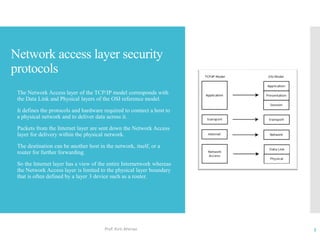
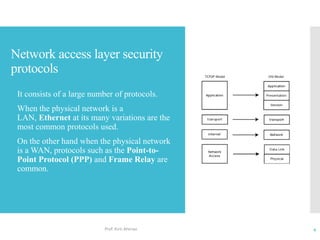
 The Network Access layer of the TCP/IP model corresponds with
the Data Link and Physical layers of the OSI reference model.
 It defines the protocols and hardware required to connect a host to
a physical network and to deliver data across it.
 Packets from the Internet layer are sent down the Network Access
layer for delivery within the physical network.
 The destination can be another host in the network, itself, or a
router for further forwarding.
 So the Internet layer has a view of the entire Internetwork whereas
the Network Access layer is limited to the physical layer boundary
that is often defined by a layer 3 device such as a router.
Prof. Kirti Ahirrao 3
Network access layer security
protocols
 It consists of a large number of protocols.
 When the physical network is a
LAN, Ethernet at its many variations are the
most common protocols used.
 On the other hand when the physical network
is a WAN, protocols such as the Point-to-
Point Protocol (PPP) and Frame Relay are
common.
Prof. Kirti Ahirrao 4
Network access layer security
protocols
Several protocols serve various functions at the Network Access layer,
including:
• Ethernet
• Wireless 802.11A, 802.11B, 802.11G and 802.11N
• FDDI
• ATM
• Frame Relay
• Pleisiosynchronous Digital Hierarchy (PDH)
• Synchronous Digital Hierarchy (SDH)
• OC3, OC12, OC48 etc.
Prof. Kirti Ahirrao 5
Layer 2 Forwarding(L2F)
Protocols:
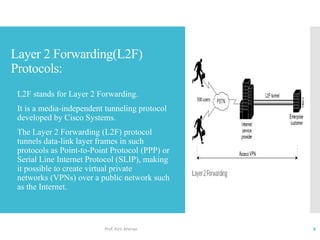
 L2F stands for Layer 2 Forwarding.
 It is a media-independent tunneling protocol
developed by Cisco Systems.
 The Layer 2 Forwarding (L2F) protocol
tunnels data-link layer frames in such
protocols as Point-to-Point Protocol (PPP) or
Serial Line Internet Protocol (SLIP), making
it possible to create virtual private
networks (VPNs) over a public network such
as the Internet.
Prof. Kirti Ahirrao 6
Layer 2 Forwarding(L2F)
Protocols (working)
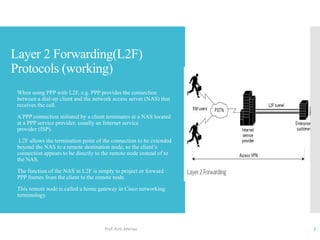
 When using PPP with L2F, e.g. PPP provides the connection
between a dial-up client and the network access server (NAS) that
receives the call.
 A PPP connection initiated by a client terminates at a NAS located
at a PPP service provider, usually an Internet service
provider (ISP).
 L2F allows the termination point of the connection to be extended
beyond the NAS to a remote destination node, so the client’s
connection appears to be directly to the remote node instead of to
the NAS.
 The function of the NAS in L2F is simply to project or forward
PPP frames from the client to the remote node.
 This remote node is called a home gateway in Cisco networking
terminology.
Prof. Kirti Ahirrao 7
Layer 2 Forwarding(L2F) Protocols -
(working)
 L2F has been largely superseded by the newer Layer 2 Tunneling
Protocol (L2TP), an Internet Engineering Task Force (IETF)
standard protocol that provides a vendor-neutral tunneling
solution.
 L2TP is an extension of the PPP protocol that supports the best
features of the Point-to-Point Tunneling Protocol (PPTP) and the
L2F protocol
Prof. Kirti Ahirrao 8
Point-to-Point
Protocol(PPP):
 Point-to-Point Protocol (PPP) is a Network
layer (layer 3) communications protocol, between
two routers directly without any host or any other
networking in between.
 It can provide connection authentication,
transmission encryption and compression.
 PPP is used over many types of physical networks
including serial cable, phone line, trunk line, cellular
telephone, specialized radio links, and fiber optic
links such as SONET.
 Internet service providers (ISPs) have used PPP for
customer dial-up access to the Internet, since IP
packets cannot be transmitted over a modem line on
their own, without some data link protocol that can
identify where the transmitted frame starts and where
it ends.
 Two derivatives of PPP, Point-to-Point Protocol over
Ethernet (PPPoE) and Point-to-Point Protocol over
ATM (PPPoA), are used most commonly by ISPs to
establish a digital subscriber line (DSL) Internet
service connection with customers.
Prof. Kirti Ahirrao 9
Point-to-Point
Protocol(PPP):
 PPP is a layered protocol that has three
components:
1.An encapsulation component that is used
to transmit datagrams over the
specified physical layer.
2.A Link Control Protocol (LCP) to
establish, configure, and test the link as
well as negotiate settings, options and the
use of features.
3.One or more Network Control Protocols
(NCP) used to negotiate optional
configuration parameters and facilities for
the network layer. There is one NCP for
each higher-layer protocol supported by
PPP.
Prof. Kirti Ahirrao 10
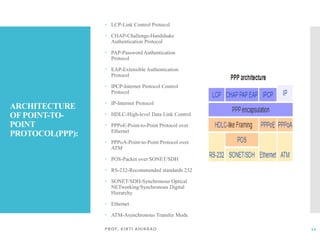
ARCHITECTURE
OFPOINT-TO-
POINT
PROTOCOL(PPP):
 LCP-Link Control Protocol
 CHAP-Challenge-Handshake
Authentication Protocol
 PAP-Password Authentication
Protocol
 EAP-Extensible Authentication
Protocol
 IPCP-Internet Protocol Control
Protocol
 IP-Internet Protocol
 HDLC-High-level Data Link Control
 PPPoE-Point-to-Point Protocol over
Ethernet
 PPPoA-Point-to-Point Protocol over
ATM
 POS-Packet over SONET/SDH
 RS-232-Recommended standards 232
 SONET/SDH-Synchronous Optical
NETworking/Synchronous Digital
Hierarchy
 Ethernet
 ATM-Asynchronous Transfer Mode
PROF. KIRTI AHIRRAO 11
Layer 2 Tunneling
Protocol(L2TP):
 It is a tunneling protocol used to
support virtual private
networks (VPNs) or as part of the
delivery of services by ISPs.
 It does not provide
any encryption or confidentiality
by itself.
 Rather, it relies on an encryption
protocol that it passes within the
tunnel to provide privacy.
Prof. Kirti Ahirrao 12
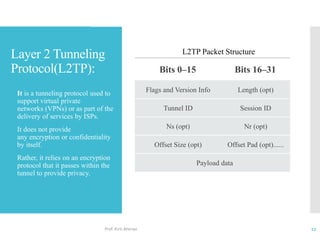
Bits 0–15 Bits 16–31
Flags and Version Info Length (opt)
Tunnel ID Session ID
Ns (opt) Nr (opt)
Offset Size (opt) Offset Pad (opt)......
Payload data
L2TP packet structure:
L2TP Packet Structure
 The two endpoints of an L2TP tunnel are called
the LAC (L2TP Access Concentrator) and the LNS (L2TP
Network Server).
 The LNS waits for new tunnels. Once a tunnel is established,
the network traffic between the peers is bidirectional.
 To be useful for networking, higher-level protocols are then
run through the L2TP tunnel.
 To facilitate this, an L2TP session (or 'call') is established
within the tunnel for each higher-level protocol such as PPP.
 Either the LAC or LNS may initiate sessions.
 The traffic for each session is isolated by L2TP, so it is
possible to set up multiple virtual networks across a single
tunnel. Maximum Transmission Unit (MTU) should be
considered when implementing L2TP.
 L2TP allows the creation of a virtual private dialup network
(VPDN) to connect a remote client to its corporate network
by using a shared infrastructure, which could be the Internet
or a service provider's network.
L2TP
(Working):
Prof. Kirti Ahirrao 13
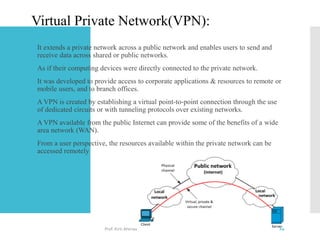
 It extends a private network across a public network and enables users to send and
receive data across shared or public networks.
 As if their computing devices were directly connected to the private network.
 It was developed to provide access to corporate applications & resources to remote or
mobile users, and to branch offices.
 A VPN is created by establishing a virtual point-to-point connection through the use
of dedicated circuits or with tunneling protocols over existing networks.
 A VPN available from the public Internet can provide some of the benefits of a wide
area network (WAN).
 From a user perspective, the resources available within the private network can be
accessed remotely
Prof. Kirti Ahirrao 14
Virtual Private Network(VPN):
Virtual Private
Network(VPN):
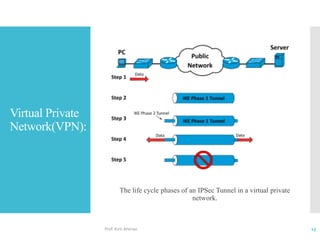
The life cycle phases of an IPSec Tunnel in a virtual private
network.
Prof. Kirti Ahirrao 15
Virtual Private
Network(VPN):
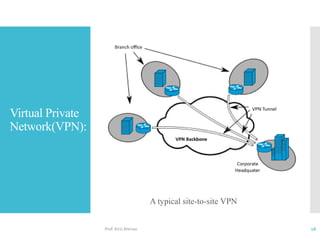
A typical site-to-site VPN
Prof. Kirti Ahirrao 16
References:
 en.wikipedia.org/wiki
 networkencyclopedia.com
Prof. Kirti Ahirrao 17
THANKYOU
PROF. KIRTI AHIRRAO 18

Network access layer security protocol

  • 1.
  • 2.
    Index: Network access layer security protocols • Layer2 Forwarding protocol • Point-to-pointTunneling Protocol • Layer 2Tunneling Protocol • Virtual private networking Types of Network access layer protocols Prof. Kirti Ahirrao 2
  • 3.
    Network access layersecurity protocols  The Network Access layer of the TCP/IP model corresponds with the Data Link and Physical layers of the OSI reference model.  It defines the protocols and hardware required to connect a host to a physical network and to deliver data across it.  Packets from the Internet layer are sent down the Network Access layer for delivery within the physical network.  The destination can be another host in the network, itself, or a router for further forwarding.  So the Internet layer has a view of the entire Internetwork whereas the Network Access layer is limited to the physical layer boundary that is often defined by a layer 3 device such as a router. Prof. Kirti Ahirrao 3
  • 4.
    Network access layersecurity protocols  It consists of a large number of protocols.  When the physical network is a LAN, Ethernet at its many variations are the most common protocols used.  On the other hand when the physical network is a WAN, protocols such as the Point-to- Point Protocol (PPP) and Frame Relay are common. Prof. Kirti Ahirrao 4
  • 5.
    Network access layersecurity protocols Several protocols serve various functions at the Network Access layer, including: • Ethernet • Wireless 802.11A, 802.11B, 802.11G and 802.11N • FDDI • ATM • Frame Relay • Pleisiosynchronous Digital Hierarchy (PDH) • Synchronous Digital Hierarchy (SDH) • OC3, OC12, OC48 etc. Prof. Kirti Ahirrao 5
  • 6.
    Layer 2 Forwarding(L2F) Protocols: L2F stands for Layer 2 Forwarding.  It is a media-independent tunneling protocol developed by Cisco Systems.  The Layer 2 Forwarding (L2F) protocol tunnels data-link layer frames in such protocols as Point-to-Point Protocol (PPP) or Serial Line Internet Protocol (SLIP), making it possible to create virtual private networks (VPNs) over a public network such as the Internet. Prof. Kirti Ahirrao 6
  • 7.
    Layer 2 Forwarding(L2F) Protocols(working)  When using PPP with L2F, e.g. PPP provides the connection between a dial-up client and the network access server (NAS) that receives the call.  A PPP connection initiated by a client terminates at a NAS located at a PPP service provider, usually an Internet service provider (ISP).  L2F allows the termination point of the connection to be extended beyond the NAS to a remote destination node, so the client’s connection appears to be directly to the remote node instead of to the NAS.  The function of the NAS in L2F is simply to project or forward PPP frames from the client to the remote node.  This remote node is called a home gateway in Cisco networking terminology. Prof. Kirti Ahirrao 7
  • 8.
    Layer 2 Forwarding(L2F)Protocols - (working)  L2F has been largely superseded by the newer Layer 2 Tunneling Protocol (L2TP), an Internet Engineering Task Force (IETF) standard protocol that provides a vendor-neutral tunneling solution.  L2TP is an extension of the PPP protocol that supports the best features of the Point-to-Point Tunneling Protocol (PPTP) and the L2F protocol Prof. Kirti Ahirrao 8
  • 9.
    Point-to-Point Protocol(PPP):  Point-to-Point Protocol(PPP) is a Network layer (layer 3) communications protocol, between two routers directly without any host or any other networking in between.  It can provide connection authentication, transmission encryption and compression.  PPP is used over many types of physical networks including serial cable, phone line, trunk line, cellular telephone, specialized radio links, and fiber optic links such as SONET.  Internet service providers (ISPs) have used PPP for customer dial-up access to the Internet, since IP packets cannot be transmitted over a modem line on their own, without some data link protocol that can identify where the transmitted frame starts and where it ends.  Two derivatives of PPP, Point-to-Point Protocol over Ethernet (PPPoE) and Point-to-Point Protocol over ATM (PPPoA), are used most commonly by ISPs to establish a digital subscriber line (DSL) Internet service connection with customers. Prof. Kirti Ahirrao 9
  • 10.
    Point-to-Point Protocol(PPP):  PPP isa layered protocol that has three components: 1.An encapsulation component that is used to transmit datagrams over the specified physical layer. 2.A Link Control Protocol (LCP) to establish, configure, and test the link as well as negotiate settings, options and the use of features. 3.One or more Network Control Protocols (NCP) used to negotiate optional configuration parameters and facilities for the network layer. There is one NCP for each higher-layer protocol supported by PPP. Prof. Kirti Ahirrao 10
  • 11.
    ARCHITECTURE OFPOINT-TO- POINT PROTOCOL(PPP):  LCP-Link ControlProtocol  CHAP-Challenge-Handshake Authentication Protocol  PAP-Password Authentication Protocol  EAP-Extensible Authentication Protocol  IPCP-Internet Protocol Control Protocol  IP-Internet Protocol  HDLC-High-level Data Link Control  PPPoE-Point-to-Point Protocol over Ethernet  PPPoA-Point-to-Point Protocol over ATM  POS-Packet over SONET/SDH  RS-232-Recommended standards 232  SONET/SDH-Synchronous Optical NETworking/Synchronous Digital Hierarchy  Ethernet  ATM-Asynchronous Transfer Mode PROF. KIRTI AHIRRAO 11
  • 12.
    Layer 2 Tunneling Protocol(L2TP): It is a tunneling protocol used to support virtual private networks (VPNs) or as part of the delivery of services by ISPs.  It does not provide any encryption or confidentiality by itself.  Rather, it relies on an encryption protocol that it passes within the tunnel to provide privacy. Prof. Kirti Ahirrao 12 Bits 0–15 Bits 16–31 Flags and Version Info Length (opt) Tunnel ID Session ID Ns (opt) Nr (opt) Offset Size (opt) Offset Pad (opt)...... Payload data L2TP packet structure: L2TP Packet Structure
  • 13.
     The twoendpoints of an L2TP tunnel are called the LAC (L2TP Access Concentrator) and the LNS (L2TP Network Server).  The LNS waits for new tunnels. Once a tunnel is established, the network traffic between the peers is bidirectional.  To be useful for networking, higher-level protocols are then run through the L2TP tunnel.  To facilitate this, an L2TP session (or 'call') is established within the tunnel for each higher-level protocol such as PPP.  Either the LAC or LNS may initiate sessions.  The traffic for each session is isolated by L2TP, so it is possible to set up multiple virtual networks across a single tunnel. Maximum Transmission Unit (MTU) should be considered when implementing L2TP.  L2TP allows the creation of a virtual private dialup network (VPDN) to connect a remote client to its corporate network by using a shared infrastructure, which could be the Internet or a service provider's network. L2TP (Working): Prof. Kirti Ahirrao 13
  • 14.
     It extendsa private network across a public network and enables users to send and receive data across shared or public networks.  As if their computing devices were directly connected to the private network.  It was developed to provide access to corporate applications & resources to remote or mobile users, and to branch offices.  A VPN is created by establishing a virtual point-to-point connection through the use of dedicated circuits or with tunneling protocols over existing networks.  A VPN available from the public Internet can provide some of the benefits of a wide area network (WAN).  From a user perspective, the resources available within the private network can be accessed remotely Prof. Kirti Ahirrao 14 Virtual Private Network(VPN):
  • 15.
    Virtual Private Network(VPN): The lifecycle phases of an IPSec Tunnel in a virtual private network. Prof. Kirti Ahirrao 15
  • 16.
    Virtual Private Network(VPN): A typicalsite-to-site VPN Prof. Kirti Ahirrao 16
  • 17.
  • 18.