Chapter 7 – Electromagnetic Interference of
Power Electronics
1
Advanced Power Electronics (EE4007A/B/D)
19/11/2019
Outline
2
Chapter 7 – Electromagnetic Interference
• Electromagnetic interference (EMI) generation and transmission
• International standards about EMI
• EMI suppression methods
• EMI related power quality issues
3
Chapter 6 – Electromagnetic Interference
Electromagnetic Interference (EMI)
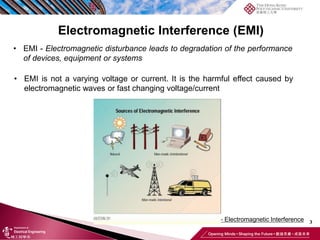
• EMI - Electromagnetic disturbance leads to degradation of the performance
of devices, equipment or systems
• EMI is not a varying voltage or current. It is the harmful effect caused by
electromagnetic waves or fast changing voltage/current
4
Chapter 7 – Electromagnetic Interference
Electromagnetic Interference (EMI)
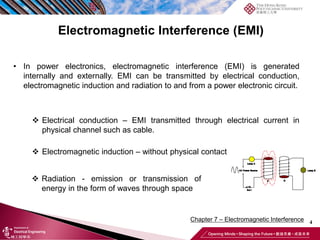
• In power electronics, electromagnetic interference (EMI) is generated
internally and externally. EMI can be transmitted by electrical conduction,
electromagnetic induction and radiation to and from a power electronic circuit.
❖ Electrical conduction – EMI transmitted through electrical current in
physical channel such as cable.
❖ Electromagnetic induction – without physical contact
❖ Radiation - emission or transmission of
energy in the form of waves through space
5
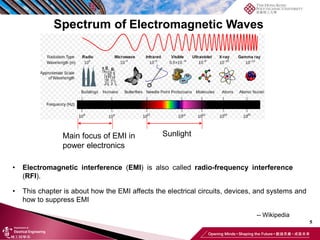
Spectrum of Electromagnetic Waves
• Electromagnetic interference (EMI) is also called radio-frequency interference
(RFI).
Sunlight
Main focus of EMI in
power electronics
-- Wikipedia
• This chapter is about how the EMI affects the electrical circuits, devices, and systems and
how to suppress EMI
6
Chapter 7 – Electromagnetic Interference
Sources of Electromagnetic Interference
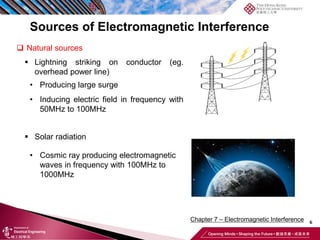
❑ Natural sources
▪ Lightning striking on conductor (eg.
overhead power line)
• Producing large surge
• Inducing electric field in frequency with
50MHz to 100MHz
▪ Solar radiation
• Cosmic ray producing electromagnetic
waves in frequency with 100MHz to
1000MHz
7
Chapter 7 – Electromagnetic Interference
Sources of Electromagnetic Interference
❑ Man-made Sources
▪ Electrostatic discharges (ESD)
• Sudden flow of electricity between two electrically charged objects
caused by contact
▪ Electromagnetic Pulse (EMP)
• From nuclear explosions or any systems or weapons with this
function (eg. EMP Bombs)
▪ Variations in mains supply voltage
• From malfunction of power systems
• From tripping of circuit breakers
• From sudden change of output of power generators, critical loads
and reactive power (VAR)
8
Chapter 7 – Electromagnetic Interference
Sources of Electromagnetic Interference
❑ Man-made Sources
▪ Electrical and electronic sub-systems producing noise from
• Systems and parts in automotive such as ignition systems,
alternators and electric machines
• Power distribution systems including power lines, static VAR
compensators (SVC) and generator stations
• Industrial equipment such as welding machines, induction heaters,
circuit breakers, variable speed drives and oscillators
• Radio transmitters including all mobile communication systems
• Emitted waves generated by switching transient of high frequency
systems such as SMPS and inverters
• Harmonics of input current of appliances from SMPS, motor drives
and any appliances without power factor correction
9
Chapter 7 – Electromagnetic Interference
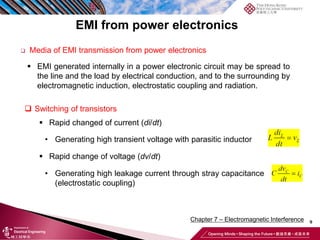
❑ Media of EMI transmission from power electronics
EMI from power electronics
❑ Switching of transistors
▪ Rapid changed of current (di/dt)
• Generating high transient voltage with parasitic inductor
▪ Rapid change of voltage (dv/dt)
• Generating high leakage current through stray capacitance
(electrostatic coupling)
▪ EMI generated internally in a power electronic circuit may be spread to
the line and the load by electrical conduction, and to the surrounding by
electromagnetic induction, electrostatic coupling and radiation.
10
Chapter 7– Electromagnetic Interference
EMI from power electronics
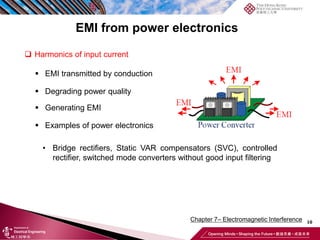
❑ Harmonics of input current
▪ EMI transmitted by conduction
▪ Degrading power quality
▪ Generating EMI
▪ Examples of power electronics
• Bridge rectifiers, Static VAR compensators (SVC), controlled
rectifier, switched mode converters without good input filtering
11
Chapter 7 – Electromagnetic Interference
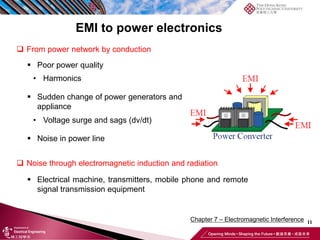
EMI to power electronics
❑ From power network by conduction
▪ Poor power quality
• Harmonics
▪ Sudden change of power generators and
appliance
• Voltage surge and sags (dv/dt)
▪ Noise in power line
❑ Noise through electromagnetic induction and radiation
▪ Electrical machine, transmitters, mobile phone and remote
signal transmission equipment
12
Chapter 7 – Electromagnetic Interference
Definition of Terms of EMI and Harmonics
❑ Electromagnetic Interference (EMI)
▪ Electromagnetic disturbance degrading performance of devices,
equipment or system
▪ Low EMI is preferred
❑ Electromagnetic Compatibility (EMC)
▪ Ability of an equipment or system to function satisfactorily in its
electromagnetic environment without introducing intolerable
electromagnetic disturbances to anything, in that environment
▪ High EMC is preferred
13
Chapter 7 – Electromagnetic Interference
Definition of Terms of EMI and Harmonics
❑ Emission
▪ Phenomenon which which electromagnetic energy emits from a source
▪ Divided into conductive emission and radiated emission
❑ Immunity (what is the difference to EMC?)
▪ Ability of a device, an equipment or a system to perform without
degradation in presence of an electromagnetic disturbance. In other
words, the ability to withstand the EMI
14
Chapter 7 – Electromagnetic Interference
Definition of Terms of EMI and Harmonics
❑ Susceptibility (the inverse of immunity)
▪ Inability of a device, an equipment or a system to perform without
degradation in the presence of an electromagnetic disturbance
❑ Total Harmonic Distortion (THD)
▪ RMS addition of all harmonics, except the fundamental, as compared to
fundamental component
▪ THD can be higher than 100%
▪ Good power quality if THD < 15%
Harmonics is one of the sources causing EMI
15
Chapter 7 – Electromagnetic Interference
International Standards
❑ The British Standards Institute (BSI) -UK
❑ The Federal Communications Commission (FCC) -USA
❑ Verband Deutscher Elektrotechniker (VDE) -Germany
❑ The International Electrotechnical Commission (IEC) -EU
❑ The International Special Committee on Radio Interference
(CISPR) -IEC
▪ Subcommittee of IEC
▪ Firstly proposing EMC standards
❑ CE Mark -EU
❑ Why are Standards needed?
16
Chapter 7 – Electromagnetic Interference
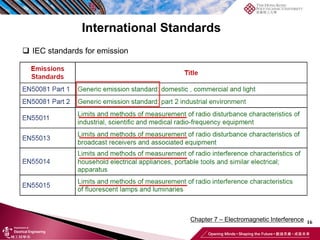
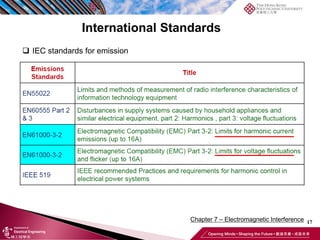
International Standards
❑ IEC standards for emission
17
Chapter 7 – Electromagnetic Interference
International Standards
❑ IEC standards for emission
18
Chapter 7 – Electromagnetic Interference
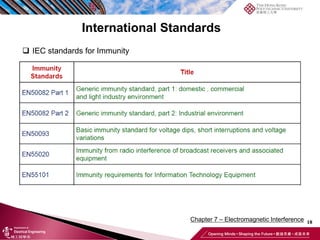
International Standards
❑ IEC standards for Immunity
19
Chapter 7 – Electromagnetic Interference
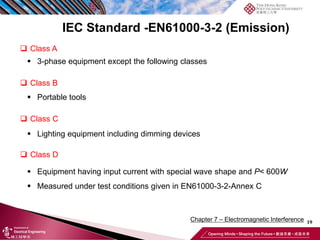
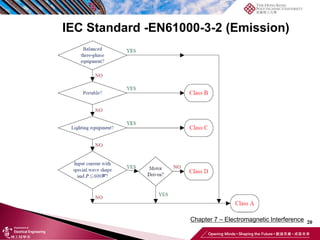
IEC Standard -EN61000-3-2 (Emission)
❑ Class A
▪ 3-phase equipment except the following classes
❑ Class B
▪ Portable tools
❑ Class C
▪ Lighting equipment including dimming devices
❑ Class D
▪ Equipment having input current with special wave shape and P< 600W
▪ Measured under test conditions given in EN61000-3-2-Annex C
20
Chapter 7 – Electromagnetic Interference
IEC Standard -EN61000-3-2 (Emission)
21
Chapter 7 – Electromagnetic Interference
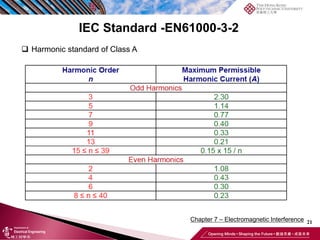
IEC Standard -EN61000-3-2
❑ Harmonic standard of Class A
22
Chapter 7 – Electromagnetic Interference
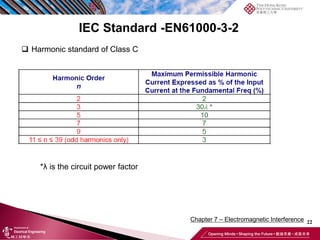
IEC Standard -EN61000-3-2
❑ Harmonic standard of Class C
*λ is the circuit power factor
23
Chapter 7 – Electromagnetic Interference
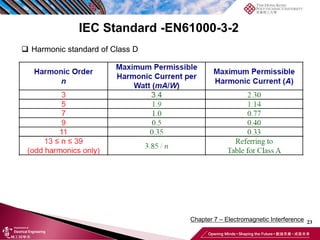
IEC Standard -EN61000-3-2
❑ Harmonic standard of Class D
24
Chapter 7 – Electromagnetic Interference
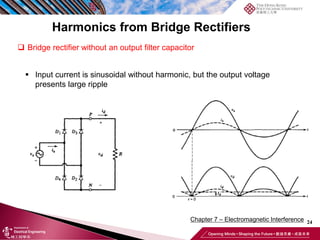
Harmonics from Bridge Rectifiers
❑ Bridge rectifier without an output filter capacitor
▪ Input current is sinusoidal without harmonic, but the output voltage
presents large ripple
25
Chapter 7 – Electromagnetic Interference
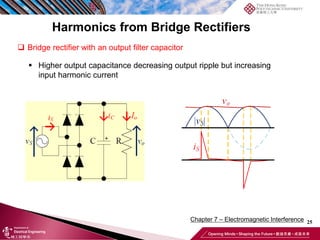
▪ Higher output capacitance decreasing output ripple but increasing
input harmonic current
Harmonics from Bridge Rectifiers
❑ Bridge rectifier with an output filter capacitor
26
Chapter 7 – Electromagnetic Interference
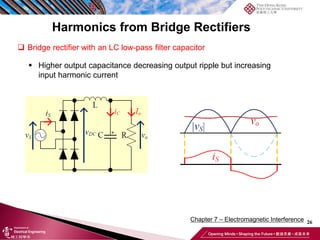
▪ Higher output capacitance decreasing output ripple but increasing
input harmonic current
Harmonics from Bridge Rectifiers
❑ Bridge rectifier with an LC low-pass filter capacitor
27
Chapter 7 – Electromagnetic Interference
Power Factor Correction Converters
❑ Power factor correction (PFC) converters can be used for voltage
rectification with regulated DC output voltage to solve the above input
harmonic current and power factor problem.
❑ AC/DC converter with very high PF and regulated output voltage
❑ Closed-loop controlled for I/P current and O/P voltage
▪ Shape of input current regulated to be half sinusoidal
▪ Phase of input current regulated to be in phase with I/P voltage
❑ Peak current mode control or average current mode control
❑ Size of output filtering capacitor NOT able to be reduced by increasing
switching frequency
28
Chapter 7 – Electromagnetic Interference
Power Factor Correction Converters
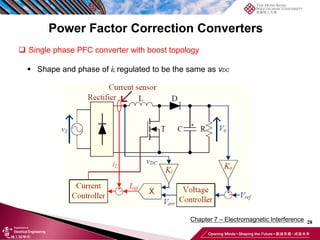
❑ Single phase PFC converter with boost topology
▪ Shape and phase of iL regulated to be the same as vDC
29
Chapter 7 – Electromagnetic Interference
Power Factor Correction Converters
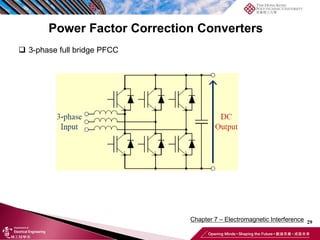
❑ 3-phase full bridge PFCC
30
Chapter 7 – Electromagnetic Interference
Active Harmonic Compensation
❑ Harmonic active filters eliminating a range or whole range of harmonics
❑ Compensating displacement VAR
❑ Fast response
❑ For shunt type, shunt connected to the line
▪ Switched mode converter (Inverters)
▪ Current mode closed-loop control
▪ Similar to STATCOM
▪ Series type active filter similar to SSSC
31
Chapter 7 – Electromagnetic Interference
Active Harmonic Compensation
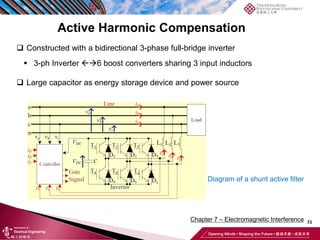
❑ Constructed with a bidirectional 3-phase full-bridge inverter
▪ 3-ph Inverter →6 boost converters sharing 3 input inductors
❑ Large capacitor as energy storage device and power source
Diagram of a shunt active filter
32
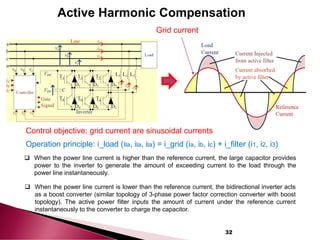
❑ When the power line current is higher than the reference current, the large capacitor provides
power to the inverter to generate the amount of exceeding current to the load through the
power line instantaneously.
❑ When the power line current is lower than the reference current, the bidirectional inverter acts
as a boost converter (similar topology of 3-phase power factor correction converter with boost
topology). The active power filter inputs the amount of current under the reference current
instantaneously to the converter to charge the capacitor.
Active Harmonic Compensation
Control objective: grid current are sinusoidal currents
Operation principle: i_load (ila, ila, ila) = i_grid (ia, ib, ic) + i_filter (i1, i2, i3)
Grid current
33
Chapter 7 – Electromagnetic Interference
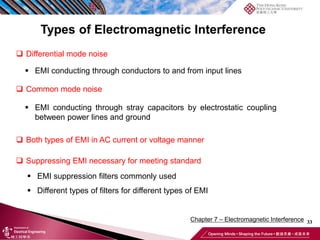
Types of Electromagnetic Interference
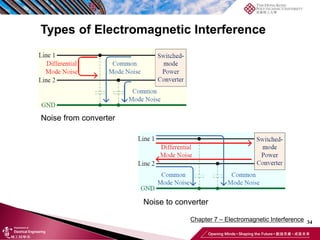
❑ Differential mode noise
❑ Common mode noise
▪ EMI conducting through conductors to and from input lines
▪ EMI conducting through stray capacitors by electrostatic coupling
between power lines and ground
❑ Both types of EMI in AC current or voltage manner
❑ Suppressing EMI necessary for meeting standard
▪ EMI suppression filters commonly used
▪ Different types of filters for different types of EMI
34
Chapter 7 – Electromagnetic Interference
Types of Electromagnetic Interference
Noise from converter
Noise to converter
35
Chapter 7 – Electromagnetic Interference
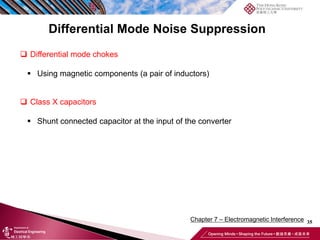
Differential Mode Noise Suppression
❑ Differential mode chokes
▪ Using magnetic components (a pair of inductors)
❑ Class X capacitors
▪ Shunt connected capacitor at the input of the converter
36
Chapter 7 – Electromagnetic Interference
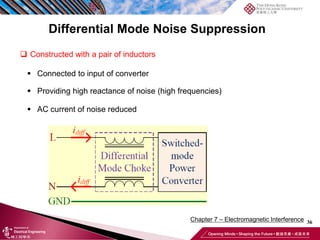
❑ Constructed with a pair of inductors
▪ Connected to input of converter
▪ Providing high reactance of noise (high frequencies)
▪ AC current of noise reduced
Differential Mode Noise Suppression
37
Chapter 7 – Electromagnetic Interference
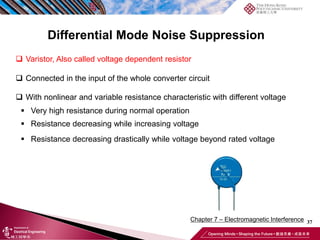
❑ Varistor, Also called voltage dependent resistor
❑ Connected in the input of the whole converter circuit
❑ With nonlinear and variable resistance characteristic with different voltage
▪ Very high resistance during normal operation
▪ Resistance decreasing while increasing voltage
▪ Resistance decreasing drastically while voltage beyond rated voltage
Differential Mode Noise Suppression
38
Chapter 7 – Electromagnetic Interference
❑ Resistance of varistor is very low during surge occurring
❑ Current returning to the power lines
▪ Circuit protected from differential mode voltage surge
▪ Especially surge during switching on the converters
❑ Selecting varistors with different varistor voltage, maximum clamping
voltage and maximum energy (Joule, J)
Differential Mode Noise Suppression
39
Chapter 7 – Electromagnetic Interference
Other Methods for Reducing EMI
❑ Good design of transformers and inductors
▪ Using toroid cores to reducing leakage magnetic flux
❑ Electrical isolation of power converters isolating differential mode
noise by the transformer
❑ Applying snubber circuits for decreasing dv/dt but this decreasing
efficiency of the converters
❑ Applying soft-switching techniques to reduce switching loss, di/dt and
or dv/dt of transistors
40
Chapter 7 – Electromagnetic Interference
Other Methods for Reducing EMI
❑ Good PCB tracks and components arrangement
▪ Decreasing inner area of PCB tracks of current loop ()
▪ Decreasing length of tracks
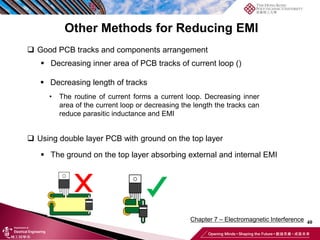
❑ Using double layer PCB with ground on the top layer
▪ The ground on the top layer absorbing external and internal EMI
• The routine of current forms a current loop. Decreasing inner
area of the current loop or decreasing the length the tracks can
reduce parasitic inductance and EMI

Chapter 7 - EMI.pdf

  • 1.
    Chapter 7 –Electromagnetic Interference of Power Electronics 1 Advanced Power Electronics (EE4007A/B/D) 19/11/2019
  • 2.
    Outline 2 Chapter 7 –Electromagnetic Interference • Electromagnetic interference (EMI) generation and transmission • International standards about EMI • EMI suppression methods • EMI related power quality issues
  • 3.
    3 Chapter 6 –Electromagnetic Interference Electromagnetic Interference (EMI) • EMI - Electromagnetic disturbance leads to degradation of the performance of devices, equipment or systems • EMI is not a varying voltage or current. It is the harmful effect caused by electromagnetic waves or fast changing voltage/current
  • 4.
    4 Chapter 7 –Electromagnetic Interference Electromagnetic Interference (EMI) • In power electronics, electromagnetic interference (EMI) is generated internally and externally. EMI can be transmitted by electrical conduction, electromagnetic induction and radiation to and from a power electronic circuit. ❖ Electrical conduction – EMI transmitted through electrical current in physical channel such as cable. ❖ Electromagnetic induction – without physical contact ❖ Radiation - emission or transmission of energy in the form of waves through space
  • 5.
    5 Spectrum of ElectromagneticWaves • Electromagnetic interference (EMI) is also called radio-frequency interference (RFI). Sunlight Main focus of EMI in power electronics -- Wikipedia • This chapter is about how the EMI affects the electrical circuits, devices, and systems and how to suppress EMI
  • 6.
    6 Chapter 7 –Electromagnetic Interference Sources of Electromagnetic Interference ❑ Natural sources ▪ Lightning striking on conductor (eg. overhead power line) • Producing large surge • Inducing electric field in frequency with 50MHz to 100MHz ▪ Solar radiation • Cosmic ray producing electromagnetic waves in frequency with 100MHz to 1000MHz
  • 7.
    7 Chapter 7 –Electromagnetic Interference Sources of Electromagnetic Interference ❑ Man-made Sources ▪ Electrostatic discharges (ESD) • Sudden flow of electricity between two electrically charged objects caused by contact ▪ Electromagnetic Pulse (EMP) • From nuclear explosions or any systems or weapons with this function (eg. EMP Bombs) ▪ Variations in mains supply voltage • From malfunction of power systems • From tripping of circuit breakers • From sudden change of output of power generators, critical loads and reactive power (VAR)
  • 8.
    8 Chapter 7 –Electromagnetic Interference Sources of Electromagnetic Interference ❑ Man-made Sources ▪ Electrical and electronic sub-systems producing noise from • Systems and parts in automotive such as ignition systems, alternators and electric machines • Power distribution systems including power lines, static VAR compensators (SVC) and generator stations • Industrial equipment such as welding machines, induction heaters, circuit breakers, variable speed drives and oscillators • Radio transmitters including all mobile communication systems • Emitted waves generated by switching transient of high frequency systems such as SMPS and inverters • Harmonics of input current of appliances from SMPS, motor drives and any appliances without power factor correction
  • 9.
    9 Chapter 7 –Electromagnetic Interference ❑ Media of EMI transmission from power electronics EMI from power electronics ❑ Switching of transistors ▪ Rapid changed of current (di/dt) • Generating high transient voltage with parasitic inductor ▪ Rapid change of voltage (dv/dt) • Generating high leakage current through stray capacitance (electrostatic coupling) ▪ EMI generated internally in a power electronic circuit may be spread to the line and the load by electrical conduction, and to the surrounding by electromagnetic induction, electrostatic coupling and radiation.
  • 10.
    10 Chapter 7– ElectromagneticInterference EMI from power electronics ❑ Harmonics of input current ▪ EMI transmitted by conduction ▪ Degrading power quality ▪ Generating EMI ▪ Examples of power electronics • Bridge rectifiers, Static VAR compensators (SVC), controlled rectifier, switched mode converters without good input filtering
  • 11.
    11 Chapter 7 –Electromagnetic Interference EMI to power electronics ❑ From power network by conduction ▪ Poor power quality • Harmonics ▪ Sudden change of power generators and appliance • Voltage surge and sags (dv/dt) ▪ Noise in power line ❑ Noise through electromagnetic induction and radiation ▪ Electrical machine, transmitters, mobile phone and remote signal transmission equipment
  • 12.
    12 Chapter 7 –Electromagnetic Interference Definition of Terms of EMI and Harmonics ❑ Electromagnetic Interference (EMI) ▪ Electromagnetic disturbance degrading performance of devices, equipment or system ▪ Low EMI is preferred ❑ Electromagnetic Compatibility (EMC) ▪ Ability of an equipment or system to function satisfactorily in its electromagnetic environment without introducing intolerable electromagnetic disturbances to anything, in that environment ▪ High EMC is preferred
  • 13.
    13 Chapter 7 –Electromagnetic Interference Definition of Terms of EMI and Harmonics ❑ Emission ▪ Phenomenon which which electromagnetic energy emits from a source ▪ Divided into conductive emission and radiated emission ❑ Immunity (what is the difference to EMC?) ▪ Ability of a device, an equipment or a system to perform without degradation in presence of an electromagnetic disturbance. In other words, the ability to withstand the EMI
  • 14.
    14 Chapter 7 –Electromagnetic Interference Definition of Terms of EMI and Harmonics ❑ Susceptibility (the inverse of immunity) ▪ Inability of a device, an equipment or a system to perform without degradation in the presence of an electromagnetic disturbance ❑ Total Harmonic Distortion (THD) ▪ RMS addition of all harmonics, except the fundamental, as compared to fundamental component ▪ THD can be higher than 100% ▪ Good power quality if THD < 15% Harmonics is one of the sources causing EMI
  • 15.
    15 Chapter 7 –Electromagnetic Interference International Standards ❑ The British Standards Institute (BSI) -UK ❑ The Federal Communications Commission (FCC) -USA ❑ Verband Deutscher Elektrotechniker (VDE) -Germany ❑ The International Electrotechnical Commission (IEC) -EU ❑ The International Special Committee on Radio Interference (CISPR) -IEC ▪ Subcommittee of IEC ▪ Firstly proposing EMC standards ❑ CE Mark -EU ❑ Why are Standards needed?
  • 16.
    16 Chapter 7 –Electromagnetic Interference International Standards ❑ IEC standards for emission
  • 17.
    17 Chapter 7 –Electromagnetic Interference International Standards ❑ IEC standards for emission
  • 18.
    18 Chapter 7 –Electromagnetic Interference International Standards ❑ IEC standards for Immunity
  • 19.
    19 Chapter 7 –Electromagnetic Interference IEC Standard -EN61000-3-2 (Emission) ❑ Class A ▪ 3-phase equipment except the following classes ❑ Class B ▪ Portable tools ❑ Class C ▪ Lighting equipment including dimming devices ❑ Class D ▪ Equipment having input current with special wave shape and P< 600W ▪ Measured under test conditions given in EN61000-3-2-Annex C
  • 20.
    20 Chapter 7 –Electromagnetic Interference IEC Standard -EN61000-3-2 (Emission)
  • 21.
    21 Chapter 7 –Electromagnetic Interference IEC Standard -EN61000-3-2 ❑ Harmonic standard of Class A
  • 22.
    22 Chapter 7 –Electromagnetic Interference IEC Standard -EN61000-3-2 ❑ Harmonic standard of Class C *λ is the circuit power factor
  • 23.
    23 Chapter 7 –Electromagnetic Interference IEC Standard -EN61000-3-2 ❑ Harmonic standard of Class D
  • 24.
    24 Chapter 7 –Electromagnetic Interference Harmonics from Bridge Rectifiers ❑ Bridge rectifier without an output filter capacitor ▪ Input current is sinusoidal without harmonic, but the output voltage presents large ripple
  • 25.
    25 Chapter 7 –Electromagnetic Interference ▪ Higher output capacitance decreasing output ripple but increasing input harmonic current Harmonics from Bridge Rectifiers ❑ Bridge rectifier with an output filter capacitor
  • 26.
    26 Chapter 7 –Electromagnetic Interference ▪ Higher output capacitance decreasing output ripple but increasing input harmonic current Harmonics from Bridge Rectifiers ❑ Bridge rectifier with an LC low-pass filter capacitor
  • 27.
    27 Chapter 7 –Electromagnetic Interference Power Factor Correction Converters ❑ Power factor correction (PFC) converters can be used for voltage rectification with regulated DC output voltage to solve the above input harmonic current and power factor problem. ❑ AC/DC converter with very high PF and regulated output voltage ❑ Closed-loop controlled for I/P current and O/P voltage ▪ Shape of input current regulated to be half sinusoidal ▪ Phase of input current regulated to be in phase with I/P voltage ❑ Peak current mode control or average current mode control ❑ Size of output filtering capacitor NOT able to be reduced by increasing switching frequency
  • 28.
    28 Chapter 7 –Electromagnetic Interference Power Factor Correction Converters ❑ Single phase PFC converter with boost topology ▪ Shape and phase of iL regulated to be the same as vDC
  • 29.
    29 Chapter 7 –Electromagnetic Interference Power Factor Correction Converters ❑ 3-phase full bridge PFCC
  • 30.
    30 Chapter 7 –Electromagnetic Interference Active Harmonic Compensation ❑ Harmonic active filters eliminating a range or whole range of harmonics ❑ Compensating displacement VAR ❑ Fast response ❑ For shunt type, shunt connected to the line ▪ Switched mode converter (Inverters) ▪ Current mode closed-loop control ▪ Similar to STATCOM ▪ Series type active filter similar to SSSC
  • 31.
    31 Chapter 7 –Electromagnetic Interference Active Harmonic Compensation ❑ Constructed with a bidirectional 3-phase full-bridge inverter ▪ 3-ph Inverter →6 boost converters sharing 3 input inductors ❑ Large capacitor as energy storage device and power source Diagram of a shunt active filter
  • 32.
    32 ❑ When thepower line current is higher than the reference current, the large capacitor provides power to the inverter to generate the amount of exceeding current to the load through the power line instantaneously. ❑ When the power line current is lower than the reference current, the bidirectional inverter acts as a boost converter (similar topology of 3-phase power factor correction converter with boost topology). The active power filter inputs the amount of current under the reference current instantaneously to the converter to charge the capacitor. Active Harmonic Compensation Control objective: grid current are sinusoidal currents Operation principle: i_load (ila, ila, ila) = i_grid (ia, ib, ic) + i_filter (i1, i2, i3) Grid current
  • 33.
    33 Chapter 7 –Electromagnetic Interference Types of Electromagnetic Interference ❑ Differential mode noise ❑ Common mode noise ▪ EMI conducting through conductors to and from input lines ▪ EMI conducting through stray capacitors by electrostatic coupling between power lines and ground ❑ Both types of EMI in AC current or voltage manner ❑ Suppressing EMI necessary for meeting standard ▪ EMI suppression filters commonly used ▪ Different types of filters for different types of EMI
  • 34.
    34 Chapter 7 –Electromagnetic Interference Types of Electromagnetic Interference Noise from converter Noise to converter
  • 35.
    35 Chapter 7 –Electromagnetic Interference Differential Mode Noise Suppression ❑ Differential mode chokes ▪ Using magnetic components (a pair of inductors) ❑ Class X capacitors ▪ Shunt connected capacitor at the input of the converter
  • 36.
    36 Chapter 7 –Electromagnetic Interference ❑ Constructed with a pair of inductors ▪ Connected to input of converter ▪ Providing high reactance of noise (high frequencies) ▪ AC current of noise reduced Differential Mode Noise Suppression
  • 37.
    37 Chapter 7 –Electromagnetic Interference ❑ Varistor, Also called voltage dependent resistor ❑ Connected in the input of the whole converter circuit ❑ With nonlinear and variable resistance characteristic with different voltage ▪ Very high resistance during normal operation ▪ Resistance decreasing while increasing voltage ▪ Resistance decreasing drastically while voltage beyond rated voltage Differential Mode Noise Suppression
  • 38.
    38 Chapter 7 –Electromagnetic Interference ❑ Resistance of varistor is very low during surge occurring ❑ Current returning to the power lines ▪ Circuit protected from differential mode voltage surge ▪ Especially surge during switching on the converters ❑ Selecting varistors with different varistor voltage, maximum clamping voltage and maximum energy (Joule, J) Differential Mode Noise Suppression
  • 39.
    39 Chapter 7 –Electromagnetic Interference Other Methods for Reducing EMI ❑ Good design of transformers and inductors ▪ Using toroid cores to reducing leakage magnetic flux ❑ Electrical isolation of power converters isolating differential mode noise by the transformer ❑ Applying snubber circuits for decreasing dv/dt but this decreasing efficiency of the converters ❑ Applying soft-switching techniques to reduce switching loss, di/dt and or dv/dt of transistors
  • 40.
    40 Chapter 7 –Electromagnetic Interference Other Methods for Reducing EMI ❑ Good PCB tracks and components arrangement ▪ Decreasing inner area of PCB tracks of current loop () ▪ Decreasing length of tracks ❑ Using double layer PCB with ground on the top layer ▪ The ground on the top layer absorbing external and internal EMI • The routine of current forms a current loop. Decreasing inner area of the current loop or decreasing the length the tracks can reduce parasitic inductance and EMI