Chapter 3 – Resonant DC/DC Converters
1
Advanced Power Electronics (EE4007A/B/D/4211 )
04-10-2019
Outline
2
Chapter 3 – Resonant-mode DC/DC Converters
• Problems of hard-switching converters
• Solutions
 Snubber circuits
 Soft-switching resonant converters
• Purpose
 Reduce switching loss
3
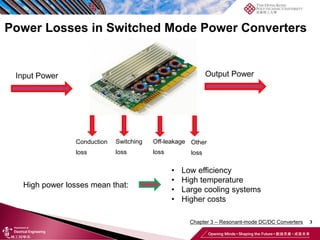
Conduction
loss
Input Power Output Power
Power Losses in Switched Mode Power Converters
Off-leakage
loss
Switching
loss
Other
loss
High power losses mean that:
• Low efficiency
• High temperature
• Large cooling systems
• Higher costs
Chapter 3 – Resonant-mode DC/DC Converters
4
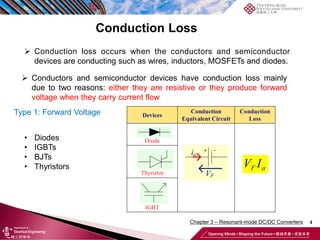
 Conduction loss occurs when the conductors and semiconductor
devices are conducting such as wires, inductors, MOSFETs and diodes.
 Conductors and semiconductor devices have conduction loss mainly
due to two reasons: either they are resistive or they produce forward
voltage when they carry current flow
Type 1: Forward Voltage
• Diodes
• IGBTs
• BJTs
• Thyristors
Conduction Loss
Chapter 3 – Resonant-mode DC/DC Converters
5
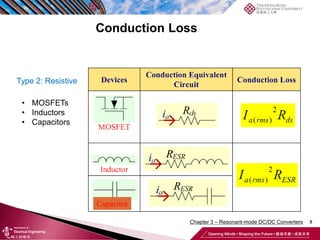
Type 2: Resistive
• MOSFETs
• Inductors
• Capacitors
Capacitor
Conduction Loss
Chapter 3 – Resonant-mode DC/DC Converters
Switching Loss
6
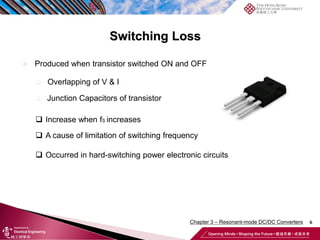
 Produced when transistor switched ON and OFF
 Overlapping of V & I
 Junction Capacitors of transistor
 Increase when fS increases
 A cause of limitation of switching frequency
 Occurred in hard-switching power electronic circuits
Chapter 3 – Resonant-mode DC/DC Converters
Switching Loss
7
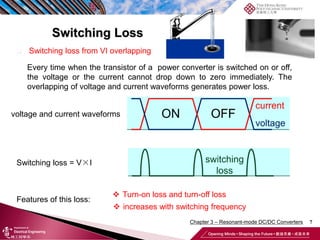
 Switching loss from VI overlapping
Every time when the transistor of a power converter is switched on or off,
the voltage or the current cannot drop down to zero immediately. The
overlapping of voltage and current waveforms generates power loss.
voltage and current waveforms
Switching loss = V×I
 Turn-on loss and turn-off loss
Features of this loss:
 increases with switching frequency
Chapter 3 – Resonant-mode DC/DC Converters
Switching Loss
8
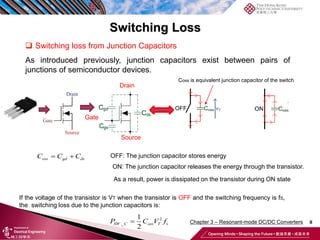
 Switching loss from Junction Capacitors
As introduced previously, junction capacitors exist between pairs of
junctions of semiconductor devices.
If the voltage of the transistor is VT when the transistor is OFF and the switching frequency is fS,
the switching loss due to the junction capacitors is:
ON: The junction capacitor releases the energy through the transistor.
Coss is equivalent junction capacitor of the switch
Drain
Source
Gate
OFF: The junction capacitor stores energy
As a result, power is dissipated on the transistor during ON state
2
_
1
2

SW C oss T s
P C V f
 
oss gd ds
C C C
Chapter 3 – Resonant-mode DC/DC Converters
9
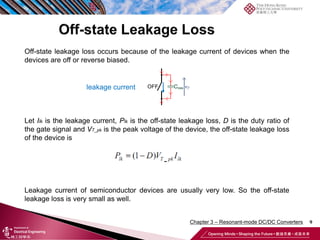
Off-state leakage loss occurs because of the leakage current of devices when the
devices are off or reverse biased.
Let Ilk is the leakage current, Plk is the off-state leakage loss, D is the duty ratio of
the gate signal and VT_pk is the peak voltage of the device, the off-state leakage loss
of the device is
Leakage current of semiconductor devices are usually very low. So the off-state
leakage loss is very small as well.
leakage current
Chapter 3 – Resonant-mode DC/DC Converters
10
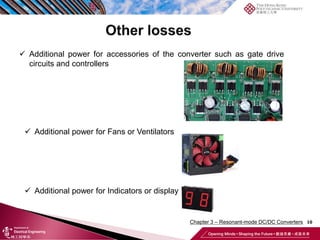
 Additional power for accessories of the converter such as gate drive
circuits and controllers
 Additional power for Fans or Ventilators
 Additional power for Indicators or display
Chapter 3 – Resonant-mode DC/DC Converters
11
Total power loss = Off-state leakage loss + Conduction loss +
Switching loss + Other losses
Chapter 3 – Resonant-mode DC/DC Converters
Transient Voltage and Current of Transistors
12
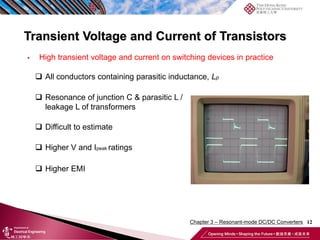
 High transient voltage and current on switching devices in practice
 All conductors containing parasitic inductance, Lp
 Resonance of junction C & parasitic L /
leakage L of transformers
 Difficult to estimate
 Higher V and Ipeak ratings
 Higher EMI
Chapter 3 – Resonant-mode DC/DC Converters
Switching Noise of Hard-switching Converters
13
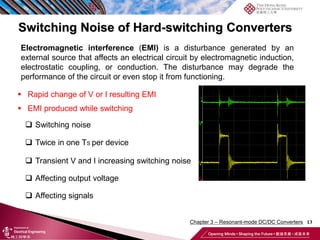
 Rapid change of V or I resulting EMI
 EMI produced while switching
 Switching noise
 Twice in one TS per device
 Transient V and I increasing switching noise
 Affecting output voltage
 Affecting signals
Electromagnetic interference (EMI) is a disturbance generated by an
external source that affects an electrical circuit by electromagnetic induction,
electrostatic coupling, or conduction. The disturbance may degrade the
performance of the circuit or even stop it from functioning.
Chapter 3 – Resonant-mode DC/DC Converters
Snubber Circuits
14
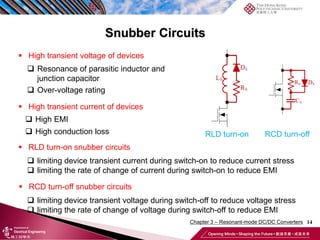
 High transient voltage of devices
 Resonance of parasitic inductor and
junction capacitor
 Over-voltage rating
 High transient current of devices
 High EMI
 High conduction loss
 RLD turn-on snubber circuits
 RCD turn-off snubber circuits
 limiting device transient voltage during switch-off to reduce voltage stress
 limiting the rate of change of voltage during switch-off to reduce EMI
 limiting device transient current during switch-on to reduce current stress
 limiting the rate of change of current during switch-on to reduce EMI
RLD turn-on RCD turn-off
Chapter 3 – Resonant-mode DC/DC Converters
RCD Turn-off Snubber Circuits
15
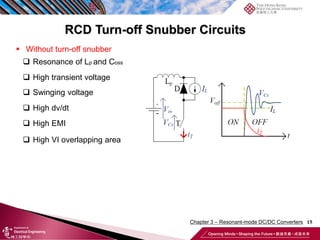
 Without turn-off snubber
 Resonance of Lp and Coss
 High transient voltage
 Swinging voltage
 High dv/dt
 High EMI
 High VI overlapping area
Chapter 3 – Resonant-mode DC/DC Converters
RCD Turn-off Snubber Circuits
16
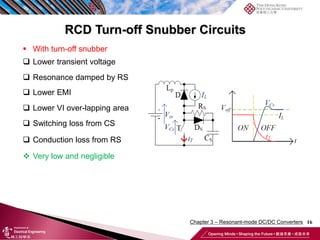
 With turn-off snubber
 Lower transient voltage
 Resonance damped by RS
 Lower EMI
 Lower VI over-lapping area
 Switching loss from CS
 Conduction loss from RS
 Very low and negligible
Chapter 3 – Resonant-mode DC/DC Converters
Snubber Circuits
17
 Although snubber circuits reduce the area of voltage and current
overlapping of a transistor, they reduce the efficiency of the power
electronic circuits unless the switching frequency is very low
 Actually, turn-off snubber circuits are very commonly used in products
while turn-on snubber is not popular because the inductance of a turn-
on snubber circuit may cause high transient voltage of the switching
devices.
Chapter 3 – Resonant-mode DC/DC Converters
Resonant Converters
18
 Features of Resonant Converters
 Using resonance of L and C to force transistor in zero-current
switching and / or zero-voltage switching
 Soft-switching
 Very low switching loss
 Low EMI
 High switching frequency
 Complicated structure
 High cost
Chapter 3 – Resonant-mode DC/DC Converters
LC Natural Resonance
19
 Occurring when L and C existing in a system
 Like pulling and pushing between L and C
 
0
0
sin
1 cos




  

in
Lr
cr in
V
i t
Z
v V t



 



 


Lr
r in cr
cr
r Lr
di
L V v
dt
dv
C i
dt
Chapter 3 – Resonant-mode DC/DC Converters
LC Natural Resonance
20
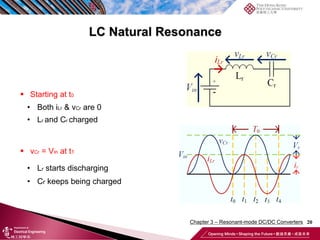
 Starting at t0
• Both iLr & vCr are 0
• Lr and Cr charged
 vCr = Vin at t1
• Lr starts discharging
• Cr keeps being charged
Chapter 3 – Resonant-mode DC/DC Converters
21
LC Natural Resonance
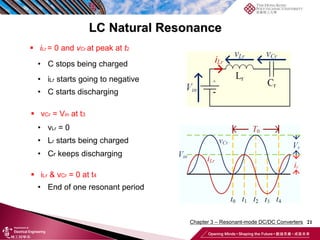
 iLr = 0 and vCr at peak at t2
• C stops being charged
• iLr starts going to negative
• C starts discharging
 vCr = Vin at t3
• vLr = 0
• Lr starts being charged
• Cr keeps discharging
 iLr & vCr = 0 at t4
• End of one resonant period
Chapter 3 – Resonant-mode DC/DC Converters
22
LC Natural Resonance
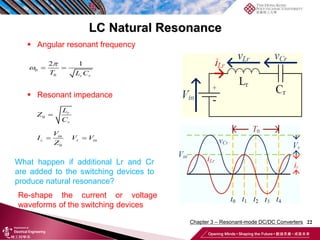
 Angular resonant frequency
 Resonant impedance
0
0
2 1
 
r r
T L C


0  r
r
L
Z
C
0
 
in
r r in
V
I V V
Z
What happen if additional Lr and Cr
are added to the switching devices to
produce natural resonance?
Chapter 3 – Resonant-mode DC/DC Converters
Re-shape the current or voltage
waveforms of the switching devices
Resonant Switches
23
 Resonant switch was promoted in mid 1980s by Fred C. Lee to reduce the
switching loss
 Applied in any classical hard-switching converters
• Buck, boost, buck-boost, flyback, forward, etc
• Replacing transistor of hard-switching converters
• Modifying to be basic quasi-resonant converters
• ZCS or ZVS
• Half-wave mode and full-wave mode
• Switching loss and EMI
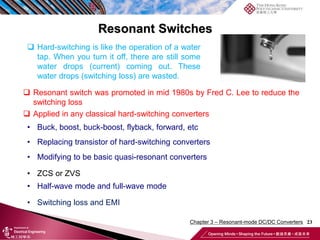
 Hard-switching is like the operation of a water
tap. When you turn it off, there are still some
water drops (current) coming out. These
water drops (switching loss) are wasted.
Chapter 3 – Resonant-mode DC/DC Converters
Zero-current Resonant Switches
24
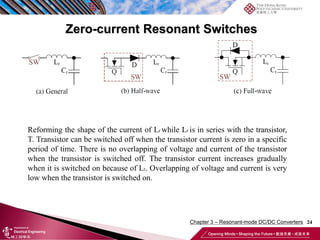
Reforming the shape of the current of Lr while Lr is in series with the transistor,
T. Transistor can be switched off when the transistor current is zero in a specific
period of time. There is no overlapping of voltage and current of the transistor
when the transistor is switched off. The transistor current increases gradually
when it is switched on because of Lr. Overlapping of voltage and current is very
low when the transistor is switched on.
Chapter 3 – Resonant-mode DC/DC Converters
25
Zero-voltage Resonant Switches
When the switch is turned off, considerable time is required to charge Cr from
zero voltage and hence the voltage across the switch is not increased
instantaneously. The overlapping between the current and voltage of the switch
is therefore very small.
Chapter 3 – Resonant-mode DC/DC Converters
Switching trajectory
26
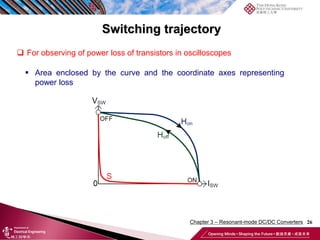
 For observing of power loss of transistors in oscilloscopes
 Area enclosed by the curve and the coordinate axes representing
power loss
Chapter 3 – Resonant-mode DC/DC Converters
Types of Resonant Techniques
27
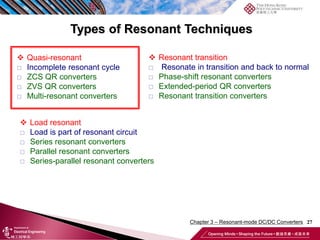
 Quasi-resonant
 Incomplete resonant cycle
 ZCS QR converters
 ZVS QR converters
 Multi-resonant converters
 Load resonant
 Load is part of resonant circuit
 Series resonant converters
 Parallel resonant converters
 Series-parallel resonant converters
 Resonant transition
 Resonate in transition and back to normal
 Phase-shift resonant converters
 Extended-period QR converters
 Resonant transition converters
Chapter 3 – Resonant-mode DC/DC Converters
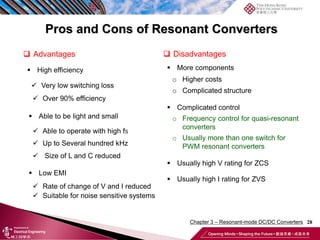
Pros and Cons of Resonant Converters
28
 Advantages
 High efficiency
 Very low switching loss
 Over 90% efficiency
 Able to be light and small
 Able to operate with high fS
 Up to Several hundred kHz
 Size of L and C reduced
 Low EMI
 Rate of change of V and I reduced
 Suitable for noise sensitive systems
 Disadvantages
 More components
o Complicated structure
o Higher costs
 Complicated control
o Frequency control for quasi-resonant
converters
o Usually more than one switch for
PWM resonant converters
 Usually high V rating for ZCS
 Usually high I rating for ZVS
Chapter 3 – Resonant-mode DC/DC Converters
29
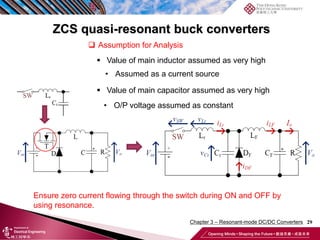
ZCS quasi-resonant buck converters
Ensure zero current flowing through the switch during ON and OFF by
using resonance.
 Assumption for Analysis
 Value of main inductor assumed as very high
• Assumed as a current source
 Value of main capacitor assumed as very high
• O/P voltage assumed as constant
Chapter 3 – Resonant-mode DC/DC Converters
30
ZCS quasi-resonant buck converters
 State I (Linear) [t0 – t1]  State II (Resonant) [t1 – t2]
 State III (Recovering) [t2 – t3]  State IV (Free Wheeling) [t3 – t4]
Chapter 3 – Resonant-mode DC/DC Converters
31
ZCS quasi-resonant buck converters
Duration of State I:
Boundary Condition at t1
 State I (Linear) [t0 – t1] ON OFF
When switch is turned on at t0, diode
DF is still conducting the load current
Io through LF in the previous stage.
32
ZCS quasi-resonant buck converters
Angular Resonant Frequency
Resonant Impedance
 State II (Resonant) [t1 – t2] ON OFF
Diode DF stops conducting.
Lr and Cr starts to
resonant.
33
ZCS quasi-resonant buck converters
 State II (Resonant) [t1 – t2]
Boundary Condition at t2
Half-wave
Full-wave
at t2
ON OFF
0 2 1
( )
 
set t t
 
Switch can be
turned off after t2
34
ZCS quasi-resonant buck converters
Boundary Condition at t3
 State III (Recovering) [t2 – t3]
Duration of State III
ON OFF
Resonant stops. Cr begins to be
discharged through LF with a
discharging current equal to Io
35
ZCS quasi-resonant buck converters
Duration of State IV
 State IV (Free Wheeling) [t3 – t4] ON OFF
DF is conducting, output current
freewheels through DF.
36
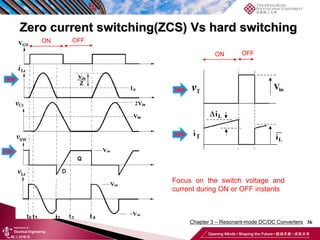
Zero current switching(ZCS) Vs hard switching
ON OFF
ON OFF
Focus on the switch voltage and
current during ON or OFF instants
Chapter 3 – Resonant-mode DC/DC Converters
37
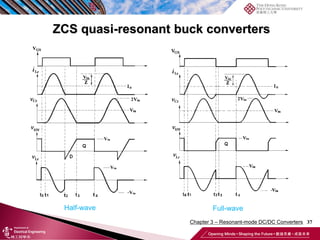
ZCS quasi-resonant buck converters
Half-wave Full-wave
Chapter 3 – Resonant-mode DC/DC Converters
38
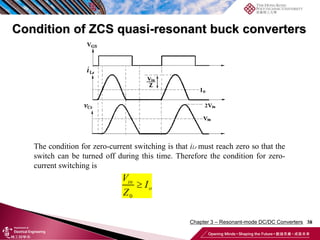
Condition of ZCS quasi-resonant buck converters
The condition for zero-current switching is that iLr must reach zero so that the
switch can be turned off during this time. Therefore the condition for zero-
current switching is
Chapter 3 – Resonant-mode DC/DC Converters
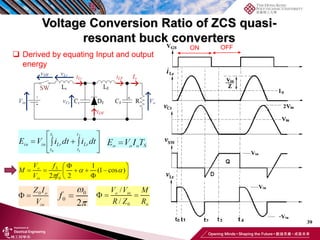
39
Voltage Conversion Ratio of ZCS quasi-
resonant buck converters
 Derived by equating Input and output
energy
ON OFF
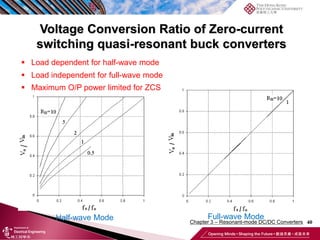
40
 Load dependent for half-wave mode
 Load independent for full-wave mode
 Maximum O/P power limited for ZCS
Voltage Conversion Ratio of Zero-current
switching quasi-resonant buck converters
Half-wave Mode Full-wave Mode
Chapter 3 – Resonant-mode DC/DC Converters
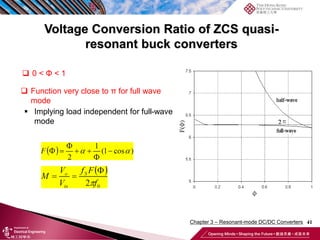
41
 0 < Φ < 1
 Function very close to π for full wave
mode
 Implying load independent for full-wave
mode
Voltage Conversion Ratio of ZCS quasi-
resonant buck converters
Chapter 3 – Resonant-mode DC/DC Converters
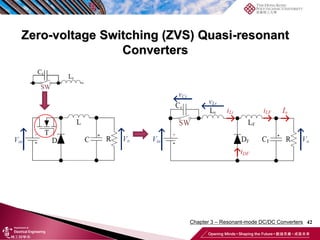
Zero-voltage Switching (ZVS) Quasi-resonant
Converters
42
Chapter 3 – Resonant-mode DC/DC Converters
ZVS Quasi-resonant Converters
43
 State I (Linear) [t0 – t1]  State II (Resonant) [t1 – t2]
 State III (Recovering) [t2 – t3]  State IV (Free Wheeling) [t3 – t4]
Chapter 3 – Resonant-mode DC/DC Converters
ZVS Quasi-resonant Converters
44
Duration of State I:
Boundary Condition at t1
 State I (Linear) [t0 – t1] ON
OFF
Cr begins to be charged
ZVS Quasi-resonant Converters
45
Angular Resonant Frequency
Resonant Impedance
 State II (Resonant) [t1 – t2] ON
OFF
When Cr increases to Vin, voltage
across DF becomes positive
Chapter 3 – Resonant-mode DC/DC Converters
ZVS Quasi-resonant Converters
46
 State II (Resonant) [t1 – t2] ON
OFF
Boundary condition at t2
Half-wave
Full-wave
Chapter 3 – Resonant-mode DC/DC Converters
ZVS Quasi-resonant Converters
47
Boundary Condition at t3
Duration of State III:
 State III (Recovering) [t2 – t3] ON
OFF
Resonance stops, Lr begins to be charged
by Vin. This state finishes when iLr reaches
Io, then DF on longer conducts
Switch can be
turned on after t2
Chapter 3 – Resonant-mode DC/DC Converters
ZVS Quasi-resonant Converters
48
 State IV (Free Wheeling) [t3 – t4] ON
OFF
Output current Io freewheels through Lr and
switch SW.
Chapter 3 – Resonant-mode DC/DC Converters
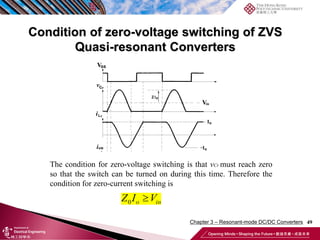
Condition of zero-voltage switching of ZVS
Quasi-resonant Converters
49
The condition for zero-voltage switching is that vCr must reach zero
so that the switch can be turned on during this time. Therefore the
condition for zero-current switching is
Chapter 3 – Resonant-mode DC/DC Converters
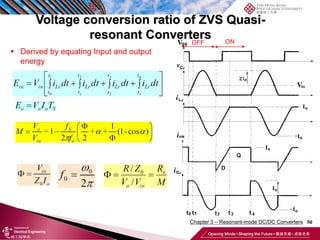
Voltage conversion ratio of ZVS Quasi-
resonant Converters
50
 Derived by equating Input and output
energy
ON
OFF
Chapter 3 – Resonant-mode DC/DC Converters
51
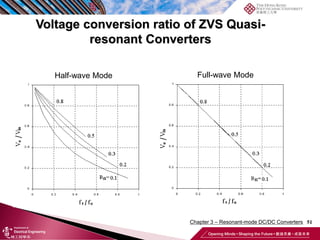
Voltage conversion ratio of ZVS Quasi-
resonant Converters
Half-wave Mode Full-wave Mode
Chapter 3 – Resonant-mode DC/DC Converters
Switching Loss of Full-wave Mode of ZVS
Quasi-resonant Converters
52
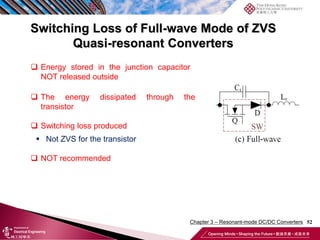
 Energy stored in the junction capacitor
NOT released outside
 The energy dissipated through the
transistor
 Switching loss produced
 Not ZVS for the transistor
 NOT recommended
Chapter 3 – Resonant-mode DC/DC Converters
Comparison of ZCS and ZVS Quasi-resonant
Converters
53
 It is noted zero-voltage switching resonant technique can help to
reduce the switching losses from both current voltage overlapping and
from junction capacitors. Zero-current switching resonant techniques
can only reduce the switching loss from current voltage overlapping
but not the switching loss from junction capacitors. Both resonant
technique can reduce EMI efficiently
 The zero-current switching is to switch the converter under zero-
current conditions. In fact, the switching device usually has a junction
capacitor. When the device is under off-state, the device behaves as a
capacitor and it will be charged with the off-state voltage. the energy
will then dissipated internally when the device is turned on. The loss
appears in every switching cycle. Therefore, its loss increases as the
switching frequency increases and the operational voltage increases.
Chapter 3 – Resonant-mode DC/DC Converters

Chapter 3 - Resonant-mode DC-DC Converter.pdf

  • 1.
    Chapter 3 –Resonant DC/DC Converters 1 Advanced Power Electronics (EE4007A/B/D/4211 ) 04-10-2019
  • 2.
    Outline 2 Chapter 3 –Resonant-mode DC/DC Converters • Problems of hard-switching converters • Solutions  Snubber circuits  Soft-switching resonant converters • Purpose  Reduce switching loss
  • 3.
    3 Conduction loss Input Power OutputPower Power Losses in Switched Mode Power Converters Off-leakage loss Switching loss Other loss High power losses mean that: • Low efficiency • High temperature • Large cooling systems • Higher costs Chapter 3 – Resonant-mode DC/DC Converters
  • 4.
    4  Conduction lossoccurs when the conductors and semiconductor devices are conducting such as wires, inductors, MOSFETs and diodes.  Conductors and semiconductor devices have conduction loss mainly due to two reasons: either they are resistive or they produce forward voltage when they carry current flow Type 1: Forward Voltage • Diodes • IGBTs • BJTs • Thyristors Conduction Loss Chapter 3 – Resonant-mode DC/DC Converters
  • 5.
    5 Type 2: Resistive •MOSFETs • Inductors • Capacitors Capacitor Conduction Loss Chapter 3 – Resonant-mode DC/DC Converters
  • 6.
    Switching Loss 6  Producedwhen transistor switched ON and OFF  Overlapping of V & I  Junction Capacitors of transistor  Increase when fS increases  A cause of limitation of switching frequency  Occurred in hard-switching power electronic circuits Chapter 3 – Resonant-mode DC/DC Converters
  • 7.
    Switching Loss 7  Switchingloss from VI overlapping Every time when the transistor of a power converter is switched on or off, the voltage or the current cannot drop down to zero immediately. The overlapping of voltage and current waveforms generates power loss. voltage and current waveforms Switching loss = V×I  Turn-on loss and turn-off loss Features of this loss:  increases with switching frequency Chapter 3 – Resonant-mode DC/DC Converters
  • 8.
    Switching Loss 8  Switchingloss from Junction Capacitors As introduced previously, junction capacitors exist between pairs of junctions of semiconductor devices. If the voltage of the transistor is VT when the transistor is OFF and the switching frequency is fS, the switching loss due to the junction capacitors is: ON: The junction capacitor releases the energy through the transistor. Coss is equivalent junction capacitor of the switch Drain Source Gate OFF: The junction capacitor stores energy As a result, power is dissipated on the transistor during ON state 2 _ 1 2  SW C oss T s P C V f   oss gd ds C C C Chapter 3 – Resonant-mode DC/DC Converters
  • 9.
    9 Off-state leakage lossoccurs because of the leakage current of devices when the devices are off or reverse biased. Let Ilk is the leakage current, Plk is the off-state leakage loss, D is the duty ratio of the gate signal and VT_pk is the peak voltage of the device, the off-state leakage loss of the device is Leakage current of semiconductor devices are usually very low. So the off-state leakage loss is very small as well. leakage current Chapter 3 – Resonant-mode DC/DC Converters
  • 10.
    10  Additional powerfor accessories of the converter such as gate drive circuits and controllers  Additional power for Fans or Ventilators  Additional power for Indicators or display Chapter 3 – Resonant-mode DC/DC Converters
  • 11.
    11 Total power loss= Off-state leakage loss + Conduction loss + Switching loss + Other losses Chapter 3 – Resonant-mode DC/DC Converters
  • 12.
    Transient Voltage andCurrent of Transistors 12  High transient voltage and current on switching devices in practice  All conductors containing parasitic inductance, Lp  Resonance of junction C & parasitic L / leakage L of transformers  Difficult to estimate  Higher V and Ipeak ratings  Higher EMI Chapter 3 – Resonant-mode DC/DC Converters
  • 13.
    Switching Noise ofHard-switching Converters 13  Rapid change of V or I resulting EMI  EMI produced while switching  Switching noise  Twice in one TS per device  Transient V and I increasing switching noise  Affecting output voltage  Affecting signals Electromagnetic interference (EMI) is a disturbance generated by an external source that affects an electrical circuit by electromagnetic induction, electrostatic coupling, or conduction. The disturbance may degrade the performance of the circuit or even stop it from functioning. Chapter 3 – Resonant-mode DC/DC Converters
  • 14.
    Snubber Circuits 14  Hightransient voltage of devices  Resonance of parasitic inductor and junction capacitor  Over-voltage rating  High transient current of devices  High EMI  High conduction loss  RLD turn-on snubber circuits  RCD turn-off snubber circuits  limiting device transient voltage during switch-off to reduce voltage stress  limiting the rate of change of voltage during switch-off to reduce EMI  limiting device transient current during switch-on to reduce current stress  limiting the rate of change of current during switch-on to reduce EMI RLD turn-on RCD turn-off Chapter 3 – Resonant-mode DC/DC Converters
  • 15.
    RCD Turn-off SnubberCircuits 15  Without turn-off snubber  Resonance of Lp and Coss  High transient voltage  Swinging voltage  High dv/dt  High EMI  High VI overlapping area Chapter 3 – Resonant-mode DC/DC Converters
  • 16.
    RCD Turn-off SnubberCircuits 16  With turn-off snubber  Lower transient voltage  Resonance damped by RS  Lower EMI  Lower VI over-lapping area  Switching loss from CS  Conduction loss from RS  Very low and negligible Chapter 3 – Resonant-mode DC/DC Converters
  • 17.
    Snubber Circuits 17  Althoughsnubber circuits reduce the area of voltage and current overlapping of a transistor, they reduce the efficiency of the power electronic circuits unless the switching frequency is very low  Actually, turn-off snubber circuits are very commonly used in products while turn-on snubber is not popular because the inductance of a turn- on snubber circuit may cause high transient voltage of the switching devices. Chapter 3 – Resonant-mode DC/DC Converters
  • 18.
    Resonant Converters 18  Featuresof Resonant Converters  Using resonance of L and C to force transistor in zero-current switching and / or zero-voltage switching  Soft-switching  Very low switching loss  Low EMI  High switching frequency  Complicated structure  High cost Chapter 3 – Resonant-mode DC/DC Converters
  • 19.
    LC Natural Resonance 19 Occurring when L and C existing in a system  Like pulling and pushing between L and C   0 0 sin 1 cos         in Lr cr in V i t Z v V t             Lr r in cr cr r Lr di L V v dt dv C i dt Chapter 3 – Resonant-mode DC/DC Converters
  • 20.
    LC Natural Resonance 20 Starting at t0 • Both iLr & vCr are 0 • Lr and Cr charged  vCr = Vin at t1 • Lr starts discharging • Cr keeps being charged Chapter 3 – Resonant-mode DC/DC Converters
  • 21.
    21 LC Natural Resonance iLr = 0 and vCr at peak at t2 • C stops being charged • iLr starts going to negative • C starts discharging  vCr = Vin at t3 • vLr = 0 • Lr starts being charged • Cr keeps discharging  iLr & vCr = 0 at t4 • End of one resonant period Chapter 3 – Resonant-mode DC/DC Converters
  • 22.
    22 LC Natural Resonance Angular resonant frequency  Resonant impedance 0 0 2 1   r r T L C   0  r r L Z C 0   in r r in V I V V Z What happen if additional Lr and Cr are added to the switching devices to produce natural resonance? Chapter 3 – Resonant-mode DC/DC Converters Re-shape the current or voltage waveforms of the switching devices
  • 23.
    Resonant Switches 23  Resonantswitch was promoted in mid 1980s by Fred C. Lee to reduce the switching loss  Applied in any classical hard-switching converters • Buck, boost, buck-boost, flyback, forward, etc • Replacing transistor of hard-switching converters • Modifying to be basic quasi-resonant converters • ZCS or ZVS • Half-wave mode and full-wave mode • Switching loss and EMI  Hard-switching is like the operation of a water tap. When you turn it off, there are still some water drops (current) coming out. These water drops (switching loss) are wasted. Chapter 3 – Resonant-mode DC/DC Converters
  • 24.
    Zero-current Resonant Switches 24 Reformingthe shape of the current of Lr while Lr is in series with the transistor, T. Transistor can be switched off when the transistor current is zero in a specific period of time. There is no overlapping of voltage and current of the transistor when the transistor is switched off. The transistor current increases gradually when it is switched on because of Lr. Overlapping of voltage and current is very low when the transistor is switched on. Chapter 3 – Resonant-mode DC/DC Converters
  • 25.
    25 Zero-voltage Resonant Switches Whenthe switch is turned off, considerable time is required to charge Cr from zero voltage and hence the voltage across the switch is not increased instantaneously. The overlapping between the current and voltage of the switch is therefore very small. Chapter 3 – Resonant-mode DC/DC Converters
  • 26.
    Switching trajectory 26  Forobserving of power loss of transistors in oscilloscopes  Area enclosed by the curve and the coordinate axes representing power loss Chapter 3 – Resonant-mode DC/DC Converters
  • 27.
    Types of ResonantTechniques 27  Quasi-resonant  Incomplete resonant cycle  ZCS QR converters  ZVS QR converters  Multi-resonant converters  Load resonant  Load is part of resonant circuit  Series resonant converters  Parallel resonant converters  Series-parallel resonant converters  Resonant transition  Resonate in transition and back to normal  Phase-shift resonant converters  Extended-period QR converters  Resonant transition converters Chapter 3 – Resonant-mode DC/DC Converters
  • 28.
    Pros and Consof Resonant Converters 28  Advantages  High efficiency  Very low switching loss  Over 90% efficiency  Able to be light and small  Able to operate with high fS  Up to Several hundred kHz  Size of L and C reduced  Low EMI  Rate of change of V and I reduced  Suitable for noise sensitive systems  Disadvantages  More components o Complicated structure o Higher costs  Complicated control o Frequency control for quasi-resonant converters o Usually more than one switch for PWM resonant converters  Usually high V rating for ZCS  Usually high I rating for ZVS Chapter 3 – Resonant-mode DC/DC Converters
  • 29.
    29 ZCS quasi-resonant buckconverters Ensure zero current flowing through the switch during ON and OFF by using resonance.  Assumption for Analysis  Value of main inductor assumed as very high • Assumed as a current source  Value of main capacitor assumed as very high • O/P voltage assumed as constant Chapter 3 – Resonant-mode DC/DC Converters
  • 30.
    30 ZCS quasi-resonant buckconverters  State I (Linear) [t0 – t1]  State II (Resonant) [t1 – t2]  State III (Recovering) [t2 – t3]  State IV (Free Wheeling) [t3 – t4] Chapter 3 – Resonant-mode DC/DC Converters
  • 31.
    31 ZCS quasi-resonant buckconverters Duration of State I: Boundary Condition at t1  State I (Linear) [t0 – t1] ON OFF When switch is turned on at t0, diode DF is still conducting the load current Io through LF in the previous stage.
  • 32.
    32 ZCS quasi-resonant buckconverters Angular Resonant Frequency Resonant Impedance  State II (Resonant) [t1 – t2] ON OFF Diode DF stops conducting. Lr and Cr starts to resonant.
  • 33.
    33 ZCS quasi-resonant buckconverters  State II (Resonant) [t1 – t2] Boundary Condition at t2 Half-wave Full-wave at t2 ON OFF 0 2 1 ( )   set t t   Switch can be turned off after t2
  • 34.
    34 ZCS quasi-resonant buckconverters Boundary Condition at t3  State III (Recovering) [t2 – t3] Duration of State III ON OFF Resonant stops. Cr begins to be discharged through LF with a discharging current equal to Io
  • 35.
    35 ZCS quasi-resonant buckconverters Duration of State IV  State IV (Free Wheeling) [t3 – t4] ON OFF DF is conducting, output current freewheels through DF.
  • 36.
    36 Zero current switching(ZCS)Vs hard switching ON OFF ON OFF Focus on the switch voltage and current during ON or OFF instants Chapter 3 – Resonant-mode DC/DC Converters
  • 37.
    37 ZCS quasi-resonant buckconverters Half-wave Full-wave Chapter 3 – Resonant-mode DC/DC Converters
  • 38.
    38 Condition of ZCSquasi-resonant buck converters The condition for zero-current switching is that iLr must reach zero so that the switch can be turned off during this time. Therefore the condition for zero- current switching is Chapter 3 – Resonant-mode DC/DC Converters
  • 39.
    39 Voltage Conversion Ratioof ZCS quasi- resonant buck converters  Derived by equating Input and output energy ON OFF
  • 40.
    40  Load dependentfor half-wave mode  Load independent for full-wave mode  Maximum O/P power limited for ZCS Voltage Conversion Ratio of Zero-current switching quasi-resonant buck converters Half-wave Mode Full-wave Mode Chapter 3 – Resonant-mode DC/DC Converters
  • 41.
    41  0 <Φ < 1  Function very close to π for full wave mode  Implying load independent for full-wave mode Voltage Conversion Ratio of ZCS quasi- resonant buck converters Chapter 3 – Resonant-mode DC/DC Converters
  • 42.
    Zero-voltage Switching (ZVS)Quasi-resonant Converters 42 Chapter 3 – Resonant-mode DC/DC Converters
  • 43.
    ZVS Quasi-resonant Converters 43 State I (Linear) [t0 – t1]  State II (Resonant) [t1 – t2]  State III (Recovering) [t2 – t3]  State IV (Free Wheeling) [t3 – t4] Chapter 3 – Resonant-mode DC/DC Converters
  • 44.
    ZVS Quasi-resonant Converters 44 Durationof State I: Boundary Condition at t1  State I (Linear) [t0 – t1] ON OFF Cr begins to be charged
  • 45.
    ZVS Quasi-resonant Converters 45 AngularResonant Frequency Resonant Impedance  State II (Resonant) [t1 – t2] ON OFF When Cr increases to Vin, voltage across DF becomes positive Chapter 3 – Resonant-mode DC/DC Converters
  • 46.
    ZVS Quasi-resonant Converters 46 State II (Resonant) [t1 – t2] ON OFF Boundary condition at t2 Half-wave Full-wave Chapter 3 – Resonant-mode DC/DC Converters
  • 47.
    ZVS Quasi-resonant Converters 47 BoundaryCondition at t3 Duration of State III:  State III (Recovering) [t2 – t3] ON OFF Resonance stops, Lr begins to be charged by Vin. This state finishes when iLr reaches Io, then DF on longer conducts Switch can be turned on after t2 Chapter 3 – Resonant-mode DC/DC Converters
  • 48.
    ZVS Quasi-resonant Converters 48 State IV (Free Wheeling) [t3 – t4] ON OFF Output current Io freewheels through Lr and switch SW. Chapter 3 – Resonant-mode DC/DC Converters
  • 49.
    Condition of zero-voltageswitching of ZVS Quasi-resonant Converters 49 The condition for zero-voltage switching is that vCr must reach zero so that the switch can be turned on during this time. Therefore the condition for zero-current switching is Chapter 3 – Resonant-mode DC/DC Converters
  • 50.
    Voltage conversion ratioof ZVS Quasi- resonant Converters 50  Derived by equating Input and output energy ON OFF Chapter 3 – Resonant-mode DC/DC Converters
  • 51.
    51 Voltage conversion ratioof ZVS Quasi- resonant Converters Half-wave Mode Full-wave Mode Chapter 3 – Resonant-mode DC/DC Converters
  • 52.
    Switching Loss ofFull-wave Mode of ZVS Quasi-resonant Converters 52  Energy stored in the junction capacitor NOT released outside  The energy dissipated through the transistor  Switching loss produced  Not ZVS for the transistor  NOT recommended Chapter 3 – Resonant-mode DC/DC Converters
  • 53.
    Comparison of ZCSand ZVS Quasi-resonant Converters 53  It is noted zero-voltage switching resonant technique can help to reduce the switching losses from both current voltage overlapping and from junction capacitors. Zero-current switching resonant techniques can only reduce the switching loss from current voltage overlapping but not the switching loss from junction capacitors. Both resonant technique can reduce EMI efficiently  The zero-current switching is to switch the converter under zero- current conditions. In fact, the switching device usually has a junction capacitor. When the device is under off-state, the device behaves as a capacitor and it will be charged with the off-state voltage. the energy will then dissipated internally when the device is turned on. The loss appears in every switching cycle. Therefore, its loss increases as the switching frequency increases and the operational voltage increases. Chapter 3 – Resonant-mode DC/DC Converters