GOVERNMENT ENGINEERING COLLEGE
BHARUCH
SUBJECT :- P.S.O.C.
TOPIC:-Automatic Voltage Control
Submitted by:-
Enroll. No. :- 140140109083
Name:- Sumit B. Patel
ELECTRICAL DEPARTMENT
(8TH SEM)
Outline
• Regulator
- Voltage Regulator
- Need for AVR
- Category of Voltage Regulator
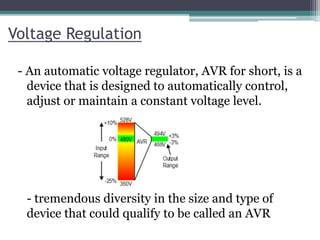
Voltage Regulation
- An automatic voltage regulator, AVR for short, is a
device that is designed to automatically control,
adjust or maintain a constant voltage level.
- tremendous diversity in the size and type of
device that could qualify to be called an AVR
Need for Voltage Regulator
• the ultimate reason for using voltage regulation
is financial
– to avoid the costs associated with equipment
damage and downtime caused by poor voltage
levels.
- Utility Voltage Levels
- - Voltage Drop in a Facility
- - Sensitivity to Voltage Levels and Voltage
Fluctuation
Utility Level
• 120V to a small or large degree
• Factors contributing to voltage level fluctuation such as
1. location on the local distribution line
2. proximity to large electricity consumers
3. proximity to utility voltage regulating equipment
4. seasonal variations in overall system voltage levels
5. load factor on local transmission and distribution system
• Try to Maintain the voltage level within
+/-5% (480V+/-5%)
• Sometimes 6% high or 13% low
(509V(480+6%) to 420V(480-13%))
Voltage Drop in a Facility
• a voltage drop of 3 to 5% to the end user
• due to wiring impedance within a building will
always drive voltage levels lower
• Eg, if the incoming utility voltage is 5% low,
the voltage at the point of usage might be
8 to 10% (5%+3% to 5%+5%) below nominal
due to the voltage drop within a building
Sensitivity to Voltage Levels and
Voltage Fluctuation
• Every piece of electrical equipment will operate
within a range of voltage levels, however not
necessarily with optimal performance. When the
voltage level falls outside of its operational
range, a device may be unable to start or
operate, it may malfunction or the device may be
damaged.
• utility voltage levels are very dynamic and will
most assuredly change over time and there is no
advance warning about when, how much or in
which direction they will change, due to the little
control over the amount of electricity demanded
by any customer at any given time by the utility .
• Thus, increasing use of relatively sensitive
electronics in nearly all facets of business and
industry and the growing need for voltage
regulation becomes clearer.
Category of Voltage Regulator
• Feed :-forward design or negative feedback
control loops
• Mechanical voltage regulator or electronic
voltage regulator
• used to regulate AC or DC voltages
• Active regulators or shunt regulators
Linear regulat
Switching regulators
THANK YOU

automatic voltage regulator

  • 1.
    GOVERNMENT ENGINEERING COLLEGE BHARUCH SUBJECT:- P.S.O.C. TOPIC:-Automatic Voltage Control Submitted by:- Enroll. No. :- 140140109083 Name:- Sumit B. Patel ELECTRICAL DEPARTMENT (8TH SEM)
  • 2.
    Outline • Regulator - VoltageRegulator - Need for AVR - Category of Voltage Regulator
  • 3.
    Voltage Regulation - Anautomatic voltage regulator, AVR for short, is a device that is designed to automatically control, adjust or maintain a constant voltage level. - tremendous diversity in the size and type of device that could qualify to be called an AVR
  • 4.
    Need for VoltageRegulator • the ultimate reason for using voltage regulation is financial – to avoid the costs associated with equipment damage and downtime caused by poor voltage levels. - Utility Voltage Levels - - Voltage Drop in a Facility - - Sensitivity to Voltage Levels and Voltage Fluctuation
  • 5.
    Utility Level • 120Vto a small or large degree • Factors contributing to voltage level fluctuation such as 1. location on the local distribution line 2. proximity to large electricity consumers 3. proximity to utility voltage regulating equipment 4. seasonal variations in overall system voltage levels 5. load factor on local transmission and distribution system • Try to Maintain the voltage level within +/-5% (480V+/-5%) • Sometimes 6% high or 13% low (509V(480+6%) to 420V(480-13%))
  • 6.
    Voltage Drop ina Facility • a voltage drop of 3 to 5% to the end user • due to wiring impedance within a building will always drive voltage levels lower • Eg, if the incoming utility voltage is 5% low, the voltage at the point of usage might be 8 to 10% (5%+3% to 5%+5%) below nominal due to the voltage drop within a building
  • 7.
    Sensitivity to VoltageLevels and Voltage Fluctuation • Every piece of electrical equipment will operate within a range of voltage levels, however not necessarily with optimal performance. When the voltage level falls outside of its operational range, a device may be unable to start or operate, it may malfunction or the device may be damaged.
  • 8.
    • utility voltagelevels are very dynamic and will most assuredly change over time and there is no advance warning about when, how much or in which direction they will change, due to the little control over the amount of electricity demanded by any customer at any given time by the utility . • Thus, increasing use of relatively sensitive electronics in nearly all facets of business and industry and the growing need for voltage regulation becomes clearer.
  • 9.
    Category of VoltageRegulator • Feed :-forward design or negative feedback control loops • Mechanical voltage regulator or electronic voltage regulator • used to regulate AC or DC voltages • Active regulators or shunt regulators Linear regulat Switching regulators
  • 10.