












SOCIAL CASE WORK
Rizwan Abbas
Week 4
NATURE OF
SOCIAL
CASE
WORK
Social worker has to deal
with individual’s:
• Problems and causes.
• reactions and experiences towards
problem.
Main task of social worker
is to develop self-direction
and self-dependence.
SOCIAL CASE
• A social case is a
‘living event’ within
which there are
always
• economic
• physical
• mental and
• social factors
in varying
proportion
DEFINITION
• “Social casework is method of social work which intervenes
in the psycho–social aspects of a person’s life
• to improve
• to restore
• to maintain
• to enhance
his social functioning by improving his role performance
(Warner Boehm, 1958).”
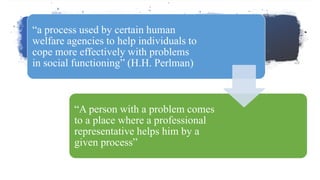
“a process used by certain human
welfare agencies to help individuals to
cope more effectively with problems
in social functioning” (H.H. Perlman)
“A person with a problem comes
to a place where a professional
representative helps him by a
given process”
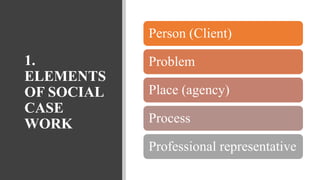
1.
ELEMENTS
OF SOCIAL
CASE
WORK
Person (Client)
Problem
Place (agency)
Process
Professional representative
PERSON
• Any individual with problem is focus of attention.
• A person can be anyone – a man, woman, (even a she male), a child,
etc.
• In some difficulty a problem which he /she cannot solve without some
help.
• Such person is referred as “client”.
• He may voluntarily come, or may be referred to the agency by some
other institutions.
• Basic assumptions of social case work is that each individual is
different from others.
For studying a person following points
should be kept in mind:
• Taking of client’s history: not by worker but
agency.
• Person’s behavior has meaning and purpose.
• Effectiveness of person’s behavior.
• Potential problem vs. real problem (coping and
double stress).
• person should be understood through bio-psycho-
social background.
PROBLEM
• The problem is a situation, event or anything which impairs
the normal functioning of the individual and makes him
handicapped.
• A problem is a situation which exists anywhere and effects
any person (Horton).
• These problems could be of different types.
• Search to find the solution.
Aspects of problem
• Prioritize the problem by understanding
the nature. Following are the basis:
• What are the client wants and
needs.
• Worker’s judgement and possible
solution.
• What the agency is for and offer.
• Problem tend to create ‘chain reaction’
(cause and effect).
• Problem has subjective and objective
significance depending person’s mental,
social and physical situation.
PLACE
• The place may be a
• social service agency,
• department, or
• human welfare agency,
• provides psycho- social services or any other aid to the client
with the help of a social worker.
• The complete process of case work is influenced by
objectives, function, policies and resources of the agency.
Classification of agency by different criteria:
•Private or public agency.
•Primary or secondary agency.
•Local, provincial or national agency
•Closed or open agency.
•Agency’s effectiveness depends on the resources.
•Employment of case worker, nature of function
defined by agency.
PROCESS
The process is a progressive
transaction between the professional
helper (case worker) and the client.
It consists of a series of problem-
solving operations carried on within
a meaningful relationship.
It is the intervention stage in which
case worker initiates the formal
procedure of helping the client.
FIRST CONTACT
•Relationship establishment.
•Rapport building.
•Enable client to express and explain what he
wants.
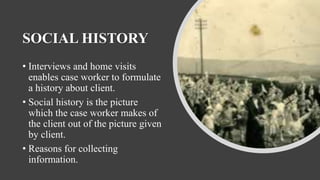
SOCIAL HISTORY
• Interviews and home visits
enables case worker to formulate
a history about client.
• Social history is the picture
which the case worker makes of
the client out of the picture given
by client.
• Reasons for collecting
information.
PROFESSIONAL
REPRESENTATIVE
• After client, Case worker is the most
significant component of case work
process, as helping process of client
cannot be initiated without him.
• He acts as a liaison between case
work agency and the client, because
of his capabilities, he/she is referred
as change agent in social work
profession.
2. GENERAL
PRINCIPLES OF SCW
PRACTICE
•Social case work practice is constituted on
the principle of:
1. Acceptance
2. Communication
3. Individualization
4. Non-judgmental Attitude
5. Controlled Emotional Involvement
6. Participation
7. Confidentiality
8. Self-awareness
ACCEPTANCE
• The recognition of client’s innate
dignity, worth, equality, basic rights,
and needs
• Regardless of client’s individual
qualities arising from heredity,
environment, behavior, or any
other source.
• Acceptance does not mean approval
of the client’s behavior, attitudes, or
standards
• Acceptance includes thought and
feeling elements, and is expressed
primarily in the manner of service.
COMMUNICATION
• Communication is a two way process
• When the communication is inadequate or
insufficient the problems occurs
• The social worker should have enough
skills to grasp the communication.
• The proper communication is crucial in
social work relationship because the
background of the client and worker may be
different.
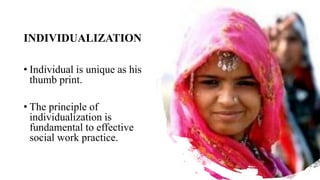
INDIVIDUALIZATION
• Individual is unique as his
thumb print.
• The principle of
individualization is
fundamental to effective
social work practice.
NON-JUDGMENTAL
ATTITUDE
• Social worker should
begin without any bias.
• Not form opinion about
the client.
• Treat the client as
somebody who has come
to him for help.
• willing to help the client
without being influenced
by the opinions of others.
CONTROLLED EMOTIONAL
INVOLVEMENT
Guides social worker not to indulge too much
personally in the client's difficult situation or
being too objective.
Social worker should maintain a reasonable
emotional distance.
PARTICIPATION • Participation means to take part.
• By active participation of the
client, a caseworker can
• Find out the effective
solution of the problem.
• assess the client’s strength &
weakness.
• increase the client’s
confidence
• Active Participation increases
client’s self determination,
capacity of decision making
regarding the different elements
of the stressful situation.
CONFIDENTIALITY
• Confidentiality means law of keeping
secret.
• In social case work practice,
confidentiality is-
• the preservation of secret information
concerning the client.
• the basic right of the client.
• the ethical obligation of the client.
• necessary for effective casework
practice.
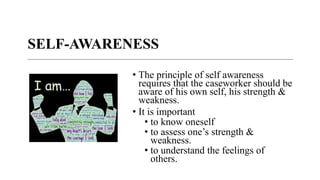
SELF-AWARENESS
• The principle of self awareness
requires that the caseworker should be
aware of his own self, his strength &
weakness.
• It is important
• to know oneself
• to assess one’s strength &
weakness.
• to understand the feelings of
others.
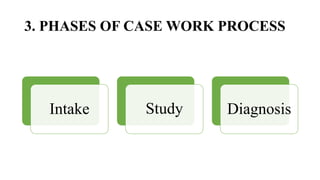
3. PHASES OF CASE WORK PROCESS
Intake Study Diagnosis
INTAKE
• Starts with first encounter and
ends with second interview with
the social worker.
• It requires a very skillful probing
into the client’s problem.
• Areas for probing are
(i) the stage of the problem,
through whom and reason for
coming to agency
(ii) the nature of request and its
relation to his problem, and the
cause of his problem, as the
client sees;
(iii) does the request relate directly to his needs/problem;
(iv) his adjustment to his social functions in job, family
(v) the state of his physical and mental health;
(vi) his appearance including dress in the first meeting;
(vii) his personal and social resources including material
and financial positions;
(viii) appropriateness and intensity of feelings;
(ix) nature of defense mechanisms he frequently uses;
(x) level of motivation.
(xi) nature of family, its status,
values, relationship pattern
within family; and
(xii) reactions of the worker
and seeking help from the
agency and sex of caseworker
who will be suitable to help
the person.
STUDY
• Secure every fact.
• An exhaustive collection
of facts about the client
and his situation is called
study- the first step
(process) in the
continuum.
• Enable case worker to
make initial assessment
for diagnosis.
• It requires the analysis of social,
psychological and biological
determinants of the client’s
current stressful situation.
• Maintain confidentiality.
• Limited time schedule for
studying problem.
DIAGNOSIS
• Diagnosis is the identifying nature
of cause of something (Dictionary).
• Diagnosis is;
• An explanation formulated in
the light of known facts
• An explanation made in the
knowledge of other possible
explanations
• Subject to change or revision
whenever subsequent material
warrants a different explanation.
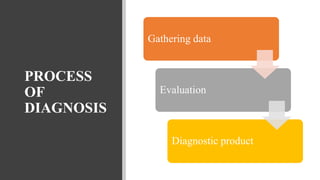
PROCESS
OF
DIAGNOSIS
Gathering data
Evaluation
Diagnostic product
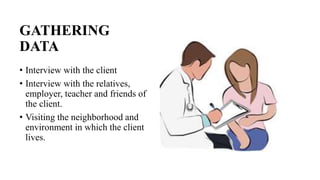
GATHERING
DATA
• Interview with the client
• Interview with the relatives,
employer, teacher and friends of
the client.
• Visiting the neighborhood and
environment in which the client
lives.
EVALUATION
• This means finding the nature of the problem, its organization
and extent and who is going to be affected.
FACTORS CAUSING
PROBLEM
• Physical illness or disability.
• Psychological.
• Social.
• Income level, Housing,
Neighborhood, Employment,
Religion, availability of services
and educational problems.
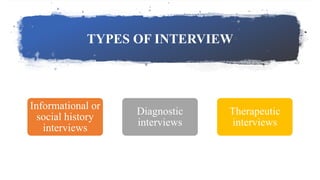
TYPES OF INTERVIEW
Informational or
social history
interviews
Diagnostic
interviews
Therapeutic
interviews
DIAGNOSTIC
PRODUCT
• After identification of the problem
areas and the factors relating to
them, the attempts are made towards
possible solution.
• Emotional – ability to relate others,
ability to feel, experiencing,
containing.
• Social intelligence Capacity – how
much the client has left over work
on problem solving.
COUNSELING
• Personal help directed towards the solution of the problem.
• Psychological help in which information and clarification are used for
making the client aware about the problem.
• Some particular purposes like marriage counseling, family counseling.
• Counseling is not possible without rapport and effective
communication.
• Counseling enables the counselee to solve his future problem on his
own.
• Adjust to the situation.
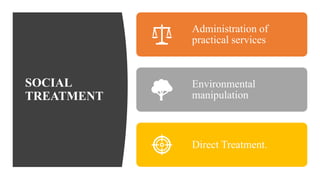
SOCIAL
TREATMENT
Administration of
practical services
Environmental
manipulation
Direct Treatment.
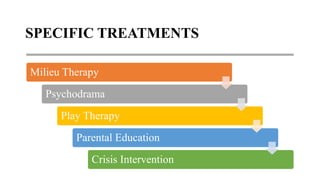
SPECIFIC TREATMENTS
Milieu Therapy
Psychodrama
Play Therapy
Parental Education
Crisis Intervention
SCOPE OF SW IN PAKISTAN
• Broadly in three fields. i.e., Correctional, medical and educational
Social Case Work - Week 4

Social Case Work - Week 4

  • 1.
  • 2.
    NATURE OF SOCIAL CASE WORK Social workerhas to deal with individual’s: • Problems and causes. • reactions and experiences towards problem. Main task of social worker is to develop self-direction and self-dependence.
  • 3.
    SOCIAL CASE • Asocial case is a ‘living event’ within which there are always • economic • physical • mental and • social factors in varying proportion
  • 4.
    DEFINITION • “Social caseworkis method of social work which intervenes in the psycho–social aspects of a person’s life • to improve • to restore • to maintain • to enhance his social functioning by improving his role performance (Warner Boehm, 1958).”
  • 5.
    “a process usedby certain human welfare agencies to help individuals to cope more effectively with problems in social functioning” (H.H. Perlman) “A person with a problem comes to a place where a professional representative helps him by a given process”
  • 6.
    1. ELEMENTS OF SOCIAL CASE WORK Person (Client) Problem Place(agency) Process Professional representative
  • 7.
    PERSON • Any individualwith problem is focus of attention. • A person can be anyone – a man, woman, (even a she male), a child, etc. • In some difficulty a problem which he /she cannot solve without some help. • Such person is referred as “client”. • He may voluntarily come, or may be referred to the agency by some other institutions. • Basic assumptions of social case work is that each individual is different from others.
  • 8.
    For studying aperson following points should be kept in mind: • Taking of client’s history: not by worker but agency. • Person’s behavior has meaning and purpose. • Effectiveness of person’s behavior. • Potential problem vs. real problem (coping and double stress). • person should be understood through bio-psycho- social background.
  • 9.
    PROBLEM • The problemis a situation, event or anything which impairs the normal functioning of the individual and makes him handicapped. • A problem is a situation which exists anywhere and effects any person (Horton). • These problems could be of different types. • Search to find the solution.
  • 10.
    Aspects of problem •Prioritize the problem by understanding the nature. Following are the basis: • What are the client wants and needs. • Worker’s judgement and possible solution. • What the agency is for and offer. • Problem tend to create ‘chain reaction’ (cause and effect). • Problem has subjective and objective significance depending person’s mental, social and physical situation.
  • 11.
    PLACE • The placemay be a • social service agency, • department, or • human welfare agency, • provides psycho- social services or any other aid to the client with the help of a social worker. • The complete process of case work is influenced by objectives, function, policies and resources of the agency.
  • 12.
    Classification of agencyby different criteria: •Private or public agency. •Primary or secondary agency. •Local, provincial or national agency •Closed or open agency. •Agency’s effectiveness depends on the resources. •Employment of case worker, nature of function defined by agency.
  • 13.
    PROCESS The process isa progressive transaction between the professional helper (case worker) and the client. It consists of a series of problem- solving operations carried on within a meaningful relationship. It is the intervention stage in which case worker initiates the formal procedure of helping the client.
  • 14.
    FIRST CONTACT •Relationship establishment. •Rapportbuilding. •Enable client to express and explain what he wants.
  • 15.
    SOCIAL HISTORY • Interviewsand home visits enables case worker to formulate a history about client. • Social history is the picture which the case worker makes of the client out of the picture given by client. • Reasons for collecting information.
  • 16.
    PROFESSIONAL REPRESENTATIVE • After client,Case worker is the most significant component of case work process, as helping process of client cannot be initiated without him. • He acts as a liaison between case work agency and the client, because of his capabilities, he/she is referred as change agent in social work profession.
  • 17.
  • 18.
    •Social case workpractice is constituted on the principle of: 1. Acceptance 2. Communication 3. Individualization 4. Non-judgmental Attitude 5. Controlled Emotional Involvement 6. Participation 7. Confidentiality 8. Self-awareness
  • 19.
    ACCEPTANCE • The recognitionof client’s innate dignity, worth, equality, basic rights, and needs • Regardless of client’s individual qualities arising from heredity, environment, behavior, or any other source. • Acceptance does not mean approval of the client’s behavior, attitudes, or standards • Acceptance includes thought and feeling elements, and is expressed primarily in the manner of service.
  • 20.
    COMMUNICATION • Communication isa two way process • When the communication is inadequate or insufficient the problems occurs • The social worker should have enough skills to grasp the communication. • The proper communication is crucial in social work relationship because the background of the client and worker may be different.
  • 21.
    INDIVIDUALIZATION • Individual isunique as his thumb print. • The principle of individualization is fundamental to effective social work practice.
  • 22.
    NON-JUDGMENTAL ATTITUDE • Social workershould begin without any bias. • Not form opinion about the client. • Treat the client as somebody who has come to him for help. • willing to help the client without being influenced by the opinions of others.
  • 23.
    CONTROLLED EMOTIONAL INVOLVEMENT Guides socialworker not to indulge too much personally in the client's difficult situation or being too objective. Social worker should maintain a reasonable emotional distance.
  • 24.
    PARTICIPATION • Participationmeans to take part. • By active participation of the client, a caseworker can • Find out the effective solution of the problem. • assess the client’s strength & weakness. • increase the client’s confidence • Active Participation increases client’s self determination, capacity of decision making regarding the different elements of the stressful situation.
  • 25.
    CONFIDENTIALITY • Confidentiality meanslaw of keeping secret. • In social case work practice, confidentiality is- • the preservation of secret information concerning the client. • the basic right of the client. • the ethical obligation of the client. • necessary for effective casework practice.
  • 26.
    SELF-AWARENESS • The principleof self awareness requires that the caseworker should be aware of his own self, his strength & weakness. • It is important • to know oneself • to assess one’s strength & weakness. • to understand the feelings of others.
  • 27.
    3. PHASES OFCASE WORK PROCESS Intake Study Diagnosis
  • 28.
    INTAKE • Starts withfirst encounter and ends with second interview with the social worker. • It requires a very skillful probing into the client’s problem. • Areas for probing are (i) the stage of the problem, through whom and reason for coming to agency (ii) the nature of request and its relation to his problem, and the cause of his problem, as the client sees;
  • 29.
    (iii) does therequest relate directly to his needs/problem; (iv) his adjustment to his social functions in job, family (v) the state of his physical and mental health; (vi) his appearance including dress in the first meeting; (vii) his personal and social resources including material and financial positions; (viii) appropriateness and intensity of feelings; (ix) nature of defense mechanisms he frequently uses;
  • 30.
    (x) level ofmotivation. (xi) nature of family, its status, values, relationship pattern within family; and (xii) reactions of the worker and seeking help from the agency and sex of caseworker who will be suitable to help the person.
  • 31.
    STUDY • Secure everyfact. • An exhaustive collection of facts about the client and his situation is called study- the first step (process) in the continuum. • Enable case worker to make initial assessment for diagnosis.
  • 32.
    • It requiresthe analysis of social, psychological and biological determinants of the client’s current stressful situation. • Maintain confidentiality. • Limited time schedule for studying problem.
  • 33.
    DIAGNOSIS • Diagnosis isthe identifying nature of cause of something (Dictionary). • Diagnosis is; • An explanation formulated in the light of known facts • An explanation made in the knowledge of other possible explanations • Subject to change or revision whenever subsequent material warrants a different explanation.
  • 34.
  • 35.
    GATHERING DATA • Interview withthe client • Interview with the relatives, employer, teacher and friends of the client. • Visiting the neighborhood and environment in which the client lives.
  • 36.
    EVALUATION • This meansfinding the nature of the problem, its organization and extent and who is going to be affected.
  • 37.
    FACTORS CAUSING PROBLEM • Physicalillness or disability. • Psychological. • Social. • Income level, Housing, Neighborhood, Employment, Religion, availability of services and educational problems.
  • 38.
    TYPES OF INTERVIEW Informationalor social history interviews Diagnostic interviews Therapeutic interviews
  • 39.
    DIAGNOSTIC PRODUCT • After identificationof the problem areas and the factors relating to them, the attempts are made towards possible solution. • Emotional – ability to relate others, ability to feel, experiencing, containing. • Social intelligence Capacity – how much the client has left over work on problem solving.
  • 40.
    COUNSELING • Personal helpdirected towards the solution of the problem. • Psychological help in which information and clarification are used for making the client aware about the problem. • Some particular purposes like marriage counseling, family counseling. • Counseling is not possible without rapport and effective communication. • Counseling enables the counselee to solve his future problem on his own. • Adjust to the situation.
  • 41.
  • 42.
    SPECIFIC TREATMENTS Milieu Therapy Psychodrama PlayTherapy Parental Education Crisis Intervention
  • 43.
    SCOPE OF SWIN PAKISTAN • Broadly in three fields. i.e., Correctional, medical and educational