Voter and
Voter Behavior
Chapter 6
The Right to Vote
Section 1
Introduction
• How have voting rights changed over the
course of American history?
o Over time, voting rights have been extended to more
Americans.
o Voting qualifications based on property ownership,
religion, race, and sex have all been eliminated
through federal laws and constitutional amendments.
o The age requirement for voting has been reduced.
The Electorate
• The Constitution originally gave the power to
decide voter qualifications to the States.
o At first most States allowed only white male
property owners to vote.
• Since 1789, many restrictions on voting rights
have been eliminated.
• At the same time, the power to decide who
has the right to vote has been shifting from
the States to the federal government.
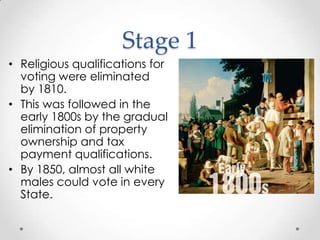
Stage 1
• Religious qualifications for
voting were eliminated
by 1810.
• This was followed in the
early 1800s by the gradual
elimination of property
ownership and tax
payment qualifications.
• By 1850, almost all white
males could vote in every
State.
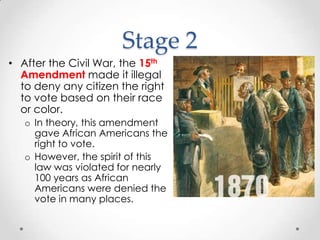
Stage 2
• After the Civil War, the 15th
Amendment made it illegal
to deny any citizen the right
to vote based on their race
or color.
o In theory, this amendment
gave African Americans the
right to vote.
o However, the spirit of this
law was violated for nearly
100 years as African
Americans were denied the
vote in many places.
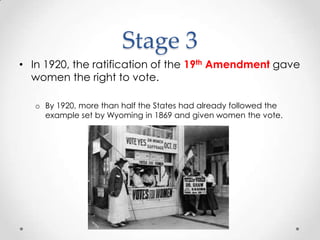
Stage 3
• In 1920, the ratification of the 19th Amendment gave
women the right to vote.
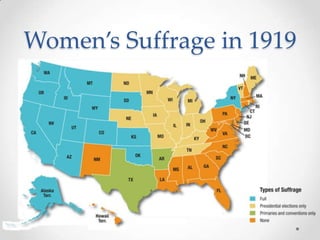
o By 1920, more than half the States had already followed the
example set by Wyoming in 1869 and given women the vote.
Women’s Suffrage in 1919
Stages 4 and 5
• During the 1960s, the civil rights movement
led to new protections for African American
voting rights.
o The Voting Rights Act of 1965 defended racial equality in voting.
o The 24th Amendment eliminated the poll tax in federal elections.
• In 1971 the 26th Amendment gave those 18
and older the right to vote.
Voting Qualifications
• The Constitution sets five restrictions on the
ability of the States to set voter qualifications.
o Anyone allowed to vote for members of their State
legislature must be allowed to vote for members of
Congress.
o The 15th Amendment bans the States from depriving
any person of the right to vote on account of their
race, color, or having once been enslaved.
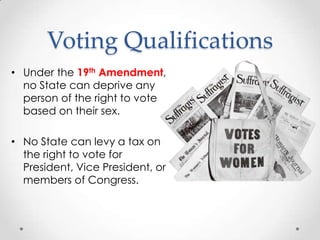
Voting Qualifications
• Under the 19th Amendment,
no State can deprive any
person of the right to vote
based on their sex.
• No State can levy a tax on
the right to vote for
President, Vice President, or
members of Congress.
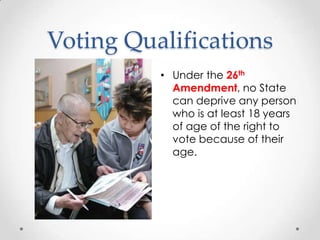
Voting Qualifications
• Under the 26th
Amendment, no State
can deprive any person
who is at least 18 years
of age of the right to
vote because of their
age.
Voting Qualifications
• In addition, no State can violate any other
provision in the Constitution when setting its
voting qualifications.
o For example, a State cannot set suffrage qualifications that
violate the Equal Protection Clause of the 14th Amendment.
Voter Qualifications
Section 2
Introduction
• What are the qualifications for voting, and how
have they changed over time?
o The basic requirements for voting are that
you must be a U.S. citizen, have established
residency in the State where you are casting
your vote, and be at least 18 years of age.
o The minimum voting age and minimum
length of residency have both been lowered
over time.
Citizenship
• In most States, foreign-born residents
who have not become citizens cannot
vote.
o Citizenship is up to each State to decide.
o States can also distinguish between native-born and
naturalized citizens, requiring that voters become citizens
of that State for a minimum period of time before being
allowed to vote.
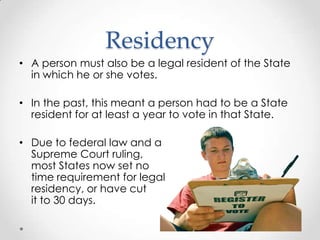
Residency
• A person must also be a legal resident of the State
in which he or she votes.
• In the past, this meant a person had to be a State
resident for at least a year to vote in that State.
• Due to federal law and a
Supreme Court ruling,
most States now set no
time requirement for legal
residency, or have cut
it to 30 days.
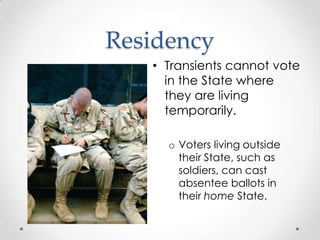
Residency
• Transients cannot vote
in the State where
they are living
temporarily.
o Voters living outside
their State, such as
soldiers, can cast
absentee ballots in
their home State.
Age
• Under the 26th Amendment, the minimum
voting age cannot be older than 18.
o Before the passage of this amendment, the
minimum age had been 21 in most States.
o Some States allow 17-year-olds to vote in primary
elections.
• Historically, young voters have been less
likely to vote than any other age group of
eligible voters.
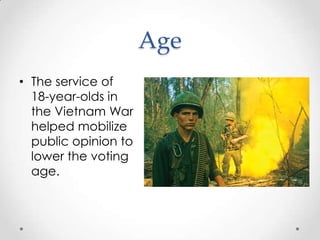
Age
• The service of
18-year-olds in
the Vietnam War
helped mobilize
public opinion to
lower the voting
age.
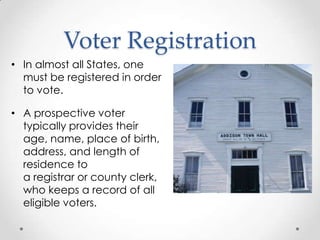
Voter Registration
• In almost all States, one
must be registered in order
to vote.
• A prospective voter
typically provides their
age, name, place of birth,
address, and length of
residence to
a registrar or county clerk,
who keeps a record of all
eligible voters.
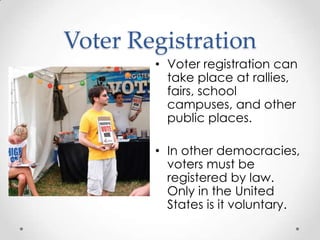
Voter Registration
• Voter registration can
take place at rallies,
fairs, school
campuses, and other
public places.
• In other democracies,
voters must be
registered by law.
Only in the United
States is it voluntary.
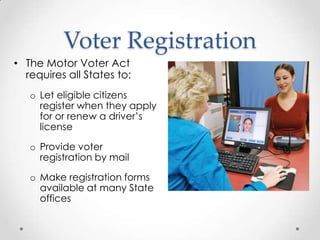
Voter Registration
• The Motor Voter Act
requires all States to:
o Let eligible citizens
register when they apply
for or renew a driver’s
license
o Provide voter
registration by mail
o Make registration forms
available at many State
offices
Should You Need an ID to Vote?
• In 2005, Indiana passed a law requiring
voters to present photo ID to vote.
• In 2008, the Supreme Court ruled that the
law was constitutional and did not
create a barrier to voting.
o This ruling allowed
other states to add
stronger ID
requirements to
election laws.
Tests and Taxes
• Literacy tests for voting were once common,
but are no longer used.
o These tests were often aimed at denying African
Americans the vote, with grandfather clauses allowing
whites to vote without being tested.
• Some States, particularly in the South, also
charged a poll tax to vote.
o In 1964 the 24th Amendment banned the use of any voting
taxes.
Persons Denied the Vote
• Every State denies the vote to some people.
o Few States allow people found mentally incompetent
to vote.
o Most States disqualify people convicted of serious
crimes from voting, although it is often possible for
convicted felons to regain their voting rights.
o Some States also ban those dishonorably discharged
from the armed forces from voting.

Chapter 6 presentation

  • 1.
  • 2.
    The Right toVote Section 1
  • 3.
    Introduction • How havevoting rights changed over the course of American history? o Over time, voting rights have been extended to more Americans. o Voting qualifications based on property ownership, religion, race, and sex have all been eliminated through federal laws and constitutional amendments. o The age requirement for voting has been reduced.
  • 4.
    The Electorate • TheConstitution originally gave the power to decide voter qualifications to the States. o At first most States allowed only white male property owners to vote. • Since 1789, many restrictions on voting rights have been eliminated. • At the same time, the power to decide who has the right to vote has been shifting from the States to the federal government.
  • 5.
    Stage 1 • Religiousqualifications for voting were eliminated by 1810. • This was followed in the early 1800s by the gradual elimination of property ownership and tax payment qualifications. • By 1850, almost all white males could vote in every State.
  • 6.
    Stage 2 • Afterthe Civil War, the 15th Amendment made it illegal to deny any citizen the right to vote based on their race or color. o In theory, this amendment gave African Americans the right to vote. o However, the spirit of this law was violated for nearly 100 years as African Americans were denied the vote in many places.
  • 7.
    Stage 3 • In1920, the ratification of the 19th Amendment gave women the right to vote. o By 1920, more than half the States had already followed the example set by Wyoming in 1869 and given women the vote.
  • 8.
  • 9.
    Stages 4 and5 • During the 1960s, the civil rights movement led to new protections for African American voting rights. o The Voting Rights Act of 1965 defended racial equality in voting. o The 24th Amendment eliminated the poll tax in federal elections. • In 1971 the 26th Amendment gave those 18 and older the right to vote.
  • 10.
    Voting Qualifications • TheConstitution sets five restrictions on the ability of the States to set voter qualifications. o Anyone allowed to vote for members of their State legislature must be allowed to vote for members of Congress. o The 15th Amendment bans the States from depriving any person of the right to vote on account of their race, color, or having once been enslaved.
  • 11.
    Voting Qualifications • Underthe 19th Amendment, no State can deprive any person of the right to vote based on their sex. • No State can levy a tax on the right to vote for President, Vice President, or members of Congress.
  • 12.
    Voting Qualifications • Underthe 26th Amendment, no State can deprive any person who is at least 18 years of age of the right to vote because of their age.
  • 13.
    Voting Qualifications • Inaddition, no State can violate any other provision in the Constitution when setting its voting qualifications. o For example, a State cannot set suffrage qualifications that violate the Equal Protection Clause of the 14th Amendment.
  • 14.
  • 15.
    Introduction • What arethe qualifications for voting, and how have they changed over time? o The basic requirements for voting are that you must be a U.S. citizen, have established residency in the State where you are casting your vote, and be at least 18 years of age. o The minimum voting age and minimum length of residency have both been lowered over time.
  • 16.
    Citizenship • In mostStates, foreign-born residents who have not become citizens cannot vote. o Citizenship is up to each State to decide. o States can also distinguish between native-born and naturalized citizens, requiring that voters become citizens of that State for a minimum period of time before being allowed to vote.
  • 17.
    Residency • A personmust also be a legal resident of the State in which he or she votes. • In the past, this meant a person had to be a State resident for at least a year to vote in that State. • Due to federal law and a Supreme Court ruling, most States now set no time requirement for legal residency, or have cut it to 30 days.
  • 18.
    Residency • Transients cannotvote in the State where they are living temporarily. o Voters living outside their State, such as soldiers, can cast absentee ballots in their home State.
  • 19.
    Age • Under the26th Amendment, the minimum voting age cannot be older than 18. o Before the passage of this amendment, the minimum age had been 21 in most States. o Some States allow 17-year-olds to vote in primary elections. • Historically, young voters have been less likely to vote than any other age group of eligible voters.
  • 20.
    Age • The serviceof 18-year-olds in the Vietnam War helped mobilize public opinion to lower the voting age.
  • 21.
    Voter Registration • Inalmost all States, one must be registered in order to vote. • A prospective voter typically provides their age, name, place of birth, address, and length of residence to a registrar or county clerk, who keeps a record of all eligible voters.
  • 22.
    Voter Registration • Voterregistration can take place at rallies, fairs, school campuses, and other public places. • In other democracies, voters must be registered by law. Only in the United States is it voluntary.
  • 23.
    Voter Registration • TheMotor Voter Act requires all States to: o Let eligible citizens register when they apply for or renew a driver’s license o Provide voter registration by mail o Make registration forms available at many State offices
  • 24.
    Should You Needan ID to Vote? • In 2005, Indiana passed a law requiring voters to present photo ID to vote. • In 2008, the Supreme Court ruled that the law was constitutional and did not create a barrier to voting. o This ruling allowed other states to add stronger ID requirements to election laws.
  • 25.
    Tests and Taxes •Literacy tests for voting were once common, but are no longer used. o These tests were often aimed at denying African Americans the vote, with grandfather clauses allowing whites to vote without being tested. • Some States, particularly in the South, also charged a poll tax to vote. o In 1964 the 24th Amendment banned the use of any voting taxes.
  • 26.
    Persons Denied theVote • Every State denies the vote to some people. o Few States allow people found mentally incompetent to vote. o Most States disqualify people convicted of serious crimes from voting, although it is often possible for convicted felons to regain their voting rights. o Some States also ban those dishonorably discharged from the armed forces from voting.