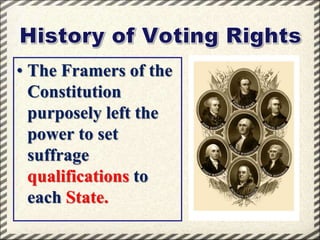
• The Framers of the
Constitution
purposely left the
power to set
suffrage
qualifications to
each State.
• Both of these terms
have the same
meaning:

–The RIGHT or
PRIVILEGE to
vote.
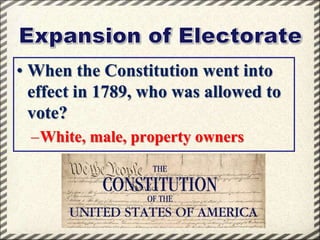
• When the Constitution went into
effect in 1789, who was allowed to
vote?
–White, male, property owners
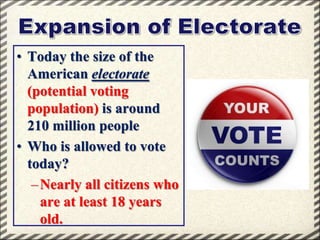
• Today the size of the
American electorate
(potential voting
population) is around
210 million people
• Who is allowed to vote
today?
– Nearly all citizens who
are at least 18 years
old.
• That big number is a result of some 200
years of continuing, often bitter and
sometimes violent struggle.
• The history of suffrage has been marked
by (2) long-term trends:
1. The gradual elimination of restrictions on the
right to vote
2. The State’s power over the right to vote has
been assumed by the Federal government.
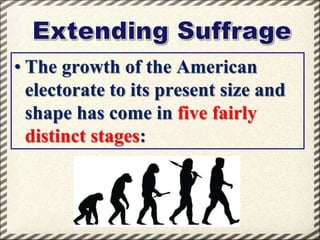
• The growth of the American
electorate to its present size and
shape has come in five fairly
distinct stages:
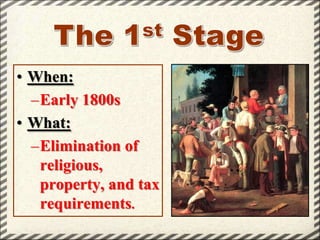
• When:
–Early 1800s
• What:
–Elimination of
religious,
property, and tax
requirements.
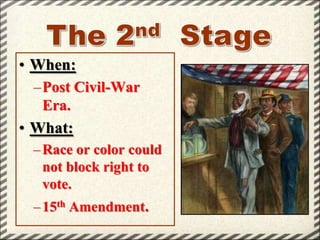
• When:
–Post Civil-War
Era.
• What:
– Race or color could
not block right to
vote.
– 15th Amendment.
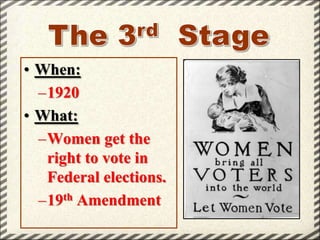
• When:
–1920
• What:
–Women get the
right to vote in
Federal elections.
–19th Amendment
• When:
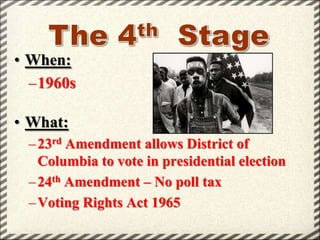
–1960s

• What:
– 23rd Amendment allows District of
Columbia to vote in presidential election
– 24th Amendment – No poll tax
– Voting Rights Act 1965
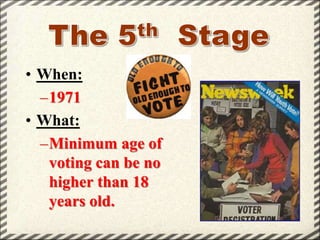
• When:
–1971
• What:
–Minimum age of
voting can be no
higher than 18
years old.
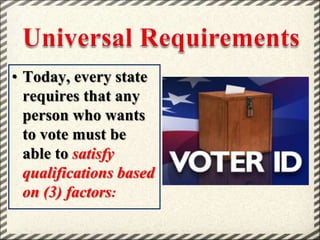
• Today, every state
requires that any
person who wants
to vote must be
able to satisfy
qualifications based
on (3) factors:
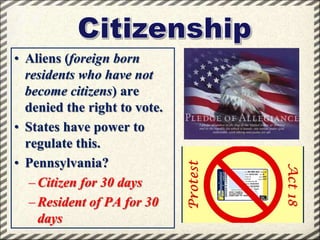
• Aliens (foreign born
residents who have not
become citizens) are
denied the right to vote.
• States have power to
regulate this.
• Pennsylvania?
– Citizen for 30 days
– Resident of PA for 30
days
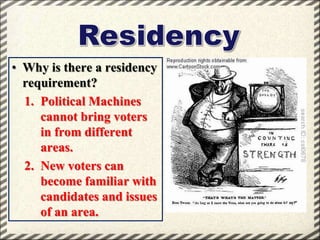
• Why is there a residency
requirement?
1. Political Machines
cannot bring voters
in from different
areas.
2. New voters can
become familiar with
candidates and issues
of an area.
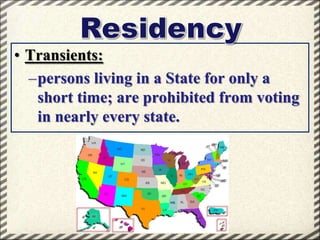
• Transients:
–persons living in a State for only a
short time; are prohibited from voting
in nearly every state.
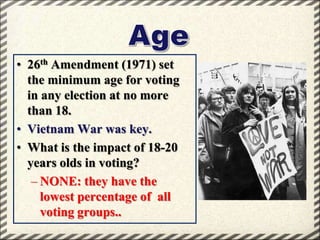
• 26th Amendment (1971) set
the minimum age for voting
in any election at no more
than 18.
• Vietnam War was key.
• What is the impact of 18-20
years olds in voting?
– NONE: they have the
lowest percentage of all
voting groups..
• The States have imposed a
number of other qualifications
over time.
1.
2.
3.
4.

Registration
Literacy
Tax Payment
Persons Denied the Vote
• Procedure of voter identification intended
to prevent fraudulent voting.
• A prospective voter must register his/her
name, age, place of birth, present address,
length of residence, and similar facts.
• What is purging?
– Reviewing the lists of registered voters and
removing the names of the ineligible.
• Some people argue
that the registration
requirement is bar
to voter turnout,
especially among the
poor and lesseducated.
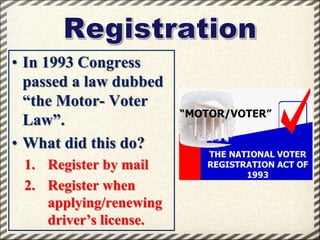
• In 1993 Congress
passed a law dubbed
“the Motor- Voter
Law”.
• What did this do?
1. Register by mail
2. Register when
applying/renewing
driver’s license.
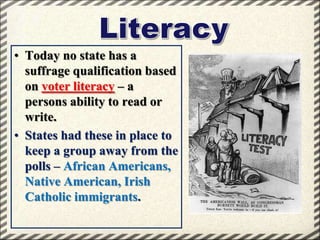
• Today no state has a
suffrage qualification based
on voter literacy – a
persons ability to read or
write.
• States had these in place to
keep a group away from the
polls – African Americans,
Native American, Irish
Catholic immigrants.
• What eliminated
all of these
requirements?
–Voting Rights Act
Amendments of
1970
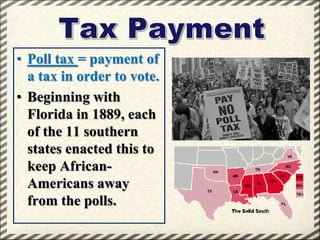
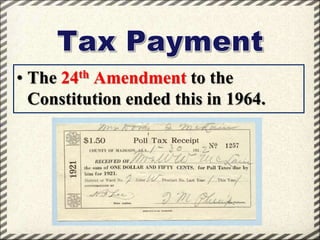
• Poll tax = payment of
a tax in order to vote.
• Beginning with
Florida in 1889, each
of the 11 southern
states enacted this to
keep AfricanAmericans away
from the polls.
• The
Amendment to the
Constitution ended this in 1964.
th
24
• Some states deny the right to vote to
certain persons:
– People in mental institutions.
– Persons found legally incompetent.
– Persons convicted of serious crimes.
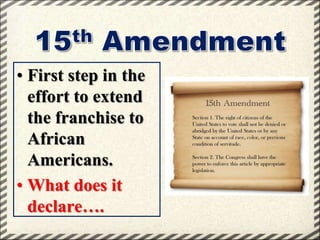
• First step in the
effort to extend
the franchise to
African
Americans.
• What does it
declare….
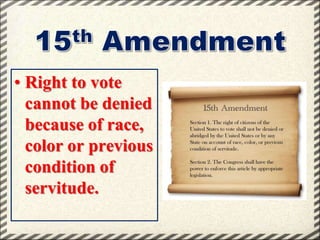
• Right to vote
cannot be denied
because of race,
color or previous
condition of
servitude.
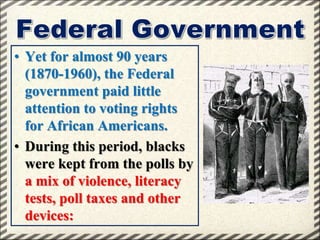
• Yet for almost 90 years
(1870-1960), the Federal
government paid little
attention to voting rights
for African Americans.
• During this period, blacks
were kept from the polls by
a mix of violence, literacy
tests, poll taxes and other
devices:
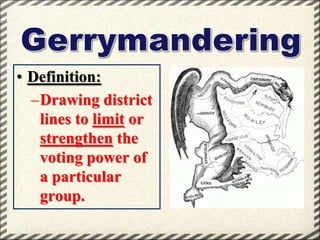
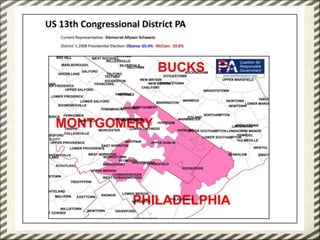
• Definition:
–Drawing district
lines to limit or
strengthen the
voting power of
a particular
group.
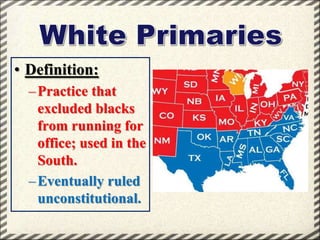
• Definition:
– Practice that
excluded blacks
from running for
office; used in the
South.
– Eventually ruled
unconstitutional.
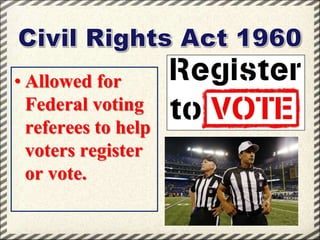
• Allowed for
Federal voting
referees to help
voters register
or vote.
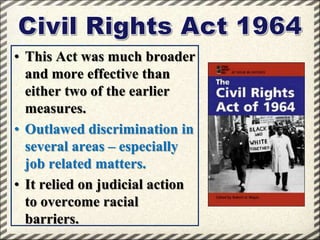
• This Act was much broader
and more effective than
either two of the earlier
measures.
• Outlawed discrimination in
several areas – especially
job related matters.
• It relied on judicial action
to overcome racial
barriers.
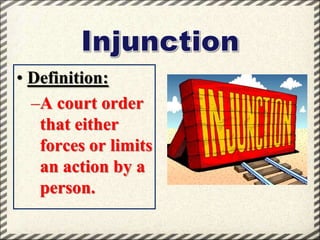
• Definition:
–A court order
that either
forces or limits
an action by a
person.
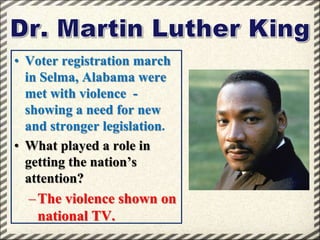
• Voter registration march
in Selma, Alabama were
met with violence showing a need for new
and stronger legislation.
• What played a role in
getting the nation’s
attention?

– The violence shown on
national TV.
• This act applied to ALL
elections held anywhere
in this country – state
and local as well as
federal.
• Originally, the Act was
to be in effect for 5 years
but Congress has
extended its life three
times.
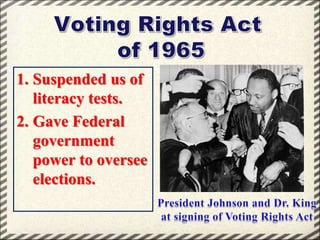
1. Suspended us of
literacy tests.
2. Gave Federal
government
power to oversee
elections.
• Changes that must be
approved:
– Location of polling
places
– Boundaries of districts
– Deadlines in election
process
– Qualifications of
candidates
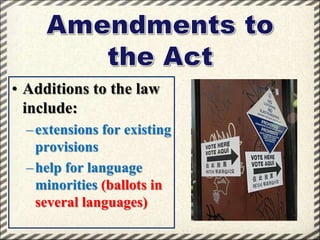
• Additions to the law
include:
– extensions for existing
provisions
– help for language
minorities (ballots in
several languages)
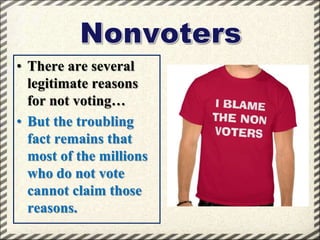
• There are several
legitimate reasons
for not voting…
• But the troubling
fact remains that
most of the millions
who do not vote
cannot claim those
reasons.
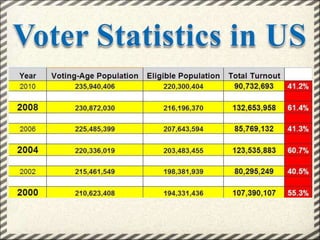
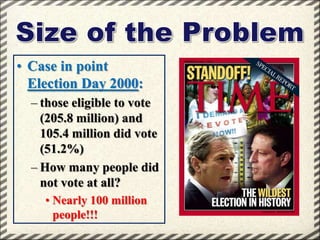
• Case in point
Election Day 2000:
– those eligible to vote
(205.8 million) and
105.4 million did vote
(51.2%)
– How many people did
not vote at all?
• Nearly 100 million
people!!!
• Off-year elections, which
are the congressional
elections in between a
President’s term, have even
lower rates of voter
turnout.
• What does it mean to be a
“nonvoting voter”?
– Vote for candidates at
top of ballot, but no other
offices.
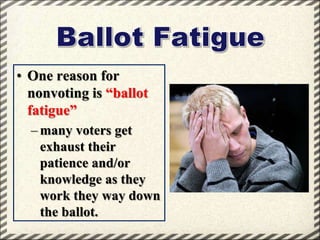
• One reason for
nonvoting is “ballot
fatigue”
– many voters get
exhaust their
patience and/or
knowledge as they
work they way down
the ballot.
• There are any
number of reasons
for not voting:
– Belief that it makes
no difference who
wins.
– Others are satisfied
with the political
world as they it.
• Define
– People who lack any
feeling of influence or
effectiveness in
politics.

• Why do people have it?
– They believe they
have no impact on
what the government
does.
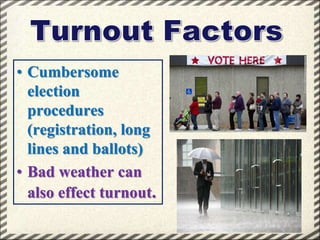
• Cumbersome
election
procedures
(registration, long
lines and ballots)
• Bad weather can
also effect turnout.
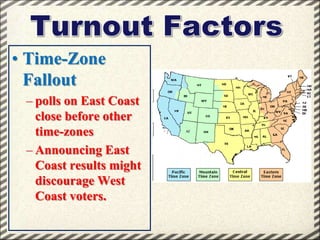
• Time-Zone
Fallout
– polls on East Coast
close before other
time-zones
– Announcing East
Coast results might
discourage West
Coast voters.
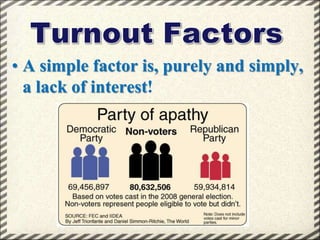
• A simple factor is, purely and simply,
a lack of interest!
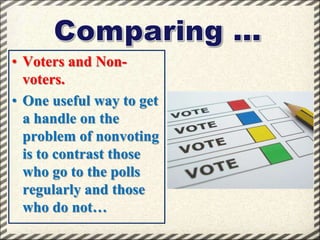
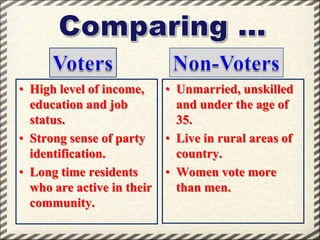
• Voters and Nonvoters.
• One useful way to get
a handle on the
problem of nonvoting
is to contrast those
who go to the polls
regularly and those
who do not…
• High level of income,
education and job
status.
• Strong sense of party
identification.
• Long time residents
who are active in their
community.

• Unmarried, unskilled
and under the age of
35.
• Live in rural areas of
country.
• Women vote more
than men.
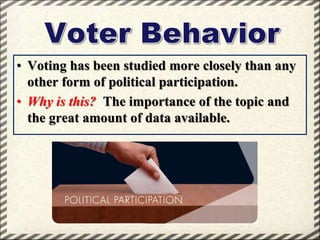
• Voting has been studied more closely than any
other form of political participation.
• Why is this? The importance of the topic and
the great amount of data available.
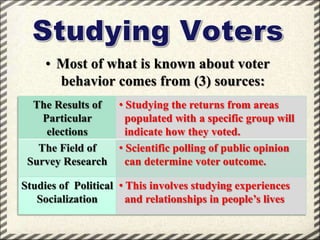
• Most of what is known about voter
behavior comes from (3) sources:
The Results of
Particular
elections
The Field of
Survey Research

• Studying the returns from areas
populated with a specific group will
indicate how they voted.
• Scientific polling of public opinion
can determine voter outcome.

Studies of Political • This involves studying experiences
Socialization
and relationships in people’s lives
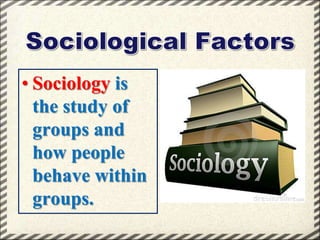
• Sociology is
the study of
groups and
how people
behave within
groups.
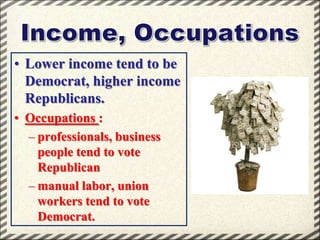
• Lower income tend to be
Democrat, higher income
Republicans.
• Occupations :
– professionals, business
people tend to vote
Republican
– manual labor, union
workers tend to vote
Democrat.
• College grads vote
for Republicans in
higher percentages
than do high school
grads; High school
grads vote GOP
more than grade
school grads.
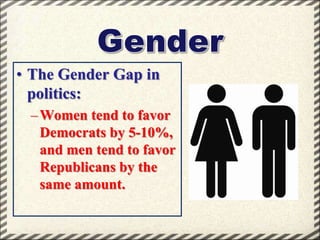
• The Gender Gap in
politics:
– Women tend to favor
Democrats by 5-10%,
and men tend to favor
Republicans by the
same amount.
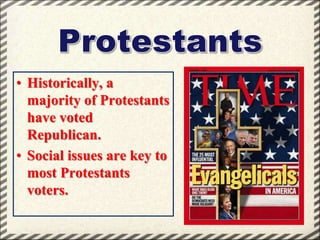
• Historically, a
majority of Protestants
have voted
Republican.
• Social issues are key to
most Protestants
voters.
• Traditional, have
voted Democrat.
• Immigration in early
1900s.
• Recent trend is that
they are swing voters:
– 2004 52% for Bush
– 2008 58% for Obama
• Traditionally have
always voted Democrat.
• Immigration in early
1900s.
• Recent trend:
– 2004 75% for Bush
– 2008 79% for Obama
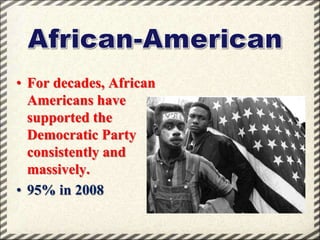
• For decades, African
Americans have
supported the
Democratic Party
consistently and
massively.
• 95% in 2008
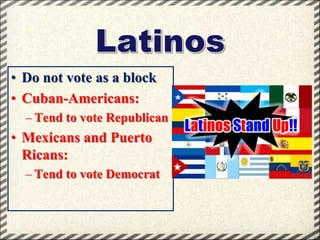
• Do not vote as a block
• Cuban-Americans:
– Tend to vote Republican

• Mexicans and Puerto
Ricans:
– Tend to vote Democrat
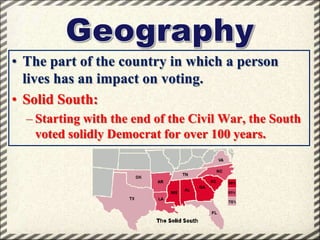
• The part of the country in which a person
lives has an impact on voting.
• Solid South:
– Starting with the end of the Civil War, the South
voted solidly Democrat for over 100 years.
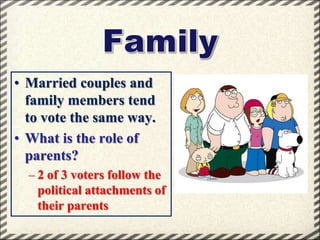
• Married couples and
family members tend
to vote the same way.
• What is the role of
parents?
– 2 of 3 voters follow the
political attachments of
their parents
• Psychology is
the study of
the mind and
of individual
behavior.
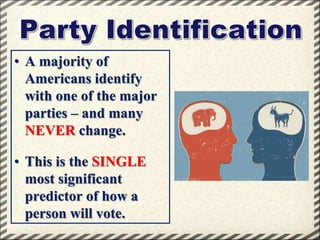
• A majority of
Americans identify
with one of the major
parties – and many
NEVER change.
• This is the SINGLE
most significant
predictor of how a
person will vote.
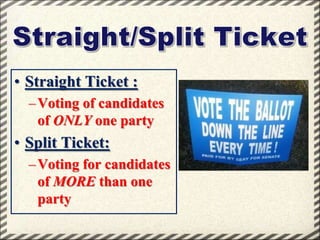
• Straight Ticket :
– Voting of candidates
of ONLY one party

• Split Ticket:
– Voting for candidates
of MORE than one
party
• Term used for
people with no
party affiliation.
• New breed of:
– Often young and
above average in
education, income
and job status.
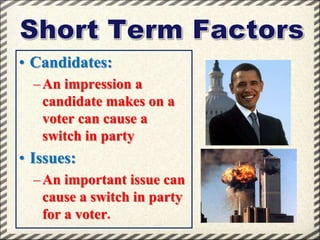
• Candidates:
– An impression a
candidate makes on a
voter can cause a
switch in party

• Issues:
– An important issue can
cause a switch in party
for a voter.

Unit 4 voting

  • 3.
    • The Framersof the Constitution purposely left the power to set suffrage qualifications to each State.
  • 4.
    • Both ofthese terms have the same meaning: –The RIGHT or PRIVILEGE to vote.
  • 6.
    • When theConstitution went into effect in 1789, who was allowed to vote? –White, male, property owners
  • 7.
    • Today thesize of the American electorate (potential voting population) is around 210 million people • Who is allowed to vote today? – Nearly all citizens who are at least 18 years old.
  • 8.
    • That bignumber is a result of some 200 years of continuing, often bitter and sometimes violent struggle. • The history of suffrage has been marked by (2) long-term trends: 1. The gradual elimination of restrictions on the right to vote 2. The State’s power over the right to vote has been assumed by the Federal government.
  • 9.
    • The growthof the American electorate to its present size and shape has come in five fairly distinct stages:
  • 10.
    • When: –Early 1800s •What: –Elimination of religious, property, and tax requirements.
  • 11.
    • When: –Post Civil-War Era. •What: – Race or color could not block right to vote. – 15th Amendment.
  • 12.
    • When: –1920 • What: –Womenget the right to vote in Federal elections. –19th Amendment
  • 13.
    • When: –1960s • What: –23rd Amendment allows District of Columbia to vote in presidential election – 24th Amendment – No poll tax – Voting Rights Act 1965
  • 14.
    • When: –1971 • What: –Minimumage of voting can be no higher than 18 years old.
  • 16.
    • Today, everystate requires that any person who wants to vote must be able to satisfy qualifications based on (3) factors:
  • 17.
    • Aliens (foreignborn residents who have not become citizens) are denied the right to vote. • States have power to regulate this. • Pennsylvania? – Citizen for 30 days – Resident of PA for 30 days
  • 18.
    • Why isthere a residency requirement? 1. Political Machines cannot bring voters in from different areas. 2. New voters can become familiar with candidates and issues of an area.
  • 19.
    • Transients: –persons livingin a State for only a short time; are prohibited from voting in nearly every state.
  • 20.
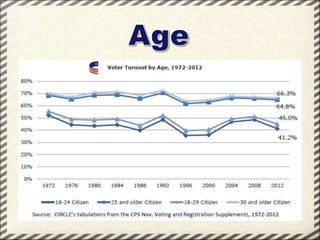
    • 26th Amendment(1971) set the minimum age for voting in any election at no more than 18. • Vietnam War was key. • What is the impact of 18-20 years olds in voting? – NONE: they have the lowest percentage of all voting groups..
  • 22.
    • The Stateshave imposed a number of other qualifications over time. 1. 2. 3. 4. Registration Literacy Tax Payment Persons Denied the Vote
  • 23.
    • Procedure ofvoter identification intended to prevent fraudulent voting. • A prospective voter must register his/her name, age, place of birth, present address, length of residence, and similar facts. • What is purging? – Reviewing the lists of registered voters and removing the names of the ineligible.
  • 24.
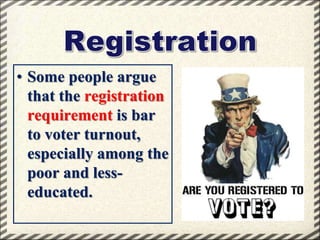
    • Some peopleargue that the registration requirement is bar to voter turnout, especially among the poor and lesseducated.
  • 25.
    • In 1993Congress passed a law dubbed “the Motor- Voter Law”. • What did this do? 1. Register by mail 2. Register when applying/renewing driver’s license.
  • 26.
    • Today nostate has a suffrage qualification based on voter literacy – a persons ability to read or write. • States had these in place to keep a group away from the polls – African Americans, Native American, Irish Catholic immigrants.
  • 27.
    • What eliminated allof these requirements? –Voting Rights Act Amendments of 1970
  • 28.
    • Poll tax= payment of a tax in order to vote. • Beginning with Florida in 1889, each of the 11 southern states enacted this to keep AfricanAmericans away from the polls.
  • 29.
    • The Amendment tothe Constitution ended this in 1964. th 24
  • 30.
    • Some statesdeny the right to vote to certain persons: – People in mental institutions. – Persons found legally incompetent. – Persons convicted of serious crimes.
  • 32.
    • First stepin the effort to extend the franchise to African Americans. • What does it declare….
  • 33.
    • Right tovote cannot be denied because of race, color or previous condition of servitude.
  • 34.
    • Yet foralmost 90 years (1870-1960), the Federal government paid little attention to voting rights for African Americans. • During this period, blacks were kept from the polls by a mix of violence, literacy tests, poll taxes and other devices:
  • 35.
    • Definition: –Drawing district linesto limit or strengthen the voting power of a particular group.
  • 37.
    • Definition: – Practicethat excluded blacks from running for office; used in the South. – Eventually ruled unconstitutional.
  • 38.
    • Allowed for Federalvoting referees to help voters register or vote.
  • 39.
    • This Actwas much broader and more effective than either two of the earlier measures. • Outlawed discrimination in several areas – especially job related matters. • It relied on judicial action to overcome racial barriers.
  • 40.
    • Definition: –A courtorder that either forces or limits an action by a person.
  • 41.
    • Voter registrationmarch in Selma, Alabama were met with violence showing a need for new and stronger legislation. • What played a role in getting the nation’s attention? – The violence shown on national TV.
  • 42.
    • This actapplied to ALL elections held anywhere in this country – state and local as well as federal. • Originally, the Act was to be in effect for 5 years but Congress has extended its life three times.
  • 43.
    1. Suspended usof literacy tests. 2. Gave Federal government power to oversee elections.
  • 44.
    • Changes thatmust be approved: – Location of polling places – Boundaries of districts – Deadlines in election process – Qualifications of candidates
  • 45.
    • Additions tothe law include: – extensions for existing provisions – help for language minorities (ballots in several languages)
  • 47.
    • There areseveral legitimate reasons for not voting… • But the troubling fact remains that most of the millions who do not vote cannot claim those reasons.
  • 48.
    • Case inpoint Election Day 2000: – those eligible to vote (205.8 million) and 105.4 million did vote (51.2%) – How many people did not vote at all? • Nearly 100 million people!!!
  • 49.
    • Off-year elections,which are the congressional elections in between a President’s term, have even lower rates of voter turnout. • What does it mean to be a “nonvoting voter”? – Vote for candidates at top of ballot, but no other offices.
  • 50.
    • One reasonfor nonvoting is “ballot fatigue” – many voters get exhaust their patience and/or knowledge as they work they way down the ballot.
  • 51.
    • There areany number of reasons for not voting: – Belief that it makes no difference who wins. – Others are satisfied with the political world as they it.
  • 52.
    • Define – Peoplewho lack any feeling of influence or effectiveness in politics. • Why do people have it? – They believe they have no impact on what the government does.
  • 53.
    • Cumbersome election procedures (registration, long linesand ballots) • Bad weather can also effect turnout.
  • 54.
    • Time-Zone Fallout – pollson East Coast close before other time-zones – Announcing East Coast results might discourage West Coast voters.
  • 55.
    • A simplefactor is, purely and simply, a lack of interest!
  • 56.
    • Voters andNonvoters. • One useful way to get a handle on the problem of nonvoting is to contrast those who go to the polls regularly and those who do not…
  • 57.
    • High levelof income, education and job status. • Strong sense of party identification. • Long time residents who are active in their community. • Unmarried, unskilled and under the age of 35. • Live in rural areas of country. • Women vote more than men.
  • 58.
    • Voting hasbeen studied more closely than any other form of political participation. • Why is this? The importance of the topic and the great amount of data available.
  • 59.
    • Most ofwhat is known about voter behavior comes from (3) sources: The Results of Particular elections The Field of Survey Research • Studying the returns from areas populated with a specific group will indicate how they voted. • Scientific polling of public opinion can determine voter outcome. Studies of Political • This involves studying experiences Socialization and relationships in people’s lives
  • 60.
    • Sociology is thestudy of groups and how people behave within groups.
  • 61.
    • Lower incometend to be Democrat, higher income Republicans. • Occupations : – professionals, business people tend to vote Republican – manual labor, union workers tend to vote Democrat.
  • 62.
    • College gradsvote for Republicans in higher percentages than do high school grads; High school grads vote GOP more than grade school grads.
  • 63.
    • The GenderGap in politics: – Women tend to favor Democrats by 5-10%, and men tend to favor Republicans by the same amount.
  • 64.
    • Historically, a majorityof Protestants have voted Republican. • Social issues are key to most Protestants voters.
  • 65.
    • Traditional, have votedDemocrat. • Immigration in early 1900s. • Recent trend is that they are swing voters: – 2004 52% for Bush – 2008 58% for Obama
  • 66.
    • Traditionally have alwaysvoted Democrat. • Immigration in early 1900s. • Recent trend: – 2004 75% for Bush – 2008 79% for Obama
  • 67.
    • For decades,African Americans have supported the Democratic Party consistently and massively. • 95% in 2008
  • 68.
    • Do notvote as a block • Cuban-Americans: – Tend to vote Republican • Mexicans and Puerto Ricans: – Tend to vote Democrat
  • 69.
    • The partof the country in which a person lives has an impact on voting. • Solid South: – Starting with the end of the Civil War, the South voted solidly Democrat for over 100 years.
  • 70.
    • Married couplesand family members tend to vote the same way. • What is the role of parents? – 2 of 3 voters follow the political attachments of their parents
  • 71.
    • Psychology is thestudy of the mind and of individual behavior.
  • 72.
    • A majorityof Americans identify with one of the major parties – and many NEVER change. • This is the SINGLE most significant predictor of how a person will vote.
  • 73.
    • Straight Ticket: – Voting of candidates of ONLY one party • Split Ticket: – Voting for candidates of MORE than one party
  • 74.
    • Term usedfor people with no party affiliation. • New breed of: – Often young and above average in education, income and job status.
  • 75.
    • Candidates: – Animpression a candidate makes on a voter can cause a switch in party • Issues: – An important issue can cause a switch in party for a voter.