The Presidency
Chapter 13
THE PRESIDENT’S JOB
DESCRIPTION
Section 1
Introduction
• What are the roles and qualifications of the
office of the President?
• The President’s roles include:
• Chief of state
• Chief executive
• Chief administrator
• Chief diplomat
• Commander in chief
• Chief legislator
• Chief citizen
• Qualifications for President include being 35 years
old, a natural born U.S. citizen, and having lived
in the United States for 14 years.
Presidential Roles
• The President acts as chief of state, the
ceremonial head of the U.S. government and
the symbol of the American people.
• The President is the chief executive,
holding the nation’s executive power in
domestic and foreign affairs.
• The President is the chief administrator,
directing the more than 2.7 million civilian
employees of the executive branch.
Presidential Roles
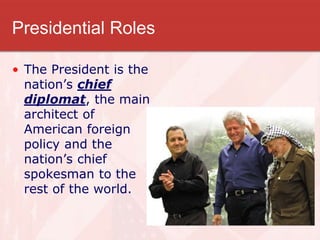
• The President is the
nation’s chief
diplomat, the main
architect of
American foreign
policy and the
nation’s chief
spokesman to the
rest of the world.
Presidential Roles
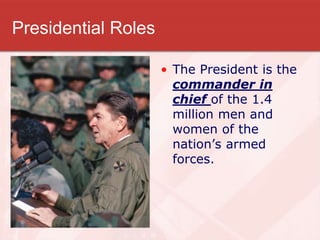
• The President is the
commander in
chief of the 1.4
million men and
women of the
nation’s armed
forces.
Presidential Roles
• The President is the chief legislator,
proposing laws that set the congressional
legislative agenda.
• The President is the unofficial head of the
political party that controls the executive
branch.
• The President is the unofficial chief
citizen, expected to champion the public
interest and be the representative of all the
people.
Formal Qualifications
• The President must be a natural born
citizen of the United States.
• The President must be at least 35
years of age.
• The President must have been a U.S.
resident for at least 14 years.
Terms in Office
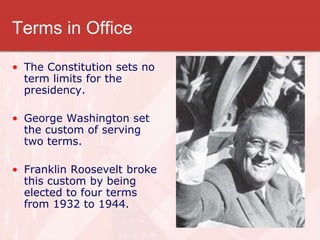
• The Constitution sets no
term limits for the
presidency.
• George Washington set
the custom of serving
two terms.
• Franklin Roosevelt broke
this custom by being
elected to four terms
from 1932 to 1944.
Terms in Office
• The 22nd Amendment, ratified in 1944,
limits Presidents to no more than two
full elected terms in office.
• If a President succeeds to the office after
the middle of a term, he or she can still
seek two full terms.
• No President can serve more than 10
years in office.
Views on Term Limits
• Many people, including some Presidents, have
argued that the two-term rule unfairly limits the
right of the people to choose their President.
• Some say it also weakens a President’s influence at
the end of the second term in office.
• Supporters say the amendment protects against
abuse of executive power.
• Some have argued for a single six-year term, which
would free the President from worrying about
reelection.
Pay and Benefits
• Congress decides the President’s annual
salary.
• This salary cannot be changed while a President
is in office.
• The current salary, set in 2001, is $400,000 a
year plus $50,000 a year for expenses.
• The Constitution forbids the President from
receiving any other pay from the government or
the States while in office.
Pay and Benefits
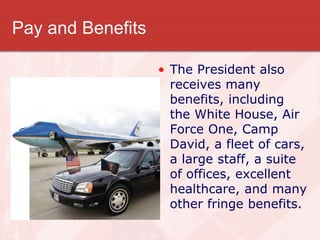
• The President also
receives many
benefits, including
the White House, Air
Force One, Camp
David, a fleet of cars,
a large staff, a suite
of offices, excellent
healthcare, and many
other fringe benefits.
PRESIDENTIAL SUCCESSION
& THE VICE PRESIDENCY
Section 2
Introduction
• What occurs when the President is unable to
perform the duties of the office?
• If a President dies, resigns, or is removed by
impeachment, the Vice President succeeds to the
presidency.
• If the President is temporarily incapacitated, the
Vice President becomes Acting President until the
President can resume office.
Presidential Succession
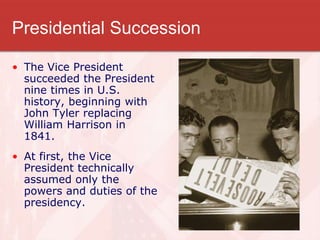
• The Vice President
succeeded the President
nine times in U.S.
history, beginning with
John Tyler replacing
William Harrison in
1841.
• At first, the Vice
President technically
assumed only the
powers and duties of the
presidency.
Presidential Succession
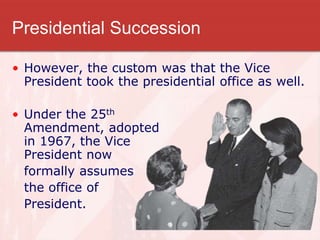
• However, the custom was that the Vice
President took the presidential office as well.
• Under the 25th
Amendment, adopted
in 1967, the Vice
President now
formally assumes
the office of
President.
Order of Succession
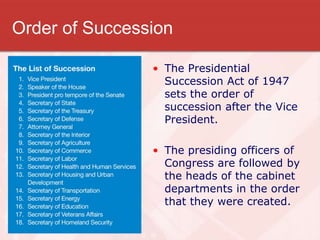
• The Presidential
Succession Act of 1947
sets the order of
succession after the Vice
President.
• The presiding officers of
Congress are followed by
the heads of the cabinet
departments in the order
that they were created.
Presidential Disability
• For many years, there were no provisions for
deciding if a President was too disabled to
continue in office.
• Woodrow Wilson suffered a stroke in 1919 and
was too ill to meet with his cabinet for seven
months.
• President Eisenhower had three serious but
temporary illnesses while in office.
• In 1981, President Reagan was badly wounded in
an assassination attempt.
Presidential Disability
• The 25th Amendment addressed the
disability issue. The Vice President
becomes Acting President if:
• The President informs Congress, in
writing, that he or she cannot carry out
the powers and duties of the office, OR
• The Vice President and a majority of the
members of the Cabinet inform Congress,
in writing, that the President is
incapacitated.
The Vice Presidency
• The Constitution gives the Vice
President two formal duties: to preside
over the Senate, and to help decide if
the President is disabled (under the
25th Amendment).
• Otherwise, the Vice President must be
ready to assume the duties of the
presidency if necessary.
The Vice Presidency
• Historically, the office of Vice President has had low
status.
• Often the vice presidential candidate is chosen
because he or she can balance the ticket, helping
the president get elected due to personal
characteristics such as ideology, geographic
background, race, ethnicity, or gender.
• This puts little emphasis on the presidential qualities
possessed by a vice presidential candidate.
The Vice Presidency Today
• Recent Vice Presidents have had more political
experience and influence.
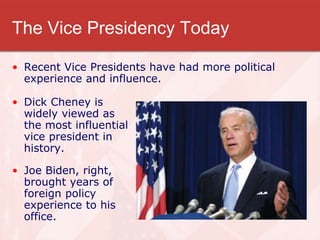
• Dick Cheney is
widely viewed as
the most influential
vice president in
history.
• Joe Biden, right,
brought years of
foreign policy
experience to his
office.
The Vice Presidency Today
• No Vice President
has been given as
much power as the
President, in part
because the
President cannot
remove the Vice
President.
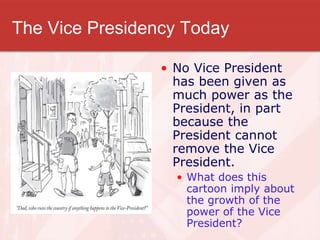
• What does this
cartoon imply about
the growth of the
power of the Vice
President?
Vice Presidential Vacancies
• The vice presidency has been left vacant
nine times by succession, seven times by
death, and twice by resignation.
• Under the 25th Amendment, the President
can fill a vice presidential vacancy by
nominating a Vice President, who must be
confirmed by both houses of Congress.
• In 1973, Gerald Ford became the first Vice
President appointed in this fashion.
THE FRAMERS’ PLAN
Section 3
Introduction
• How did the process of choosing a
President change over time?
• At first electors cast two votes for president, each
for a different candidate. The winner became
President and the runner-up became Vice
President.
• The 12th Amendment added separate electoral
votes for President and Vice President.
• Electors also pledged to vote for their party’s
candidates.
The Constitutional Debate
• The Framers of the Constitution debated
whether to have the President chosen by
Congress or by the popular vote of the
people.
• Opponents of congressional selection felt it
would upset the separation of powers
between the executive and legislative
branches.
• Opponents of popular election felt that the
people would not know enough about the
candidates to make wise choices.
The Electoral College
• The Framers agreed on a plan put forth by
Alexander Hamilton.
• They created the electoral college, a special
body of presidential electors representing
each state.
• Each state would have as many electors as it had
senators and representatives in Congress.
• The state legislatures would decide how
presidential electors would be chosen in each
state.
The Electoral College
• Each elector would cast two electoral votes,
each for a different candidate.
• The candidate with the most electoral votes
would become President.
• The candidate with the second-most votes would
become Vice President.
• The Framers did not anticipate the rise of
political parties competing for the
presidency.
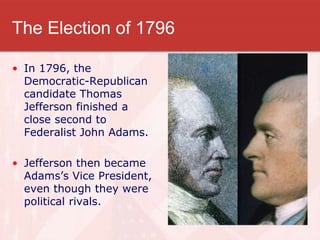
The Election of 1796
• In 1796, the
Democratic-Republican
candidate Thomas
Jefferson finished a
close second to
Federalist John Adams.
• Jefferson then became
Adams’s Vice President,
even though they were
political rivals.
The Election of 1800
• In 1800, the Federalists and Democratic-
Republicans faced each other again.
• For the first time, each party nominated two
candidates, one for President and one for
Vice President.
• John Adams and Alexander Hamilton formed the
Federalist ticket, while Thomas Jefferson and
Aaron Burr were the Democratic-Republican
candidates.
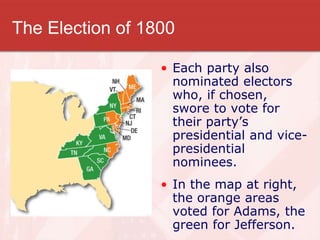
The Election of 1800
• Each party also
nominated electors
who, if chosen,
swore to vote for
their party’s
presidential and vice-
presidential
nominees.
• In the map at right,
the orange areas
voted for Adams, the
green for Jefferson.
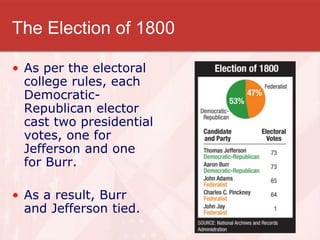
The Election of 1800
• As per the electoral
college rules, each
Democratic-
Republican elector
cast two presidential
votes, one for
Jefferson and one
for Burr.
• As a result, Burr
and Jefferson tied.
The Election of 1800
• Popular opinion favored Jefferson, who had
run as the party’s formal presidential
candidate. But there was no rule stating that
he should win the electoral tie.
• Instead, it took the House of
Representatives 36 separate votes to break
the tie and elect Jefferson as President,
making Burr the Vice President.
The Election of 1800
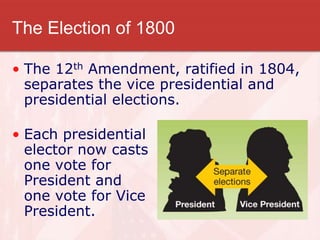
• The 12th Amendment, ratified in 1804,
separates the vice presidential and
presidential elections.
• Each presidential
elector now casts
one vote for
President and
one vote for Vice
President.
PRESIDENTIAL NOMINATIONS
Section 3
Introduction
• Does the nominating system allow
Americans to choose the best candidates for
President?
• The widely used presidential primary system does
force candidates to prove their political abilities
before moving on in the nominating process.
• Whether the current system produces the most
skilled candidates remains a matter of debate.
Nominating the President
• The system of nominating the President is not
mentioned in the Constitution and has been created
by the two major parties.
• Each party’s national committee sets the time and
place of its national convention.
• The committees also assign each State party a
certain number of convention delegates. In 2008,
the Republican convention had 2,380 delegates and
the Democrats had 4,233 delegates.
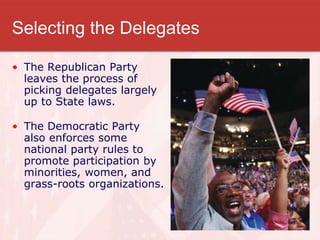
Selecting the Delegates
• The Republican Party
leaves the process of
picking delegates largely
up to State laws.
• The Democratic Party
also enforces some
national party rules to
promote participation by
minorities, women, and
grass-roots organizations.
Presidential Primaries
• The details of delegate-selection vary from
State to State.
• In some States, the presidential primary
chooses party delegates to the national
convention.
• In others it expresses a preference among
presidential contenders.
• In some States it does both.
• Many States choose early dates for their
primaries.
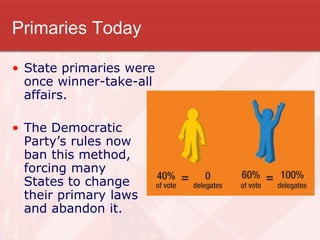
Primaries Today
• State primaries were
once winner-take-all
affairs.
• The Democratic
Party’s rules now
ban this method,
forcing many
States to change
their primary laws
and abandon it.
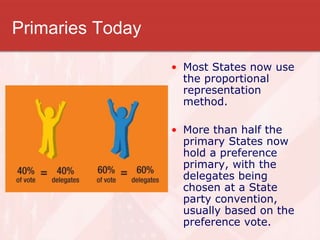
Primaries Today
• Most States now use
the proportional
representation
method.
• More than half the
primary States now
hold a preference
primary, with the
delegates being
chosen at a State
party convention,
usually based on the
preference vote.
Evaluation of the Primary
• They force potential nominees to test their
political strength and prove their worthiness
as main contenders.
• Primaries also make the nomination process
more democratic.
• Primaries are less important to the party in
power, which typically will either nominate
the sitting President or the candidate
endorsed by the President.
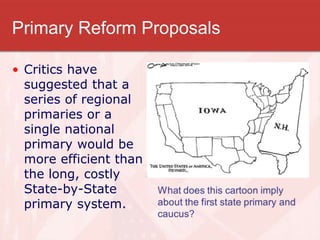
Primary Reform Proposals
• Critics have
suggested that a
series of regional
primaries or a
single national
primary would be
more efficient than
the long, costly
State-by-State
primary system.
Caucuses
• In States that do not hold primaries,
caucuses choose the delegates to the
national convention.
• Party voters attend local caucuses where they
vote for delegates to attend district conventions.
• The district conventions choose delegates to the
State convention, which then selects the State
delegates who will represent the party at the
national convention.
The National Conventions
• Today a party’s nominee is usually decided before
the convention.
• Conventions have three key goals:
• Naming the party’s presidential and vice presidential
candidates
• Uniting the party’s factions and leaders in one place
for a common purpose
• Adopting the party platform, stating its basic
principles, policy goals, and objectives for the
campaign and beyond.
• Conventions also draw media attention for the party
and its candidate.
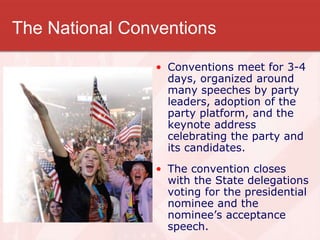
The National Conventions
• Conventions meet for 3-4
days, organized around
many speeches by party
leaders, adoption of the
party platform, and the
keynote address
celebrating the party and
its candidates.
• The convention closes
with the State delegations
voting for the presidential
nominee and the
nominee’s acceptance
speech.
Race for the Presidency
• The race for the presidency begins long
before the election.
• One to four years before the election, potential
candidates begin to explore their chances,
organize, and raise funds.
• From January to June of the election year,
primaries and caucuses help decide the party’s
frontrunner.
• In August and September, major parties hold
conventions, adopt platforms, and nominate their
presidential candidate.
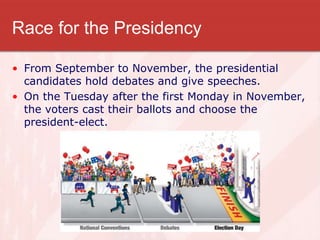
Race for the Presidency
• From September to November, the presidential
candidates hold debates and give speeches.
• On the Tuesday after the first Monday in November,
the voters cast their ballots and choose the
president-elect.
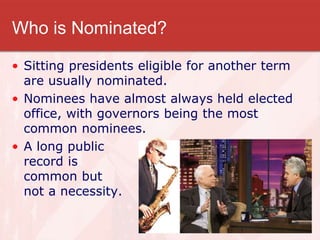
Who is Nominated?
• Sitting presidents eligible for another term
are usually nominated.
• Nominees have almost always held elected
office, with governors being the most
common nominees.
• A long public
record is
common but
not a necessity.
Who is Nominated?
• The overwhelming majority of nominees
have been white, male, Protestant, and
married.
• Women and minorities had not been serious
major party candidates until 2008, with
Hillary Clinton and Barack Obama vying for
the Democratic nomination and Obama
winning the presidency.
• Republican nominee John McCain was the
oldest major party presidential candidate in
history.
THE PRESIDENTIAL ELECTION
Section 4
Introduction
• Does the election process serve the goals of
American democracy today?
• This question is still widely debated.
• Critics note that the current electoral process
does not always elect the winner of the popular
vote.
• Supporters note that the winner of the popular
vote usually wins the presidency and that the
current process preserves the influence of the
individual States.
Presidential Campaigns
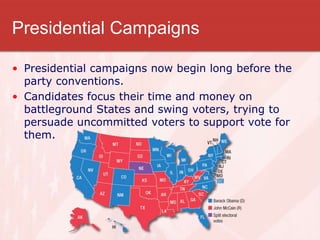
• Presidential campaigns now begin long before the
party conventions.
• Candidates focus their time and money on
battleground States and swing voters, trying to
persuade uncommitted voters to support vote for
them.
Presidential Campaigns
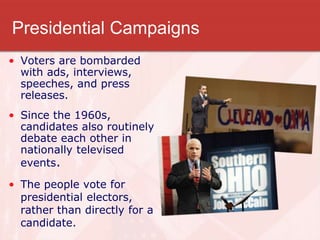
• Voters are bombarded
with ads, interviews,
speeches, and press
releases.
• Since the 1960s,
candidates also routinely
debate each other in
nationally televised
events.
• The people vote for
presidential electors,
rather than directly for a
candidate.
Choosing Electors
• Presidential electors cast the actual votes for
President and Vice President. Electors are chosen by
the results of the State popular vote on election
day.
• Electors meet at their State capital after the election
and cast one electoral vote for President and one for
Vice President. The results are sent to Washington
and tallied.
• The Framers expected electors to use their own
judgment, but now electors are expected to vote for
their party’s candidates.
Counting Electoral Votes
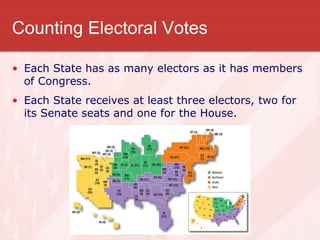
• Each State has as many electors as it has members
of Congress.
• Each State receives at least three electors, two for
its Senate seats and one for the House.
Counting Electoral Votes
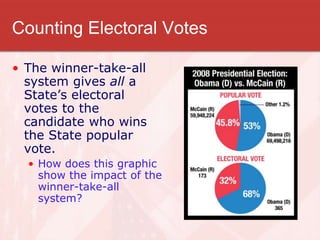
• The winner-take-all
system gives all a
State’s electoral
votes to the
candidate who wins
the State popular
vote.
• How does this graphic
show the impact of the
winner-take-all
system?
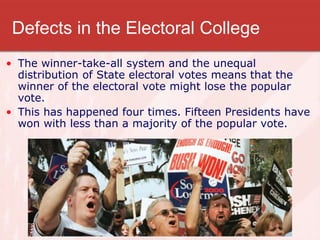
Defects in the Electoral College
• The winner-take-all system and the unequal
distribution of State electoral votes means that the
winner of the electoral vote might lose the popular
vote.
• This has happened four times. Fifteen Presidents have
won with less than a majority of the popular vote.
Bush v. Gore
• In 2000, Al Gore
narrowly won the
popular vote, but
George W. Bush won
the electoral college by
one vote.
• Florida’s popular vote
was disputed, leading to
a recount stopped by a
5-4 decision of the
Supreme Court, giving
Bush Florida’s 25
electoral votes.
The House
• Electors are not required by the Constitution
to pick the winner of the popular vote in
their State.
• It is possible that a presidential election will
need to be decided in the House.
• House votes are by State, not individual
members, which gives small States undue
influence.
• If a majority of State representatives cannot
agree on a choice, the State loses its vote.
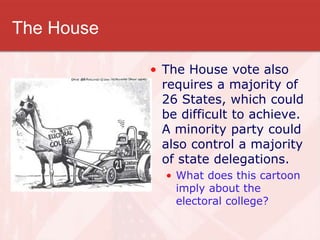
The House
• The House vote also
requires a majority of
26 States, which could
be difficult to achieve.
A minority party could
also control a majority
of state delegations.
• What does this cartoon
imply about the
electoral college?
Proposed Reforms
• The district plan lets every State congressional
district select its own electors by popular vote.
• The proportional plan gives each candidate a share
of the State electoral vote equal to their share of
the State popular vote.
• These plans require no constitutional amendment
but do not guarantee that the winner of the national
popular vote will win the election. More elections
might have to be decided by the House.
Direct Popular Election
• The direct popular election plan abolishes
the electoral college. Voters would vote
directly for President and Vice President.
• The plan has popular support but faces
several obstacles:
• It would take a constitutional amendment to get
rid of the electoral college.
• It would make individual States less important.
• It would force candidates to campaign
everywhere, at great expense.
National Popular Vote Plan
• The national popular vote plan calls on States to
reform the electoral college and has wide support.
• All State electoral votes would be given to the winner
of the national popular vote.
• All States would enter into a compact that would
make this change effective only if approved by States
totaling at least 270 electoral votes.
• So far only 4 States have successfully changed their
electoral laws. But 20 other States have tried.
Defending the Electoral College
• It is a known process. Reforms may have
unknown flaws.
• The present system usually identifies the
president-elect quickly and clearly.
• The electoral college promotes the nation’s two-
party system.
• Only two presidential elections have ever gone
to the House of Representatives.

Chapter 13 presentation

  • 1.
  • 2.
  • 3.
    Introduction • What arethe roles and qualifications of the office of the President? • The President’s roles include: • Chief of state • Chief executive • Chief administrator • Chief diplomat • Commander in chief • Chief legislator • Chief citizen • Qualifications for President include being 35 years old, a natural born U.S. citizen, and having lived in the United States for 14 years.
  • 4.
    Presidential Roles • ThePresident acts as chief of state, the ceremonial head of the U.S. government and the symbol of the American people. • The President is the chief executive, holding the nation’s executive power in domestic and foreign affairs. • The President is the chief administrator, directing the more than 2.7 million civilian employees of the executive branch.
  • 5.
    Presidential Roles • ThePresident is the nation’s chief diplomat, the main architect of American foreign policy and the nation’s chief spokesman to the rest of the world.
  • 6.
    Presidential Roles • ThePresident is the commander in chief of the 1.4 million men and women of the nation’s armed forces.
  • 7.
    Presidential Roles • ThePresident is the chief legislator, proposing laws that set the congressional legislative agenda. • The President is the unofficial head of the political party that controls the executive branch. • The President is the unofficial chief citizen, expected to champion the public interest and be the representative of all the people.
  • 8.
    Formal Qualifications • ThePresident must be a natural born citizen of the United States. • The President must be at least 35 years of age. • The President must have been a U.S. resident for at least 14 years.
  • 9.
    Terms in Office •The Constitution sets no term limits for the presidency. • George Washington set the custom of serving two terms. • Franklin Roosevelt broke this custom by being elected to four terms from 1932 to 1944.
  • 10.
    Terms in Office •The 22nd Amendment, ratified in 1944, limits Presidents to no more than two full elected terms in office. • If a President succeeds to the office after the middle of a term, he or she can still seek two full terms. • No President can serve more than 10 years in office.
  • 11.
    Views on TermLimits • Many people, including some Presidents, have argued that the two-term rule unfairly limits the right of the people to choose their President. • Some say it also weakens a President’s influence at the end of the second term in office. • Supporters say the amendment protects against abuse of executive power. • Some have argued for a single six-year term, which would free the President from worrying about reelection.
  • 12.
    Pay and Benefits •Congress decides the President’s annual salary. • This salary cannot be changed while a President is in office. • The current salary, set in 2001, is $400,000 a year plus $50,000 a year for expenses. • The Constitution forbids the President from receiving any other pay from the government or the States while in office.
  • 13.
    Pay and Benefits •The President also receives many benefits, including the White House, Air Force One, Camp David, a fleet of cars, a large staff, a suite of offices, excellent healthcare, and many other fringe benefits.
  • 14.
    PRESIDENTIAL SUCCESSION & THEVICE PRESIDENCY Section 2
  • 15.
    Introduction • What occurswhen the President is unable to perform the duties of the office? • If a President dies, resigns, or is removed by impeachment, the Vice President succeeds to the presidency. • If the President is temporarily incapacitated, the Vice President becomes Acting President until the President can resume office.
  • 16.
    Presidential Succession • TheVice President succeeded the President nine times in U.S. history, beginning with John Tyler replacing William Harrison in 1841. • At first, the Vice President technically assumed only the powers and duties of the presidency.
  • 17.
    Presidential Succession • However,the custom was that the Vice President took the presidential office as well. • Under the 25th Amendment, adopted in 1967, the Vice President now formally assumes the office of President.
  • 18.
    Order of Succession •The Presidential Succession Act of 1947 sets the order of succession after the Vice President. • The presiding officers of Congress are followed by the heads of the cabinet departments in the order that they were created.
  • 19.
    Presidential Disability • Formany years, there were no provisions for deciding if a President was too disabled to continue in office. • Woodrow Wilson suffered a stroke in 1919 and was too ill to meet with his cabinet for seven months. • President Eisenhower had three serious but temporary illnesses while in office. • In 1981, President Reagan was badly wounded in an assassination attempt.
  • 20.
    Presidential Disability • The25th Amendment addressed the disability issue. The Vice President becomes Acting President if: • The President informs Congress, in writing, that he or she cannot carry out the powers and duties of the office, OR • The Vice President and a majority of the members of the Cabinet inform Congress, in writing, that the President is incapacitated.
  • 21.
    The Vice Presidency •The Constitution gives the Vice President two formal duties: to preside over the Senate, and to help decide if the President is disabled (under the 25th Amendment). • Otherwise, the Vice President must be ready to assume the duties of the presidency if necessary.
  • 22.
    The Vice Presidency •Historically, the office of Vice President has had low status. • Often the vice presidential candidate is chosen because he or she can balance the ticket, helping the president get elected due to personal characteristics such as ideology, geographic background, race, ethnicity, or gender. • This puts little emphasis on the presidential qualities possessed by a vice presidential candidate.
  • 23.
    The Vice PresidencyToday • Recent Vice Presidents have had more political experience and influence. • Dick Cheney is widely viewed as the most influential vice president in history. • Joe Biden, right, brought years of foreign policy experience to his office.
  • 24.
    The Vice PresidencyToday • No Vice President has been given as much power as the President, in part because the President cannot remove the Vice President. • What does this cartoon imply about the growth of the power of the Vice President?
  • 25.
    Vice Presidential Vacancies •The vice presidency has been left vacant nine times by succession, seven times by death, and twice by resignation. • Under the 25th Amendment, the President can fill a vice presidential vacancy by nominating a Vice President, who must be confirmed by both houses of Congress. • In 1973, Gerald Ford became the first Vice President appointed in this fashion.
  • 26.
  • 27.
    Introduction • How didthe process of choosing a President change over time? • At first electors cast two votes for president, each for a different candidate. The winner became President and the runner-up became Vice President. • The 12th Amendment added separate electoral votes for President and Vice President. • Electors also pledged to vote for their party’s candidates.
  • 28.
    The Constitutional Debate •The Framers of the Constitution debated whether to have the President chosen by Congress or by the popular vote of the people. • Opponents of congressional selection felt it would upset the separation of powers between the executive and legislative branches. • Opponents of popular election felt that the people would not know enough about the candidates to make wise choices.
  • 29.
    The Electoral College •The Framers agreed on a plan put forth by Alexander Hamilton. • They created the electoral college, a special body of presidential electors representing each state. • Each state would have as many electors as it had senators and representatives in Congress. • The state legislatures would decide how presidential electors would be chosen in each state.
  • 30.
    The Electoral College •Each elector would cast two electoral votes, each for a different candidate. • The candidate with the most electoral votes would become President. • The candidate with the second-most votes would become Vice President. • The Framers did not anticipate the rise of political parties competing for the presidency.
  • 31.
    The Election of1796 • In 1796, the Democratic-Republican candidate Thomas Jefferson finished a close second to Federalist John Adams. • Jefferson then became Adams’s Vice President, even though they were political rivals.
  • 32.
    The Election of1800 • In 1800, the Federalists and Democratic- Republicans faced each other again. • For the first time, each party nominated two candidates, one for President and one for Vice President. • John Adams and Alexander Hamilton formed the Federalist ticket, while Thomas Jefferson and Aaron Burr were the Democratic-Republican candidates.
  • 33.
    The Election of1800 • Each party also nominated electors who, if chosen, swore to vote for their party’s presidential and vice- presidential nominees. • In the map at right, the orange areas voted for Adams, the green for Jefferson.
  • 34.
    The Election of1800 • As per the electoral college rules, each Democratic- Republican elector cast two presidential votes, one for Jefferson and one for Burr. • As a result, Burr and Jefferson tied.
  • 35.
    The Election of1800 • Popular opinion favored Jefferson, who had run as the party’s formal presidential candidate. But there was no rule stating that he should win the electoral tie. • Instead, it took the House of Representatives 36 separate votes to break the tie and elect Jefferson as President, making Burr the Vice President.
  • 36.
    The Election of1800 • The 12th Amendment, ratified in 1804, separates the vice presidential and presidential elections. • Each presidential elector now casts one vote for President and one vote for Vice President.
  • 37.
  • 38.
    Introduction • Does thenominating system allow Americans to choose the best candidates for President? • The widely used presidential primary system does force candidates to prove their political abilities before moving on in the nominating process. • Whether the current system produces the most skilled candidates remains a matter of debate.
  • 39.
    Nominating the President •The system of nominating the President is not mentioned in the Constitution and has been created by the two major parties. • Each party’s national committee sets the time and place of its national convention. • The committees also assign each State party a certain number of convention delegates. In 2008, the Republican convention had 2,380 delegates and the Democrats had 4,233 delegates.
  • 40.
    Selecting the Delegates •The Republican Party leaves the process of picking delegates largely up to State laws. • The Democratic Party also enforces some national party rules to promote participation by minorities, women, and grass-roots organizations.
  • 41.
    Presidential Primaries • Thedetails of delegate-selection vary from State to State. • In some States, the presidential primary chooses party delegates to the national convention. • In others it expresses a preference among presidential contenders. • In some States it does both. • Many States choose early dates for their primaries.
  • 42.
    Primaries Today • Stateprimaries were once winner-take-all affairs. • The Democratic Party’s rules now ban this method, forcing many States to change their primary laws and abandon it.
  • 43.
    Primaries Today • MostStates now use the proportional representation method. • More than half the primary States now hold a preference primary, with the delegates being chosen at a State party convention, usually based on the preference vote.
  • 44.
    Evaluation of thePrimary • They force potential nominees to test their political strength and prove their worthiness as main contenders. • Primaries also make the nomination process more democratic. • Primaries are less important to the party in power, which typically will either nominate the sitting President or the candidate endorsed by the President.
  • 45.
    Primary Reform Proposals •Critics have suggested that a series of regional primaries or a single national primary would be more efficient than the long, costly State-by-State primary system.
  • 46.
    Caucuses • In Statesthat do not hold primaries, caucuses choose the delegates to the national convention. • Party voters attend local caucuses where they vote for delegates to attend district conventions. • The district conventions choose delegates to the State convention, which then selects the State delegates who will represent the party at the national convention.
  • 47.
    The National Conventions •Today a party’s nominee is usually decided before the convention. • Conventions have three key goals: • Naming the party’s presidential and vice presidential candidates • Uniting the party’s factions and leaders in one place for a common purpose • Adopting the party platform, stating its basic principles, policy goals, and objectives for the campaign and beyond. • Conventions also draw media attention for the party and its candidate.
  • 48.
    The National Conventions •Conventions meet for 3-4 days, organized around many speeches by party leaders, adoption of the party platform, and the keynote address celebrating the party and its candidates. • The convention closes with the State delegations voting for the presidential nominee and the nominee’s acceptance speech.
  • 49.
    Race for thePresidency • The race for the presidency begins long before the election. • One to four years before the election, potential candidates begin to explore their chances, organize, and raise funds. • From January to June of the election year, primaries and caucuses help decide the party’s frontrunner. • In August and September, major parties hold conventions, adopt platforms, and nominate their presidential candidate.
  • 50.
    Race for thePresidency • From September to November, the presidential candidates hold debates and give speeches. • On the Tuesday after the first Monday in November, the voters cast their ballots and choose the president-elect.
  • 51.
    Who is Nominated? •Sitting presidents eligible for another term are usually nominated. • Nominees have almost always held elected office, with governors being the most common nominees. • A long public record is common but not a necessity.
  • 52.
    Who is Nominated? •The overwhelming majority of nominees have been white, male, Protestant, and married. • Women and minorities had not been serious major party candidates until 2008, with Hillary Clinton and Barack Obama vying for the Democratic nomination and Obama winning the presidency. • Republican nominee John McCain was the oldest major party presidential candidate in history.
  • 53.
  • 54.
    Introduction • Does theelection process serve the goals of American democracy today? • This question is still widely debated. • Critics note that the current electoral process does not always elect the winner of the popular vote. • Supporters note that the winner of the popular vote usually wins the presidency and that the current process preserves the influence of the individual States.
  • 55.
    Presidential Campaigns • Presidentialcampaigns now begin long before the party conventions. • Candidates focus their time and money on battleground States and swing voters, trying to persuade uncommitted voters to support vote for them.
  • 56.
    Presidential Campaigns • Votersare bombarded with ads, interviews, speeches, and press releases. • Since the 1960s, candidates also routinely debate each other in nationally televised events. • The people vote for presidential electors, rather than directly for a candidate.
  • 57.
    Choosing Electors • Presidentialelectors cast the actual votes for President and Vice President. Electors are chosen by the results of the State popular vote on election day. • Electors meet at their State capital after the election and cast one electoral vote for President and one for Vice President. The results are sent to Washington and tallied. • The Framers expected electors to use their own judgment, but now electors are expected to vote for their party’s candidates.
  • 58.
    Counting Electoral Votes •Each State has as many electors as it has members of Congress. • Each State receives at least three electors, two for its Senate seats and one for the House.
  • 59.
    Counting Electoral Votes •The winner-take-all system gives all a State’s electoral votes to the candidate who wins the State popular vote. • How does this graphic show the impact of the winner-take-all system?
  • 60.
    Defects in theElectoral College • The winner-take-all system and the unequal distribution of State electoral votes means that the winner of the electoral vote might lose the popular vote. • This has happened four times. Fifteen Presidents have won with less than a majority of the popular vote.
  • 61.
    Bush v. Gore •In 2000, Al Gore narrowly won the popular vote, but George W. Bush won the electoral college by one vote. • Florida’s popular vote was disputed, leading to a recount stopped by a 5-4 decision of the Supreme Court, giving Bush Florida’s 25 electoral votes.
  • 62.
    The House • Electorsare not required by the Constitution to pick the winner of the popular vote in their State. • It is possible that a presidential election will need to be decided in the House. • House votes are by State, not individual members, which gives small States undue influence. • If a majority of State representatives cannot agree on a choice, the State loses its vote.
  • 63.
    The House • TheHouse vote also requires a majority of 26 States, which could be difficult to achieve. A minority party could also control a majority of state delegations. • What does this cartoon imply about the electoral college?
  • 64.
    Proposed Reforms • Thedistrict plan lets every State congressional district select its own electors by popular vote. • The proportional plan gives each candidate a share of the State electoral vote equal to their share of the State popular vote. • These plans require no constitutional amendment but do not guarantee that the winner of the national popular vote will win the election. More elections might have to be decided by the House.
  • 65.
    Direct Popular Election •The direct popular election plan abolishes the electoral college. Voters would vote directly for President and Vice President. • The plan has popular support but faces several obstacles: • It would take a constitutional amendment to get rid of the electoral college. • It would make individual States less important. • It would force candidates to campaign everywhere, at great expense.
  • 66.
    National Popular VotePlan • The national popular vote plan calls on States to reform the electoral college and has wide support. • All State electoral votes would be given to the winner of the national popular vote. • All States would enter into a compact that would make this change effective only if approved by States totaling at least 270 electoral votes. • So far only 4 States have successfully changed their electoral laws. But 20 other States have tried.
  • 67.
    Defending the ElectoralCollege • It is a known process. Reforms may have unknown flaws. • The present system usually identifies the president-elect quickly and clearly. • The electoral college promotes the nation’s two- party system. • Only two presidential elections have ever gone to the House of Representatives.