PRINCIPLES OF GOVERNMENT
CHAPTER 1
GOVERNMENT & THE STATE
SECTION 1
INTRODUCTION
• What is government and what is its purpose?
• Government is the institution that allows a society
to make and enforce public policies
• Every government has three basic types of power.
These include the legislative power to make
laws, the executive power to enforce laws, and
the judicial power to interpret laws and settle
disputes.
BASIC TYPES OF GOVERNMENT
• In a dictatorship, all powers are held by one
person or group.
• In a democracy, authority lies with the
people.
• The U.S. government gives executive power
to the President, legislative power to
Congress, and judicial power to the
Supreme Court.
THE STATE
• States are the main unit of government in the
world today.
• There are more than 200 states, varying greatly in
size, population, and power.
• A state is not strictly the same thing as a nation (which
refers to large groups of people) or a country (which
refers to a particular region).
• Every state has four basic characteristics:
population, territory, sovereignty, and
a government.
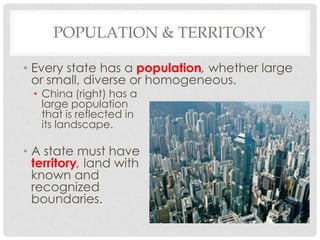
POPULATION & TERRITORY
• Every state has a population, whether large
or small, diverse or homogeneous.
• China (right) has a
large population
that is reflected in
its landscape.
• A state must have
territory, land with
known and
recognized
boundaries.
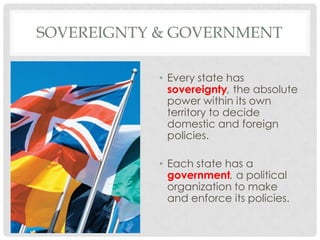
SOVEREIGNTY & GOVERNMENT
• Every state has
sovereignty, the absolute
power within its own
territory to decide
domestic and foreign
policies.
• Each state has a
government, a political
organization to make
and enforce its policies.
ORIGINS OF THE STATE
• Many theories have been developed to
explain the origins of the state.
• These include the force theory, the
evolutionary theory, the divine right
theory, and the social contract theory.
FORCE THEORY
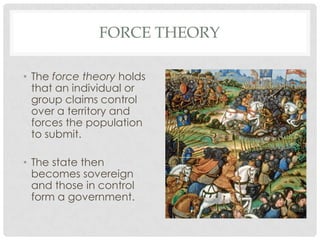
• The force theory holds
that an individual or
group claims control
over a territory and
forces the population
to submit.
• The state then
becomes sovereign
and those in control
form a government.
EVOLUTIONARY THEORY
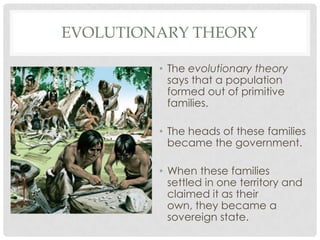
• The evolutionary theory
says that a population
formed out of primitive
families.
• The heads of these families
became the government.
• When these families
settled in one territory and
claimed it as their
own, they became a
sovereign state.
DIVINE RIGHT THEORY
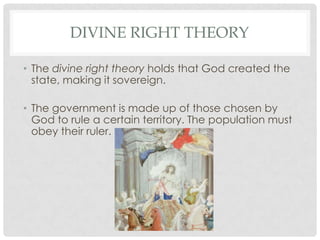
• The divine right theory holds that God created the
state, making it sovereign.
• The government is made up of those chosen by
God to rule a certain territory. The population must
obey their ruler.
SOCIAL CONTRACT THEORY
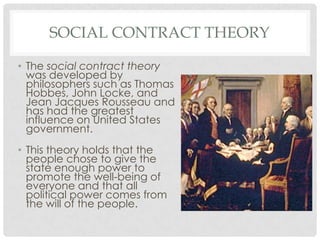
• The social contract theory
was developed by
philosophers such as Thomas
Hobbes, John Locke, and
Jean Jacques Rousseau and
has had the greatest
influence on United States
government.
• This theory holds that the
people chose to give the
state enough power to
promote the well-being of
everyone and that all
political power comes from
the will of the people.
SOCIAL CONTRACT THEORY, CONT.
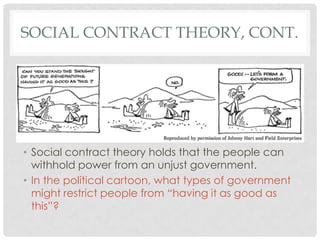
• Social contract theory holds that the people can
withhold power from an unjust government.
• In the political cartoon, what types of government
might restrict people from “having it as good as
this”?
PURPOSE OF THE GOVERNMENT
• The Preamble to the U.S. Constitution sets
forth the basic purposes of America’s
government.
• It forms “a more perfect Union” by uniting the
state governments and the American people.
• It establishes justice by attempting to create and
administer laws in a fair, reasonable, and impartial
fashion.
PURPOSE OF THE GOVERNMENT
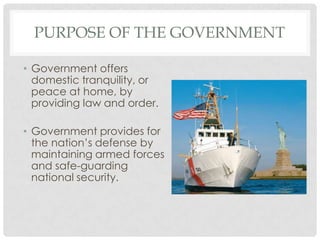
• Government offers
domestic tranquility, or
peace at home, by
providing law and order.
• Government provides for
the nation’s defense by
maintaining armed forces
and safe-guarding
national security.
PURPOSE OF THE GOVERNMENT
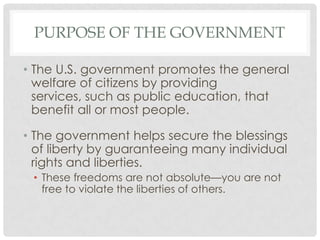
• The U.S. government promotes the general
welfare of citizens by providing
services, such as public education, that
benefit all or most people.
• The government helps secure the blessings
of liberty by guaranteeing many individual
rights and liberties.
• These freedoms are not absolute—you are not
free to violate the liberties of others.
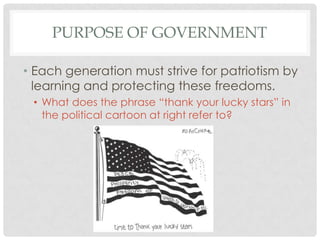
PURPOSE OF GOVERNMENT
• Each generation must strive for patriotism by
learning and protecting these freedoms.
• What does the phrase “thank your lucky stars” in
the political cartoon at right refer to?
FORMS OF GOVERNMENT
SECTION 2
INTRODUCTION
• What are some forms of government in the
world today?
• Democracies and dictatorships are classified
according to who can participate in government.
• Unitary, federal, and confederation-style
governments are classified based on how power
is divided geographically.
• Presidential and parliamentary governments are
defined by the relationship between the
executive and legislative branches.
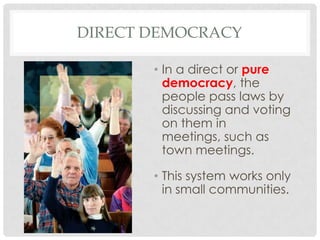
DIRECT DEMOCRACY
• In a direct or pure
democracy, the
people pass laws by
discussing and voting
on them in
meetings, such as
town meetings.
• This system works only
in small communities.
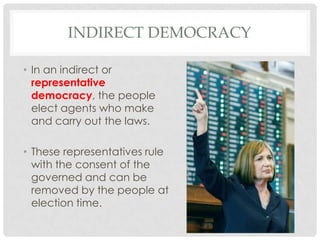
INDIRECT DEMOCRACY
• In an indirect or
representative
democracy, the people
elect agents who make
and carry out the laws.
• These representatives rule
with the consent of the
governed and can be
removed by the people at
election time.
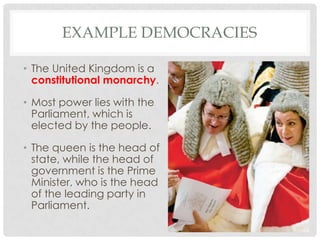
EXAMPLE DEMOCRACIES
• The United Kingdom is a
constitutional monarchy.
• Most power lies with the
Parliament, which is
elected by the people.
• The queen is the head of
state, while the head of
government is the Prime
Minister, who is the head
of the leading party in
Parliament.
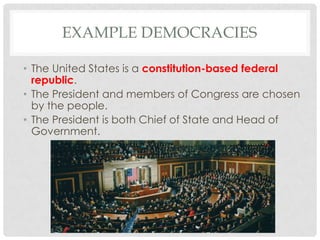
EXAMPLE DEMOCRACIES
• The United States is a constitution-based federal
republic.
• The President and members of Congress are chosen
by the people.
• The President is both Chief of State and Head of
Government.
DICTATORSHIPS
• In an autocracy, one person holds total
political power, while in an oligarchy a small
elite group shares political power.
• Both are forms of dictatorships, holding
absolute and unchallenged authority over
the people, who have no say in
government.
EXAMPLE DICTATORSHIPS
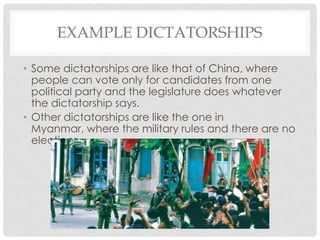
• Some dictatorships are like that of China, where
people can vote only for candidates from one
political party and the legislature does whatever
the dictatorship says.
• Other dictatorships are like the one in
Myanmar, where the military rules and there are no
elections.
UNITARY GOVERNMENT
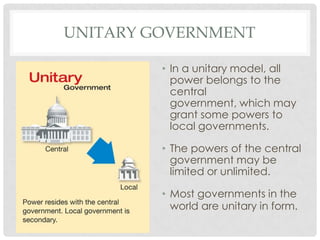
• In a unitary model, all
power belongs to the
central
government, which may
grant some powers to
local governments.
• The powers of the central
government may be
limited or unlimited.
• Most governments in the
world are unitary in form.
FEDERAL GOVERNMENT
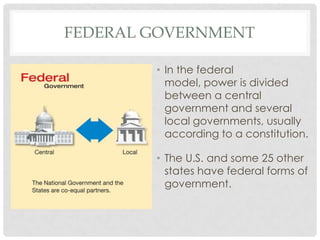
• In the federal
model, power is divided
between a central
government and several
local governments, usually
according to a constitution.
• The U.S. and some 25 other
states have federal forms of
government.
CONFEDERATE GOVERNMENT
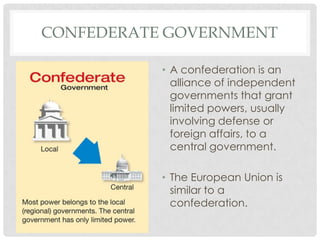
• A confederation is an
alliance of independent
governments that grant
limited powers, usually
involving defense or
foreign affairs, to a
central government.
• The European Union is
similar to a
confederation.
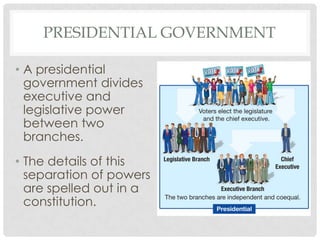
PRESIDENTIAL GOVERNMENT
• A presidential
government divides
executive and
legislative power
between two
branches.
• The details of this
separation of powers
are spelled out in a
constitution.
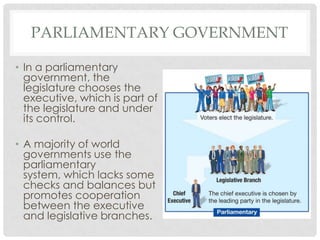
PARLIAMENTARY GOVERNMENT
• In a parliamentary
government, the
legislature chooses the
executive, which is part of
the legislature and under
its control.
• A majority of world
governments use the
parliamentary
system, which lacks some
checks and balances but
promotes cooperation
between the executive
and legislative branches.
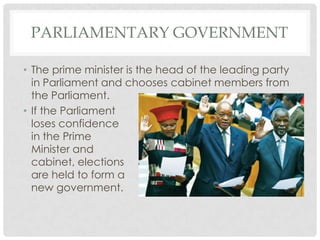
PARLIAMENTARY GOVERNMENT
• The prime minister is the head of the leading party
in Parliament and chooses cabinet members from
the Parliament.
• If the Parliament
loses confidence
in the Prime
Minister and
cabinet, elections
are held to form a
new government.
BASIC CONCEPTS OF
DEMOCRACY
SECTION 3
INTRODUCTION
• What are the basic concepts of democracy?
• Recognition of the fundamental worth and dignity of
every person
• Respect for the equality of all persons
• Faith in majority rule and an insistence upon minority
rights
• Acceptance of the necessity of compromise
• Insistence upon the widest possible degree of individual
freedom
WORTH OF THE INDIVIDUAL
• Democracy is based on a belief in the dignity and
worth of every individual.
• Individuals can be forced to do things that serve
the good of the many, like paying taxes.
• Respect for individuals means that serving the many
should not be a case of simply benefiting the
majority over the minority, but of trying to meet the
needs of all individuals in society.
EQUALITY OF ALL PERSONS
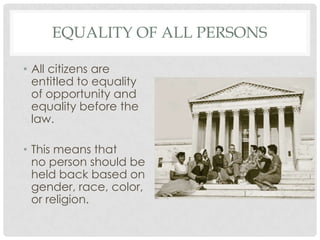
• All citizens are
entitled to equality
of opportunity and
equality before the
law.
• This means that
no person should be
held back based on
gender, race, color,
or religion.
EQUALITY OF ALL PERSONS
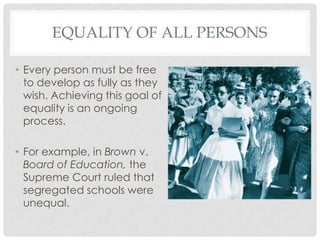
• Every person must be free
to develop as fully as they
wish. Achieving this goal of
equality is an ongoing
process.
• For example, in Brown v.
Board of Education, the
Supreme Court ruled that
segregated schools were
unequal.
MAJORITY RULES, MINORITY RIGHTS
• Democracy holds that the majority will be
right more often than it is wrong and will be
right more often than any small group.
• The majority will not always make the best
decisions or even the right decisions, but in a
democracy their choices can be improved
or changed over time.
• The majority must respect the rights of
minorities and listen to their viewpoint.
NECESSITY OF COMPROMISE
• Compromise is a key part of the democratic
process.
• In a society made of many equal individuals with
different opinions and interests, public decisions
require compromises.
• Most public issues can be addressed in several
ways.
• Determining which way best meets the needs of
the public also requires compromise.
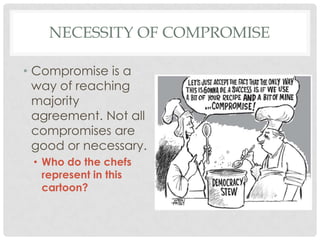
NECESSITY OF COMPROMISE
• Compromise is a
way of reaching
majority
agreement. Not all
compromises are
good or necessary.
• Who do the chefs
represent in this
cartoon?
INDIVIDUAL FREEDOM
• Democracy cannot allow complete individual
freedom, which would lead to anarchy and
lawlessness.
• Democracy does require that each individual be as
free as possible without interfering with the freedom
of others.
• Democratic government works constantly to find
the balance between individual freedom and
government authority.
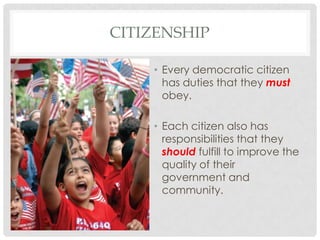
CITIZENSHIP
• Every democratic citizen
has duties that they must
obey.
• Each citizen also has
responsibilities that they
should fulfill to improve the
quality of their
government and
community.
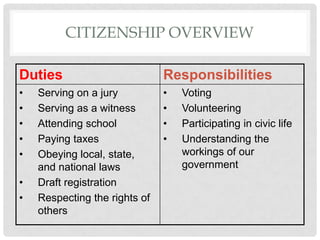
CITIZENSHIP OVERVIEW
Duties Responsibilities
• Serving on a jury
• Serving as a witness
• Attending school
• Paying taxes
• Obeying local, state,
and national laws
• Draft registration
• Respecting the rights of
others
• Voting
• Volunteering
• Participating in civic life
• Understanding the
workings of our
government
HOW FREE ENTERPRISE WORKS
• Free enterprise, also called capitalism, is an
economic system based on private
ownership, individual initiative, profit, and
competition.
• Individuals, not the government, decide
what to make, how to make it, at what price
to sell it, and whether to buy it.
• Greater demand tends to increase prices, while
lower demand tends to decrease them.
GOVERNMENT & FREE ENTERPRISE
• Both democracy and free enterprise are based on the
idea of individual freedom.
• U.S. government involvement in the economy is aimed
at protecting both the public and private enterprise.
• The government regulates many economic activities to
encourage competition and protect public welfare.
• The government also offers many essential services, such
as public education and transportation.

Chapter 1 presentation

  • 1.
  • 2.
    GOVERNMENT & THESTATE SECTION 1
  • 3.
    INTRODUCTION • What isgovernment and what is its purpose? • Government is the institution that allows a society to make and enforce public policies • Every government has three basic types of power. These include the legislative power to make laws, the executive power to enforce laws, and the judicial power to interpret laws and settle disputes.
  • 4.
    BASIC TYPES OFGOVERNMENT • In a dictatorship, all powers are held by one person or group. • In a democracy, authority lies with the people. • The U.S. government gives executive power to the President, legislative power to Congress, and judicial power to the Supreme Court.
  • 5.
    THE STATE • Statesare the main unit of government in the world today. • There are more than 200 states, varying greatly in size, population, and power. • A state is not strictly the same thing as a nation (which refers to large groups of people) or a country (which refers to a particular region). • Every state has four basic characteristics: population, territory, sovereignty, and a government.
  • 6.
    POPULATION & TERRITORY •Every state has a population, whether large or small, diverse or homogeneous. • China (right) has a large population that is reflected in its landscape. • A state must have territory, land with known and recognized boundaries.
  • 7.
    SOVEREIGNTY & GOVERNMENT •Every state has sovereignty, the absolute power within its own territory to decide domestic and foreign policies. • Each state has a government, a political organization to make and enforce its policies.
  • 8.
    ORIGINS OF THESTATE • Many theories have been developed to explain the origins of the state. • These include the force theory, the evolutionary theory, the divine right theory, and the social contract theory.
  • 9.
    FORCE THEORY • Theforce theory holds that an individual or group claims control over a territory and forces the population to submit. • The state then becomes sovereign and those in control form a government.
  • 10.
    EVOLUTIONARY THEORY • Theevolutionary theory says that a population formed out of primitive families. • The heads of these families became the government. • When these families settled in one territory and claimed it as their own, they became a sovereign state.
  • 11.
    DIVINE RIGHT THEORY •The divine right theory holds that God created the state, making it sovereign. • The government is made up of those chosen by God to rule a certain territory. The population must obey their ruler.
  • 12.
    SOCIAL CONTRACT THEORY •The social contract theory was developed by philosophers such as Thomas Hobbes, John Locke, and Jean Jacques Rousseau and has had the greatest influence on United States government. • This theory holds that the people chose to give the state enough power to promote the well-being of everyone and that all political power comes from the will of the people.
  • 13.
    SOCIAL CONTRACT THEORY,CONT. • Social contract theory holds that the people can withhold power from an unjust government. • In the political cartoon, what types of government might restrict people from “having it as good as this”?
  • 14.
    PURPOSE OF THEGOVERNMENT • The Preamble to the U.S. Constitution sets forth the basic purposes of America’s government. • It forms “a more perfect Union” by uniting the state governments and the American people. • It establishes justice by attempting to create and administer laws in a fair, reasonable, and impartial fashion.
  • 15.
    PURPOSE OF THEGOVERNMENT • Government offers domestic tranquility, or peace at home, by providing law and order. • Government provides for the nation’s defense by maintaining armed forces and safe-guarding national security.
  • 16.
    PURPOSE OF THEGOVERNMENT • The U.S. government promotes the general welfare of citizens by providing services, such as public education, that benefit all or most people. • The government helps secure the blessings of liberty by guaranteeing many individual rights and liberties. • These freedoms are not absolute—you are not free to violate the liberties of others.
  • 17.
    PURPOSE OF GOVERNMENT •Each generation must strive for patriotism by learning and protecting these freedoms. • What does the phrase “thank your lucky stars” in the political cartoon at right refer to?
  • 18.
  • 19.
    INTRODUCTION • What aresome forms of government in the world today? • Democracies and dictatorships are classified according to who can participate in government. • Unitary, federal, and confederation-style governments are classified based on how power is divided geographically. • Presidential and parliamentary governments are defined by the relationship between the executive and legislative branches.
  • 20.
    DIRECT DEMOCRACY • Ina direct or pure democracy, the people pass laws by discussing and voting on them in meetings, such as town meetings. • This system works only in small communities.
  • 21.
    INDIRECT DEMOCRACY • Inan indirect or representative democracy, the people elect agents who make and carry out the laws. • These representatives rule with the consent of the governed and can be removed by the people at election time.
  • 22.
    EXAMPLE DEMOCRACIES • TheUnited Kingdom is a constitutional monarchy. • Most power lies with the Parliament, which is elected by the people. • The queen is the head of state, while the head of government is the Prime Minister, who is the head of the leading party in Parliament.
  • 23.
    EXAMPLE DEMOCRACIES • TheUnited States is a constitution-based federal republic. • The President and members of Congress are chosen by the people. • The President is both Chief of State and Head of Government.
  • 24.
    DICTATORSHIPS • In anautocracy, one person holds total political power, while in an oligarchy a small elite group shares political power. • Both are forms of dictatorships, holding absolute and unchallenged authority over the people, who have no say in government.
  • 25.
    EXAMPLE DICTATORSHIPS • Somedictatorships are like that of China, where people can vote only for candidates from one political party and the legislature does whatever the dictatorship says. • Other dictatorships are like the one in Myanmar, where the military rules and there are no elections.
  • 26.
    UNITARY GOVERNMENT • Ina unitary model, all power belongs to the central government, which may grant some powers to local governments. • The powers of the central government may be limited or unlimited. • Most governments in the world are unitary in form.
  • 27.
    FEDERAL GOVERNMENT • Inthe federal model, power is divided between a central government and several local governments, usually according to a constitution. • The U.S. and some 25 other states have federal forms of government.
  • 28.
    CONFEDERATE GOVERNMENT • Aconfederation is an alliance of independent governments that grant limited powers, usually involving defense or foreign affairs, to a central government. • The European Union is similar to a confederation.
  • 29.
    PRESIDENTIAL GOVERNMENT • Apresidential government divides executive and legislative power between two branches. • The details of this separation of powers are spelled out in a constitution.
  • 30.
    PARLIAMENTARY GOVERNMENT • Ina parliamentary government, the legislature chooses the executive, which is part of the legislature and under its control. • A majority of world governments use the parliamentary system, which lacks some checks and balances but promotes cooperation between the executive and legislative branches.
  • 31.
    PARLIAMENTARY GOVERNMENT • Theprime minister is the head of the leading party in Parliament and chooses cabinet members from the Parliament. • If the Parliament loses confidence in the Prime Minister and cabinet, elections are held to form a new government.
  • 32.
  • 33.
    INTRODUCTION • What arethe basic concepts of democracy? • Recognition of the fundamental worth and dignity of every person • Respect for the equality of all persons • Faith in majority rule and an insistence upon minority rights • Acceptance of the necessity of compromise • Insistence upon the widest possible degree of individual freedom
  • 34.
    WORTH OF THEINDIVIDUAL • Democracy is based on a belief in the dignity and worth of every individual. • Individuals can be forced to do things that serve the good of the many, like paying taxes. • Respect for individuals means that serving the many should not be a case of simply benefiting the majority over the minority, but of trying to meet the needs of all individuals in society.
  • 35.
    EQUALITY OF ALLPERSONS • All citizens are entitled to equality of opportunity and equality before the law. • This means that no person should be held back based on gender, race, color, or religion.
  • 36.
    EQUALITY OF ALLPERSONS • Every person must be free to develop as fully as they wish. Achieving this goal of equality is an ongoing process. • For example, in Brown v. Board of Education, the Supreme Court ruled that segregated schools were unequal.
  • 37.
    MAJORITY RULES, MINORITYRIGHTS • Democracy holds that the majority will be right more often than it is wrong and will be right more often than any small group. • The majority will not always make the best decisions or even the right decisions, but in a democracy their choices can be improved or changed over time. • The majority must respect the rights of minorities and listen to their viewpoint.
  • 38.
    NECESSITY OF COMPROMISE •Compromise is a key part of the democratic process. • In a society made of many equal individuals with different opinions and interests, public decisions require compromises. • Most public issues can be addressed in several ways. • Determining which way best meets the needs of the public also requires compromise.
  • 39.
    NECESSITY OF COMPROMISE •Compromise is a way of reaching majority agreement. Not all compromises are good or necessary. • Who do the chefs represent in this cartoon?
  • 40.
    INDIVIDUAL FREEDOM • Democracycannot allow complete individual freedom, which would lead to anarchy and lawlessness. • Democracy does require that each individual be as free as possible without interfering with the freedom of others. • Democratic government works constantly to find the balance between individual freedom and government authority.
  • 41.
    CITIZENSHIP • Every democraticcitizen has duties that they must obey. • Each citizen also has responsibilities that they should fulfill to improve the quality of their government and community.
  • 42.
    CITIZENSHIP OVERVIEW Duties Responsibilities •Serving on a jury • Serving as a witness • Attending school • Paying taxes • Obeying local, state, and national laws • Draft registration • Respecting the rights of others • Voting • Volunteering • Participating in civic life • Understanding the workings of our government
  • 43.
    HOW FREE ENTERPRISEWORKS • Free enterprise, also called capitalism, is an economic system based on private ownership, individual initiative, profit, and competition. • Individuals, not the government, decide what to make, how to make it, at what price to sell it, and whether to buy it. • Greater demand tends to increase prices, while lower demand tends to decrease them.
  • 44.
    GOVERNMENT & FREEENTERPRISE • Both democracy and free enterprise are based on the idea of individual freedom. • U.S. government involvement in the economy is aimed at protecting both the public and private enterprise. • The government regulates many economic activities to encourage competition and protect public welfare. • The government also offers many essential services, such as public education and transportation.