Chapter 12
Section 1
Introduction
 How do constitutional and party officers keep
Congress organized?
 The Speaker of the House and the presiding officer of
the Senate settle rules issues and direct the flow of floor
debate.
 The majority and minority leaders and whips organize
party policy and voting on issues.
 The committee chairs guide the passage of bills through
each house.
Opening Day in Congress
 Congress begins a new term every two years, on
January 3 of odd years.
 In the House, the members elect a Speaker, who takes
the oath of office and swears in the other members.
 The House then elects various officers such as the
clerk.
 Next the House adopts the rules for the current term.
 These rules have developed for over 200 years and are
occasionally amended or expanded.
Opening Day in Congress
 The House then appoints the members of the 20
permanent committees.
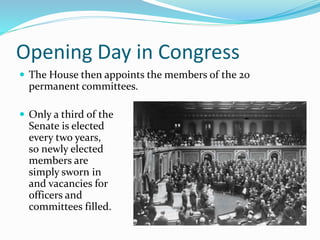
 Only a third of the
Senate is elected
every two years,
so newly elected
members are
simply sworn in
and vacancies for
officers and
committees filled.
The State of the Union
 The President delivers the State of the Union address
to a joint session of Congress a few weeks after it is
organized.
 In addition to describing the general state of national
affairs, the President describes the planned policies of
his or her administration to Congress and the nation,
requesting that Congress pass specific pieces of
legislation.
Speaker of the House
 The Speaker of the House
is the presiding officer of
the House and the leader
of its majority party, a
powerful combination.
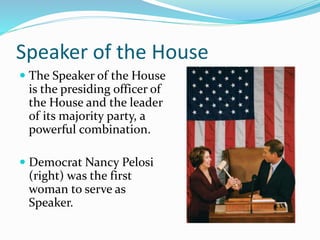
 Democrat Nancy Pelosi
(right) was the first
woman to serve as
Speaker.
Speaker of the House
 The Speaker presides and keeps order.
 The Speaker chairs most sessions of the House. No
member can speak on the floor unless recognized by the
Speaker.
 The Speaker interprets and applies rules and procedures,
refers bills to committees, and puts motions to a vote.
 The Speaker also names the members of all select and
conference committees.
President of the Senate
 The Constitution names the Vice President as the
Senate’s presiding officer.
 The President of the Senate can recognize members, put
questions to a vote, and so forth, but cannot take part in
debates and votes only to break a tie.
 The President pro tempore is a member of the Senate’s
majority party elected to serve as Senate leader in the
Vice President’s absence.
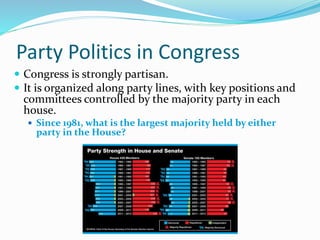
Party Politics in Congress
 Congress is strongly partisan.
 It is organized along party lines, with key positions and
committees controlled by the majority party in each
house.
 Since 1981, what is the largest majority held by either
party in the House?
Party Caucus
 A party caucus is a closed meeting of the members of
each party in each house.
 The caucus discusses policy issues and selects the
party’s floor leaders and committee chairs.
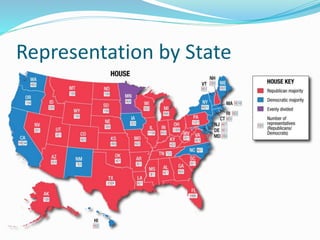
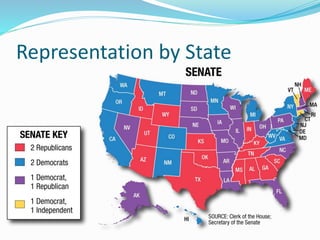
Representation by State
Floor Leaders
 The floor leaders are party officers in the House and
Senate.
 The majority leader represents the majority party in
each house and controls the order of business on the
floor.
 The party whips are assistant floor leaders who help
connect the party leadership with the rank-and-file
members.
 The whips count votes and help see that members are
present for key votes.
Committee Chairperson
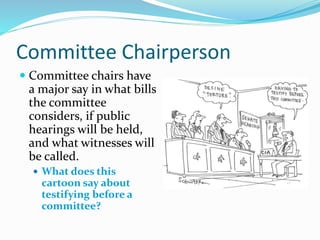
 Committee chairs have
a major say in what bills
the committee
considers, if public
hearings will be held,
and what witnesses will
be called.
 What does this
cartoon say about
testifying before a
committee?
The Seniority Rule
 The seniority rule in an unwritten custom granting
the most important posts in Congress, such as
committee chairmen, to the party members with
the longest service.
 Critics say this rule ignores ability, discourages younger
members, and limits fresh ideas.
 Supporters say the rule ensures experienced leadership
and is easy to apply without sparking debates.
Section 2
Introduction
 How do committees help Congress do its work?
 Standing committees review and modify bills
and decide if they should be reported to the
floor for a vote. Subcommittees then do much of
the work of reviewing a bill.
 Joint committees coordinate the efforts of both
houses on key issues, while select committees
conduct special investigations.
Standing Committees
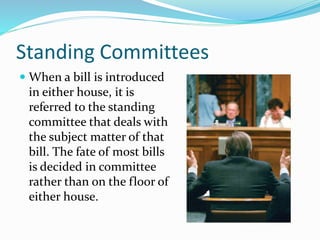
 When a bill is introduced
in either house, it is
referred to the standing
committee that deals with
the subject matter of that
bill. The fate of most bills
is decided in committee
rather than on the floor of
either house.
Standing Committees
 Members of each standing committee are elected
by a floor vote at the beginning of each term of
Congress.
 Each House committee has from 10 to 75 members,
while Senate committees have from 14 to 28 members.
 Representatives usually serve on one or two standing
committees, while senators serve on three or four.
 Committee chairmen are chosen according to the
seniority rule.
Standing Committees
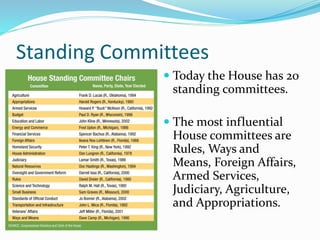
 Today the House has 20
standing committees.
 The most influential
House committees are
Rules, Ways and
Means, Foreign Affairs,
Armed Services,
Judiciary, Agriculture,
and Appropriations.
Standing Committees
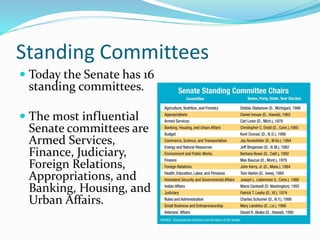
 Today the Senate has 16
standing committees.
 The most influential
Senate committees are
Armed Services,
Finance, Judiciary,
Foreign Relations,
Appropriations, and
Banking, Housing, and
Urban Affairs.
Subcommittees
 Most standing committees are divided into more
specific subcommittees, which do much of the
work of researching and reviewing bills.
 There are 99 subcommittees in the House and
nearly 70 in the Senate.
 The subcommittees relay their findings to the
main committee.
The House Rules Committee
 The House Rules Committee controls which bills
make it to the floor of the House.
 Bills that leave their standing committee must
then be scheduled for floor consideration by the
Rules Committee.
 This power lets the Rules Committee speed, delay,
or block House action on a measure.
A Sample Bill
 The Food and Energy Security Act was introduced
in the House in 2007.
 The Speaker referred the bill to the Committee on
Agriculture, which reviewed and reported it, and the
Committee on Foreign Affairs, which simply discharged
it.
 After leaving committee, the bill was scheduled for floor
debate and amendment by the Rules Committee.
 The bill was then considered by the full house.
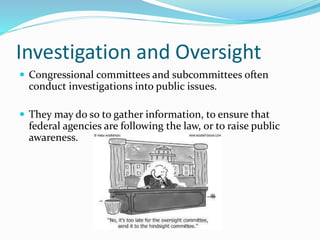
Investigation and Oversight
 Congressional committees and subcommittees often
conduct investigations into public issues.
 They may do so to gather information, to ensure that
federal agencies are following the law, or to raise public
awareness.
Select Committees
 Select or special committees are typically temporary
panels set up to investigate a specific issue.
 The Senate Watergate Committee investigated the
Watergate scandal.
 The Iran-Contra Committee examined the arms-for-
hostages deal and illegal aid to the Contras.
 The Senate Committee on Indian Affairs uncovered
corruption tied to lobbyists for Native American tribes.
Joint Committees
 Joint committees include members from both
houses.
 Those shown in the chart are permanent groups,
while others are select committees.
Conference Committees
 Joint committees coordinate the efforts of each house
of Congress on specific subjects and help administer
shared functions.
 Conference committees are temporary, joint panels
formed to create a compromise bill when each house
has passed a different version of a bill.
Section 3
Introduction
 What steps does a successful bill follow as it moves
through the House?
 A bill is introduced, receives a first reading, and is assigned to
a committee.
 The committee may hold hearings on a bill and amend it
before reporting it to the floor.
 On the floor, a bill receives a second reading and can be
debated and amended before being voted on, printed, and
receiving a third and final reading.
The First Steps
 Most bills are drafted in the executive branch or by special
interest groups before being presented to members of
Congress.
 Members often try to get support or cosponsors from
members before introducing a proposed bill.
 All tax bills must begin in the House.
 House members introduce bills by dropping them into a
hopper on the clerk’s desk.
Bills and Resolutions
 Public bills are measures that apply to the nation
as a whole.
 Private bills are measures that apply to certain
persons or places.
 Joint resolutions are special measures that have the
force of law. They are used to deal with unusual or
temporary matters, such as funding inaugurations
or proposing constitutional amendments.
Bills and Resolutions
 Concurrent resolutions do not have the force of
law. They are used when both the House and
Senate want to state a position on an issue.
 Simple resolutions are used by each house to adopt
or amend its rules.
 A rider is a provision tacked on to an unrelated
bill, such as appropriations bill, that is more likely
to be passed than the rider would be on its own.
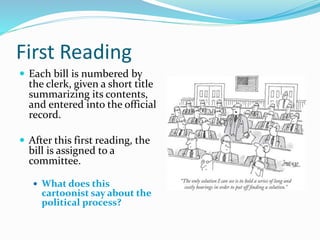
First Reading
 Each bill is numbered by
the clerk, given a short title
summarizing its contents,
and entered into the official
record.
 After this first reading, the
bill is assigned to a
committee.
 What does this
cartoonist say about the
political process?
The Bill in Committee
 Though not mentioned in the Constitution,
committees play an essential role by filtering the
many bills submitted to Congress.
 Most bills are pigeonholed. That is, they die in
committee.
The Bill in Committee
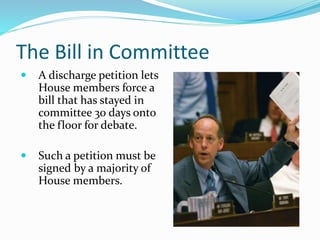
 A discharge petition lets
House members force a
bill that has stayed in
committee 30 days onto
the floor for debate.
 Such a petition must be
signed by a majority of
House members.
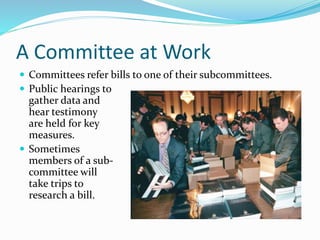
A Committee at Work
 Committees refer bills to one of their subcommittees.
 Public hearings to
gather data and
hear testimony
are held for key
measures.
 Sometimes
members of a sub-
committee will
take trips to
research a bill.
Committee Actions
 A committee can:
 Report a bill with a “do pass” recommendation.
 Pigeonhole the bill and kill it.
 Report an amended version of the bill.
 Report the bill with a “do not pass”
recommendation.
 Report a committee bill as a substitute for a bill
referred to it.
Congressional Staffers
 More than 2500 people serve congressional committees,
offering expert advice on the content and politics
associated with various bills.
 Their hard work includes research and presenting
information on issues.
Scheduling Floor Debate
 A bill reported by a standing committee must be
placed on one of five House calendars before it
comes up for floor debate.
 The Rules Committee must then grant a rule to a
bill, setting a time for it to appear on the floor.
 By not granting a rule, the Committee can kill a bill.
 Special rules can limit debate on a bill.
The Bill on the Floor
 Minor bills get a brief second reading and are passed
or defeated.
 Major bills are addressed on the House floor by the
Committee of the Whole, which consists of at least 100
members.
 The House session is suspended as the Committee reads the
bill section by section, debating and possibly amending each
section.
 The House then returns to session to adopt the completed
bill.
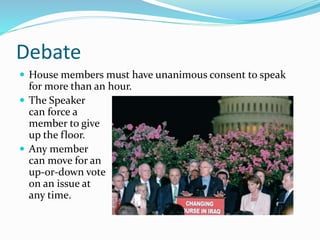
Debate
 House members must have unanimous consent to speak
for more than an hour.
 The Speaker
can force a
member to give
up the floor.
 Any member
can move for an
up-or-down vote
on an issue at
any time.
Voting in the House
 Voice votes in which the Speaker counts the “yes” and
“no” votes.
 A standing vote, where those in favor and against are
counted by the clerk.
 A roll-call vote that goes member by member can be
demanded by one fifth of the members present.
 The rare teller vote has a teller count the votes for
each party.
Voting in the House
 The House now uses a computerized voting system
that shows instantly how each member has voted.
 Members have 15 minutes to cast their votes or respond
to quorum calls.
 The Senate does not use electronic or teller votes.
 Once a bill is approved, it is printed and given a
third and final reading before being sent to the
other house.
Section 4
Introduction
 What are the major differences in the lawmaking
process in the House and the Senate?
 The Senate has fewer rules limiting floor debate than
the House.
 The Senate also has the filibuster and the cloture rule,
which allow the minority to block measures supported
by the majority.
 Finally, the Senate lacks the Rules Committee of the
House.
The Senate
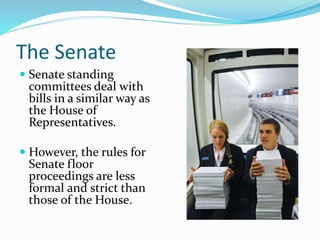
 Senate standing
committees deal with
bills in a similar way as
the House of
Representatives.
 However, the rules for
Senate floor
proceedings are less
formal and strict than
those of the House.
Debate in the Senate
 There are few limits on floor debate in the Senate.
 In general, a senator can speak on the floor as long as he or
she pleases about any topic that he or she wants to.
However, no senator may speak more than twice on the
same question on the same day.
 Many Senate bills are debated under a unanimous consent
agreement that limits the amount of floor debate.
The Filibuster
 A filibuster is a stalling tactic used by a minority of
senators to talk a bill to death.
 Filibusterers try to take up so much floor time with
speeches and other time-killing motions that the Senate
has to drop or modify a bill to move forward.
 The Senate tries to beat filibusters by holding long daily
sessions and enforcing strict rules to wear down talkers.
The Filibuster
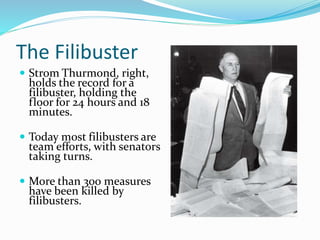
 Strom Thurmond, right,
holds the record for a
filibuster, holding the
floor for 24 hours and 18
minutes.
 Today most filibusters are
team efforts, with senators
taking turns.
 More than 300 measures
have been killed by
filibusters.
Cloture
 The Cloture rule was adopted in 1917 after a three week
filibuster killed a measure related to World War I.
 Cloture allows debate to be limited by a special
procedure that requires support by 60 senators.
 Only a third of the 600 attempts to invoke cloture have
succeeded, so filibusters remain effective.
 Senators often oppose cloture to preserve free debate
and the value of the filibuster.
Conference Committees
 A conference committee is formed to iron out the
differences and create a compromise bill.
 The committee members are usually leading members
of the standing committees that handled the bill in
each house.
Conference Committees
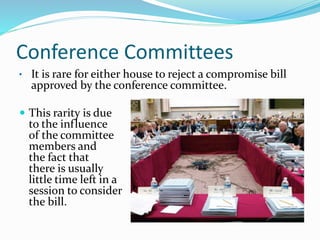
• It is rare for either house to reject a compromise bill
approved by the conference committee.
 This rarity is due
to the influence
of the committee
members and
the fact that
there is usually
little time left in a
session to consider
the bill.
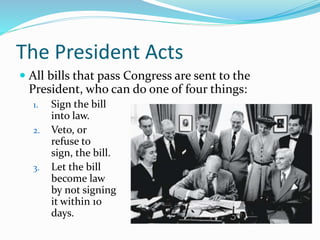
The President Acts
 All bills that pass Congress are sent to the
President, who can do one of four things:
1. Sign the bill
into law.
2. Veto, or
refuse to
sign, the bill.
3. Let the bill
become law
by not signing
it within 10
days.
The President Acts
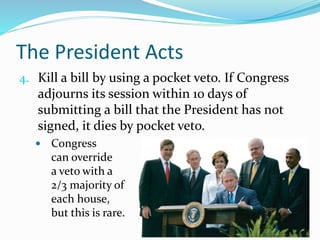
4. Kill a bill by using a pocket veto. If Congress
adjourns its session within 10 days of
submitting a bill that the President has not
signed, it dies by pocket veto.
 Congress
can override
a veto with a
2/3 majority of
each house,
but this is rare.
Authors & Co-Sponsors
 Members of Congress work
hard to gather support and
find cosponsors before they
draft and submit a bill.
 Authors also tweak the
wording of bills so that they
will be steered to favorable
committees.
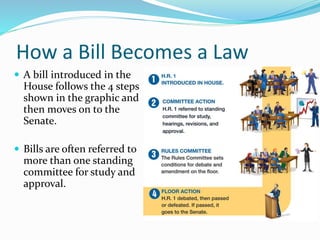
How a Bill Becomes a Law
 A bill introduced in the
House follows the 4 steps
shown in the graphic and
then moves on to the
Senate.
 Bills are often referred to
more than one standing
committee for study and
approval.
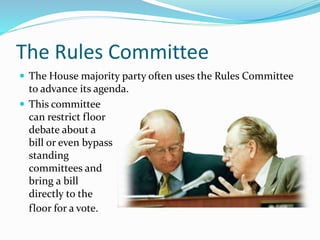
The Rules Committee
 The House majority party often uses the Rules Committee
to advance its agenda.
 This committee
can restrict floor
debate about a
bill or even bypass
standing
committees and
bring a bill
directly to the
floor for a vote.
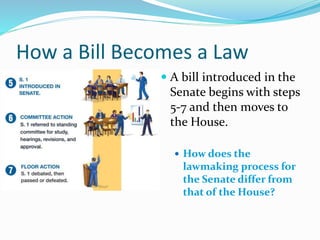
How a Bill Becomes a Law
 A bill introduced in the
Senate begins with steps
5-7 and then moves to
the House.
 How does the
lawmaking process for
the Senate differ from
that of the House?
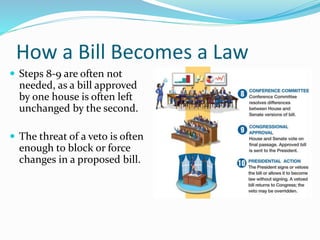
How a Bill Becomes a Law
 Steps 8-9 are often not
needed, as a bill approved
by one house is often left
unchanged by the second.
 The threat of a veto is often
enough to block or force
changes in a proposed bill.

Chapter 12 presentation

  • 1.
  • 2.
  • 3.
    Introduction  How doconstitutional and party officers keep Congress organized?  The Speaker of the House and the presiding officer of the Senate settle rules issues and direct the flow of floor debate.  The majority and minority leaders and whips organize party policy and voting on issues.  The committee chairs guide the passage of bills through each house.
  • 4.
    Opening Day inCongress  Congress begins a new term every two years, on January 3 of odd years.  In the House, the members elect a Speaker, who takes the oath of office and swears in the other members.  The House then elects various officers such as the clerk.  Next the House adopts the rules for the current term.  These rules have developed for over 200 years and are occasionally amended or expanded.
  • 5.
    Opening Day inCongress  The House then appoints the members of the 20 permanent committees.  Only a third of the Senate is elected every two years, so newly elected members are simply sworn in and vacancies for officers and committees filled.
  • 6.
    The State ofthe Union  The President delivers the State of the Union address to a joint session of Congress a few weeks after it is organized.  In addition to describing the general state of national affairs, the President describes the planned policies of his or her administration to Congress and the nation, requesting that Congress pass specific pieces of legislation.
  • 7.
    Speaker of theHouse  The Speaker of the House is the presiding officer of the House and the leader of its majority party, a powerful combination.  Democrat Nancy Pelosi (right) was the first woman to serve as Speaker.
  • 8.
    Speaker of theHouse  The Speaker presides and keeps order.  The Speaker chairs most sessions of the House. No member can speak on the floor unless recognized by the Speaker.  The Speaker interprets and applies rules and procedures, refers bills to committees, and puts motions to a vote.  The Speaker also names the members of all select and conference committees.
  • 9.
    President of theSenate  The Constitution names the Vice President as the Senate’s presiding officer.  The President of the Senate can recognize members, put questions to a vote, and so forth, but cannot take part in debates and votes only to break a tie.  The President pro tempore is a member of the Senate’s majority party elected to serve as Senate leader in the Vice President’s absence.
  • 10.
    Party Politics inCongress  Congress is strongly partisan.  It is organized along party lines, with key positions and committees controlled by the majority party in each house.  Since 1981, what is the largest majority held by either party in the House?
  • 11.
    Party Caucus  Aparty caucus is a closed meeting of the members of each party in each house.  The caucus discusses policy issues and selects the party’s floor leaders and committee chairs.
  • 12.
  • 13.
  • 14.
    Floor Leaders  Thefloor leaders are party officers in the House and Senate.  The majority leader represents the majority party in each house and controls the order of business on the floor.  The party whips are assistant floor leaders who help connect the party leadership with the rank-and-file members.  The whips count votes and help see that members are present for key votes.
  • 15.
    Committee Chairperson  Committeechairs have a major say in what bills the committee considers, if public hearings will be held, and what witnesses will be called.  What does this cartoon say about testifying before a committee?
  • 16.
    The Seniority Rule The seniority rule in an unwritten custom granting the most important posts in Congress, such as committee chairmen, to the party members with the longest service.  Critics say this rule ignores ability, discourages younger members, and limits fresh ideas.  Supporters say the rule ensures experienced leadership and is easy to apply without sparking debates.
  • 17.
  • 18.
    Introduction  How docommittees help Congress do its work?  Standing committees review and modify bills and decide if they should be reported to the floor for a vote. Subcommittees then do much of the work of reviewing a bill.  Joint committees coordinate the efforts of both houses on key issues, while select committees conduct special investigations.
  • 19.
    Standing Committees  Whena bill is introduced in either house, it is referred to the standing committee that deals with the subject matter of that bill. The fate of most bills is decided in committee rather than on the floor of either house.
  • 20.
    Standing Committees  Membersof each standing committee are elected by a floor vote at the beginning of each term of Congress.  Each House committee has from 10 to 75 members, while Senate committees have from 14 to 28 members.  Representatives usually serve on one or two standing committees, while senators serve on three or four.  Committee chairmen are chosen according to the seniority rule.
  • 21.
    Standing Committees  Todaythe House has 20 standing committees.  The most influential House committees are Rules, Ways and Means, Foreign Affairs, Armed Services, Judiciary, Agriculture, and Appropriations.
  • 22.
    Standing Committees  Todaythe Senate has 16 standing committees.  The most influential Senate committees are Armed Services, Finance, Judiciary, Foreign Relations, Appropriations, and Banking, Housing, and Urban Affairs.
  • 23.
    Subcommittees  Most standingcommittees are divided into more specific subcommittees, which do much of the work of researching and reviewing bills.  There are 99 subcommittees in the House and nearly 70 in the Senate.  The subcommittees relay their findings to the main committee.
  • 24.
    The House RulesCommittee  The House Rules Committee controls which bills make it to the floor of the House.  Bills that leave their standing committee must then be scheduled for floor consideration by the Rules Committee.  This power lets the Rules Committee speed, delay, or block House action on a measure.
  • 25.
    A Sample Bill The Food and Energy Security Act was introduced in the House in 2007.  The Speaker referred the bill to the Committee on Agriculture, which reviewed and reported it, and the Committee on Foreign Affairs, which simply discharged it.  After leaving committee, the bill was scheduled for floor debate and amendment by the Rules Committee.  The bill was then considered by the full house.
  • 26.
    Investigation and Oversight Congressional committees and subcommittees often conduct investigations into public issues.  They may do so to gather information, to ensure that federal agencies are following the law, or to raise public awareness.
  • 27.
    Select Committees  Selector special committees are typically temporary panels set up to investigate a specific issue.  The Senate Watergate Committee investigated the Watergate scandal.  The Iran-Contra Committee examined the arms-for- hostages deal and illegal aid to the Contras.  The Senate Committee on Indian Affairs uncovered corruption tied to lobbyists for Native American tribes.
  • 28.
    Joint Committees  Jointcommittees include members from both houses.  Those shown in the chart are permanent groups, while others are select committees.
  • 29.
    Conference Committees  Jointcommittees coordinate the efforts of each house of Congress on specific subjects and help administer shared functions.  Conference committees are temporary, joint panels formed to create a compromise bill when each house has passed a different version of a bill.
  • 30.
  • 31.
    Introduction  What stepsdoes a successful bill follow as it moves through the House?  A bill is introduced, receives a first reading, and is assigned to a committee.  The committee may hold hearings on a bill and amend it before reporting it to the floor.  On the floor, a bill receives a second reading and can be debated and amended before being voted on, printed, and receiving a third and final reading.
  • 32.
    The First Steps Most bills are drafted in the executive branch or by special interest groups before being presented to members of Congress.  Members often try to get support or cosponsors from members before introducing a proposed bill.  All tax bills must begin in the House.  House members introduce bills by dropping them into a hopper on the clerk’s desk.
  • 33.
    Bills and Resolutions Public bills are measures that apply to the nation as a whole.  Private bills are measures that apply to certain persons or places.  Joint resolutions are special measures that have the force of law. They are used to deal with unusual or temporary matters, such as funding inaugurations or proposing constitutional amendments.
  • 34.
    Bills and Resolutions Concurrent resolutions do not have the force of law. They are used when both the House and Senate want to state a position on an issue.  Simple resolutions are used by each house to adopt or amend its rules.  A rider is a provision tacked on to an unrelated bill, such as appropriations bill, that is more likely to be passed than the rider would be on its own.
  • 35.
    First Reading  Eachbill is numbered by the clerk, given a short title summarizing its contents, and entered into the official record.  After this first reading, the bill is assigned to a committee.  What does this cartoonist say about the political process?
  • 36.
    The Bill inCommittee  Though not mentioned in the Constitution, committees play an essential role by filtering the many bills submitted to Congress.  Most bills are pigeonholed. That is, they die in committee.
  • 37.
    The Bill inCommittee  A discharge petition lets House members force a bill that has stayed in committee 30 days onto the floor for debate.  Such a petition must be signed by a majority of House members.
  • 38.
    A Committee atWork  Committees refer bills to one of their subcommittees.  Public hearings to gather data and hear testimony are held for key measures.  Sometimes members of a sub- committee will take trips to research a bill.
  • 39.
    Committee Actions  Acommittee can:  Report a bill with a “do pass” recommendation.  Pigeonhole the bill and kill it.  Report an amended version of the bill.  Report the bill with a “do not pass” recommendation.  Report a committee bill as a substitute for a bill referred to it.
  • 40.
    Congressional Staffers  Morethan 2500 people serve congressional committees, offering expert advice on the content and politics associated with various bills.  Their hard work includes research and presenting information on issues.
  • 41.
    Scheduling Floor Debate A bill reported by a standing committee must be placed on one of five House calendars before it comes up for floor debate.  The Rules Committee must then grant a rule to a bill, setting a time for it to appear on the floor.  By not granting a rule, the Committee can kill a bill.  Special rules can limit debate on a bill.
  • 42.
    The Bill onthe Floor  Minor bills get a brief second reading and are passed or defeated.  Major bills are addressed on the House floor by the Committee of the Whole, which consists of at least 100 members.  The House session is suspended as the Committee reads the bill section by section, debating and possibly amending each section.  The House then returns to session to adopt the completed bill.
  • 43.
    Debate  House membersmust have unanimous consent to speak for more than an hour.  The Speaker can force a member to give up the floor.  Any member can move for an up-or-down vote on an issue at any time.
  • 44.
    Voting in theHouse  Voice votes in which the Speaker counts the “yes” and “no” votes.  A standing vote, where those in favor and against are counted by the clerk.  A roll-call vote that goes member by member can be demanded by one fifth of the members present.  The rare teller vote has a teller count the votes for each party.
  • 45.
    Voting in theHouse  The House now uses a computerized voting system that shows instantly how each member has voted.  Members have 15 minutes to cast their votes or respond to quorum calls.  The Senate does not use electronic or teller votes.  Once a bill is approved, it is printed and given a third and final reading before being sent to the other house.
  • 46.
  • 47.
    Introduction  What arethe major differences in the lawmaking process in the House and the Senate?  The Senate has fewer rules limiting floor debate than the House.  The Senate also has the filibuster and the cloture rule, which allow the minority to block measures supported by the majority.  Finally, the Senate lacks the Rules Committee of the House.
  • 48.
    The Senate  Senatestanding committees deal with bills in a similar way as the House of Representatives.  However, the rules for Senate floor proceedings are less formal and strict than those of the House.
  • 49.
    Debate in theSenate  There are few limits on floor debate in the Senate.  In general, a senator can speak on the floor as long as he or she pleases about any topic that he or she wants to. However, no senator may speak more than twice on the same question on the same day.  Many Senate bills are debated under a unanimous consent agreement that limits the amount of floor debate.
  • 50.
    The Filibuster  Afilibuster is a stalling tactic used by a minority of senators to talk a bill to death.  Filibusterers try to take up so much floor time with speeches and other time-killing motions that the Senate has to drop or modify a bill to move forward.  The Senate tries to beat filibusters by holding long daily sessions and enforcing strict rules to wear down talkers.
  • 51.
    The Filibuster  StromThurmond, right, holds the record for a filibuster, holding the floor for 24 hours and 18 minutes.  Today most filibusters are team efforts, with senators taking turns.  More than 300 measures have been killed by filibusters.
  • 52.
    Cloture  The Cloturerule was adopted in 1917 after a three week filibuster killed a measure related to World War I.  Cloture allows debate to be limited by a special procedure that requires support by 60 senators.  Only a third of the 600 attempts to invoke cloture have succeeded, so filibusters remain effective.  Senators often oppose cloture to preserve free debate and the value of the filibuster.
  • 53.
    Conference Committees  Aconference committee is formed to iron out the differences and create a compromise bill.  The committee members are usually leading members of the standing committees that handled the bill in each house.
  • 54.
    Conference Committees • Itis rare for either house to reject a compromise bill approved by the conference committee.  This rarity is due to the influence of the committee members and the fact that there is usually little time left in a session to consider the bill.
  • 55.
    The President Acts All bills that pass Congress are sent to the President, who can do one of four things: 1. Sign the bill into law. 2. Veto, or refuse to sign, the bill. 3. Let the bill become law by not signing it within 10 days.
  • 56.
    The President Acts 4.Kill a bill by using a pocket veto. If Congress adjourns its session within 10 days of submitting a bill that the President has not signed, it dies by pocket veto.  Congress can override a veto with a 2/3 majority of each house, but this is rare.
  • 57.
    Authors & Co-Sponsors Members of Congress work hard to gather support and find cosponsors before they draft and submit a bill.  Authors also tweak the wording of bills so that they will be steered to favorable committees.
  • 58.
    How a BillBecomes a Law  A bill introduced in the House follows the 4 steps shown in the graphic and then moves on to the Senate.  Bills are often referred to more than one standing committee for study and approval.
  • 59.
    The Rules Committee The House majority party often uses the Rules Committee to advance its agenda.  This committee can restrict floor debate about a bill or even bypass standing committees and bring a bill directly to the floor for a vote.
  • 60.
    How a BillBecomes a Law  A bill introduced in the Senate begins with steps 5-7 and then moves to the House.  How does the lawmaking process for the Senate differ from that of the House?
  • 61.
    How a BillBecomes a Law  Steps 8-9 are often not needed, as a bill approved by one house is often left unchanged by the second.  The threat of a veto is often enough to block or force changes in a proposed bill.