VOTING AND VOTER
BEHAVIOR
Voting Terms
• suffrage – the right to vote
• enfranchise – to be given the right to
vote
• disenfranchise - to have the right to
vote blocked/taken away
• electorate – the group of people who
can vote in a given election
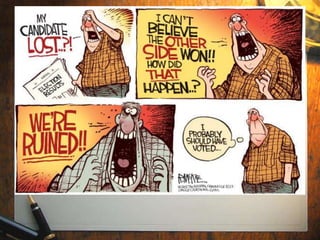
If You Don’t Vote, DON’T
COMPLAIN!
• Voting lets your voice and your opinions
be heard in gov’t
– You elect someone to speak for you
(someone whose values you agree with)
• It is your duty as a citizen to vote and
participate in the gov’t you live under 
USE YOUR VOICE!
Be an INFORMED Voter
• Stay informed and know the
candidates, issues, and current
events before you vote!
• Be a responsible citizen and
know about your gov’t!
Voting Qualifications
• You must be:
–A U.S. citizen
–18 years old
–Registered to vote
–A resident of the state you are
registered in
Who are they?
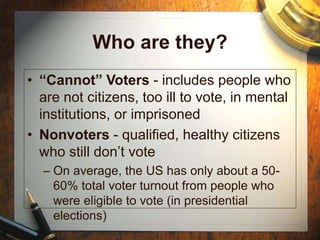
• “Cannot” Voters - includes people who
are not citizens, too ill to vote, in mental
institutions, or imprisoned
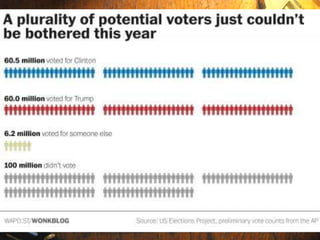
• Nonvoters - qualified, healthy citizens
who still don’t vote
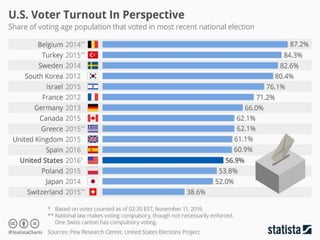
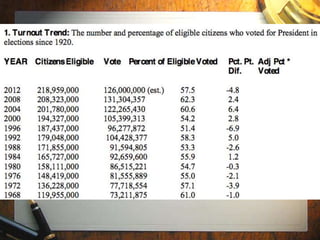
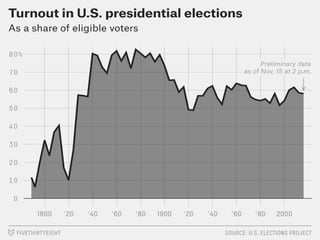
– On average, the US has only about a 50-
60% total voter turnout from people who
were eligible to vote (in presidential
elections)
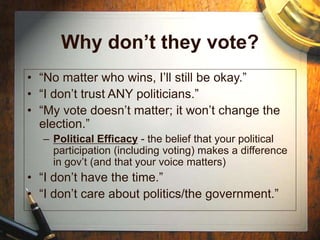
Why don’t they vote?
• “No matter who wins, I’ll still be okay.”
• “I don’t trust ANY politicians.”
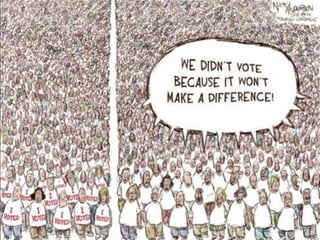
• “My vote doesn’t matter; it won’t change the
election.”
– Political Efficacy - the belief that your political
participation (including voting) makes a difference
in gov’t (and that your voice matters)
• “I don’t have the time.”
• “I don’t care about politics/the government.”
Who is MOST likely to
vote?
People who:
-are native-born U.S. citizens
-are at least high school graduates (especially college
grads)
-are 45+ years in age
-are married
-have incomes of $50,000-$100,000 or more per year
-have voted before
-identify with a particular political party
Voting Trends by
Single Factors
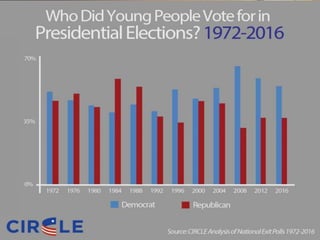
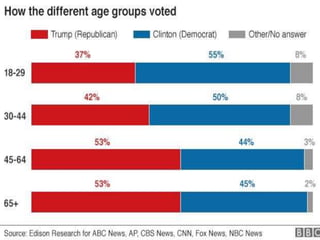
• 1.) AGE
-the older you are = more likely you are
to vote
-younger voters tend to vote Democrat,
older ones vote Republican
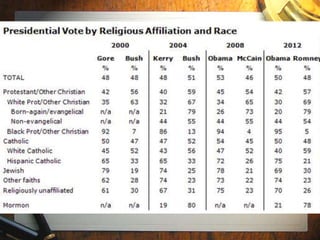
• 2.) RELIGION
– Protestants (non-Catholics) tend to vote
Republican
– Catholics, Jews, and non-religious
populations tend to vote Democrat
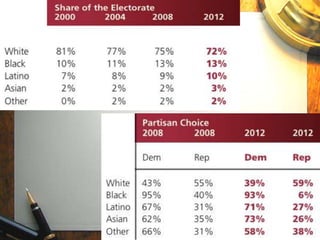
• 3.) ETHNICITY / RACE
– White populations usually vote Republican,
minority groups usually vote Democrat
– Whites tend to vote more than minorities
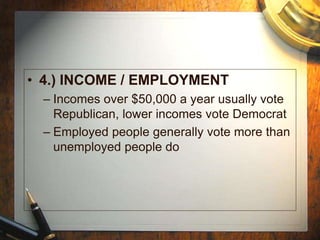
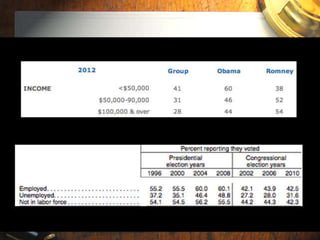
• 4.) INCOME / EMPLOYMENT
– Incomes over $50,000 a year usually vote
Republican, lower incomes vote Democrat
– Employed people generally vote more than
unemployed people do
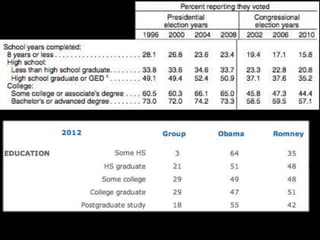
• 5.) EDUCATION
– People with a HS diploma or higher
(college education) tend to vote more than
those without one
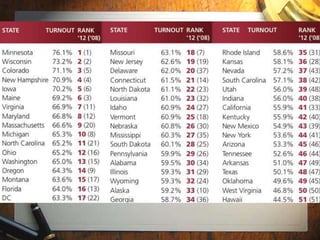
• 6.) GEOGRAPHY
– Cities tend to vote Democrat, while rural
areas vote Republican
– Some states have higher turnout rates
depending on registration rules, politics,
etc.
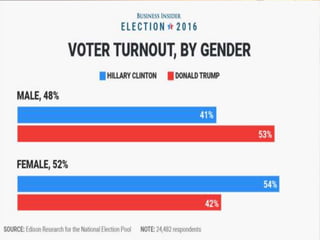
7.) GENDER
• Women tend to vote more than men do
– Men tend to vote Republican, women tend
to vote Democrat (gender gap)
Party Identification
• Party identification - the loyalty of people to
a particular political party (the party they
identify/associate with most)
– People who identify more with a certain political
party tend to vote more
• Straight-ticket voting - voting for candidates
from only one party on your ballot
• Split-ticket voting - voting for candidates
from both parties on your ballot
History of Voting:
Corruption
• Throughout history, many methods were used to
keep people from voting:
– Literacy tests – people had to prove they were
able to read before they could vote
– Gerrymandering – voting districts would be
redrawn to keep certain groups of people from
voting
– Poll taxes – people had to pay a fee to vote
– Voter I.D.s* - people are required to show photo
I.D.s at the polls in many states (*current issue)
History of Voting:
Expanding Suffrage
• Originally, only white men with property could
vote
• 15th Amendment (1870) – enabled all men to
vote regardless of race or color (enforced by
Voting Rights Act of 1965)
• 19th Amendment (1920)– all women could
vote
• 24th Amendment (1964) – Prohibited the use
of poll taxes as a requirement to vote
• 26th Amendment (1971)– minimum voting
age is 18 years old
Voting Rights Act of 1965
• Landmark civil rights legislation focused on
ending voting discrimination and enforcing the
15th Amendment
– Prohibited any gov’t level from using voting
methods that would deny someone the right to
vote based on race or color
– Prohibited literacy test requirements
– Enforced by federal officials manning state
polls to ensure proper procedures and access
to registration
– Later amended in 1982 to prohibit racial
gerrymandering
Voting on State Measures
• Initiative - voters want to change their
state laws and petition to put it on the
ballot/send to state legislature
– VOTERS start the process with petitions
• Referendum - state legislature sends a
measure/possible law for voter approval
on ballot
• Ex: changes to a state constitution must
be approved by the state’s residents
• Recall - lets voters remove/replace a
gov’t official before they finish their term
in office
– Happens on the state level

Voting and Voter Behavior

  • 1.
  • 3.
    Voting Terms • suffrage– the right to vote • enfranchise – to be given the right to vote • disenfranchise - to have the right to vote blocked/taken away • electorate – the group of people who can vote in a given election
  • 4.
    If You Don’tVote, DON’T COMPLAIN! • Voting lets your voice and your opinions be heard in gov’t – You elect someone to speak for you (someone whose values you agree with) • It is your duty as a citizen to vote and participate in the gov’t you live under  USE YOUR VOICE!
  • 5.
    Be an INFORMEDVoter • Stay informed and know the candidates, issues, and current events before you vote! • Be a responsible citizen and know about your gov’t!
  • 6.
    Voting Qualifications • Youmust be: –A U.S. citizen –18 years old –Registered to vote –A resident of the state you are registered in
  • 9.
    Who are they? •“Cannot” Voters - includes people who are not citizens, too ill to vote, in mental institutions, or imprisoned • Nonvoters - qualified, healthy citizens who still don’t vote – On average, the US has only about a 50- 60% total voter turnout from people who were eligible to vote (in presidential elections)
  • 12.
    Why don’t theyvote? • “No matter who wins, I’ll still be okay.” • “I don’t trust ANY politicians.” • “My vote doesn’t matter; it won’t change the election.” – Political Efficacy - the belief that your political participation (including voting) makes a difference in gov’t (and that your voice matters) • “I don’t have the time.” • “I don’t care about politics/the government.”
  • 14.
    Who is MOSTlikely to vote? People who: -are native-born U.S. citizens -are at least high school graduates (especially college grads) -are 45+ years in age -are married -have incomes of $50,000-$100,000 or more per year -have voted before -identify with a particular political party
  • 15.
    Voting Trends by SingleFactors • 1.) AGE -the older you are = more likely you are to vote -younger voters tend to vote Democrat, older ones vote Republican
  • 18.
    • 2.) RELIGION –Protestants (non-Catholics) tend to vote Republican – Catholics, Jews, and non-religious populations tend to vote Democrat
  • 20.
    • 3.) ETHNICITY/ RACE – White populations usually vote Republican, minority groups usually vote Democrat – Whites tend to vote more than minorities
  • 22.
    • 4.) INCOME/ EMPLOYMENT – Incomes over $50,000 a year usually vote Republican, lower incomes vote Democrat – Employed people generally vote more than unemployed people do
  • 24.
    • 5.) EDUCATION –People with a HS diploma or higher (college education) tend to vote more than those without one
  • 26.
    • 6.) GEOGRAPHY –Cities tend to vote Democrat, while rural areas vote Republican – Some states have higher turnout rates depending on registration rules, politics, etc.
  • 28.
    7.) GENDER • Womentend to vote more than men do – Men tend to vote Republican, women tend to vote Democrat (gender gap)
  • 30.
    Party Identification • Partyidentification - the loyalty of people to a particular political party (the party they identify/associate with most) – People who identify more with a certain political party tend to vote more • Straight-ticket voting - voting for candidates from only one party on your ballot • Split-ticket voting - voting for candidates from both parties on your ballot
  • 31.
    History of Voting: Corruption •Throughout history, many methods were used to keep people from voting: – Literacy tests – people had to prove they were able to read before they could vote – Gerrymandering – voting districts would be redrawn to keep certain groups of people from voting – Poll taxes – people had to pay a fee to vote – Voter I.D.s* - people are required to show photo I.D.s at the polls in many states (*current issue)
  • 32.
    History of Voting: ExpandingSuffrage • Originally, only white men with property could vote • 15th Amendment (1870) – enabled all men to vote regardless of race or color (enforced by Voting Rights Act of 1965) • 19th Amendment (1920)– all women could vote • 24th Amendment (1964) – Prohibited the use of poll taxes as a requirement to vote • 26th Amendment (1971)– minimum voting age is 18 years old
  • 33.
    Voting Rights Actof 1965 • Landmark civil rights legislation focused on ending voting discrimination and enforcing the 15th Amendment – Prohibited any gov’t level from using voting methods that would deny someone the right to vote based on race or color – Prohibited literacy test requirements – Enforced by federal officials manning state polls to ensure proper procedures and access to registration – Later amended in 1982 to prohibit racial gerrymandering
  • 34.
    Voting on StateMeasures • Initiative - voters want to change their state laws and petition to put it on the ballot/send to state legislature – VOTERS start the process with petitions
  • 35.
    • Referendum -state legislature sends a measure/possible law for voter approval on ballot • Ex: changes to a state constitution must be approved by the state’s residents
  • 36.
    • Recall -lets voters remove/replace a gov’t official before they finish their term in office – Happens on the state level