By Erica Pounds
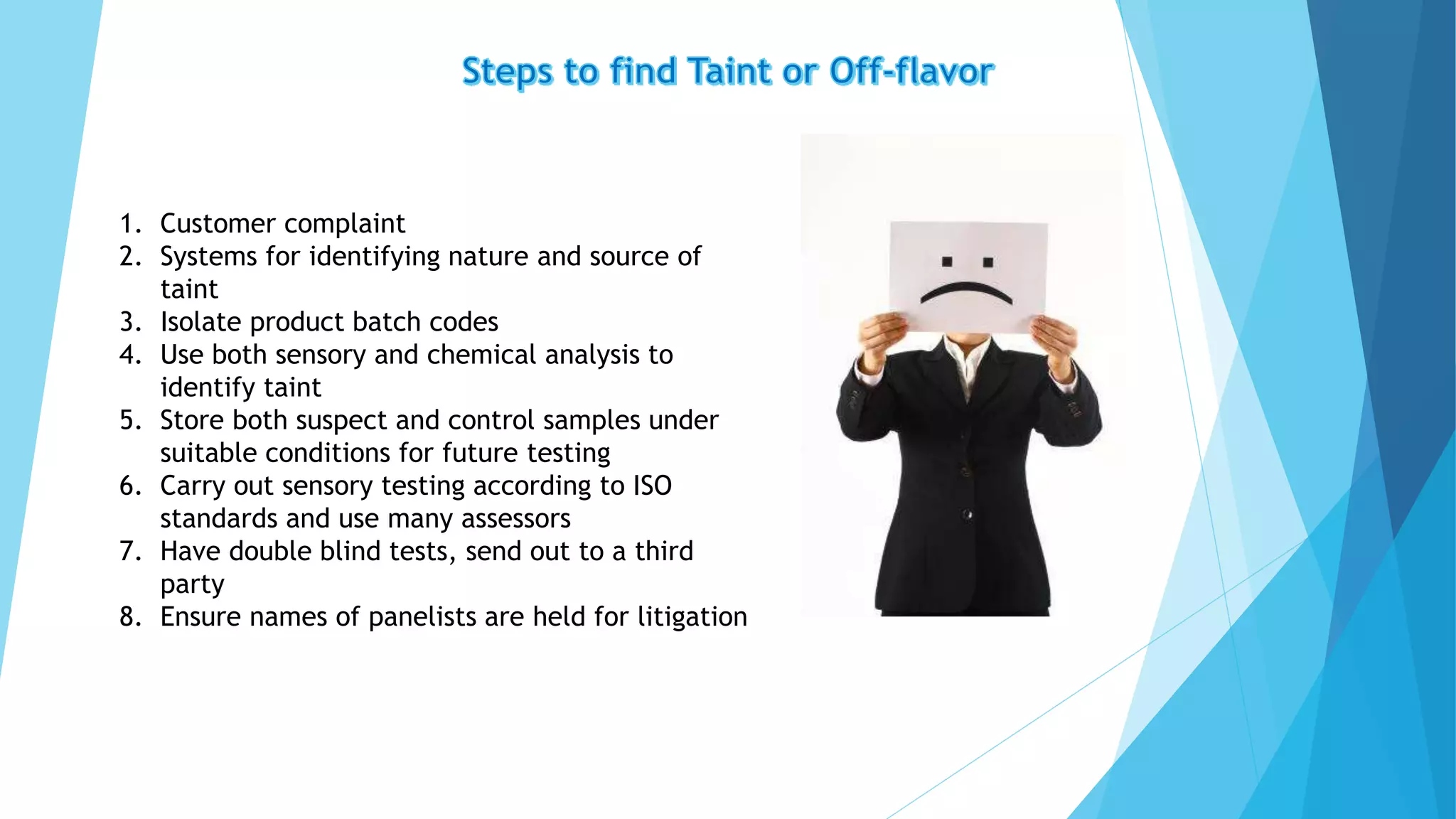
1. Customer complaint
2. Systems for identifying nature and source of
taint
3. Isolate product batch codes
4. Use both sensory and chemical analysis to
identify taint
5. Store both suspect and control samples under
suitable conditions for future testing
6. Carry out sensory testing according to ISO
standards and use many assessors
7. Have double blind tests, send out to a third
party
8. Ensure names of panelists are held for litigation
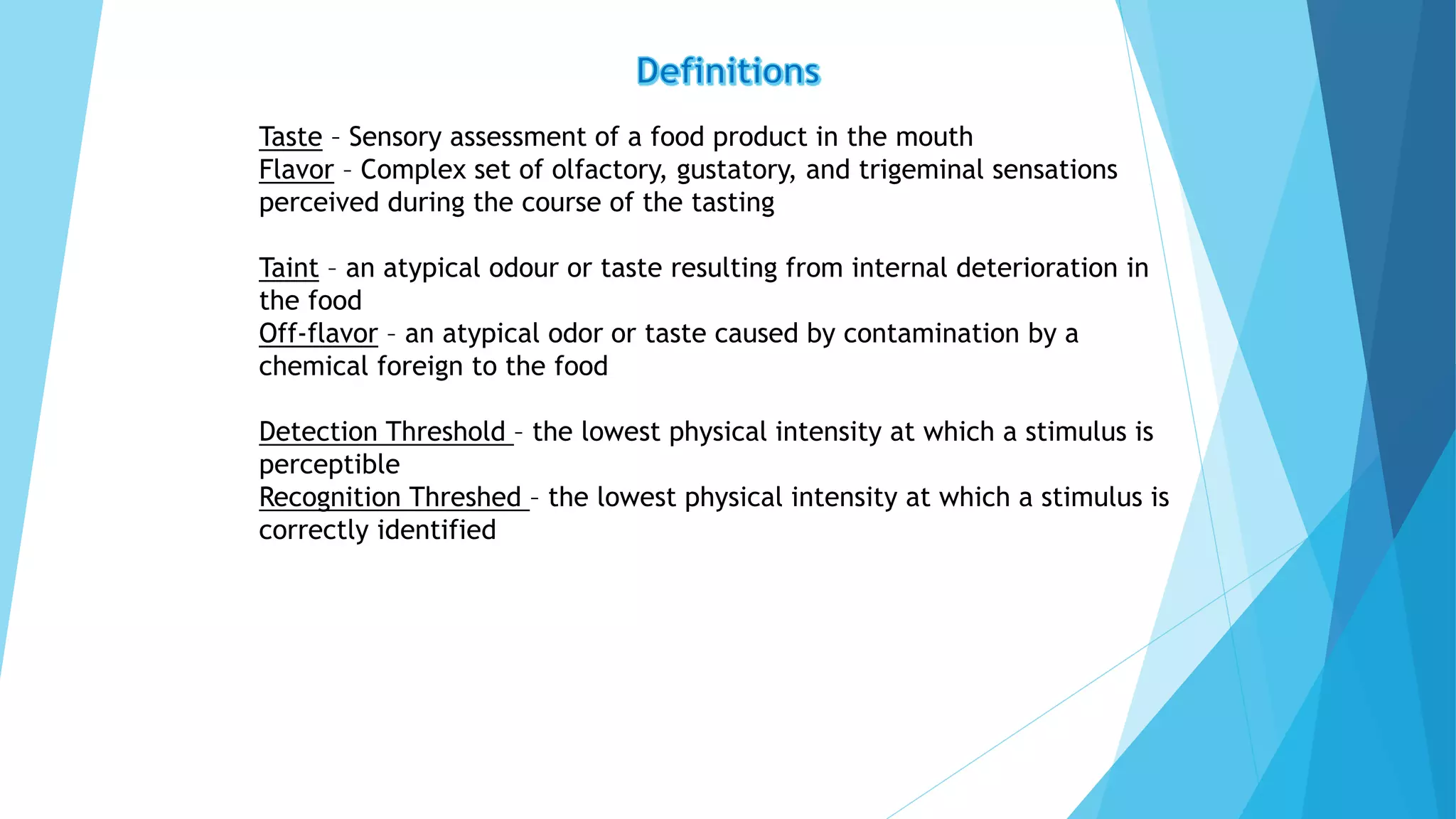
Taste – Sensory assessment of a food product in the mouth
Flavor – Complex set of olfactory, gustatory, and trigeminal sensations
perceived during the course of the tasting
Taint – an atypical odour or taste resulting from internal deterioration in
the food
Off-flavor – an atypical odor or taste caused by contamination by a
chemical foreign to the food
Detection Threshold – the lowest physical intensity at which a stimulus is
perceptible
Recognition Threshed – the lowest physical intensity at which a stimulus is
correctly identified
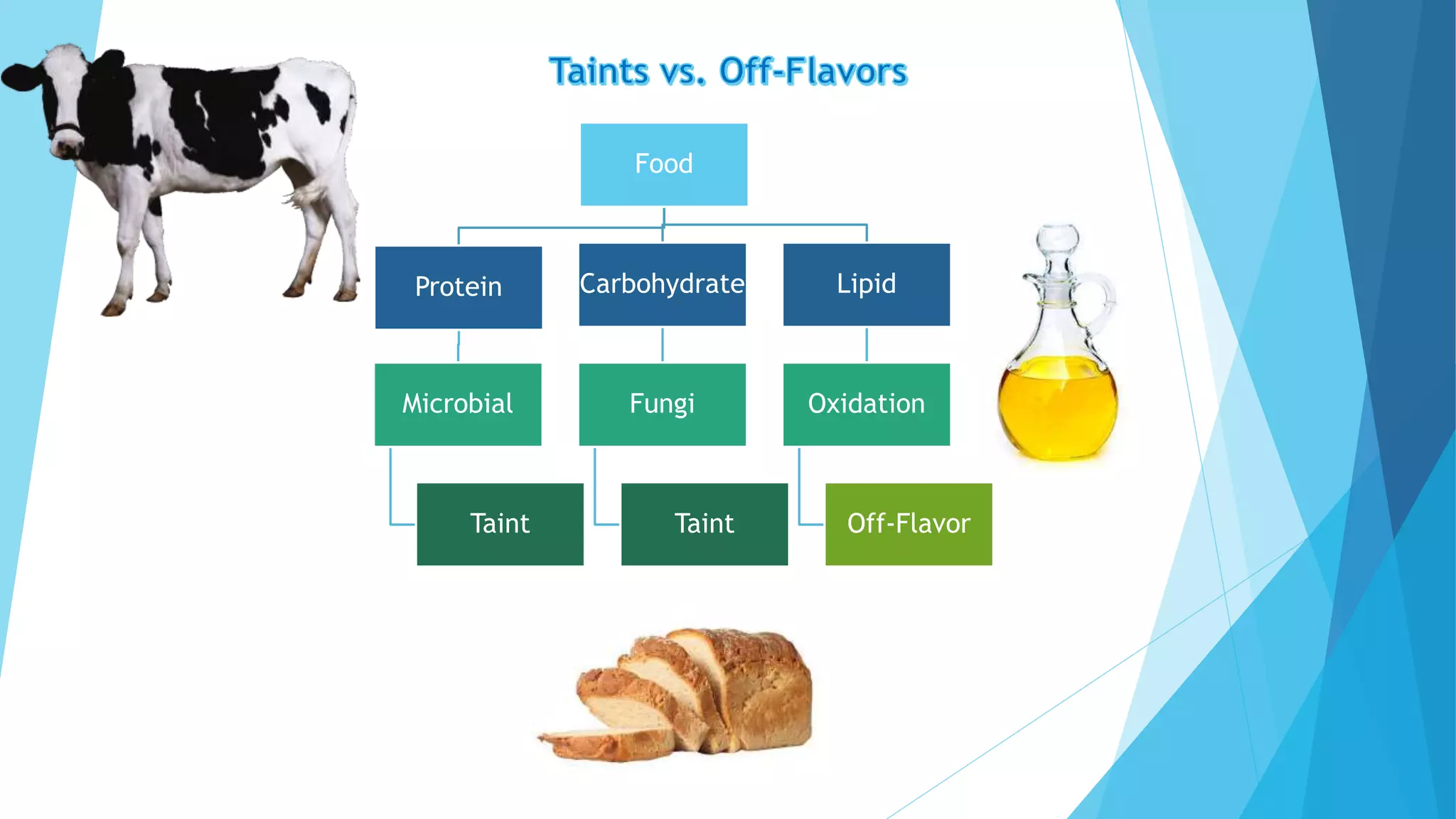
Food
Protein
Microbial
Taint
Carbohydrate
Fungi
Taint
Lipid
Oxidation
Off-Flavor
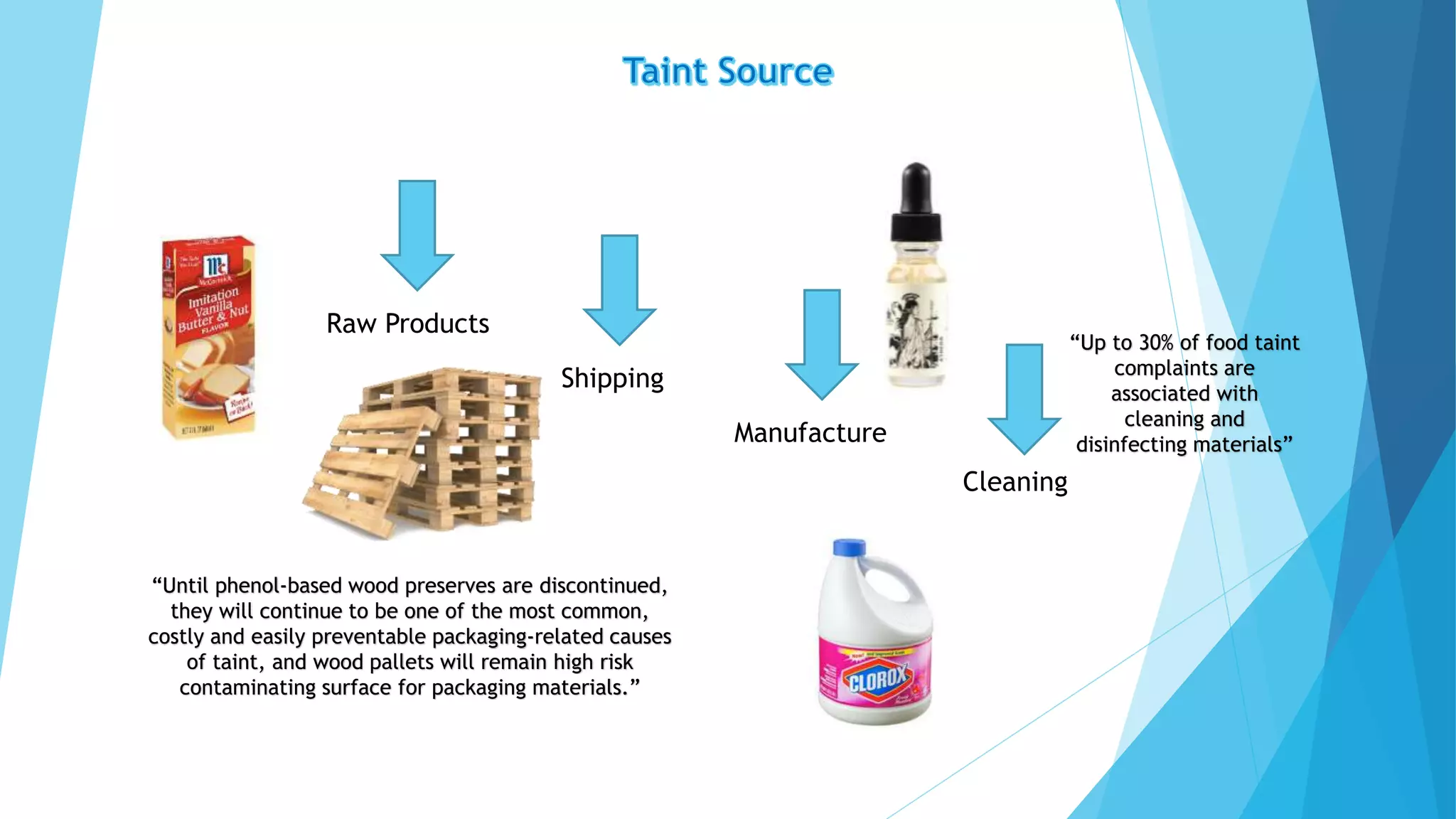
Raw Products
Shipping
Manufacture
Cleaning
“Up to 30% of food taint
complaints are
associated with
cleaning and
disinfecting materials”
“Until phenol-based wood preserves are discontinued,
they will continue to be one of the most common,
costly and easily preventable packaging-related causes
of taint, and wood pallets will remain high risk
contaminating surface for packaging materials.”
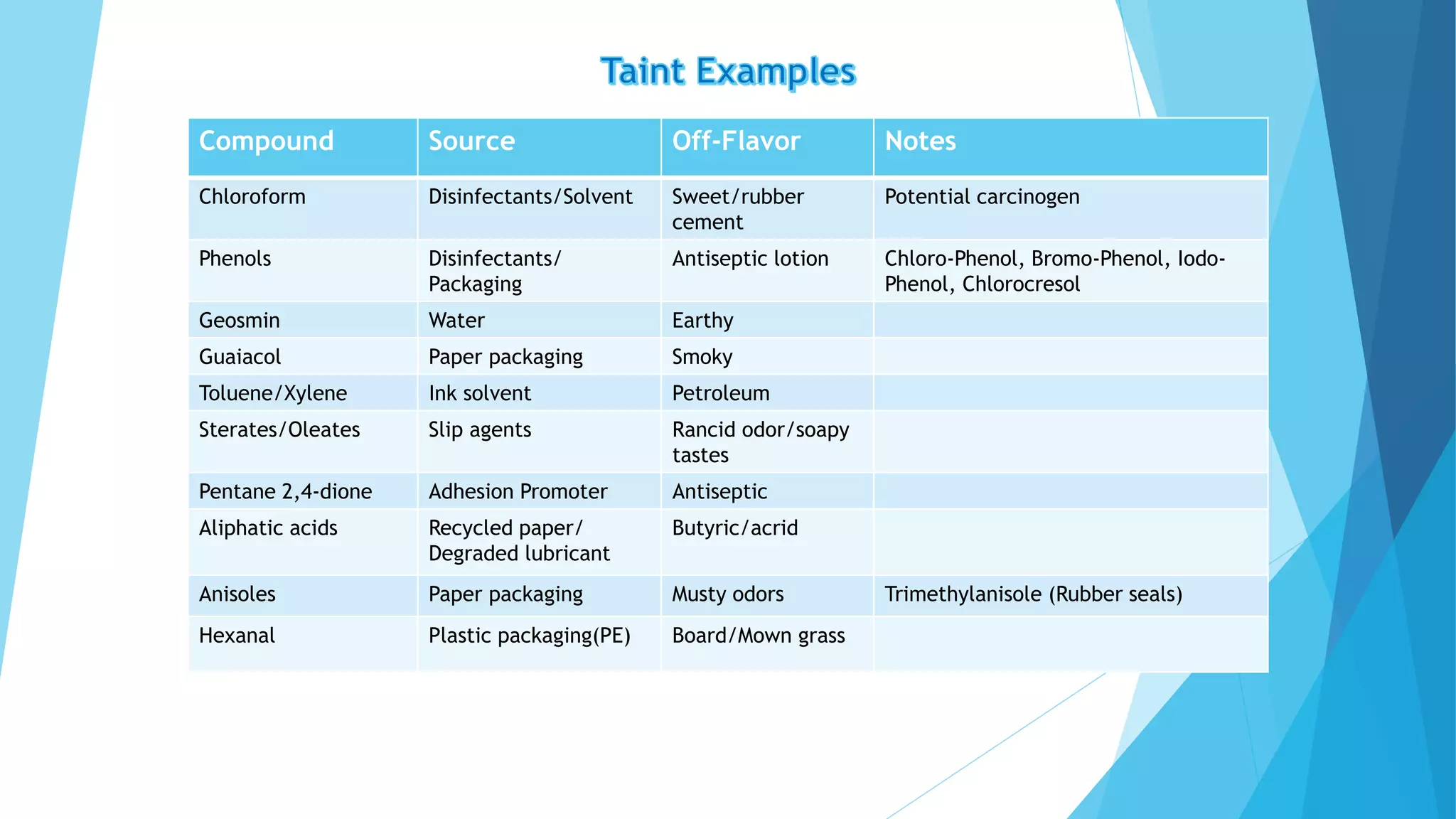
Compound Source Off-Flavor Notes
Chloroform Disinfectants/Solvent Sweet/rubber
cement
Potential carcinogen
Phenols Disinfectants/
Packaging
Antiseptic lotion Chloro-Phenol, Bromo-Phenol, Iodo-
Phenol, Chlorocresol
Geosmin Water Earthy
Guaiacol Paper packaging Smoky
Toluene/Xylene Ink solvent Petroleum
Sterates/Oleates Slip agents Rancid odor/soapy
tastes
Pentane 2,4-dione Adhesion Promoter Antiseptic
Aliphatic acids Recycled paper/
Degraded lubricant
Butyric/acrid
Anisoles Paper packaging Musty odors Trimethylanisole (Rubber seals)
Hexanal Plastic packaging(PE) Board/Mown grass
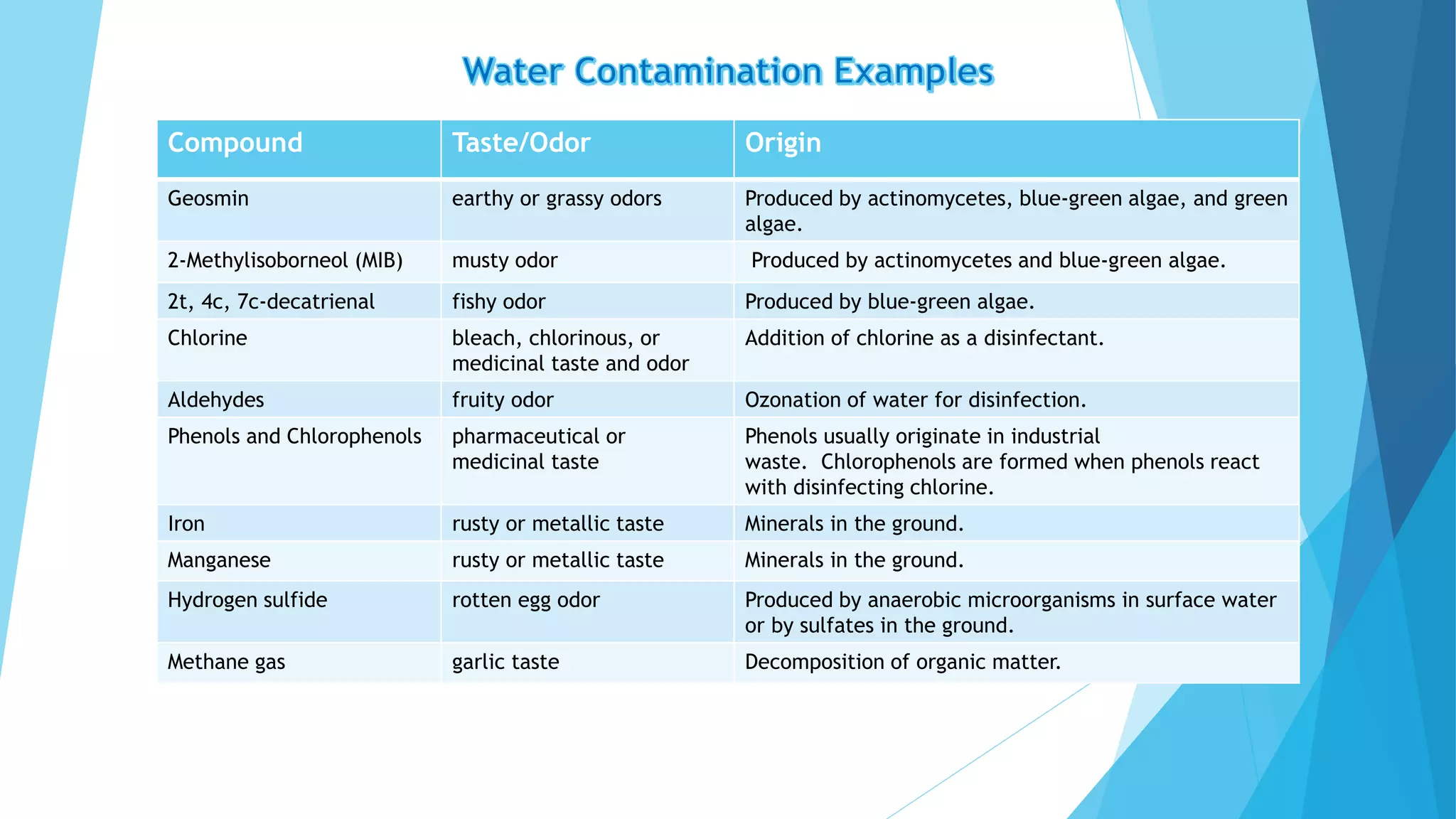
Compound Taste/Odor Origin
Geosmin earthy or grassy odors Produced by actinomycetes, blue-green algae, and green
algae.
2-Methylisoborneol (MIB) musty odor Produced by actinomycetes and blue-green algae.
2t, 4c, 7c-decatrienal fishy odor Produced by blue-green algae.
Chlorine bleach, chlorinous, or
medicinal taste and odor
Addition of chlorine as a disinfectant.
Aldehydes fruity odor Ozonation of water for disinfection.
Phenols and Chlorophenols pharmaceutical or
medicinal taste
Phenols usually originate in industrial
waste. Chlorophenols are formed when phenols react
with disinfecting chlorine.
Iron rusty or metallic taste Minerals in the ground.
Manganese rusty or metallic taste Minerals in the ground.
Hydrogen sulfide rotten egg odor Produced by anaerobic microorganisms in surface water
or by sulfates in the ground.
Methane gas garlic taste Decomposition of organic matter.
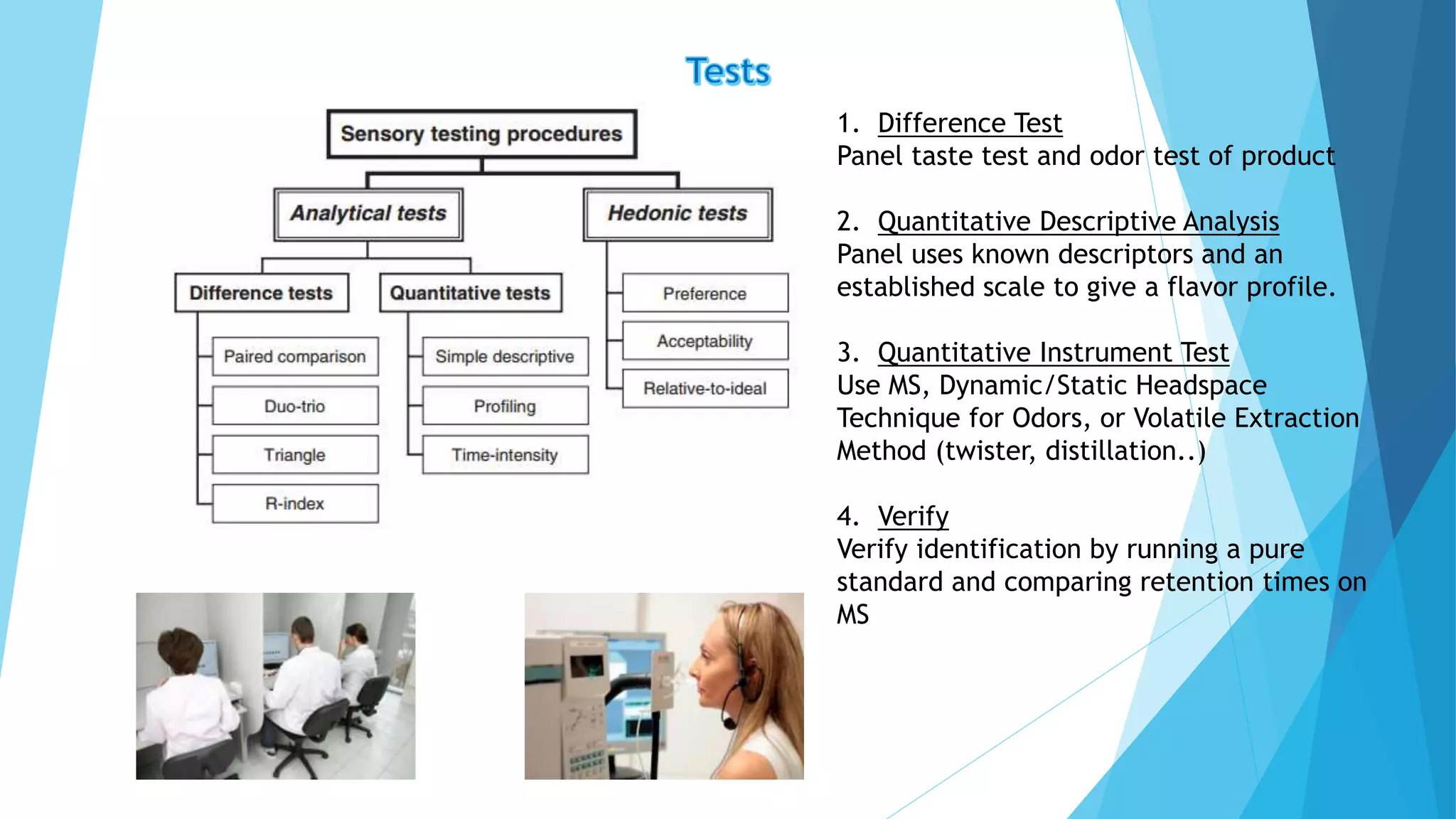
1. Difference Test
Panel taste test and odor test of product
2. Quantitative Descriptive Analysis
Panel uses known descriptors and an
established scale to give a flavor profile.
3. Quantitative Instrument Test
Use MS, Dynamic/Static Headspace
Technique for Odors, or Volatile Extraction
Method (twister, distillation..)
4. Verify
Verify identification by running a pure
standard and comparing retention times on
MS
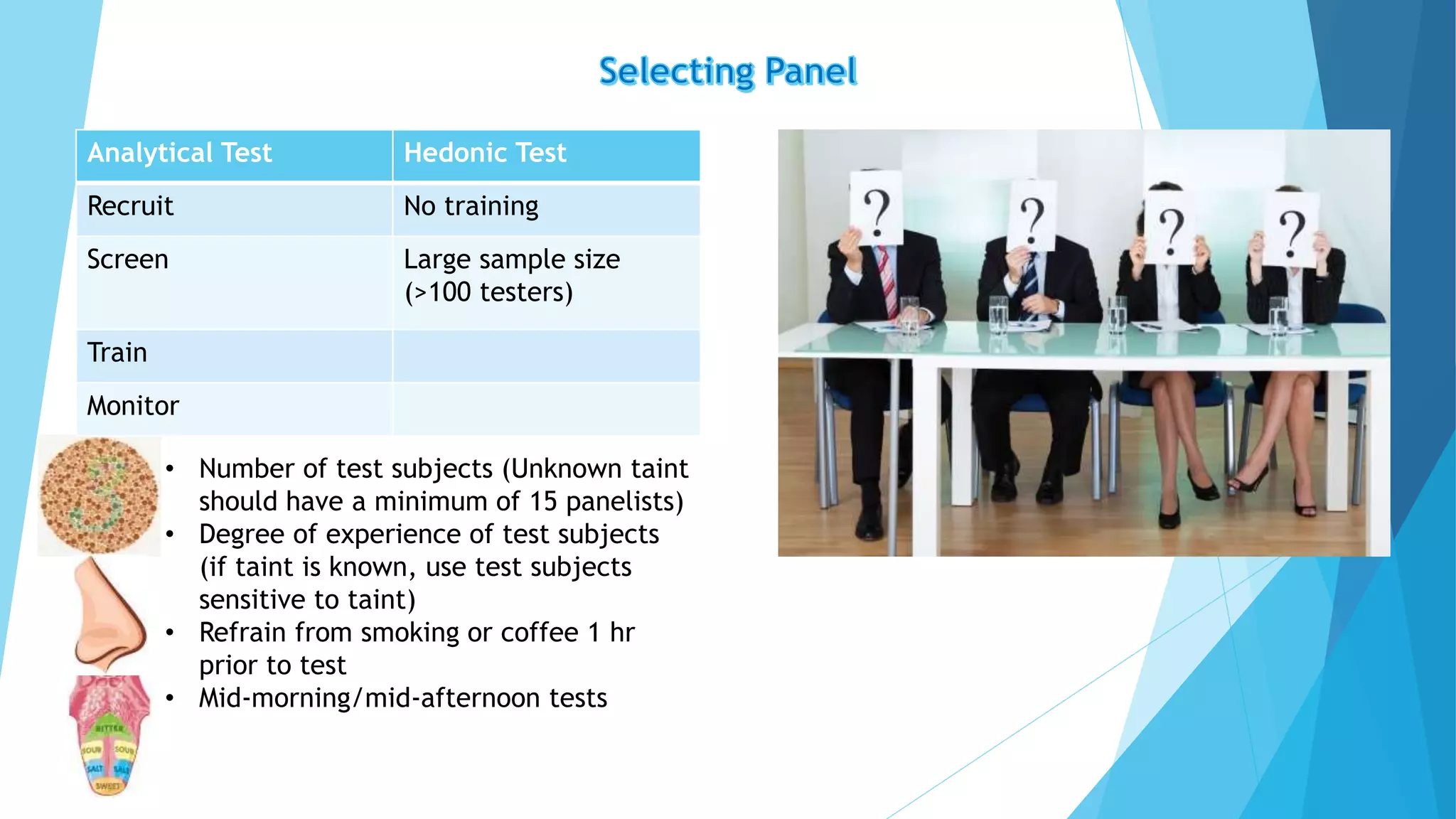
Analytical Test Hedonic Test
Recruit No training
Screen Large sample size
(>100 testers)
Train
Monitor
• Number of test subjects (Unknown taint
should have a minimum of 15 panelists)
• Degree of experience of test subjects
(if taint is known, use test subjects
sensitive to taint)
• Refrain from smoking or coffee 1 hr
prior to test
• Mid-morning/mid-afternoon tests
• Comfortable temperature, relative
humidity, with limited airflow
• Odor free room (air filters with activated
carbon filter)
• Cleaning agents should not leave odors
• Sound should be restricted (sound-
resistant room)
• Lighting may partially mask the test
sample so that tests can be done only on
flavor
• Lighting shall be uniform
• Surfaces should be non-absorbent
• Wall colors should be off-white or a light-
neutral grey
• Booths shall be painted matt gray with
15% luminance factor
• Booths/work stations should be a
minimum of 3” x 2” with a divider of 1”
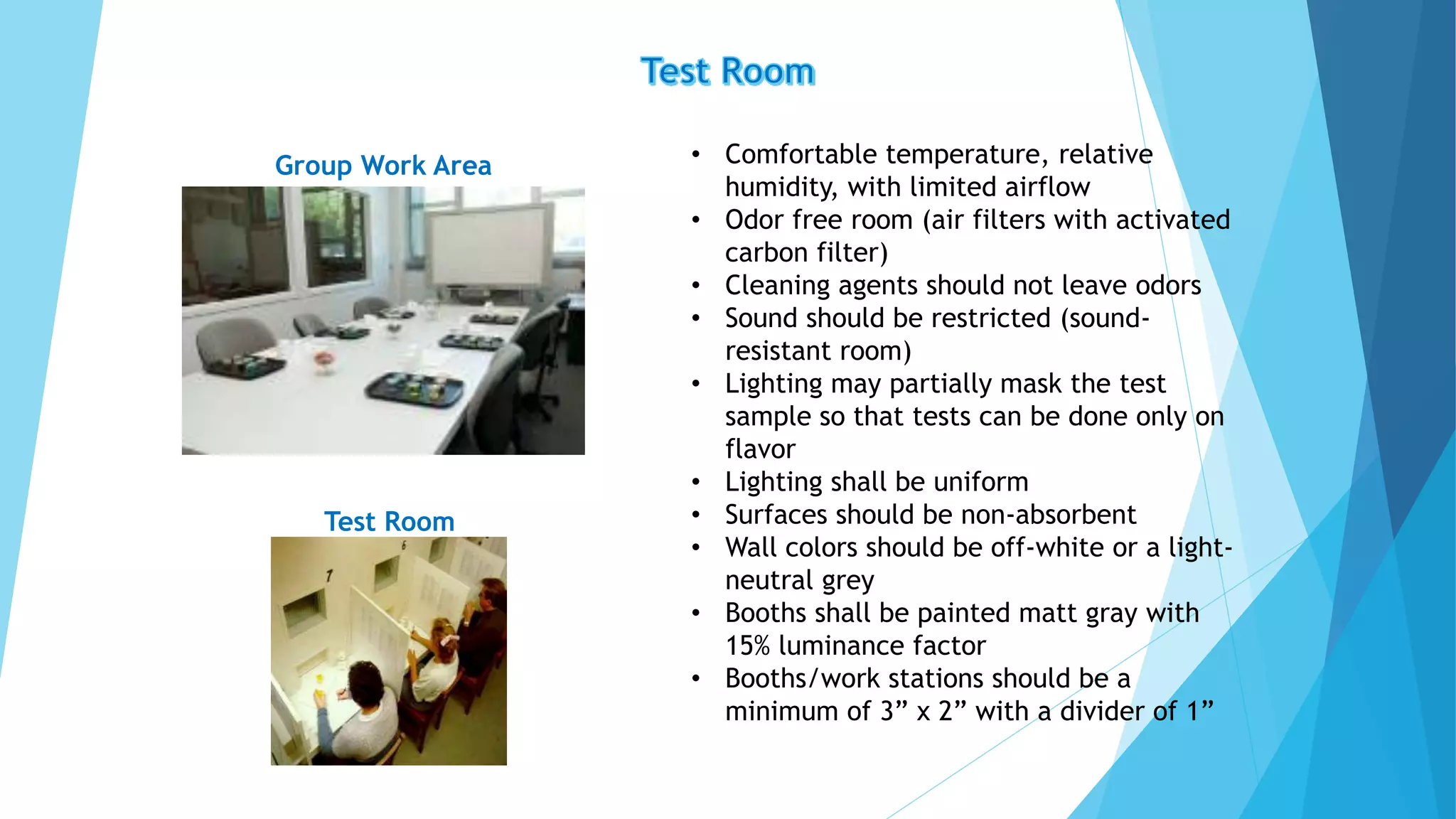
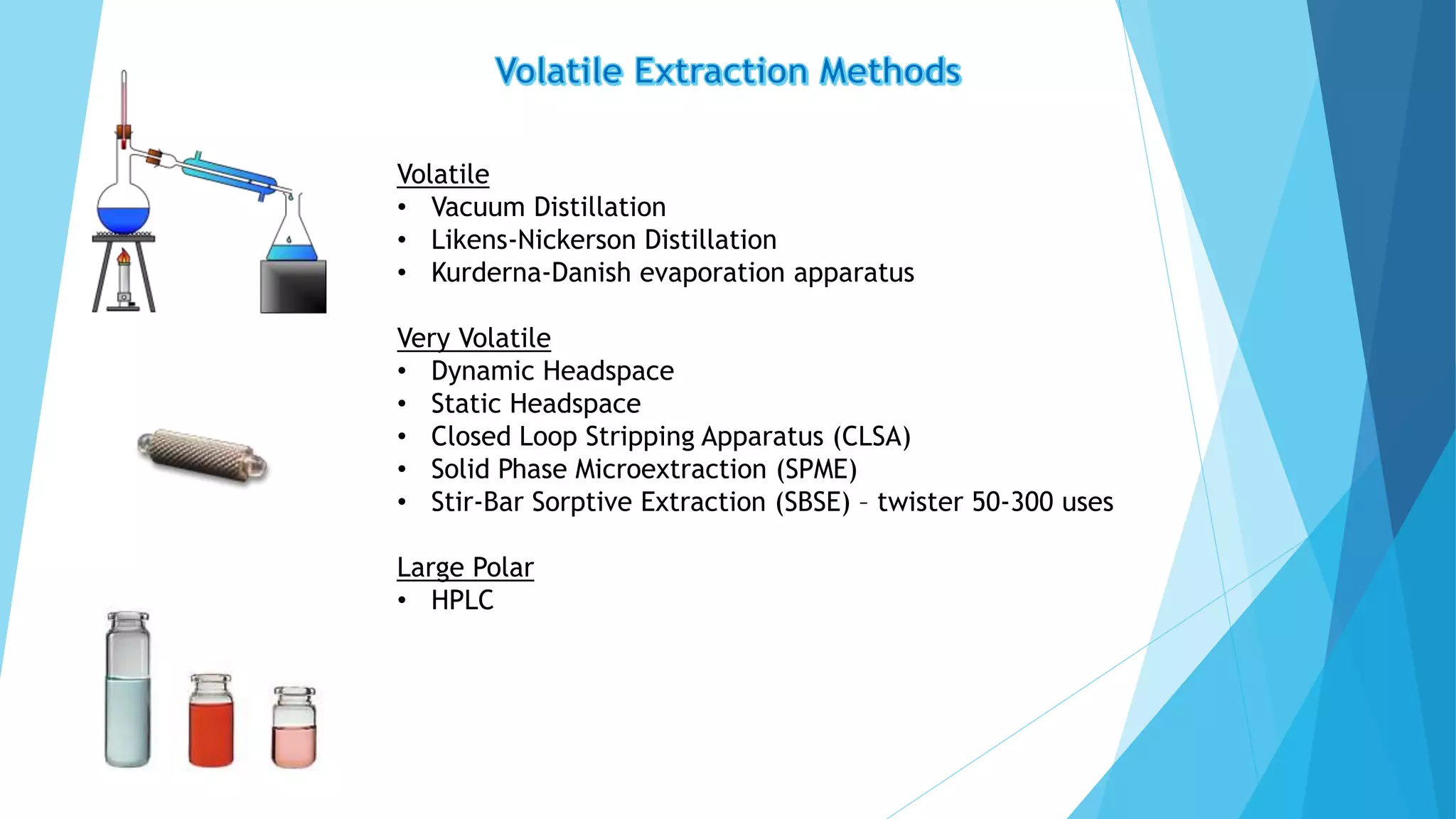
Test Room
Group Work Area
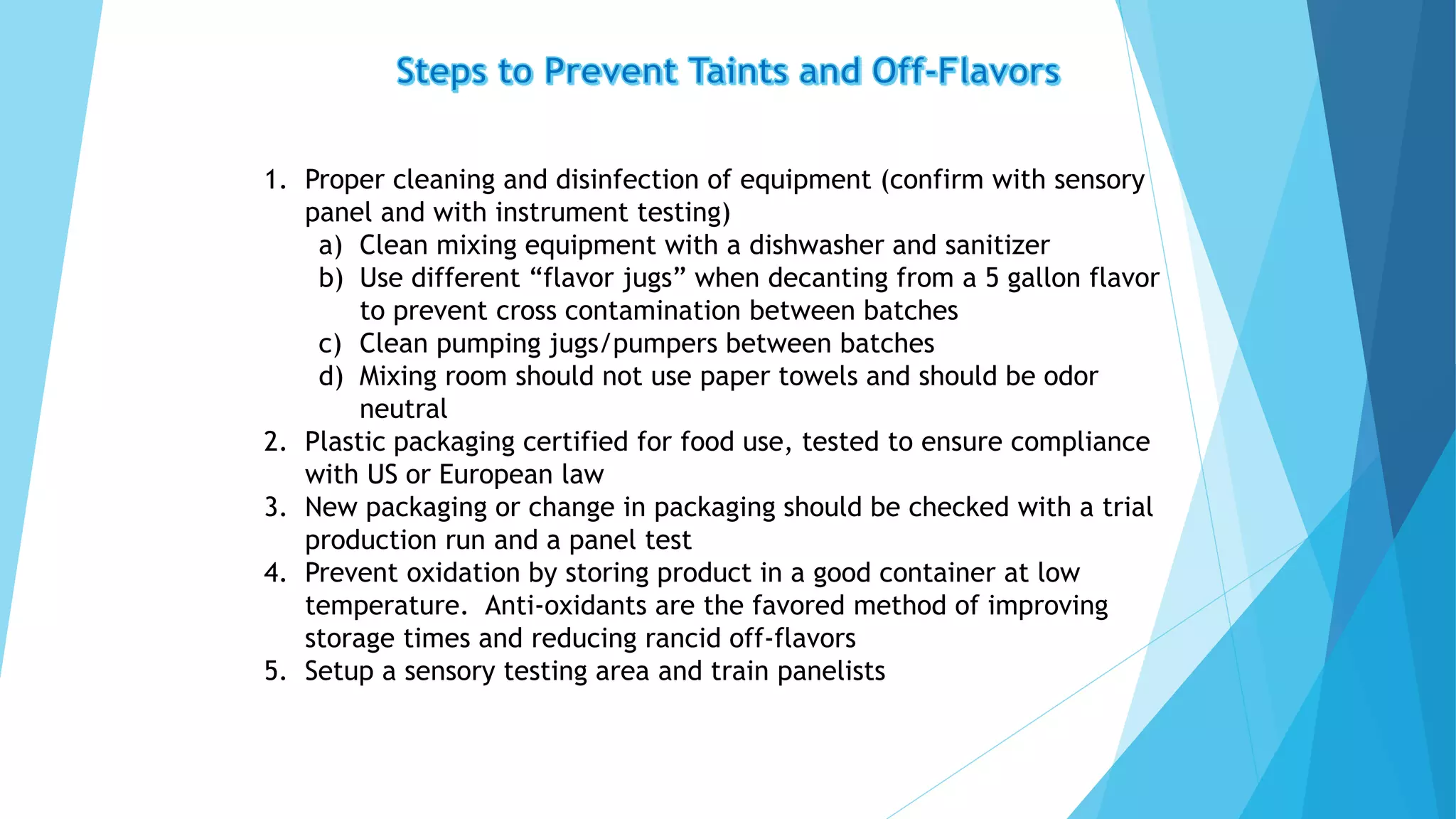
Volatile
• Vacuum Distillation
• Likens-Nickerson Distillation
• Kurderna-Danish evaporation apparatus
Very Volatile
• Dynamic Headspace
• Static Headspace
• Closed Loop Stripping Apparatus (CLSA)
• Solid Phase Microextraction (SPME)
• Stir-Bar Sorptive Extraction (SBSE) – twister 50-300 uses
Large Polar
• HPLC
1. Proper cleaning and disinfection of equipment (confirm with sensory
panel and with instrument testing)
a) Clean mixing equipment with a dishwasher and sanitizer
b) Use different “flavor jugs” when decanting from a 5 gallon flavor
to prevent cross contamination between batches
c) Clean pumping jugs/pumpers between batches
d) Mixing room should not use paper towels and should be odor
neutral
2. Plastic packaging certified for food use, tested to ensure compliance
with US or European law
3. New packaging or change in packaging should be checked with a trial
production run and a panel test
4. Prevent oxidation by storing product in a good container at low
temperature. Anti-oxidants are the favored method of improving
storage times and reducing rancid off-flavors
5. Setup a sensory testing area and train panelists
• http://water.me.vccs.edu/
• Taints and Off-Flavours in food Edited by Brian Baigrie
• ISO 6658 Sensory Analysis – Methodology – General Guidance
• ISO 8589 Sensory Analysis – General Guidance for the Design of Test Rooms
• ISO 8586 Sensory Analysis – General Guidelines for the Selection, Training, and
Monitoring of Selected Assessors and Expert Sensory Assessors
• ISO 10399 Sensory Analysis – Methodology – Duo-trio Test
• ISO 13302 Sensory Analysis – Methods for assessing modifications to the flavor of
foodstuffs due to packaging

Training and Testing of Off-Flavors, Taints

  • 1.
  • 2.
    1. Customer complaint 2.Systems for identifying nature and source of taint 3. Isolate product batch codes 4. Use both sensory and chemical analysis to identify taint 5. Store both suspect and control samples under suitable conditions for future testing 6. Carry out sensory testing according to ISO standards and use many assessors 7. Have double blind tests, send out to a third party 8. Ensure names of panelists are held for litigation
  • 3.
    Taste – Sensoryassessment of a food product in the mouth Flavor – Complex set of olfactory, gustatory, and trigeminal sensations perceived during the course of the tasting Taint – an atypical odour or taste resulting from internal deterioration in the food Off-flavor – an atypical odor or taste caused by contamination by a chemical foreign to the food Detection Threshold – the lowest physical intensity at which a stimulus is perceptible Recognition Threshed – the lowest physical intensity at which a stimulus is correctly identified
  • 4.
  • 5.
    Raw Products Shipping Manufacture Cleaning “Up to30% of food taint complaints are associated with cleaning and disinfecting materials” “Until phenol-based wood preserves are discontinued, they will continue to be one of the most common, costly and easily preventable packaging-related causes of taint, and wood pallets will remain high risk contaminating surface for packaging materials.”
  • 6.
    Compound Source Off-FlavorNotes Chloroform Disinfectants/Solvent Sweet/rubber cement Potential carcinogen Phenols Disinfectants/ Packaging Antiseptic lotion Chloro-Phenol, Bromo-Phenol, Iodo- Phenol, Chlorocresol Geosmin Water Earthy Guaiacol Paper packaging Smoky Toluene/Xylene Ink solvent Petroleum Sterates/Oleates Slip agents Rancid odor/soapy tastes Pentane 2,4-dione Adhesion Promoter Antiseptic Aliphatic acids Recycled paper/ Degraded lubricant Butyric/acrid Anisoles Paper packaging Musty odors Trimethylanisole (Rubber seals) Hexanal Plastic packaging(PE) Board/Mown grass
  • 7.
    Compound Taste/Odor Origin Geosminearthy or grassy odors Produced by actinomycetes, blue-green algae, and green algae. 2-Methylisoborneol (MIB) musty odor Produced by actinomycetes and blue-green algae. 2t, 4c, 7c-decatrienal fishy odor Produced by blue-green algae. Chlorine bleach, chlorinous, or medicinal taste and odor Addition of chlorine as a disinfectant. Aldehydes fruity odor Ozonation of water for disinfection. Phenols and Chlorophenols pharmaceutical or medicinal taste Phenols usually originate in industrial waste. Chlorophenols are formed when phenols react with disinfecting chlorine. Iron rusty or metallic taste Minerals in the ground. Manganese rusty or metallic taste Minerals in the ground. Hydrogen sulfide rotten egg odor Produced by anaerobic microorganisms in surface water or by sulfates in the ground. Methane gas garlic taste Decomposition of organic matter.
  • 8.
    1. Difference Test Paneltaste test and odor test of product 2. Quantitative Descriptive Analysis Panel uses known descriptors and an established scale to give a flavor profile. 3. Quantitative Instrument Test Use MS, Dynamic/Static Headspace Technique for Odors, or Volatile Extraction Method (twister, distillation..) 4. Verify Verify identification by running a pure standard and comparing retention times on MS
  • 9.
    Analytical Test HedonicTest Recruit No training Screen Large sample size (>100 testers) Train Monitor • Number of test subjects (Unknown taint should have a minimum of 15 panelists) • Degree of experience of test subjects (if taint is known, use test subjects sensitive to taint) • Refrain from smoking or coffee 1 hr prior to test • Mid-morning/mid-afternoon tests
  • 10.
    • Comfortable temperature,relative humidity, with limited airflow • Odor free room (air filters with activated carbon filter) • Cleaning agents should not leave odors • Sound should be restricted (sound- resistant room) • Lighting may partially mask the test sample so that tests can be done only on flavor • Lighting shall be uniform • Surfaces should be non-absorbent • Wall colors should be off-white or a light- neutral grey • Booths shall be painted matt gray with 15% luminance factor • Booths/work stations should be a minimum of 3” x 2” with a divider of 1” Test Room Group Work Area
  • 11.
    Volatile • Vacuum Distillation •Likens-Nickerson Distillation • Kurderna-Danish evaporation apparatus Very Volatile • Dynamic Headspace • Static Headspace • Closed Loop Stripping Apparatus (CLSA) • Solid Phase Microextraction (SPME) • Stir-Bar Sorptive Extraction (SBSE) – twister 50-300 uses Large Polar • HPLC
  • 12.
    1. Proper cleaningand disinfection of equipment (confirm with sensory panel and with instrument testing) a) Clean mixing equipment with a dishwasher and sanitizer b) Use different “flavor jugs” when decanting from a 5 gallon flavor to prevent cross contamination between batches c) Clean pumping jugs/pumpers between batches d) Mixing room should not use paper towels and should be odor neutral 2. Plastic packaging certified for food use, tested to ensure compliance with US or European law 3. New packaging or change in packaging should be checked with a trial production run and a panel test 4. Prevent oxidation by storing product in a good container at low temperature. Anti-oxidants are the favored method of improving storage times and reducing rancid off-flavors 5. Setup a sensory testing area and train panelists
  • 13.
    • http://water.me.vccs.edu/ • Taintsand Off-Flavours in food Edited by Brian Baigrie • ISO 6658 Sensory Analysis – Methodology – General Guidance • ISO 8589 Sensory Analysis – General Guidance for the Design of Test Rooms • ISO 8586 Sensory Analysis – General Guidelines for the Selection, Training, and Monitoring of Selected Assessors and Expert Sensory Assessors • ISO 10399 Sensory Analysis – Methodology – Duo-trio Test • ISO 13302 Sensory Analysis – Methods for assessing modifications to the flavor of foodstuffs due to packaging