CHAPTER 6
ACID, BASE AND SALT
PREPARED BY : ESTHER ANNE ANAK RANDI
Chapter 6 Acid, Base and Salt
6.1 Role of water in showing acidic and alkaline
properties.
6.2 pH value
6.3 Strength of acids and alkalis
6.4 Chemical properties of acids and alkalis
6.5 Concentration of aqueous solutions
6.6 Standard solution
6.7 Neutralisation
6.8 Salts, crystals and their uses in daily life
6.9 Preparation of salts
6.10 Effect of heat on salts
6.11 Qualitative analysis
M
CONSTRUCTION OF IONIC EQUATIONS
THROUGH THE CONTINUOUS
VARIATION METHOD
Construction of Ionic Equations through the Continuous Variation Method
• The continuous variation method is used to construct the ionic equation for the
formation of insoluble salts.
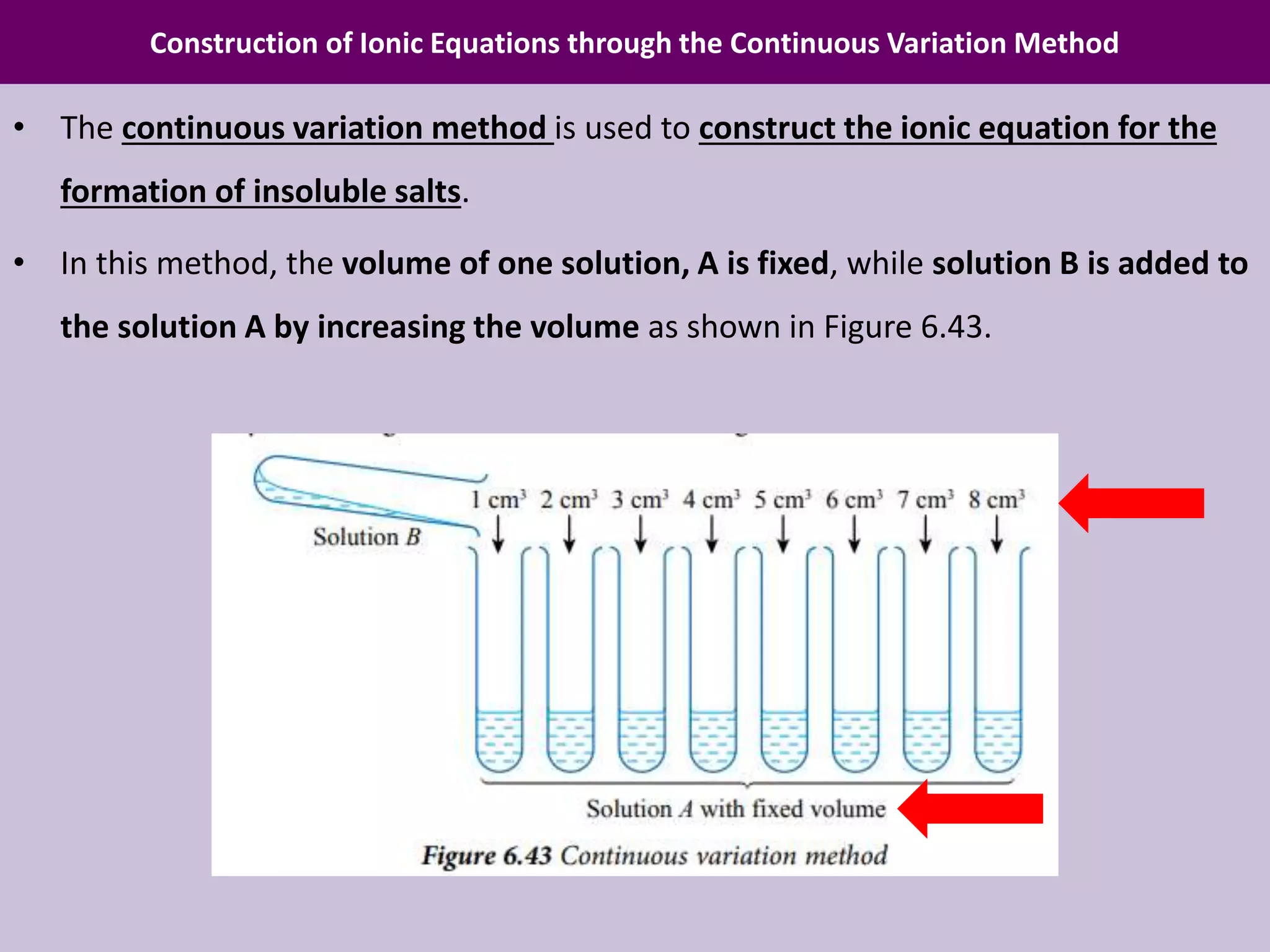
• In this method, the volume of one solution, A is fixed, while solution B is added to
the solution A by increasing the volume as shown in Figure 6.43.
Construction of Ionic Equations through the Continuous Variation Method
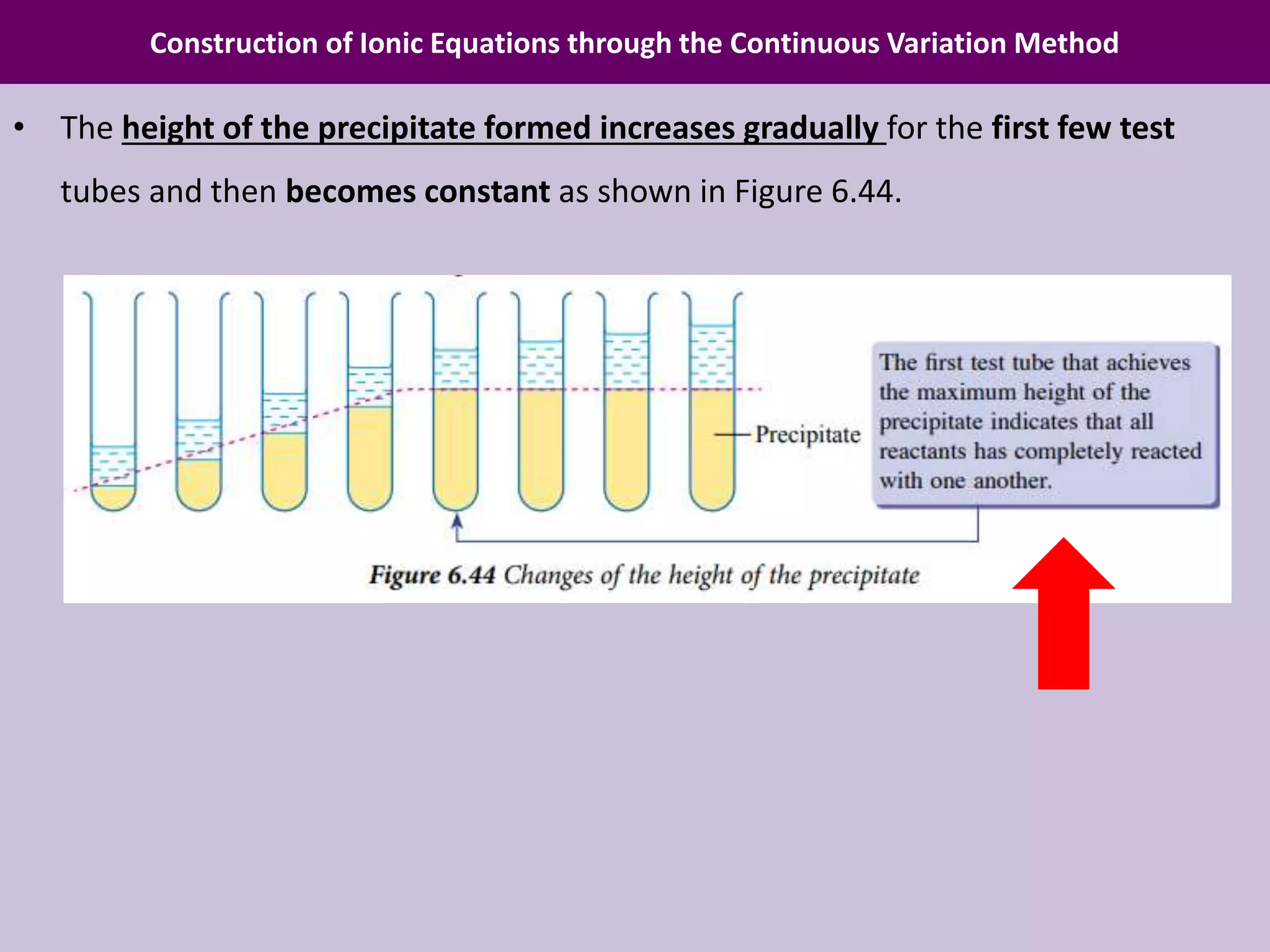
• The height of the precipitate formed increases gradually for the first few test
tubes and then becomes constant as shown in Figure 6.44.
EXPERIMENT 6.6 (TEXTBOOK PAGE 186)
Aim : To construct an ionic equation for the formation of lead(II) iodide.
Problem statement : How to construct an ionic equation for the formation of lead(II)
iodide?
Hypothesis : As the volume of potassium iodide solution, KI added to lead(II) nitrate
solution, Pb(NO3)2 increases, the height of the precipitate will increase
and then remain constant.
Variables :
Manipulated : Volume of potassium iodide solution, KI
Responding : Height of the precipitate
Fixed : Volume and concentration of lead(II) nitrate solution, Pb(NO3)2 , concentration
of potassium iodide solution, KI
EXPERIMENT 6.6 (TEXTBOOK PAGE 186)
Materials : 0.5 mol dm–3 lead(II) nitrate solution, Pb(NO3)2 , 0.5 mol dm–3 potassium
iodide solution, KI and distilled water
Apparatus : Test tubes of the same size, glass rod, test tube rack, burette, retort stand
with clamp and ruler
Safety precaution : Make sure all the test tube used are of the same size.
EXPERIMENT 6.6 (TEXTBOOK PAGE 186)
Procedures :
1.Label eight test tubes from 1 to 8 and place all
the test tubes in a test tube rack.
2. Using a burette, fill each test tube with 5 cm3
of 0.5 mol dm-3 lead(II) nitrate solution, Pb(NO3)2.
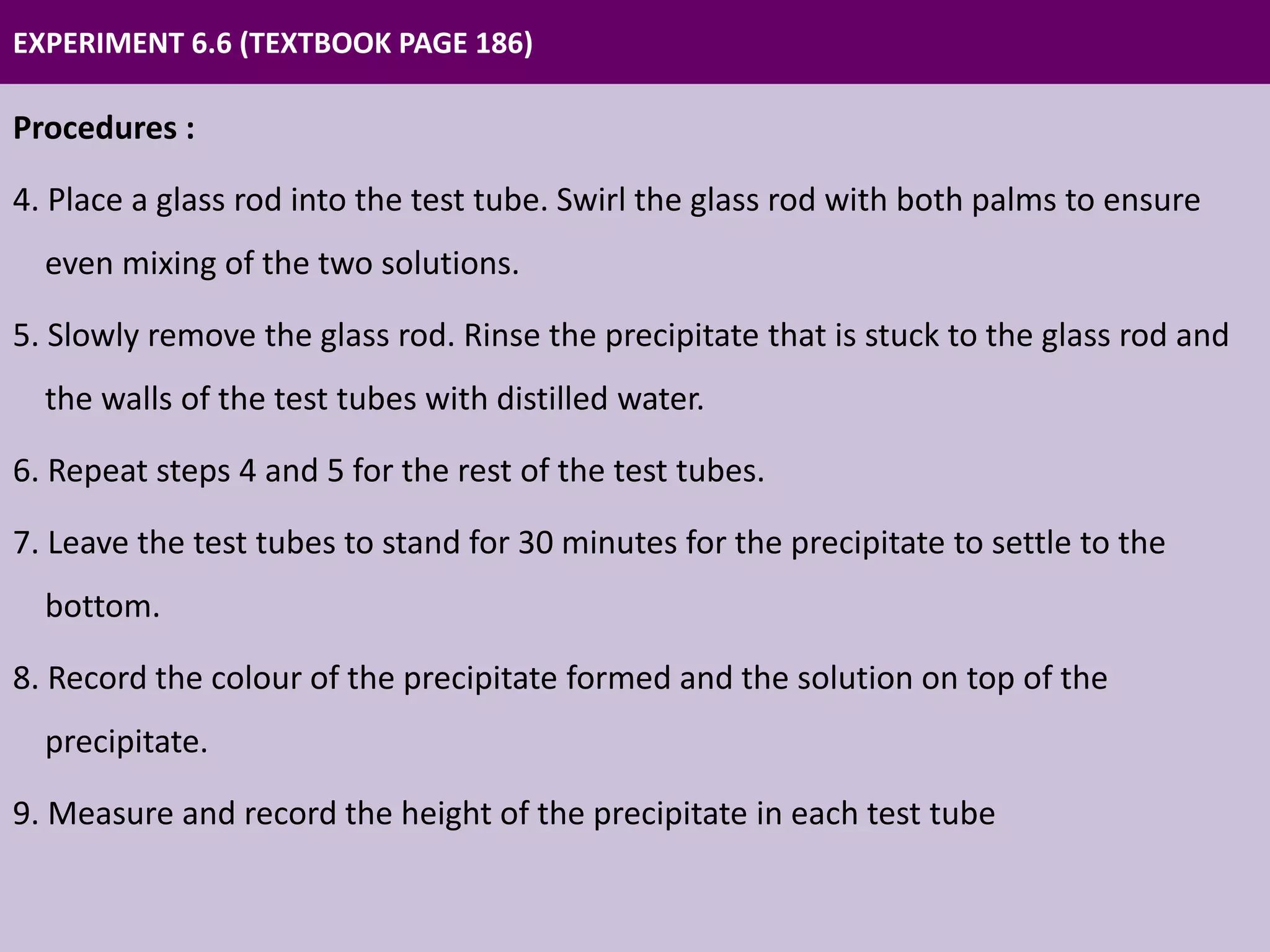
3. Using a second burette, add 0.5 mol dm-3
potassium iodide solution, KI into each test tube
according to the volume stated in Table 6.7.
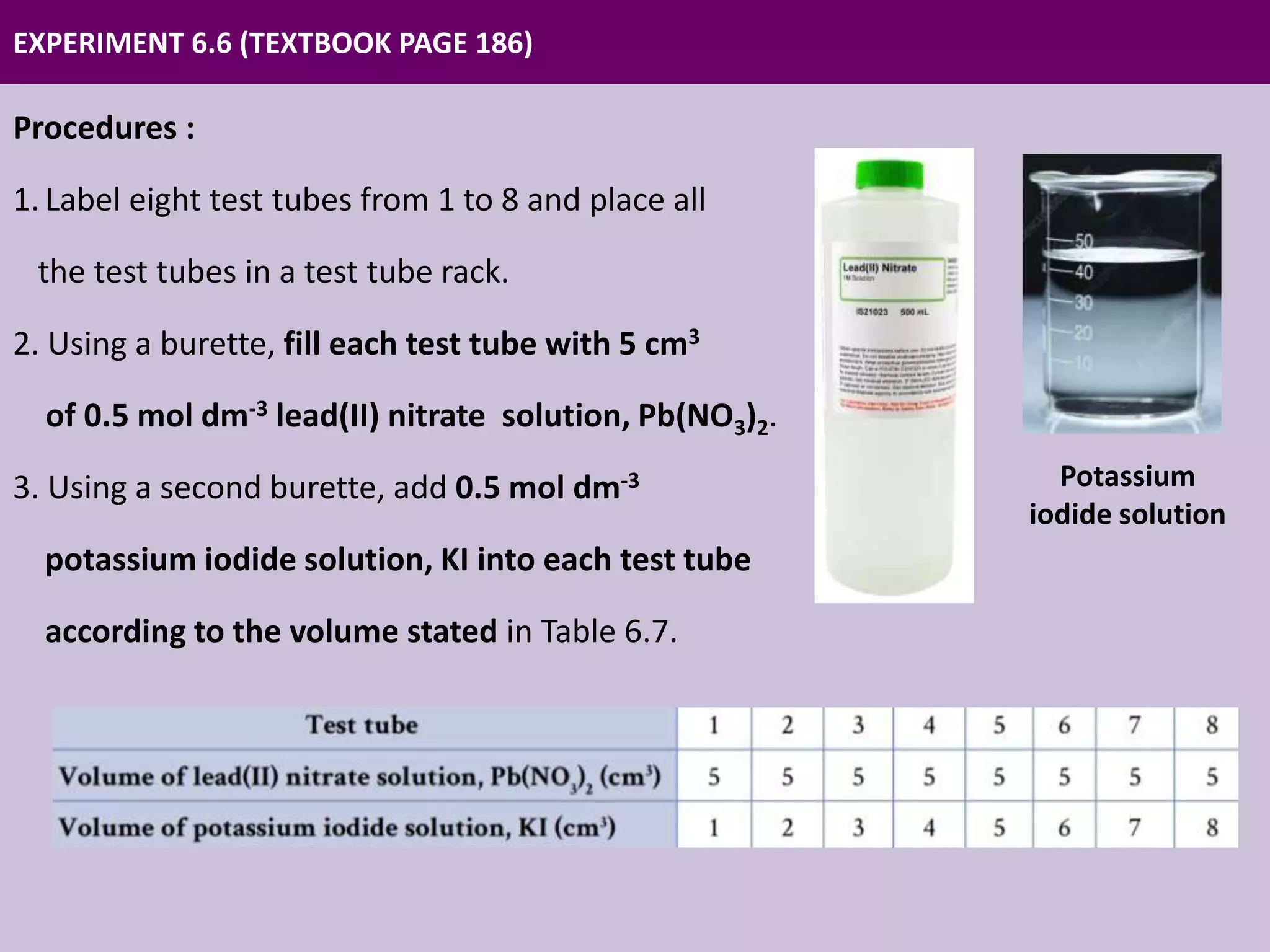
Potassium
iodide solution
EXPERIMENT 6.6 (TEXTBOOK PAGE 186)
Procedures :
4. Place a glass rod into the test tube. Swirl the glass rod with both palms to ensure
even mixing of the two solutions.
5. Slowly remove the glass rod. Rinse the precipitate that is stuck to the glass rod and
the walls of the test tubes with distilled water.
6. Repeat steps 4 and 5 for the rest of the test tubes.
7. Leave the test tubes to stand for 30 minutes for the precipitate to settle to the
bottom.
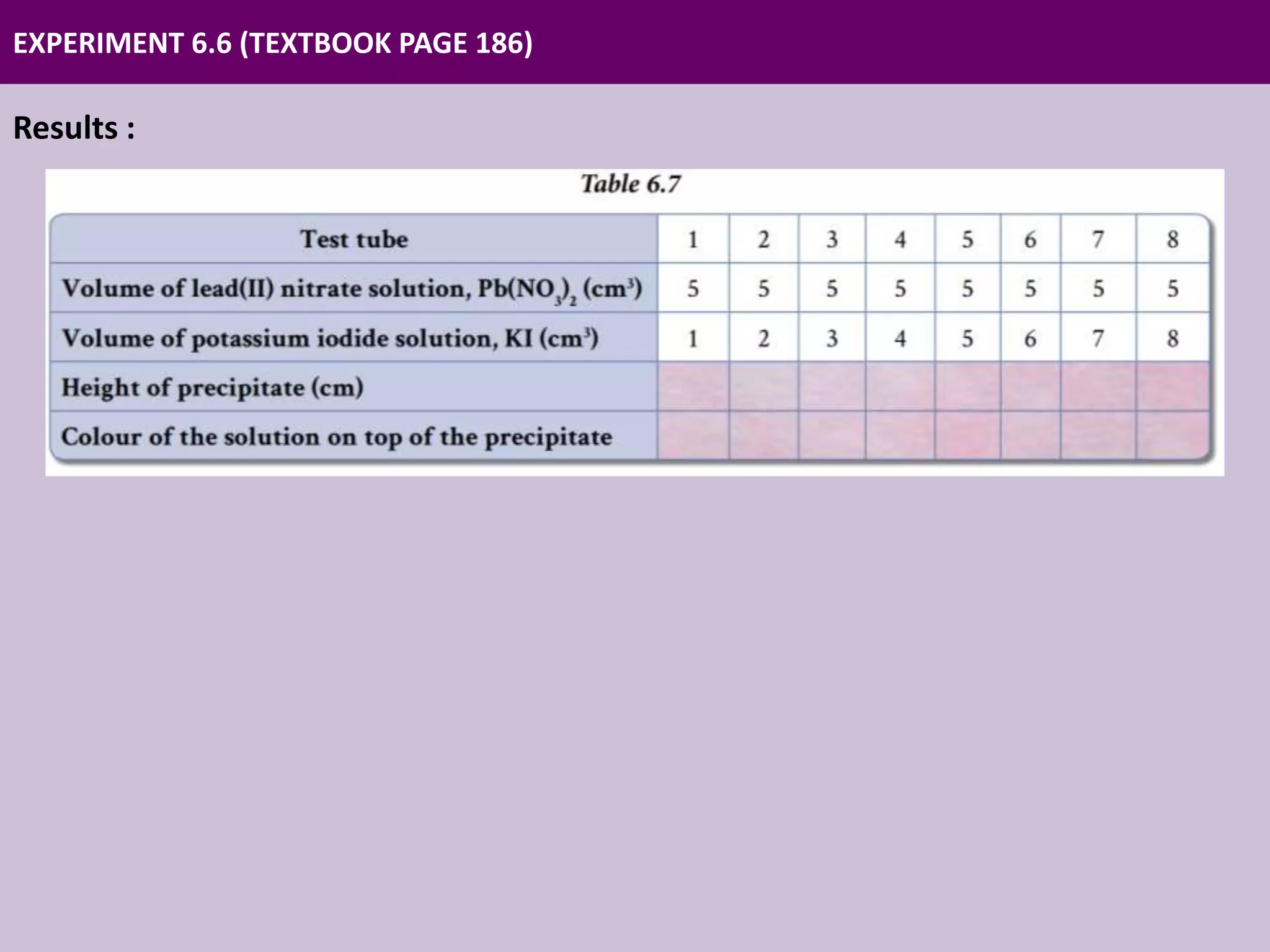
8. Record the colour of the precipitate formed and the solution on top of the
precipitate.
9. Measure and record the height of the precipitate in each test tube
EXPERIMENT 6.6 (TEXTBOOK PAGE 186)
Results :
EXPERIMENT 6.6 (TEXTBOOK PAGE 186)
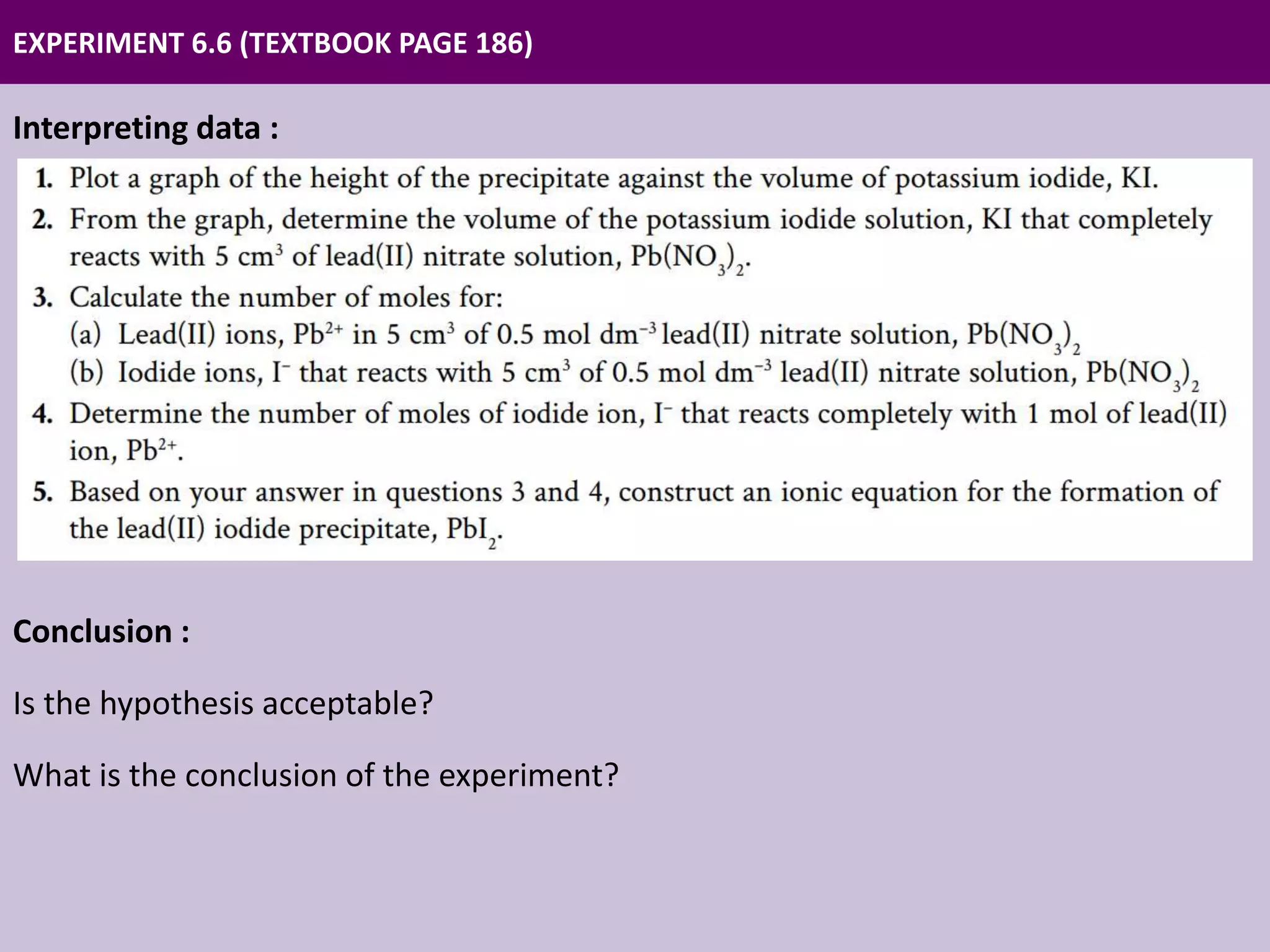
Interpreting data :
Conclusion :
Is the hypothesis acceptable?
What is the conclusion of the experiment?
EXPERIMENT 6.6 (TEXTBOOK PAGE 186)
Discussion :
1. Why should the test tubes be of the same size?
So that the height of the precipitate formed is not affected by the space in the
test tube.
2. Explain why the height of the precipitate increases gradually and then remains
constant.
From test tubes 1 to 4, more iodide ions, I– react with lead(II) ions, Pb2+.
Thus, more lead(II) iodide precipitate, PbI2 is formed and the higher is the height
of the precipitate.
In test tube 5, the height of the precipitate is maximum because all the lead(II)
ions, Pb2+ have reacted completely with iodide ions, I– to form lead(II) iodide
precipitate, PbI2.
From test tubes 6 to 8, the height of the precipitate does not change because all
the lead(II) ions, Pb2+ have reacted completely with iodide ions, I–.
EXPERIMENT 6.6 (TEXTBOOK PAGE 186)
• In the continuous variation method, fixing the volume of lead(II) nitrate solution,
Pb(NO3)2 while manipulating the volume of potassium iodide, KI is to determine
the mole ratio of lead(II) ions, Pb2+ that will react completely with the iodide ions, I–
.
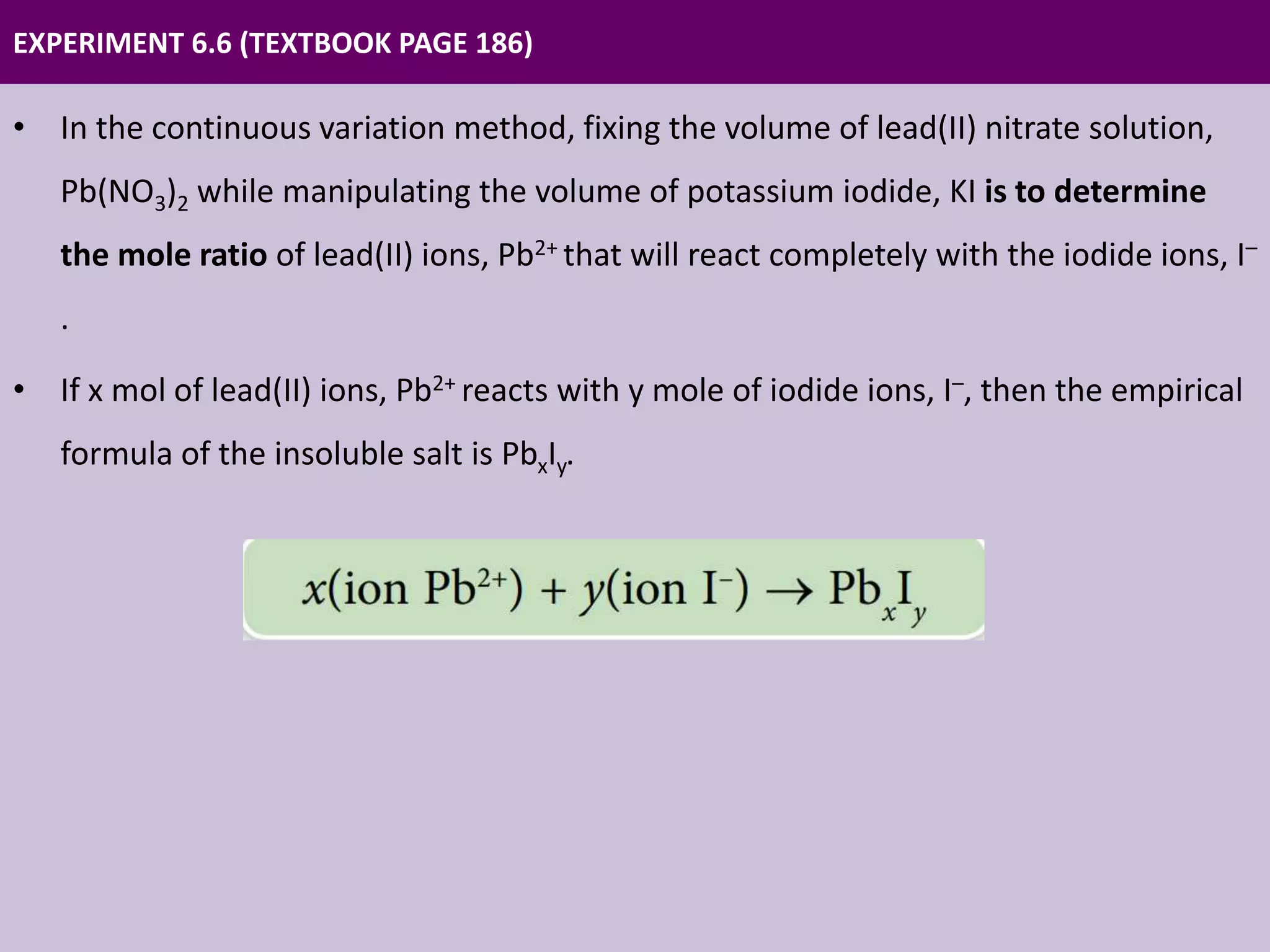
• If x mol of lead(II) ions, Pb2+ reacts with y mole of iodide ions, I–, then the empirical
formula of the insoluble salt is PbxIy.

Construction of Ionic Equations through the Continuous Variation Method

  • 1.
    CHAPTER 6 ACID, BASEAND SALT PREPARED BY : ESTHER ANNE ANAK RANDI
  • 2.
    Chapter 6 Acid,Base and Salt 6.1 Role of water in showing acidic and alkaline properties. 6.2 pH value 6.3 Strength of acids and alkalis 6.4 Chemical properties of acids and alkalis 6.5 Concentration of aqueous solutions 6.6 Standard solution 6.7 Neutralisation 6.8 Salts, crystals and their uses in daily life 6.9 Preparation of salts 6.10 Effect of heat on salts 6.11 Qualitative analysis
  • 3.
    M CONSTRUCTION OF IONICEQUATIONS THROUGH THE CONTINUOUS VARIATION METHOD
  • 4.
    Construction of IonicEquations through the Continuous Variation Method • The continuous variation method is used to construct the ionic equation for the formation of insoluble salts. • In this method, the volume of one solution, A is fixed, while solution B is added to the solution A by increasing the volume as shown in Figure 6.43.
  • 5.
    Construction of IonicEquations through the Continuous Variation Method • The height of the precipitate formed increases gradually for the first few test tubes and then becomes constant as shown in Figure 6.44.
  • 6.
    EXPERIMENT 6.6 (TEXTBOOKPAGE 186) Aim : To construct an ionic equation for the formation of lead(II) iodide. Problem statement : How to construct an ionic equation for the formation of lead(II) iodide? Hypothesis : As the volume of potassium iodide solution, KI added to lead(II) nitrate solution, Pb(NO3)2 increases, the height of the precipitate will increase and then remain constant. Variables : Manipulated : Volume of potassium iodide solution, KI Responding : Height of the precipitate Fixed : Volume and concentration of lead(II) nitrate solution, Pb(NO3)2 , concentration of potassium iodide solution, KI
  • 7.
    EXPERIMENT 6.6 (TEXTBOOKPAGE 186) Materials : 0.5 mol dm–3 lead(II) nitrate solution, Pb(NO3)2 , 0.5 mol dm–3 potassium iodide solution, KI and distilled water Apparatus : Test tubes of the same size, glass rod, test tube rack, burette, retort stand with clamp and ruler Safety precaution : Make sure all the test tube used are of the same size.
  • 8.
    EXPERIMENT 6.6 (TEXTBOOKPAGE 186) Procedures : 1.Label eight test tubes from 1 to 8 and place all the test tubes in a test tube rack. 2. Using a burette, fill each test tube with 5 cm3 of 0.5 mol dm-3 lead(II) nitrate solution, Pb(NO3)2. 3. Using a second burette, add 0.5 mol dm-3 potassium iodide solution, KI into each test tube according to the volume stated in Table 6.7. Potassium iodide solution
  • 9.
    EXPERIMENT 6.6 (TEXTBOOKPAGE 186) Procedures : 4. Place a glass rod into the test tube. Swirl the glass rod with both palms to ensure even mixing of the two solutions. 5. Slowly remove the glass rod. Rinse the precipitate that is stuck to the glass rod and the walls of the test tubes with distilled water. 6. Repeat steps 4 and 5 for the rest of the test tubes. 7. Leave the test tubes to stand for 30 minutes for the precipitate to settle to the bottom. 8. Record the colour of the precipitate formed and the solution on top of the precipitate. 9. Measure and record the height of the precipitate in each test tube
  • 10.
    EXPERIMENT 6.6 (TEXTBOOKPAGE 186) Results :
  • 11.
    EXPERIMENT 6.6 (TEXTBOOKPAGE 186) Interpreting data : Conclusion : Is the hypothesis acceptable? What is the conclusion of the experiment?
  • 12.
    EXPERIMENT 6.6 (TEXTBOOKPAGE 186) Discussion : 1. Why should the test tubes be of the same size? So that the height of the precipitate formed is not affected by the space in the test tube. 2. Explain why the height of the precipitate increases gradually and then remains constant. From test tubes 1 to 4, more iodide ions, I– react with lead(II) ions, Pb2+. Thus, more lead(II) iodide precipitate, PbI2 is formed and the higher is the height of the precipitate. In test tube 5, the height of the precipitate is maximum because all the lead(II) ions, Pb2+ have reacted completely with iodide ions, I– to form lead(II) iodide precipitate, PbI2. From test tubes 6 to 8, the height of the precipitate does not change because all the lead(II) ions, Pb2+ have reacted completely with iodide ions, I–.
  • 13.
    EXPERIMENT 6.6 (TEXTBOOKPAGE 186) • In the continuous variation method, fixing the volume of lead(II) nitrate solution, Pb(NO3)2 while manipulating the volume of potassium iodide, KI is to determine the mole ratio of lead(II) ions, Pb2+ that will react completely with the iodide ions, I– . • If x mol of lead(II) ions, Pb2+ reacts with y mole of iodide ions, I–, then the empirical formula of the insoluble salt is PbxIy.