CHAPTER2
PIXEL RELATION
Dr. Varun Kumar Ojha
and
Prof. (Dr.) Paramartha Dutta
Visva Bharati University
Santiniketan, West Bengal, India
Pixel Relationship
 Pixel
 Pixel Neighbourhood and Type of Neighbourhood
 Pixel Connectivity
 Connected Component
 Different Distance Measure Techniques
 Arithmetic/Logical Operator
 Neighborhood Operation
Back to Course Content Page
Click Here
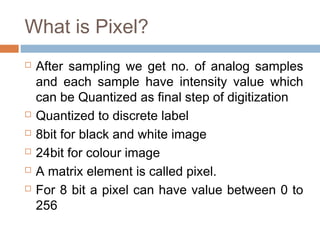
What is Pixel?
 After sampling we get no. of analog samples
and each sample have intensity value which
can be Quantized as final step of digitization
 Quantized to discrete label
 8bit for black and white image
 24bit for colour image
 A matrix element is called pixel.
 For 8 bit a pixel can have value between 0 to
256
Back to the chapter content
Click Here
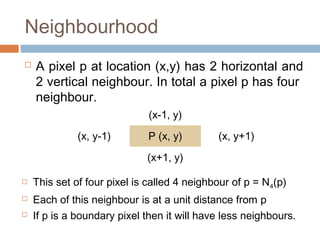
Neighbourhood
 A pixel p at location (x,y) has 2 horizontal and
2 vertical neighbour. In total a pixel p has four
neighbour.
(x-1, y)
(x, y-1) P (x, y) (x, y+1)
(x+1, y)
 This set of four pixel is called 4 neighbour of p = N4(p)
 Each of this neighbour is at a unit distance from p
 If p is a boundary pixel then it will have less neighbours.
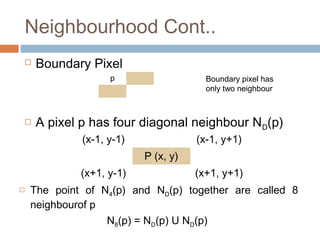
Neighbourhood Cont..
 Boundary Pixel
p Boundary pixel has
only two neighbour
 A pixel p has four diagonal neighbour ND(p)
(x-1, y-1) (x-1, y+1)
P (x, y)
(x+1, y-1) (x+1, y+1)
 The point of N4(p) and ND(p) together are called 8
neighbourof p
N8(p) = ND(p) U ND(p)
Back to the chapter content
Click Here
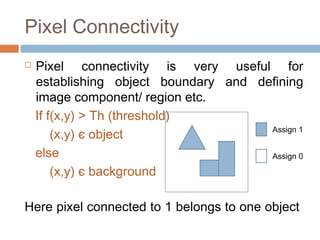
Pixel Connectivity
 Pixel connectivity is very useful for
establishing object boundary and defining
image component/ region etc.
If f(x,y) > Th (threshold)
(x,y) є object
else
(x,y) є background
Here pixel connected to 1 belongs to one object
Assign 1
Assign 0
Pixel Connectivity Cont..
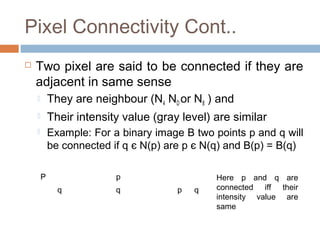
 Two pixel are said to be connected if they are
adjacent in same sense
 They are neighbour (N4 ND or N8 ) and
 Their intensity value (gray level) are similar
 Example: For a binary image B two points p and q will
be connected if q є N(p) are p є N(q) and B(p) = B(q)
P
q
p
q p q
Here p and q are
connected iff their
intensity value are
same
Define Connectivity in Gray
Level
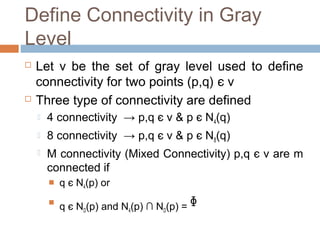
 Let v be the set of gray level used to define
connectivity for two points (p,q) є v
 Three type of connectivity are defined
 4 connectivity → p,q є v & p є N4(q)
 8 connectivity → p,q є v & p є N8(q)
 M connectivity (Mixed Connectivity) p,q є v are m
connected if
 q є N4(p) or

q є ND(p) and N4(p) ∩ ND(p) = ᶲ
Mixed Connectivity
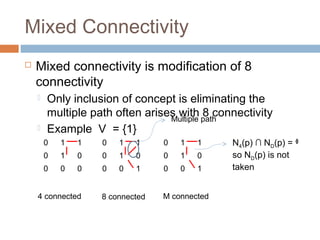
 Mixed connectivity is modification of 8
connectivity
 Only inclusion of concept is eliminating the
multiple path often arises with 8 connectivity
 Example V = {1}
0 1 1
0 1 0
0 0 0
0 1 1
0 1 0
0 0 1
0 1 1
0 1 0
0 0 1
4 connected 8 connected M connected
Multiple path
N4(p) ∩ ND(p) = ᶲ
so ND(p) is not
taken
Back to the chapter content
Click Here
Connected Component
 Adjacency : Two pixel p & q are adjacent if they are
connected
 4 adjacency
 8 adjacency
 M adjacency
 Depending on type of connectivity used two image
subset si and sj are adjacent If p є si and q є sj such that
p and q are adjacent
p
q
si
sj
Connected Component
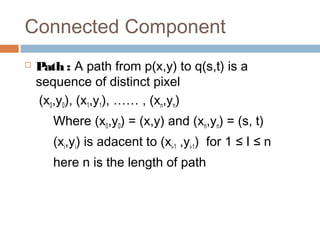
 Path : A path from p(x,y) to q(s,t) is a
sequence of distinct pixel
(x0,y0), (x1,y1), …… , (xn,yn)
Where (x0,y0) = (x,y) and (xn,yn) = (s, t)
(xi,yi) is adacent to (xi-1 ,yi-1) for 1 ≤ I ≤ n
here n is the length of path
Connected Component
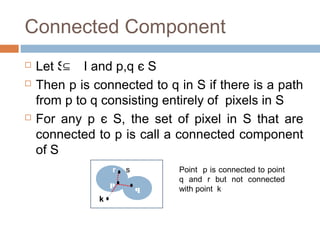
 Let S I and p,q є S
 Then p is connected to q in S if there is a path
from p to q consisting entirely of pixels in S
 For any p є S, the set of pixel in S that are
connected to p is call a connected component
of S
p
q
sr Point p is connected to point
q and r but not connected
with point k
k
Connected Component
Labeling
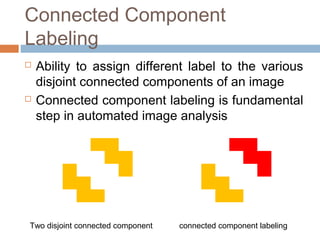
 Ability to assign different label to the various
disjoint connected components of an image
 Connected component labeling is fundamental
step in automated image analysis
Two disjoint connected component connected component labeling
Algorithm (Group identification)
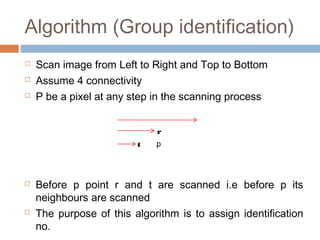
 Scan image from Left to Right and Top to Bottom
 Assume 4 connectivity
 P be a pixel at any step in the scanning process
 Before p point r and t are scanned i.e before p its
neighbours are scanned
 The purpose of this algorithm is to assign identification
no.
r
t p
Algorithm Steps
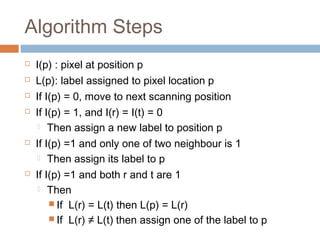
 I(p) : pixel at position p
 L(p): label assigned to pixel location p
 If I(p) = 0, move to next scanning position
 If I(p) = 1, and I(r) = I(t) = 0
 Then assign a new label to position p
 If I(p) =1 and only one of two neighbour is 1
 Then assign its label to p
 If I(p) =1 and both r and t are 1
 Then
 If L(r) = L(t) then L(p) = L(r)
 If L(r) ≠ L(t) then assign one of the label to p
Algorithm Steps Cont..
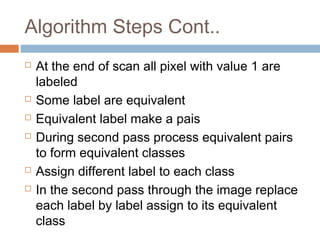
 At the end of scan all pixel with value 1 are
labeled
 Some label are equivalent
 Equivalent label make a pais
 During second pass process equivalent pairs
to form equivalent classes
 Assign different label to each class
 In the second pass through the image replace
each label by label assign to its equivalent
class
Algorithm Demo
1 2
1 2 3 3
1 1 1 1 4 4 4 4
1 1 4 4
5 1 4 4 4
5
Assign 1
because its left
neighbour is 1
Assign new
label (say 2) as
I(r) = I(t) = 0
2
1 1
1
5 1
3
4 4
(1,2) , (4,3) and (5,1) are
equivalent pair
First Pass
Algorithm Demo
1 1
1 1 3 3
1 1 1 1 3 3 3 3
1 1 3 3
1 1 3 3 3
1
Second Pass : In the second pass through the image replace each label by
label assign to its equivalent class
Here two separate region/ group are identified YELLOE (1) region and
RED (3) region
Back to the chapter content
Click Here
Distance Measure
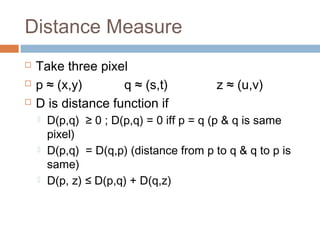
 Take three pixel
 p ≈ (x,y) q ≈ (s,t) z ≈ (u,v)
 D is distance function if
 D(p,q) ≥ 0 ; D(p,q) = 0 iff p = q (p & q is same
pixel)
 D(p,q) = D(q,p) (distance from p to q & q to p is
same)
 D(p, z) ≤ D(p,q) + D(q,z)
Distance Measure Technique
 Euclidean Distance
 City BlockDistance (Manhattan Distance)
 Chess Board Distance
 Euclidean distance between two point p(x,y) &
q(s,t) is defined as
D(p,q) = [|x-s|2
+|y-t|2
]1/2
p(x,y)
q(s,t)
Distance Measure Technique
 City BlockDistance
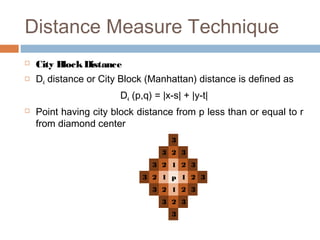
 D4 distance or City Block (Manhattan) distance is defined as
D4 (p,q) = |x-s| + |y-t|
 Point having city block distance from p less than or equal to r
from diamond center
3
3 2 3
3 2 1 2 3
3 2 1 p 1 2 3
3 2 1 2 3
3 2 3
3
Distance Measure Technique
 Chess Board Distance
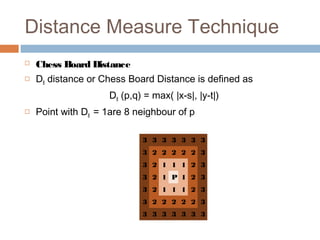
 D8 distance or Chess Board Distance is defined as
D8 (p,q) = max( |x-s|, |y-t|)
 Point with D8 = 1are 8 neighbour of p
3 3 3 3 3 3 3
3 2 2 2 2 2 3
3 2 1 1 1 2 3
3 2 1 P 1 2 3
3 2 1 1 1 2 3
3 2 2 2 2 2 3
3 3 3 3 3 3 3
Back to the chapter content
Click Here
Arithmetic/Logical Operator
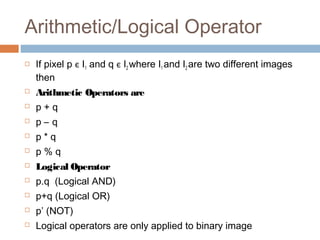
 If pixel p є I1 and q є I2 where I1 and I2 are two different images
then
 Arithmetic Operators are
 p + q
 p – q
 p * q
 p % q
 Logical Operator
 p.q (Logical AND)
 p+q (Logical OR)
 p’ (NOT)
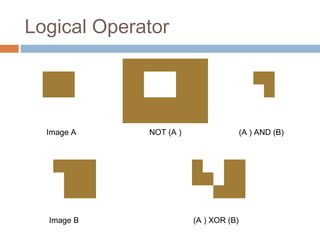
 Logical operators are only applied to binary image
Logical Operator
Image A
Image B
NOT (A ) (A ) AND (B)
(A ) XOR (B)
Back to the chapter content
Click Here
Neighbourhood Operation
 The value assigned to a pixel is a function of
its gray label and the gray label of its
neighbours
Z1 Z2 Z3
Z4 Z5 Z6
Z7 Z8 Z9
 Averaging
Z = 1/9 (Z1+ Z2 + …….. + Z9 )
Neighbourhood Operation
Z1 Z2 Z3
Z4 Z5 Z6
Z7 Z8 Z9
 More general form
W1 W2 W3
W4 W5 W6
W7 W8 W9
Z = W1 Z1+W2 Z2 + …….. +W9 Z9
= ∑ Wi Zi for i = 1 to 9
It is useful for
Noise filtering
Edge Detection
Various important operation can be implemented by
proper selection of coefficient Wi
Back to the chapter content
Click Here

Chapter 2 Image Processing: Pixel Relation

  • 1.
    CHAPTER2 PIXEL RELATION Dr. VarunKumar Ojha and Prof. (Dr.) Paramartha Dutta Visva Bharati University Santiniketan, West Bengal, India
  • 2.
    Pixel Relationship  Pixel Pixel Neighbourhood and Type of Neighbourhood  Pixel Connectivity  Connected Component  Different Distance Measure Techniques  Arithmetic/Logical Operator  Neighborhood Operation Back to Course Content Page Click Here
  • 3.
    What is Pixel? After sampling we get no. of analog samples and each sample have intensity value which can be Quantized as final step of digitization  Quantized to discrete label  8bit for black and white image  24bit for colour image  A matrix element is called pixel.  For 8 bit a pixel can have value between 0 to 256
  • 4.
    Back to thechapter content Click Here
  • 5.
    Neighbourhood  A pixelp at location (x,y) has 2 horizontal and 2 vertical neighbour. In total a pixel p has four neighbour. (x-1, y) (x, y-1) P (x, y) (x, y+1) (x+1, y)  This set of four pixel is called 4 neighbour of p = N4(p)  Each of this neighbour is at a unit distance from p  If p is a boundary pixel then it will have less neighbours.
  • 6.
    Neighbourhood Cont..  BoundaryPixel p Boundary pixel has only two neighbour  A pixel p has four diagonal neighbour ND(p) (x-1, y-1) (x-1, y+1) P (x, y) (x+1, y-1) (x+1, y+1)  The point of N4(p) and ND(p) together are called 8 neighbourof p N8(p) = ND(p) U ND(p)
  • 7.
    Back to thechapter content Click Here
  • 8.
    Pixel Connectivity  Pixelconnectivity is very useful for establishing object boundary and defining image component/ region etc. If f(x,y) > Th (threshold) (x,y) є object else (x,y) є background Here pixel connected to 1 belongs to one object Assign 1 Assign 0
  • 9.
    Pixel Connectivity Cont.. Two pixel are said to be connected if they are adjacent in same sense  They are neighbour (N4 ND or N8 ) and  Their intensity value (gray level) are similar  Example: For a binary image B two points p and q will be connected if q є N(p) are p є N(q) and B(p) = B(q) P q p q p q Here p and q are connected iff their intensity value are same
  • 10.
    Define Connectivity inGray Level  Let v be the set of gray level used to define connectivity for two points (p,q) є v  Three type of connectivity are defined  4 connectivity → p,q є v & p є N4(q)  8 connectivity → p,q є v & p є N8(q)  M connectivity (Mixed Connectivity) p,q є v are m connected if  q є N4(p) or  q є ND(p) and N4(p) ∩ ND(p) = ᶲ
  • 11.
    Mixed Connectivity  Mixedconnectivity is modification of 8 connectivity  Only inclusion of concept is eliminating the multiple path often arises with 8 connectivity  Example V = {1} 0 1 1 0 1 0 0 0 0 0 1 1 0 1 0 0 0 1 0 1 1 0 1 0 0 0 1 4 connected 8 connected M connected Multiple path N4(p) ∩ ND(p) = ᶲ so ND(p) is not taken
  • 12.
    Back to thechapter content Click Here
  • 13.
    Connected Component  Adjacency: Two pixel p & q are adjacent if they are connected  4 adjacency  8 adjacency  M adjacency  Depending on type of connectivity used two image subset si and sj are adjacent If p є si and q є sj such that p and q are adjacent p q si sj
  • 14.
    Connected Component  Path: A path from p(x,y) to q(s,t) is a sequence of distinct pixel (x0,y0), (x1,y1), …… , (xn,yn) Where (x0,y0) = (x,y) and (xn,yn) = (s, t) (xi,yi) is adacent to (xi-1 ,yi-1) for 1 ≤ I ≤ n here n is the length of path
  • 15.
    Connected Component  LetS I and p,q є S  Then p is connected to q in S if there is a path from p to q consisting entirely of pixels in S  For any p є S, the set of pixel in S that are connected to p is call a connected component of S p q sr Point p is connected to point q and r but not connected with point k k
  • 16.
    Connected Component Labeling  Abilityto assign different label to the various disjoint connected components of an image  Connected component labeling is fundamental step in automated image analysis Two disjoint connected component connected component labeling
  • 17.
    Algorithm (Group identification) Scan image from Left to Right and Top to Bottom  Assume 4 connectivity  P be a pixel at any step in the scanning process  Before p point r and t are scanned i.e before p its neighbours are scanned  The purpose of this algorithm is to assign identification no. r t p
  • 18.
    Algorithm Steps  I(p): pixel at position p  L(p): label assigned to pixel location p  If I(p) = 0, move to next scanning position  If I(p) = 1, and I(r) = I(t) = 0  Then assign a new label to position p  If I(p) =1 and only one of two neighbour is 1  Then assign its label to p  If I(p) =1 and both r and t are 1  Then  If L(r) = L(t) then L(p) = L(r)  If L(r) ≠ L(t) then assign one of the label to p
  • 19.
    Algorithm Steps Cont.. At the end of scan all pixel with value 1 are labeled  Some label are equivalent  Equivalent label make a pais  During second pass process equivalent pairs to form equivalent classes  Assign different label to each class  In the second pass through the image replace each label by label assign to its equivalent class
  • 20.
    Algorithm Demo 1 2 12 3 3 1 1 1 1 4 4 4 4 1 1 4 4 5 1 4 4 4 5 Assign 1 because its left neighbour is 1 Assign new label (say 2) as I(r) = I(t) = 0 2 1 1 1 5 1 3 4 4 (1,2) , (4,3) and (5,1) are equivalent pair First Pass
  • 21.
    Algorithm Demo 1 1 11 3 3 1 1 1 1 3 3 3 3 1 1 3 3 1 1 3 3 3 1 Second Pass : In the second pass through the image replace each label by label assign to its equivalent class Here two separate region/ group are identified YELLOE (1) region and RED (3) region
  • 22.
    Back to thechapter content Click Here
  • 23.
    Distance Measure  Takethree pixel  p ≈ (x,y) q ≈ (s,t) z ≈ (u,v)  D is distance function if  D(p,q) ≥ 0 ; D(p,q) = 0 iff p = q (p & q is same pixel)  D(p,q) = D(q,p) (distance from p to q & q to p is same)  D(p, z) ≤ D(p,q) + D(q,z)
  • 24.
    Distance Measure Technique Euclidean Distance  City BlockDistance (Manhattan Distance)  Chess Board Distance  Euclidean distance between two point p(x,y) & q(s,t) is defined as D(p,q) = [|x-s|2 +|y-t|2 ]1/2 p(x,y) q(s,t)
  • 25.
    Distance Measure Technique City BlockDistance  D4 distance or City Block (Manhattan) distance is defined as D4 (p,q) = |x-s| + |y-t|  Point having city block distance from p less than or equal to r from diamond center 3 3 2 3 3 2 1 2 3 3 2 1 p 1 2 3 3 2 1 2 3 3 2 3 3
  • 26.
    Distance Measure Technique Chess Board Distance  D8 distance or Chess Board Distance is defined as D8 (p,q) = max( |x-s|, |y-t|)  Point with D8 = 1are 8 neighbour of p 3 3 3 3 3 3 3 3 2 2 2 2 2 3 3 2 1 1 1 2 3 3 2 1 P 1 2 3 3 2 1 1 1 2 3 3 2 2 2 2 2 3 3 3 3 3 3 3 3
  • 27.
    Back to thechapter content Click Here
  • 28.
    Arithmetic/Logical Operator  Ifpixel p є I1 and q є I2 where I1 and I2 are two different images then  Arithmetic Operators are  p + q  p – q  p * q  p % q  Logical Operator  p.q (Logical AND)  p+q (Logical OR)  p’ (NOT)  Logical operators are only applied to binary image
  • 29.
    Logical Operator Image A ImageB NOT (A ) (A ) AND (B) (A ) XOR (B)
  • 30.
    Back to thechapter content Click Here
  • 31.
    Neighbourhood Operation  Thevalue assigned to a pixel is a function of its gray label and the gray label of its neighbours Z1 Z2 Z3 Z4 Z5 Z6 Z7 Z8 Z9  Averaging Z = 1/9 (Z1+ Z2 + …….. + Z9 )
  • 32.
    Neighbourhood Operation Z1 Z2Z3 Z4 Z5 Z6 Z7 Z8 Z9  More general form W1 W2 W3 W4 W5 W6 W7 W8 W9 Z = W1 Z1+W2 Z2 + …….. +W9 Z9 = ∑ Wi Zi for i = 1 to 9 It is useful for Noise filtering Edge Detection Various important operation can be implemented by proper selection of coefficient Wi
  • 33.
    Back to thechapter content Click Here