Chapter 6Ancient China
Section 1Geography Shapes Ancient China
Geographic Features of ChinaCivilization centered around two rivers which brought water and siltMade farming possibleIsolated by BarriersWater barriers: Yellow Sea, East China Sea, & Pacific OceanDesert barriers: Gobi Desert & Taklimakan DesertMts.: Pamir, Tian Shan, & Himalaya mts.Geographically isolatedMade spread of ideas & goods difficultFew outside influences
Two River SystemsChang Jiang a.k.a. Yangtze RiversCentral ChinaHuang He (or Yellow River)North ChinaAncient farmingDone between Chang Jiang & Huang HeSilt made fertile soilCenter of Chinese civilization
A Varied ClimateHad varied climateWestern China: dry, mostly deserts & mts.; sparsely populated & usable farmlandNortheast China: cold winters & warm summersSoutheast China: mild winters & hot, rainy summersClimate variety lead to variety of crops producedRice, wheat, soybeans, & millet
The Shang DynastyShang Kings1766 B.C. Shang family began to control some citiesSet-up dynasty (a family or group that rules for several generations)Kings: responsible for religious activitiesRuled w/ god’s permissionRuled central North China PlainUsed chariots to defend themselves against nomads
Shang FamiliesRespect for parents & ancestors was importantClose tie to religionSpirits of ancestors could bring good fortuneAnimals were sacrificedMen ruled within the family
Developing LanguageKings claimed to be able to influence godsReceived messages through oracle bonesAnimal bones that were scratched to question the gods (became early form of writing)Developed pictographsUsed huge # of symbolsCould read Chinese w/o being able to speak itHelped to unify a large varied land
The Zhou DynastyZhou moved down from the northwestClashed w/ Shang1027 B.C.Wu Wang led forces & defeated ShangAdopted many Shang waysNew ideas also introduced
The Zhou & the Dynastic CycleNew dynasty est.Dynasties rose & fell in a patternDynastic CycleTrouble resulted from rulers losing heaven’s favorClaimed last Shang ruler was bad & god took away Shang right to rule & gave it to ZhouMandate of HeavenBad or foolish ruler = approval of the gods would be taken awayExamples: uprisings, invasions, floods, or earthquakes
Zhou GovernmentCentral gov’t was weakPeople w/ family ties or other trusted people were in chargeLocal rulers (lords) owed loyalty & military service to kingKing promised in return to protect their landsLords became more powerful as cities grewMore group under their powerLess dependent on kingLords began to fight with each other & other peoplesAdded lands expanded Chinese territory
The Time of the Warring StatesInvasion was a constant theme800 B.C.Nomads from the north & west invaded771 B.C.Invaders destroyed capital city of Hao & king was killedKings were weakLords fought constantlyAs their power grew they claimed to be kings of their own territories (Time of the Warring States)
Section 2China’s Ancient Philosophies
IntroDuring Time of Warring States Chinese society experienced much disorderKings & Warlords fought over land, while scholars wondered what it would take to bring peace3 ways of thinking developedLegalismConfucianismDaoism
LegalismBelief that a powerful, efficient gov’t and a strict legal system are the keys to social orderFeared disorderStrong gov’t & strict laws would restore order
Strict Laws & Harsh PunishmentsLegalists believed human nature was wickedPeople do good only when forced toGov’t should pass strict laws to control behavior in peopleNeeded to make people afraid to do wrong
An Increase in Government ControlLegalists believed rulers should reward those who carried out their duties wellPunishment was, however, stressed more than rewardsShang Yang (Legalist)Wanted people to report lawbreakersThose who didn’t should be executedLegalistsDid not want people ? or complain about the gov’tArrested those that didBurned books that contained different philosophies or ideas
ConfucianismConfuciusLived from 551-479 B.C. during time of unrest in ChinaWanted to restore orderBelieved more in peace to end conflictRespect for others was absolutely necessary for peace and orderGov’t leaders should set good example for people to seeIdeas were collected in a book called the AnalectsBecame belief system of Confucianism
The Five RelationshipsCode of proper conduct/behavior for people5 basic relationships in Confucianism each with its own duties and its own codeFather and sonElder brother and younger brotherHusband and wifeFriend and friendRuler and subject*Two basic categories: proper conduct in the family & proper conduct in society
Proper ConductConfuciusGood conduct & respect began at homeHusband good to wives, wives obeyed husbands, brothers kind to brothers, younger had to follow wishes of olderMost important teachingFilial piety: treating parents w/ respectBehavior in societyAuthority should be respectedRuler was to live correctly & respect subjectsSubjects should obey if they didPeace in society would come if followed
The Impact of ConfucianismChinese found ways to avoid conflict and live peacefullyMany rulers tried to live up to Confucius’s model for a good rulerGroundwork was laid for fair and skilled gov’t officials
DaoismLaozi500s B.C.Book of his teachings was DaodejingThe WayBelieved a universal force called the Dao (or Way) guides thingsAll creatures, except humans, live in harmony w/ this forceHumans argue about right and wrong (arguments are pointless)To relate to nature humans had to find individual was to followEach should learn to live in harmony w/ nature & their inner feelingsNatural order was more important than social orderSocial order would follow if everyone learned to live in their own individual harmony
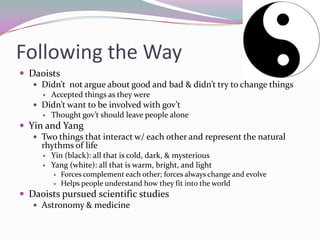
Following the WayDaoistsDidn’t  not argue about good and bad & didn’t try to change thingsAccepted things as they wereDidn’t want to be involved with gov’tThought gov’t should leave people aloneYin and YangTwo things that interact w/ each other and represent the natural rhythms of lifeYin (black): all that is cold, dark, & mysteriousYang (white): all that is warm, bright, and lightForces complement each other; forces always change and evolveHelps people understand how they fit into the worldDaoists pursued scientific studiesAstronomy & medicine

Chapter 6 blog notes

  • 1.
  • 2.
  • 3.
    Geographic Features ofChinaCivilization centered around two rivers which brought water and siltMade farming possibleIsolated by BarriersWater barriers: Yellow Sea, East China Sea, & Pacific OceanDesert barriers: Gobi Desert & Taklimakan DesertMts.: Pamir, Tian Shan, & Himalaya mts.Geographically isolatedMade spread of ideas & goods difficultFew outside influences
  • 4.
    Two River SystemsChangJiang a.k.a. Yangtze RiversCentral ChinaHuang He (or Yellow River)North ChinaAncient farmingDone between Chang Jiang & Huang HeSilt made fertile soilCenter of Chinese civilization
  • 5.
    A Varied ClimateHadvaried climateWestern China: dry, mostly deserts & mts.; sparsely populated & usable farmlandNortheast China: cold winters & warm summersSoutheast China: mild winters & hot, rainy summersClimate variety lead to variety of crops producedRice, wheat, soybeans, & millet
  • 6.
    The Shang DynastyShangKings1766 B.C. Shang family began to control some citiesSet-up dynasty (a family or group that rules for several generations)Kings: responsible for religious activitiesRuled w/ god’s permissionRuled central North China PlainUsed chariots to defend themselves against nomads
  • 7.
    Shang FamiliesRespect forparents & ancestors was importantClose tie to religionSpirits of ancestors could bring good fortuneAnimals were sacrificedMen ruled within the family
  • 8.
    Developing LanguageKings claimedto be able to influence godsReceived messages through oracle bonesAnimal bones that were scratched to question the gods (became early form of writing)Developed pictographsUsed huge # of symbolsCould read Chinese w/o being able to speak itHelped to unify a large varied land
  • 9.
    The Zhou DynastyZhoumoved down from the northwestClashed w/ Shang1027 B.C.Wu Wang led forces & defeated ShangAdopted many Shang waysNew ideas also introduced
  • 10.
    The Zhou &the Dynastic CycleNew dynasty est.Dynasties rose & fell in a patternDynastic CycleTrouble resulted from rulers losing heaven’s favorClaimed last Shang ruler was bad & god took away Shang right to rule & gave it to ZhouMandate of HeavenBad or foolish ruler = approval of the gods would be taken awayExamples: uprisings, invasions, floods, or earthquakes
  • 11.
    Zhou GovernmentCentral gov’twas weakPeople w/ family ties or other trusted people were in chargeLocal rulers (lords) owed loyalty & military service to kingKing promised in return to protect their landsLords became more powerful as cities grewMore group under their powerLess dependent on kingLords began to fight with each other & other peoplesAdded lands expanded Chinese territory
  • 12.
    The Time ofthe Warring StatesInvasion was a constant theme800 B.C.Nomads from the north & west invaded771 B.C.Invaders destroyed capital city of Hao & king was killedKings were weakLords fought constantlyAs their power grew they claimed to be kings of their own territories (Time of the Warring States)
  • 13.
  • 14.
    IntroDuring Time ofWarring States Chinese society experienced much disorderKings & Warlords fought over land, while scholars wondered what it would take to bring peace3 ways of thinking developedLegalismConfucianismDaoism
  • 15.
    LegalismBelief that apowerful, efficient gov’t and a strict legal system are the keys to social orderFeared disorderStrong gov’t & strict laws would restore order
  • 16.
    Strict Laws &Harsh PunishmentsLegalists believed human nature was wickedPeople do good only when forced toGov’t should pass strict laws to control behavior in peopleNeeded to make people afraid to do wrong
  • 17.
    An Increase inGovernment ControlLegalists believed rulers should reward those who carried out their duties wellPunishment was, however, stressed more than rewardsShang Yang (Legalist)Wanted people to report lawbreakersThose who didn’t should be executedLegalistsDid not want people ? or complain about the gov’tArrested those that didBurned books that contained different philosophies or ideas
  • 18.
    ConfucianismConfuciusLived from 551-479B.C. during time of unrest in ChinaWanted to restore orderBelieved more in peace to end conflictRespect for others was absolutely necessary for peace and orderGov’t leaders should set good example for people to seeIdeas were collected in a book called the AnalectsBecame belief system of Confucianism
  • 19.
    The Five RelationshipsCodeof proper conduct/behavior for people5 basic relationships in Confucianism each with its own duties and its own codeFather and sonElder brother and younger brotherHusband and wifeFriend and friendRuler and subject*Two basic categories: proper conduct in the family & proper conduct in society
  • 20.
    Proper ConductConfuciusGood conduct& respect began at homeHusband good to wives, wives obeyed husbands, brothers kind to brothers, younger had to follow wishes of olderMost important teachingFilial piety: treating parents w/ respectBehavior in societyAuthority should be respectedRuler was to live correctly & respect subjectsSubjects should obey if they didPeace in society would come if followed
  • 21.
    The Impact ofConfucianismChinese found ways to avoid conflict and live peacefullyMany rulers tried to live up to Confucius’s model for a good rulerGroundwork was laid for fair and skilled gov’t officials
  • 22.
    DaoismLaozi500s B.C.Book ofhis teachings was DaodejingThe WayBelieved a universal force called the Dao (or Way) guides thingsAll creatures, except humans, live in harmony w/ this forceHumans argue about right and wrong (arguments are pointless)To relate to nature humans had to find individual was to followEach should learn to live in harmony w/ nature & their inner feelingsNatural order was more important than social orderSocial order would follow if everyone learned to live in their own individual harmony
  • 23.
    Following the WayDaoistsDidn’t not argue about good and bad & didn’t try to change thingsAccepted things as they wereDidn’t want to be involved with gov’tThought gov’t should leave people aloneYin and YangTwo things that interact w/ each other and represent the natural rhythms of lifeYin (black): all that is cold, dark, & mysteriousYang (white): all that is warm, bright, and lightForces complement each other; forces always change and evolveHelps people understand how they fit into the worldDaoists pursued scientific studiesAstronomy & medicine