Tibet A Buddhist Theocracy
Overview of a Theocracy Much has been made of Tibet as a Shangri-la The real Tibet is at once more and less than meets the eye Tibetan Buddhism is an intriguing model of the universe Daily life of the Tibetan herdsman or peasant is somewhat more mundane We look at both sides of Tibetan life in this module
Location of Tibet Tibet lies between China and India in the Himalaya chain Virtually all of the country is highland peaks and plateaus
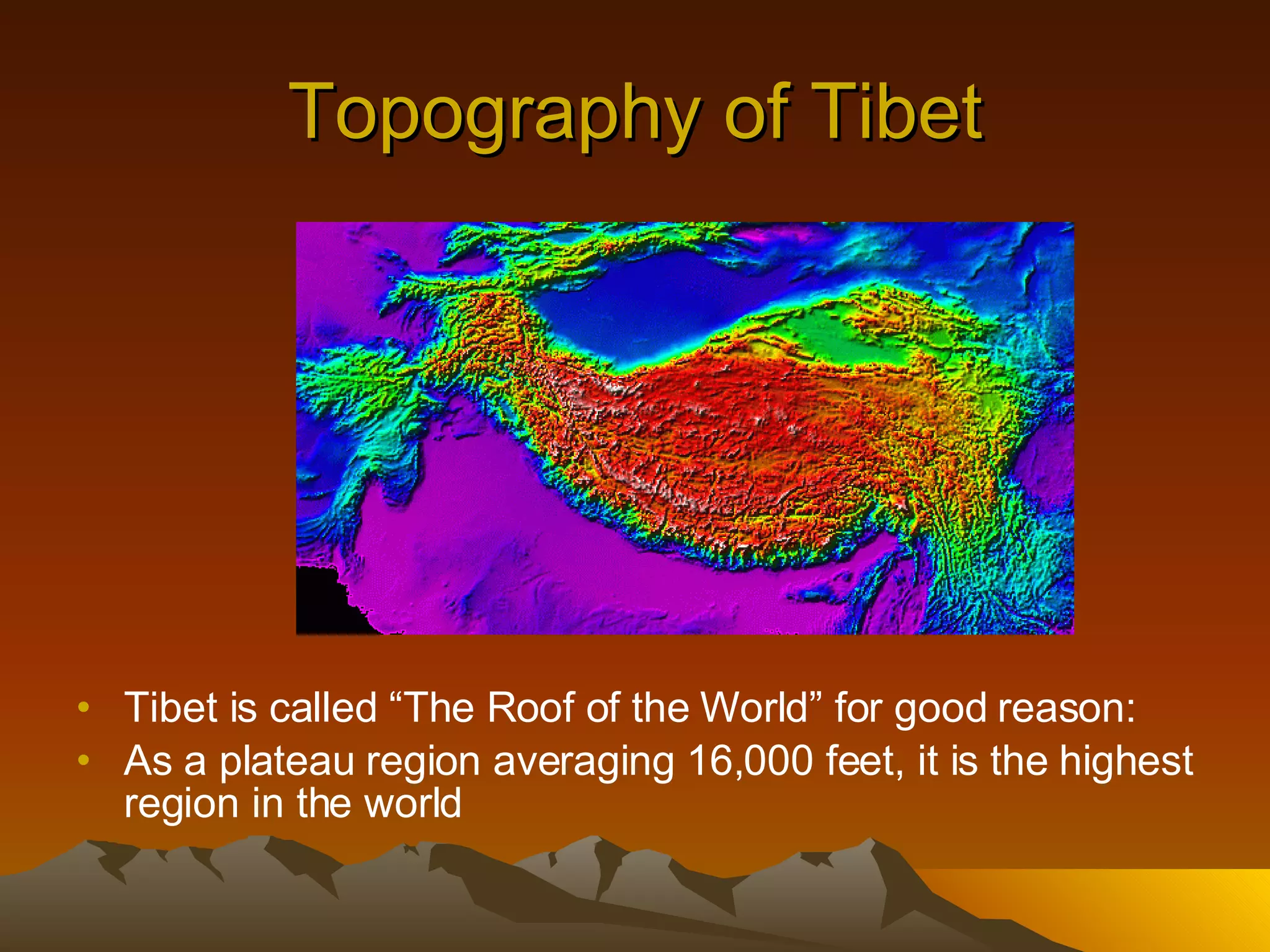
Topography of Tibet Tibet is called “The Roof of the World” for good reason: As a plateau region averaging 16,000 feet, it is the highest region in the world
Cultures of Tibet: Subsistence Base Arable land is scarce, so that Tibetans are either herdsmen (upper left) or subsistence peasants The animal of choice is the yak, used as both beasts of burden and for milk, cloth, hides, and meat (lower left) This is an ox whose matted undercoat and shaggy outer hair protects them from the cold Other animals include horses, sheep, goats, and camels Crops grown include wheat, barley, rye, buckwheat, and others
Cultures of Tibet: Polyandry Fraternal polyandry has drawn much attention Women marry two or more men who are brothers to each other Rationale: Limited land resources encourage population control Only one child at a time can be born
Cultures of Tibet: The Question of Feudalism (Michael Parenti) Were the monasteries of Tibet based on feudalism? Ideal: every household has a male lama in a monastery Argument: 700,000 of 1,2 million were serfs They were allowed a small parcel of land But worked for the monasteries or secular lords  Captured escapees were beaten until they bled Some serfs actually welcomed the Chinese ”liberation” Source: Michael Parenti, “Friendly Feudalism: The Tibet Myth” Link:  http://www.swans.com/library/art9/mparen01.html#6
Culture of Tibet: “A Lie Repeated”  Joshua Frei argues Parenti has little direct knowledge of Tibet He relies on four Chinese-related sources for his data All four, including Anna Louise Strong, romanticized Maoist revolution Counterargument: Parenti ignores the statements by the Tibetan refugees themselves For more on this issue, log on to this link: http://studentsforafreetibet.org/article.php?id=425
Principles of Buddhism (and Hinduism) With Hinduism, postulates  Samsara We live in a world of birth, death, and rebirth  (Upper Left, Tibetan Wheel of Samsara) Form of our rebirth is driven by  karma Past deeds determine our rebirth Samsara, however, is an illusion Nirvana involves recognition of this illusion
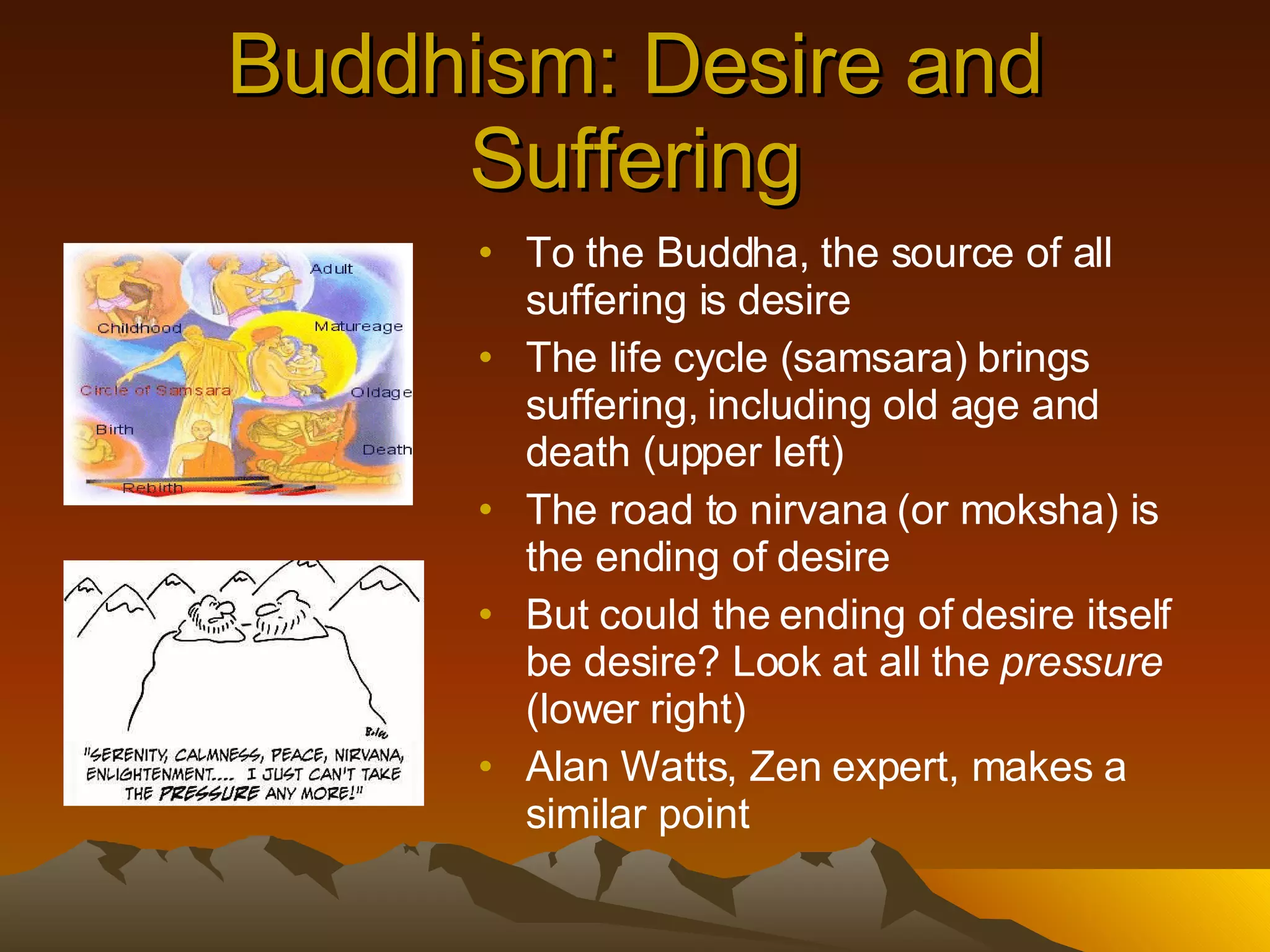
Buddhism: Desire and Suffering To the Buddha, the source of all suffering is desire The life cycle (samsara) brings suffering, including old age and death (upper left) The road to nirvana (or moksha) is the ending of desire But could the ending of desire itself be desire? Look at all the  pressure  (lower right) Alan Watts, Zen expert, makes a similar point
Tibetan Buddhism Tibetan Buddhism follows the Mahanyana (Great Vehicle) school  The principle lies in reaching a state of Buddhahood or enlightenment In doing so, the lama or monk helps all other sentient beings attain that state Sometimes defined as a state of omniscience, the Buddhist principle that all things derive from mind All limitations to help others are thereby removed Karma of sentient beings limit the Buddhists’ ability to help them
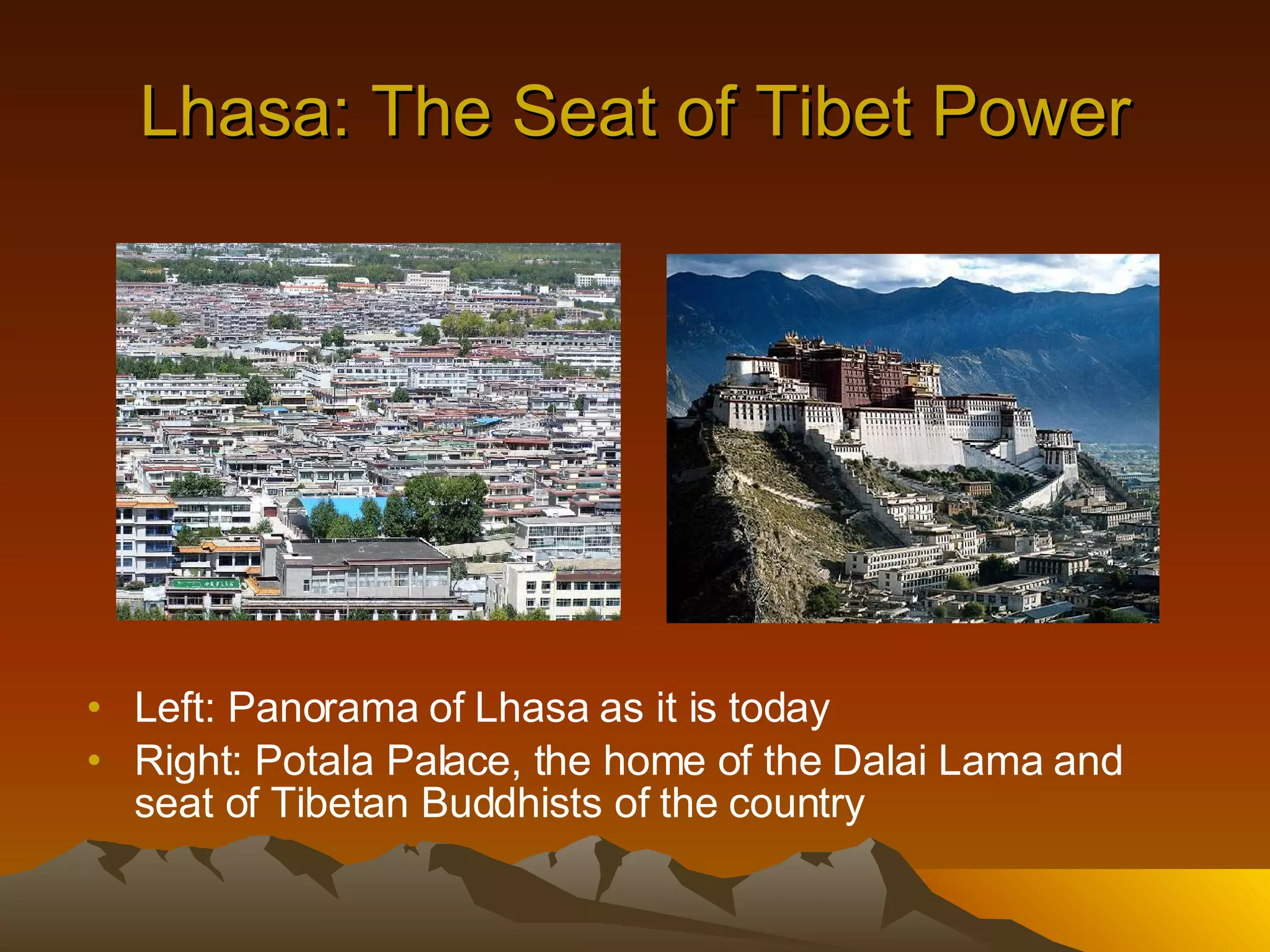
Lhasa: The Seat of Tibet Power Left: Panorama of Lhasa as it is today Right: Potala Palace, the home of the Dalai Lama and seat of Tibetan Buddhists of the country
Definitions of “Buddhism Introspection, or “internist,” is the Tibetan definition of Buddhism Story of Aryadeva cleaning the outside of a cess-pot When asked why he ignored the inside, replied that ritualism also ignores the essential Two steps: to have taken refuge from the external And to observe the four seals of dharma:
Four Seals of Dharma  All compounded (complicated) things are impermanent All emotions are painful All phenomena are empty; they lack inherent existence Nirvana is beyond extremes In the absence of these seals, Buddhist path would be theistic, religious dogma The external would displace the internal.
Methods of Buddhist Practice Preliminary practice , comprising  Renunciation of the world, Bodhicitta (wish to attain enlightenment), and Wisdom (of recognizing emptiness) Vajrayana practice  is the fastest way to reach Buddhahood Also the riskiest: it Increases ego problems Induces greater suffering Requires solid preliminary practice under direction of an adept lama.
Four Schools of Tibetan Buddhism Nyingmapa:  “Ancient ones,” or the oldest tradition founded by Padmasambhava Kagyupa:  “Oral lineage,” comprising several sub-sects Sakyapa:  “Gray earth,” the most scholarly of the traditions Gelugpa:  “Way of virtue,” the tradition to which the present Dalai Lama belongs. The Dalai Lamas of that school ruled from the 17 th  to the 20 th  centuries
Cross-Cuttng Features of the Schools ‘ Old Translation” (Nyingampa): reliance on the original translation of the scriptures “ New Translation” (the other three traditions): reliance on more recent translation “ Red Hat”: Color of the hats worn by lamas in the first three traditions “ Yellow Hat”:  Color of the hats worn by lamas of the Gelugpa tradition, the current ruling group Other movements: Jonangpa in Eastern Tibet Rim é , an ecumenical movement
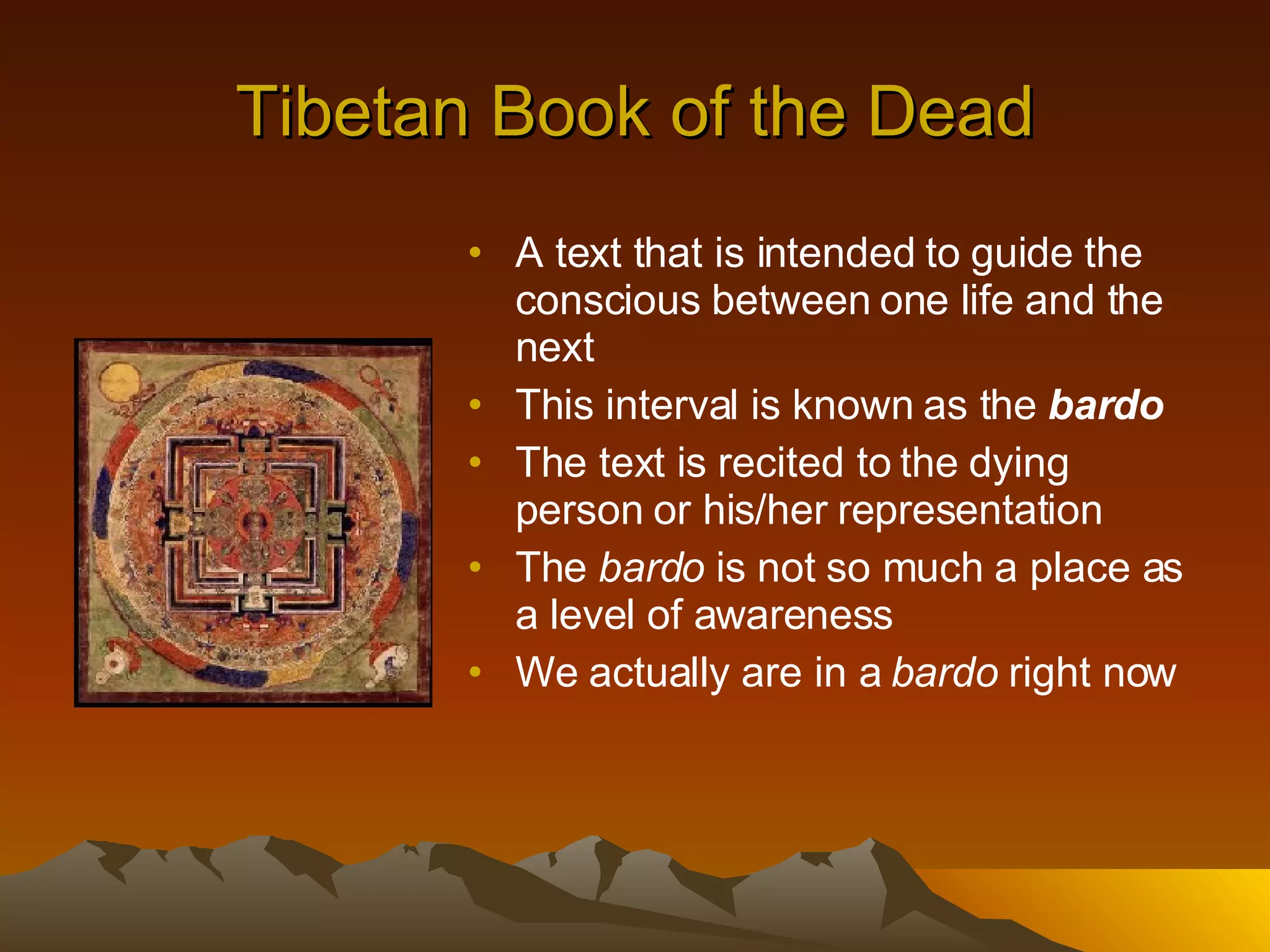
Tibetan Book of the Dead A text that is intended to guide the conscious between one life and the next This interval is known as the  bardo The text is recited to the dying person or his/her representation The  bardo  is not so much a place as a level of awareness We actually are in a  bardo  right now
The Three  Bardos :  Chikhai Bardo:  the bardo at the moment of death Chonyid Bardo:  experiencing of various realities, represented by various Buddhist forms Whether wrathful or peaceful, the forms are projections of the soul’s own illusion Sidpa Bardo:  the bardo of rebirth after Judgment
Tibetan Book of the Dead: Images Left: A wrathful deity, which one might encounter in the Chonyid Bardo Right: A more peaceable deity, portraying the Buddha and his consort in an erotic pose.
China’s Intervention Chinese troops invaded Tibet in 1951 Rationale of invasion: to overthrow the feudal system  Replace religion with atheism Hundreds of monasteries were destroyed Lamas, including the Dalai lama, were forced into exile Chinese have repopulated the area with Han (ethnic Chinese)  A worldwide Tibetan movement has been launched to recover the country
Conclusion Tibet is a classical theocracy Whether it was an oppressive theocracy has been debated Peoples themselves are either herders or peasants or both Tibetan Buddhism emphasizes the major tenets of most Mahayana schools The Dalai Lama represents the Gelugpa tradition Tibetan Book of the Dead  is a model of the transition between one life and the next.

Tibet

  • 1.
  • 2.
    Overview of aTheocracy Much has been made of Tibet as a Shangri-la The real Tibet is at once more and less than meets the eye Tibetan Buddhism is an intriguing model of the universe Daily life of the Tibetan herdsman or peasant is somewhat more mundane We look at both sides of Tibetan life in this module
  • 3.
    Location of TibetTibet lies between China and India in the Himalaya chain Virtually all of the country is highland peaks and plateaus
  • 4.
    Topography of TibetTibet is called “The Roof of the World” for good reason: As a plateau region averaging 16,000 feet, it is the highest region in the world
  • 5.
    Cultures of Tibet:Subsistence Base Arable land is scarce, so that Tibetans are either herdsmen (upper left) or subsistence peasants The animal of choice is the yak, used as both beasts of burden and for milk, cloth, hides, and meat (lower left) This is an ox whose matted undercoat and shaggy outer hair protects them from the cold Other animals include horses, sheep, goats, and camels Crops grown include wheat, barley, rye, buckwheat, and others
  • 6.
    Cultures of Tibet:Polyandry Fraternal polyandry has drawn much attention Women marry two or more men who are brothers to each other Rationale: Limited land resources encourage population control Only one child at a time can be born
  • 7.
    Cultures of Tibet:The Question of Feudalism (Michael Parenti) Were the monasteries of Tibet based on feudalism? Ideal: every household has a male lama in a monastery Argument: 700,000 of 1,2 million were serfs They were allowed a small parcel of land But worked for the monasteries or secular lords Captured escapees were beaten until they bled Some serfs actually welcomed the Chinese ”liberation” Source: Michael Parenti, “Friendly Feudalism: The Tibet Myth” Link: http://www.swans.com/library/art9/mparen01.html#6
  • 8.
    Culture of Tibet:“A Lie Repeated” Joshua Frei argues Parenti has little direct knowledge of Tibet He relies on four Chinese-related sources for his data All four, including Anna Louise Strong, romanticized Maoist revolution Counterargument: Parenti ignores the statements by the Tibetan refugees themselves For more on this issue, log on to this link: http://studentsforafreetibet.org/article.php?id=425
  • 9.
    Principles of Buddhism(and Hinduism) With Hinduism, postulates Samsara We live in a world of birth, death, and rebirth (Upper Left, Tibetan Wheel of Samsara) Form of our rebirth is driven by karma Past deeds determine our rebirth Samsara, however, is an illusion Nirvana involves recognition of this illusion
  • 10.
    Buddhism: Desire andSuffering To the Buddha, the source of all suffering is desire The life cycle (samsara) brings suffering, including old age and death (upper left) The road to nirvana (or moksha) is the ending of desire But could the ending of desire itself be desire? Look at all the pressure (lower right) Alan Watts, Zen expert, makes a similar point
  • 11.
    Tibetan Buddhism TibetanBuddhism follows the Mahanyana (Great Vehicle) school The principle lies in reaching a state of Buddhahood or enlightenment In doing so, the lama or monk helps all other sentient beings attain that state Sometimes defined as a state of omniscience, the Buddhist principle that all things derive from mind All limitations to help others are thereby removed Karma of sentient beings limit the Buddhists’ ability to help them
  • 12.
    Lhasa: The Seatof Tibet Power Left: Panorama of Lhasa as it is today Right: Potala Palace, the home of the Dalai Lama and seat of Tibetan Buddhists of the country
  • 13.
    Definitions of “BuddhismIntrospection, or “internist,” is the Tibetan definition of Buddhism Story of Aryadeva cleaning the outside of a cess-pot When asked why he ignored the inside, replied that ritualism also ignores the essential Two steps: to have taken refuge from the external And to observe the four seals of dharma:
  • 14.
    Four Seals ofDharma All compounded (complicated) things are impermanent All emotions are painful All phenomena are empty; they lack inherent existence Nirvana is beyond extremes In the absence of these seals, Buddhist path would be theistic, religious dogma The external would displace the internal.
  • 15.
    Methods of BuddhistPractice Preliminary practice , comprising Renunciation of the world, Bodhicitta (wish to attain enlightenment), and Wisdom (of recognizing emptiness) Vajrayana practice is the fastest way to reach Buddhahood Also the riskiest: it Increases ego problems Induces greater suffering Requires solid preliminary practice under direction of an adept lama.
  • 16.
    Four Schools ofTibetan Buddhism Nyingmapa: “Ancient ones,” or the oldest tradition founded by Padmasambhava Kagyupa: “Oral lineage,” comprising several sub-sects Sakyapa: “Gray earth,” the most scholarly of the traditions Gelugpa: “Way of virtue,” the tradition to which the present Dalai Lama belongs. The Dalai Lamas of that school ruled from the 17 th to the 20 th centuries
  • 17.
    Cross-Cuttng Features ofthe Schools ‘ Old Translation” (Nyingampa): reliance on the original translation of the scriptures “ New Translation” (the other three traditions): reliance on more recent translation “ Red Hat”: Color of the hats worn by lamas in the first three traditions “ Yellow Hat”: Color of the hats worn by lamas of the Gelugpa tradition, the current ruling group Other movements: Jonangpa in Eastern Tibet Rim é , an ecumenical movement
  • 18.
    Tibetan Book ofthe Dead A text that is intended to guide the conscious between one life and the next This interval is known as the bardo The text is recited to the dying person or his/her representation The bardo is not so much a place as a level of awareness We actually are in a bardo right now
  • 19.
    The Three Bardos : Chikhai Bardo: the bardo at the moment of death Chonyid Bardo: experiencing of various realities, represented by various Buddhist forms Whether wrathful or peaceful, the forms are projections of the soul’s own illusion Sidpa Bardo: the bardo of rebirth after Judgment
  • 20.
    Tibetan Book ofthe Dead: Images Left: A wrathful deity, which one might encounter in the Chonyid Bardo Right: A more peaceable deity, portraying the Buddha and his consort in an erotic pose.
  • 21.
    China’s Intervention Chinesetroops invaded Tibet in 1951 Rationale of invasion: to overthrow the feudal system Replace religion with atheism Hundreds of monasteries were destroyed Lamas, including the Dalai lama, were forced into exile Chinese have repopulated the area with Han (ethnic Chinese) A worldwide Tibetan movement has been launched to recover the country
  • 22.
    Conclusion Tibet isa classical theocracy Whether it was an oppressive theocracy has been debated Peoples themselves are either herders or peasants or both Tibetan Buddhism emphasizes the major tenets of most Mahayana schools The Dalai Lama represents the Gelugpa tradition Tibetan Book of the Dead is a model of the transition between one life and the next.

Editor's Notes

  • #2 One of the most thoroughly theocratic kingdoms of the world is Tibet. We take an overview of this kingdom and introduce the online literature and videos that accompany this lecture.