Chapter 7
Ancient Greece
Section 1
Early People of Greece
Mountains & the Sea
• Greece is nearly ¾ covered with mountains
 ▫ Early farmers grew olives, grapes, & grain foods in
   the thin, rocky, & dry climate
 ▫ Raised sheep, goats, pigs, & cattle to get skins for
   clothing
 ▫ Rugged land made travel hard & impossible in
   some areas
    Mountain people survived on the food they raised
    Each village formed their own governments &
     became independent of each other
• Greeks living near the sea became fishers,
  sailors, & merchants
 ▫ Little natural resources led Greek to look outside
   Greece for trade
• Greece’s location made it a great trading center
• Traders on the Mediterranean were eager to
  exchange their goods for olive oil, wool, & wine
• 3000 & 1550 B.C. the Mediterranean’s 1st great
  trading center grew on the island of Crete
The Minoans
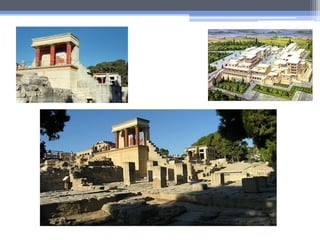
• 1990 B.C. people of Crete built huge palaces
  ▫ Palaces were like small cities
  ▫ Were centers of government & religion
      Largest was Knossos (stood 3 stories high)
      Other buildings for storing food & decorative paintings
• Minoans built Knossos & other cities of Crete
  ▫ Were seafaring traders
  ▫ Traded with people in Africa, Asia, & Europe
      Egypt & Syria were main trading partners
  ▫ Trading ships carried olive oil, wine, wool, pottery, & other goods
    to oversea ports
      Returned with copper, tin, & gold
      Mixed copper & tin to form bronze
  ▫ Developed a writing system to keep track of their trade
• Minoan kingdom destroyed by fire or earthquake in 1450 B.C.
The Mycenaeans
• Seemed to be warlike people
• Measured wealth by number of weapons they owned
• Learned many Minoan customs through trade with
  them
 ▫ Adapted Minoan art & pottery styles
 ▫ Changed writing system to fit their language &
   borrowed some religious beliefs
• 1450 B.C. Mycenaeans invaded Crete
 ▫ Controlled Crete & Peloponnesus from 1450 to 1100
   B.C.
Ancient Stories & Legends
• Stories of Homer tell us history of Mycenaeans
 ▫ Long stories were called epics
 ▫ Storytellers retold these epics
    Iliad: epic which tells about people’s actions during a
     great war
    Odyssey: describes the adventure of the hero
     Odysseus on his journey home from the war
 ▫ War described by Homer was fought between the
   Greeks & the people of Troy
    Trojan War

Section 1

  • 1.
  • 2.
  • 3.
    Mountains & theSea • Greece is nearly ¾ covered with mountains ▫ Early farmers grew olives, grapes, & grain foods in the thin, rocky, & dry climate ▫ Raised sheep, goats, pigs, & cattle to get skins for clothing ▫ Rugged land made travel hard & impossible in some areas  Mountain people survived on the food they raised  Each village formed their own governments & became independent of each other
  • 4.
    • Greeks livingnear the sea became fishers, sailors, & merchants ▫ Little natural resources led Greek to look outside Greece for trade • Greece’s location made it a great trading center • Traders on the Mediterranean were eager to exchange their goods for olive oil, wool, & wine • 3000 & 1550 B.C. the Mediterranean’s 1st great trading center grew on the island of Crete
  • 5.
    The Minoans • 1990B.C. people of Crete built huge palaces ▫ Palaces were like small cities ▫ Were centers of government & religion  Largest was Knossos (stood 3 stories high)  Other buildings for storing food & decorative paintings • Minoans built Knossos & other cities of Crete ▫ Were seafaring traders ▫ Traded with people in Africa, Asia, & Europe  Egypt & Syria were main trading partners ▫ Trading ships carried olive oil, wine, wool, pottery, & other goods to oversea ports  Returned with copper, tin, & gold  Mixed copper & tin to form bronze ▫ Developed a writing system to keep track of their trade • Minoan kingdom destroyed by fire or earthquake in 1450 B.C.
  • 7.
    The Mycenaeans • Seemedto be warlike people • Measured wealth by number of weapons they owned • Learned many Minoan customs through trade with them ▫ Adapted Minoan art & pottery styles ▫ Changed writing system to fit their language & borrowed some religious beliefs • 1450 B.C. Mycenaeans invaded Crete ▫ Controlled Crete & Peloponnesus from 1450 to 1100 B.C.
  • 8.
    Ancient Stories &Legends • Stories of Homer tell us history of Mycenaeans ▫ Long stories were called epics ▫ Storytellers retold these epics  Iliad: epic which tells about people’s actions during a great war  Odyssey: describes the adventure of the hero Odysseus on his journey home from the war ▫ War described by Homer was fought between the Greeks & the people of Troy  Trojan War