BACTERIAL GROWTH
Dr. Roma Goyal
Bacterial growth
4-2
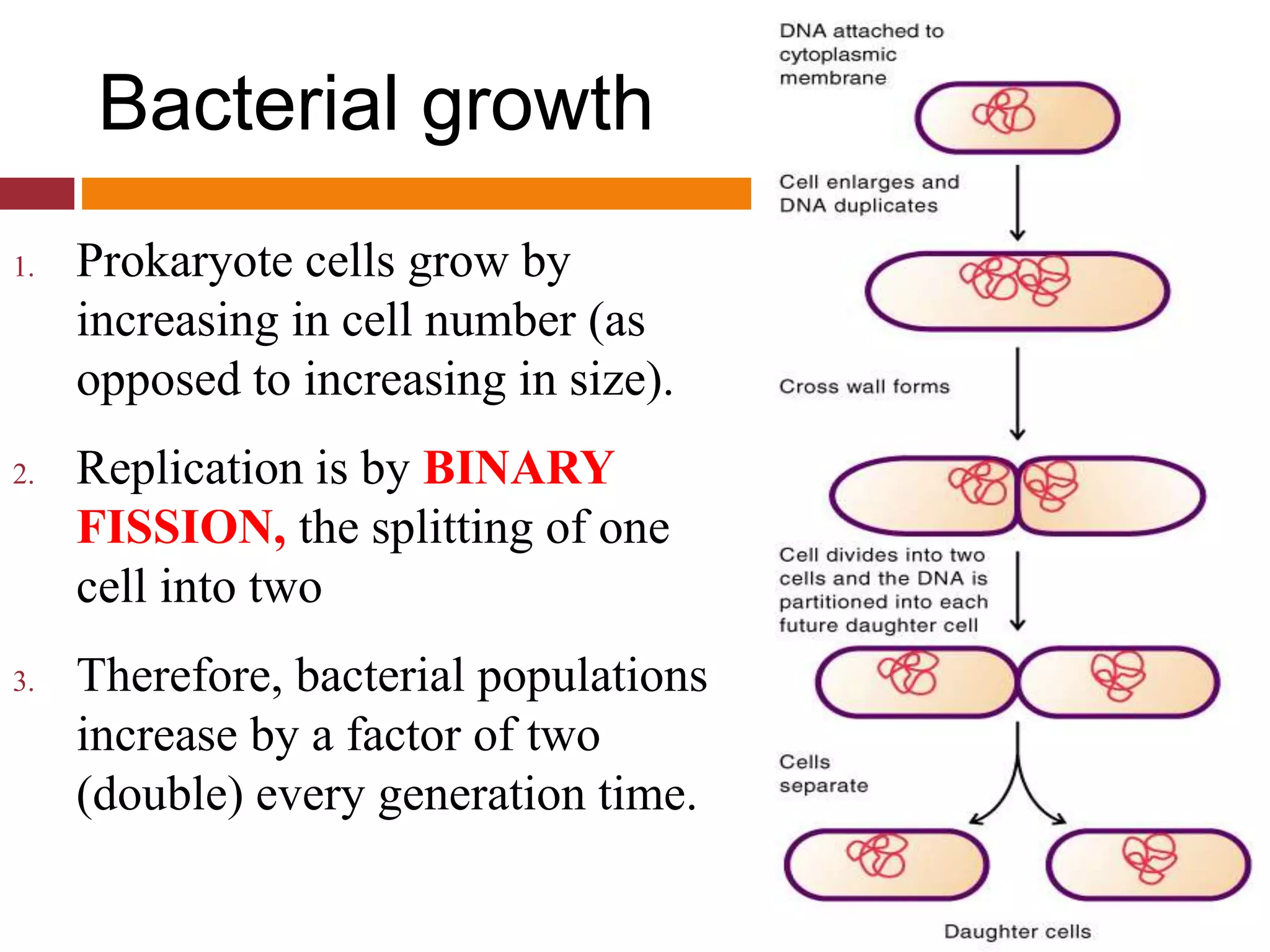
1. Prokaryote cells grow by
increasing in cell number (as
opposed to increasing in size).
2. Replication is by BINARY
FISSION, the splitting of one
cell into two
3. Therefore, bacterial populations
increase by a factor of two
(double) every generation time.
Generation time
4-3
 The time required to for a population to double (doubling
time) in number.
 Ex. Escherichia coli (E. coli) double every 20 minutes
 Ex. Mycobacterium tuberculosis double every 12 to 24
hours
Figure 6.12b
Fig 6.13
Bacterial Growth Curve
Illustrates the dynamics of growth
Phases of growth
Lag phase
Exponential or
logarithmic (log) phase
Stationary phase
Death phase (decline phase)
1. Bacteria growing in batch culture produce a growth curve with up to four
distinct phases.
2. Batch cultures are grown in tubes or flasks and are closed systems where no
fresh nutrients are added or waste products removed.
3. Lag phase occurs when bacteria are adjusting to them medium. For example,
with a nutritionally poor medium, several anabolic pathways need to be turned
on, resulting in a lag before active growth begins.
4. In log or exponential phase, the cells are growing as fast as they can, limited
only by growth conditions and genetic potential. During this phase, almost all
cells are alive, they are most nearly identical, and they are most affected by
outside influences like disinfectants.
5. Due to nutrient depletion and/or accumulation of toxic end products,
replication stops and cells enter a stationary phase where there is no net
change in cell number.
6. Death phase occurs when cells can no longer maintain viability and numbers
decrease as a proportion.
Growth in Batch Culture
BACTERIAL GROWTH REQUIREMENTS
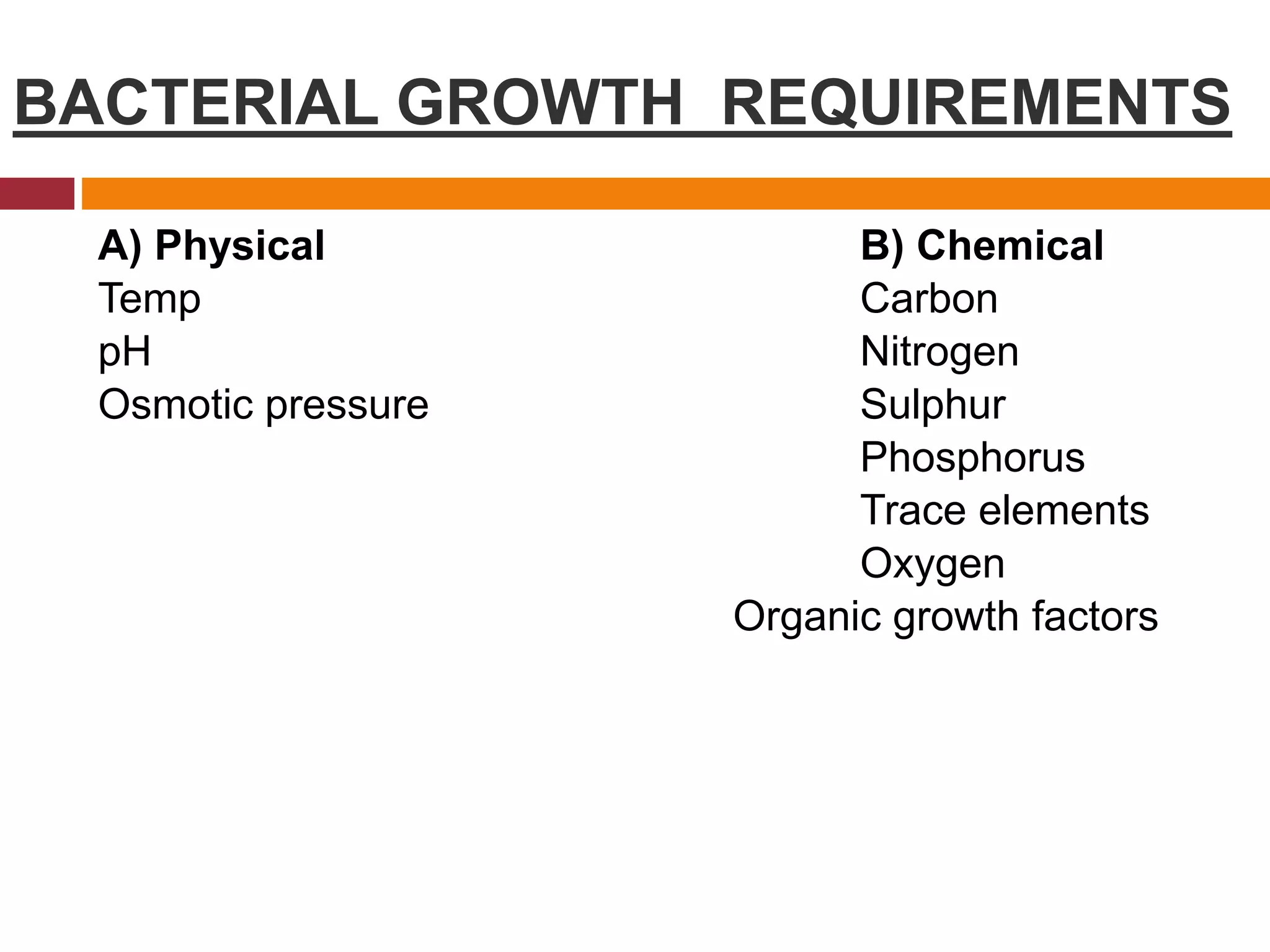
A) Physical B) Chemical
Temp Carbon
pH Nitrogen
Osmotic pressure Sulphur
Phosphorus
Trace elements
Oxygen
Organic growth factors
BACTERIAL GROWTH REQUIREMENTS
Environmental factors
4-10
 Temperature
 Oxygen requirement
 pH
 Water availability
 Minimum growth temperature
 Optimum growth temperature
 Maximum growth temperature
Five groups based on optimum growth temperature
1. Psychrophiles
2. Psychrotrophs
3. Mesophiles
4. Thermophiles
5. Hyperthermophiles
Temperature
Temperature
 Psychrophile
 0o to 18o C
 Psychrotroph
 20°C to 30°C
 Important in food spoilage
 Mesophile
 25°C to 45°C
 More common
 Disease causing
 Thermophiles
 45°C to 70°C
 Common in hot springs and hot water heaters
 Hyperthermophiles
 70°C to 110°C
 Live at very high temperatures, high enough where water threatens to become
a gas
 Usually members of Archaea
 Found in hydrothermal vents
Oxygen requirements
• Obligately aerobic bacteria can obtain energy only through aerobic respiration and have to have oxygen
available. Thus, they will grow only at the surface of thioglycollate broth.
• Obligately anaerobic bacteria die in the presence of oxygen and can only grow at the bottom of
thioglycollate broth. Some anaerobes are so sensitive to oxygen that even thioglycollate broth is not
anoxic enough to provide suitable anaerobic conditions.
• Microaerophiles require oxygen for growth but the 20% in air is too toxic. As a result, they grow near the
top but beneath the surface of thioglycollate broth where the oxygen concentration is typically 4 – 10%.
• Facultative anaerobes can use oxygen for aerobic respiration but can switch to fermentative metabolism in
the absence of oxygen. As a result, they will grow throughout thioglycollate broth. (Heavier growth at
top.)
• Aerotolerant anaerobes are anaerobic bacteria that can grow in the presence of air.
pH
4-14
 Neutrophiles grow best around neutral pH (7)
 Acidophiles grow best at pH < 7
 Alkophiles grow best at pH > 7
 Acidotolerant grow best at pH 7 but can also grow at
lower pH
 Alkotolerant grow best at pH 7 but can also grow at
higher pH
Water Activity
 Microbes that require a high water activity (near or at 1) are
termed nonhalophiles. (Halophile = salt-loving)
 Some bacteria require salt to grow and are called halophiles. If a
very high concentration of salt is required (around saturation), the
organisms are termed extreme halophiles.
 A nonhalophile that can grows best with almost no salt but can still
grow with low levels of salt (~ 7%) is called halotolerant.
 In general, fungi are more tolerant of low water activity.
(That’s why your jelly is more likely to get contaminated by
fungi than bacteria.)
Nutritional Requirements
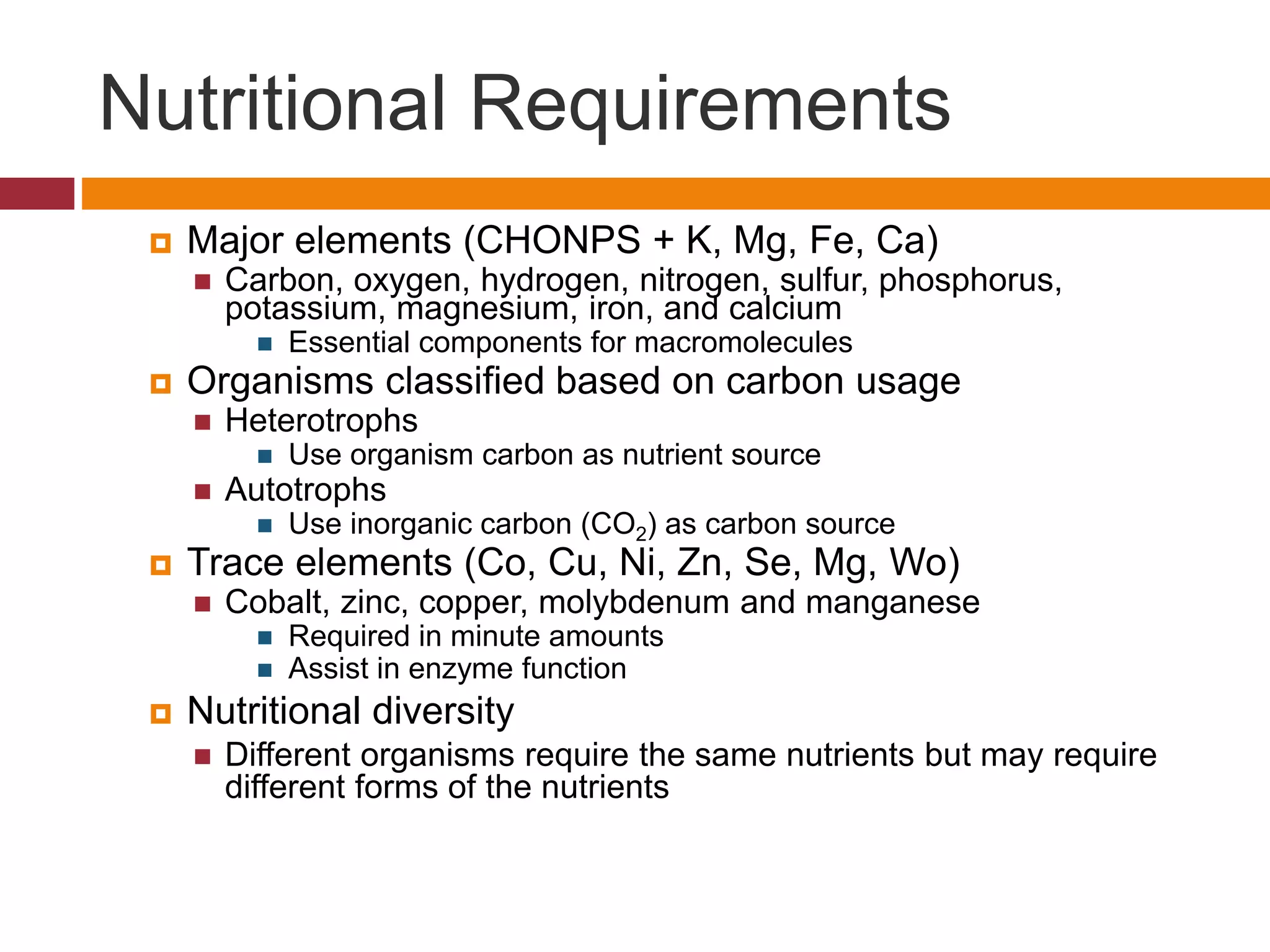
 Major elements (CHONPS + K, Mg, Fe, Ca)
 Carbon, oxygen, hydrogen, nitrogen, sulfur, phosphorus,
potassium, magnesium, iron, and calcium
 Essential components for macromolecules
 Organisms classified based on carbon usage
 Heterotrophs
 Use organism carbon as nutrient source
 Autotrophs
 Use inorganic carbon (CO2) as carbon source
 Trace elements (Co, Cu, Ni, Zn, Se, Mg, Wo)
 Cobalt, zinc, copper, molybdenum and manganese
 Required in minute amounts
 Assist in enzyme function
 Nutritional diversity
 Different organisms require the same nutrients but may require
different forms of the nutrients
Major elements
Culture Media
4-19
 Complex (contains undefined components)
 Chemically defined (all concentrations are known)
 Selective (favors the growth of a particular organism or
group of organisms)
 Differential (has reactions that give isolates different
appearance)
 Anaerobic (oxygen-free)
4-20
Characteristics of Media
Direct Measurements of Microbial
Growth
Viable cell counts: Plate counts: Serial
dilutions put on plates CFUs form colonies
Figure 6.15, step 1
Fig 6.17
Measuring Microbial Growth -
Overview
Direct Methods
 Plate counts
 Filtration
 MPN
 Direct microscopic count
Indirect Methods
 Turbidity
THANKS

Bacterial Growth and Nutrition

  • 1.
  • 2.
    Bacterial growth 4-2 1. Prokaryotecells grow by increasing in cell number (as opposed to increasing in size). 2. Replication is by BINARY FISSION, the splitting of one cell into two 3. Therefore, bacterial populations increase by a factor of two (double) every generation time.
  • 3.
    Generation time 4-3  Thetime required to for a population to double (doubling time) in number.  Ex. Escherichia coli (E. coli) double every 20 minutes  Ex. Mycobacterium tuberculosis double every 12 to 24 hours
  • 4.
  • 5.
    Bacterial Growth Curve Illustratesthe dynamics of growth Phases of growth Lag phase Exponential or logarithmic (log) phase Stationary phase Death phase (decline phase)
  • 6.
    1. Bacteria growingin batch culture produce a growth curve with up to four distinct phases. 2. Batch cultures are grown in tubes or flasks and are closed systems where no fresh nutrients are added or waste products removed. 3. Lag phase occurs when bacteria are adjusting to them medium. For example, with a nutritionally poor medium, several anabolic pathways need to be turned on, resulting in a lag before active growth begins. 4. In log or exponential phase, the cells are growing as fast as they can, limited only by growth conditions and genetic potential. During this phase, almost all cells are alive, they are most nearly identical, and they are most affected by outside influences like disinfectants. 5. Due to nutrient depletion and/or accumulation of toxic end products, replication stops and cells enter a stationary phase where there is no net change in cell number. 6. Death phase occurs when cells can no longer maintain viability and numbers decrease as a proportion. Growth in Batch Culture
  • 8.
  • 9.
    A) Physical B)Chemical Temp Carbon pH Nitrogen Osmotic pressure Sulphur Phosphorus Trace elements Oxygen Organic growth factors BACTERIAL GROWTH REQUIREMENTS
  • 10.
    Environmental factors 4-10  Temperature Oxygen requirement  pH  Water availability
  • 11.
     Minimum growthtemperature  Optimum growth temperature  Maximum growth temperature Five groups based on optimum growth temperature 1. Psychrophiles 2. Psychrotrophs 3. Mesophiles 4. Thermophiles 5. Hyperthermophiles Temperature
  • 12.
    Temperature  Psychrophile  0oto 18o C  Psychrotroph  20°C to 30°C  Important in food spoilage  Mesophile  25°C to 45°C  More common  Disease causing  Thermophiles  45°C to 70°C  Common in hot springs and hot water heaters  Hyperthermophiles  70°C to 110°C  Live at very high temperatures, high enough where water threatens to become a gas  Usually members of Archaea  Found in hydrothermal vents
  • 13.
    Oxygen requirements • Obligatelyaerobic bacteria can obtain energy only through aerobic respiration and have to have oxygen available. Thus, they will grow only at the surface of thioglycollate broth. • Obligately anaerobic bacteria die in the presence of oxygen and can only grow at the bottom of thioglycollate broth. Some anaerobes are so sensitive to oxygen that even thioglycollate broth is not anoxic enough to provide suitable anaerobic conditions. • Microaerophiles require oxygen for growth but the 20% in air is too toxic. As a result, they grow near the top but beneath the surface of thioglycollate broth where the oxygen concentration is typically 4 – 10%. • Facultative anaerobes can use oxygen for aerobic respiration but can switch to fermentative metabolism in the absence of oxygen. As a result, they will grow throughout thioglycollate broth. (Heavier growth at top.) • Aerotolerant anaerobes are anaerobic bacteria that can grow in the presence of air.
  • 14.
    pH 4-14  Neutrophiles growbest around neutral pH (7)  Acidophiles grow best at pH < 7  Alkophiles grow best at pH > 7  Acidotolerant grow best at pH 7 but can also grow at lower pH  Alkotolerant grow best at pH 7 but can also grow at higher pH
  • 15.
    Water Activity  Microbesthat require a high water activity (near or at 1) are termed nonhalophiles. (Halophile = salt-loving)  Some bacteria require salt to grow and are called halophiles. If a very high concentration of salt is required (around saturation), the organisms are termed extreme halophiles.  A nonhalophile that can grows best with almost no salt but can still grow with low levels of salt (~ 7%) is called halotolerant.  In general, fungi are more tolerant of low water activity. (That’s why your jelly is more likely to get contaminated by fungi than bacteria.)
  • 17.
    Nutritional Requirements  Majorelements (CHONPS + K, Mg, Fe, Ca)  Carbon, oxygen, hydrogen, nitrogen, sulfur, phosphorus, potassium, magnesium, iron, and calcium  Essential components for macromolecules  Organisms classified based on carbon usage  Heterotrophs  Use organism carbon as nutrient source  Autotrophs  Use inorganic carbon (CO2) as carbon source  Trace elements (Co, Cu, Ni, Zn, Se, Mg, Wo)  Cobalt, zinc, copper, molybdenum and manganese  Required in minute amounts  Assist in enzyme function  Nutritional diversity  Different organisms require the same nutrients but may require different forms of the nutrients
  • 18.
  • 19.
    Culture Media 4-19  Complex(contains undefined components)  Chemically defined (all concentrations are known)  Selective (favors the growth of a particular organism or group of organisms)  Differential (has reactions that give isolates different appearance)  Anaerobic (oxygen-free)
  • 20.
  • 21.
  • 22.
    Direct Measurements ofMicrobial Growth Viable cell counts: Plate counts: Serial dilutions put on plates CFUs form colonies
  • 23.
  • 24.
    Measuring Microbial Growth- Overview Direct Methods  Plate counts  Filtration  MPN  Direct microscopic count Indirect Methods  Turbidity
  • 25.