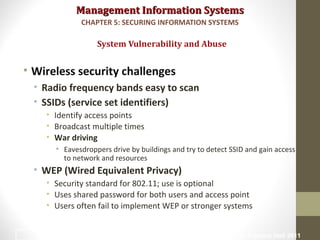
This document discusses security challenges for information systems. It describes how systems are vulnerable through accessibility of networks, software and hardware problems, and disasters. Specific threats are discussed like hacking, malware, identity theft, and internal threats from employees. The document also outlines security controls and policies needed to protect systems and mitigate risks from threats.
Management Information SystemsManagementInformation Systems
• Why are information systems vulnerable to
destruction, error, and abuse?
• What is the business value of security and control?
• What are the components of an organizational
framework for security and control?
• What are the most important tools and
technologies for safeguarding information
resources?
Learning Objectives
CHAPTER 5: SECURING INFORMATION SYSTEMS
2
3.
Management Information SystemsManagementInformation Systems
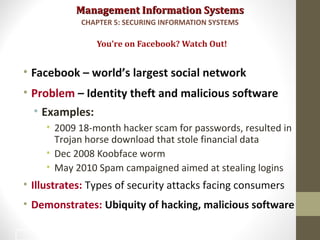
• Facebook – world’s largest social network
• Problem – Identity theft and malicious software
• Examples:
• 2009 18-month hacker scam for passwords, resulted in
Trojan horse download that stole financial data
• Dec 2008 Koobface worm
• May 2010 Spam campaigned aimed at stealing logins
• Illustrates: Types of security attacks facing consumers
• Demonstrates: Ubiquity of hacking, malicious software
You’re on Facebook? Watch Out!
CHAPTER 5: SECURING INFORMATION SYSTEMS
3
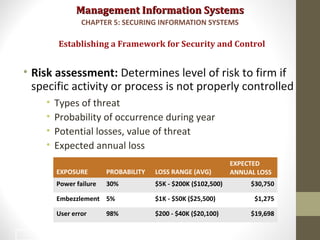
4.
Management Information SystemsManagementInformation Systems
• Security:
• Policies, procedures and technical measures used to
prevent unauthorized access, alteration, theft, or
physical damage to information systems
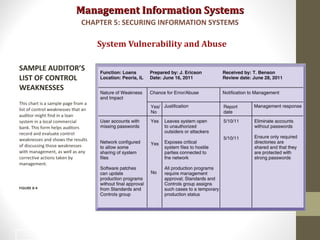
• Controls:
• Methods, policies, and organizational procedures that
ensure safety of organization’s assets; accuracy and
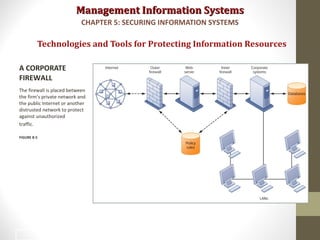
reliability of its accounting records; and operational
adherence to management standards
System Vulnerability and Abuse
CHAPTER 5: SECURING INFORMATION SYSTEMS
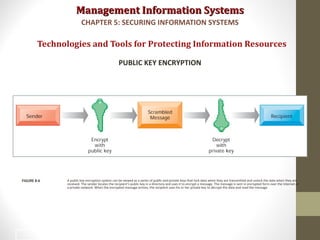
4
5.
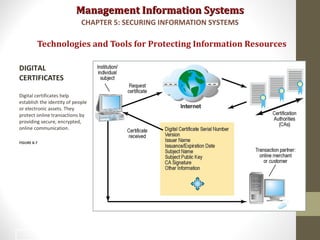
Management Information SystemsManagementInformation Systems
• Why systems are vulnerable
• Accessibility of networks
• Hardware problems (breakdowns, configuration
errors, damage from improper use or crime)
• Software problems (programming errors, installation
errors, unauthorized changes)
• Disasters
• Use of networks/computers outside of firm’s control
• Loss and theft of portable devices
System Vulnerability and Abuse
CHAPTER 5: SECURING INFORMATION SYSTEMS
5
6.
Management Information SystemsManagementInformation Systems
System Vulnerability and Abuse
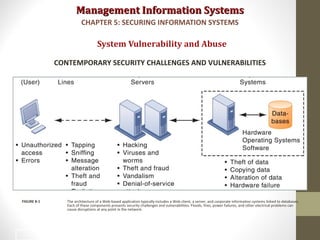
CONTEMPORARY SECURITY CHALLENGES AND VULNERABILITIES
The architecture of a Web-based application typically includes a Web client, a server, and corporate information systems linked to databases.
Each of these components presents security challenges and vulnerabilities. Floods, fires, power failures, and other electrical problems can
cause disruptions at any point in the network.
FIGURE 8-1
CHAPTER 5: SECURING INFORMATION SYSTEMS
6
7.
Management Information SystemsManagementInformation Systems
• Internet vulnerabilities
• Network open to anyone
• Size of Internet means abuses can have wide impact
• Use of fixed Internet addresses with cable or DSL
modems creates fixed targets hackers
• Unencrypted VOIP
• E-mail, P2P, IM
• Interception
• Attachments with malicious software
• Transmitting trade secrets
System Vulnerability and Abuse
CHAPTER 5: SECURING INFORMATION SYSTEMS
7
Management Information SystemsManagementInformation Systems
System Vulnerability and Abuse
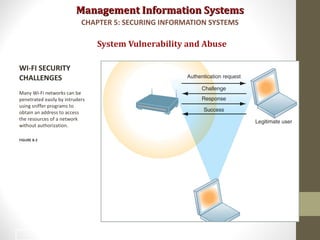
WI-FI SECURITY
CHALLENGES
Many Wi-Fi networks can be
penetrated easily by intruders
using sniffer programs to
obtain an address to access
the resources of a network
without authorization.
FIGURE 8-2
CHAPTER 5: SECURING INFORMATION SYSTEMS
9
10.
Management Information SystemsManagementInformation Systems
• Malware (malicious software)
• Viruses
• Rogue software program that attaches itself to other
software programs or data files in order to be executed
• Worms
• Independent computer programs that copy themselves
from one computer to other computers over a network.
• Trojan horses
• Software program that appears to be benign but then
does something other than expected.
System Vulnerability and Abuse
CHAPTER 5: SECURING INFORMATION SYSTEMS
10
11.
Management Information SystemsManagementInformation Systems
• Malware (cont.)
• SQL injection attacks
• Hackers submit data to Web forms that exploits site’s
unprotected software and sends rogue SQL query to
database
• Spyware
• Small programs install themselves surreptitiously on
computers to monitor user Web surfing activity and
serve up advertising
• Key loggers
• Record every keystroke on computer to steal serial
numbers, passwords, launch Internet attacks
System Vulnerability and Abuse
CHAPTER 5: SECURING INFORMATION SYSTEMS
11
12.
Management Information SystemsManagementInformation Systems
•Hackers and computer crime
• Hackers vs. crackers
• Activities include
• System intrusion
• System damage
• Cybervandalism
• Intentional disruption, defacement,
destruction of Web site or corporate
information system
System Vulnerability and Abuse
CHAPTER 5: SECURING INFORMATION SYSTEMS
12
13.
Management Information SystemsManagementInformation Systems
• Spoofing
• Misrepresenting oneself by using fake e-mail
addresses or masquerading as someone else
• Redirecting Web link to address different from
intended one, with site masquerading as intended
destination
• Sniffer
• Eavesdropping program that monitors information
traveling over network
• Enables hackers to steal proprietary information such
as e-mail, company files, etc.
System Vulnerability and Abuse
CHAPTER 5: SECURING INFORMATION SYSTEMS
13
14.
Management Information SystemsManagementInformation Systems
• Denial-of-service attacks (DoS)
• Flooding server with thousands of false requests to
crash the network.
• Distributed denial-of-service attacks (DDoS)
• Use of numerous computers to launch a DoS
• Botnets
• Networks of “zombie” PCs infiltrated by bot malware
• Worldwide, 6 - 24 million computers serve as zombie
PCs in thousands of botnets
System Vulnerability and Abuse
CHAPTER 5: SECURING INFORMATION SYSTEMS
14
15.
Management Information SystemsManagementInformation Systems
• Computer crime
• Defined as “any violations of criminal law that involve
a knowledge of computer technology for their
perpetration, investigation, or prosecution”
• Computer may be target of crime, e.g.:
• Breaching confidentiality of protected computerized
data
• Accessing a computer system without authority
• Computer may be instrument of crime, e.g.:
• Theft of trade secrets
• Using e-mail for threats or harassment
System Vulnerability and Abuse
CHAPTER 5: SECURING INFORMATION SYSTEMS
15
16.
Management Information SystemsManagementInformation Systems
• Identity theft
• Theft of personal Information (social security id,
driver’s license or credit card numbers) to
impersonate someone else
• Phishing
• Setting up fake Web sites or sending e-mail messages
that look like legitimate businesses to ask users for
confidential personal data.
• Evil twins
• Wireless networks that pretend to offer trustworthy
Wi-Fi connections to the Internet
System Vulnerability and Abuse
CHAPTER 5: SECURING INFORMATION SYSTEMS
16
17.
Management Information SystemsManagementInformation Systems
• Pharming
• Redirects users to a bogus Web page, even when
individual types correct Web page address into his or
her browser
• Click fraud
• Occurs when individual or computer program
fraudulently clicks on online ad without any intention
of learning more about the advertiser or making a
purchase
• Cyberterrorism and Cyberwarfare
System Vulnerability and Abuse
CHAPTER 5: SECURING INFORMATION SYSTEMS
17
18.
Management Information SystemsManagementInformation Systems
• Internal threats: employees
• Security threats often originate inside an organization
• Inside knowledge
• Sloppy security procedures
• User lack of knowledge
• Social engineering:
• Tricking employees into revealing their passwords by
pretending to be legitimate members of the company in
need of information
System Vulnerability and Abuse
CHAPTER 5: SECURING INFORMATION SYSTEMS
18
19.
Management Information SystemsManagementInformation Systems
• Software vulnerability
• Commercial software contains flaws that create
security vulnerabilities
• Hidden bugs (program code defects)
• Zero defects cannot be achieved because complete testing is not
possible with large programs
• Flaws can open networks to intruders
• Patches
• Vendors release small pieces of software to repair flaws
• However exploits often created faster than patches be
released and implemented
System Vulnerability and Abuse
CHAPTER 5: SECURING INFORMATION SYSTEMS
19
20.
Management Information SystemsManagementInformation Systems
Read the Interactive Session and discuss the following questions
• What management, organization, and technology factors
were responsible for McAfee’s software problem?
• What was the business impact of this software problem,
both for McAfee and for its customers?
• If you were a McAfee enterprise customer, would you
consider McAfee’s response to the problem be acceptable?
Why or why not?
• What should McAfee do in the future to avoid similar
problems?
System Vulnerability and Abuse
WHEN ANTIVIRUS SOFTWARE CRIPPLES YOUR COMPUTERS
CHAPTER 5: SECURING INFORMATION SYSTEMS
20
21.
Management Information SystemsManagementInformation Systems
• Failed computer systems can lead to significant or
total loss of business function
• Firms now more vulnerable than ever
• Confidential personal and financial data
• Trade secrets, new products, strategies
• A security breach may cut into firm’s market value
almost immediately
• Inadequate security and controls also bring forth
issues of liability
Business Value of Security and Control
CHAPTER 5: SECURING INFORMATION SYSTEMS
21
22.
Management Information SystemsManagementInformation Systems
• Legal and regulatory requirements for electronic
records management and privacy protection
• HIPAA: Medical security and privacy rules and
procedures
• Gramm-Leach-Bliley Act: Requires financial
institutions to ensure the security and confidentiality
of customer data
• Sarbanes-Oxley Act: Imposes responsibility on
companies and their management to safeguard the
accuracy and integrity of financial information that is
used internally and released externally
Business Value of Security and Control
CHAPTER 5: SECURING INFORMATION SYSTEMS
22
23.
Management Information SystemsManagementInformation Systems
• Electronic evidence
• Evidence for white collar crimes often in digital form
• Data on computers, e-mail, instant messages, e-
commerce transactions
• Proper control of data can save time and money
when responding to legal discovery request
• Computer forensics:
• Scientific collection, examination, authentication,
preservation, and analysis of data from computer
storage media for use as evidence in court of law
• Includes recovery of ambient and hidden data
Business Value of Security and Control
CHAPTER 5: SECURING INFORMATION SYSTEMS
23
24.
Management Information SystemsManagementInformation Systems
• Information systems controls
• Manual and automated controls
• General and application controls
• General controls
• Govern design, security, and use of computer
programs and security of data files in general
throughout organization’s information technology
infrastructure.
• Apply to all computerized applications
• Combination of hardware, software, and manual
procedures to create overall control environment
Establishing a Framework for Security and Control
CHAPTER 5: SECURING INFORMATION SYSTEMS
24
25.
Management Information SystemsManagementInformation Systems
•Types of general controls
• Software controls
• Hardware controls
• Computer operations controls
• Data security controls
• Implementation controls
• Administrative controls
Establishing a Framework for Security and Control
CHAPTER 5: SECURING INFORMATION SYSTEMS
25
26.
Management Information SystemsManagementInformation Systems
• Application controls
• Specific controls unique to each computerized
application, such as payroll or order processing
• Include both automated and manual procedures
• Ensure that only authorized data are completely and
accurately processed by that application
• Include:
• Input controls
• Processing controls
• Output controls
Establishing a Framework for Security and Control
CHAPTER 5: SECURING INFORMATION SYSTEMS
26
27.
Management Information SystemsManagementInformation Systems
• Risk assessment: Determines level of risk to firm if
specific activity or process is not properly controlled
• Types of threat
• Probability of occurrence during year
• Potential losses, value of threat
• Expected annual loss
Establishing a Framework for Security and Control
CHAPTER 5: SECURING INFORMATION SYSTEMS
27
EXPOSURE PROBABILITY LOSS RANGE (AVG)
EXPECTED
ANNUAL LOSS
Power failure 30% $5K - $200K ($102,500) $30,750
Embezzlement 5% $1K - $50K ($25,500) $1,275
User error 98% $200 - $40K ($20,100) $19,698
28.
Management Information SystemsManagementInformation Systems
• Security policy
• Ranks information risks, identifies acceptable security
goals, and identifies mechanisms for achieving these
goals
• Drives other policies
• Acceptable use policy (AUP)
• Defines acceptable uses of firm’s information resources and
computing equipment
• Authorization policies
• Determine differing levels of user access to information assets
Establishing a Framework for Security and Control
CHAPTER 5: SECURING INFORMATION SYSTEMS
28
29.
Management Information SystemsManagementInformation Systems
• Identity management
• Business processes and tools to identify valid
users of system and control access
• Identifies and authorizes different categories of
users
• Specifies which portion of system users can access
• Authenticating users and protects identities
• Identity management systems
• Captures access rules for different levels of users
Establishing a Framework for Security and Control
CHAPTER 5: SECURING INFORMATION SYSTEMS
29
30.
Management Information SystemsManagementInformation Systems
System Vulnerability and Abuse
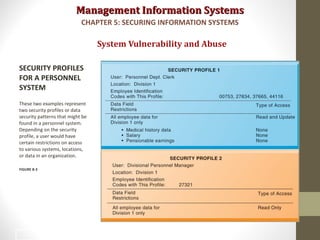
SECURITY PROFILES
FOR A PERSONNEL
SYSTEM
These two examples represent
two security profiles or data
security patterns that might be
found in a personnel system.
Depending on the security
profile, a user would have
certain restrictions on access
to various systems, locations,
or data in an organization.
FIGURE 8-3
CHAPTER 5: SECURING INFORMATION SYSTEMS
30
31.
Management Information SystemsManagementInformation Systems
• Disaster recovery planning: Devises plans for
restoration of disrupted services
• Business continuity planning: Focuses on restoring
business operations after disaster
• Both types of plans needed to identify firm’s most
critical systems
• Business impact analysis to determine impact of an
outage
• Management must determine which systems
restored first
Establishing a Framework for Security and Control
CHAPTER 5: SECURING INFORMATION SYSTEMS
31
32.
Management Information SystemsManagementInformation Systems
• MIS audit
• Examines firm’s overall security environment as well
as controls governing individual information systems
• Reviews technologies, procedures, documentation,
training, and personnel.
• May even simulate disaster to test response of
technology, IS staff, other employees.
• Lists and ranks all control weaknesses and estimates
probability of their occurrence.
• Assesses financial and organizational impact of each
threat
Establishing a Framework for Security and Control
CHAPTER 5: SECURING INFORMATION SYSTEMS
32
33.
Management Information SystemsManagementInformation Systems
System Vulnerability and Abuse
SAMPLE AUDITOR’S
LIST OF CONTROL
WEAKNESSES
This chart is a sample page from a
list of control weaknesses that an
auditor might find in a loan
system in a local commercial
bank. This form helps auditors
record and evaluate control
weaknesses and shows the results
of discussing those weaknesses
with management, as well as any
corrective actions taken by
management.
FIGURE 8-4
CHAPTER 5: SECURING INFORMATION SYSTEMS
33
34.
Management Information SystemsManagementInformation Systems
• Identity management software
• Automates keeping track of all users and privileges
• Authenticates users, protecting identities, controlling
access
• Authentication
• Password systems
• Tokens
• Smart cards
• Biometric authentication
Technologies and Tools for Protecting Information Resources
CHAPTER 5: SECURING INFORMATION SYSTEMS
34
35.
Management Information SystemsManagementInformation Systems
•Firewall:
• Combination of hardware and software
that prevents unauthorized users from
accessing private networks
• Technologies include:
• Static packet filtering
• Network address translation (NAT)
• Application proxy filtering
Technologies and Tools for Protecting Information Resources
CHAPTER 5: SECURING INFORMATION SYSTEMS
35
36.
Management Information SystemsManagementInformation Systems
Technologies and Tools for Protecting Information Resources
A CORPORATE
FIREWALL
The firewall is placed between
the firm’s private network and
the public Internet or another
distrusted network to protect
against unauthorized
traffic.
FIGURE 8-5
CHAPTER 5: SECURING INFORMATION SYSTEMS
36
37.
Management Information SystemsManagementInformation Systems
• Intrusion detection systems:
• Monitor hot spots on corporate networks to detect
and deter intruders
• Examines events as they are happening to discover
attacks in progress
• Antivirus and antispyware software:
• Checks computers for presence of malware and can
often eliminate it as well
• Require continual updating
• Unified threat management (UTM) systems
Technologies and Tools for Protecting Information Resources
CHAPTER 5: SECURING INFORMATION SYSTEMS
37
38.
Management Information SystemsManagementInformation Systems
• Securing wireless networks
• WEP security can provide some security by
• Assigning unique name to network’s SSID and
not broadcasting SSID
• Using it with VPN technology
• Wi-Fi Alliance finalized WAP2 specification,
replacing WEP with stronger standards
• Continually changing keys
• Encrypted authentication system with central
server
Technologies and Tools for Protecting Information Resources
CHAPTER 5: SECURING INFORMATION SYSTEMS
38
39.
Management Information SystemsManagementInformation Systems
•Encryption:
• Transforming text or data into cipher text
that cannot be read by unintended
recipients
• Two methods for encryption on networks
• Secure Sockets Layer (SSL) and successor
Transport Layer Security (TLS)
• Secure Hypertext Transfer Protocol (S-
HTTP)
Technologies and Tools for Protecting Information Resources
CHAPTER 5: SECURING INFORMATION SYSTEMS
39
40.
Management Information SystemsManagementInformation Systems
• Two methods of encryption
• Symmetric key encryption
• Sender and receiver use single, shared key
• Public key encryption
• Uses two, mathematically related keys: Public
key and private key
• Sender encrypts message with recipient’s public
key
• Recipient decrypts with private key
Technologies and Tools for Protecting Information Resources
CHAPTER 5: SECURING INFORMATION SYSTEMS
40
41.
Management Information SystemsManagementInformation Systems
Technologies and Tools for Protecting Information Resources
PUBLIC KEY ENCRYPTION
A public key encryption system can be viewed as a series of public and private keys that lock data when they are transmitted and unlock the data when they are
received. The sender locates the recipient’s public key in a directory and uses it to encrypt a message. The message is sent in encrypted form over the Internet or
a private network. When the encrypted message arrives, the recipient uses his or her private key to decrypt the data and read the message.
FIGURE 8-6
CHAPTER 5: SECURING INFORMATION SYSTEMS
41
42.
Management Information SystemsManagementInformation Systems
• Digital certificate:
• Data file used to establish the identity of users and
electronic assets for protection of online transactions
• Uses a trusted third party, certification authority (CA), to
validate a user’s identity
• CA verifies user’s identity, stores information in CA server,
which generates encrypted digital certificate containing
owner ID information and copy of owner’s public key
• Public key infrastructure (PKI)
• Use of public key cryptography working with certificate
authority
• Widely used in e-commerce
Technologies and Tools for Protecting Information Resources
CHAPTER 5: SECURING INFORMATION SYSTEMS
42
43.
Management Information SystemsManagementInformation Systems
Technologies and Tools for Protecting Information Resources
DIGITAL
CERTIFICATES
Digital certificates help
establish the identity of people
or electronic assets. They
protect online transactions by
providing secure, encrypted,
online communication.
FIGURE 8-7
CHAPTER 5: SECURING INFORMATION SYSTEMS
43
44.
Management Information SystemsManagementInformation Systems
• Ensuring system availability
• Online transaction processing requires 100%
availability, no downtime
• Fault-tolerant computer systems
• For continuous availability, e.g. stock markets
• Contain redundant hardware, software, and power
supply components that create an environment that
provides continuous, uninterrupted service
• High-availability computing
• Helps recover quickly from crash
• Minimizes, does not eliminate downtime
Technologies and Tools for Protecting Information Resources
CHAPTER 5: SECURING INFORMATION SYSTEMS
44
45.
Management Information SystemsManagementInformation Systems
• Recovery-oriented computing
• Designing systems that recover quickly with
capabilities to help operators pinpoint and correct of
faults in multi-component systems
• Controlling network traffic
• Deep packet inspection (DPI)
• Video and music blocking
• Security outsourcing
• Managed security service providers (MSSPs)
Technologies and Tools for Protecting Information Resources
CHAPTER 5: SECURING INFORMATION SYSTEMS
45
46.
Management Information SystemsManagementInformation Systems
• Security in the cloud
• Responsibility for security resides with company
owning the data
• Firms must ensure providers provides adequate
protection
• Service level agreements (SLAs)
• Securing mobile platforms
• Security policies should include and cover any special
requirements for mobile devices
• E.g. updating smart phones with latest security patches,
etc.
Technologies and Tools for Protecting Information Resources
CHAPTER 5: SECURING INFORMATION SYSTEMS
46
47.
Management Information SystemsManagementInformation Systems
Read the Interactive Session and discuss the following questions
• What security and control problems are described in this
case?
• What people, organization, and technology factors
contribute to these problems?
• How secure is cloud computing? Explain your answer.
• If you were in charge of your company’s information
systems department, what issues would you want to clarify
with prospective vendors?
• Would you entrust your corporate systems to a cloud
computing provider? Why or why not?
Technologies and Tools for Protecting Information Resources
HOW SECURE IS THE CLOUD?
CHAPTER 5: SECURING INFORMATION SYSTEMS
47
48.
Management Information SystemsManagementInformation Systems
• Ensuring software quality
• Software metrics: Objective assessments of system in
form of quantified measurements
• Number of transactions
• Online response time
• Payroll checks printed per hour
• Known bugs per hundred lines of code
• Early and regular testing
• Walkthrough: Review of specification or design
document by small group of qualified people
• Debugging: Process by which errors are eliminated
Technologies and Tools for Protecting Information Resources
CHAPTER 5: SECURING INFORMATION SYSTEMS
48