Faculty of Economics and
     Administrative Sciences


Management Information
      Systems
    Course Code 51458
            by
     Dr. Muath Asmar
Management Information Systems
     MANAGING THE DIGITAL FIRM, 12TH EDITION


Chapter 3
INFORMATION SYSTEMS,
ORGANIZATIONS, AND STRATEGY
Management Information Systems
          CHAPTER 3: INFORMATION SYSTEMS, ORGANIZATIONS,
                           AND STRATEGY
                     Learning Objectives


• Identify and describe important features of
  organizations that managers need to know about in
  order to build and use information systems
  successfully.
• Demonstrate how Porter’s competitive forces
  model helps companies develop competitive
  strategies using information systems.
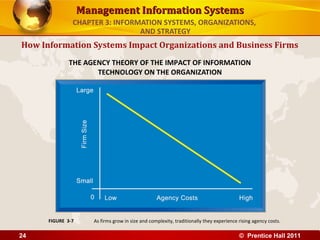
• Explain how the value chain and value web models
  help businesses identify opportunities for strategic
  information system applications.
3                                                  © Prentice Hall 2011
Management Information Systems
          CHAPTER 3: INFORMATION SYSTEMS, ORGANIZATIONS,
                           AND STRATEGY
                  Learning Objectives (cont.)


• Demonstrate how information systems help
  businesses use synergies, core competencies, and
  network-based strategies to achieve competitive
  advantage.
• Assess the challenges posed by strategic
  information systems and management solutions.


4                                                  © Prentice Hall 2011
Management Information Systems
           CHAPTER 3: INFORMATION SYSTEMS, ORGANIZATIONS,
                            AND STRATEGY
            Organizations and Information Systems


• Information technology and organizations
  influence one another
    – Complex relationship influenced by
      organization’s
       • Structure
       • Business processes
       • Politics
       • Culture
       • Environment, and
       • Management decisions
5                                                   © Prentice Hall 2011
Management Information Systems
                        CHAPTER 3: INFORMATION SYSTEMS, ORGANIZATIONS,
                                         AND STRATEGY
                           Organizations and Information Systems

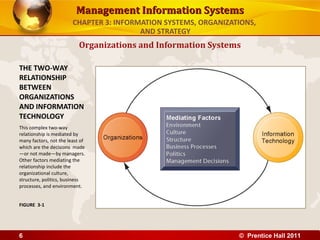
THE TWO-WAY
RELATIONSHIP
BETWEEN
ORGANIZATIONS
AND INFORMATION
TECHNOLOGY
This complex two-way
relationship is mediated by
many factors, not the least of
which are the decisions made
—or not made—by managers.
Other factors mediating the
relationship include the
organizational culture,
structure, politics, business
processes, and environment.


FIGURE 3-1


6                                                                © Prentice Hall 2011
Management Information Systems
            CHAPTER 3: INFORMATION SYSTEMS, ORGANIZATIONS,
                             AND STRATEGY
             Organizations and Information Systems


• What is an organization?
    – Technical definition:
       • Stable, formal social structure that takes resources
         from environment and processes them to produce
         outputs
       • A formal legal entity with internal rules and
         procedures, as well as a social structure
    – Behavioral definition:
       • A collection of rights, privileges, obligations, and
         responsibilities that is delicately balanced over a period
         of time through conflict and conflict resolution

7                                                    © Prentice Hall 2011
Management Information Systems
                   CHAPTER 3: INFORMATION SYSTEMS, ORGANIZATIONS,
                                    AND STRATEGY
                      Organizations and Information Systems
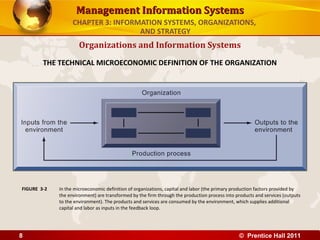
        THE TECHNICAL MICROECONOMIC DEFINITION OF THE ORGANIZATION


FIGURE 3-2   In the microeconomic definition of organizations, capital and labor (the primary production factors provided by
             the environment) are transformed by the firm through the production process into products and services (outputs
             to the environment). The products and services are consumed by the environment, which supplies additional
             capital and labor as inputs in the feedback loop.


8                                                                                              © Prentice Hall 2011
Management Information Systems
               CHAPTER 3: INFORMATION SYSTEMS, ORGANIZATIONS,
                                AND STRATEGY
                  Organizations and Information Systems
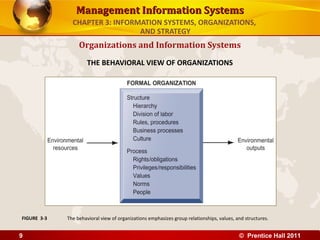
                      THE BEHAVIORAL VIEW OF ORGANIZATIONS


FIGURE 3-3   The behavioral view of organizations emphasizes group relationships, values, and structures.


9                                                                                          © Prentice Hall 2011
Management Information Systems
          CHAPTER 3: INFORMATION SYSTEMS, ORGANIZATIONS,
                           AND STRATEGY
           Organizations and Information Systems


• Features of organizations
     • Use of hierarchical structure
     • Accountability, authority in system of impartial
       decision making
     • Adherence to principle of efficiency
     • Routines and business processes
     • Organizational politics, culture, environments
       and structures
10                                                 © Prentice Hall 2011
Management Information Systems
         CHAPTER 3: INFORMATION SYSTEMS, ORGANIZATIONS,
                          AND STRATEGY
          Organizations and Information Systems


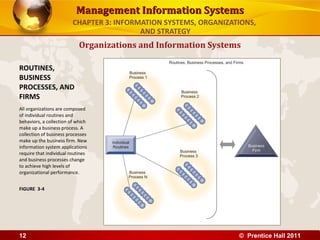
• Routines and business processes
   • Routines (standard operating procedures)
      • Precise rules, procedures, and practices
        developed to cope with virtually all
        expected situations
   • Business processes: Collections of routines
   • Business firm: Collection of business
     processes

11                                                © Prentice Hall 2011
Management Information Systems
                         CHAPTER 3: INFORMATION SYSTEMS, ORGANIZATIONS,
                                          AND STRATEGY
                            Organizations and Information Systems

ROUTINES,
BUSINESS
PROCESSES, AND
FIRMS
All organizations are composed
of individual routines and
behaviors, a collection of which
make up a business process. A
collection of business processes
make up the business firm. New
information system applications
require that individual routines
and business processes change
to achieve high levels of
organizational performance.


FIGURE 3-4


12                                                                © Prentice Hall 2011
Management Information Systems
          CHAPTER 3: INFORMATION SYSTEMS, ORGANIZATIONS,
                           AND STRATEGY
           Organizations and Information Systems


• Organizational politics
     • Divergent viewpoints lead to
       political struggle, competition,
       and conflict
     • Political resistance greatly
       hampers organizational change


13                                                 © Prentice Hall 2011
Management Information Systems
           CHAPTER 3: INFORMATION SYSTEMS, ORGANIZATIONS,
                            AND STRATEGY
            Organizations and Information Systems


• Organizational culture:
     • Encompasses set of assumptions that
       define goal and product
       • What products the organization should produce
       • How and where it should be produced
       • For whom the products should be produced
     • May be powerful unifying force as well as
       restraint on change
14                                                  © Prentice Hall 2011
Management Information Systems
            CHAPTER 3: INFORMATION SYSTEMS, ORGANIZATIONS,
                             AND STRATEGY
             Organizations and Information Systems


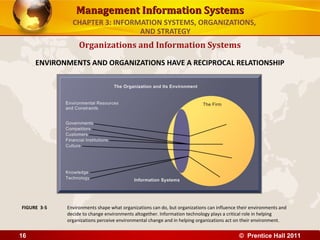
• Organizational environments:
     • Organizations and environments have a reciprocal
       relationship
     • Organizations are open to, and dependent on, the
       social and physical environment
     • Organizations can influence their environments
     • Environments generally change faster than
       organizations
     • Information systems can be an instrument of
       environmental scanning, act as a lens
15                                                   © Prentice Hall 2011
Management Information Systems
               CHAPTER 3: INFORMATION SYSTEMS, ORGANIZATIONS,
                                AND STRATEGY
                  Organizations and Information Systems
     ENVIRONMENTS AND ORGANIZATIONS HAVE A RECIPROCAL RELATIONSHIP


FIGURE 3-5   Environments shape what organizations can do, but organizations can influence their environments and
             decide to change environments altogether. Information technology plays a critical role in helping
             organizations perceive environmental change and in helping organizations act on their environment.


16                                                                                         © Prentice Hall 2011
Management Information Systems
           CHAPTER 3: INFORMATION SYSTEMS, ORGANIZATIONS,
                            AND STRATEGY
             Organizations and Information Systems


• Disruptive technologies
     – Technology that brings about sweeping change
       to businesses, industries, markets
     – Examples: personal computers, word processing
       software, the Internet, the PageRank algorithm
     – First movers and fast followers
        • First movers – inventors of disruptive
          technologies
        • Fast followers – firms with the size and
          resources to capitalize on that technology
17                                                  © Prentice Hall 2011
Management Information Systems
             CHAPTER 3: INFORMATION SYSTEMS, ORGANIZATIONS,
                              AND STRATEGY
               Organizations and Information Systems


• 5 basic kinds of organizational structure
     – Entrepreneurial:
        • Small start-up business
     – Machine bureaucracy:
        • Midsize manufacturing firm
     – Divisionalized bureaucracy:
        • Fortune 500 firms
     – Professional bureaucracy:
        • Law firms, school systems, hospitals
     – Adhocracy:
        • Consulting firms

18                                                    © Prentice Hall 2011
Management Information Systems
          CHAPTER 3: INFORMATION SYSTEMS, ORGANIZATIONS,
                           AND STRATEGY
           Organizations and Information Systems


• Other organizational features
     – Goals
     – Constituencies
     – Leadership styles
     – Tasks
     – Surrounding environments

19                                                 © Prentice Hall 2011
Management Information Systems
             CHAPTER 3: INFORMATION SYSTEMS, ORGANIZATIONS,
                              AND STRATEGY
How Information Systems Impact Organizations and Business Firms


• Economic impacts
     – IT changes relative costs of capital and the costs of
       information
     – Information systems technology is a factor of
       production, like capital and labor
     – IT affects the cost and quality of information and
       changes economics of information
        • Information technology helps firms contract in size
          because it can reduce transaction costs (the cost of
          participating in markets)
           – Outsourcing

20                                                    © Prentice Hall 2011
Management Information Systems
            CHAPTER 3: INFORMATION SYSTEMS, ORGANIZATIONS,
                             AND STRATEGY
How Information Systems Impact Organizations and Business Firms


• Transaction cost theory
     – Firms seek to economize on transaction
       costs (the costs of participating in markets)
         • Vertical integration, hiring more
           employees, buying suppliers and
           distributors
     – IT lowers market transaction costs for a
       firm, making it worthwhile for firms to
       transact with other firms rather than grow
       the number of employees
21                                                   © Prentice Hall 2011
Management Information Systems
                   CHAPTER 3: INFORMATION SYSTEMS, ORGANIZATIONS,
                                    AND STRATEGY
How Information Systems Impact Organizations and Business Firms
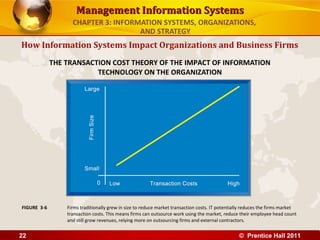
             THE TRANSACTION COST THEORY OF THE IMPACT OF INFORMATION
                         TECHNOLOGY ON THE ORGANIZATION


FIGURE 3-6       Firms traditionally grew in size to reduce market transaction costs. IT potentially reduces the firms market
                 transaction costs. This means firms can outsource work using the market, reduce their employee head count
                 and still grow revenues, relying more on outsourcing firms and external contractors.


22                                                                                                © Prentice Hall 2011
Management Information Systems
            CHAPTER 3: INFORMATION SYSTEMS, ORGANIZATIONS,
                             AND STRATEGY
How Information Systems Impact Organizations and Business Firms


• Agency theory:
     – Firm is nexus of contracts among self-interested
       parties requiring supervision
     – Firms experience agency costs (the cost of
       managing and supervising) which rise as firm
       grows
     – IT can reduce agency costs, making it possible for
       firms to grow without adding to the costs of
       supervising, and without adding employees


23                                                   © Prentice Hall 2011
Management Information Systems
               CHAPTER 3: INFORMATION SYSTEMS, ORGANIZATIONS,
                                AND STRATEGY
How Information Systems Impact Organizations and Business Firms
              THE AGENCY THEORY OF THE IMPACT OF INFORMATION
                     TECHNOLOGY ON THE ORGANIZATION


      FIGURE 3-7      As firms grow in size and complexity, traditionally they experience rising agency costs.

24                                                                                        © Prentice Hall 2011
Management Information Systems
            CHAPTER 3: INFORMATION SYSTEMS, ORGANIZATIONS,
                             AND STRATEGY
How Information Systems Impact Organizations and Business Firms


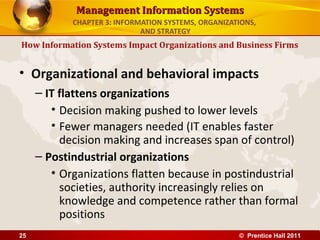
• Organizational and behavioral impacts
     – IT flattens organizations
        • Decision making pushed to lower levels
        • Fewer managers needed (IT enables faster
          decision making and increases span of control)
     – Postindustrial organizations
        • Organizations flatten because in postindustrial
          societies, authority increasingly relies on
          knowledge and competence rather than formal
          positions
25                                                   © Prentice Hall 2011
Management Information Systems
                        CHAPTER 3: INFORMATION SYSTEMS, ORGANIZATIONS,
                                         AND STRATEGY
How Information Systems Impact Organizations and Business Firms

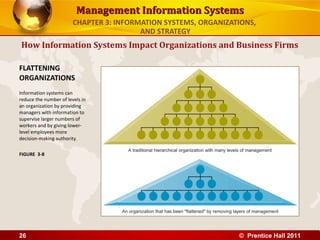
FLATTENING
ORGANIZATIONS
Information systems can
reduce the number of levels in
an organization by providing
managers with information to
supervise larger numbers of
workers and by giving lower-
level employees more
decision-making authority.

FIGURE 3-8


26                                                               © Prentice Hall 2011
Management Information Systems
            CHAPTER 3: INFORMATION SYSTEMS, ORGANIZATIONS,
                             AND STRATEGY
How Information Systems Impact Organizations and Business Firms


• Organizational resistance to change
     – Information systems become bound up in
       organizational politics because they influence
       access to a key resource – information
     – Information systems potentially change an
       organization’s structure, culture, politics, and
       work
     – Most common reason for failure of large projects
       is due to organizational and political resistance
       to change
27                                                   © Prentice Hall 2011
Management Information Systems
                        CHAPTER 3: INFORMATION SYSTEMS, ORGANIZATIONS,
                                         AND STRATEGY
How Information Systems Impact Organizations and Business Firms

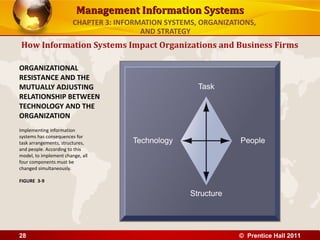
ORGANIZATIONAL
RESISTANCE AND THE
MUTUALLY ADJUSTING
RELATIONSHIP BETWEEN
TECHNOLOGY AND THE
ORGANIZATION
Implementing information
systems has consequences for
task arrangements, structures,
and people. According to this
model, to implement change, all
four components must be
changed simultaneously.

FIGURE 3-9


28                                                               © Prentice Hall 2011
Management Information Systems
            CHAPTER 3: INFORMATION SYSTEMS, ORGANIZATIONS,
                             AND STRATEGY
How Information Systems Impact Organizations and Business Firms


• The Internet and organizations
     – The Internet increases the accessibility, storage,
       and distribution of information and knowledge
       for organizations
     – The Internet can greatly lower transaction and
       agency costs
        • Example: Large firm delivers internal manuals
          to employees via a corporate Web site, saving
          millions of dollars in distribution costs


29                                                   © Prentice Hall 2011
Management Information Systems
             CHAPTER 3: INFORMATION SYSTEMS, ORGANIZATIONS,
                              AND STRATEGY
How Information Systems Impact Organizations and Business Firms


• Central organizational factors to consider when
  planning a new system:
     – Environment
     – Structure
        • Hierarchy, specialization, routines, business processes
     – Culture and politics
     – Type of organization and style of leadership
     – Main interest groups affected by system; attitudes of
       end users
     – Tasks, decisions, and business processes the system
       will assist
30                                                    © Prentice Hall 2011
Management Information Systems
              CHAPTER 3: INFORMATION SYSTEMS, ORGANIZATIONS,
                               AND STRATEGY
     Using Information Systems to Achieve Competitive Advantage


• Why do some firms become leaders in their industry?
• Michael Porter’s competitive forces model
     – Provides general view of firm, its competitors, and
       environment
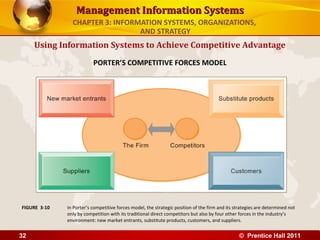
     – Five competitive forces shape fate of firm
        1.   Traditional competitors
        2.   New market entrants
        3.   Substitute products and services
        4.   Customers
        5.   Suppliers

31                                                     © Prentice Hall 2011
Management Information Systems
                CHAPTER 3: INFORMATION SYSTEMS, ORGANIZATIONS,
                                 AND STRATEGY
     Using Information Systems to Achieve Competitive Advantage
                          PORTER’S COMPETITIVE FORCES MODEL


FIGURE 3-10   In Porter’s competitive forces model, the strategic position of the firm and its strategies are determined not
              only by competition with its traditional direct competitors but also by four other forces in the industry’s
              environment: new market entrants, substitute products, customers, and suppliers.


32                                                                                               © Prentice Hall 2011
Management Information Systems
             CHAPTER 3: INFORMATION SYSTEMS, ORGANIZATIONS,
                              AND STRATEGY
     Using Information Systems to Achieve Competitive Advantage


• Traditional competitors
     – All firms share market space with competitors who
       are continuously devising new products, services,
       efficiencies, switching costs
• New market entrants
     – Some industries have high barriers to entry, e.g.
       computer chip business
     – New companies have new equipment, younger
       workers, but little brand recognition


33                                                    © Prentice Hall 2011
Management Information Systems
             CHAPTER 3: INFORMATION SYSTEMS, ORGANIZATIONS,
                              AND STRATEGY
     Using Information Systems to Achieve Competitive Advantage


• Substitute products and services
     – Substitutes customers might use if your prices
       become too high, e.g. iTunes substitutes for CDs
• Customers
     – Can customers easily switch to competitor’s
       products? Can they force businesses to compete on
       price alone in transparent marketplace?
• Suppliers
     – Market power of suppliers when firm cannot raise
       prices as fast as suppliers
34                                                    © Prentice Hall 2011
Management Information Systems
             CHAPTER 3: INFORMATION SYSTEMS, ORGANIZATIONS,
                              AND STRATEGY
     Using Information Systems to Achieve Competitive Advantage


• Four generic strategies for dealing
  with competitive forces, enabled by
  using IT
     – Low-cost leadership
     – Product differentiation
     – Focus on market niche
     – Strengthen customer and supplier
       intimacy
35                                                    © Prentice Hall 2011
Management Information Systems
             CHAPTER 3: INFORMATION SYSTEMS, ORGANIZATIONS,
                              AND STRATEGY
     Using Information Systems to Achieve Competitive Advantage


• Low-cost leadership
     – Produce products and services at a lower price than
       competitors while enhancing quality and level of
       service
     – Examples: Wal-Mart
• Product differentiation
     – Enable new products or services, greatly change
       customer convenience and experience
     – Examples: Google, Nike, Apple


36                                                    © Prentice Hall 2011
Management Information Systems
             CHAPTER 3: INFORMATION SYSTEMS, ORGANIZATIONS,
                              AND STRATEGY
     Using Information Systems to Achieve Competitive Advantage


• Focus on market niche
     – Use information systems to enable a focused
       strategy on a single market niche; specialize
     – Example: Hilton Hotels
• Strengthen customer and supplier intimacy
     – Use information systems to develop strong ties and
       loyalty with customers and suppliers; increase
       switching costs
     – Example: Netflix, Amazon


37                                                    © Prentice Hall 2011
Management Information Systems
             CHAPTER 3: INFORMATION SYSTEMS, ORGANIZATIONS,
                              AND STRATEGY
     Using Information Systems to Achieve Competitive Advantage


• The Internet’s impact on competitive advantage
     – Transformation, destruction, threat to some
       industries
        • E.g. travel agency, printed encyclopedia, newspaper
     – Competitive forces still at work, but rivalry more
       intense
     – Universal standards allow new rivals, entrants to
       market
     – New opportunities for building brands and loyal
       customer bases

38                                                    © Prentice Hall 2011
Management Information Systems
             CHAPTER 3: INFORMATION SYSTEMS, ORGANIZATIONS,
                              AND STRATEGY
     Using Information Systems to Achieve Competitive Advantage


• Business value chain model
     – Views firm as series of activities that add value to
       products or services
     – Highlights activities where competitive strategies
       can best be applied
        • Primary activities vs. support activities
     – At each stage, determine how information systems
       can improve operational efficiency and improve
       customer and supplier intimacy
     – Utilize benchmarking, industry best practices

39                                                    © Prentice Hall 2011
Management Information Systems
                         CHAPTER 3: INFORMATION SYSTEMS, ORGANIZATIONS,
                                          AND STRATEGY
       Using Information Systems to Achieve Competitive Advantage

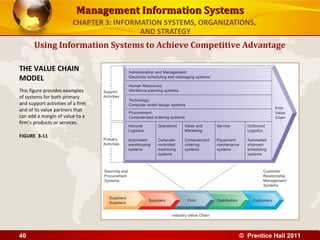
THE VALUE CHAIN
MODEL
This figure provides examples
of systems for both primary
and support activities of a firm
and of its value partners that
can add a margin of value to a
firm’s products or services.

FIGURE 3-11


40                                                                © Prentice Hall 2011
Management Information Systems
             CHAPTER 3: INFORMATION SYSTEMS, ORGANIZATIONS,
                              AND STRATEGY
     Using Information Systems to Achieve Competitive Advantage


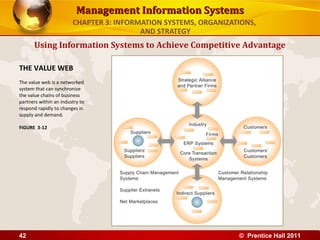
• Value web:
     – Collection of independent firms using
       highly synchronized IT to coordinate
       value chains to produce product or
       service collectively
     – More customer driven, less linear
       operation than traditional value chain


41                                                    © Prentice Hall 2011
Management Information Systems
                        CHAPTER 3: INFORMATION SYSTEMS, ORGANIZATIONS,
                                         AND STRATEGY
      Using Information Systems to Achieve Competitive Advantage

THE VALUE WEB
The value web is a networked
system that can synchronize
the value chains of business
partners within an industry to
respond rapidly to changes in
supply and demand.

FIGURE 3-12


42                                                               © Prentice Hall 2011
Management Information Systems
             CHAPTER 3: INFORMATION SYSTEMS, ORGANIZATIONS,
                              AND STRATEGY
     Using Information Systems to Achieve Competitive Advantage


• Information systems can improve overall
  performance of business units by promoting
  synergies and core competencies
     – Synergies
        • When output of some units used as inputs to
          others, or organizations pool markets and
          expertise
        • Example: merger of Bank of NY and JPMorgan
          Chase
        • Purchase of YouTube by Google
43                                                    © Prentice Hall 2011
Management Information Systems
             CHAPTER 3: INFORMATION SYSTEMS, ORGANIZATIONS,
                              AND STRATEGY
     Using Information Systems to Achieve Competitive Advantage


• Core competencies
     – Activity for which firm is world-class
       leader
     – Relies on knowledge, experience, and
       sharing this across business units
     – Example: Procter & Gamble’s intranet
       and directory of subject matter experts


44                                                    © Prentice Hall 2011
Management Information Systems
             CHAPTER 3: INFORMATION SYSTEMS, ORGANIZATIONS,
                              AND STRATEGY
     Using Information Systems to Achieve Competitive Advantage


• Network-based strategies
     – Take advantage of firm’s abilities to
       network with each other
     – Include use of:
        • Network economics
        • Virtual company model
        • Business ecosystems


45                                                    © Prentice Hall 2011
Management Information Systems
             CHAPTER 3: INFORMATION SYSTEMS, ORGANIZATIONS,
                              AND STRATEGY
     Using Information Systems to Achieve Competitive Advantage


• Traditional economics: Law of diminishing returns
     – The more any given resource is applied to production,
       the lower the marginal gain in output, until a point is
       reached where the additional inputs produce no
       additional outputs
• Network economics:
     – Marginal cost of adding new participant almost zero, with
       much greater marginal gain
     – Value of community grows with size
     – Value of software grows as installed customer base
       grows
46                                                    © Prentice Hall 2011
Management Information Systems
             CHAPTER 3: INFORMATION SYSTEMS, ORGANIZATIONS,
                              AND STRATEGY
     Using Information Systems to Achieve Competitive Advantage


• Virtual company strategy
     – Virtual company uses networks to ally with
       other companies to create and distribute
       products without being limited by traditional
       organizational boundaries or physical
       locations
     – E.g. Li & Fung manages production, shipment
       of garments for major fashion companies,
       outsourcing all work to over 7,500 suppliers


47                                                    © Prentice Hall 2011
Management Information Systems
             CHAPTER 3: INFORMATION SYSTEMS, ORGANIZATIONS,
                              AND STRATEGY
     Using Information Systems to Achieve Competitive Advantage


• Business ecosystems
     – Industry sets of firms providing related services and
       products
        • Microsoft platform used by thousands of firms
        • Wal-Mart’s order entry and inventory management
     – Keystone firms: Dominate ecosystem and create
       platform used by other firms
     – Niche firms: Rely on platform developed by keystone
       firm
     – Individual firms can consider how IT will help them
       become profitable niche players in larger ecosystems
48                                                    © Prentice Hall 2011
Management Information Systems
                CHAPTER 3: INFORMATION SYSTEMS, ORGANIZATIONS,
                                 AND STRATEGY
     Using Information Systems to Achieve Competitive Advantage
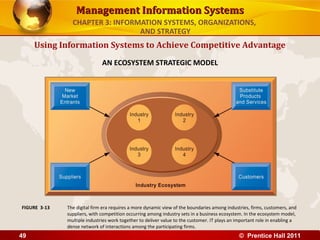
                              AN ECOSYSTEM STRATEGIC MODEL


FIGURE 3-13   The digital firm era requires a more dynamic view of the boundaries among industries, firms, customers, and
              suppliers, with competition occurring among industry sets in a business ecosystem. In the ecosystem model,
              multiple industries work together to deliver value to the customer. IT plays an important role in enabling a
              dense network of interactions among the participating firms.
49                                                                                             © Prentice Hall 2011
Management Information Systems
               CHAPTER 3: INFORMATION SYSTEMS, ORGANIZATIONS,
                                AND STRATEGY
Using Information Systems for Competitive Advantage: Management Issues


  • Sustaining competitive advantage
       – Because competitors can retaliate and copy strategic
         systems, competitive advantage is not always sustainable;
         systems may become tools for survival
  • Performing strategic systems analysis
       – What is structure of industry?
       – What are value chains for this firm?
  • Managing strategic transitions
       – Adopting strategic systems requires changes in business
         goals, relationships with customers and suppliers, and
         business processes
  50                                                    © Prentice Hall 2011

MIS Chapter 3

  • 1.
    Faculty of Economicsand Administrative Sciences Management Information Systems Course Code 51458 by Dr. Muath Asmar
  • 2.
    Management Information Systems MANAGING THE DIGITAL FIRM, 12TH EDITION Chapter 3 INFORMATION SYSTEMS, ORGANIZATIONS, AND STRATEGY
  • 3.
    Management Information Systems CHAPTER 3: INFORMATION SYSTEMS, ORGANIZATIONS, AND STRATEGY Learning Objectives • Identify and describe important features of organizations that managers need to know about in order to build and use information systems successfully. • Demonstrate how Porter’s competitive forces model helps companies develop competitive strategies using information systems. • Explain how the value chain and value web models help businesses identify opportunities for strategic information system applications. 3 © Prentice Hall 2011
  • 4.
    Management Information Systems CHAPTER 3: INFORMATION SYSTEMS, ORGANIZATIONS, AND STRATEGY Learning Objectives (cont.) • Demonstrate how information systems help businesses use synergies, core competencies, and network-based strategies to achieve competitive advantage. • Assess the challenges posed by strategic information systems and management solutions. 4 © Prentice Hall 2011
  • 5.
    Management Information Systems CHAPTER 3: INFORMATION SYSTEMS, ORGANIZATIONS, AND STRATEGY Organizations and Information Systems • Information technology and organizations influence one another – Complex relationship influenced by organization’s • Structure • Business processes • Politics • Culture • Environment, and • Management decisions 5 © Prentice Hall 2011
  • 6.
    Management Information Systems CHAPTER 3: INFORMATION SYSTEMS, ORGANIZATIONS, AND STRATEGY Organizations and Information Systems THE TWO-WAY RELATIONSHIP BETWEEN ORGANIZATIONS AND INFORMATION TECHNOLOGY This complex two-way relationship is mediated by many factors, not the least of which are the decisions made —or not made—by managers. Other factors mediating the relationship include the organizational culture, structure, politics, business processes, and environment. FIGURE 3-1 6 © Prentice Hall 2011
  • 7.
    Management Information Systems CHAPTER 3: INFORMATION SYSTEMS, ORGANIZATIONS, AND STRATEGY Organizations and Information Systems • What is an organization? – Technical definition: • Stable, formal social structure that takes resources from environment and processes them to produce outputs • A formal legal entity with internal rules and procedures, as well as a social structure – Behavioral definition: • A collection of rights, privileges, obligations, and responsibilities that is delicately balanced over a period of time through conflict and conflict resolution 7 © Prentice Hall 2011
  • 8.
    Management Information Systems CHAPTER 3: INFORMATION SYSTEMS, ORGANIZATIONS, AND STRATEGY Organizations and Information Systems THE TECHNICAL MICROECONOMIC DEFINITION OF THE ORGANIZATION FIGURE 3-2 In the microeconomic definition of organizations, capital and labor (the primary production factors provided by the environment) are transformed by the firm through the production process into products and services (outputs to the environment). The products and services are consumed by the environment, which supplies additional capital and labor as inputs in the feedback loop. 8 © Prentice Hall 2011
  • 9.
    Management Information Systems CHAPTER 3: INFORMATION SYSTEMS, ORGANIZATIONS, AND STRATEGY Organizations and Information Systems THE BEHAVIORAL VIEW OF ORGANIZATIONS FIGURE 3-3 The behavioral view of organizations emphasizes group relationships, values, and structures. 9 © Prentice Hall 2011
  • 10.
    Management Information Systems CHAPTER 3: INFORMATION SYSTEMS, ORGANIZATIONS, AND STRATEGY Organizations and Information Systems • Features of organizations • Use of hierarchical structure • Accountability, authority in system of impartial decision making • Adherence to principle of efficiency • Routines and business processes • Organizational politics, culture, environments and structures 10 © Prentice Hall 2011
  • 11.
    Management Information Systems CHAPTER 3: INFORMATION SYSTEMS, ORGANIZATIONS, AND STRATEGY Organizations and Information Systems • Routines and business processes • Routines (standard operating procedures) • Precise rules, procedures, and practices developed to cope with virtually all expected situations • Business processes: Collections of routines • Business firm: Collection of business processes 11 © Prentice Hall 2011
  • 12.
    Management Information Systems CHAPTER 3: INFORMATION SYSTEMS, ORGANIZATIONS, AND STRATEGY Organizations and Information Systems ROUTINES, BUSINESS PROCESSES, AND FIRMS All organizations are composed of individual routines and behaviors, a collection of which make up a business process. A collection of business processes make up the business firm. New information system applications require that individual routines and business processes change to achieve high levels of organizational performance. FIGURE 3-4 12 © Prentice Hall 2011
  • 13.
    Management Information Systems CHAPTER 3: INFORMATION SYSTEMS, ORGANIZATIONS, AND STRATEGY Organizations and Information Systems • Organizational politics • Divergent viewpoints lead to political struggle, competition, and conflict • Political resistance greatly hampers organizational change 13 © Prentice Hall 2011
  • 14.
    Management Information Systems CHAPTER 3: INFORMATION SYSTEMS, ORGANIZATIONS, AND STRATEGY Organizations and Information Systems • Organizational culture: • Encompasses set of assumptions that define goal and product • What products the organization should produce • How and where it should be produced • For whom the products should be produced • May be powerful unifying force as well as restraint on change 14 © Prentice Hall 2011
  • 15.
    Management Information Systems CHAPTER 3: INFORMATION SYSTEMS, ORGANIZATIONS, AND STRATEGY Organizations and Information Systems • Organizational environments: • Organizations and environments have a reciprocal relationship • Organizations are open to, and dependent on, the social and physical environment • Organizations can influence their environments • Environments generally change faster than organizations • Information systems can be an instrument of environmental scanning, act as a lens 15 © Prentice Hall 2011
  • 16.
    Management Information Systems CHAPTER 3: INFORMATION SYSTEMS, ORGANIZATIONS, AND STRATEGY Organizations and Information Systems ENVIRONMENTS AND ORGANIZATIONS HAVE A RECIPROCAL RELATIONSHIP FIGURE 3-5 Environments shape what organizations can do, but organizations can influence their environments and decide to change environments altogether. Information technology plays a critical role in helping organizations perceive environmental change and in helping organizations act on their environment. 16 © Prentice Hall 2011
  • 17.
    Management Information Systems CHAPTER 3: INFORMATION SYSTEMS, ORGANIZATIONS, AND STRATEGY Organizations and Information Systems • Disruptive technologies – Technology that brings about sweeping change to businesses, industries, markets – Examples: personal computers, word processing software, the Internet, the PageRank algorithm – First movers and fast followers • First movers – inventors of disruptive technologies • Fast followers – firms with the size and resources to capitalize on that technology 17 © Prentice Hall 2011
  • 18.
    Management Information Systems CHAPTER 3: INFORMATION SYSTEMS, ORGANIZATIONS, AND STRATEGY Organizations and Information Systems • 5 basic kinds of organizational structure – Entrepreneurial: • Small start-up business – Machine bureaucracy: • Midsize manufacturing firm – Divisionalized bureaucracy: • Fortune 500 firms – Professional bureaucracy: • Law firms, school systems, hospitals – Adhocracy: • Consulting firms 18 © Prentice Hall 2011
  • 19.
    Management Information Systems CHAPTER 3: INFORMATION SYSTEMS, ORGANIZATIONS, AND STRATEGY Organizations and Information Systems • Other organizational features – Goals – Constituencies – Leadership styles – Tasks – Surrounding environments 19 © Prentice Hall 2011
  • 20.
    Management Information Systems CHAPTER 3: INFORMATION SYSTEMS, ORGANIZATIONS, AND STRATEGY How Information Systems Impact Organizations and Business Firms • Economic impacts – IT changes relative costs of capital and the costs of information – Information systems technology is a factor of production, like capital and labor – IT affects the cost and quality of information and changes economics of information • Information technology helps firms contract in size because it can reduce transaction costs (the cost of participating in markets) – Outsourcing 20 © Prentice Hall 2011
  • 21.
    Management Information Systems CHAPTER 3: INFORMATION SYSTEMS, ORGANIZATIONS, AND STRATEGY How Information Systems Impact Organizations and Business Firms • Transaction cost theory – Firms seek to economize on transaction costs (the costs of participating in markets) • Vertical integration, hiring more employees, buying suppliers and distributors – IT lowers market transaction costs for a firm, making it worthwhile for firms to transact with other firms rather than grow the number of employees 21 © Prentice Hall 2011
  • 22.
    Management Information Systems CHAPTER 3: INFORMATION SYSTEMS, ORGANIZATIONS, AND STRATEGY How Information Systems Impact Organizations and Business Firms THE TRANSACTION COST THEORY OF THE IMPACT OF INFORMATION TECHNOLOGY ON THE ORGANIZATION FIGURE 3-6 Firms traditionally grew in size to reduce market transaction costs. IT potentially reduces the firms market transaction costs. This means firms can outsource work using the market, reduce their employee head count and still grow revenues, relying more on outsourcing firms and external contractors. 22 © Prentice Hall 2011
  • 23.
    Management Information Systems CHAPTER 3: INFORMATION SYSTEMS, ORGANIZATIONS, AND STRATEGY How Information Systems Impact Organizations and Business Firms • Agency theory: – Firm is nexus of contracts among self-interested parties requiring supervision – Firms experience agency costs (the cost of managing and supervising) which rise as firm grows – IT can reduce agency costs, making it possible for firms to grow without adding to the costs of supervising, and without adding employees 23 © Prentice Hall 2011
  • 24.
    Management Information Systems CHAPTER 3: INFORMATION SYSTEMS, ORGANIZATIONS, AND STRATEGY How Information Systems Impact Organizations and Business Firms THE AGENCY THEORY OF THE IMPACT OF INFORMATION TECHNOLOGY ON THE ORGANIZATION FIGURE 3-7 As firms grow in size and complexity, traditionally they experience rising agency costs. 24 © Prentice Hall 2011
  • 25.
    Management Information Systems CHAPTER 3: INFORMATION SYSTEMS, ORGANIZATIONS, AND STRATEGY How Information Systems Impact Organizations and Business Firms • Organizational and behavioral impacts – IT flattens organizations • Decision making pushed to lower levels • Fewer managers needed (IT enables faster decision making and increases span of control) – Postindustrial organizations • Organizations flatten because in postindustrial societies, authority increasingly relies on knowledge and competence rather than formal positions 25 © Prentice Hall 2011
  • 26.
    Management Information Systems CHAPTER 3: INFORMATION SYSTEMS, ORGANIZATIONS, AND STRATEGY How Information Systems Impact Organizations and Business Firms FLATTENING ORGANIZATIONS Information systems can reduce the number of levels in an organization by providing managers with information to supervise larger numbers of workers and by giving lower- level employees more decision-making authority. FIGURE 3-8 26 © Prentice Hall 2011
  • 27.
    Management Information Systems CHAPTER 3: INFORMATION SYSTEMS, ORGANIZATIONS, AND STRATEGY How Information Systems Impact Organizations and Business Firms • Organizational resistance to change – Information systems become bound up in organizational politics because they influence access to a key resource – information – Information systems potentially change an organization’s structure, culture, politics, and work – Most common reason for failure of large projects is due to organizational and political resistance to change 27 © Prentice Hall 2011
  • 28.
    Management Information Systems CHAPTER 3: INFORMATION SYSTEMS, ORGANIZATIONS, AND STRATEGY How Information Systems Impact Organizations and Business Firms ORGANIZATIONAL RESISTANCE AND THE MUTUALLY ADJUSTING RELATIONSHIP BETWEEN TECHNOLOGY AND THE ORGANIZATION Implementing information systems has consequences for task arrangements, structures, and people. According to this model, to implement change, all four components must be changed simultaneously. FIGURE 3-9 28 © Prentice Hall 2011
  • 29.
    Management Information Systems CHAPTER 3: INFORMATION SYSTEMS, ORGANIZATIONS, AND STRATEGY How Information Systems Impact Organizations and Business Firms • The Internet and organizations – The Internet increases the accessibility, storage, and distribution of information and knowledge for organizations – The Internet can greatly lower transaction and agency costs • Example: Large firm delivers internal manuals to employees via a corporate Web site, saving millions of dollars in distribution costs 29 © Prentice Hall 2011
  • 30.
    Management Information Systems CHAPTER 3: INFORMATION SYSTEMS, ORGANIZATIONS, AND STRATEGY How Information Systems Impact Organizations and Business Firms • Central organizational factors to consider when planning a new system: – Environment – Structure • Hierarchy, specialization, routines, business processes – Culture and politics – Type of organization and style of leadership – Main interest groups affected by system; attitudes of end users – Tasks, decisions, and business processes the system will assist 30 © Prentice Hall 2011
  • 31.
    Management Information Systems CHAPTER 3: INFORMATION SYSTEMS, ORGANIZATIONS, AND STRATEGY Using Information Systems to Achieve Competitive Advantage • Why do some firms become leaders in their industry? • Michael Porter’s competitive forces model – Provides general view of firm, its competitors, and environment – Five competitive forces shape fate of firm 1. Traditional competitors 2. New market entrants 3. Substitute products and services 4. Customers 5. Suppliers 31 © Prentice Hall 2011
  • 32.
    Management Information Systems CHAPTER 3: INFORMATION SYSTEMS, ORGANIZATIONS, AND STRATEGY Using Information Systems to Achieve Competitive Advantage PORTER’S COMPETITIVE FORCES MODEL FIGURE 3-10 In Porter’s competitive forces model, the strategic position of the firm and its strategies are determined not only by competition with its traditional direct competitors but also by four other forces in the industry’s environment: new market entrants, substitute products, customers, and suppliers. 32 © Prentice Hall 2011
  • 33.
    Management Information Systems CHAPTER 3: INFORMATION SYSTEMS, ORGANIZATIONS, AND STRATEGY Using Information Systems to Achieve Competitive Advantage • Traditional competitors – All firms share market space with competitors who are continuously devising new products, services, efficiencies, switching costs • New market entrants – Some industries have high barriers to entry, e.g. computer chip business – New companies have new equipment, younger workers, but little brand recognition 33 © Prentice Hall 2011
  • 34.
    Management Information Systems CHAPTER 3: INFORMATION SYSTEMS, ORGANIZATIONS, AND STRATEGY Using Information Systems to Achieve Competitive Advantage • Substitute products and services – Substitutes customers might use if your prices become too high, e.g. iTunes substitutes for CDs • Customers – Can customers easily switch to competitor’s products? Can they force businesses to compete on price alone in transparent marketplace? • Suppliers – Market power of suppliers when firm cannot raise prices as fast as suppliers 34 © Prentice Hall 2011
  • 35.
    Management Information Systems CHAPTER 3: INFORMATION SYSTEMS, ORGANIZATIONS, AND STRATEGY Using Information Systems to Achieve Competitive Advantage • Four generic strategies for dealing with competitive forces, enabled by using IT – Low-cost leadership – Product differentiation – Focus on market niche – Strengthen customer and supplier intimacy 35 © Prentice Hall 2011
  • 36.
    Management Information Systems CHAPTER 3: INFORMATION SYSTEMS, ORGANIZATIONS, AND STRATEGY Using Information Systems to Achieve Competitive Advantage • Low-cost leadership – Produce products and services at a lower price than competitors while enhancing quality and level of service – Examples: Wal-Mart • Product differentiation – Enable new products or services, greatly change customer convenience and experience – Examples: Google, Nike, Apple 36 © Prentice Hall 2011
  • 37.
    Management Information Systems CHAPTER 3: INFORMATION SYSTEMS, ORGANIZATIONS, AND STRATEGY Using Information Systems to Achieve Competitive Advantage • Focus on market niche – Use information systems to enable a focused strategy on a single market niche; specialize – Example: Hilton Hotels • Strengthen customer and supplier intimacy – Use information systems to develop strong ties and loyalty with customers and suppliers; increase switching costs – Example: Netflix, Amazon 37 © Prentice Hall 2011
  • 38.
    Management Information Systems CHAPTER 3: INFORMATION SYSTEMS, ORGANIZATIONS, AND STRATEGY Using Information Systems to Achieve Competitive Advantage • The Internet’s impact on competitive advantage – Transformation, destruction, threat to some industries • E.g. travel agency, printed encyclopedia, newspaper – Competitive forces still at work, but rivalry more intense – Universal standards allow new rivals, entrants to market – New opportunities for building brands and loyal customer bases 38 © Prentice Hall 2011
  • 39.
    Management Information Systems CHAPTER 3: INFORMATION SYSTEMS, ORGANIZATIONS, AND STRATEGY Using Information Systems to Achieve Competitive Advantage • Business value chain model – Views firm as series of activities that add value to products or services – Highlights activities where competitive strategies can best be applied • Primary activities vs. support activities – At each stage, determine how information systems can improve operational efficiency and improve customer and supplier intimacy – Utilize benchmarking, industry best practices 39 © Prentice Hall 2011
  • 40.
    Management Information Systems CHAPTER 3: INFORMATION SYSTEMS, ORGANIZATIONS, AND STRATEGY Using Information Systems to Achieve Competitive Advantage THE VALUE CHAIN MODEL This figure provides examples of systems for both primary and support activities of a firm and of its value partners that can add a margin of value to a firm’s products or services. FIGURE 3-11 40 © Prentice Hall 2011
  • 41.
    Management Information Systems CHAPTER 3: INFORMATION SYSTEMS, ORGANIZATIONS, AND STRATEGY Using Information Systems to Achieve Competitive Advantage • Value web: – Collection of independent firms using highly synchronized IT to coordinate value chains to produce product or service collectively – More customer driven, less linear operation than traditional value chain 41 © Prentice Hall 2011
  • 42.
    Management Information Systems CHAPTER 3: INFORMATION SYSTEMS, ORGANIZATIONS, AND STRATEGY Using Information Systems to Achieve Competitive Advantage THE VALUE WEB The value web is a networked system that can synchronize the value chains of business partners within an industry to respond rapidly to changes in supply and demand. FIGURE 3-12 42 © Prentice Hall 2011
  • 43.
    Management Information Systems CHAPTER 3: INFORMATION SYSTEMS, ORGANIZATIONS, AND STRATEGY Using Information Systems to Achieve Competitive Advantage • Information systems can improve overall performance of business units by promoting synergies and core competencies – Synergies • When output of some units used as inputs to others, or organizations pool markets and expertise • Example: merger of Bank of NY and JPMorgan Chase • Purchase of YouTube by Google 43 © Prentice Hall 2011
  • 44.
    Management Information Systems CHAPTER 3: INFORMATION SYSTEMS, ORGANIZATIONS, AND STRATEGY Using Information Systems to Achieve Competitive Advantage • Core competencies – Activity for which firm is world-class leader – Relies on knowledge, experience, and sharing this across business units – Example: Procter & Gamble’s intranet and directory of subject matter experts 44 © Prentice Hall 2011
  • 45.
    Management Information Systems CHAPTER 3: INFORMATION SYSTEMS, ORGANIZATIONS, AND STRATEGY Using Information Systems to Achieve Competitive Advantage • Network-based strategies – Take advantage of firm’s abilities to network with each other – Include use of: • Network economics • Virtual company model • Business ecosystems 45 © Prentice Hall 2011
  • 46.
    Management Information Systems CHAPTER 3: INFORMATION SYSTEMS, ORGANIZATIONS, AND STRATEGY Using Information Systems to Achieve Competitive Advantage • Traditional economics: Law of diminishing returns – The more any given resource is applied to production, the lower the marginal gain in output, until a point is reached where the additional inputs produce no additional outputs • Network economics: – Marginal cost of adding new participant almost zero, with much greater marginal gain – Value of community grows with size – Value of software grows as installed customer base grows 46 © Prentice Hall 2011
  • 47.
    Management Information Systems CHAPTER 3: INFORMATION SYSTEMS, ORGANIZATIONS, AND STRATEGY Using Information Systems to Achieve Competitive Advantage • Virtual company strategy – Virtual company uses networks to ally with other companies to create and distribute products without being limited by traditional organizational boundaries or physical locations – E.g. Li & Fung manages production, shipment of garments for major fashion companies, outsourcing all work to over 7,500 suppliers 47 © Prentice Hall 2011
  • 48.
    Management Information Systems CHAPTER 3: INFORMATION SYSTEMS, ORGANIZATIONS, AND STRATEGY Using Information Systems to Achieve Competitive Advantage • Business ecosystems – Industry sets of firms providing related services and products • Microsoft platform used by thousands of firms • Wal-Mart’s order entry and inventory management – Keystone firms: Dominate ecosystem and create platform used by other firms – Niche firms: Rely on platform developed by keystone firm – Individual firms can consider how IT will help them become profitable niche players in larger ecosystems 48 © Prentice Hall 2011
  • 49.
    Management Information Systems CHAPTER 3: INFORMATION SYSTEMS, ORGANIZATIONS, AND STRATEGY Using Information Systems to Achieve Competitive Advantage AN ECOSYSTEM STRATEGIC MODEL FIGURE 3-13 The digital firm era requires a more dynamic view of the boundaries among industries, firms, customers, and suppliers, with competition occurring among industry sets in a business ecosystem. In the ecosystem model, multiple industries work together to deliver value to the customer. IT plays an important role in enabling a dense network of interactions among the participating firms. 49 © Prentice Hall 2011
  • 50.
    Management Information Systems CHAPTER 3: INFORMATION SYSTEMS, ORGANIZATIONS, AND STRATEGY Using Information Systems for Competitive Advantage: Management Issues • Sustaining competitive advantage – Because competitors can retaliate and copy strategic systems, competitive advantage is not always sustainable; systems may become tools for survival • Performing strategic systems analysis – What is structure of industry? – What are value chains for this firm? • Managing strategic transitions – Adopting strategic systems requires changes in business goals, relationships with customers and suppliers, and business processes 50 © Prentice Hall 2011