Why Security is Needed
Sourov Das
MBA-IT(2014-2016)
14030141080
We Protect:
Business Need First:
ď‚´ Information security performs four important functions for an
organization:
1) Protecting the organization’s ability to function
2) Enabling the safe operation of the applications running on the
organization’s IT systems
3) Protecting the data the organization collects and uses
4) Safeguarding the organization’s technology assets
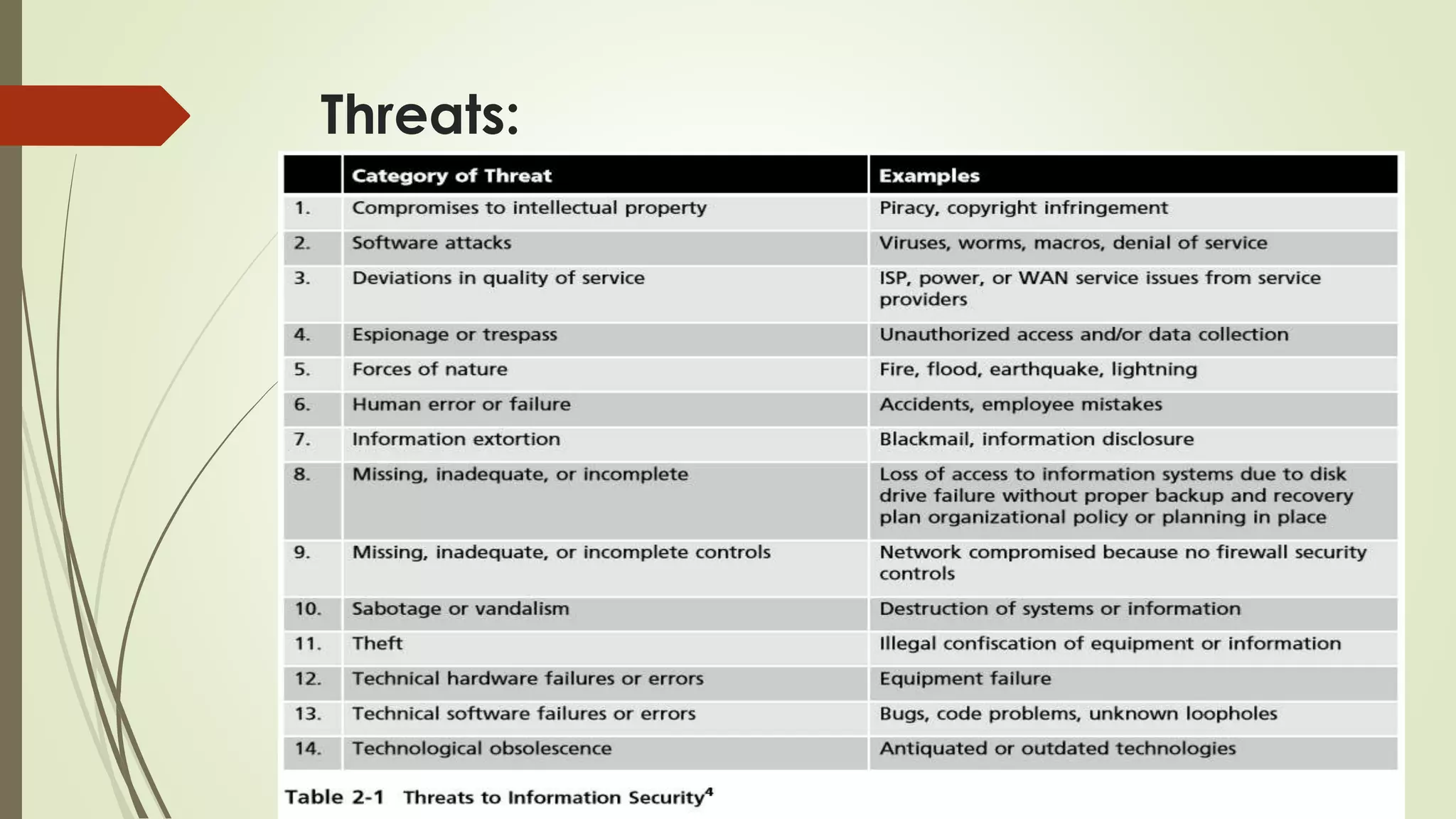
Threats:
Compromises to Intellectual Property:
 Intellectual property is defined as “the ownership of ideas and control over
the tangible or virtual representation of those ideas. Use of another person’s
intellectual property may or may not involve royalty payments or
permission, but should always include proper credit to the source.”
ď‚´ The most common IP breach is the unlawful use or duplication of software-
based intellectual property, more commonly known as software piracy.
Deliberate Software Attacks:
ď‚´ Deliberate software attacks occur when an individual or group designs and deploys
software to attack a system.
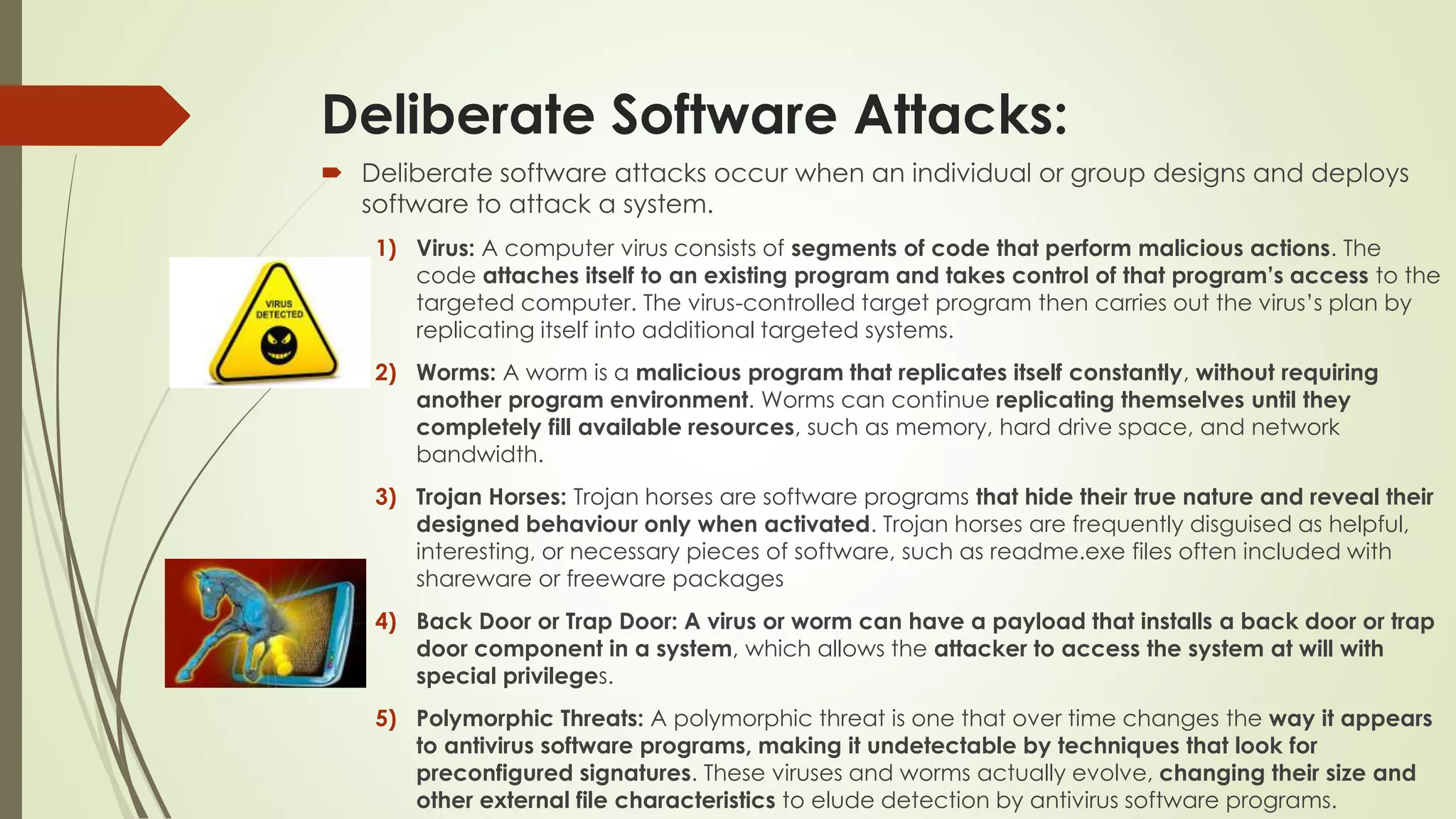
1) Virus: A computer virus consists of segments of code that perform malicious actions. The
code attaches itself to an existing program and takes control of that program’s access to the
targeted computer. The virus-controlled target program then carries out the virus’s plan by
replicating itself into additional targeted systems.
2) Worms: A worm is a malicious program that replicates itself constantly, without requiring
another program environment. Worms can continue replicating themselves until they
completely fill available resources, such as memory, hard drive space, and network
bandwidth.
3) Trojan Horses: Trojan horses are software programs that hide their true nature and reveal their
designed behaviour only when activated. Trojan horses are frequently disguised as helpful,
interesting, or necessary pieces of software, such as readme.exe files often included with
shareware or freeware packages
4) Back Door or Trap Door: A virus or worm can have a payload that installs a back door or trap
door component in a system, which allows the attacker to access the system at will with
special privileges.
5) Polymorphic Threats: A polymorphic threat is one that over time changes the way it appears
to antivirus software programs, making it undetectable by techniques that look for
preconfigured signatures. These viruses and worms actually evolve, changing their size and
other external file characteristics to elude detection by antivirus software programs.
Deviations in Quality of Service:
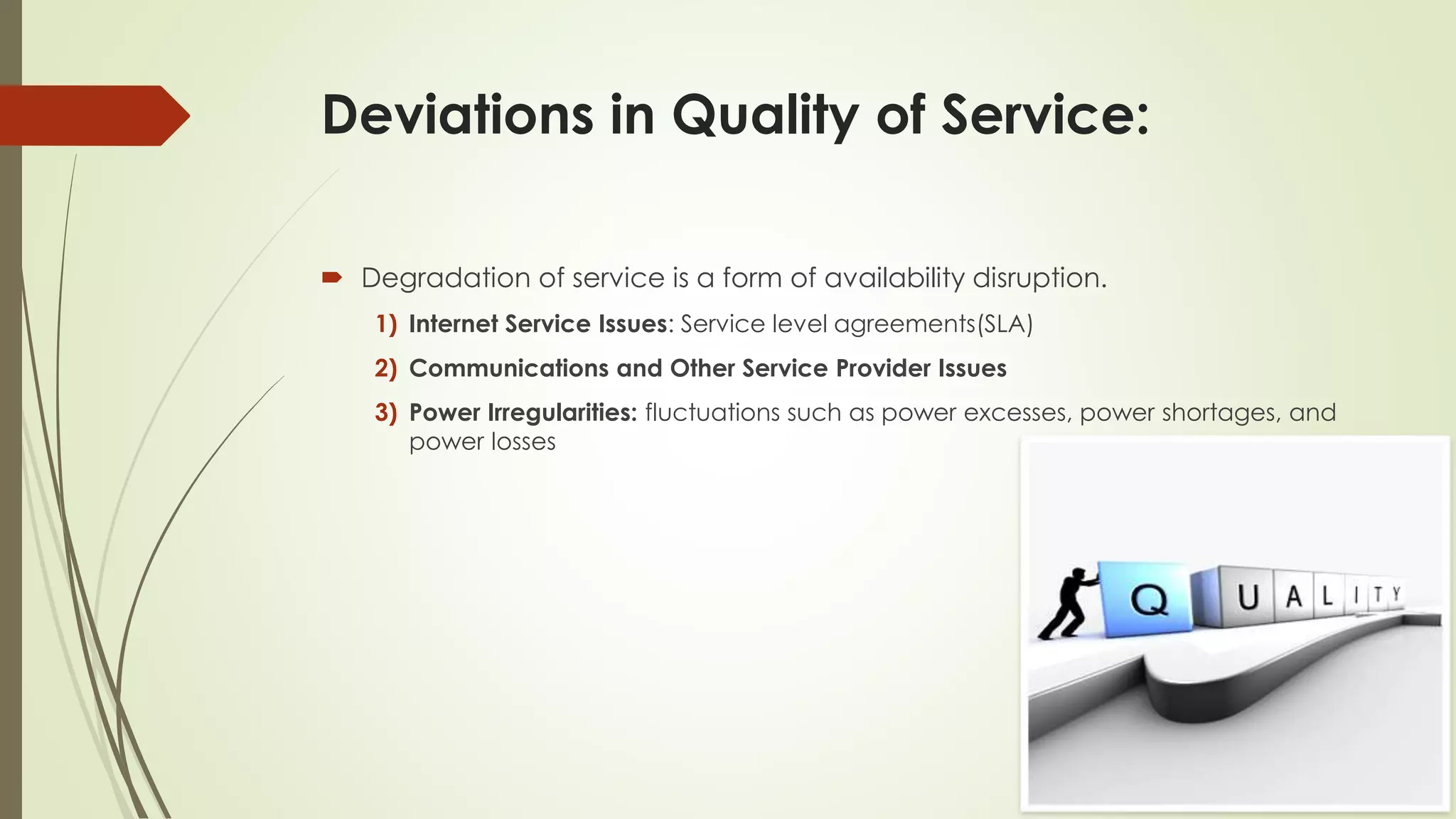
ď‚´ Degradation of service is a form of availability disruption.
1) Internet Service Issues: Service level agreements(SLA)
2) Communications and Other Service Provider Issues
3) Power Irregularities: fluctuations such as power excesses, power shortages, and
power losses
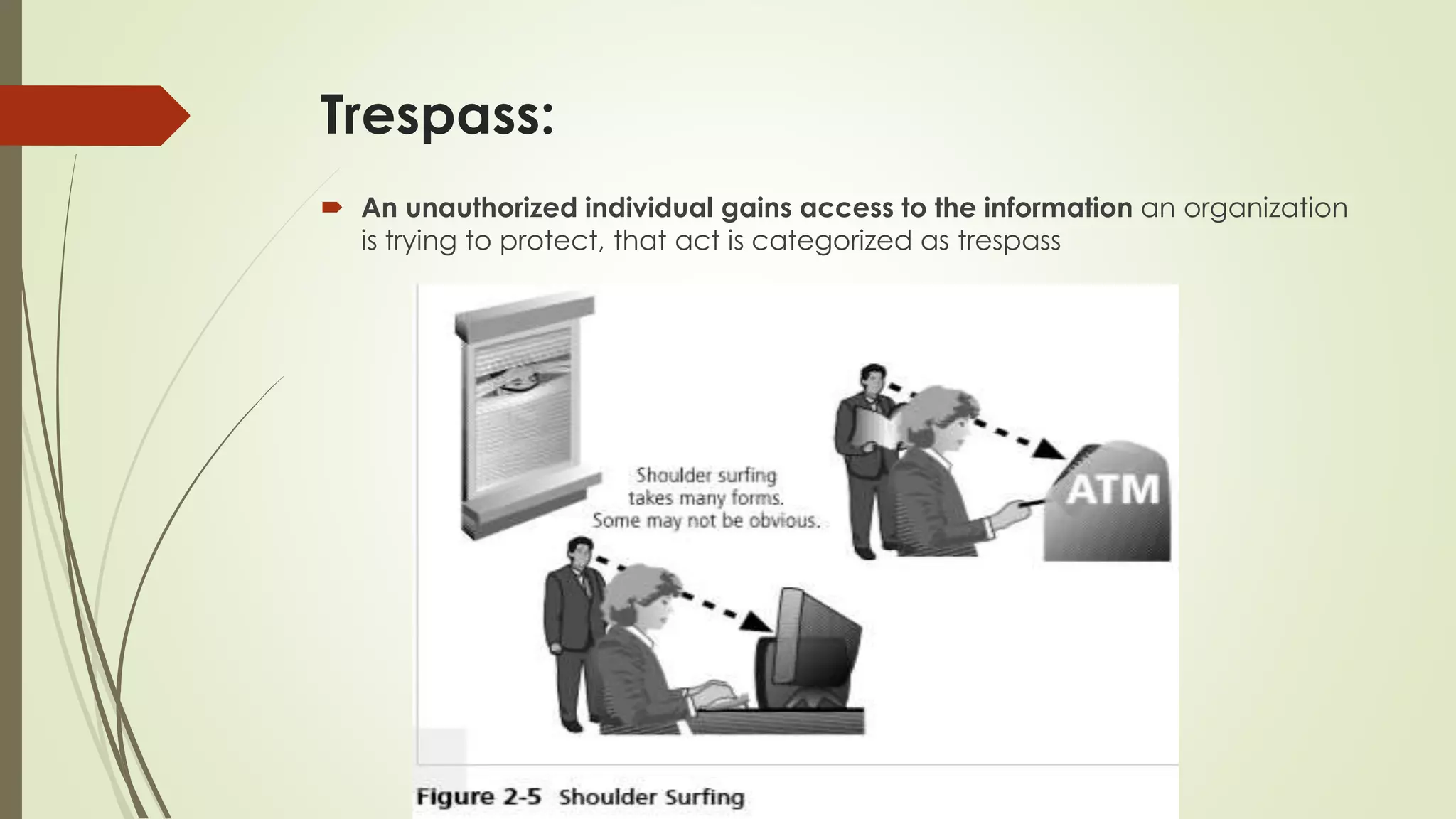
Trespass:
ď‚´ An unauthorized individual gains access to the information an organization
is trying to protect, that act is categorized as trespass
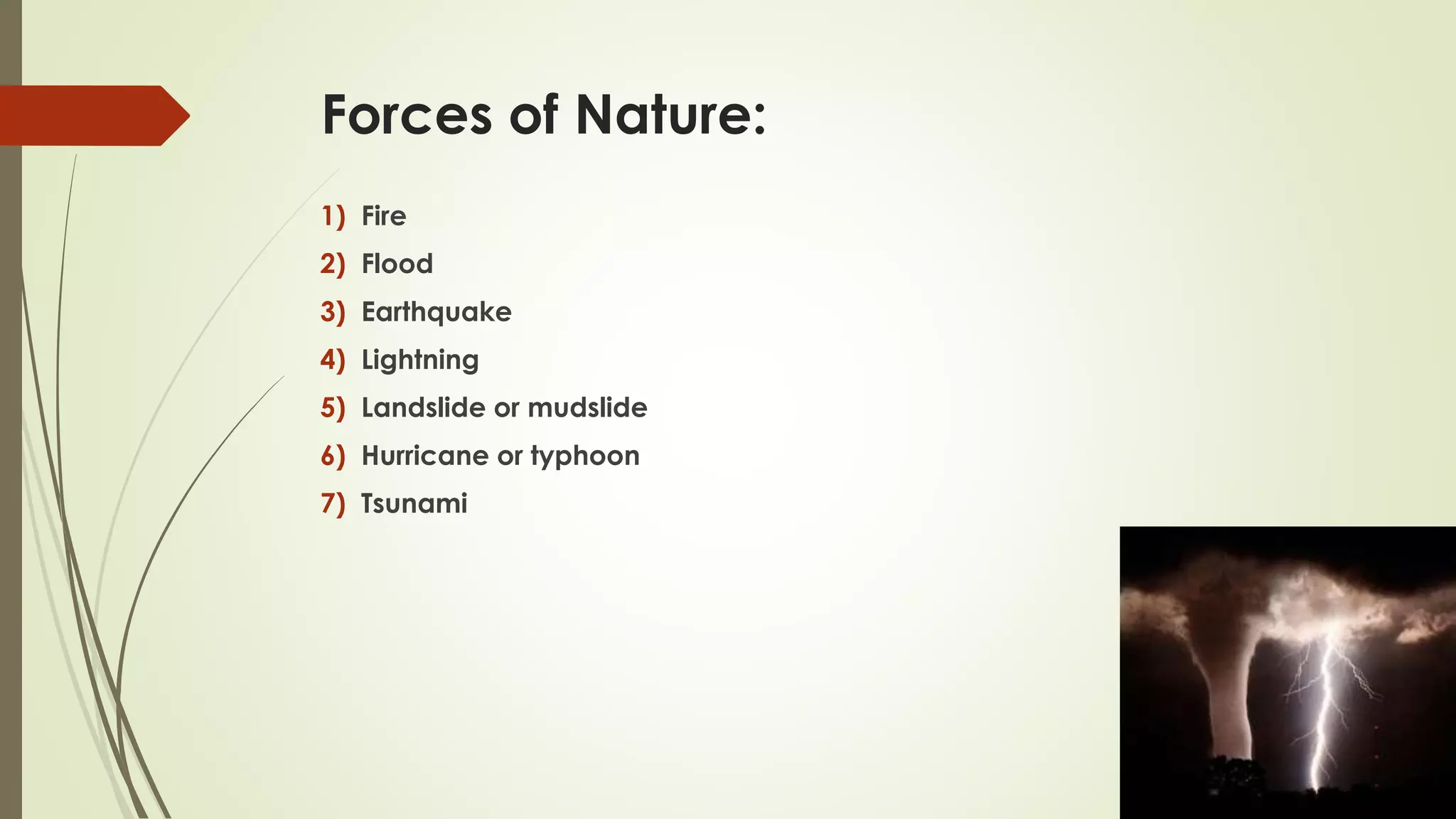
Forces of Nature:
1) Fire
2) Flood
3) Earthquake
4) Lightning
5) Landslide or mudslide
6) Hurricane or typhoon
7) Tsunami
Human Error or
Failure:
ď‚´ Acts performed without intent or
malicious purpose by an
authorized user
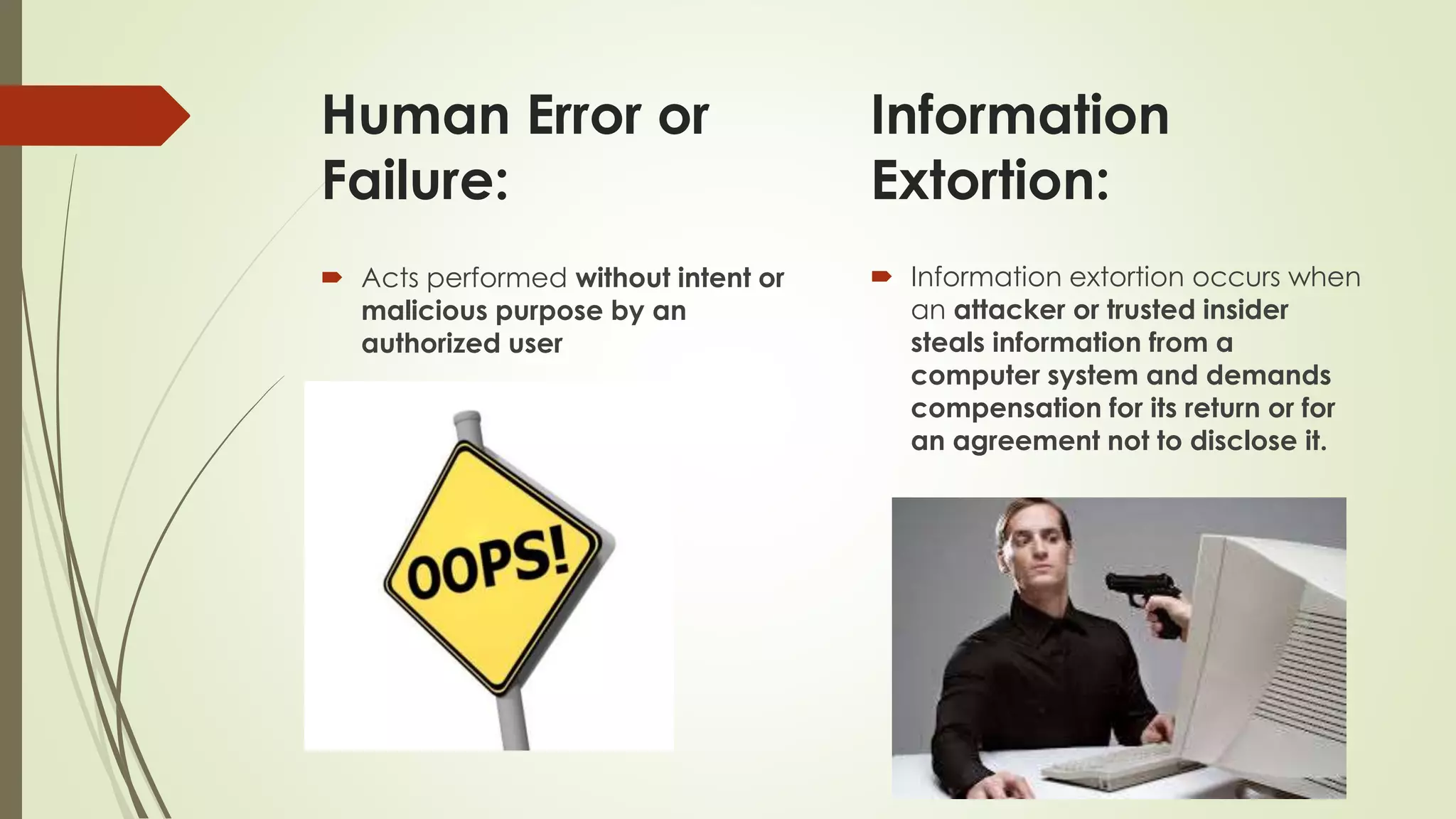
ď‚´ Information extortion occurs when
an attacker or trusted insider
steals information from a
computer system and demands
compensation for its return or for
an agreement not to disclose it.
Information
Extortion:
Missing, inadequate, or Incomplete
Organizational Policy or Planning:
ď‚´ Missing, inadequate, or incomplete organizational policy or planning makes
an organization vulnerable to loss, damage, or disclosure of information
assets when other threats lead to attacks
Sabotage or Vandalism:
ď‚´ This category of threat involves the deliberate sabotage of a computer
system or business, or acts of vandalism to either destroy an asset or
damage the image of an organization. These acts can range from petty
vandalism by employees to organized sabotage against an organization
Theft:
 The threat of theft—the illegal taking of another’s property, which can be
physical, electronic, or intellectual—is a constant.
 The value of information is diminished when it is copied without the owner’s
knowledge
Technical Hardware Failures or Errors:
ď‚´ Technical hardware failures or errors occur when a manufacturer distributes
equipment containing a known or unknown flaw.
Technical Software
failures or Errors:
ď‚´ A system failure occurs when the
delivered service no longer
complies with the specifications,
the latter being an agreed
description of the system's
expected function and/or service
ď‚´ When a technical product or
service is no longer needed or
wanted even though it could still
be in working order.
ď‚´ Technological obsolescence
generally occurs when a new
product has been created to
replace an older version.
Technological
Obsolescence:
Attacks:
1) Malicious Code: The malicious code attack includes the execution of viruses, worms, Trojan
horses, and active Web scripts with the intent to destroy or steal information
2) Back Doors: Using a known or previously unknown and newly discovered access mechanism, an
attacker can gain access to a system or network resource through a back door
3) Password Crack: Attempting to reverse-calculate a password is often called cracking
4) Brute Force: The application of computing and network resources to try every possible password
combination is called a brute force attack
5) Dictionary: The dictionary attack is a variation of the brute force attack which narrows the field
by selecting specific target accounts and using a list of commonly used passwords (the
dictionary) instead of random combinations
6) Denial of Service(DOS) and Distributed Denial of Service(DDOS):
1) In a denial-of-service (DoS) attack, the attacker sends a large number of connection or
information requests to a target. So many requests are made that the target system becomes
overloaded and cannot respond to legitimate requests for service. The system may crash or
simply become unable to perform ordinary functions
2) A distributed denial of-service (DDoS) is an attack in which a coordinated stream of requests is
launched against a target from many locations at the same time
7) Spoofing: Spoofing is a technique used to gain unauthorized access to computers, wherein the
intruder sends messages with a source IP address that has been forged to indicate that the
messages are coming from a trusted host.
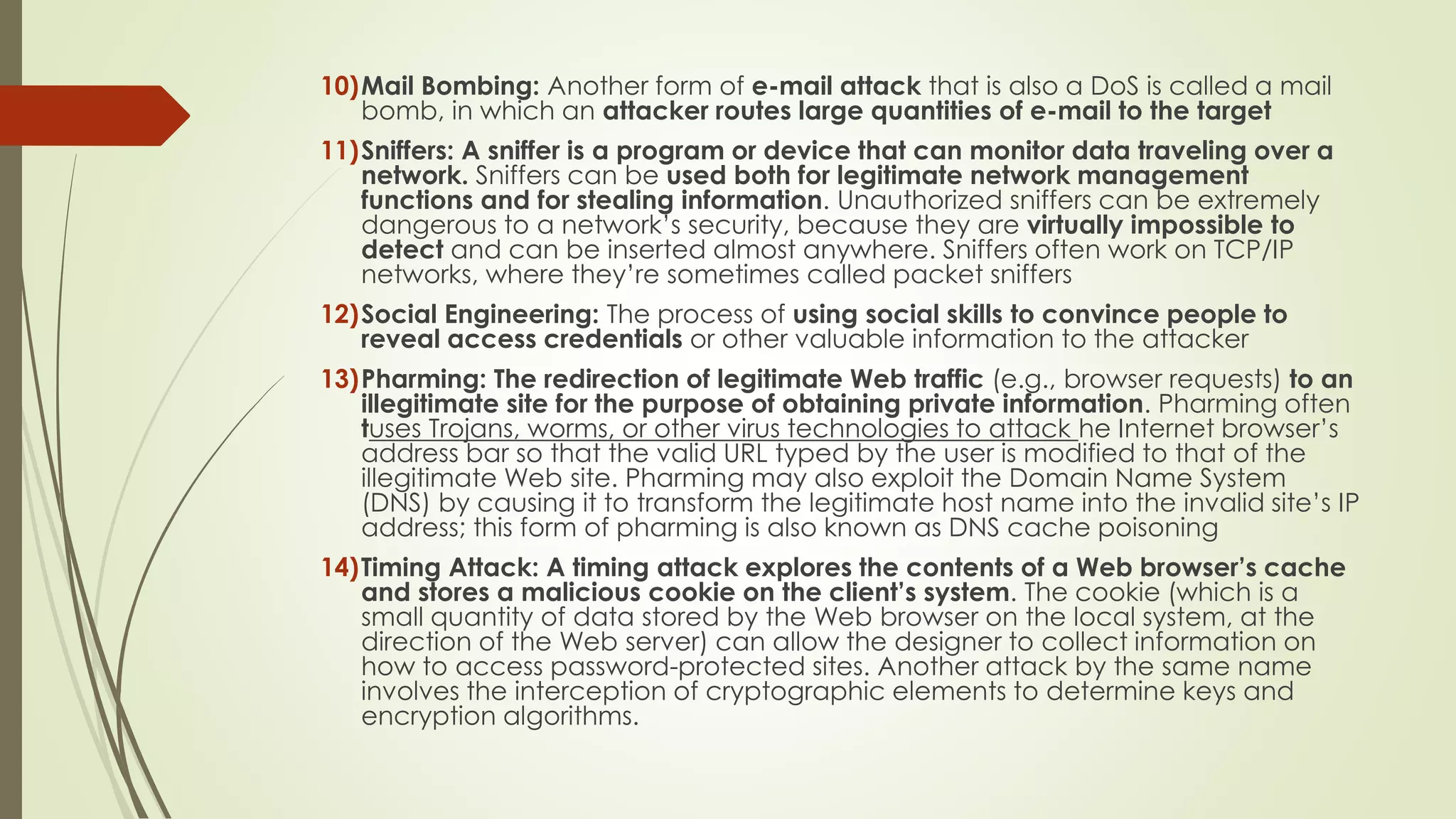
8) Man in the middle or TCP hijacking attack: An attacker monitors (or sniffs)
packets from the network, modifies them, and inserts them back into the
network
9) Spam: Also known as junk email or unsolicited bulk email (UBE). It is used as
a means of enhancing malicious code attack
10)Mail Bombing: Another form of e-mail attack that is also a DoS is called a mail
bomb, in which an attacker routes large quantities of e-mail to the target
11)Sniffers: A sniffer is a program or device that can monitor data traveling over a
network. Sniffers can be used both for legitimate network management
functions and for stealing information. Unauthorized sniffers can be extremely
dangerous to a network’s security, because they are virtually impossible to
detect and can be inserted almost anywhere. Sniffers often work on TCP/IP
networks, where they’re sometimes called packet sniffers
12)Social Engineering: The process of using social skills to convince people to
reveal access credentials or other valuable information to the attacker
13)Pharming: The redirection of legitimate Web traffic (e.g., browser requests) to an
illegitimate site for the purpose of obtaining private information. Pharming often
tuses Trojans, worms, or other virus technologies to attack he Internet browser’s
address bar so that the valid URL typed by the user is modified to that of the
illegitimate Web site. Pharming may also exploit the Domain Name System
(DNS) by causing it to transform the legitimate host name into the invalid site’s IP
address; this form of pharming is also known as DNS cache poisoning
14)Timing Attack: A timing attack explores the contents of a Web browser’s cache
and stores a malicious cookie on the client’s system. The cookie (which is a
small quantity of data stored by the Web browser on the local system, at the
direction of the Web server) can allow the designer to collect information on
how to access password-protected sites. Another attack by the same name
involves the interception of cryptographic elements to determine keys and
encryption algorithms.
Secure Software Development:
ď‚´ The development of systems and the software they use is often accomplished using a
methodology, such as the systems development life cycle (SDLC)
1) Software Assurance and the SA Common Body of knowledge
1) Two basic questions are:
1) What are the engineering activities or aspects of activities that are relevant to achieving secure
software?
2) What knowledge is needed to perform these activities or aspects?
2) Software Design principles
1) Software Development Security Problem
1) Buffer Overruns
2) Cross-site Scripting
3) Failure to Handle Errors
4) Failure to Protect Network Traffic
5) Failure to Store and Protect Data Securely
6) Improper File Access
7) Information Leakage
8) SQL Injection
9) Poor Usability
why security is needed

why security is needed

  • 1.
    Why Security isNeeded Sourov Das MBA-IT(2014-2016) 14030141080
  • 2.
  • 3.
    Business Need First: Information security performs four important functions for an organization: 1) Protecting the organization’s ability to function 2) Enabling the safe operation of the applications running on the organization’s IT systems 3) Protecting the data the organization collects and uses 4) Safeguarding the organization’s technology assets
  • 4.
  • 5.
    Compromises to IntellectualProperty:  Intellectual property is defined as “the ownership of ideas and control over the tangible or virtual representation of those ideas. Use of another person’s intellectual property may or may not involve royalty payments or permission, but should always include proper credit to the source.”  The most common IP breach is the unlawful use or duplication of software- based intellectual property, more commonly known as software piracy.
  • 6.
    Deliberate Software Attacks: Deliberate software attacks occur when an individual or group designs and deploys software to attack a system. 1) Virus: A computer virus consists of segments of code that perform malicious actions. The code attaches itself to an existing program and takes control of that program’s access to the targeted computer. The virus-controlled target program then carries out the virus’s plan by replicating itself into additional targeted systems. 2) Worms: A worm is a malicious program that replicates itself constantly, without requiring another program environment. Worms can continue replicating themselves until they completely fill available resources, such as memory, hard drive space, and network bandwidth. 3) Trojan Horses: Trojan horses are software programs that hide their true nature and reveal their designed behaviour only when activated. Trojan horses are frequently disguised as helpful, interesting, or necessary pieces of software, such as readme.exe files often included with shareware or freeware packages 4) Back Door or Trap Door: A virus or worm can have a payload that installs a back door or trap door component in a system, which allows the attacker to access the system at will with special privileges. 5) Polymorphic Threats: A polymorphic threat is one that over time changes the way it appears to antivirus software programs, making it undetectable by techniques that look for preconfigured signatures. These viruses and worms actually evolve, changing their size and other external file characteristics to elude detection by antivirus software programs.
  • 7.
    Deviations in Qualityof Service: ď‚´ Degradation of service is a form of availability disruption. 1) Internet Service Issues: Service level agreements(SLA) 2) Communications and Other Service Provider Issues 3) Power Irregularities: fluctuations such as power excesses, power shortages, and power losses
  • 8.
    Trespass: ď‚´ An unauthorizedindividual gains access to the information an organization is trying to protect, that act is categorized as trespass
  • 9.
    Forces of Nature: 1)Fire 2) Flood 3) Earthquake 4) Lightning 5) Landslide or mudslide 6) Hurricane or typhoon 7) Tsunami
  • 10.
    Human Error or Failure: ď‚´Acts performed without intent or malicious purpose by an authorized user ď‚´ Information extortion occurs when an attacker or trusted insider steals information from a computer system and demands compensation for its return or for an agreement not to disclose it. Information Extortion:
  • 11.
    Missing, inadequate, orIncomplete Organizational Policy or Planning: ď‚´ Missing, inadequate, or incomplete organizational policy or planning makes an organization vulnerable to loss, damage, or disclosure of information assets when other threats lead to attacks
  • 12.
    Sabotage or Vandalism: ď‚´This category of threat involves the deliberate sabotage of a computer system or business, or acts of vandalism to either destroy an asset or damage the image of an organization. These acts can range from petty vandalism by employees to organized sabotage against an organization
  • 13.
    Theft:  The threatof theft—the illegal taking of another’s property, which can be physical, electronic, or intellectual—is a constant.  The value of information is diminished when it is copied without the owner’s knowledge
  • 14.
    Technical Hardware Failuresor Errors: ď‚´ Technical hardware failures or errors occur when a manufacturer distributes equipment containing a known or unknown flaw.
  • 15.
    Technical Software failures orErrors: ď‚´ A system failure occurs when the delivered service no longer complies with the specifications, the latter being an agreed description of the system's expected function and/or service ď‚´ When a technical product or service is no longer needed or wanted even though it could still be in working order. ď‚´ Technological obsolescence generally occurs when a new product has been created to replace an older version. Technological Obsolescence:
  • 16.
    Attacks: 1) Malicious Code:The malicious code attack includes the execution of viruses, worms, Trojan horses, and active Web scripts with the intent to destroy or steal information 2) Back Doors: Using a known or previously unknown and newly discovered access mechanism, an attacker can gain access to a system or network resource through a back door 3) Password Crack: Attempting to reverse-calculate a password is often called cracking 4) Brute Force: The application of computing and network resources to try every possible password combination is called a brute force attack 5) Dictionary: The dictionary attack is a variation of the brute force attack which narrows the field by selecting specific target accounts and using a list of commonly used passwords (the dictionary) instead of random combinations 6) Denial of Service(DOS) and Distributed Denial of Service(DDOS): 1) In a denial-of-service (DoS) attack, the attacker sends a large number of connection or information requests to a target. So many requests are made that the target system becomes overloaded and cannot respond to legitimate requests for service. The system may crash or simply become unable to perform ordinary functions 2) A distributed denial of-service (DDoS) is an attack in which a coordinated stream of requests is launched against a target from many locations at the same time 7) Spoofing: Spoofing is a technique used to gain unauthorized access to computers, wherein the intruder sends messages with a source IP address that has been forged to indicate that the messages are coming from a trusted host.
  • 17.
    8) Man inthe middle or TCP hijacking attack: An attacker monitors (or sniffs) packets from the network, modifies them, and inserts them back into the network 9) Spam: Also known as junk email or unsolicited bulk email (UBE). It is used as a means of enhancing malicious code attack
  • 18.
    10)Mail Bombing: Anotherform of e-mail attack that is also a DoS is called a mail bomb, in which an attacker routes large quantities of e-mail to the target 11)Sniffers: A sniffer is a program or device that can monitor data traveling over a network. Sniffers can be used both for legitimate network management functions and for stealing information. Unauthorized sniffers can be extremely dangerous to a network’s security, because they are virtually impossible to detect and can be inserted almost anywhere. Sniffers often work on TCP/IP networks, where they’re sometimes called packet sniffers 12)Social Engineering: The process of using social skills to convince people to reveal access credentials or other valuable information to the attacker 13)Pharming: The redirection of legitimate Web traffic (e.g., browser requests) to an illegitimate site for the purpose of obtaining private information. Pharming often tuses Trojans, worms, or other virus technologies to attack he Internet browser’s address bar so that the valid URL typed by the user is modified to that of the illegitimate Web site. Pharming may also exploit the Domain Name System (DNS) by causing it to transform the legitimate host name into the invalid site’s IP address; this form of pharming is also known as DNS cache poisoning 14)Timing Attack: A timing attack explores the contents of a Web browser’s cache and stores a malicious cookie on the client’s system. The cookie (which is a small quantity of data stored by the Web browser on the local system, at the direction of the Web server) can allow the designer to collect information on how to access password-protected sites. Another attack by the same name involves the interception of cryptographic elements to determine keys and encryption algorithms.
  • 19.
    Secure Software Development: ď‚´The development of systems and the software they use is often accomplished using a methodology, such as the systems development life cycle (SDLC) 1) Software Assurance and the SA Common Body of knowledge 1) Two basic questions are: 1) What are the engineering activities or aspects of activities that are relevant to achieving secure software? 2) What knowledge is needed to perform these activities or aspects? 2) Software Design principles 1) Software Development Security Problem 1) Buffer Overruns 2) Cross-site Scripting 3) Failure to Handle Errors 4) Failure to Protect Network Traffic 5) Failure to Store and Protect Data Securely 6) Improper File Access 7) Information Leakage 8) SQL Injection 9) Poor Usability