Information Systems inInformation Systems in
Business TodayBusiness Today
Chapter 1
VIDEO CASES
Case 1: UPS Global Operations with the DIAD IV
Case 2: Google Data Center Efficiency Best Practices
Instructional Video 1: Green Energy Efficiency in a Data
Center Using Tivoli Architecture
Instructional Video 2: Tour IBM’s Raleigh Data Center
1.2 Copyright © 2016 Pearson Education, Inc.
Management Information Systems
Chapter 1: Information Systems in Global Business Today
• How are information systems transforming business,
and why are they so essential for running and
managing a business today?
• What is an information system? How does it work?
What are its management, organization, and
technology components? Why are complementary
assets essential for ensuring that information
systems provide genuine value for organizations?
• What academic disciplines are used to study
information systems and how does each contribute
to an understanding of information systems?
Learning Objectives
1.3 Copyright © 2016 Pearson Education, Inc.
Management Information Systems
Chapter 1: Information Systems in Global Business Today
• How information systems are transforming
business
– Emerging mobile digital platform
– Growing business use of “big data”
– Growth in cloud computing
• Globalization opportunities
– Internet has drastically reduced costs of operating on
global scale
– Increases in foreign trade, outsourcing
– Presents both challenges and opportunities
The Role of Information Systems in Business Today
1.4 Copyright © 2016 Pearson Education, Inc.
Management Information Systems
Chapter 1: Information Systems in Global Business Today
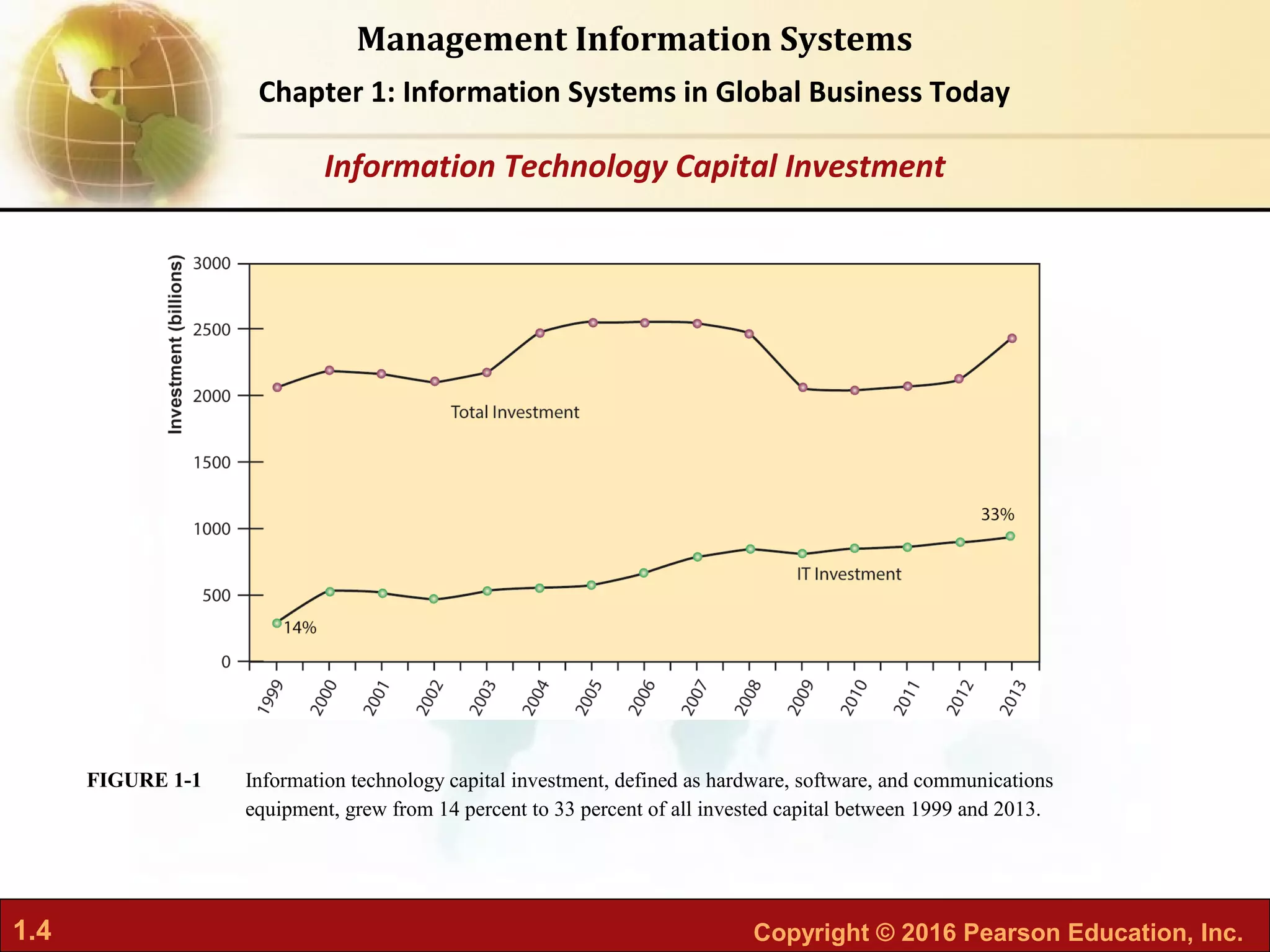
Information technology capital investment, defined as hardware, software, and communications
equipment, grew from 14 percent to 33 percent of all invested capital between 1999 and 2013.
FIGURE 1-1
Information Technology Capital Investment
1.5 Copyright © 2016 Pearson Education, Inc.
Management Information Systems
Chapter 1: Information Systems in Global Business Today
• In the emerging, fully digital firm:
– Significant business relationships are digitally
enabled and mediated.
– Core business processes are accomplished through
digital networks.
– Key corporate assets are managed digitally.
• Digital firms offer greater flexibility in
organization and management.
– Time shifting, space shifting
The Role of Information Systems in Business Today
1.6 Copyright © 2016 Pearson Education, Inc.
Management Information Systems
Chapter 1: Information Systems in Global Business Today
• Growing interdependence
between:
– Ability to use information technology
and
– Ability to implement corporate
strategies and achieve corporate goals
The Role of Information Systems in Business Today
1.7 Copyright © 2016 Pearson Education, Inc.
Management Information Systems
Chapter 1: Information Systems in Global Business Today
• Firms invest heavily in information
systems to achieve six strategic business
objectives:
1. Operational excellence
2. New products, services, and business models
3. Customer and supplier intimacy
4. Improved decision making
5. Competitive advantage
6. Survival
The Role of Information Systems in Business Today
1.8 Copyright © 2016 Pearson Education, Inc.
Management Information Systems
Chapter 1: Information Systems in Global Business Today
In contemporary systems there is a growing interdependence between a firm’s information systems and its
business capabilities. Changes in strategy, rules, and business processes increasingly require changes in
hardware, software, databases, and telecommunications. Often, what the organization would like to do depends
on what its systems will permit it to do.
Figure 1.2
The Interdependence Between Organizations and Information Technology
1.9 Copyright © 2016 Pearson Education, Inc.
Management Information Systems
Chapter 1: Information Systems in Global Business Today
• Operational excellence:
– Improvement of efficiency to attain higher
profitability
– Information systems, technology an important
tool in achieving greater efficiency and
productivity
– Walmart’s Retail Link system links suppliers to
stores for superior replenishment system
The Role of Information Systems in Business Today
1.10 Copyright © 2016 Pearson Education, Inc.
Management Information Systems
Chapter 1: Information Systems in Global Business Today
• New products, services, and business
models:
– Business model: describes how company
produces, delivers, and sells product or service to
create wealth
– Information systems and technology a major
enabling tool for new products, services,
business models
•Examples: Apple’s iPad, Google’s Android OS,
and Netflix
The Role of Information Systems in Business Today
1.11 Copyright © 2016 Pearson Education, Inc.
Management Information Systems
Chapter 1: Information Systems in Global Business Today
• Customer and supplier intimacy:
– Serving customers well leads to customers returning,
which raises revenues and profits.
• Example: High-end hotels that use computers to track
customer preferences and used to monitor and
customize environment
– Intimacy with suppliers allows them to provide vital
inputs, which lowers costs.
• Example: JCPenney’s information system which links
sales records to contract manufacturer
The Role of Information Systems in Business Today
1.12 Copyright © 2016 Pearson Education, Inc.
Management Information Systems
Chapter 1: Information Systems in Global Business Today
• Improved decision making
– Without accurate information:
• Managers must use forecasts, best guesses, luck
• Results in:
– Overproduction, underproduction
– Misallocation of resources
– Poor response times
• Poor outcomes raise costs, lose customers
– Example: Verizon’s Web-based digital dashboard to
provide managers with real-time data on customer
complaints, network performance, line outages, and
so on
The Role of Information Systems in Business Today
1.13 Copyright © 2016 Pearson Education, Inc.
Management Information Systems
Chapter 1: Information Systems in Global Business Today
• Competitive advantage
– Delivering better performance
– Charging less for superior products
– Responding to customers and suppliers in
real time
– Examples: Apple, Walmart, UPS
The Role of Information Systems in Business Today
1.14 Copyright © 2016 Pearson Education, Inc.
Management Information Systems
Chapter 1: Information Systems in Global Business Today
• Survival
– Information technologies as necessity of business
– Industry-level changes
•Example: Citibank’s introduction of ATMs
– Governmental regulations requiring record-
keeping
•Examples: Toxic Substances Control Act,
Sarbanes-Oxley Act
•Dodd-Frank Act
The Role of Information Systems in Business Today
1.15 Copyright © 2016 Pearson Education, Inc.
Management Information Systems
Chapter 1: Information Systems in Global Business Today
• Information system:
– Set of interrelated components
– Collect, process, store, and distribute
information
– Support decision making, coordination, and
control
• Information vs. data
– Data are streams of raw facts.
– Information is data shaped into meaningful form.
What Is an Information System?
1.16 Copyright © 2016 Pearson Education, Inc.
Management Information Systems
Chapter 1: Information Systems in Global Business Today
Raw data from a supermarket checkout counter can be processed and organized to produce meaningful
information, such as the total unit sales of dish detergent or the total sales revenue from dish detergent for a
specific store or sales territory.
Figure 1.3
Data and Information
1.17 Copyright © 2016 Pearson Education, Inc.
Management Information Systems
Chapter 1: Information Systems in Global Business Today
• Three activities of information systems
produce information organizations need
– Input: Captures raw data from organization or
external environment
– Processing: Converts raw data into meaningful
form
– Output: Transfers processed information to
people or activities that use it
What Is an Information System?
1.18 Copyright © 2016 Pearson Education, Inc.
Management Information Systems
Chapter 1: Information Systems in Global Business Today
• Feedback:
– Output is returned to appropriate members of
organization to help evaluate or correct input stage.
• Computer/computer program vs.
information system
– Computers and software are technical foundation
and tools, similar to the material and tools used to
build a house.
What Is an Information System?
1.19 Copyright © 2016 Pearson Education, Inc.
Management Information Systems
Chapter 1: Information Systems in Global Business Today
An information system contains
information about an
organization and its
surrounding environment.
Three basic activities—input,
processing, and output—
produce the information
organizations need. Feedback is
output returned to appropriate
people or activities in the
organization to evaluate and
refine the input. Environmental
actors, such as customers,
suppliers, competitors,
stockholders, and regulatory
agencies, interact with the
organization and its
information systems.
Figure 1.4
Functions of an Information System
1.20 Copyright © 2016 Pearson Education, Inc.
Management Information Systems
Chapter 1: Information Systems in Global Business Today
Using information systems
effectively requires an
understanding of the
organization, management, and
information technology shaping
the systems. An information
system creates value for the
firm as an organizational and
management solution to
challenges posed by the
environment.
Figure 1.5
Information Systems Are More Than Computers
1.21 Copyright © 2016 Pearson Education, Inc.
Management Information Systems
Chapter 1: Information Systems in Global Business Today
• Organizational dimension of information
systems
– Hierarchy of authority, responsibility
•Senior management
•Middle management
•Operational management
•Knowledge workers
•Data workers
•Production or service workers
What Is an Information System?
1.22 Copyright © 2016 Pearson Education, Inc.
Management Information Systems
Chapter 1: Information Systems in Global Business Today
Business organizations are
hierarchies consisting of three
principal levels: senior
management, middle
management, and operational
management. Information
systems serve each of these
levels. Scientists and
knowledge workers often work
with middle management.
Figure 1.6
Levels in a Firm
1.23 Copyright © 2016 Pearson Education, Inc.
Management Information Systems
Chapter 1: Information Systems in Global Business Today
• Organizational dimension of information
systems (cont.)
– Separation of business functions
• Sales and marketing
• Human resources
• Finance and accounting
• Manufacturing and production
– Unique business processes
– Unique business culture
– Organizational politics
What Is an Information System?
1.24 Copyright © 2016 Pearson Education, Inc.
Management Information Systems
Chapter 1: Information Systems in Global Business Today
• Management dimension of information
systems
– Managers set organizational strategy for
responding to business challenges
– In addition, managers must act creatively:
•Creation of new products and services
•Occasionally re-creating the organization
What Is an Information System?
1.25 Copyright © 2016 Pearson Education, Inc.
Management Information Systems
Chapter 1: Information Systems in Global Business Today
• Technology dimension of information
systems
– Computer hardware and software
– Data management technology
– Networking and telecommunications technology
•Networks, the Internet, intranets and
extranets, World Wide Web
– IT infrastructure: provides platform that system
is built on
What Is an Information System?
1.26 Copyright © 2016 Pearson Education, Inc.
Management Information Systems
Chapter 1: Information Systems in Global Business Today
Read the Interactive Session and discuss the following questions
Interactive Session: Organizations
• What are the inputs, processing, and outputs of
UPS’s package tracking system?
• What technologies are used by UPS? How are these
technologies related to UPS’s business strategy?
• What business objectives do UPS’s information
systems address?
• What would happen if these systems were not
available?
UPS COMPETES GLOBALLY WITH I.T.
1.27 Copyright © 2016 Pearson Education, Inc.
Management Information Systems
Chapter 1: Information Systems in Global Business Today
• Dimensions of UPS tracking system
– Organizational:
• Procedures for tracking packages and managing
inventory and provide information
– Management:
• Monitor service levels and costs
– Technology:
• Handheld computers, bar-code scanners, networks,
desktop computers, and so on
What Is an Information System?
1.28 Copyright © 2016 Pearson Education, Inc.
Management Information Systems
Chapter 1: Information Systems in Global Business Today
• Business perspective on information
systems:
– Information system is instrument for creating
value
– Investments in information technology will result
in superior returns:
•Productivity increases
•Revenue increases
•Superior long-term strategic positioning
What Is an Information System?
1.29 Copyright © 2016 Pearson Education, Inc.
Management Information Systems
Chapter 1: Information Systems in Global Business Today
• Business information value chain
– Raw data acquired and transformed through stages
that add value to that information
– Value of information system determined in part by
extent to which it leads to better decisions, greater
efficiency, and higher profits
• Business perspective:
– Calls attention to organizational and managerial
nature of information systems
What Is an Information System?
1.30 Copyright © 2016 Pearson Education, Inc.
Management Information Systems
Chapter 1: Information Systems in Global Business Today
From a business perspective, information systems are part of a series of value-adding activities for acquiring,
transforming, and distributing information that managers can use to improve decision making, enhance
organizational performance, and, ultimately, increase firm profitability.
Figure 1-7
The Business Information Value Chain
1.31 Copyright © 2016 Pearson Education, Inc.
Management Information Systems
Chapter 1: Information Systems in Global Business Today
• Investing in information technology does not
guarantee good returns.
• There is considerable variation in the returns
firms receive from systems investments.
• Factors:
– Adopting the right business model
– Investing in complementary assets (organizational
and management capital)
What Is an Information System?
1.32 Copyright © 2016 Pearson Education, Inc.
Management Information Systems
Chapter 1: Information Systems in Global Business Today
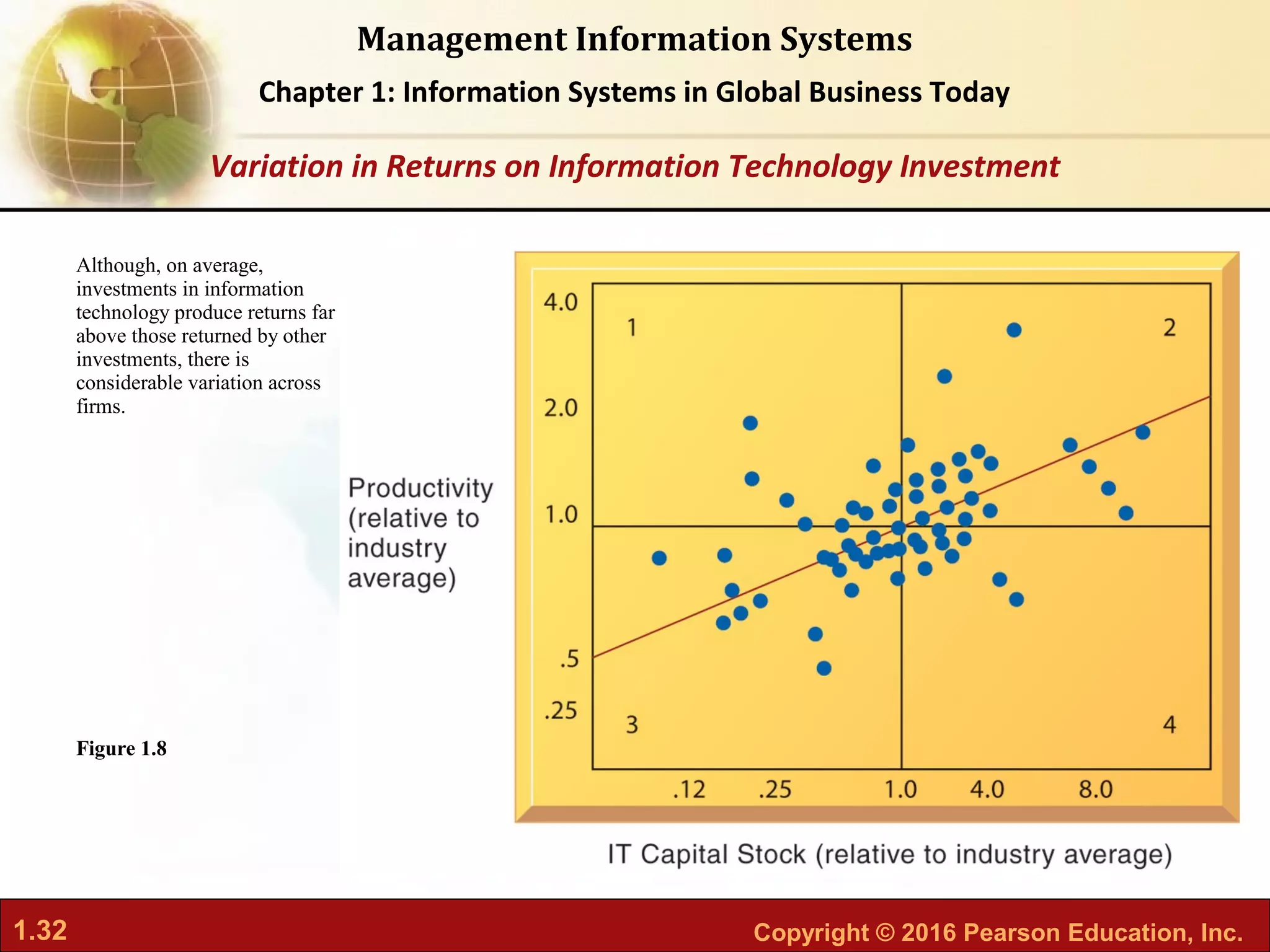
Although, on average,
investments in information
technology produce returns far
above those returned by other
investments, there is
considerable variation across
firms.
Figure 1.8
Variation in Returns on Information Technology Investment
1.33 Copyright © 2016 Pearson Education, Inc.
Management Information Systems
Chapter 1: Information Systems in Global Business Today
• Complementary assets:
– Assets required to derive value from a primary
investment
– Firms supporting technology investments with
investment in complementary assets receive
superior returns
– Example: Invest in technology and the people to
make it work properly
What Is an Information System?
1.34 Copyright © 2016 Pearson Education, Inc.
Management Information Systems
Chapter 1: Information Systems in Global Business Today
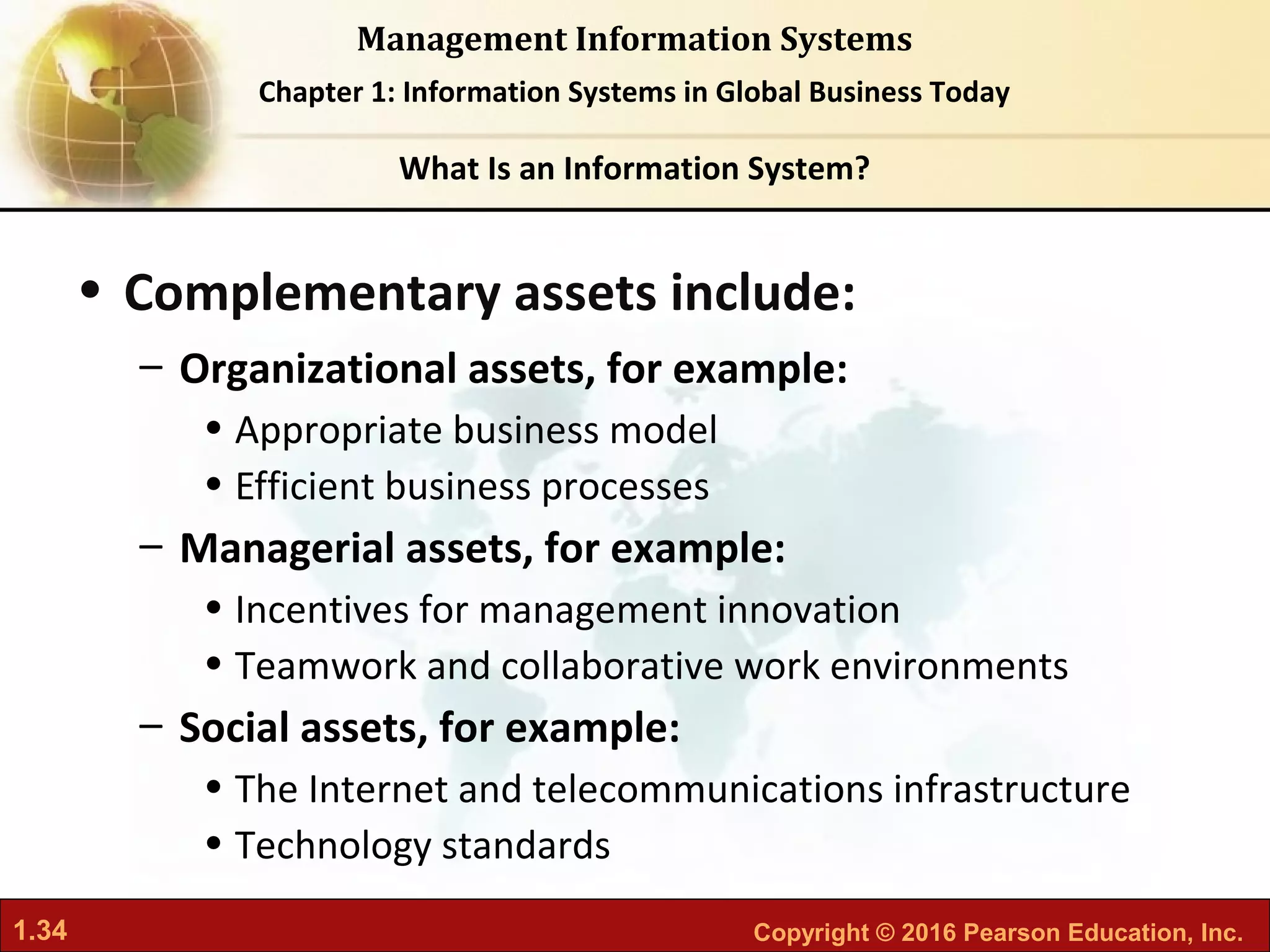
• Complementary assets include:
– Organizational assets, for example:
• Appropriate business model
• Efficient business processes
– Managerial assets, for example:
• Incentives for management innovation
• Teamwork and collaborative work environments
– Social assets, for example:
• The Internet and telecommunications infrastructure
• Technology standards
What Is an Information System?
1.35 Copyright © 2016 Pearson Education, Inc.
Management Information Systems
Chapter 1: Information Systems in Global Business Today
The study of information
systems deals with issues and
insights contributed from
technical and behavioral
disciplines.
Figure 1.9
Contemporary Approaches to Information Systems
1.36 Copyright © 2016 Pearson Education, Inc.
Management Information Systems
Chapter 1: Information Systems in Global Business Today
• Technical approach
– Emphasizes mathematically based models
– Computer science, management science, operations
research
• Behavioral approach
– Behavioral issues (strategic business integration,
implementation, etc.)
– Psychology, economics, sociology
Studying Information Systems
1.37 Copyright © 2016 Pearson Education, Inc.
Management Information Systems
Chapter 1: Information Systems in Global Business Today
• Management Information Systems
– Combines computer science, management science,
operations research, and practical orientation with
behavioral issues
• Four main actors
– Suppliers of hardware and software
– Business firms
– Managers and employees
– Firm’s environment (legal, social, cultural context)
Studying Information Systems
1.38 Copyright © 2016 Pearson Education, Inc.
Management Information Systems
Chapter 1: Information Systems in Global Business Today
• Approach of this book: Sociotechnical view
– Optimal organizational performance achieved by
jointly optimizing both social and technical systems
used in production
– Helps avoid purely technological approach
Studying Information Systems
1.39 Copyright © 2016 Pearson Education, Inc.
Management Information Systems
Chapter 1: Information Systems in Global Business Today
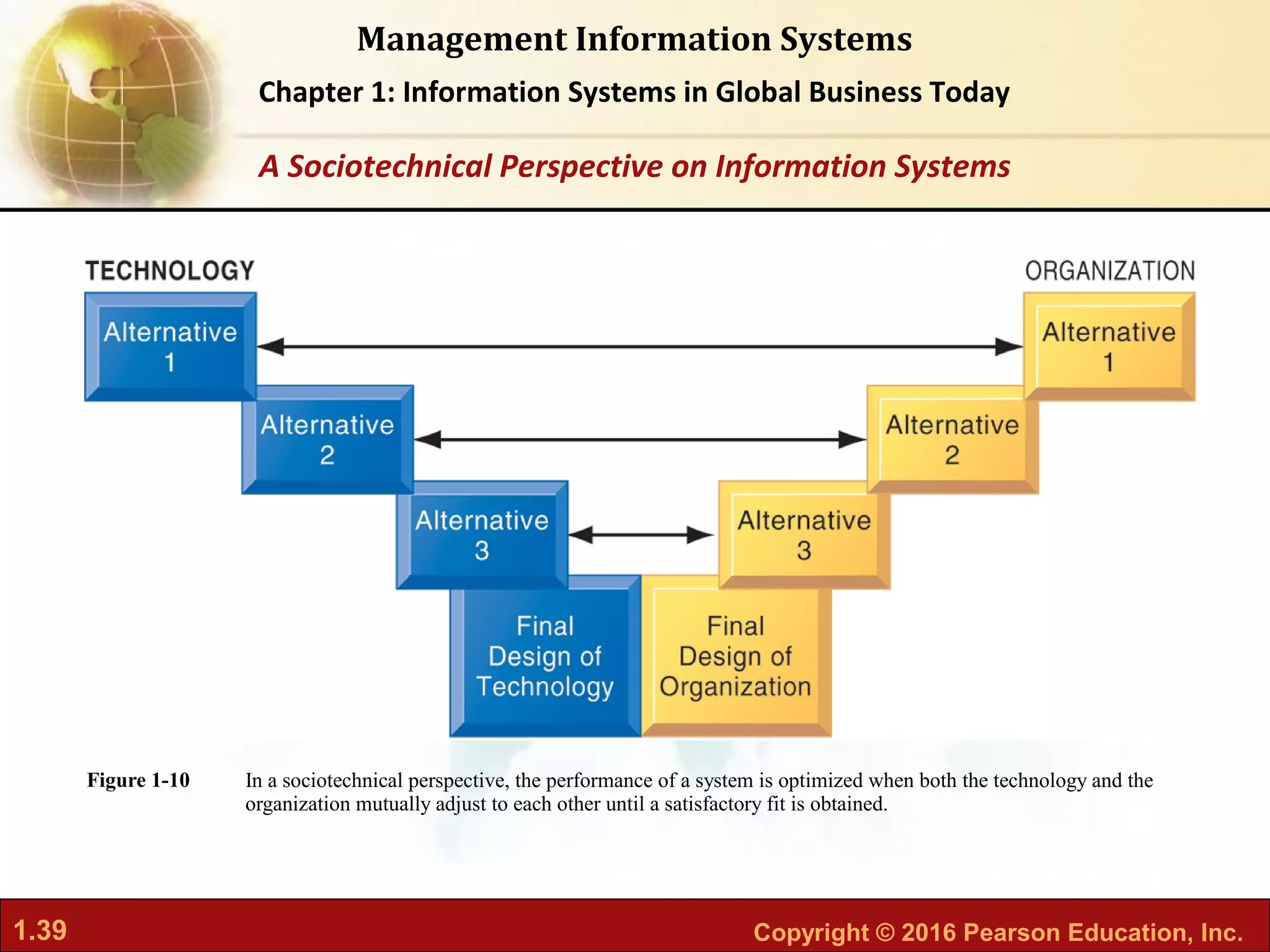
In a sociotechnical perspective, the performance of a system is optimized when both the technology and the
organization mutually adjust to each other until a satisfactory fit is obtained.
Figure 1-10
A Sociotechnical Perspective on Information Systems
1.40 Copyright © 2016 Pearson Education, Inc.
Management Information Systems
Chapter 1: Information Systems in Global Business Today

Laudon mis14 ch01

  • 1.
    Information Systems inInformationSystems in Business TodayBusiness Today Chapter 1 VIDEO CASES Case 1: UPS Global Operations with the DIAD IV Case 2: Google Data Center Efficiency Best Practices Instructional Video 1: Green Energy Efficiency in a Data Center Using Tivoli Architecture Instructional Video 2: Tour IBM’s Raleigh Data Center
  • 2.
    1.2 Copyright ©2016 Pearson Education, Inc. Management Information Systems Chapter 1: Information Systems in Global Business Today • How are information systems transforming business, and why are they so essential for running and managing a business today? • What is an information system? How does it work? What are its management, organization, and technology components? Why are complementary assets essential for ensuring that information systems provide genuine value for organizations? • What academic disciplines are used to study information systems and how does each contribute to an understanding of information systems? Learning Objectives
  • 3.
    1.3 Copyright ©2016 Pearson Education, Inc. Management Information Systems Chapter 1: Information Systems in Global Business Today • How information systems are transforming business – Emerging mobile digital platform – Growing business use of “big data” – Growth in cloud computing • Globalization opportunities – Internet has drastically reduced costs of operating on global scale – Increases in foreign trade, outsourcing – Presents both challenges and opportunities The Role of Information Systems in Business Today
  • 4.
    1.4 Copyright ©2016 Pearson Education, Inc. Management Information Systems Chapter 1: Information Systems in Global Business Today Information technology capital investment, defined as hardware, software, and communications equipment, grew from 14 percent to 33 percent of all invested capital between 1999 and 2013. FIGURE 1-1 Information Technology Capital Investment
  • 5.
    1.5 Copyright ©2016 Pearson Education, Inc. Management Information Systems Chapter 1: Information Systems in Global Business Today • In the emerging, fully digital firm: – Significant business relationships are digitally enabled and mediated. – Core business processes are accomplished through digital networks. – Key corporate assets are managed digitally. • Digital firms offer greater flexibility in organization and management. – Time shifting, space shifting The Role of Information Systems in Business Today
  • 6.
    1.6 Copyright ©2016 Pearson Education, Inc. Management Information Systems Chapter 1: Information Systems in Global Business Today • Growing interdependence between: – Ability to use information technology and – Ability to implement corporate strategies and achieve corporate goals The Role of Information Systems in Business Today
  • 7.
    1.7 Copyright ©2016 Pearson Education, Inc. Management Information Systems Chapter 1: Information Systems in Global Business Today • Firms invest heavily in information systems to achieve six strategic business objectives: 1. Operational excellence 2. New products, services, and business models 3. Customer and supplier intimacy 4. Improved decision making 5. Competitive advantage 6. Survival The Role of Information Systems in Business Today
  • 8.
    1.8 Copyright ©2016 Pearson Education, Inc. Management Information Systems Chapter 1: Information Systems in Global Business Today In contemporary systems there is a growing interdependence between a firm’s information systems and its business capabilities. Changes in strategy, rules, and business processes increasingly require changes in hardware, software, databases, and telecommunications. Often, what the organization would like to do depends on what its systems will permit it to do. Figure 1.2 The Interdependence Between Organizations and Information Technology
  • 9.
    1.9 Copyright ©2016 Pearson Education, Inc. Management Information Systems Chapter 1: Information Systems in Global Business Today • Operational excellence: – Improvement of efficiency to attain higher profitability – Information systems, technology an important tool in achieving greater efficiency and productivity – Walmart’s Retail Link system links suppliers to stores for superior replenishment system The Role of Information Systems in Business Today
  • 10.
    1.10 Copyright ©2016 Pearson Education, Inc. Management Information Systems Chapter 1: Information Systems in Global Business Today • New products, services, and business models: – Business model: describes how company produces, delivers, and sells product or service to create wealth – Information systems and technology a major enabling tool for new products, services, business models •Examples: Apple’s iPad, Google’s Android OS, and Netflix The Role of Information Systems in Business Today
  • 11.
    1.11 Copyright ©2016 Pearson Education, Inc. Management Information Systems Chapter 1: Information Systems in Global Business Today • Customer and supplier intimacy: – Serving customers well leads to customers returning, which raises revenues and profits. • Example: High-end hotels that use computers to track customer preferences and used to monitor and customize environment – Intimacy with suppliers allows them to provide vital inputs, which lowers costs. • Example: JCPenney’s information system which links sales records to contract manufacturer The Role of Information Systems in Business Today
  • 12.
    1.12 Copyright ©2016 Pearson Education, Inc. Management Information Systems Chapter 1: Information Systems in Global Business Today • Improved decision making – Without accurate information: • Managers must use forecasts, best guesses, luck • Results in: – Overproduction, underproduction – Misallocation of resources – Poor response times • Poor outcomes raise costs, lose customers – Example: Verizon’s Web-based digital dashboard to provide managers with real-time data on customer complaints, network performance, line outages, and so on The Role of Information Systems in Business Today
  • 13.
    1.13 Copyright ©2016 Pearson Education, Inc. Management Information Systems Chapter 1: Information Systems in Global Business Today • Competitive advantage – Delivering better performance – Charging less for superior products – Responding to customers and suppliers in real time – Examples: Apple, Walmart, UPS The Role of Information Systems in Business Today
  • 14.
    1.14 Copyright ©2016 Pearson Education, Inc. Management Information Systems Chapter 1: Information Systems in Global Business Today • Survival – Information technologies as necessity of business – Industry-level changes •Example: Citibank’s introduction of ATMs – Governmental regulations requiring record- keeping •Examples: Toxic Substances Control Act, Sarbanes-Oxley Act •Dodd-Frank Act The Role of Information Systems in Business Today
  • 15.
    1.15 Copyright ©2016 Pearson Education, Inc. Management Information Systems Chapter 1: Information Systems in Global Business Today • Information system: – Set of interrelated components – Collect, process, store, and distribute information – Support decision making, coordination, and control • Information vs. data – Data are streams of raw facts. – Information is data shaped into meaningful form. What Is an Information System?
  • 16.
    1.16 Copyright ©2016 Pearson Education, Inc. Management Information Systems Chapter 1: Information Systems in Global Business Today Raw data from a supermarket checkout counter can be processed and organized to produce meaningful information, such as the total unit sales of dish detergent or the total sales revenue from dish detergent for a specific store or sales territory. Figure 1.3 Data and Information
  • 17.
    1.17 Copyright ©2016 Pearson Education, Inc. Management Information Systems Chapter 1: Information Systems in Global Business Today • Three activities of information systems produce information organizations need – Input: Captures raw data from organization or external environment – Processing: Converts raw data into meaningful form – Output: Transfers processed information to people or activities that use it What Is an Information System?
  • 18.
    1.18 Copyright ©2016 Pearson Education, Inc. Management Information Systems Chapter 1: Information Systems in Global Business Today • Feedback: – Output is returned to appropriate members of organization to help evaluate or correct input stage. • Computer/computer program vs. information system – Computers and software are technical foundation and tools, similar to the material and tools used to build a house. What Is an Information System?
  • 19.
    1.19 Copyright ©2016 Pearson Education, Inc. Management Information Systems Chapter 1: Information Systems in Global Business Today An information system contains information about an organization and its surrounding environment. Three basic activities—input, processing, and output— produce the information organizations need. Feedback is output returned to appropriate people or activities in the organization to evaluate and refine the input. Environmental actors, such as customers, suppliers, competitors, stockholders, and regulatory agencies, interact with the organization and its information systems. Figure 1.4 Functions of an Information System
  • 20.
    1.20 Copyright ©2016 Pearson Education, Inc. Management Information Systems Chapter 1: Information Systems in Global Business Today Using information systems effectively requires an understanding of the organization, management, and information technology shaping the systems. An information system creates value for the firm as an organizational and management solution to challenges posed by the environment. Figure 1.5 Information Systems Are More Than Computers
  • 21.
    1.21 Copyright ©2016 Pearson Education, Inc. Management Information Systems Chapter 1: Information Systems in Global Business Today • Organizational dimension of information systems – Hierarchy of authority, responsibility •Senior management •Middle management •Operational management •Knowledge workers •Data workers •Production or service workers What Is an Information System?
  • 22.
    1.22 Copyright ©2016 Pearson Education, Inc. Management Information Systems Chapter 1: Information Systems in Global Business Today Business organizations are hierarchies consisting of three principal levels: senior management, middle management, and operational management. Information systems serve each of these levels. Scientists and knowledge workers often work with middle management. Figure 1.6 Levels in a Firm
  • 23.
    1.23 Copyright ©2016 Pearson Education, Inc. Management Information Systems Chapter 1: Information Systems in Global Business Today • Organizational dimension of information systems (cont.) – Separation of business functions • Sales and marketing • Human resources • Finance and accounting • Manufacturing and production – Unique business processes – Unique business culture – Organizational politics What Is an Information System?
  • 24.
    1.24 Copyright ©2016 Pearson Education, Inc. Management Information Systems Chapter 1: Information Systems in Global Business Today • Management dimension of information systems – Managers set organizational strategy for responding to business challenges – In addition, managers must act creatively: •Creation of new products and services •Occasionally re-creating the organization What Is an Information System?
  • 25.
    1.25 Copyright ©2016 Pearson Education, Inc. Management Information Systems Chapter 1: Information Systems in Global Business Today • Technology dimension of information systems – Computer hardware and software – Data management technology – Networking and telecommunications technology •Networks, the Internet, intranets and extranets, World Wide Web – IT infrastructure: provides platform that system is built on What Is an Information System?
  • 26.
    1.26 Copyright ©2016 Pearson Education, Inc. Management Information Systems Chapter 1: Information Systems in Global Business Today Read the Interactive Session and discuss the following questions Interactive Session: Organizations • What are the inputs, processing, and outputs of UPS’s package tracking system? • What technologies are used by UPS? How are these technologies related to UPS’s business strategy? • What business objectives do UPS’s information systems address? • What would happen if these systems were not available? UPS COMPETES GLOBALLY WITH I.T.
  • 27.
    1.27 Copyright ©2016 Pearson Education, Inc. Management Information Systems Chapter 1: Information Systems in Global Business Today • Dimensions of UPS tracking system – Organizational: • Procedures for tracking packages and managing inventory and provide information – Management: • Monitor service levels and costs – Technology: • Handheld computers, bar-code scanners, networks, desktop computers, and so on What Is an Information System?
  • 28.
    1.28 Copyright ©2016 Pearson Education, Inc. Management Information Systems Chapter 1: Information Systems in Global Business Today • Business perspective on information systems: – Information system is instrument for creating value – Investments in information technology will result in superior returns: •Productivity increases •Revenue increases •Superior long-term strategic positioning What Is an Information System?
  • 29.
    1.29 Copyright ©2016 Pearson Education, Inc. Management Information Systems Chapter 1: Information Systems in Global Business Today • Business information value chain – Raw data acquired and transformed through stages that add value to that information – Value of information system determined in part by extent to which it leads to better decisions, greater efficiency, and higher profits • Business perspective: – Calls attention to organizational and managerial nature of information systems What Is an Information System?
  • 30.
    1.30 Copyright ©2016 Pearson Education, Inc. Management Information Systems Chapter 1: Information Systems in Global Business Today From a business perspective, information systems are part of a series of value-adding activities for acquiring, transforming, and distributing information that managers can use to improve decision making, enhance organizational performance, and, ultimately, increase firm profitability. Figure 1-7 The Business Information Value Chain
  • 31.
    1.31 Copyright ©2016 Pearson Education, Inc. Management Information Systems Chapter 1: Information Systems in Global Business Today • Investing in information technology does not guarantee good returns. • There is considerable variation in the returns firms receive from systems investments. • Factors: – Adopting the right business model – Investing in complementary assets (organizational and management capital) What Is an Information System?
  • 32.
    1.32 Copyright ©2016 Pearson Education, Inc. Management Information Systems Chapter 1: Information Systems in Global Business Today Although, on average, investments in information technology produce returns far above those returned by other investments, there is considerable variation across firms. Figure 1.8 Variation in Returns on Information Technology Investment
  • 33.
    1.33 Copyright ©2016 Pearson Education, Inc. Management Information Systems Chapter 1: Information Systems in Global Business Today • Complementary assets: – Assets required to derive value from a primary investment – Firms supporting technology investments with investment in complementary assets receive superior returns – Example: Invest in technology and the people to make it work properly What Is an Information System?
  • 34.
    1.34 Copyright ©2016 Pearson Education, Inc. Management Information Systems Chapter 1: Information Systems in Global Business Today • Complementary assets include: – Organizational assets, for example: • Appropriate business model • Efficient business processes – Managerial assets, for example: • Incentives for management innovation • Teamwork and collaborative work environments – Social assets, for example: • The Internet and telecommunications infrastructure • Technology standards What Is an Information System?
  • 35.
    1.35 Copyright ©2016 Pearson Education, Inc. Management Information Systems Chapter 1: Information Systems in Global Business Today The study of information systems deals with issues and insights contributed from technical and behavioral disciplines. Figure 1.9 Contemporary Approaches to Information Systems
  • 36.
    1.36 Copyright ©2016 Pearson Education, Inc. Management Information Systems Chapter 1: Information Systems in Global Business Today • Technical approach – Emphasizes mathematically based models – Computer science, management science, operations research • Behavioral approach – Behavioral issues (strategic business integration, implementation, etc.) – Psychology, economics, sociology Studying Information Systems
  • 37.
    1.37 Copyright ©2016 Pearson Education, Inc. Management Information Systems Chapter 1: Information Systems in Global Business Today • Management Information Systems – Combines computer science, management science, operations research, and practical orientation with behavioral issues • Four main actors – Suppliers of hardware and software – Business firms – Managers and employees – Firm’s environment (legal, social, cultural context) Studying Information Systems
  • 38.
    1.38 Copyright ©2016 Pearson Education, Inc. Management Information Systems Chapter 1: Information Systems in Global Business Today • Approach of this book: Sociotechnical view – Optimal organizational performance achieved by jointly optimizing both social and technical systems used in production – Helps avoid purely technological approach Studying Information Systems
  • 39.
    1.39 Copyright ©2016 Pearson Education, Inc. Management Information Systems Chapter 1: Information Systems in Global Business Today In a sociotechnical perspective, the performance of a system is optimized when both the technology and the organization mutually adjust to each other until a satisfactory fit is obtained. Figure 1-10 A Sociotechnical Perspective on Information Systems
  • 40.
    1.40 Copyright ©2016 Pearson Education, Inc. Management Information Systems Chapter 1: Information Systems in Global Business Today