INFORMATION
SYSTEMS SECURITY
AND MANAGEMENT
Learning objectives
• After this discussion you should be able to:
– understand and assess potential threats to a computer-based
information system;
– propose an overall strategy for ensuring the security of a
computer-based information system;
– Explain why information systems need special protection
from destruction, error, and abuse
– Assess the business value of security and control
– Evaluate elements of an organizational and managerial
framework for security and control
Management issues
• From a managerial perspective, this discussion addresses the
following areas:
– An understanding of approaches towards information
systems security will help managers develop and implement
an overall strategy for security.
– An understanding of the threats to information systems will
help in predicting and anticipating acts such as denial of
service attacks.
– Knowledge of specific techniques for protecting information
systems will help in the development of effective
countermeasures.
– As organizations turn to the Internet for business purposes, it
becomes important to understand some of the new threats
that must be faced.
What is Information Security?
Related security concepts
• Authentication: a means to verify that an entity is who it
claims to be for decisions in support of confidentiality
and integrity
• Access Control: a means to enforce which entities have
access to information to support confidentiality and
integrity
• Authorization: a combination of authentication (who)
and access control
• Non-repudiation: integrity of the pair (information,
creator of information)
• Privacy: confidentiality of personal information
• Anonymity: confidentiality of identity
What are the common threats to IS
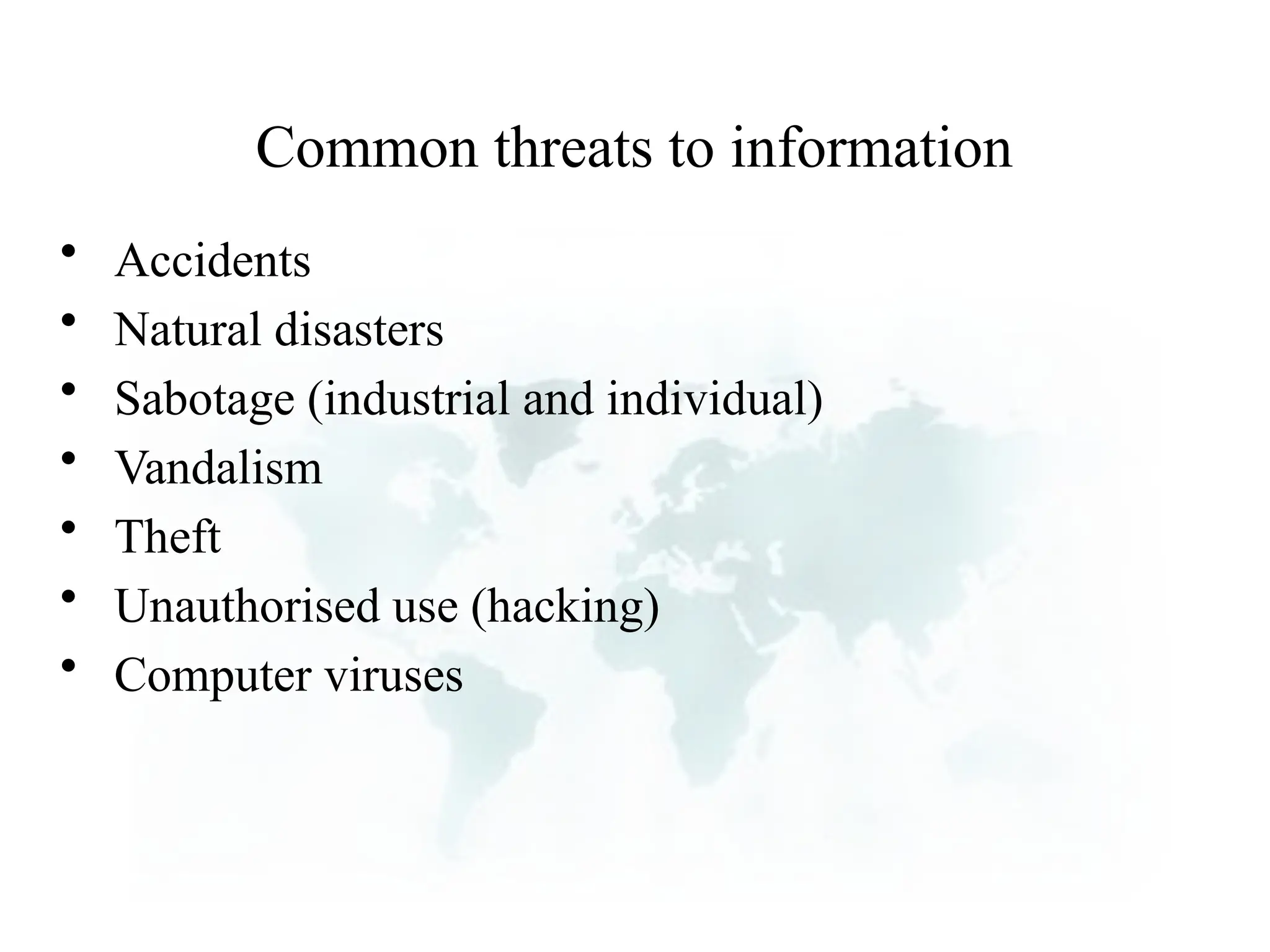
Common threats to information
• Accidents
• Natural disasters
• Sabotage (industrial and individual)
• Vandalism
• Theft
• Unauthorised use (hacking)
• Computer viruses
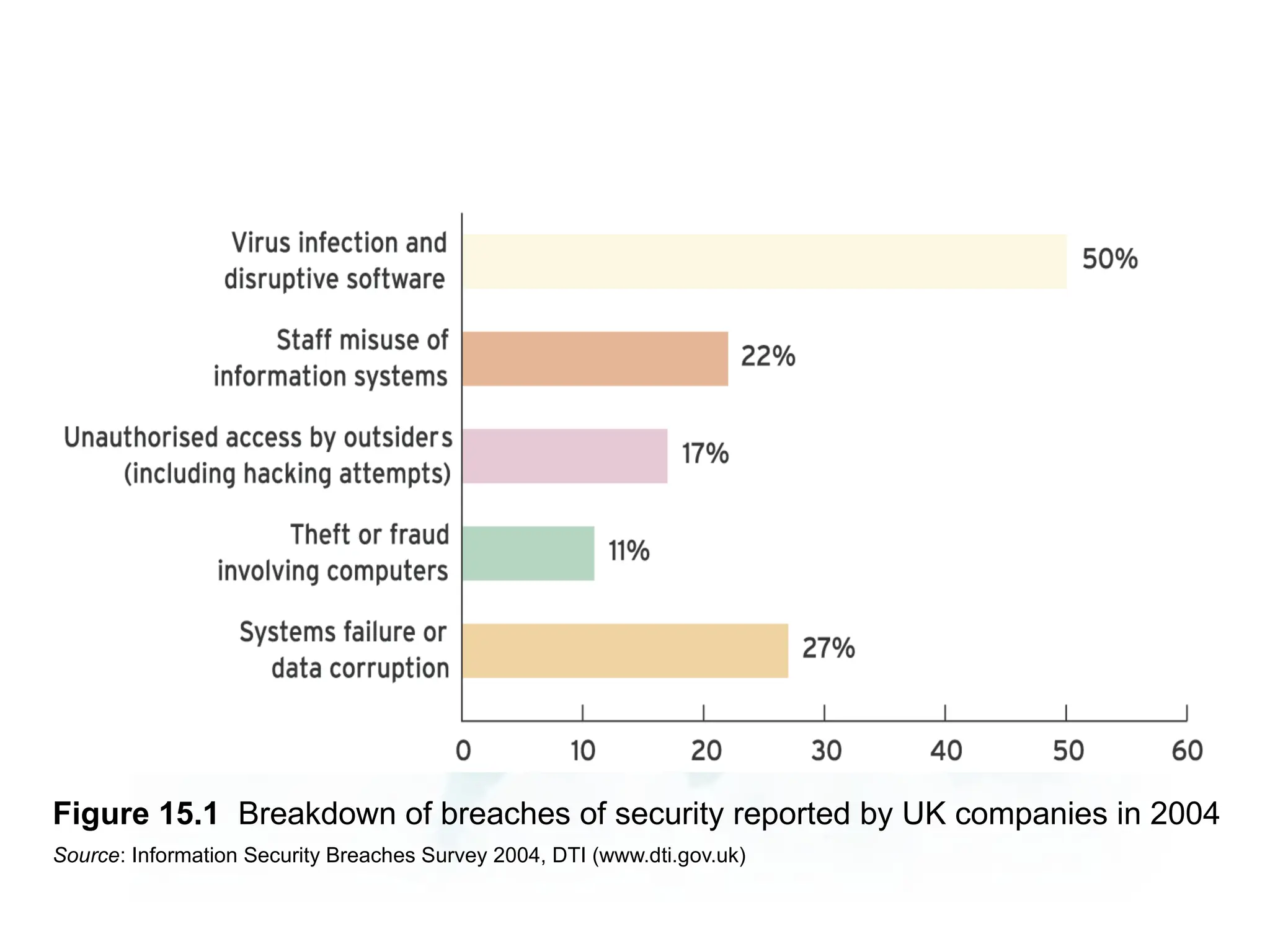
Figure 15.1 Breakdown of breaches of security reported by UK companies in 2004
Source: Information Security Breaches Survey 2004, DTI (www.dti.gov.uk)
Accidents
• Inaccurate data entry
• Attempts to carry out tasks beyond the
ability of the employee
• Failure to comply with procedures for the
use of organisational information systems.
• Failure to carry out backup procedures or
verify data backups.
Natural disasters
• All information systems are susceptible to damage
caused by natural phenomena, such as storms,
lightning strikes, floods and earthquakes.
• In Japan and the United States, for example, great care
is taken to protect critical information systems from
the effects of earthquakes.
• Although such hazards are of less concern in much of
Africa and Europe, properly designed systems will
make allowances for unexpected natural disasters.
Sabotage
• Deliberate deletion of data or applications
– Logic bomb: Sometimes also known as a time bomb, a logic
bomb is a destructive computer program that activates at a
certain time or in reaction to a specific event.
– Back door: A section of program code that allows a user to
circumvent security procedures in order to gain full access to
an information system.
– Data theft: This can involve stealing sensitive information
or making unauthorised changes to computer records.
Unauthorised use
• Hacker: Hackers are often described as individuals who
seek to break into systems as a test of their abilities. Few
hackers attempt to cause damage to systems they access and
few are interested in gaining any sort of financial profit.
• Cracker: A person who gains access to an information
system for malicious reasons is often termed a cracker rather
than a hacker. This is because some people draw a
distinction between ‘ethical’ hackers and malicious hackers.
Social engineering
• Social engineering: This involves tricking people into
providing information that can be used to gain access
to a computer system.
• As an example, someone might pose as a technician
during a telephone call and ask for information, such
as passwords or user names.
Computer virus
• Computer virus: This is a computer program that is
capable of self-replication, allowing it to spread from one
‘infected’ machine to another.
• The origin of the term computer virus is credited to Fred
Cohen, author of the 1984 book Computer Viruses:
Theories and Experiments. However, ‘natural’ computer
viruses were reported as early as 1974 and papers
describing mathematical models of the theory of
epidemics were published in the early 1950s.
Trojans and worms
• Worm: A small program that moves through a
computer system randomly changing or overwriting
pieces of data as it moves.
• Trojan: A Trojan presents itself as a legitimate
program in order to gain access to a computer system.
Trojans are often used as delivery systems for
computer viruses.
Spyware and adware
• Spyware: Describes a category of software intended
to collect and transmit confidential information
without the knowledge or consent of a computer user.
• Adware: Describes a type of software that contains
spyware intended to monitor a user’s online activities,
usually so that advertising can be targeted more
accurately.
Internet-related threats 1
• Denial of service (DoS): This is a form of attack on company information
systems that involves flooding the company's Internet servers with huge
amounts of traffic. Such attacks effectively halt all of the company's Internet
activities until the problem is dealt with.
• Brand abuse: This describes a wide range of activities, ranging from the sale
of counterfeit goods (e.g. software applications) to exploiting a well-known
brand name for commercial gain.
• Cybersquatting: The act of registering an Internet domain with the intention
of selling it for profit to an interested party. As an example, the name of a
celebrity might be registered and then offered for sale at an extremely high
price.
• Cyberstalking: This refers to the use of the Internet as a means of harassing
another individual. A related activity is known as corporate stalking, where an
organisation uses its resources to harass individuals or business competitors.
• Cyberterrorism: This describes attacks made on information systems that are
motivated by political or religious beliefs.
Internet-related threats 2
• Online stock fraud: Most online stock fraud involves
posting false information to the Internet in order to
increase or decrease the values of stocks.
• Phishing: A relatively new development, phishing
involves attempting to gather confidential information
through fake e-mail messages and web sites.
SYSTEM VULNERABILITY AND ABUSE
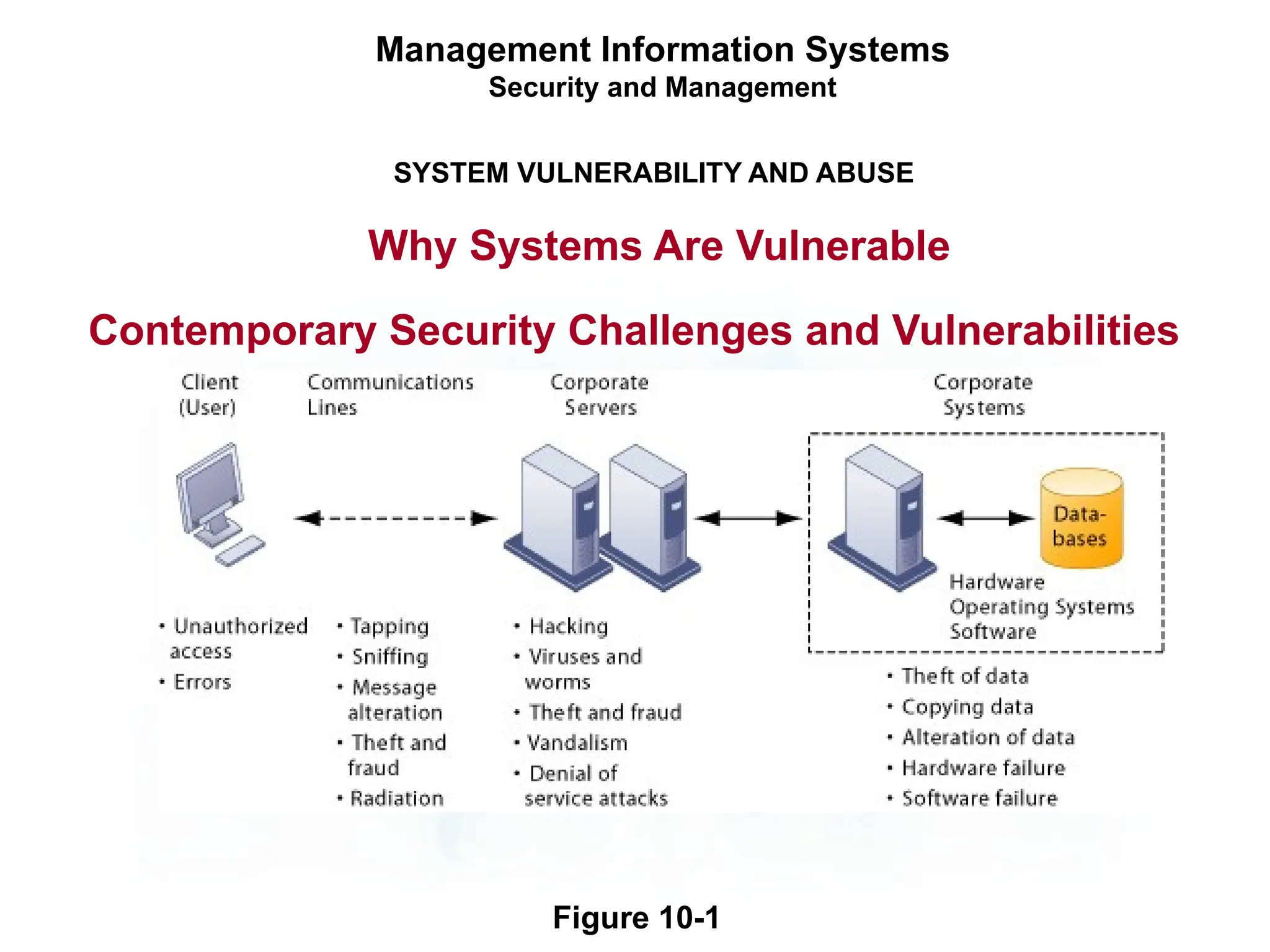
Why Systems Are Vulnerable
Management Information Systems
Security and Management
Contemporary Security Challenges and Vulnerabilities
Figure 10-1
SYSTEM VULNERABILITY AND ABUSE
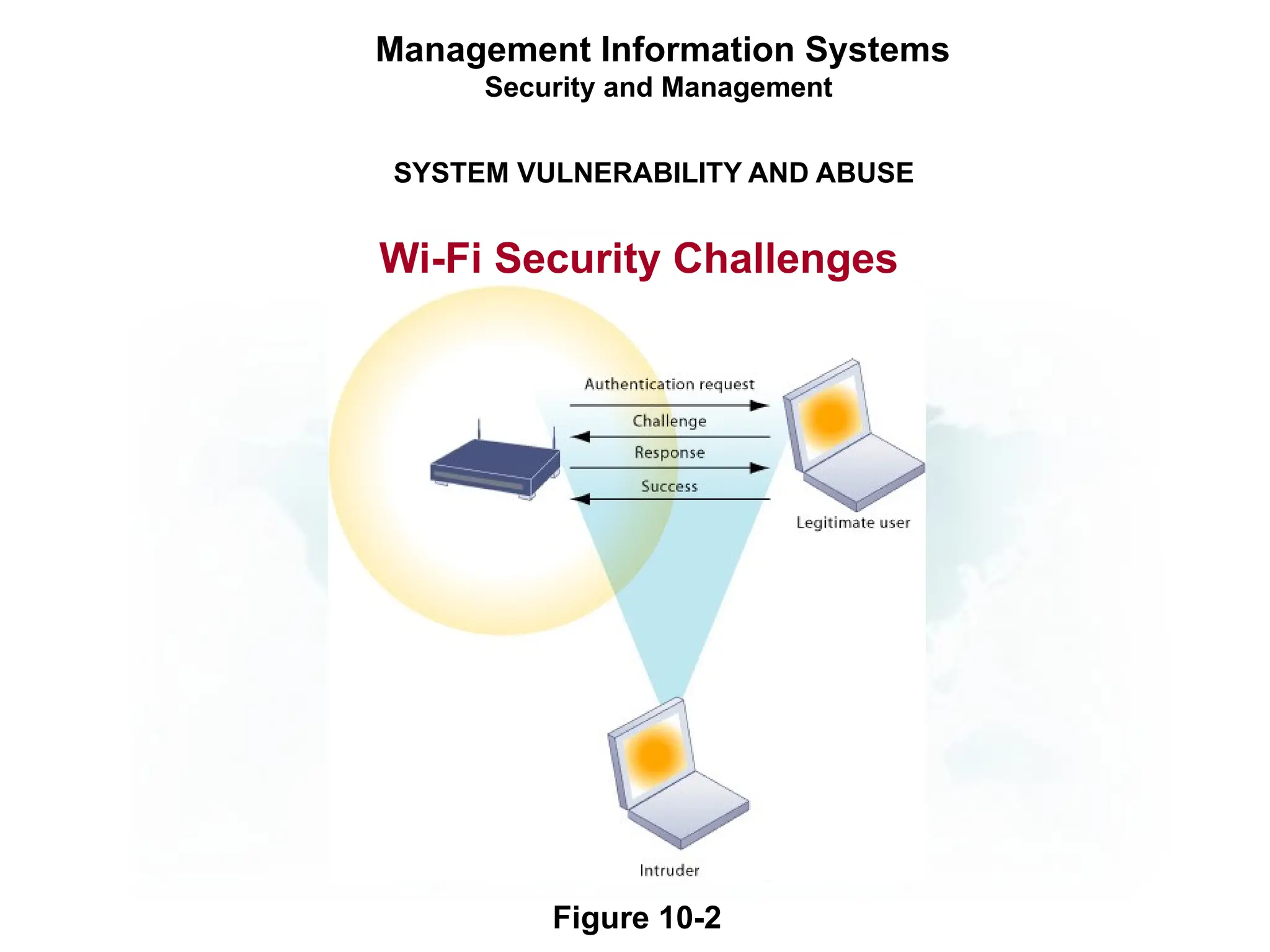
Wi-Fi Security Challenges
Management Information Systems
Security and Management
Figure 10-2
Disaster
• Destroys computer hardware, programs, data
files, and other equipment
Security
• Prevents unauthorized access, alteration,
theft, or physical damage
Errors
• Cause computers to disrupt or destroy
organization’s record-keeping and operations
SYSTEM VULNERABILITY AND ABUSE
Concerns for System Builders and Users
Bugs
• Program code defects or errors
Maintenance Nightmare
• Maintenance costs high due to organizational
change, software complexity, and faulty
system analysis and design
SYSTEM VULNERABILITY AND ABUSE
System Quality Problems: Software and Data
SYSTEM VULNERABILITY AND ABUSE
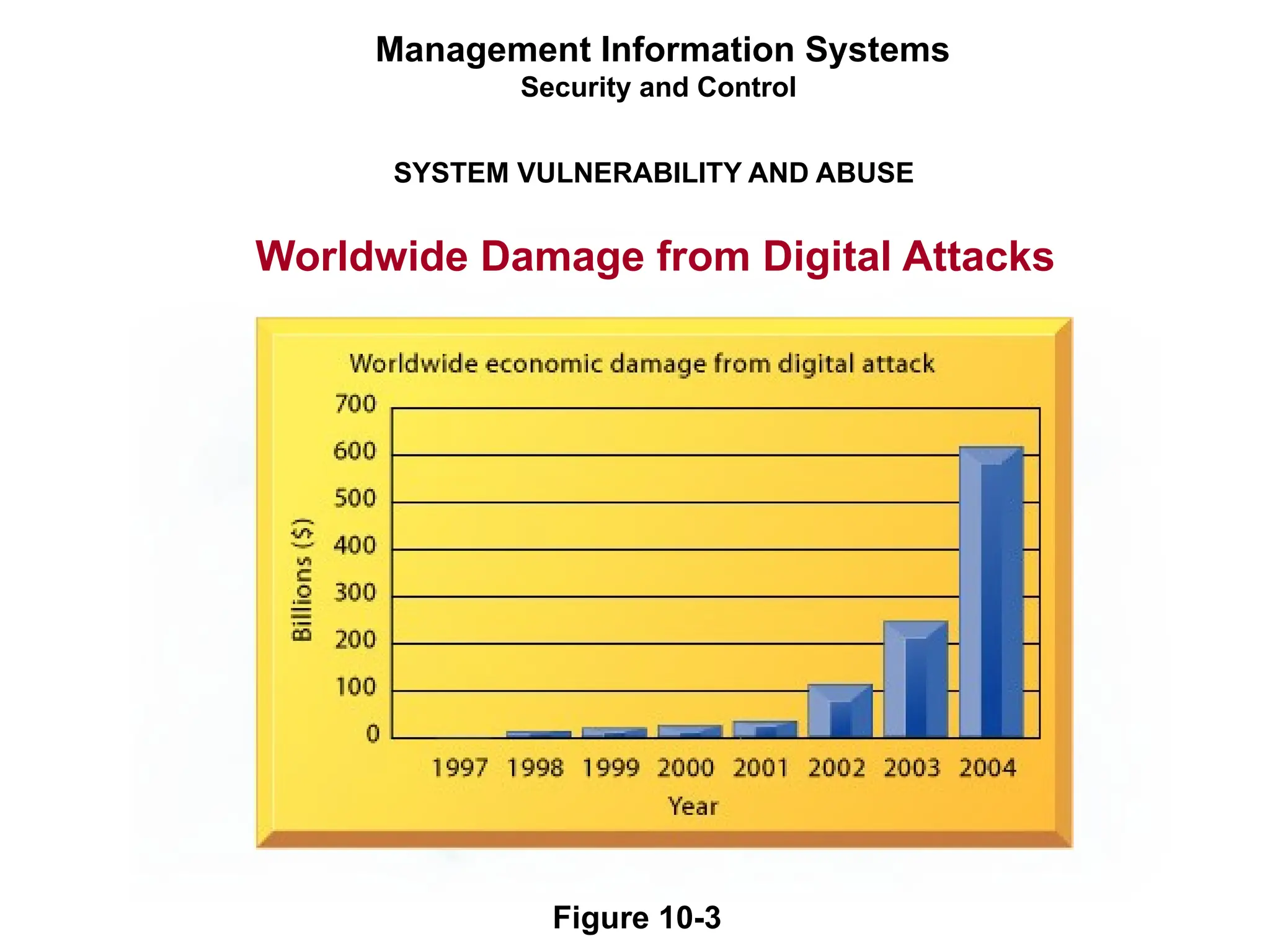
Worldwide Damage from Digital Attacks
Management Information Systems
Security and Control
Figure 10-3
• Inadequate security and control may create serious
legal liability.
• Businesses must protect not only their own information
assets but also those of customers, employees, and
business partners. Failure to do so can lead to costly
litigation for data exposure or theft.
• A sound security and control framework that protects
business information assets can thus produce a high
return on investment.
Management Information Systems
Security and Control
BUSINESS VALUE OF SECURITY AND CONTROL
Security Incidents Continue to Rise
Management Information Systems
Security and Control
BUSINESS VALUE OF SECURITY AND CONTROL
Figure 10-4
Source: CERT Coordination
Center, www.cert.org, accessed
July 6, 2004.
Management Information Systems
Security and Control
BUSINESS VALUE OF SECURITY AND CONTROL
Legal and Regulatory Requirements for Electronic
Records Management
• Electronic Records Management (ERM): Policies,
procedures and tools for managing the retention,
destruction, and storage of electronic records
Management Information Systems
Security and Control
BUSINESS VALUE OF SECURITY AND CONTROL
Data Security and Control Laws:
• The Health Insurance Portability and Accountability
Act (HIPAA)
• Sarbanes-Oxley Act of 2002
• Electronic Evidence: Computer data stored on disks
and drives, e-mail, instant messages, and e-
commerce transactions
• Computer Forensics: Scientific collection,
examination, authentication, preservation, and
analysis of computer data for use as evidence in a
court of law
Management Information Systems
Security and Control
BUSINESS VALUE OF SECURITY AND CONTROL
Electronic Evidence and Computer Forensics
Controls
• Methods, policies, and procedures
• Ensures protection of organization’s assets
• Ensures accuracy and reliability of records,
and operational adherence to management
standards
CREATING A CONTROL ENVIRONMENT
Overview
General controls
• Establish framework for controlling design,
security, and use of computer programs
• Include software, hardware, computer
operations, data security, implementation,
and administrative controls
CREATING A CONTROL ENVIRONMENT
General Controls and Application Controls
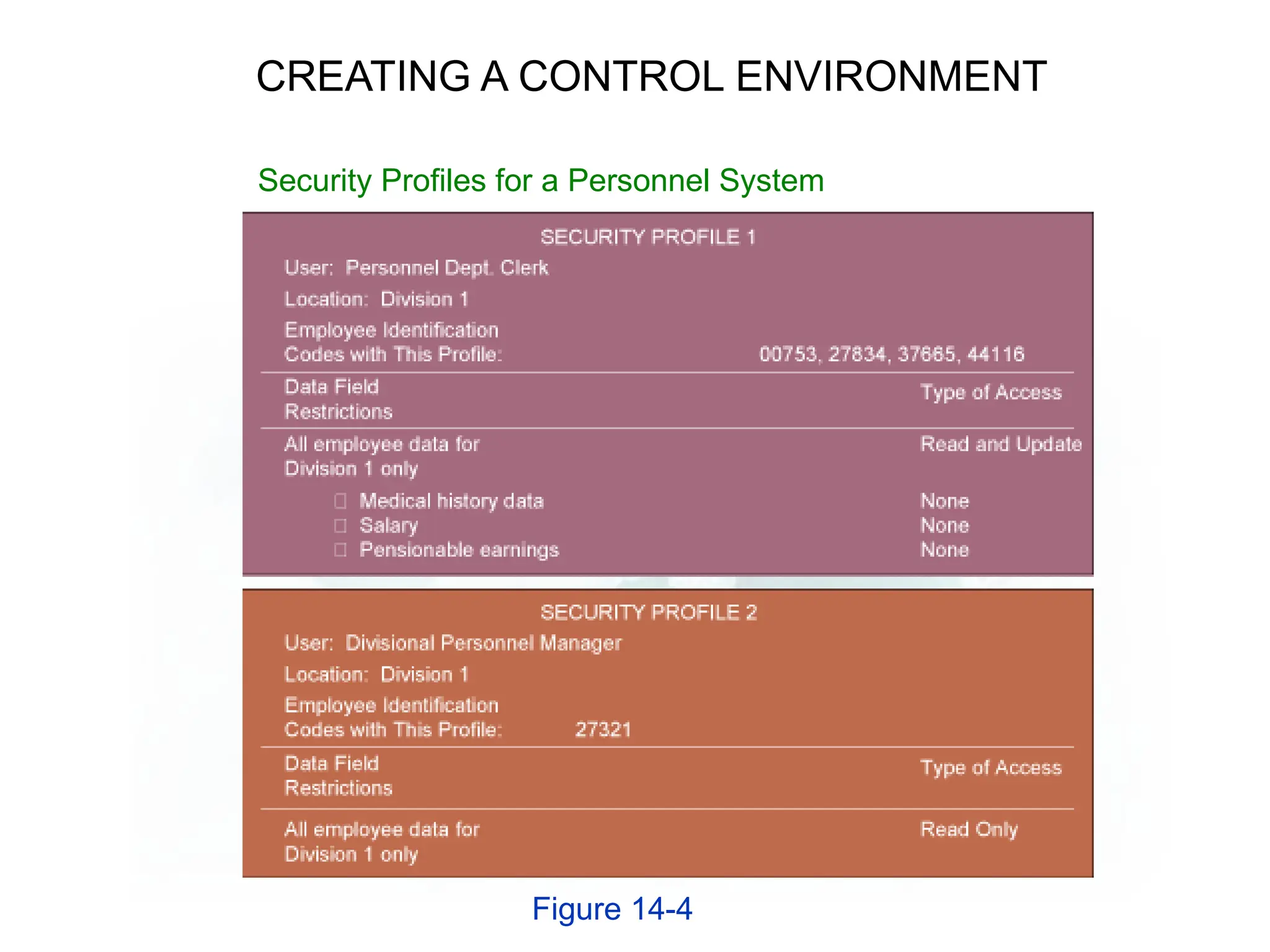
Security Profiles for a Personnel System
CREATING A CONTROL ENVIRONMENT
Figure 14-4
• Unique to each computerized application
• Include input, processing, and output
controls
Management Information System
Security and Control
ESTABLISHING A MANAGEMENT FRAMEWORK FOR
SECURITY AND CONTROL
Application controls:
• Determines the level of risk to the firm if a specific
activity or process is not properly controlled
Management Information Systems
Security and Control
ESTABLISHING A MANAGEMENT FRAMEWORK FOR
SECURITY AND CONTROL
Risk Assessment:
Security Policy
Management Information Systems
Security and Control
ESTABLISHING A MANAGEMENT FRAMEWORK FOR
SECURITY AND CONTROL
Security Profiles for a Personnel System
Figure 10-5
• Downtime: Period of time in which a system is not
operational
• Fault-tolerant computer systems: Redundant
hardware, software, and power supply components to
provide continuous, uninterrupted service
• High-availability computing: Designing to maximize
application and system availability
Management Information Systems
Security and Control
ESTABLISHING A MANAGEMENT FRAMEWORK FOR
SECURITY AND CONTROL
Ensuring Business Continuity
• Load balancing: Distributes access requests across
multiple servers
• Mirroring: Backup server that duplicates processes on
primary server
• Recovery-oriented computing: Designing computing
systems to recover more rapidly from mishaps
Management Information Systems
Security and Control
ESTABLISHING A MANAGEMENT FRAMEWORK FOR
SECURITY AND CONTROL
Ensuring Business Continuity
(Continued)
• Disaster recovery planning: Plans for restoration of
computing and communications disrupted by an
event such as an earthquake, flood, or terrorist
attack
• Business continuity planning: Plans for handling
mission-critical functions if systems go down
Management Information Systems
Security and Control
ESTABLISHING A MANAGEMENT FRAMEWORK FOR
SECURITY AND CONTROL
Ensuring Business Continuity
(Continued)
• MIS audit: Identifies all of the controls that govern
individual information systems and assesses their
effectiveness
• Security audits: Review technologies, procedures,
documentation, training, and personnel
Management Information Systems
Security and Control
ESTABLISHING A MANAGEMENT FRAMEWORK FOR
SECURITY AND CONTROL
Auditing:
Management Information Systems
Security and Control
ESTABLISHING A MANAGEMENT FRAMEWORK FOR
SECURITY AND CONTROL
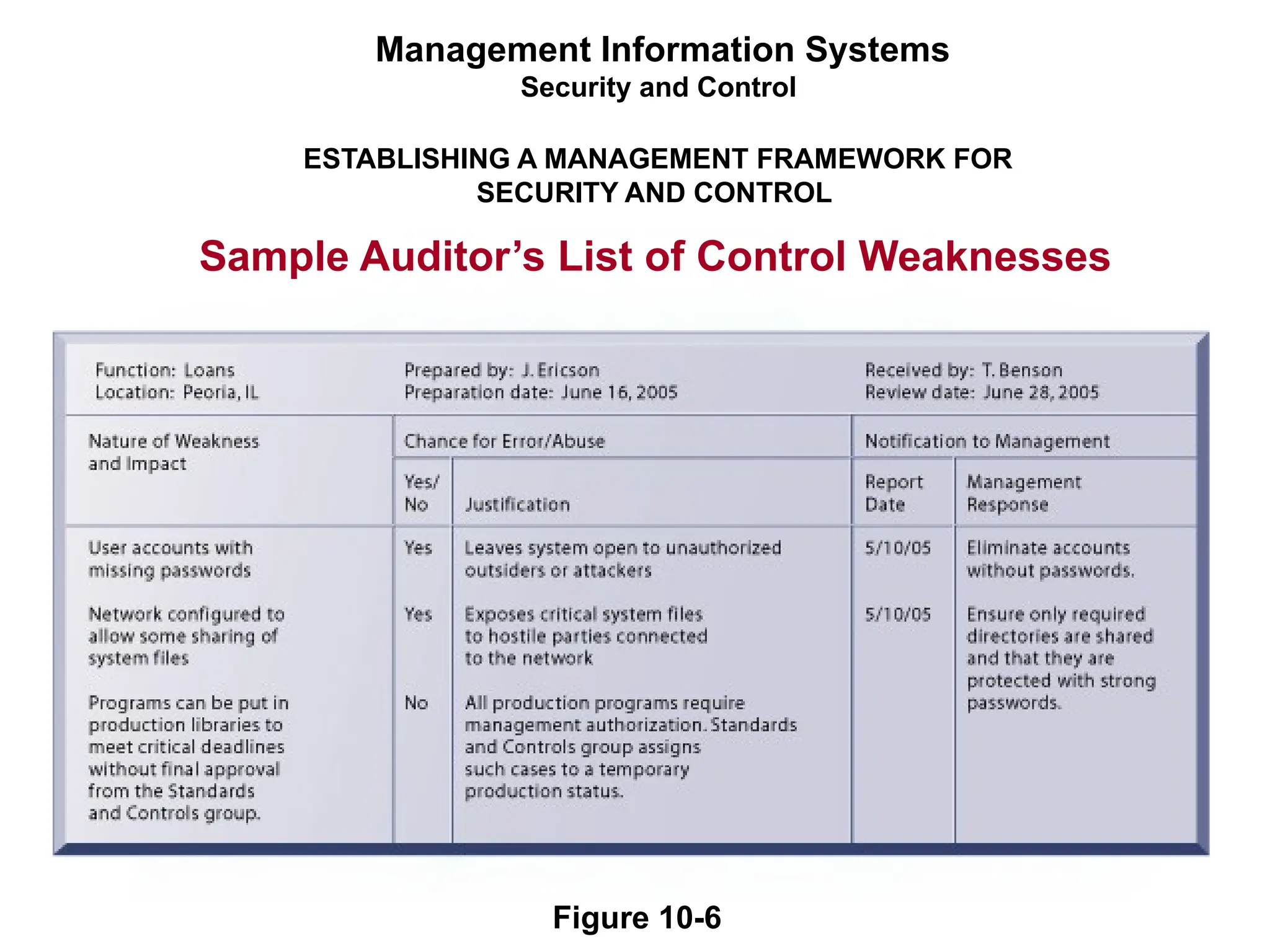
Sample Auditor’s List of Control Weaknesses
Figure 10-6
Management Information Systems
Security and Control
TECHNOLOGIES AND TOOLS FOR SECURITY AND CONTROL
Access Control
• Passwords
Authentication:
Access control: Consists of all the policies and
procedures a company uses to prevent improper access
to systems by unauthorized insiders and outsiders
• Tokens, smart cards
• Biometric authentication
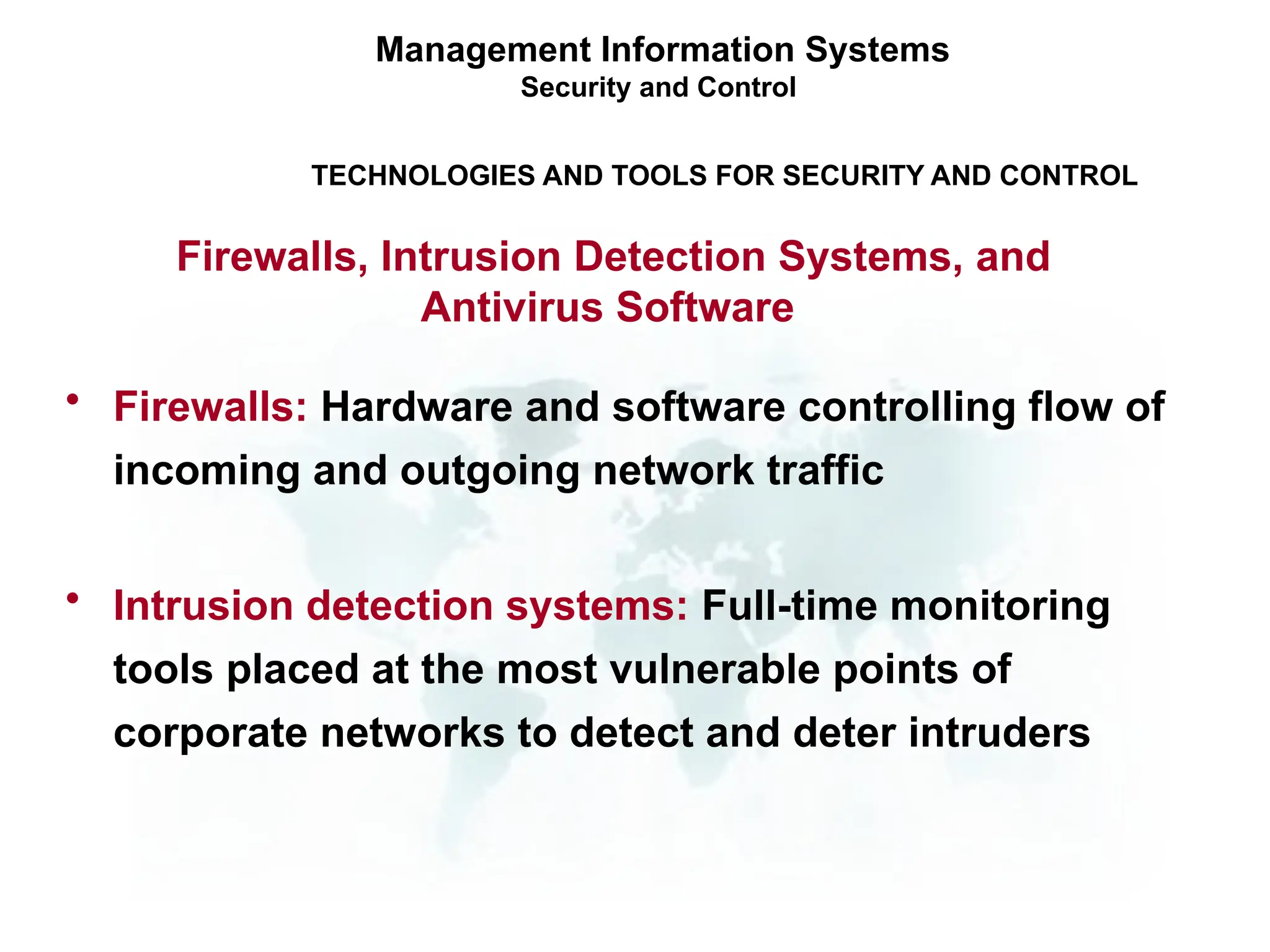
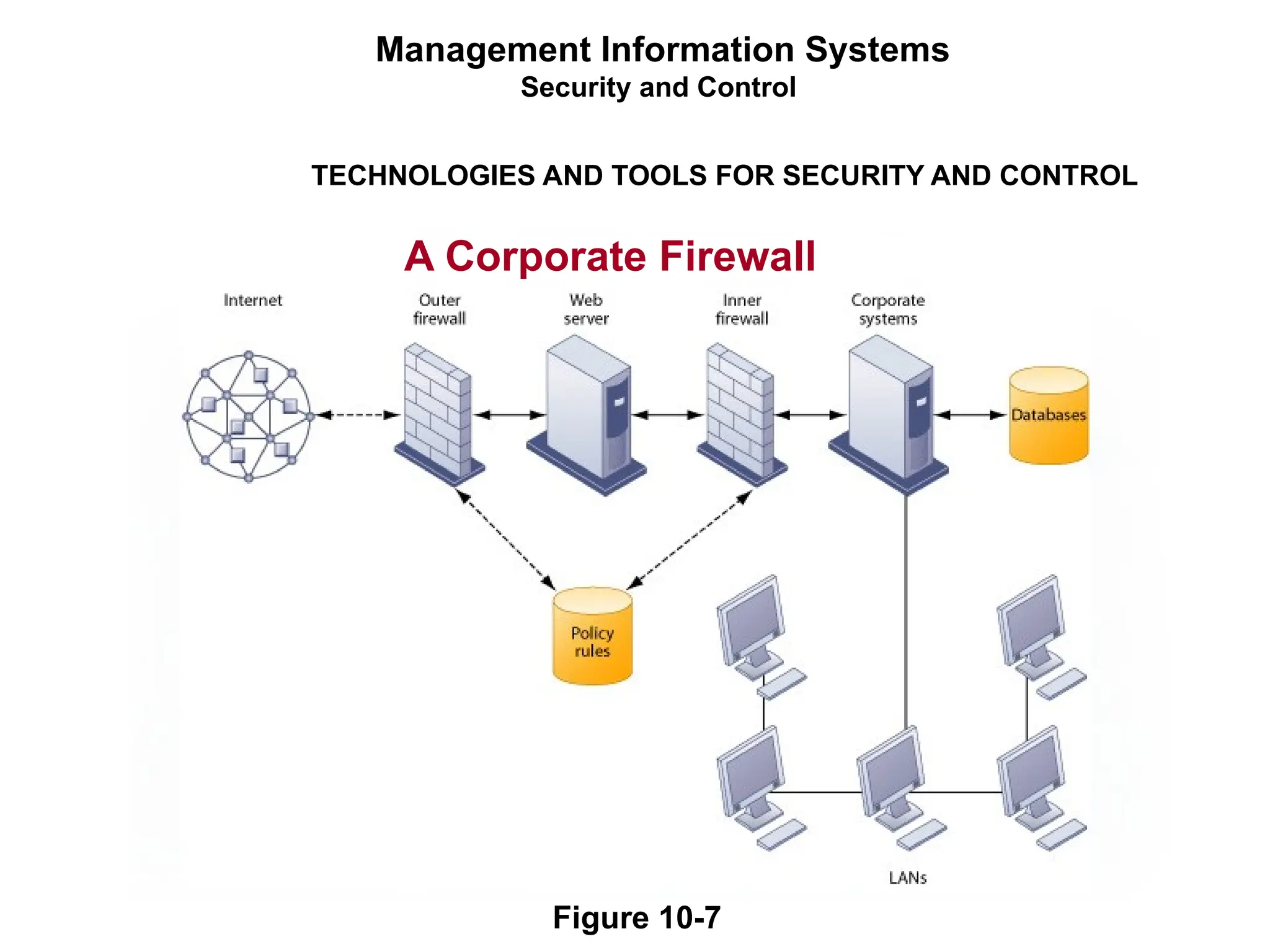
• Firewalls: Hardware and software controlling flow of
incoming and outgoing network traffic
• Intrusion detection systems: Full-time monitoring
tools placed at the most vulnerable points of
corporate networks to detect and deter intruders
Management Information Systems
Security and Control
TECHNOLOGIES AND TOOLS FOR SECURITY AND CONTROL
Firewalls, Intrusion Detection Systems, and
Antivirus Software
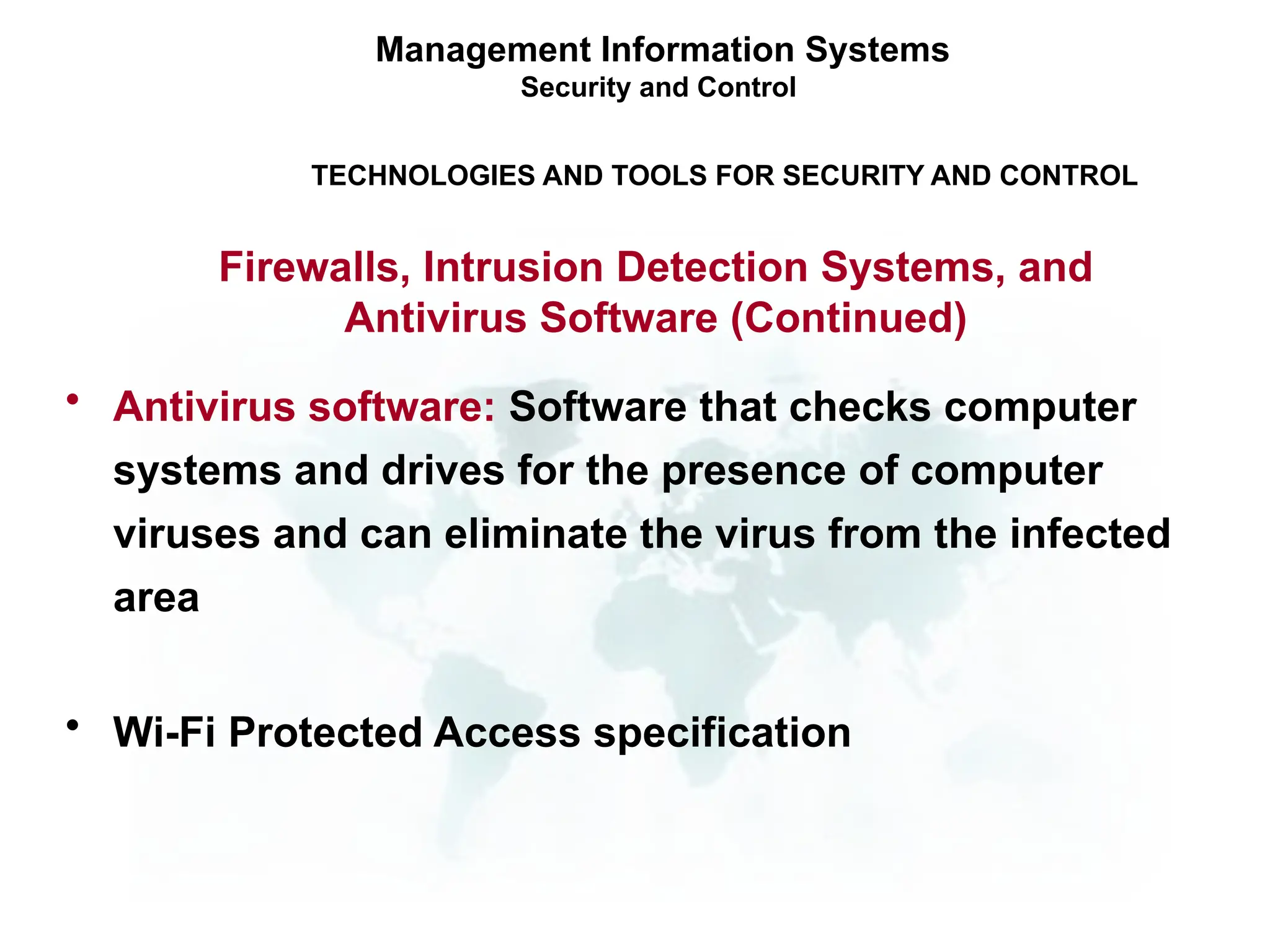
• Antivirus software: Software that checks computer
systems and drives for the presence of computer
viruses and can eliminate the virus from the infected
area
• Wi-Fi Protected Access specification
Management Information Systems
Security and Control
TECHNOLOGIES AND TOOLS FOR SECURITY AND CONTROL
Firewalls, Intrusion Detection Systems, and
Antivirus Software (Continued)
Management Information Systems
Security and Control
TECHNOLOGIES AND TOOLS FOR SECURITY AND CONTROL
A Corporate Firewall
Figure 10-7
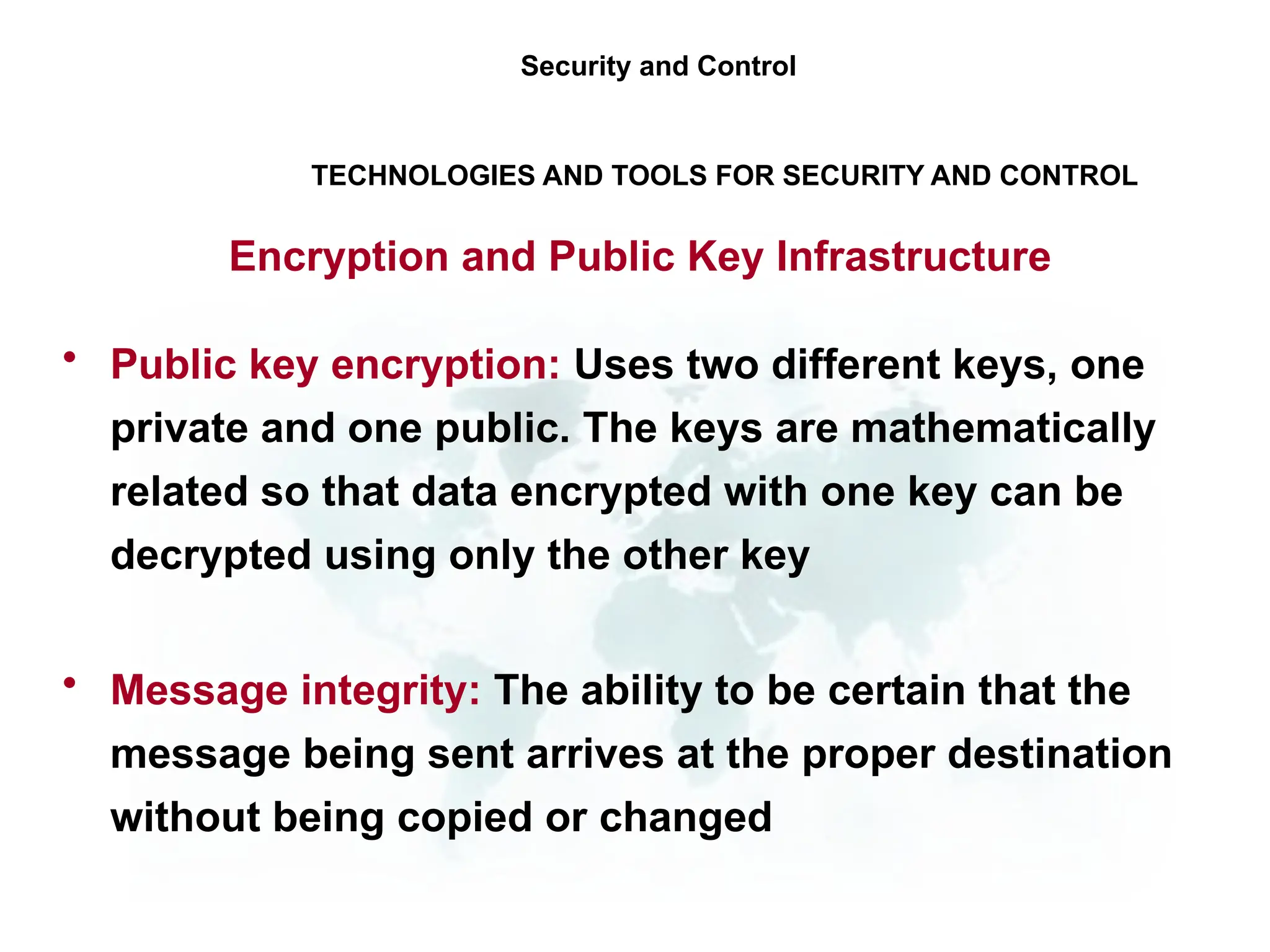
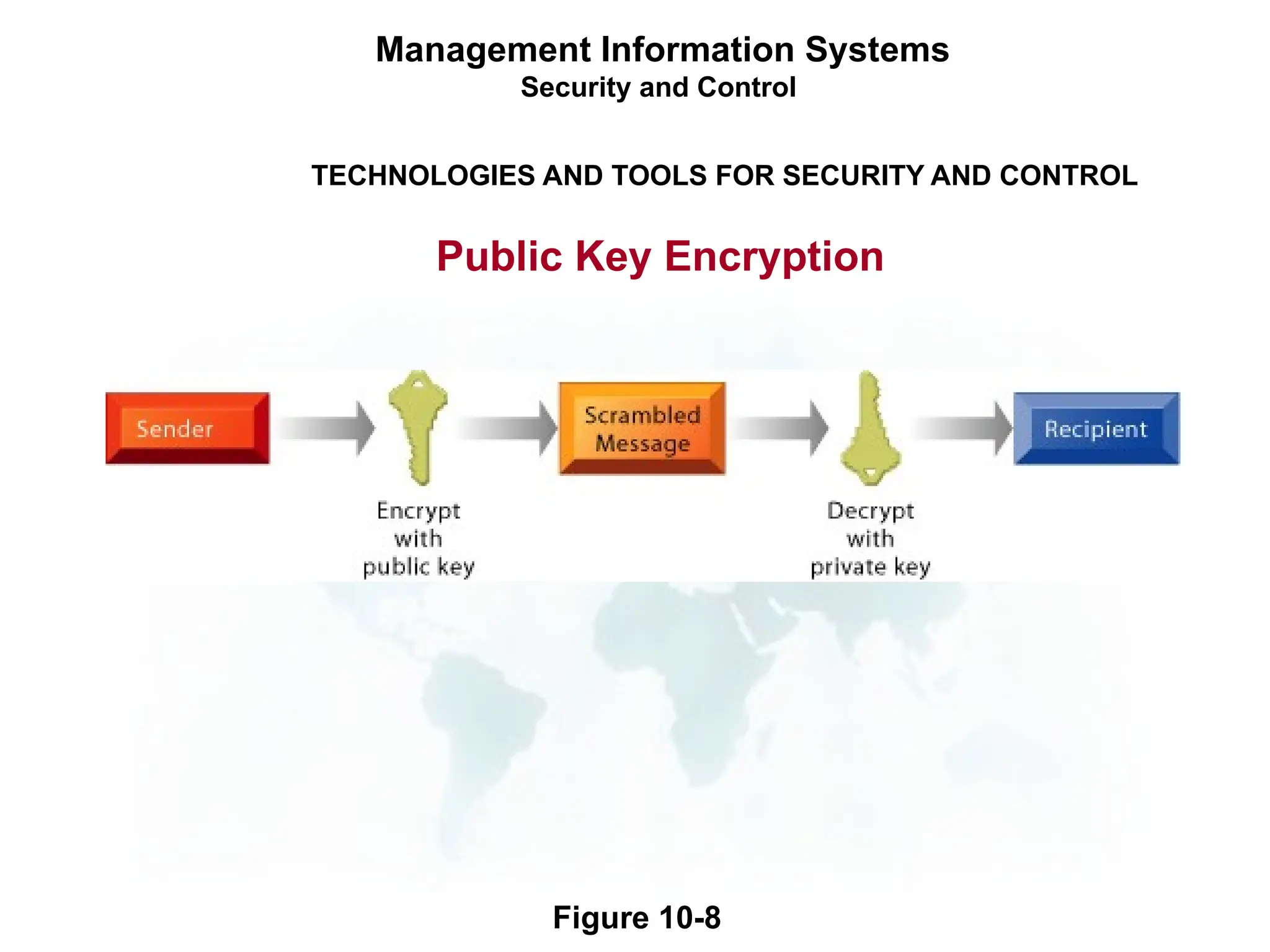
• Public key encryption: Uses two different keys, one
private and one public. The keys are mathematically
related so that data encrypted with one key can be
decrypted using only the other key
• Message integrity: The ability to be certain that the
message being sent arrives at the proper destination
without being copied or changed
Security and Control
TECHNOLOGIES AND TOOLS FOR SECURITY AND CONTROL
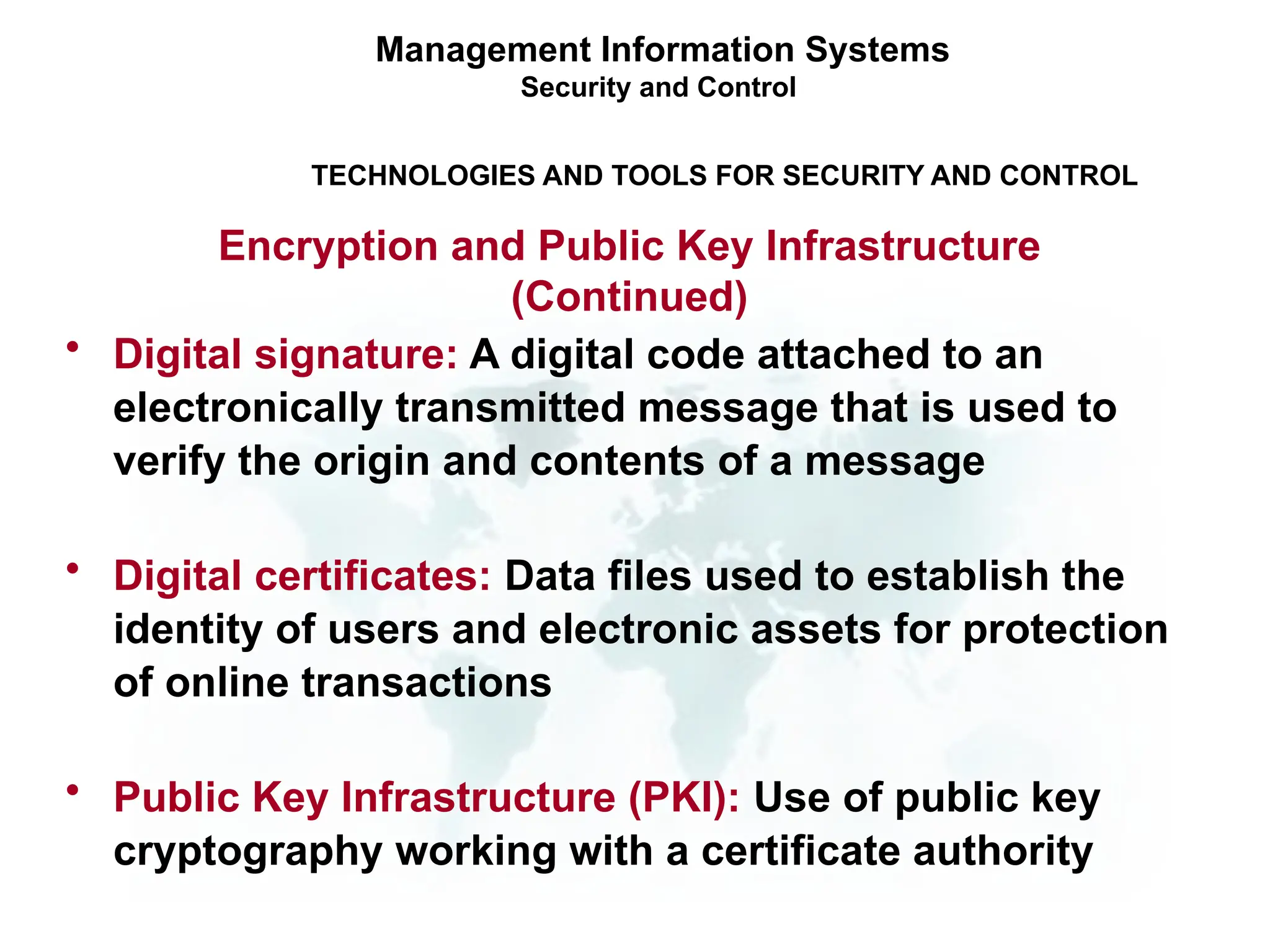
Encryption and Public Key Infrastructure
• Digital signature: A digital code attached to an
electronically transmitted message that is used to
verify the origin and contents of a message
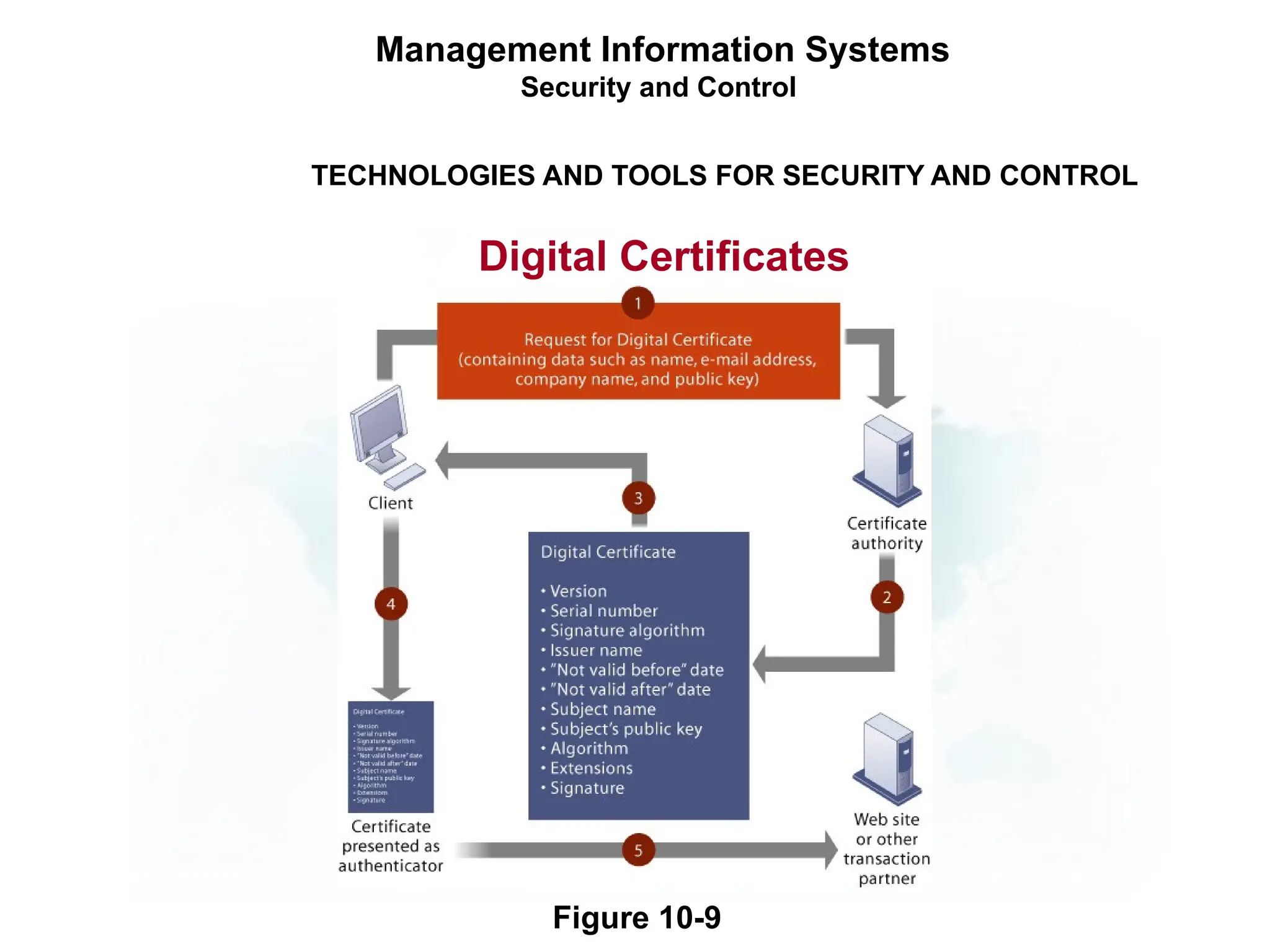
• Digital certificates: Data files used to establish the
identity of users and electronic assets for protection
of online transactions
• Public Key Infrastructure (PKI): Use of public key
cryptography working with a certificate authority
Management Information Systems
Security and Control
TECHNOLOGIES AND TOOLS FOR SECURITY AND CONTROL
Encryption and Public Key Infrastructure
(Continued)
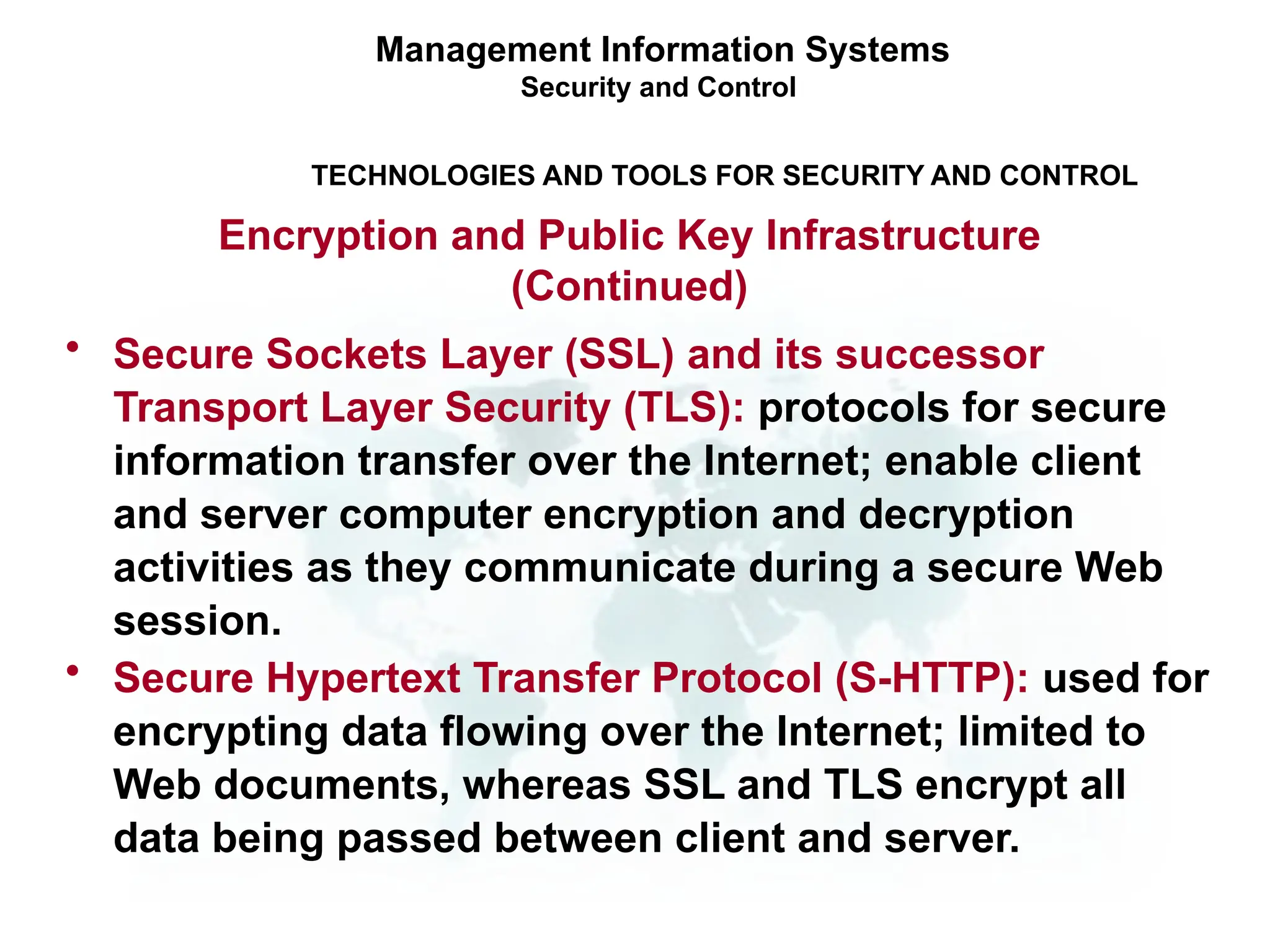
• Secure Sockets Layer (SSL) and its successor
Transport Layer Security (TLS): protocols for secure
information transfer over the Internet; enable client
and server computer encryption and decryption
activities as they communicate during a secure Web
session.
• Secure Hypertext Transfer Protocol (S-HTTP): used for
encrypting data flowing over the Internet; limited to
Web documents, whereas SSL and TLS encrypt all
data being passed between client and server.
Management Information Systems
Security and Control
TECHNOLOGIES AND TOOLS FOR SECURITY AND CONTROL
Encryption and Public Key Infrastructure
(Continued)
Management Information Systems
Security and Control
TECHNOLOGIES AND TOOLS FOR SECURITY AND CONTROL
Public Key Encryption
Figure 10-8
Management Information Systems
Security and Control
TECHNOLOGIES AND TOOLS FOR SECURITY AND CONTROL
Digital Certificates
Figure 10-9
Management Information Systems
Security and Control
MANAGEMENT OPPORTUNITIES, CHALLENGES AND SOLUTIONS
Management Opportunities:
Creation of secure, reliable Web sites and
systems that can support e-commerce and
e-business strategies
• Designing systems that are neither overcontrolled
nor undercontrolled
• Implementing an effective security policy
Management Information Systems
Security and Control
MANAGEMENT OPPORTUNITIES, CHALLENGES AND SOLUTIONS
Management Challenges:
• Security and control must become a more visible
and explicit priority and area of information
systems investment.
• Support and commitment from top management is
required to show that security is indeed a corporate
priority and vital to all aspects of the business.
• Security and control should be the responsibility of
everyone in the organization.
Management Information Systems
Security and Control
MANAGEMENT OPPORTUNITIES, CHALLENGES AND SOLUTIONS
Solution Guidelines:

Management Information Systems ( Security and Control.pptx

  • 1.
  • 2.
    Learning objectives • Afterthis discussion you should be able to: – understand and assess potential threats to a computer-based information system; – propose an overall strategy for ensuring the security of a computer-based information system; – Explain why information systems need special protection from destruction, error, and abuse – Assess the business value of security and control – Evaluate elements of an organizational and managerial framework for security and control
  • 3.
    Management issues • Froma managerial perspective, this discussion addresses the following areas: – An understanding of approaches towards information systems security will help managers develop and implement an overall strategy for security. – An understanding of the threats to information systems will help in predicting and anticipating acts such as denial of service attacks. – Knowledge of specific techniques for protecting information systems will help in the development of effective countermeasures. – As organizations turn to the Internet for business purposes, it becomes important to understand some of the new threats that must be faced.
  • 4.
  • 5.
    Related security concepts •Authentication: a means to verify that an entity is who it claims to be for decisions in support of confidentiality and integrity • Access Control: a means to enforce which entities have access to information to support confidentiality and integrity • Authorization: a combination of authentication (who) and access control • Non-repudiation: integrity of the pair (information, creator of information) • Privacy: confidentiality of personal information • Anonymity: confidentiality of identity
  • 6.
    What are thecommon threats to IS
  • 7.
    Common threats toinformation • Accidents • Natural disasters • Sabotage (industrial and individual) • Vandalism • Theft • Unauthorised use (hacking) • Computer viruses
  • 8.
    Figure 15.1 Breakdownof breaches of security reported by UK companies in 2004 Source: Information Security Breaches Survey 2004, DTI (www.dti.gov.uk)
  • 9.
    Accidents • Inaccurate dataentry • Attempts to carry out tasks beyond the ability of the employee • Failure to comply with procedures for the use of organisational information systems. • Failure to carry out backup procedures or verify data backups.
  • 10.
    Natural disasters • Allinformation systems are susceptible to damage caused by natural phenomena, such as storms, lightning strikes, floods and earthquakes. • In Japan and the United States, for example, great care is taken to protect critical information systems from the effects of earthquakes. • Although such hazards are of less concern in much of Africa and Europe, properly designed systems will make allowances for unexpected natural disasters.
  • 11.
    Sabotage • Deliberate deletionof data or applications – Logic bomb: Sometimes also known as a time bomb, a logic bomb is a destructive computer program that activates at a certain time or in reaction to a specific event. – Back door: A section of program code that allows a user to circumvent security procedures in order to gain full access to an information system. – Data theft: This can involve stealing sensitive information or making unauthorised changes to computer records.
  • 12.
    Unauthorised use • Hacker:Hackers are often described as individuals who seek to break into systems as a test of their abilities. Few hackers attempt to cause damage to systems they access and few are interested in gaining any sort of financial profit. • Cracker: A person who gains access to an information system for malicious reasons is often termed a cracker rather than a hacker. This is because some people draw a distinction between ‘ethical’ hackers and malicious hackers.
  • 13.
    Social engineering • Socialengineering: This involves tricking people into providing information that can be used to gain access to a computer system. • As an example, someone might pose as a technician during a telephone call and ask for information, such as passwords or user names.
  • 14.
    Computer virus • Computervirus: This is a computer program that is capable of self-replication, allowing it to spread from one ‘infected’ machine to another. • The origin of the term computer virus is credited to Fred Cohen, author of the 1984 book Computer Viruses: Theories and Experiments. However, ‘natural’ computer viruses were reported as early as 1974 and papers describing mathematical models of the theory of epidemics were published in the early 1950s.
  • 15.
    Trojans and worms •Worm: A small program that moves through a computer system randomly changing or overwriting pieces of data as it moves. • Trojan: A Trojan presents itself as a legitimate program in order to gain access to a computer system. Trojans are often used as delivery systems for computer viruses.
  • 16.
    Spyware and adware •Spyware: Describes a category of software intended to collect and transmit confidential information without the knowledge or consent of a computer user. • Adware: Describes a type of software that contains spyware intended to monitor a user’s online activities, usually so that advertising can be targeted more accurately.
  • 17.
    Internet-related threats 1 •Denial of service (DoS): This is a form of attack on company information systems that involves flooding the company's Internet servers with huge amounts of traffic. Such attacks effectively halt all of the company's Internet activities until the problem is dealt with. • Brand abuse: This describes a wide range of activities, ranging from the sale of counterfeit goods (e.g. software applications) to exploiting a well-known brand name for commercial gain. • Cybersquatting: The act of registering an Internet domain with the intention of selling it for profit to an interested party. As an example, the name of a celebrity might be registered and then offered for sale at an extremely high price. • Cyberstalking: This refers to the use of the Internet as a means of harassing another individual. A related activity is known as corporate stalking, where an organisation uses its resources to harass individuals or business competitors. • Cyberterrorism: This describes attacks made on information systems that are motivated by political or religious beliefs.
  • 18.
    Internet-related threats 2 •Online stock fraud: Most online stock fraud involves posting false information to the Internet in order to increase or decrease the values of stocks. • Phishing: A relatively new development, phishing involves attempting to gather confidential information through fake e-mail messages and web sites.
  • 19.
    SYSTEM VULNERABILITY ANDABUSE Why Systems Are Vulnerable Management Information Systems Security and Management Contemporary Security Challenges and Vulnerabilities Figure 10-1
  • 20.
    SYSTEM VULNERABILITY ANDABUSE Wi-Fi Security Challenges Management Information Systems Security and Management Figure 10-2
  • 21.
    Disaster • Destroys computerhardware, programs, data files, and other equipment Security • Prevents unauthorized access, alteration, theft, or physical damage Errors • Cause computers to disrupt or destroy organization’s record-keeping and operations SYSTEM VULNERABILITY AND ABUSE Concerns for System Builders and Users
  • 22.
    Bugs • Program codedefects or errors Maintenance Nightmare • Maintenance costs high due to organizational change, software complexity, and faulty system analysis and design SYSTEM VULNERABILITY AND ABUSE System Quality Problems: Software and Data
  • 23.
    SYSTEM VULNERABILITY ANDABUSE Worldwide Damage from Digital Attacks Management Information Systems Security and Control Figure 10-3
  • 24.
    • Inadequate securityand control may create serious legal liability. • Businesses must protect not only their own information assets but also those of customers, employees, and business partners. Failure to do so can lead to costly litigation for data exposure or theft. • A sound security and control framework that protects business information assets can thus produce a high return on investment. Management Information Systems Security and Control BUSINESS VALUE OF SECURITY AND CONTROL
  • 25.
    Security Incidents Continueto Rise Management Information Systems Security and Control BUSINESS VALUE OF SECURITY AND CONTROL Figure 10-4 Source: CERT Coordination Center, www.cert.org, accessed July 6, 2004.
  • 26.
    Management Information Systems Securityand Control BUSINESS VALUE OF SECURITY AND CONTROL Legal and Regulatory Requirements for Electronic Records Management • Electronic Records Management (ERM): Policies, procedures and tools for managing the retention, destruction, and storage of electronic records
  • 27.
    Management Information Systems Securityand Control BUSINESS VALUE OF SECURITY AND CONTROL Data Security and Control Laws: • The Health Insurance Portability and Accountability Act (HIPAA) • Sarbanes-Oxley Act of 2002
  • 28.
    • Electronic Evidence:Computer data stored on disks and drives, e-mail, instant messages, and e- commerce transactions • Computer Forensics: Scientific collection, examination, authentication, preservation, and analysis of computer data for use as evidence in a court of law Management Information Systems Security and Control BUSINESS VALUE OF SECURITY AND CONTROL Electronic Evidence and Computer Forensics
  • 29.
    Controls • Methods, policies,and procedures • Ensures protection of organization’s assets • Ensures accuracy and reliability of records, and operational adherence to management standards CREATING A CONTROL ENVIRONMENT Overview
  • 30.
    General controls • Establishframework for controlling design, security, and use of computer programs • Include software, hardware, computer operations, data security, implementation, and administrative controls CREATING A CONTROL ENVIRONMENT General Controls and Application Controls
  • 31.
    Security Profiles fora Personnel System CREATING A CONTROL ENVIRONMENT Figure 14-4
  • 32.
    • Unique toeach computerized application • Include input, processing, and output controls Management Information System Security and Control ESTABLISHING A MANAGEMENT FRAMEWORK FOR SECURITY AND CONTROL Application controls:
  • 33.
    • Determines thelevel of risk to the firm if a specific activity or process is not properly controlled Management Information Systems Security and Control ESTABLISHING A MANAGEMENT FRAMEWORK FOR SECURITY AND CONTROL Risk Assessment:
  • 34.
  • 35.
    Management Information Systems Securityand Control ESTABLISHING A MANAGEMENT FRAMEWORK FOR SECURITY AND CONTROL Security Profiles for a Personnel System Figure 10-5
  • 36.
    • Downtime: Periodof time in which a system is not operational • Fault-tolerant computer systems: Redundant hardware, software, and power supply components to provide continuous, uninterrupted service • High-availability computing: Designing to maximize application and system availability Management Information Systems Security and Control ESTABLISHING A MANAGEMENT FRAMEWORK FOR SECURITY AND CONTROL Ensuring Business Continuity
  • 37.
    • Load balancing:Distributes access requests across multiple servers • Mirroring: Backup server that duplicates processes on primary server • Recovery-oriented computing: Designing computing systems to recover more rapidly from mishaps Management Information Systems Security and Control ESTABLISHING A MANAGEMENT FRAMEWORK FOR SECURITY AND CONTROL Ensuring Business Continuity (Continued)
  • 38.
    • Disaster recoveryplanning: Plans for restoration of computing and communications disrupted by an event such as an earthquake, flood, or terrorist attack • Business continuity planning: Plans for handling mission-critical functions if systems go down Management Information Systems Security and Control ESTABLISHING A MANAGEMENT FRAMEWORK FOR SECURITY AND CONTROL Ensuring Business Continuity (Continued)
  • 39.
    • MIS audit:Identifies all of the controls that govern individual information systems and assesses their effectiveness • Security audits: Review technologies, procedures, documentation, training, and personnel Management Information Systems Security and Control ESTABLISHING A MANAGEMENT FRAMEWORK FOR SECURITY AND CONTROL Auditing:
  • 40.
    Management Information Systems Securityand Control ESTABLISHING A MANAGEMENT FRAMEWORK FOR SECURITY AND CONTROL Sample Auditor’s List of Control Weaknesses Figure 10-6
  • 41.
    Management Information Systems Securityand Control TECHNOLOGIES AND TOOLS FOR SECURITY AND CONTROL Access Control • Passwords Authentication: Access control: Consists of all the policies and procedures a company uses to prevent improper access to systems by unauthorized insiders and outsiders • Tokens, smart cards • Biometric authentication
  • 42.
    • Firewalls: Hardwareand software controlling flow of incoming and outgoing network traffic • Intrusion detection systems: Full-time monitoring tools placed at the most vulnerable points of corporate networks to detect and deter intruders Management Information Systems Security and Control TECHNOLOGIES AND TOOLS FOR SECURITY AND CONTROL Firewalls, Intrusion Detection Systems, and Antivirus Software
  • 43.
    • Antivirus software:Software that checks computer systems and drives for the presence of computer viruses and can eliminate the virus from the infected area • Wi-Fi Protected Access specification Management Information Systems Security and Control TECHNOLOGIES AND TOOLS FOR SECURITY AND CONTROL Firewalls, Intrusion Detection Systems, and Antivirus Software (Continued)
  • 44.
    Management Information Systems Securityand Control TECHNOLOGIES AND TOOLS FOR SECURITY AND CONTROL A Corporate Firewall Figure 10-7
  • 45.
    • Public keyencryption: Uses two different keys, one private and one public. The keys are mathematically related so that data encrypted with one key can be decrypted using only the other key • Message integrity: The ability to be certain that the message being sent arrives at the proper destination without being copied or changed Security and Control TECHNOLOGIES AND TOOLS FOR SECURITY AND CONTROL Encryption and Public Key Infrastructure
  • 46.
    • Digital signature:A digital code attached to an electronically transmitted message that is used to verify the origin and contents of a message • Digital certificates: Data files used to establish the identity of users and electronic assets for protection of online transactions • Public Key Infrastructure (PKI): Use of public key cryptography working with a certificate authority Management Information Systems Security and Control TECHNOLOGIES AND TOOLS FOR SECURITY AND CONTROL Encryption and Public Key Infrastructure (Continued)
  • 47.
    • Secure SocketsLayer (SSL) and its successor Transport Layer Security (TLS): protocols for secure information transfer over the Internet; enable client and server computer encryption and decryption activities as they communicate during a secure Web session. • Secure Hypertext Transfer Protocol (S-HTTP): used for encrypting data flowing over the Internet; limited to Web documents, whereas SSL and TLS encrypt all data being passed between client and server. Management Information Systems Security and Control TECHNOLOGIES AND TOOLS FOR SECURITY AND CONTROL Encryption and Public Key Infrastructure (Continued)
  • 48.
    Management Information Systems Securityand Control TECHNOLOGIES AND TOOLS FOR SECURITY AND CONTROL Public Key Encryption Figure 10-8
  • 49.
    Management Information Systems Securityand Control TECHNOLOGIES AND TOOLS FOR SECURITY AND CONTROL Digital Certificates Figure 10-9
  • 50.
    Management Information Systems Securityand Control MANAGEMENT OPPORTUNITIES, CHALLENGES AND SOLUTIONS Management Opportunities: Creation of secure, reliable Web sites and systems that can support e-commerce and e-business strategies
  • 51.
    • Designing systemsthat are neither overcontrolled nor undercontrolled • Implementing an effective security policy Management Information Systems Security and Control MANAGEMENT OPPORTUNITIES, CHALLENGES AND SOLUTIONS Management Challenges:
  • 52.
    • Security andcontrol must become a more visible and explicit priority and area of information systems investment. • Support and commitment from top management is required to show that security is indeed a corporate priority and vital to all aspects of the business. • Security and control should be the responsibility of everyone in the organization. Management Information Systems Security and Control MANAGEMENT OPPORTUNITIES, CHALLENGES AND SOLUTIONS Solution Guidelines:

Editor's Notes

  • #4 Information security is the practice of defending information from un authorised access, use , disclosure, disruption, modification, perusal, inspection, recording or even destruction
  • #9 Inaccurate data entry. As an example, consider a typical relational database management system, where update queries are used to change records, tables and reports. If the contents of the query are incorrect, errors might be produced within all of the data manipulated by the query. Although extreme, significant problems might be caused by adding or removing even a single character to a query. Attempts to carry out tasks beyond the ability of the employee. In smaller computer-based information systems, a common cause of accidental damage involves users attempting to install new hardware items or software applications. In the case of software applications, existing data may be lost when the program is installed or the program may fail to operate as expected. Failure to comply with procedures for the use of organisational information systems. Where organisational procedures are unclear or fail to anticipate potential problems, users may often ignore established methods, act on their own initiative or perform tasks incorrectly. Failure to carry out backup procedures or verify data backups. In addition to carrying out regular backups of important business data, it is also necessary to verify that any backup copies made are accurate and free from errors. Update query: Used to change records, tables and reports held in a database management system.
  • #27 Electronic Signatures Act No. 7 of 2011 Electronic Transactions Act No. 8 of 2011 UGANDA Computer Misuse Act No. 2 of 2011
  • #33 What is at risk (national security, lives, property, money)? Some risk models are based on $ values Where does the threat come from? Motivation (national security, money, fame, Capabilities (intellect, equipment, money) What vulnerabilities can be exploited Technical Process People Risk mitigation Eliminate/reduce risk Accept risk (with recovery process) Transfer risk