Technical presentation


            The Ellingham Diagram


                                                                 Bapin Kumar Rout


           Research and Development, Steelmaking and Casting Research Group
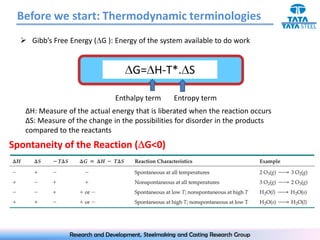
Before we start: Thermodynamic terminologies
   Gibb’s Free Energy ( G ): Energy of the system available to do work


                                      G= H-T*. S

                                Enthalpy term       Entropy term
   ∆H: Measure of the actual energy that is liberated when the reaction occurs
   ∆S: Measure of the change in the possibilities for disorder in the products
   compared to the reactants
Spontaneity of the Reaction ( G<0)


                Research and Development, Steelmaking and Casting Research Group
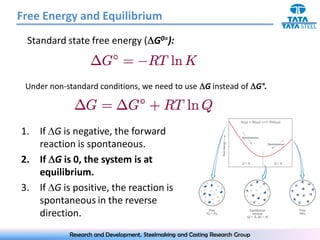
Free Energy and Equilibrium
 Standard state free energy ( G0=):


 Under non-standard conditions, we need to use G instead of G°.


1. If G is negative, the forward
   reaction is spontaneous.
2. If G is 0, the system is at
   equilibrium.
3. If G is positive, the reaction is
   spontaneous in the reverse
   direction.
            Research and Development, Steelmaking and Casting Research Group
The Ellingham Diagram
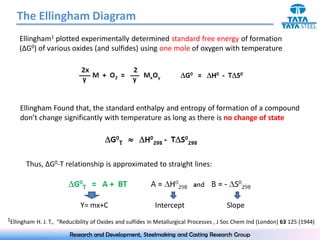
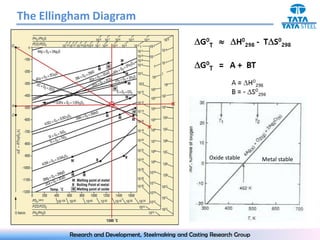
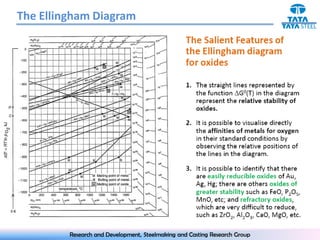
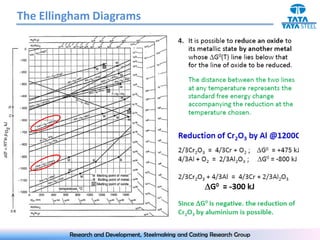
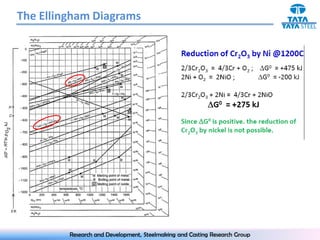
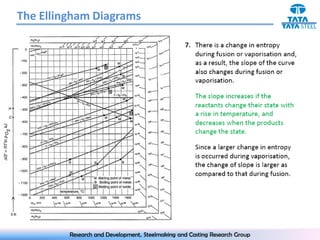
    Ellingham1 plotted experimentally determined standard free energy of formation
    (∆G0) of various oxides (and sulfides) using one mole of oxygen with temperature


     Ellingham Found that, the standard enthalpy and entropy of formation of a compound
     don’t change significantly with temperature as long as there is no change of state


       Thus, ∆G0-T relationship is approximated to straight lines:


                             Y= mx+C                       Intercept                    Slope
1Ellingham H. J. T., “Reducibility of Oxides and sulfides in Metallurgical Processes , J Soc Chem Ind (London) 63 125 (1944)

                         Research and Development, Steelmaking and Casting Research Group
The Ellingham Diagram


                                                          Oxide stable      Metal stable


         Research and Development, Steelmaking and Casting Research Group
The Ellingham Diagram


         Research and Development, Steelmaking and Casting Research Group
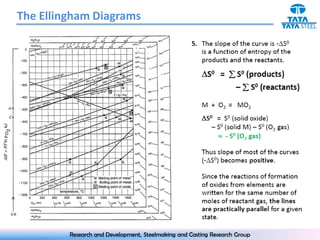
The Ellingham Diagrams


         Research and Development, Steelmaking and Casting Research Group
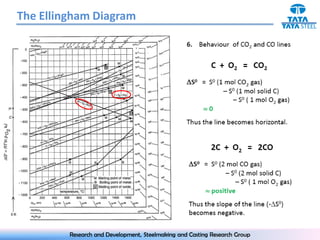
The Ellingham Diagrams


         Research and Development, Steelmaking and Casting Research Group
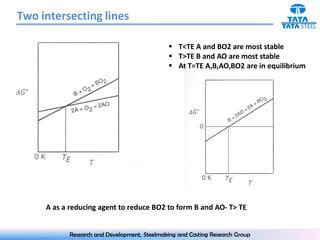
Two intersecting lines

                                                T<TE A and BO2 are most stable
                                                T>TE B and AO are most stable
                                                At T=TE A,B,AO,BO2 are in equilibrium


     A as a reducing agent to reduce BO2 to form B and AO- T> TE


            Research and Development, Steelmaking and Casting Research Group
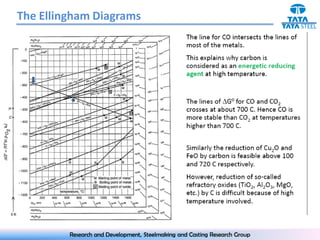
The Ellingham Diagrams


         Research and Development, Steelmaking and Casting Research Group
The Ellingham Diagram


         Research and Development, Steelmaking and Casting Research Group
The Ellingham Diagrams


         Research and Development, Steelmaking and Casting Research Group
The Ellingham Diagrams


         Research and Development, Steelmaking and Casting Research Group
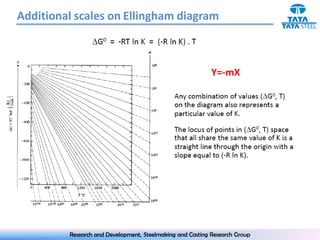
Additional scales on Ellingham diagram


                                                           Y=-mX


         Research and Development, Steelmaking and Casting Research Group
Reading pO2 from Ellingham diagram
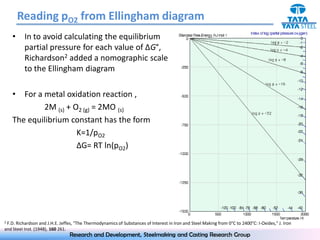
    •     In to avoid calculating the equilibrium
          partial pressure for each value of ΔG°,
          Richardson2 added a nomographic scale
          to the Ellingham diagram

    •  For a metal oxidation reaction ,
             2M (s) + O2 (g) = 2MO (s)
    The equilibrium constant has the form
                       K=1/pO2
                       ∆G= RT ln(pO2)


2 F.D. Richardson  and J.H.E. Jeffes, "The Thermodynamics of Substances of Interest in Iron and Steel Making from 0°C to 2400°C: I-Oxides," J. Iron
and Steel Inst. (1948), 160 261.
                                 Research and Development, Steelmaking and Casting Research Group
Reading pO2 from Ellingham diagram

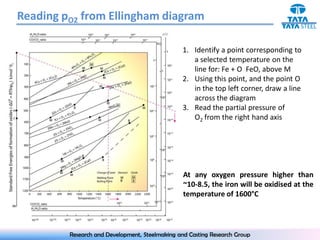
                                                 1. Identify a point corresponding to
                                                    a selected temperature on the
                                                    line for: Fe + O FeO, above M
                                                 2. Using this point, and the point O
                                                    in the top left corner, draw a line
                                                    across the diagram
                                                 3. Read the partial pressure of
                                                    O2 from the right hand axis


                                                 At any oxygen pressure higher than
                                                 ~10-8.5, the iron will be oxidised at the
                                                 temperature of 1600°C


         Research and Development, Steelmaking and Casting Research Group
Other gas mixtures
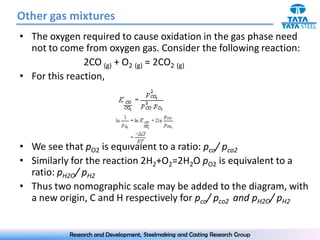
• The oxygen required to cause oxidation in the gas phase need
  not to come from oxygen gas. Consider the following reaction:
               2CO (g) + O2 (g) = 2CO2 (g)
• For this reaction,


• We see that pO2 is equivalent to a ratio: pco/ pco2
• Similarly for the reaction 2H2+O2=2H2O pO2 is equivalent to a
  ratio: pH2O/ pH2
• Thus two nomographic scale may be added to the diagram, with
  a new origin, C and H respectively for pco/ pco2 and pH2O/ pH2


           Research and Development, Steelmaking and Casting Research Group
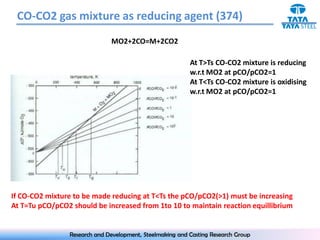
CO-CO2 gas mixture as reducing agent (374)
                               MO2+2CO=M+2CO2

                                                           At T>Ts CO-CO2 mixture is reducing
                                                           w.r.t MO2 at pCO/pCO2=1
                                                           At T<Ts CO-CO2 mixture is oxidising
                                                           w.r.t MO2 at pCO/pCO2=1


If CO-CO2 mixture to be made reducing at T<Ts the pCO/pCO2(>1) must be increasing
At T=Tu pCO/pCO2 should be increased from 1to 10 to maintain reaction equillibrium


                 Research and Development, Steelmaking and Casting Research Group
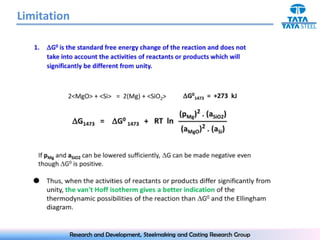
Limitation


         Research and Development, Steelmaking and Casting Research Group
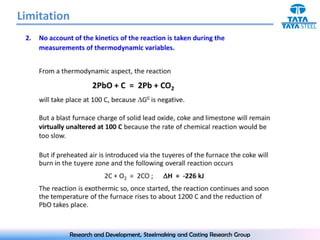
Limitation


         Research and Development, Steelmaking and Casting Research Group
References
1. D.R. Gaskell, "Introduction to the Thermodynamics of Materials“
2. http://www.doitpoms.ac.uk/tlplib/ellingham_diagrams/


                          Thank you


                Research and Development, Steelmaking and Casting Research Group
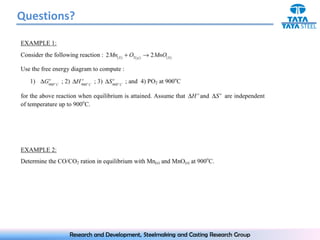
Questions?


         Research and Development, Steelmaking and Casting Research Group

Ellingham diagram

  • 1.
    Technical presentation The Ellingham Diagram Bapin Kumar Rout Research and Development, Steelmaking and Casting Research Group
  • 2.
    Before we start:Thermodynamic terminologies  Gibb’s Free Energy ( G ): Energy of the system available to do work G= H-T*. S Enthalpy term Entropy term ∆H: Measure of the actual energy that is liberated when the reaction occurs ∆S: Measure of the change in the possibilities for disorder in the products compared to the reactants Spontaneity of the Reaction ( G<0) Research and Development, Steelmaking and Casting Research Group
  • 3.
    Free Energy andEquilibrium Standard state free energy ( G0=): Under non-standard conditions, we need to use G instead of G°. 1. If G is negative, the forward reaction is spontaneous. 2. If G is 0, the system is at equilibrium. 3. If G is positive, the reaction is spontaneous in the reverse direction. Research and Development, Steelmaking and Casting Research Group
  • 4.
    The Ellingham Diagram Ellingham1 plotted experimentally determined standard free energy of formation (∆G0) of various oxides (and sulfides) using one mole of oxygen with temperature Ellingham Found that, the standard enthalpy and entropy of formation of a compound don’t change significantly with temperature as long as there is no change of state Thus, ∆G0-T relationship is approximated to straight lines: Y= mx+C Intercept Slope 1Ellingham H. J. T., “Reducibility of Oxides and sulfides in Metallurgical Processes , J Soc Chem Ind (London) 63 125 (1944) Research and Development, Steelmaking and Casting Research Group
  • 5.
    The Ellingham Diagram Oxide stable Metal stable Research and Development, Steelmaking and Casting Research Group
  • 6.
    The Ellingham Diagram Research and Development, Steelmaking and Casting Research Group
  • 7.
    The Ellingham Diagrams Research and Development, Steelmaking and Casting Research Group
  • 8.
    The Ellingham Diagrams Research and Development, Steelmaking and Casting Research Group
  • 9.
    Two intersecting lines  T<TE A and BO2 are most stable  T>TE B and AO are most stable  At T=TE A,B,AO,BO2 are in equilibrium A as a reducing agent to reduce BO2 to form B and AO- T> TE Research and Development, Steelmaking and Casting Research Group
  • 10.
    The Ellingham Diagrams Research and Development, Steelmaking and Casting Research Group
  • 11.
    The Ellingham Diagram Research and Development, Steelmaking and Casting Research Group
  • 12.
    The Ellingham Diagrams Research and Development, Steelmaking and Casting Research Group
  • 13.
    The Ellingham Diagrams Research and Development, Steelmaking and Casting Research Group
  • 14.
    Additional scales onEllingham diagram Y=-mX Research and Development, Steelmaking and Casting Research Group
  • 15.
    Reading pO2 fromEllingham diagram • In to avoid calculating the equilibrium partial pressure for each value of ΔG°, Richardson2 added a nomographic scale to the Ellingham diagram • For a metal oxidation reaction , 2M (s) + O2 (g) = 2MO (s) The equilibrium constant has the form K=1/pO2 ∆G= RT ln(pO2) 2 F.D. Richardson and J.H.E. Jeffes, "The Thermodynamics of Substances of Interest in Iron and Steel Making from 0°C to 2400°C: I-Oxides," J. Iron and Steel Inst. (1948), 160 261. Research and Development, Steelmaking and Casting Research Group
  • 16.
    Reading pO2 fromEllingham diagram 1. Identify a point corresponding to a selected temperature on the line for: Fe + O FeO, above M 2. Using this point, and the point O in the top left corner, draw a line across the diagram 3. Read the partial pressure of O2 from the right hand axis At any oxygen pressure higher than ~10-8.5, the iron will be oxidised at the temperature of 1600°C Research and Development, Steelmaking and Casting Research Group
  • 17.
    Other gas mixtures •The oxygen required to cause oxidation in the gas phase need not to come from oxygen gas. Consider the following reaction: 2CO (g) + O2 (g) = 2CO2 (g) • For this reaction, • We see that pO2 is equivalent to a ratio: pco/ pco2 • Similarly for the reaction 2H2+O2=2H2O pO2 is equivalent to a ratio: pH2O/ pH2 • Thus two nomographic scale may be added to the diagram, with a new origin, C and H respectively for pco/ pco2 and pH2O/ pH2 Research and Development, Steelmaking and Casting Research Group
  • 18.
    CO-CO2 gas mixtureas reducing agent (374) MO2+2CO=M+2CO2 At T>Ts CO-CO2 mixture is reducing w.r.t MO2 at pCO/pCO2=1 At T<Ts CO-CO2 mixture is oxidising w.r.t MO2 at pCO/pCO2=1 If CO-CO2 mixture to be made reducing at T<Ts the pCO/pCO2(>1) must be increasing At T=Tu pCO/pCO2 should be increased from 1to 10 to maintain reaction equillibrium Research and Development, Steelmaking and Casting Research Group
  • 19.
    Limitation Research and Development, Steelmaking and Casting Research Group
  • 20.
    Limitation Research and Development, Steelmaking and Casting Research Group
  • 21.
    References 1. D.R. Gaskell,"Introduction to the Thermodynamics of Materials“ 2. http://www.doitpoms.ac.uk/tlplib/ellingham_diagrams/ Thank you Research and Development, Steelmaking and Casting Research Group
  • 22.
    Questions? Research and Development, Steelmaking and Casting Research Group