BMM 104: ENGINEERING MATHEMATICS I                                                     Page 1 of 16


                                     CHAPTER 4: DIFFERENTIATION

The Derivative as a Function

Derivative Function

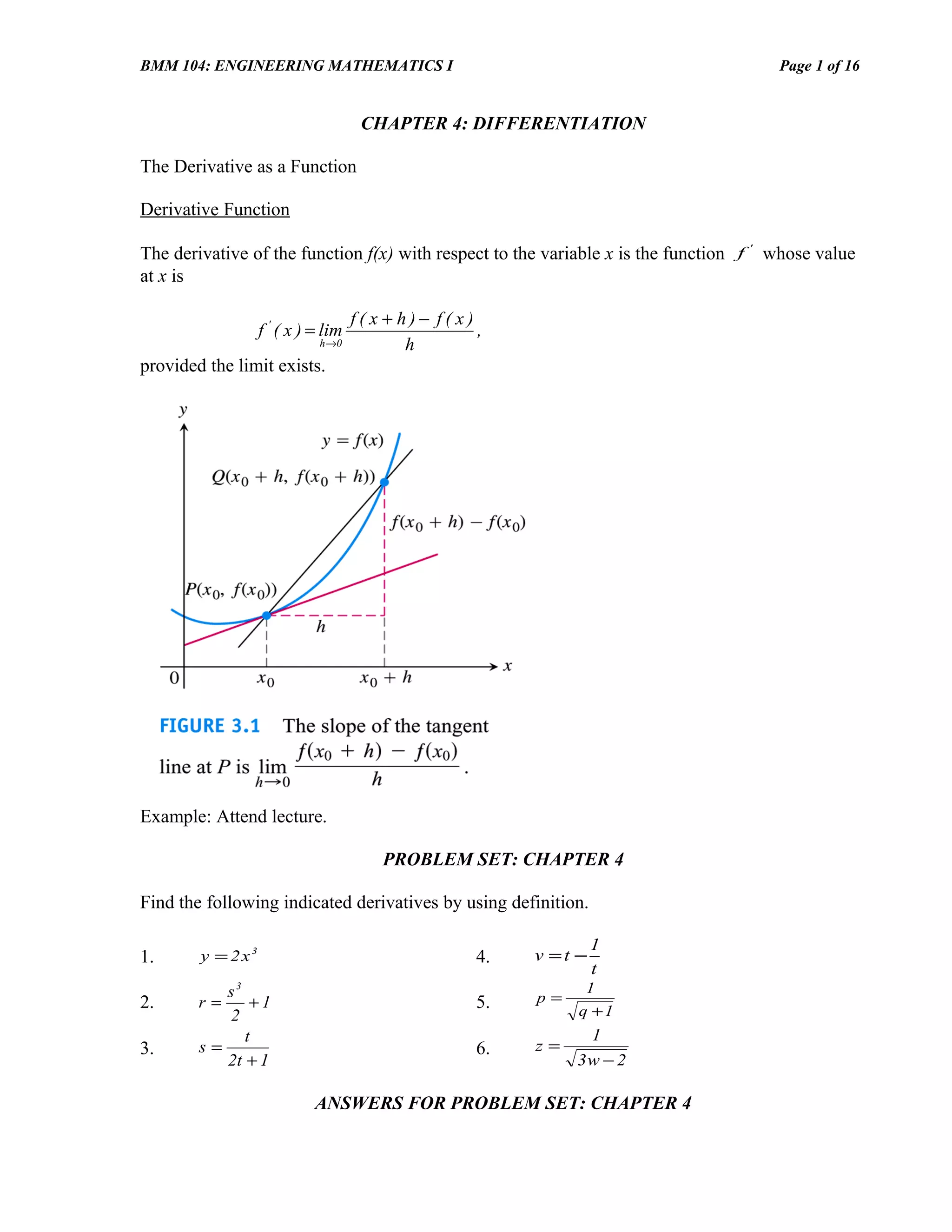
The derivative of the function f(x) with respect to the variable x is the function f ' whose value
at x is

                                    f( x + h)− f( x)
                  f ' ( x ) = lim                    ,
                            h →0            h
provided the limit exists.


Example: Attend lecture.

                                        PROBLEM SET: CHAPTER 4

Find the following indicated derivatives by using definition.

                                                                   1
1.      y = 2x3                                      4.   v =t −
                                                                   t
           s3                                                   1
2.      r=     +1                                    5.   p=
           2                                                   q +1
              t                                                 1
3.      s=                                           6.   z=
           2t + 1                                              3w − 2

                            ANSWERS FOR PROBLEM SET: CHAPTER 4
BMM 104: ENGINEERING MATHEMATICS I                                           Page 2 of 16


Find the following indicated derivatives by using definition.

                                                                1
1.      6 x2                                   4.        1+
                                                                t2
        3 2                                                   −1
2.         s                                   5.
        2                                                2( q + 1 ) 3 / 2
             1                                                 −3
3.                                             6.
        ( 2t + 1 ) 2                                     2( 3w − 2 ) 3 / 2

Differentiation Rules

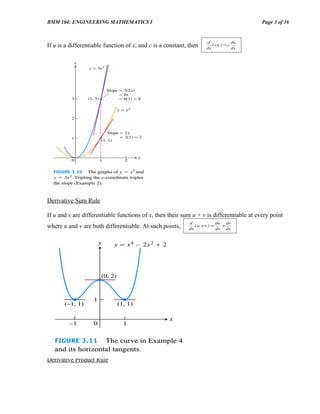
Derivative of a Constant Function

                                             df   d
If f has the constant value f(x) = c, then   dx
                                                =
                                                  dx
                                                     ( c ) =0


Power Rule for Positive Integers

If n is a positive integer, then

                       d n
                          x = nx n −1
                       dx


Constant Multiple Rule
BMM 104: ENGINEERING MATHEMATICS I                                                        Page 3 of 16


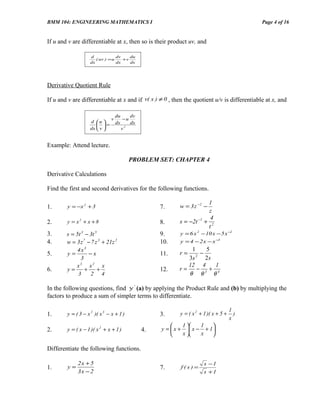
                                                                     d             du
If u is a differentiable function of x, and c is a constant, then    dx
                                                                        ( cu ) = c
                                                                                   dx


Derivative Sum Rule

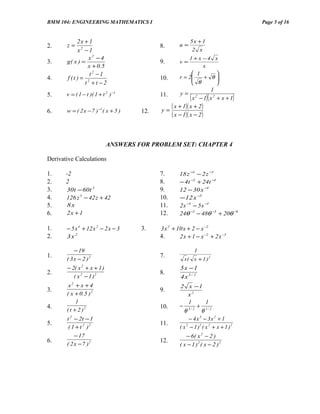
If u and v are differentiable functions of x, then their sum u + v is differentiable at every point
                                                             d             du   dv
where u and v are both differentiable. At such points,       dx
                                                                ( u +v ) =
                                                                           dx
                                                                              +
                                                                                dx


Derivative Product Rule
BMM 104: ENGINEERING MATHEMATICS I                                                           Page 4 of 16


If u and v are differentiable at x, then so is their product uv, and

                   d             dv    du
                      ( uv ) = u    +v
                   dx            dx    dx


Derivative Quotient Rule

If u and v are differentiable at x and if v( x ) ≠ 0 , then the quotient u/v is differentiable at x, and

                                   du    dv
                               v      −u
                   d u           dx    dx
                       =
                   dx  v            v2


Example: Attend lecture.

                                         PROBLEM SET: CHAPTER 4

Derivative Calculations

Find the first and second derivatives for the following functions.

                                                                         1
1.      y = −x 2 + 3                               7.     w = 3 z −2 −
                                                                         z
                                                                         4
2.      y = x2 + x + 8                             8.     s = −2t −1 +
                                                                         t2
3.      s = 5t 3 − 3t 5                            9.     y = 6 x 2 − 10 x − 5 x −2
4.      w = 3 z 7 − 7 z 3 + 21z 2                  10.    y = 4 − 2 x − x −3
             4x3                                              1     5
5.      y=         −x                              11.    r=    2
                                                                  −
              3                                              3s     2s
            x3 x2 x                                          12 4       1
6.      y=       +      +                          12.    r=    − 3+ 4
             3     2 4                                       θ θ       θ

In the following questions, find y ' (a) by applying the Product Rule and (b) by multiplying the
factors to produce a sum of simpler terms to differentiate.

                                                                                     1
1.      y = ( 3 − x 2 )( x 3 − x + 1 )             3.     y = ( x 2 + 1 )( x + 5 +     )
                                                                                     x
                                                           1    1   
2.      y = ( x − 1 )( x 2 + x + 1 )          4.   y =  x +  x − + 1
                                                           x    x   

Differentiate the following functions.

             2x + 5                                                   s −1
1.      y=                                         7.     f(s)=
             3x − 2                                                   s +1
BMM 104: ENGINEERING MATHEMATICS I                                                      Page 5 of 16


             2x + 1                                            5x + 1
2.     z=                                    8.       u=
             x2 − 1                                             2 x
                    x2 − 4                                1 + x −4 x
3.     g( x ) =                              9.       v=
                    x + 0.5                                     x
                     t2 −1                                  1     
4.      f (t ) =                             10.      r = 2
                                                               + θ
                                                                   
                   t2 + t − 2                               θ     
                                                                    1
       v = ( 1 − t )( 1 + t 2 ) −1                    y=
5.                                           11.
                                                          ( x − 1)( x 2 + x + 1)
                                                                     2


                                             y=
                                                ( x + 1)( x + 2 )
6.     w = ( 2 x − 7 ) −1 ( x + 5 )    12.
                                                ( x − 1)( x − 2 )


                              ANSWERS FOR PROBLEM SET: CHAPTER 4

Derivative Calculations

1.     -2                                    7.       18 z −4 − 2 z −3
2.     2                                     8.       − 4t −3 + 24t −4
3.     30t − 60t 3                           9.       12 − 30 x −4
4.     126 z 5 − 42 z + 42                   10.      −12 x −5
5.     8x                                    11.      2 s −4 − 5 s −3
6.     2x + 1                                12.      24θ −3 − 48θ −5 + 20θ −6

1.     − 5 x 4 + 12 x 2 − 2 x − 3      3.    3 x 2 + 10 x + 2 − x −2
2.     3x 2                                  4.       2 x + 1 − x −2 + 2 x −3

           − 19                                                   1
1.                                           7.
       ( 3 x − 2 )2                                       s ( s + 1 )2
       − 2( x 2 + x + 1 )                             5x −1
2.                                           8.
          ( x 2 − 1 )2                                4x3 / 2
        x2 + x + 4                                    2 x −1
3.                                           9.
       ( x + 0.5 ) 2                                    x2
            1                                                 1                  1
4.                                           10.      −              +
       ( t + 2 )2                                         θ   3/ 2
                                                                             θ   1/ 2

       t − 2t − 1
         2
                                                           − 4 x − 3x 2 + 1
                                                                         3

5.                                           11.
        ( 1 + t 2 )2                                  ( x 2 − 1 )2 ( x 2 + x + 1 )2
           − 17                                          − 6( x 2 − 2 )
6.                                           12.
       ( 2 x − 7 )2                                   ( x − 1 )2 ( x − 2 )2
BMM 104: ENGINEERING MATHEMATICS I                                                                Page 6 of 16


Derivatives of Trigonometric Functions

         d
1.          sin x = cos x
         dx
         d
2.          cos x = − sin x
         dx
         d
3.          tan x = sec 2 x
         dx
         d
4.          sec x = sec x tan x
         dx
         d
5.          cot x = − csc 2 x
         dx
         d
6.          csc x = − csc x cot x
         dx

Example: Attend lecture.


                                              PROBLEM SET 3.3


                                       PROBLEM SET: CHAPTER 4


       dy
Find      .
       dx

                                                                   cot x
1.       y = −10 x + 3 cos x                      7.        y=
                                                                 1 + cot x
              3                                           cos x
2.       y=     + 5 sin x                    8.    y=
              x                                         1 + sin x
                                                                 4      1
3.       y = csc x −4       x +7                  9.        y=       +
                                                               cos x tan x
                            1                                  cos x     x
4.       y = x 2 cot x −                          10.       y=       +
                            x2                                   x     cos x
5.       y = ( sec x + tan x )( sec x − tan x )   11.       y = x 2 sin x + 2 x cos x − 2 sin x
6.       y = ( sin x + cos x ) sec x              12.       y = x 2 cos x − 2 x sin x − 2 cos x


                              ANSWERS FOR PROBLEM SET: CHAPTER 4

                                                              − csc 2 x
1.       − 10 − 3 sin x                           7.
                                                           ( 1 + cot x ) 2
                                                               −1
2.       − 3 x −2 + 5 cos x                       8.
                                                           1 + sin x
BMM 104: ENGINEERING MATHEMATICS I                                                                         Page 7 of 16


                                2
3.      − csc x cot x −                                      9.        4 sec x tan x − csc 2 x
                                 x
                                                                       − x sin x − cos x cos x + x sin x
4.      − x 2 csc 2 x + 2 x cot x + 2 x −3                   10.                        +
                                                                               x2            cos 2 x
5.      0                                                    11.       x 2 cos x
6.      sec 2 x                                              12.       − x 2 sin x


The Chain Rule

If f(u) is differentiable at the point u = g(x) and g(x) is differentiable at x, then the composite
function ( f  g )( x ) = f ( g ( x )) is differentiable at x, and

                  ( f  g )' ( x ) = f ' ( g ( x )) • g ' ( x )

In Leibniz’s notation, if y = f(u) and u = g(x), then

                  dy dy du
                    =  •   ,
                  dx du dx
where dy/du is evaluated at u = g(x).

Example: Attend lecture.


                                           PROBLEM SET: CHAPTER 4

Differentiate the following functions.

        y = ( 2 x +1)                                                  y = ( 4 x + 3 ) 4 ( x + 1 ) −3
                        5
1.                                                           21.
        y = (4 − 3 x)                                                  y = ( 2 x − 5 ) −1 ( x 2 − 5 x )6
                        9
2.                                                           22.
                        −7
               x
3.      y = 1 −                                            23.       h( x ) = x tan( 2 x ) +7
               7
                        −10
            x                                                                                   1
4.      y =  − 1                                                    24.        k ( x ) = x 2 sec 
            2                                                                                   x
                                4                                                               2
            x2    1                                                            sin θ 
5.      y =
            8 +x− x
                                                            25.       f (θ ) =            
                                                                               1 + cos θ 
                            5                                                          −1
           x       1                                                  1 + cos t 
6.      y = +                                   26.         g( t ) =            
            5 5x                                                      sin t 
7.      y = sec ( tan x )                                    27.               ( )
                                                                       r = sin θ 2 cos( 2θ )
                   1                                                                1
8.      y = cot π −                                        28.       r = sec θ tan 
                   x                                                                θ 
BMM 104: ENGINEERING MATHEMATICS I                                                                  Page 8 of 16


                                                           t 
9.    y = sin 3 x                            29.   q = sin
                                                                   
                                                                    
                                                           t +1 
                                                            sin t 
10.   y = 5 cos −4 x                         30.   q = cot        
                                                            t 
11.   p=     3 −t                            31.   y = sin 2 ( πt − 2 )
12.   q = 2r − r     2
                                             32.   y = sec 2 πt
            4            4
13.   s=       sin 3t +      cos 5t          33.   y = ( 1 + cos 2t ) −4
          3π            5π
               3πt          3πt 
14.   s = sin       + cos                34.   y = ( 1 + cot( t / 2 )) −2
               2            2 
      r = ( csc θ + cot θ )                        y = sin(cos( 2t − 5 ))
                            −1
15.                                          35.
                                                                  t 
      r = −( sec θ + tan θ )                       y = cos 5 sin   
                                 −1
16.                                          36.                      
                                                                  3 
                                                                              3
                                                                   t 
17.   y = x 2 sin 4 x + x cos −2 x           37.   y =  1 + tan 4   
                                                                         
                                                                   12  

18.   y=
         1
         x
                      x
           sin −5 x − cos 3 x
                      3
                                             38.
                                                        1
                                                           (
                                                   y = 1 + cos 2 ( 7 t )
                                                       6
                                                                              )   3


                                   −1
         1                    1 
19.   y = ( 3 x − 2 )7 +  4 − 2            39.   y = 1 + cos( t 2 )
         21                  2x 
                                         4
                               12   
20.   y = ( 5 − 2 x ) −3 +       + 1       40.   y = 4 sin(      1+ t )
                               8x   


                               ANSWERS FOR PROBLEM SET: CHAPTER 4


                                                   ( 4 x + 3) 3 ( 4 x + 7 )
1.    10( 2 x + 1 )   4
                                             21.
                                                         ( x + 1) 4
                                                                                      2( x 2 − 5 x )6
2.    − 27( 4 − 3 x ) 8                            22.         6( x 2 − 5 x )5 −
                                                                                       ( 2 x − 5 )2
                −8
         x
3.    1 −                                  23.     x sec 2 ( 2 x ) + tan( 2 x )
         7
                         −11
         x                                               1     1 1
4.    − 5 − 1                              24.   2 x sec  − sec  tan 
          2                                              x     x x
                                                       2 sin θ
                           3
        x2      1 x         1 
5.    4
        8 + x − x   4 + 1 + x2 
                                            25.
                                               ( 1 + cos θ ) 2
                 4
      x 1              1                           1
6.     +           1 − 2                 26.
       5 5x           x                        1 + cos t
BMM 104: ENGINEERING MATHEMATICS I                                                                               Page 9 of 16


7.     ( sec( tan x ) tan( tan x ) ) sec 2 x         27.            − 2 sin (θ 2 ) sin ( 2θ ) + 2θ cos( 2θ ) cos(θ 2 )
                                                                                      1     2  1 
       −1           1                                                      tan θ tanθ  sec θ 
8.         csc 2 π −                               28.           (   sec θ )         −
                                                                                               θ2
                                                                                                  
       x 2
                    x                                                          2 θ                 
                                                                                                     
                                                                                                     
                                                                               t +2                   t 
9.     3( sin 2 x ) cos x                                          29.        
                                                                               2( t + 1 )3 / 2    cos
                                                                                                           
                                                                                                             
                                                                                                      t +1
                                                                             sin t   t cos t − sin t 
10.    20(cos −5 x )(sin x )                         30.            − csc 2 
                                                                                     
                                                                                                         
                                                                             t             t2        
         −1
11.                                                  31.            2π sin( πt − 2 ) cos( πt − 2 )
       2 3 −t
        1−r
12.                                                  32.            2π sec 2 πt tan πt
           2r − r 2
       4                                                                8 sin 2t
13.        (cos 3t − sin 5t )                        33.
       π                                                            ( 1 + cos 2t ) 5
                                                                                        t
                                                                                  csc 2  
       3π      3πt       3πt                                                            2
14.       (cos     − sin     )                                     34.
        2       2         2                                                             t
                                                                              ( 1 + cot   ) 3
                                                                                        2

           csc θ
15.                                                  35.            − 2 cos(cos( 2t − 5 ))(sin( 2t − 5 ))
       csc θ + cot θ

           sec θ                                                        5          t    t  
16.                                                  36.            −    sin 5 sin   cos  
                                                                                               
       sec θ + tan θ                                                    3          3    3  
17.    4 x 2 sin 3 x cos x + 2 x sin 4 x + 2 x sin x cos −3 x + cos −2 x
       − 5 −6                  1                                 1
18.          sin x cos x − 2 sin −5 x + x cos 2 x sin x − cos 3 x
         x                    x                                  3
                             1
       ( 3 x − 2 )6 −                                  
                                                                         2
                                      2                         4  t    3 t      2  t 
19.                     3
                      x 4 − 2 
                                 1          37.       1 + tan  12  tan  12  sec  12 
                                                                                   
                              2x 
                                               38.         [                      ]   2
                                                     − 7 1 + cos 2 ( 7 t ) (cos( 7 t ) sin( 7 t ))
                                                               t sin (t 2 )
                                               39.   −
                                                           1 + cos( t 2 )
                                3
                     2   
                      + 1                          cos 1 + t 
                                                               
20.         6                                  40.             
                    − 2 
                      x
                                                               t+ t
       ( 5 − 2 x )4     x

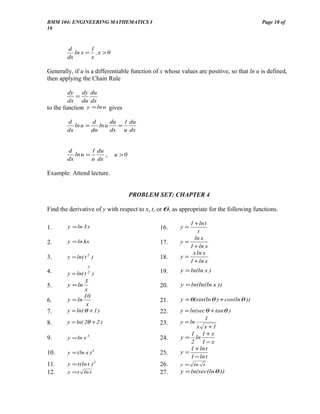
The Derivatives of y = ln x
                    x
       d          d 1        1
       dx
          ln x =    ∫ t dt = x
                 dx 1
BMM 104: ENGINEERING MATHEMATICS I                                                        Page 10 of
16


        d        1
           ln x = , x > 0
        dx       x

Generally, if u is a differentiable function of x whose values are positive, so that ln u is defined,
then applying the Chain Rule

        dy dy du
          =
        dx du dx
to the function y = ln u gives

        d         d       du 1 du
           ln u =    ln u   =
        dx        du      dx u dx


        d         1 du
           ln u =      ,    u >0
        dx        u dx

Example: Attend lecture.


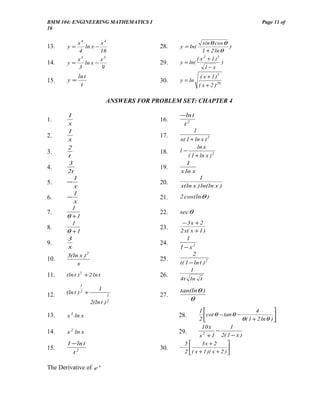
                                   PROBLEM SET: CHAPTER 4

Find the derivative of y with respect to x, t, or θ , as appropriate for the following functions.

                                                           1 + ln t
1.      y = ln 3 x                             16.      y=
                                                               t
                                                             ln x
2.      y = ln kx                              17.      y=
                                                           1 + ln x
                                                            x ln x
3.      y = ln( t 2 )                          18.      y=
                                                           1 + ln x
                  3
4.                                             19.      y = ln(ln x )
        y = ln( t 2 )
                3
5.      y = ln                                 20.      y = ln(ln(ln x ))
                x
               10
6.      y = ln                                 21.      y = θ(sin(ln θ ) + cos(ln θ ))
                 x
7.      y = ln( θ + 1 )                        22.      y = ln(sec θ + tan θ )
                                                                   1
8.      y = ln( 2θ + 2 )                       23.      y = ln
                                                               x x +1
                                                             1 1+ x
9.      y = ln x 3                             24.      y = ln
                                                             2 1−x
                                                            1 + ln t
10.     y = (ln x )3                           25.      y=
                                                             1 − ln t
11.     y = t(ln t ) 2                         26.      y = ln    t
12.     y =t    ln t                           27.      y = ln(sec(ln θ ))
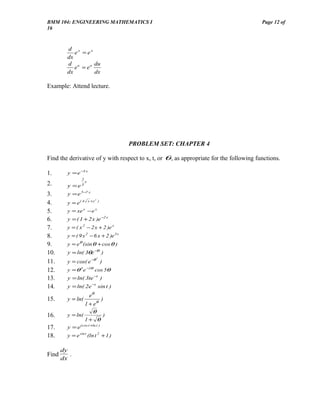
BMM 104: ENGINEERING MATHEMATICS I                                                           Page 11 of
16

               x4        x4                                       sin θ cos θ
13.    y=         ln x −                        28.   y = ln(                 )
               4         16                                       1 + 2 ln θ
               x3        x3                                     ( x 2 + 1 )5
14.    y=         ln x −                        29.   y = ln(                   )
               3         9                                          1− x
               ln t                                               ( x + 1 )5
15.    y=                                       30.   y = ln
                t                                                ( x + 2 ) 20

                                  ANSWERS FOR PROBLEM SET: CHAPTER 4

       1                                              − ln t
1.                                              16.
       x                                               t2
       1                                                     1
2.                                              17.
       x                                              x( 1 + ln x ) 2
       2                                                       ln x
3.                                              18.   1−
       t                                                  ( 1 + ln x ) 2
        3                                                1
4.                                              19.
       2t                                             x ln x
          1                                                   1
5.     −                                        20.
          x                                           x(ln x ) ln(ln x )
          1
6.     −                                        21.   2 cos(ln θ )
          x
         1
7.                                              22.   sec θ
       θ +1
         1                                             − 3x + 2
8.                                              23.
       θ +1                                           2 x( x + 1 )
       3                                                 1
9.                                              24.
       x                                              1 − x2
       3(ln x ) 2                                           2
10.                                             25.
            x                                         t( 1 − ln t ) 2
                                                            1
11.    (ln t ) 2 + 2 ln t                       26.
                                                      4t ln t
                1
                            1                         tan(ln θ )
12.    (ln t   )2   +              1            27.
                                                            θ
                        2(ln t   ) 2

                                                               1                        4         
13.    x 3 ln x                                       28.
                                                               2cot θ − tan θ − θ ( 1 + 2 ln θ ) 
                                                                                                   
                                                                10 x            1
14.    x 2 ln x                                       29.               −
                                                               x + 1 2( 1 − x )
                                                                2

       1 − ln t                                         5      3x + 2        
15.                                             30.   − 
         t2                                             2 ( x + 1 )( x + 2 ) 
                                                                              

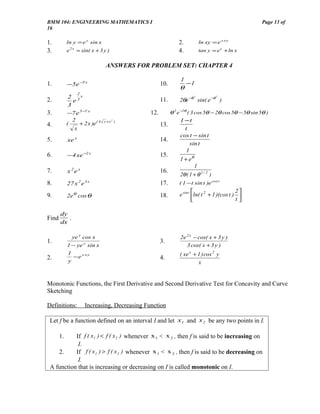
The Derivative of e x
BMM 104: ENGINEERING MATHEMATICS I                                                       Page 12 of
16


         d x
            e = ex
         dx
         d u       du
            e = eu
         dx        dx

Example: Attend lecture.


                                        PROBLEM SET: CHAPTER 4

Find the derivative of y with respect to x, t, or θ , as appropriate for the following functions.

1.       y = e −5 x
                 2
                     x
2.       y =e3
3.       y = e 5− x
                 7

                         x +x 2 )
4.       y = e( 4
5.       y = xe x − e x
6.       y = ( 1 + 2 x )e −2 x
7.       y = ( x 2 − 2 x + 2 )e x
8.       y = ( 9 x 2 − 6 x + 2 )e 3 x
9.       y = eθ (sin θ + cos θ )
10.      y = ln( 3θe −θ )
         y = cos( e −θ )
                               2
11.
12.      y = θ 3 e −2θ cos 5θ
13.      y = ln( 3te −t )
14.      y = ln( 2e −t sin t )
                   eθ
15.      y = ln(        )
                 1 + eθ
                    θ
16.      y = ln(         )
                 1+ θ
17.      y = e (cos t +ln t )
18.      y = e sin t (ln t 2 + 1 )

       dy
Find      .
       dx
BMM 104: ENGINEERING MATHEMATICS I                                                                   Page 13 of
16

1.          ln y = e y sin x                                  2.            ln xy = e x +y
3.          e 2 x = sin( x + 3 y )                            4.            tan y = e e + ln x


                                  ANSWERS FOR PROBLEM SET: CHAPTER 4

                                                               1
1.          −5e −5 x                                  10.          −1
                                                               θ
                   2
             2 3x
                                                               2θe −θ sin( e −θ )
                                                                        2           2
2.             e                                      11.
             3
3.          −7 e 5 −7 x                         12.       θ 2 e −2θ ( 3 cos 5θ − 2θ cos 5θ − 5θ sin 5θ )
               2                 x +x2 )                        1 −t
4.          (     + 2 x )e ( 4                        13.
                x                                                 t
                                                                cos t − sin t
5.          xe x                                      14.
                                                                     sin t
                                                                  1
6.          −4 xe −2 x                                15.
                                                               1 + eθ
                                                                        1
7.          x 2e x                                    16.
                                                               2θ ( 1 + θ 1 / 2 )
8.          27 x 2 e 3 x                              17.     ( 1 −t sin t )e cos t
                                                                                            2
9.          2eθ cos θ                                 18.      e sin t ln( t 2 + 1 )(cos t ) 
                                                                                            t

       dy
Find      .
       dx

              ye y cos x                                       2e 2 x − cos( x + 3 y )
1.                                                    3.
                       y
            1 − ye sin x                                          3 cos( x + 3 y )
            1
              − e x +y                                         ( xe x + 1 ) cos 2 y
2.          y
                                                      4.
                                                                        x


Monotonic Functions, the First Derivative and Second Derivative Test for Concavity and Curve
Sketching

Definitions:           Increasing, Decreasing Function

 Let f be a function defined on an interval I and let x1 and x 2 be any two points in I.

       1.  If f ( x1 ) < f ( x 2 ) whenever x 1 < x 2 , then f is said to be increasing on
            I.
    2.     If f ( x1 ) > f ( x 2 ) whenever x 1 < x 2 , then f is said to be decreasing on
            I.
 A function that is increasing or decreasing on I is called monotonic on I.
BMM 104: ENGINEERING MATHEMATICS I                                                         Page 14 of
16


First Derivative Test for Monotonic Functions

 Suppose that f is continuous on [a, b] and differentiable on (a, b).

         If f ' ( x ) > 0 at each point x ∈( a ,b ) , then f is increasing on [a, b].
         If f ' ( x ) < 0 at each point x ∈( a ,b ) , then f is decreasing on [a, b].


First Derivative Test for Local Extrema

 Suppose that c is a critical point of a continuous function f, and that f is differentiable
 at every point in some interval containing c expect possibly at c itself.
 Moving across c from left to right.

    1.      if f ' changes from negative to positive at c, then f has a local minimum at
             c;
    2.      if f ' changes from positive to negative at c, then f has a local maximum
             at c;
    3.      if f ' does not change sign at c (that is, f ' is positive on both sides of c
             or negative on both sides), then f has no local extremum at c.
BMM 104: ENGINEERING MATHEMATICS I                                                               Page 15 of
16


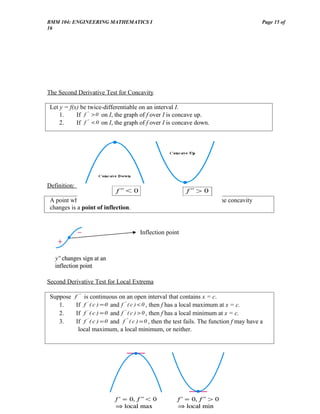
The Second Derivative Test for Concavity

 Let y = f(x) be twice-differentiable on an interval I.
     1.     If f '' > 0 on I, the graph of f over I is concave up.
     2.     If f '' < 0 on I, the graph of f over I is concave down.


Definition:            Point of Inflection

 A point where the graph of a function has a tangent line and where the concavity
 changes is a point of inflection.


                                             Inflection point


Second Derivative Test for Local Extrema

 Suppose      f  is continuous on an open interval that contains x = c.
                  ''


    1.        If f ' ( c ) = 0 and f '' ( c ) < 0 , then f has a local maximum at x = c.
    2.        If f ' ( c ) = 0 and f '' ( c ) > 0 , then f has a local minimum at x = c.
    3.        If f ' ( c ) = 0 and f '' ( c ) = 0 , then the test fails. The function f may have a
               local maximum, a local minimum, or neither.
BMM 104: ENGINEERING MATHEMATICS I                                                      Page 16 of
16


Graph Sketching

 Strategy for Graphing y = f(x)
     1.     Identify the domain of f and any symmetries the curve may have.
     2.     Find y ' and y '' .
     3.     Find the critical points of f, and identify the function’s behavior at each one.
     4.     Find where the curve is increasing and where it is decreasing.
     5.     Find the points of inflection, if any occur, and determine the concavity of the
             curve.
     6.     Identify any asymptotes.
     7.     Plot key points, such as the intercepts and the points found in Steps 3-5, and
             sketch the curve.


Example: Attend lecture

                                       PROBLEM SET: CHAPTER 4

Sketch the graph for the following functions.

1.      y = 2 x 3 − 3 x 2 − 12 x + 5
2.      y = x 3 + 6 x 2 − 15 x
3.      y = 27 x − x 3
            x3
4.      y=      + x 2 − 3x + 7
             3
                      3x 2 x3
5.      y = 1 + 4x −       −
                        2      3


                           ANSWERS FOR PROBLEM SET: CHAPTER 4

Solution: Attend lecture.

Chapter 4(differentiation)

  • 1.
    BMM 104: ENGINEERINGMATHEMATICS I Page 1 of 16 CHAPTER 4: DIFFERENTIATION The Derivative as a Function Derivative Function The derivative of the function f(x) with respect to the variable x is the function f ' whose value at x is f( x + h)− f( x) f ' ( x ) = lim , h →0 h provided the limit exists. Example: Attend lecture. PROBLEM SET: CHAPTER 4 Find the following indicated derivatives by using definition. 1 1. y = 2x3 4. v =t − t s3 1 2. r= +1 5. p= 2 q +1 t 1 3. s= 6. z= 2t + 1 3w − 2 ANSWERS FOR PROBLEM SET: CHAPTER 4
  • 2.
    BMM 104: ENGINEERINGMATHEMATICS I Page 2 of 16 Find the following indicated derivatives by using definition. 1 1. 6 x2 4. 1+ t2 3 2 −1 2. s 5. 2 2( q + 1 ) 3 / 2 1 −3 3. 6. ( 2t + 1 ) 2 2( 3w − 2 ) 3 / 2 Differentiation Rules Derivative of a Constant Function df d If f has the constant value f(x) = c, then dx = dx ( c ) =0 Power Rule for Positive Integers If n is a positive integer, then d n x = nx n −1 dx Constant Multiple Rule
  • 3.
    BMM 104: ENGINEERINGMATHEMATICS I Page 3 of 16 d du If u is a differentiable function of x, and c is a constant, then dx ( cu ) = c dx Derivative Sum Rule If u and v are differentiable functions of x, then their sum u + v is differentiable at every point d du dv where u and v are both differentiable. At such points, dx ( u +v ) = dx + dx Derivative Product Rule
  • 4.
    BMM 104: ENGINEERINGMATHEMATICS I Page 4 of 16 If u and v are differentiable at x, then so is their product uv, and d dv du ( uv ) = u +v dx dx dx Derivative Quotient Rule If u and v are differentiable at x and if v( x ) ≠ 0 , then the quotient u/v is differentiable at x, and du dv v −u d u  dx dx  = dx  v  v2 Example: Attend lecture. PROBLEM SET: CHAPTER 4 Derivative Calculations Find the first and second derivatives for the following functions. 1 1. y = −x 2 + 3 7. w = 3 z −2 − z 4 2. y = x2 + x + 8 8. s = −2t −1 + t2 3. s = 5t 3 − 3t 5 9. y = 6 x 2 − 10 x − 5 x −2 4. w = 3 z 7 − 7 z 3 + 21z 2 10. y = 4 − 2 x − x −3 4x3 1 5 5. y= −x 11. r= 2 − 3 3s 2s x3 x2 x 12 4 1 6. y= + + 12. r= − 3+ 4 3 2 4 θ θ θ In the following questions, find y ' (a) by applying the Product Rule and (b) by multiplying the factors to produce a sum of simpler terms to differentiate. 1 1. y = ( 3 − x 2 )( x 3 − x + 1 ) 3. y = ( x 2 + 1 )( x + 5 + ) x  1  1  2. y = ( x − 1 )( x 2 + x + 1 ) 4. y =  x +  x − + 1  x  x  Differentiate the following functions. 2x + 5 s −1 1. y= 7. f(s)= 3x − 2 s +1
  • 5.
    BMM 104: ENGINEERINGMATHEMATICS I Page 5 of 16 2x + 1 5x + 1 2. z= 8. u= x2 − 1 2 x x2 − 4 1 + x −4 x 3. g( x ) = 9. v= x + 0.5 x t2 −1  1  4. f (t ) = 10. r = 2  + θ  t2 + t − 2  θ  1 v = ( 1 − t )( 1 + t 2 ) −1 y= 5. 11. ( x − 1)( x 2 + x + 1) 2 y= ( x + 1)( x + 2 ) 6. w = ( 2 x − 7 ) −1 ( x + 5 ) 12. ( x − 1)( x − 2 ) ANSWERS FOR PROBLEM SET: CHAPTER 4 Derivative Calculations 1. -2 7. 18 z −4 − 2 z −3 2. 2 8. − 4t −3 + 24t −4 3. 30t − 60t 3 9. 12 − 30 x −4 4. 126 z 5 − 42 z + 42 10. −12 x −5 5. 8x 11. 2 s −4 − 5 s −3 6. 2x + 1 12. 24θ −3 − 48θ −5 + 20θ −6 1. − 5 x 4 + 12 x 2 − 2 x − 3 3. 3 x 2 + 10 x + 2 − x −2 2. 3x 2 4. 2 x + 1 − x −2 + 2 x −3 − 19 1 1. 7. ( 3 x − 2 )2 s ( s + 1 )2 − 2( x 2 + x + 1 ) 5x −1 2. 8. ( x 2 − 1 )2 4x3 / 2 x2 + x + 4 2 x −1 3. 9. ( x + 0.5 ) 2 x2 1 1 1 4. 10. − + ( t + 2 )2 θ 3/ 2 θ 1/ 2 t − 2t − 1 2 − 4 x − 3x 2 + 1 3 5. 11. ( 1 + t 2 )2 ( x 2 − 1 )2 ( x 2 + x + 1 )2 − 17 − 6( x 2 − 2 ) 6. 12. ( 2 x − 7 )2 ( x − 1 )2 ( x − 2 )2
  • 6.
    BMM 104: ENGINEERINGMATHEMATICS I Page 6 of 16 Derivatives of Trigonometric Functions d 1. sin x = cos x dx d 2. cos x = − sin x dx d 3. tan x = sec 2 x dx d 4. sec x = sec x tan x dx d 5. cot x = − csc 2 x dx d 6. csc x = − csc x cot x dx Example: Attend lecture. PROBLEM SET 3.3 PROBLEM SET: CHAPTER 4 dy Find . dx cot x 1. y = −10 x + 3 cos x 7. y= 1 + cot x 3 cos x 2. y= + 5 sin x 8. y= x 1 + sin x 4 1 3. y = csc x −4 x +7 9. y= + cos x tan x 1 cos x x 4. y = x 2 cot x − 10. y= + x2 x cos x 5. y = ( sec x + tan x )( sec x − tan x ) 11. y = x 2 sin x + 2 x cos x − 2 sin x 6. y = ( sin x + cos x ) sec x 12. y = x 2 cos x − 2 x sin x − 2 cos x ANSWERS FOR PROBLEM SET: CHAPTER 4 − csc 2 x 1. − 10 − 3 sin x 7. ( 1 + cot x ) 2 −1 2. − 3 x −2 + 5 cos x 8. 1 + sin x
  • 7.
    BMM 104: ENGINEERINGMATHEMATICS I Page 7 of 16 2 3. − csc x cot x − 9. 4 sec x tan x − csc 2 x x − x sin x − cos x cos x + x sin x 4. − x 2 csc 2 x + 2 x cot x + 2 x −3 10. + x2 cos 2 x 5. 0 11. x 2 cos x 6. sec 2 x 12. − x 2 sin x The Chain Rule If f(u) is differentiable at the point u = g(x) and g(x) is differentiable at x, then the composite function ( f  g )( x ) = f ( g ( x )) is differentiable at x, and ( f  g )' ( x ) = f ' ( g ( x )) • g ' ( x ) In Leibniz’s notation, if y = f(u) and u = g(x), then dy dy du = • , dx du dx where dy/du is evaluated at u = g(x). Example: Attend lecture. PROBLEM SET: CHAPTER 4 Differentiate the following functions. y = ( 2 x +1) y = ( 4 x + 3 ) 4 ( x + 1 ) −3 5 1. 21. y = (4 − 3 x) y = ( 2 x − 5 ) −1 ( x 2 − 5 x )6 9 2. 22. −7  x 3. y = 1 −  23. h( x ) = x tan( 2 x ) +7  7 −10 x  1 4. y =  − 1 24. k ( x ) = x 2 sec  2  x 4 2  x2 1  sin θ  5. y =  8 +x− x  25. f (θ ) =      1 + cos θ  5 −1 x 1   1 + cos t  6. y = +  26. g( t ) =    5 5x   sin t  7. y = sec ( tan x ) 27. ( ) r = sin θ 2 cos( 2θ )  1 1 8. y = cot π −  28. r = sec θ tan   x θ 
  • 8.
    BMM 104: ENGINEERINGMATHEMATICS I Page 8 of 16  t  9. y = sin 3 x 29. q = sin     t +1   sin t  10. y = 5 cos −4 x 30. q = cot    t  11. p= 3 −t 31. y = sin 2 ( πt − 2 ) 12. q = 2r − r 2 32. y = sec 2 πt 4 4 13. s= sin 3t + cos 5t 33. y = ( 1 + cos 2t ) −4 3π 5π  3πt   3πt  14. s = sin  + cos  34. y = ( 1 + cot( t / 2 )) −2  2   2  r = ( csc θ + cot θ ) y = sin(cos( 2t − 5 )) −1 15. 35.   t  r = −( sec θ + tan θ ) y = cos 5 sin    −1 16. 36.     3  3   t  17. y = x 2 sin 4 x + x cos −2 x 37. y =  1 + tan 4        12   18. y= 1 x x sin −5 x − cos 3 x 3 38. 1 ( y = 1 + cos 2 ( 7 t ) 6 ) 3 −1 1  1  19. y = ( 3 x − 2 )7 +  4 − 2  39. y = 1 + cos( t 2 ) 21  2x  4 12  20. y = ( 5 − 2 x ) −3 +  + 1 40. y = 4 sin( 1+ t ) 8x  ANSWERS FOR PROBLEM SET: CHAPTER 4 ( 4 x + 3) 3 ( 4 x + 7 ) 1. 10( 2 x + 1 ) 4 21. ( x + 1) 4 2( x 2 − 5 x )6 2. − 27( 4 − 3 x ) 8 22. 6( x 2 − 5 x )5 − ( 2 x − 5 )2 −8  x 3. 1 −  23. x sec 2 ( 2 x ) + tan( 2 x )  7 −11 x  1 1 1 4. − 5 − 1  24. 2 x sec  − sec  tan   2  x x x 2 sin θ 3  x2 1 x 1  5. 4  8 + x − x   4 + 1 + x2   25.     ( 1 + cos θ ) 2 4 x 1   1  1 6.  +  1 − 2  26.  5 5x   x  1 + cos t
  • 9.
    BMM 104: ENGINEERINGMATHEMATICS I Page 9 of 16 7. ( sec( tan x ) tan( tan x ) ) sec 2 x 27. − 2 sin (θ 2 ) sin ( 2θ ) + 2θ cos( 2θ ) cos(θ 2 )  1  2  1  −1  1 tan θ tanθ  sec θ  8. csc 2 π −  28. ( sec θ )  − θ2   x 2  x  2 θ       t +2   t  9. 3( sin 2 x ) cos x 29.   2( t + 1 )3 / 2  cos        t +1   sin t   t cos t − sin t  10. 20(cos −5 x )(sin x ) 30.  − csc 2         t   t2  −1 11. 31. 2π sin( πt − 2 ) cos( πt − 2 ) 2 3 −t 1−r 12. 32. 2π sec 2 πt tan πt 2r − r 2 4 8 sin 2t 13. (cos 3t − sin 5t ) 33. π ( 1 + cos 2t ) 5 t csc 2   3π 3πt 3πt 2 14. (cos − sin ) 34. 2 2 2 t ( 1 + cot   ) 3 2 csc θ 15. 35. − 2 cos(cos( 2t − 5 ))(sin( 2t − 5 )) csc θ + cot θ sec θ 5   t    t   16. 36. − sin 5 sin   cos      sec θ + tan θ 3   3    3   17. 4 x 2 sin 3 x cos x + 2 x sin 4 x + 2 x sin x cos −3 x + cos −2 x − 5 −6 1 1 18. sin x cos x − 2 sin −5 x + x cos 2 x sin x − cos 3 x x x 3 1 ( 3 x − 2 )6 −  2 2 4  t   3 t  2  t  19. 3 x 4 − 2  1  37. 1 + tan  12  tan  12  sec  12           2x  38. [ ] 2 − 7 1 + cos 2 ( 7 t ) (cos( 7 t ) sin( 7 t )) t sin (t 2 ) 39. − 1 + cos( t 2 ) 3 2   + 1 cos 1 + t    20. 6 40.   − 2  x t+ t ( 5 − 2 x )4 x The Derivatives of y = ln x x d d 1 1 dx ln x = ∫ t dt = x dx 1
  • 10.
    BMM 104: ENGINEERINGMATHEMATICS I Page 10 of 16 d 1 ln x = , x > 0 dx x Generally, if u is a differentiable function of x whose values are positive, so that ln u is defined, then applying the Chain Rule dy dy du = dx du dx to the function y = ln u gives d d du 1 du ln u = ln u = dx du dx u dx d 1 du ln u = , u >0 dx u dx Example: Attend lecture. PROBLEM SET: CHAPTER 4 Find the derivative of y with respect to x, t, or θ , as appropriate for the following functions. 1 + ln t 1. y = ln 3 x 16. y= t ln x 2. y = ln kx 17. y= 1 + ln x x ln x 3. y = ln( t 2 ) 18. y= 1 + ln x 3 4. 19. y = ln(ln x ) y = ln( t 2 ) 3 5. y = ln 20. y = ln(ln(ln x )) x 10 6. y = ln 21. y = θ(sin(ln θ ) + cos(ln θ )) x 7. y = ln( θ + 1 ) 22. y = ln(sec θ + tan θ ) 1 8. y = ln( 2θ + 2 ) 23. y = ln x x +1 1 1+ x 9. y = ln x 3 24. y = ln 2 1−x 1 + ln t 10. y = (ln x )3 25. y= 1 − ln t 11. y = t(ln t ) 2 26. y = ln t 12. y =t ln t 27. y = ln(sec(ln θ ))
  • 11.
    BMM 104: ENGINEERINGMATHEMATICS I Page 11 of 16 x4 x4 sin θ cos θ 13. y= ln x − 28. y = ln( ) 4 16 1 + 2 ln θ x3 x3 ( x 2 + 1 )5 14. y= ln x − 29. y = ln( ) 3 9 1− x ln t ( x + 1 )5 15. y= 30. y = ln t ( x + 2 ) 20 ANSWERS FOR PROBLEM SET: CHAPTER 4 1 − ln t 1. 16. x t2 1 1 2. 17. x x( 1 + ln x ) 2 2 ln x 3. 18. 1− t ( 1 + ln x ) 2 3 1 4. 19. 2t x ln x 1 1 5. − 20. x x(ln x ) ln(ln x ) 1 6. − 21. 2 cos(ln θ ) x 1 7. 22. sec θ θ +1 1 − 3x + 2 8. 23. θ +1 2 x( x + 1 ) 3 1 9. 24. x 1 − x2 3(ln x ) 2 2 10. 25. x t( 1 − ln t ) 2 1 11. (ln t ) 2 + 2 ln t 26. 4t ln t 1 1 tan(ln θ ) 12. (ln t )2 + 1 27. θ 2(ln t ) 2 1 4  13. x 3 ln x 28. 2cot θ − tan θ − θ ( 1 + 2 ln θ )   10 x 1 14. x 2 ln x 29. − x + 1 2( 1 − x ) 2 1 − ln t 5 3x + 2  15. 30. −  t2 2 ( x + 1 )( x + 2 )   The Derivative of e x
  • 12.
    BMM 104: ENGINEERINGMATHEMATICS I Page 12 of 16 d x e = ex dx d u du e = eu dx dx Example: Attend lecture. PROBLEM SET: CHAPTER 4 Find the derivative of y with respect to x, t, or θ , as appropriate for the following functions. 1. y = e −5 x 2 x 2. y =e3 3. y = e 5− x 7 x +x 2 ) 4. y = e( 4 5. y = xe x − e x 6. y = ( 1 + 2 x )e −2 x 7. y = ( x 2 − 2 x + 2 )e x 8. y = ( 9 x 2 − 6 x + 2 )e 3 x 9. y = eθ (sin θ + cos θ ) 10. y = ln( 3θe −θ ) y = cos( e −θ ) 2 11. 12. y = θ 3 e −2θ cos 5θ 13. y = ln( 3te −t ) 14. y = ln( 2e −t sin t ) eθ 15. y = ln( ) 1 + eθ θ 16. y = ln( ) 1+ θ 17. y = e (cos t +ln t ) 18. y = e sin t (ln t 2 + 1 ) dy Find . dx
  • 13.
    BMM 104: ENGINEERINGMATHEMATICS I Page 13 of 16 1. ln y = e y sin x 2. ln xy = e x +y 3. e 2 x = sin( x + 3 y ) 4. tan y = e e + ln x ANSWERS FOR PROBLEM SET: CHAPTER 4 1 1. −5e −5 x 10. −1 θ 2 2 3x 2θe −θ sin( e −θ ) 2 2 2. e 11. 3 3. −7 e 5 −7 x 12. θ 2 e −2θ ( 3 cos 5θ − 2θ cos 5θ − 5θ sin 5θ ) 2 x +x2 ) 1 −t 4. ( + 2 x )e ( 4 13. x t cos t − sin t 5. xe x 14. sin t 1 6. −4 xe −2 x 15. 1 + eθ 1 7. x 2e x 16. 2θ ( 1 + θ 1 / 2 ) 8. 27 x 2 e 3 x 17. ( 1 −t sin t )e cos t  2 9. 2eθ cos θ 18. e sin t ln( t 2 + 1 )(cos t )   t dy Find . dx ye y cos x 2e 2 x − cos( x + 3 y ) 1. 3. y 1 − ye sin x 3 cos( x + 3 y ) 1 − e x +y ( xe x + 1 ) cos 2 y 2. y 4. x Monotonic Functions, the First Derivative and Second Derivative Test for Concavity and Curve Sketching Definitions: Increasing, Decreasing Function Let f be a function defined on an interval I and let x1 and x 2 be any two points in I. 1. If f ( x1 ) < f ( x 2 ) whenever x 1 < x 2 , then f is said to be increasing on I. 2. If f ( x1 ) > f ( x 2 ) whenever x 1 < x 2 , then f is said to be decreasing on I. A function that is increasing or decreasing on I is called monotonic on I.
  • 14.
    BMM 104: ENGINEERINGMATHEMATICS I Page 14 of 16 First Derivative Test for Monotonic Functions Suppose that f is continuous on [a, b] and differentiable on (a, b). If f ' ( x ) > 0 at each point x ∈( a ,b ) , then f is increasing on [a, b]. If f ' ( x ) < 0 at each point x ∈( a ,b ) , then f is decreasing on [a, b]. First Derivative Test for Local Extrema Suppose that c is a critical point of a continuous function f, and that f is differentiable at every point in some interval containing c expect possibly at c itself. Moving across c from left to right. 1. if f ' changes from negative to positive at c, then f has a local minimum at c; 2. if f ' changes from positive to negative at c, then f has a local maximum at c; 3. if f ' does not change sign at c (that is, f ' is positive on both sides of c or negative on both sides), then f has no local extremum at c.
  • 15.
    BMM 104: ENGINEERINGMATHEMATICS I Page 15 of 16 The Second Derivative Test for Concavity Let y = f(x) be twice-differentiable on an interval I. 1. If f '' > 0 on I, the graph of f over I is concave up. 2. If f '' < 0 on I, the graph of f over I is concave down. Definition: Point of Inflection A point where the graph of a function has a tangent line and where the concavity changes is a point of inflection. Inflection point Second Derivative Test for Local Extrema Suppose f is continuous on an open interval that contains x = c. '' 1. If f ' ( c ) = 0 and f '' ( c ) < 0 , then f has a local maximum at x = c. 2. If f ' ( c ) = 0 and f '' ( c ) > 0 , then f has a local minimum at x = c. 3. If f ' ( c ) = 0 and f '' ( c ) = 0 , then the test fails. The function f may have a local maximum, a local minimum, or neither.
  • 16.
    BMM 104: ENGINEERINGMATHEMATICS I Page 16 of 16 Graph Sketching Strategy for Graphing y = f(x) 1. Identify the domain of f and any symmetries the curve may have. 2. Find y ' and y '' . 3. Find the critical points of f, and identify the function’s behavior at each one. 4. Find where the curve is increasing and where it is decreasing. 5. Find the points of inflection, if any occur, and determine the concavity of the curve. 6. Identify any asymptotes. 7. Plot key points, such as the intercepts and the points found in Steps 3-5, and sketch the curve. Example: Attend lecture PROBLEM SET: CHAPTER 4 Sketch the graph for the following functions. 1. y = 2 x 3 − 3 x 2 − 12 x + 5 2. y = x 3 + 6 x 2 − 15 x 3. y = 27 x − x 3 x3 4. y= + x 2 − 3x + 7 3 3x 2 x3 5. y = 1 + 4x − − 2 3 ANSWERS FOR PROBLEM SET: CHAPTER 4 Solution: Attend lecture.