Consciousness and
Its Variations
Consciousness
• Described as a stream or river by William
James
• Introspection tried to capture the structure
of consciousness
• Modern study includes roles of
psychological, physiological, social, and
cultural influences
Circadian Rhythm
• Any rhythmic change that continues at close to
a 24-hour cycle in the absence of 24-hour cues
– body temperature
– cortisol secretion
– sleep and wakefulness
• In the absence of time cues, the cycle period
will become somewhat longer than 24 hours
The Body’s Clock
• Suprachiasmatic nucleus (SCN)—cluster of
neurons in the hypothalamus that governs
the timing of circadian rhythms
• Melatonin—hormone of the pineal gland
that produces sleepiness
• Bright light decreases production of
melatonin; decreased light increases
melatonin
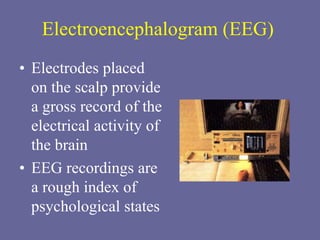
Electroencephalogram (EEG)
• Electrodes placed
on the scalp provide
a gross record of the
electrical activity of
the brain
• EEG recordings are
a rough index of
psychological states
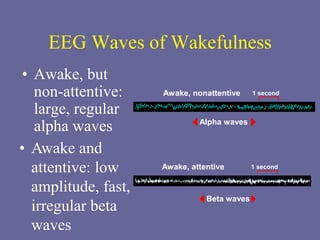
EEG Waves of Wakefulness
• Awake, but
non-attentive:
large, regular
alpha waves
1 second
Alpha waves
Awake, nonattentive
1 second
Beta waves
Awake, attentive
• Awake and
attentive: low
amplitude, fast,
irregular beta
waves
Stages of Sleep
• Awake but sleepy--relaxed. alpha waves seen
in EEG
• Hypnogogic hallucinations--vivid sensory
phenomena during onset of sleep
• Stage 1 NREM-- brief transition stage when
first falling asleep--theta waves
Stages of Sleep
• Stage 2 NREM--characterized by sleep
spindles--brief spurts of activity
• Stages 3 and 4 NREM (slow-wave sleep):
successively deeper stages of sleep
• Characterized by an increasing percentage
of slow, irregular, high-amplitude delta
waves
• Stage 4 NREM is very deep sleep
Stages of Sleep
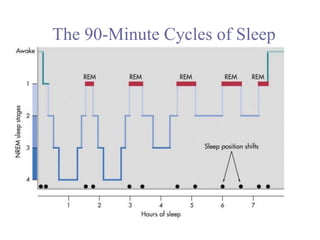
• Upon reaching stage 4 and after about 80 to 100
minutes of total sleep time, sleep lightens, returns
through stages 3 and 2
• REM sleep emerges, characterized by EEG patterns
that resemble beta waves of alert wakefulness
– muscles most relaxed
– rapid eye movements occur
– dreams occur
• Four or five sleep cycles occur in a typical night’s
sleep; less time is spent in slow-wave, more is spent
in REM
The 90-Minute Cycles of Sleep
Sleep Changes Throughout Life
• Changes in quality and quantity are
apparent
• Amount of time in deep (slow wave) and
REM sleep decreases with age
Functions of Sleep
• Restoration theory—body wears out during
the day and sleep is necessary to put it back
in shape
• Adaptive theory—sleep emerged in
evolution to preserve energy and protect
during the time of day when there is
considerable danger
Sleep Deprivation
• Microsleep--episodes lasting only a few
seconds
• REM rebound--deprivation of REM sleep
causes increase in time spent in REM
sleep to “catch up”
• NREM rebound--catching up on Stages 3
and 4 sleep
Individual Differences
in Sleep Drive
• Some individuals need more and some
less than the typical 8 hours per night
• Nonsomniacs—sleep far less than most,
but do not feel tired during the day
• Insomniacs—have a normal desire for
sleep, but are unable to and feel tired
during the day
Sleep Disorders
• Insomnia—inability to fall asleep or stay
asleep
• Night terrors—sudden arousal from sleep and
intense fear accompanied by physiological
reactions (e.g., rapid heart rate, perspiration)
that occur during slow-wave sleep
• Narcolepsy—overpowering urge to fall asleep
that may occur while talking or standing up
Sleep Disorders
• Restless Legs Syndrome--RLS unpleasant
sensations in lower legs and urge to move
legs disrupts sleep.
• Sleep apnea—failure to breathe when asleep
• REM sleep behavior disorder—sleeper acts
out his or her dreams
Dreams and REM Sleep
• True dream—vivid, detailed dreams
consisting of sensory and motor sensations
experienced during REM
• Sleep thinking—lacks vivid sensory and
motor sensations, is more similar to daytime
thinking, and occurs during slow-wave
sleep
Brain and REM Sleep
• Active areas during REM--amygdala and
hippocampus
• Inactive areas during REM--frontal lobes
and primary visual cortex
• REM sleep plays a role in memory
consolidation
Significance of Dreams
• Psychoanalytic Interpretation
• Activation Synthesis Model
Psychoanalytic Interpretation
• Manifest content—elements of the dream
that are consciously experienced and
remembered
• Latent content—the unconscious wishes
that are concealed in the manifest content
• Dreams as “wish fulfillments”
Activation Synthesis Model
• Brain activity during sleep produces dream
images (activation) which are combined by
the brain into a dream story (synthesis).
Meaning is to be found by analyzing the
way the dreamer makes sense of the
progression of chaotic dream images.
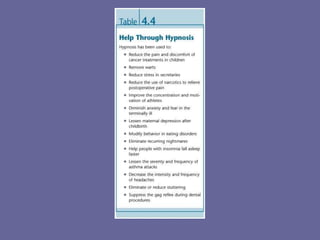
Hypnosis
• State of awareness
• Highly focused attention
• Increased responsiveness to suggestion
• Vivid imagery
• Willingness to accept distortions of
logic
• Alteration of sensation and perception
Hypnosis and Memory
• Posthypnotic suggestion--during hypnosis a
suggestion is made for the person to carry
out some behavior after hypnosis is over
• Posthypnotic amnesia--inability to
remember specific information because of a
posthypnotic suggestion
• Hypermnesia--enhancement of memory
because of posthypnotic suggestion
Meditation
• Sustained concentration that focuses
attention and heightens awareness
• Lowered physiological arousal
– decreased heart rate
– decreased BP
• Predominance of alpha brain waves
Meditation Techniques
• Concentration techniques--control attention
by focusing awareness on a visual image,
word, or phrase
• Opening-up techniques--control attention by
focusing on the “here and now”
Psychoactive Drugs
• Depressants—inhibit brain activity
• Opiates—produce pain relief and euphoria
• Stimulants—increase brain activity
• Psychedelics—distort sensory perceptions
Common Properties
• Physical dependence
• Tolerance
• Withdrawal symptoms
• Drug rebound effect
Drug Abuse
Recurrent drug use that results in
disruption of academic, social, or
occupational functioning or in
legal or psychological problems
Depressants
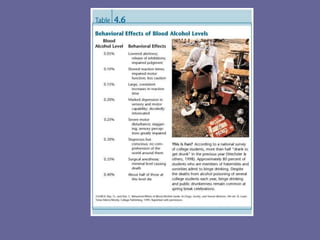
• Alcohol—CNS depressant
• Barbiturates—induce sleep but can
cause dependence and as a result
serious withdrawal symptoms
• Tranquilizers—relieve anxiety but can
be addictive
• Effects are additive
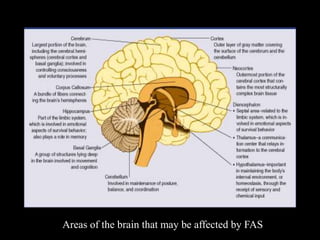
Areas of the brain that may be affected by FAS
Opiates
Chemically similar to morphine and have
strong pain-relieving properties, can be
addictive
• Mimic the brain’s endorphins
• Heroin, methadone
• Percodan, Demerol
Stimulants
• Caffeine
• Nicotine
• Amphetamines
• Cocaine
• Stimulant induced psychosis
Psychedelics
• Create perceptual distortions
• Mescaline
• LSD
• Marijuana
• Flashback reactions and psychotic
episodes
“Club” Drugs
• Ecstasy (MDMA)—feelings of euphoria,
increased well-being
• Side effects—dehydration, hyperthermia,
tremor, rapid heartbeat
• Dissociative anesthetics—include PCP and
Ketamine. Deaden pain, produce stupor or
coma, and may induce hallucinations.

Consciousness

  • 1.
  • 2.
    Consciousness • Described asa stream or river by William James • Introspection tried to capture the structure of consciousness • Modern study includes roles of psychological, physiological, social, and cultural influences
  • 3.
    Circadian Rhythm • Anyrhythmic change that continues at close to a 24-hour cycle in the absence of 24-hour cues – body temperature – cortisol secretion – sleep and wakefulness • In the absence of time cues, the cycle period will become somewhat longer than 24 hours
  • 4.
    The Body’s Clock •Suprachiasmatic nucleus (SCN)—cluster of neurons in the hypothalamus that governs the timing of circadian rhythms • Melatonin—hormone of the pineal gland that produces sleepiness • Bright light decreases production of melatonin; decreased light increases melatonin
  • 5.
    Electroencephalogram (EEG) • Electrodesplaced on the scalp provide a gross record of the electrical activity of the brain • EEG recordings are a rough index of psychological states
  • 6.
    EEG Waves ofWakefulness • Awake, but non-attentive: large, regular alpha waves 1 second Alpha waves Awake, nonattentive 1 second Beta waves Awake, attentive • Awake and attentive: low amplitude, fast, irregular beta waves
  • 7.
    Stages of Sleep •Awake but sleepy--relaxed. alpha waves seen in EEG • Hypnogogic hallucinations--vivid sensory phenomena during onset of sleep • Stage 1 NREM-- brief transition stage when first falling asleep--theta waves
  • 8.
    Stages of Sleep •Stage 2 NREM--characterized by sleep spindles--brief spurts of activity • Stages 3 and 4 NREM (slow-wave sleep): successively deeper stages of sleep • Characterized by an increasing percentage of slow, irregular, high-amplitude delta waves • Stage 4 NREM is very deep sleep
  • 9.
    Stages of Sleep •Upon reaching stage 4 and after about 80 to 100 minutes of total sleep time, sleep lightens, returns through stages 3 and 2 • REM sleep emerges, characterized by EEG patterns that resemble beta waves of alert wakefulness – muscles most relaxed – rapid eye movements occur – dreams occur • Four or five sleep cycles occur in a typical night’s sleep; less time is spent in slow-wave, more is spent in REM
  • 10.
  • 11.
    Sleep Changes ThroughoutLife • Changes in quality and quantity are apparent • Amount of time in deep (slow wave) and REM sleep decreases with age
  • 12.
    Functions of Sleep •Restoration theory—body wears out during the day and sleep is necessary to put it back in shape • Adaptive theory—sleep emerged in evolution to preserve energy and protect during the time of day when there is considerable danger
  • 13.
    Sleep Deprivation • Microsleep--episodeslasting only a few seconds • REM rebound--deprivation of REM sleep causes increase in time spent in REM sleep to “catch up” • NREM rebound--catching up on Stages 3 and 4 sleep
  • 14.
    Individual Differences in SleepDrive • Some individuals need more and some less than the typical 8 hours per night • Nonsomniacs—sleep far less than most, but do not feel tired during the day • Insomniacs—have a normal desire for sleep, but are unable to and feel tired during the day
  • 15.
    Sleep Disorders • Insomnia—inabilityto fall asleep or stay asleep • Night terrors—sudden arousal from sleep and intense fear accompanied by physiological reactions (e.g., rapid heart rate, perspiration) that occur during slow-wave sleep • Narcolepsy—overpowering urge to fall asleep that may occur while talking or standing up
  • 16.
    Sleep Disorders • RestlessLegs Syndrome--RLS unpleasant sensations in lower legs and urge to move legs disrupts sleep. • Sleep apnea—failure to breathe when asleep • REM sleep behavior disorder—sleeper acts out his or her dreams
  • 17.
    Dreams and REMSleep • True dream—vivid, detailed dreams consisting of sensory and motor sensations experienced during REM • Sleep thinking—lacks vivid sensory and motor sensations, is more similar to daytime thinking, and occurs during slow-wave sleep
  • 18.
    Brain and REMSleep • Active areas during REM--amygdala and hippocampus • Inactive areas during REM--frontal lobes and primary visual cortex • REM sleep plays a role in memory consolidation
  • 19.
    Significance of Dreams •Psychoanalytic Interpretation • Activation Synthesis Model
  • 20.
    Psychoanalytic Interpretation • Manifestcontent—elements of the dream that are consciously experienced and remembered • Latent content—the unconscious wishes that are concealed in the manifest content • Dreams as “wish fulfillments”
  • 21.
    Activation Synthesis Model •Brain activity during sleep produces dream images (activation) which are combined by the brain into a dream story (synthesis). Meaning is to be found by analyzing the way the dreamer makes sense of the progression of chaotic dream images.
  • 22.
    Hypnosis • State ofawareness • Highly focused attention • Increased responsiveness to suggestion • Vivid imagery • Willingness to accept distortions of logic • Alteration of sensation and perception
  • 24.
    Hypnosis and Memory •Posthypnotic suggestion--during hypnosis a suggestion is made for the person to carry out some behavior after hypnosis is over • Posthypnotic amnesia--inability to remember specific information because of a posthypnotic suggestion • Hypermnesia--enhancement of memory because of posthypnotic suggestion
  • 25.
    Meditation • Sustained concentrationthat focuses attention and heightens awareness • Lowered physiological arousal – decreased heart rate – decreased BP • Predominance of alpha brain waves
  • 26.
    Meditation Techniques • Concentrationtechniques--control attention by focusing awareness on a visual image, word, or phrase • Opening-up techniques--control attention by focusing on the “here and now”
  • 27.
    Psychoactive Drugs • Depressants—inhibitbrain activity • Opiates—produce pain relief and euphoria • Stimulants—increase brain activity • Psychedelics—distort sensory perceptions
  • 28.
    Common Properties • Physicaldependence • Tolerance • Withdrawal symptoms • Drug rebound effect
  • 29.
    Drug Abuse Recurrent druguse that results in disruption of academic, social, or occupational functioning or in legal or psychological problems
  • 30.
    Depressants • Alcohol—CNS depressant •Barbiturates—induce sleep but can cause dependence and as a result serious withdrawal symptoms • Tranquilizers—relieve anxiety but can be addictive • Effects are additive
  • 32.
    Areas of thebrain that may be affected by FAS
  • 33.
    Opiates Chemically similar tomorphine and have strong pain-relieving properties, can be addictive • Mimic the brain’s endorphins • Heroin, methadone • Percodan, Demerol
  • 34.
    Stimulants • Caffeine • Nicotine •Amphetamines • Cocaine • Stimulant induced psychosis
  • 35.
    Psychedelics • Create perceptualdistortions • Mescaline • LSD • Marijuana • Flashback reactions and psychotic episodes
  • 36.
    “Club” Drugs • Ecstasy(MDMA)—feelings of euphoria, increased well-being • Side effects—dehydration, hyperthermia, tremor, rapid heartbeat • Dissociative anesthetics—include PCP and Ketamine. Deaden pain, produce stupor or coma, and may induce hallucinations.