Sleep, Dream, and States of
Consciousness
Chapter 4 Overview
• What is consciousness?
• Circadian rhythms
• Sleep
• Dreams
• Meditation and hypnosis
• Psychoactive drugs
What is Consciousness?
§ Consciousness is everything of which we are aware at any given
time-our thoughts, feelings, sensations and external environment
Continuum of Consciousness
1. Controlled Processes
•Full awareness, alertness, and concentration
•Usually interferes with other ongoing activities
2. Automatic Processes
•Little awareness and take minimal attention
•Do not interfere with other ongoing activities
Continuum of Consciousness
3. Daydreaming
•Low level of awareness
•Often occurs during automatic processes
•Involves fantasizing/dreaming while awake
•Occurs in situations that are boring or require
little attention
Continuum of Consciousness
4. The Unconscious
• “It contains all sorts of significant and disturbing material which
we need to keep out of awareness because they are too
threatening to acknowledge fully” – Sigmund Freud
Continuum of Consciousness
4. The Unconscious
• Process of Free Association - a method of exploring a person's
unconscious by eliciting words and thoughts that are associated
with key words provided by a psychoanalyst
• Dream Interpretation - the process of assigning meaning to
dreams
Continuum of Consciousness
5. Unconsciousness
•Total unawareness and loss of responsiveness to
one’s environment
6. Altered States
•Awareness that differs from normal
consciousness
•Results from using any procedures: meditation,
hypnosis, or psychoactive drugs
How have psychologists’views about
consciousness changed since the early days
of psychology?
•Early psychologists saw consciousness as
psychological in nature
•Today’s psychologists use brain-imaging
techniques to identify brain activity associated
with different states of consciousness
•They view consciousness as a neurobiological
phenomenon, rather than an exclusively
psychological one
What is the connection between altered states
of consciousness and culture?
•Altered state of consciousness
• A change in awareness produced by sleep,
meditation, hypnosis, or drugs
•In some cultures, individuals deliberately
induce altered states as part of tribal
ceremonies or religious rituals
Circadian Rhythms
§More than 100 bodily functions and
behaviors follow circadian rhythms
fluctuating regularly throughout each day
In what ways do circadian rhythms affect
physiological and psychological functions?
•Circadian rhythm
• Regular fluctuation from high to low points of certain
bodily functions and behaviors within a 24-hour cycle
• Regulate all vital life functions
•Suprachiasmatic nucleus
• Structure in the hypothalamus
• The body’s biological clock
• Controls the timing of circadian rhythms
• Signals the pineal gland to secrete or suppress
melatonin
How do disruptions in circadian rhythms affect
the body and the mind?
•Jet lag and working during subjective night
disrupt circadian rhythms
• Can lead to sleep difficulty and reduced alertness
•Subjective night
• The time during a 24-hour period when the
biological clock tells a person to go to sleep
Sleep
• Before the 1950s, there was little
understanding of what goes on during the state
of consciousness know as sleep. From
analyses of sleep recordings, known as
polysomnograms, set up in sleep laboratories,
researchers discovered two major types of
sleep.
What is the difference between the restorative
and circadian theories of sleep?
•Restorative theory of sleep
• The function of sleep is to restore body and mind
•Circadian theory of sleep
• Sleep evolved to keep humans out of harm’s way
during the night
• Also known as the evolutionary theory
How do NREM and REM sleep differ?
•NREM sleep
• Non-rapid eye movement sleep
• Characterized by slow respiration and heart rate, little
body movement, and low blood pressure and brain
activity
•REM sleep
• Characterized by rapid eye movements, paralysis of
large muscles, fast and irregular heart and respiration
rates, increased brain activity, and vivid dreams
• REM sleep may be critical to the consolidation of new
memories after learning
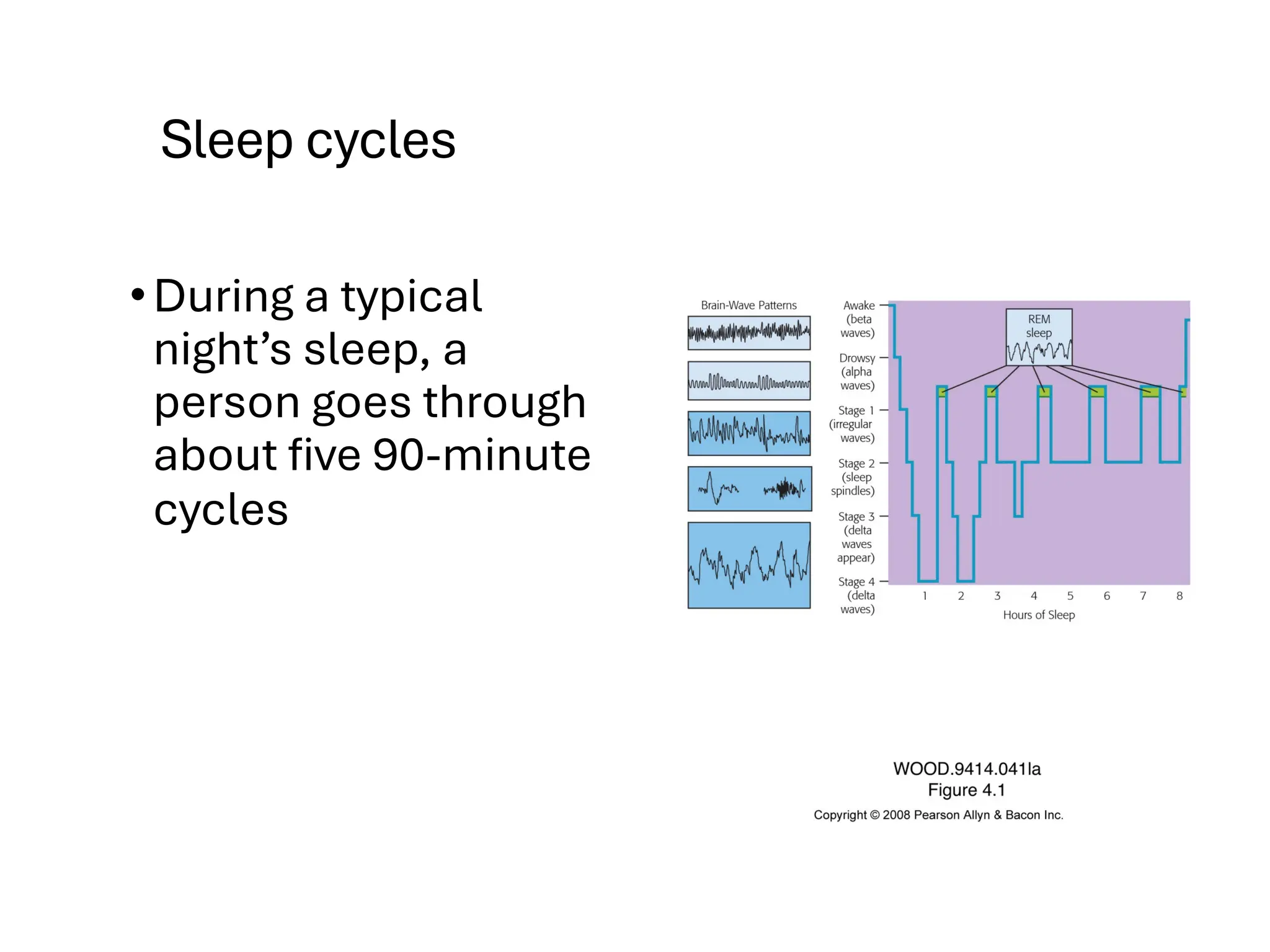
Sleep cycles
•During a typical
night’s sleep, a
person goes through
about five 90-minute
cycles
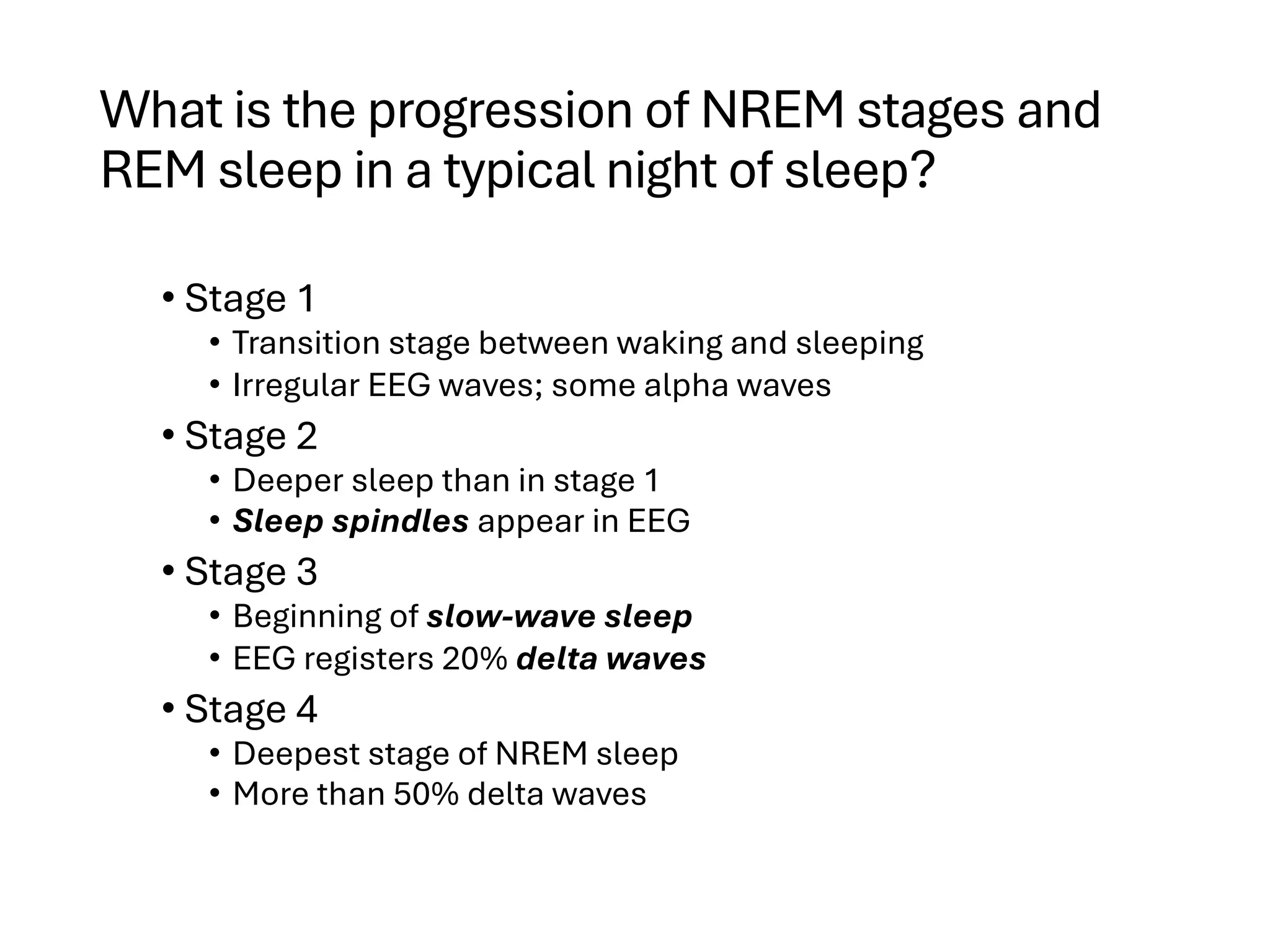
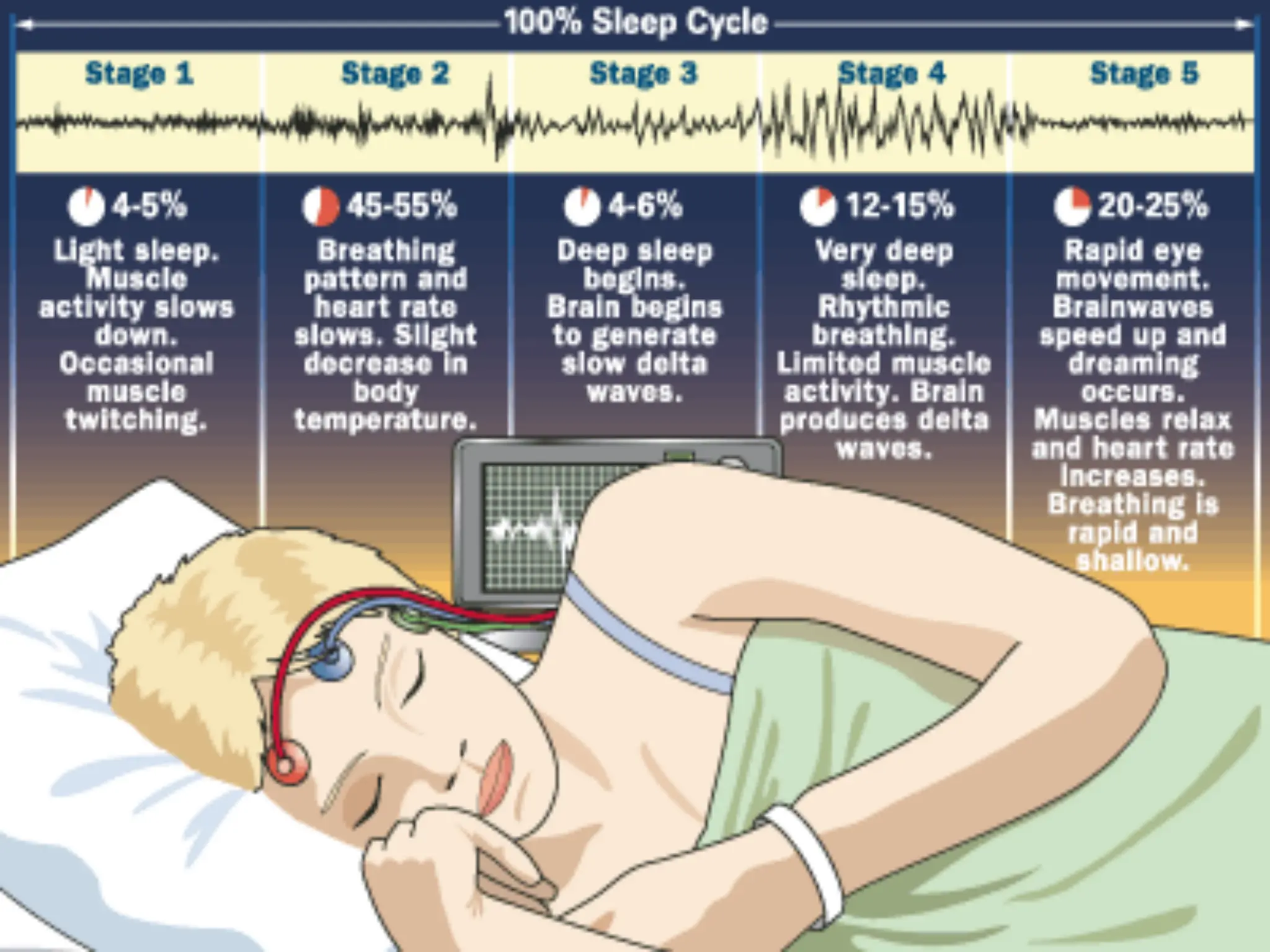
What is the progression of NREM stages and
REM sleep in a typical night of sleep?
• Stage 1
• Transition stage between waking and sleeping
• Irregular EEG waves; some alpha waves
• Stage 2
• Deeper sleep than in stage 1
• Sleep spindles appear in EEG
• Stage 3
• Beginning of slow-wave sleep
• EEG registers 20% delta waves
• Stage 4
• Deepest stage of NREM sleep
• More than 50% delta waves
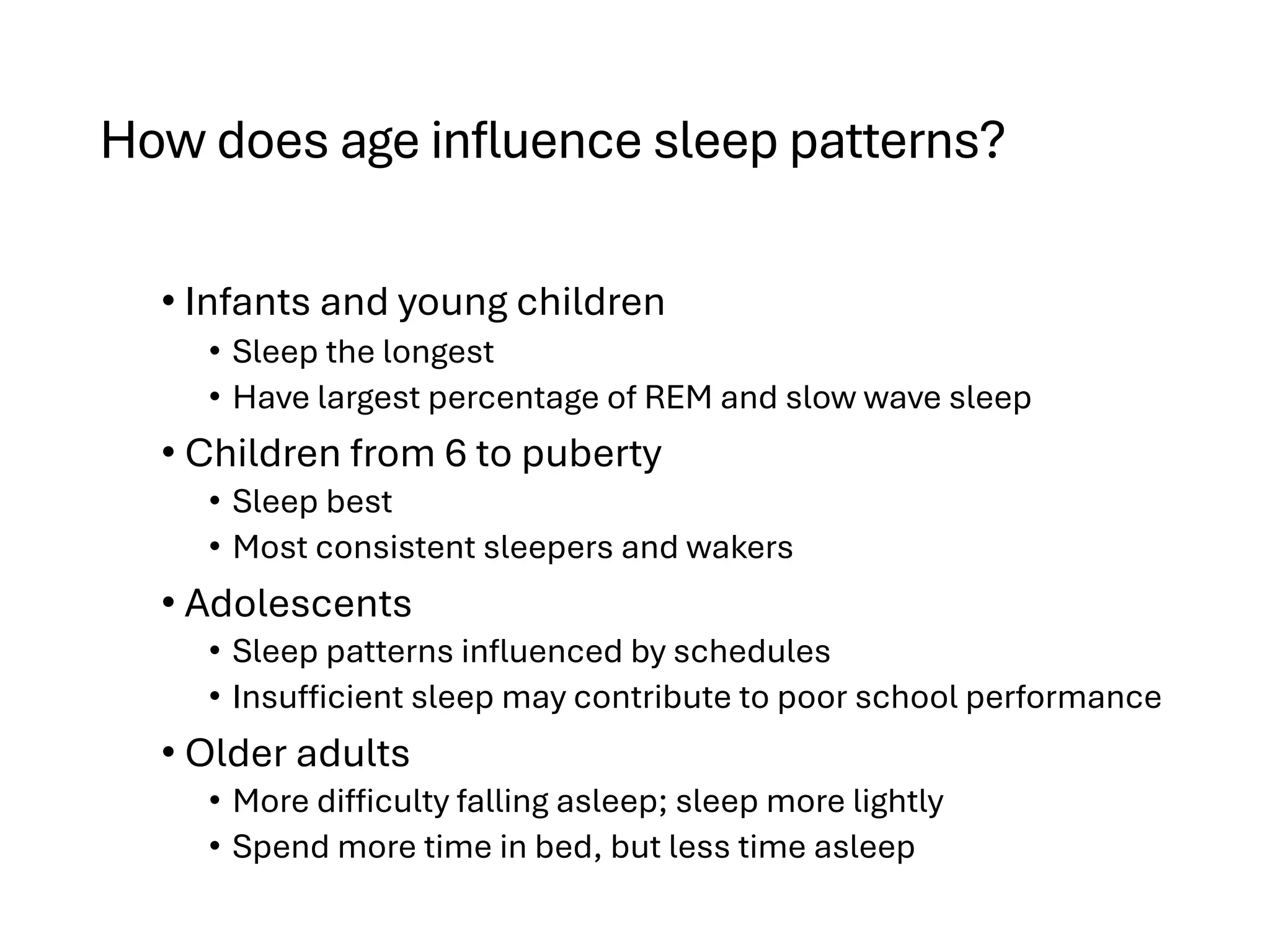
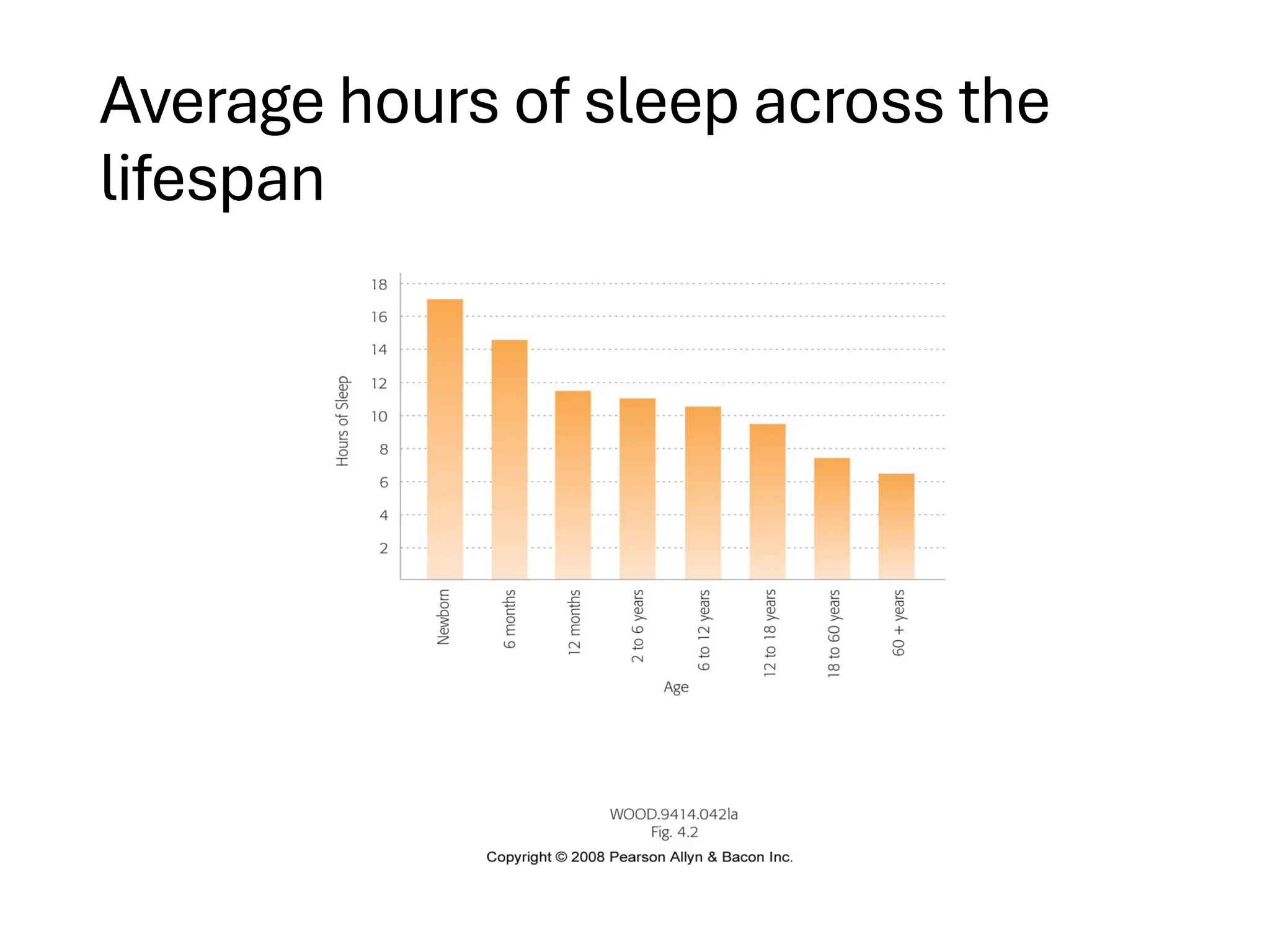
How does age influence sleep patterns?
• Infants and young children
• Sleep the longest
• Have largest percentage of REM and slow wave sleep
• Children from 6 to puberty
• Sleep best
• Most consistent sleepers and wakers
• Adolescents
• Sleep patterns influenced by schedules
• Insufficient sleep may contribute to poor school performance
• Older adults
• More difficulty falling asleep; sleep more lightly
• Spend more time in bed, but less time asleep
Average hours of sleep across the
lifespan
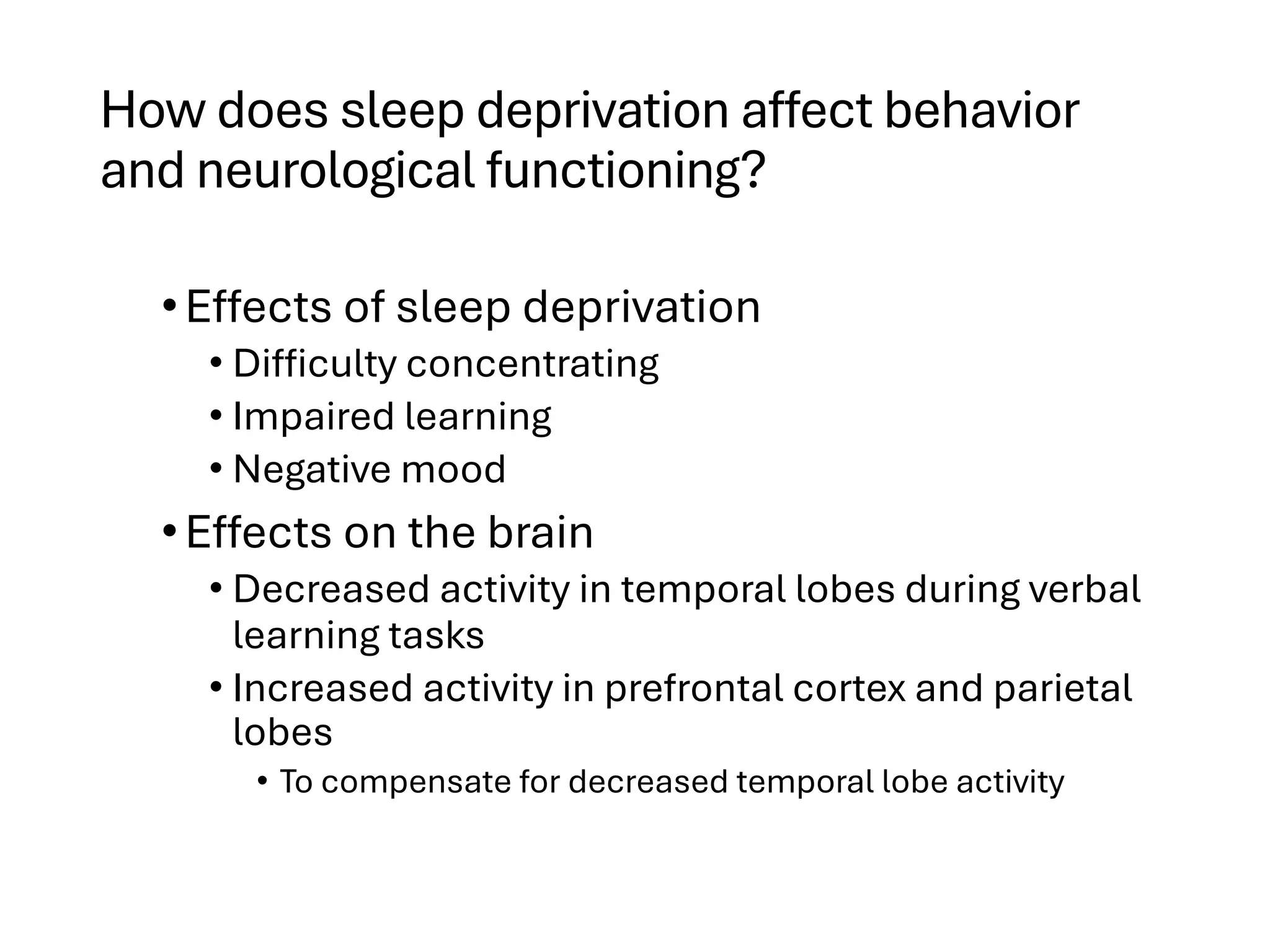
How does sleep deprivation affect behavior
and neurological functioning?
•Effects of sleep deprivation
• Difficulty concentrating
• Impaired learning
• Negative mood
•Effects on the brain
• Decreased activity in temporal lobes during verbal
learning tasks
• Increased activity in prefrontal cortex and parietal
lobes
• To compensate for decreased temporal lobe activity
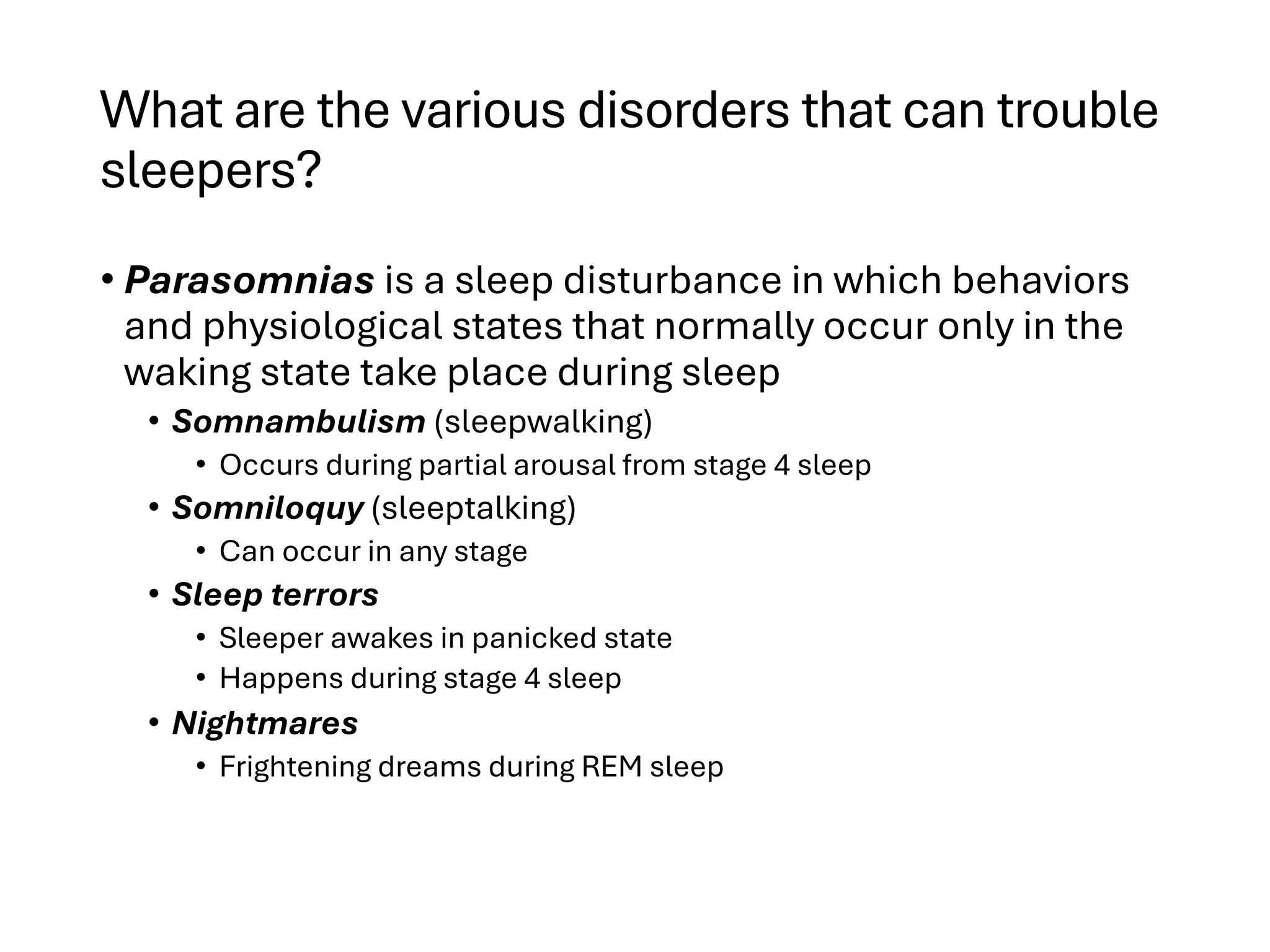
What are the various disorders that can trouble
sleepers?
• Parasomnias is a sleep disturbance in which behaviors
and physiological states that normally occur only in the
waking state take place during sleep
• Somnambulism (sleepwalking)
• Occurs during partial arousal from stage 4 sleep
• Somniloquy (sleeptalking)
• Can occur in any stage
• Sleep terrors
• Sleeper awakes in panicked state
• Happens during stage 4 sleep
• Nightmares
• Frightening dreams during REM sleep
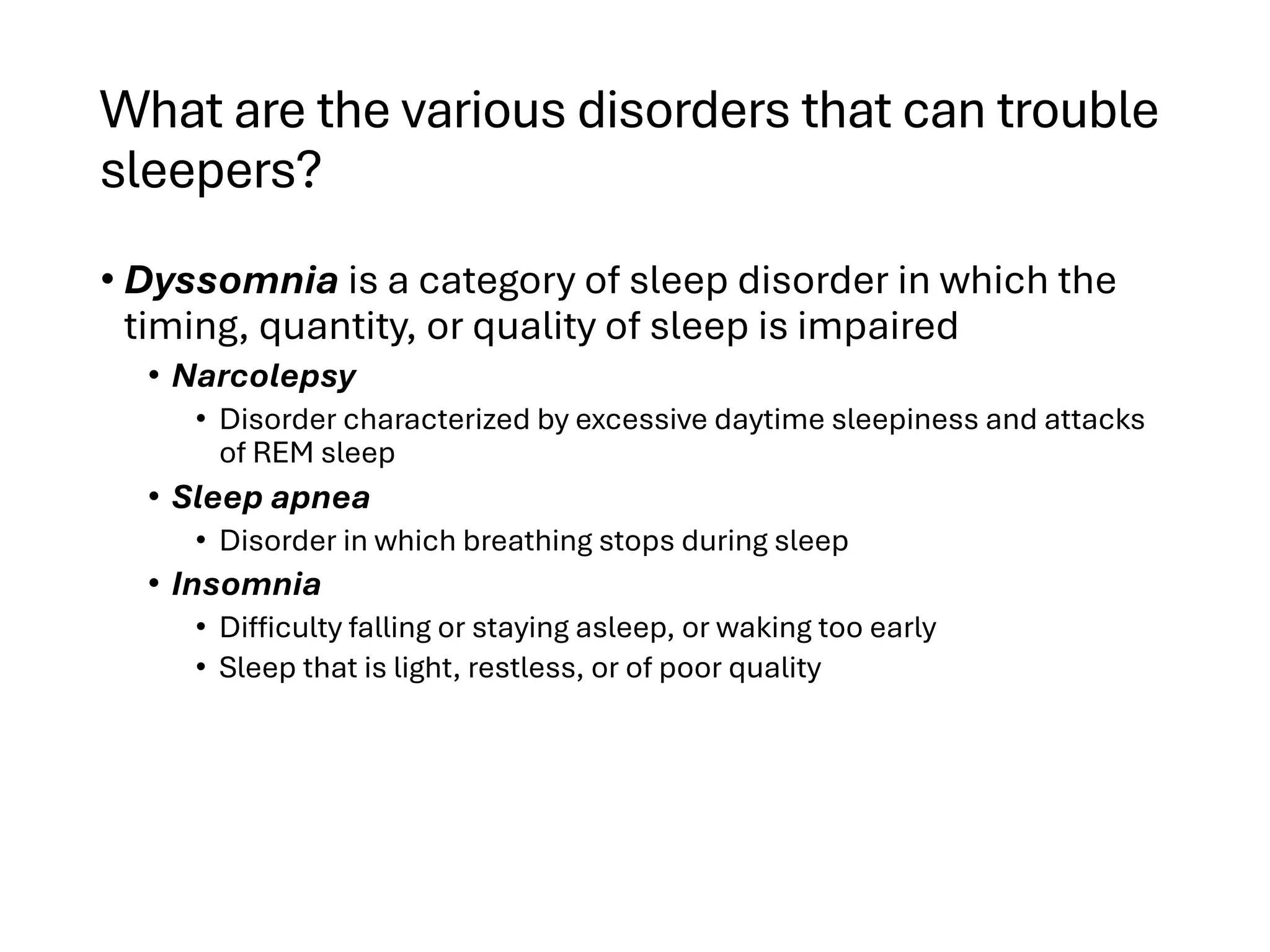
What are the various disorders that can trouble
sleepers?
• Dyssomnia is a category of sleep disorder in which the
timing, quantity, or quality of sleep is impaired
• Narcolepsy
• Disorder characterized by excessive daytime sleepiness and attacks
of REM sleep
• Sleep apnea
• Disorder in which breathing stops during sleep
• Insomnia
• Difficulty falling or staying asleep, or waking too early
• Sleep that is light, restless, or of poor quality
Dreams
•We generally think of dreaming as a pleasant,
imaginative experience, but occasionally a
frightening dream occurs. Good or bad, just
what exactly is a dream?
Dreams
• Impulses and desires of the id are suppressed by the superego.
• Because the guards are down during sleep, the unconscious has
the opportunity to act out and express the hidden desires of the id.
• However, the desires of the id can, at times, be so disturbing and
even psychologically harmful that a "censor" comes into play
and translates the id's disturbing content into a more acceptable
symbolic form.
What have researchers learned about dreams,
their biological basis, and their controllability?
•REM dreams
• Have a storylike quality
• More visual, vivid, and emotional than NREM
dreams
•NREM dreams
• Occur during NREM sleep
• Less frequent and memorable than REM dreams
•Lucid dreaming
• Set of techniques that enable dreamers to control
the content of dreams
How do the views of contemporary psychologists
concerning the nature of dreams differ from those of
Freud?
•Dreams satisfy unconscious sexual and
aggressive desires
•These wishes are unacceptable to the dreamer
and must be disguised in symbolic forms
• Manifest content
• The content of a dream as recalled by the dreamer
• Latent content
• The underlying meaning of a dream
How do the views of contemporary
psychologists concerning the nature of
dreams differ from those of Freud?
•Activation-synthesis theory of dreaming
• Dreams are the brain’s attempt to make sense of
random firing of brain cells during REM sleep
•Evolutionary theory of dreaming
• Vivid REM dreams enable people to rehearse skills
needed to deal with threatening events
Meditation and Hypnosis
• Other forms of altered consciousness that we may experience
only if we choose to do so
What are the benefits of meditation?
•Techniques used to block out distractions and
achieve an altered state of consciousness by
focusing attention on an object, word, one’s
breathing, or body movements
•Can be helpful for a variety of physical and
psychological problems
• Controlling emotions
• Lowering blood pressure
What are the effects of hypnosis and how do
theorists explain them?
•Procedure through which a hypnotist uses
power of suggestion to change thoughts,
feelings, sensations, perceptions, or behavior
in the subject
•Has been used successfully to control pain
What are the effects of hypnosis and how do
theorists explain them?
•Sociocognitive theory
• Behavior of a hypnotized person depends on that
person’s expectations about how subjects behave
under hypnosis
•Neodissociation theory
• Hypnosis induces a dissociation between two aspects
of the control of consciousness
• Planning function
• Monitoring function
•Theory of dissociated control
• Hypnosis weakens control of the executive function
over other parts of consciousness
Psychoactive Drugs
• Any substance that alters mood, perception, or thought
• Controlled substances are approved for medical use
• Illicit substances are illegal
How do drugs affect the brain’s
neurotransmitter system?
•Psychoactive drugs create a sense of pleasure by
increasing availability of dopamine in the
nucleus accumbens, a part of the brain’s limbic
system
•How drugs affect neurotransmission
• Opiates mimic the effects of endorphins
• Depressants act on GABA receptors
• Stimulants mimic the effects of epinephrine
What is the difference between physical and
psychological drug dependence?
•Substance abuse
• Continued use of a substance after several episodes in which
use has negatively affected an individual's work, education,
and social relationships
•Physical drug dependence
• Compulsive pattern of drug use in which the user develops
drug tolerance coupled with unpleasant withdrawal
symptoms when the drug use is discontinued
•Psychological drug dependence
• A craving or irresistible urge for the drug’s pleasurable effects
How do stimulants affect behavior?
•Speed up activity in the central nervous system
• Suppress appetite
• Make people feel more awake, alert, and energetic
•Stimulants include
• Caffeine
• Nicotine
• Amphetamines
• Cocaine
What are the behavioral effects of
depressants?
•Decrease activity in the central nervous
system
• Slow down bodily functions
• Reduce sensitivity to outside stimulation
•Sedative-hypnotics
• Alcohol
• Barbiturates
• Minor tranquilizers (benzodiazepines)
•Narcotics (opiates)
• Morphine, heroin
• Oxycontin, Vicodin
In what way do hallucinogens influence
behavior?
•Drugs that can alter and distort perceptions of
time and space, alter mood, cause
hallucinations
• Also called psychedelics
•Hallucinogens include
• Marijuana
• LSD
• Designer drugs (e.g., MDMA or Ecstasy)

Lesson_7.1_Sleep_and_Altered_States_of_Consciousness.pdf

  • 1.
    Sleep, Dream, andStates of Consciousness
  • 2.
    Chapter 4 Overview •What is consciousness? • Circadian rhythms • Sleep • Dreams • Meditation and hypnosis • Psychoactive drugs
  • 3.
    What is Consciousness? §Consciousness is everything of which we are aware at any given time-our thoughts, feelings, sensations and external environment
  • 4.
    Continuum of Consciousness 1.Controlled Processes •Full awareness, alertness, and concentration •Usually interferes with other ongoing activities 2. Automatic Processes •Little awareness and take minimal attention •Do not interfere with other ongoing activities
  • 5.
    Continuum of Consciousness 3.Daydreaming •Low level of awareness •Often occurs during automatic processes •Involves fantasizing/dreaming while awake •Occurs in situations that are boring or require little attention
  • 6.
    Continuum of Consciousness 4.The Unconscious • “It contains all sorts of significant and disturbing material which we need to keep out of awareness because they are too threatening to acknowledge fully” – Sigmund Freud
  • 7.
    Continuum of Consciousness 4.The Unconscious • Process of Free Association - a method of exploring a person's unconscious by eliciting words and thoughts that are associated with key words provided by a psychoanalyst • Dream Interpretation - the process of assigning meaning to dreams
  • 8.
    Continuum of Consciousness 5.Unconsciousness •Total unawareness and loss of responsiveness to one’s environment 6. Altered States •Awareness that differs from normal consciousness •Results from using any procedures: meditation, hypnosis, or psychoactive drugs
  • 9.
    How have psychologists’viewsabout consciousness changed since the early days of psychology? •Early psychologists saw consciousness as psychological in nature •Today’s psychologists use brain-imaging techniques to identify brain activity associated with different states of consciousness •They view consciousness as a neurobiological phenomenon, rather than an exclusively psychological one
  • 10.
    What is theconnection between altered states of consciousness and culture? •Altered state of consciousness • A change in awareness produced by sleep, meditation, hypnosis, or drugs •In some cultures, individuals deliberately induce altered states as part of tribal ceremonies or religious rituals
  • 11.
    Circadian Rhythms §More than100 bodily functions and behaviors follow circadian rhythms fluctuating regularly throughout each day
  • 12.
    In what waysdo circadian rhythms affect physiological and psychological functions? •Circadian rhythm • Regular fluctuation from high to low points of certain bodily functions and behaviors within a 24-hour cycle • Regulate all vital life functions •Suprachiasmatic nucleus • Structure in the hypothalamus • The body’s biological clock • Controls the timing of circadian rhythms • Signals the pineal gland to secrete or suppress melatonin
  • 13.
    How do disruptionsin circadian rhythms affect the body and the mind? •Jet lag and working during subjective night disrupt circadian rhythms • Can lead to sleep difficulty and reduced alertness •Subjective night • The time during a 24-hour period when the biological clock tells a person to go to sleep
  • 14.
    Sleep • Before the1950s, there was little understanding of what goes on during the state of consciousness know as sleep. From analyses of sleep recordings, known as polysomnograms, set up in sleep laboratories, researchers discovered two major types of sleep.
  • 15.
    What is thedifference between the restorative and circadian theories of sleep? •Restorative theory of sleep • The function of sleep is to restore body and mind •Circadian theory of sleep • Sleep evolved to keep humans out of harm’s way during the night • Also known as the evolutionary theory
  • 16.
    How do NREMand REM sleep differ? •NREM sleep • Non-rapid eye movement sleep • Characterized by slow respiration and heart rate, little body movement, and low blood pressure and brain activity •REM sleep • Characterized by rapid eye movements, paralysis of large muscles, fast and irregular heart and respiration rates, increased brain activity, and vivid dreams • REM sleep may be critical to the consolidation of new memories after learning
  • 17.
    Sleep cycles •During atypical night’s sleep, a person goes through about five 90-minute cycles
  • 18.
    What is theprogression of NREM stages and REM sleep in a typical night of sleep? • Stage 1 • Transition stage between waking and sleeping • Irregular EEG waves; some alpha waves • Stage 2 • Deeper sleep than in stage 1 • Sleep spindles appear in EEG • Stage 3 • Beginning of slow-wave sleep • EEG registers 20% delta waves • Stage 4 • Deepest stage of NREM sleep • More than 50% delta waves
  • 20.
    How does ageinfluence sleep patterns? • Infants and young children • Sleep the longest • Have largest percentage of REM and slow wave sleep • Children from 6 to puberty • Sleep best • Most consistent sleepers and wakers • Adolescents • Sleep patterns influenced by schedules • Insufficient sleep may contribute to poor school performance • Older adults • More difficulty falling asleep; sleep more lightly • Spend more time in bed, but less time asleep
  • 21.
    Average hours ofsleep across the lifespan
  • 22.
    How does sleepdeprivation affect behavior and neurological functioning? •Effects of sleep deprivation • Difficulty concentrating • Impaired learning • Negative mood •Effects on the brain • Decreased activity in temporal lobes during verbal learning tasks • Increased activity in prefrontal cortex and parietal lobes • To compensate for decreased temporal lobe activity
  • 23.
    What are thevarious disorders that can trouble sleepers? • Parasomnias is a sleep disturbance in which behaviors and physiological states that normally occur only in the waking state take place during sleep • Somnambulism (sleepwalking) • Occurs during partial arousal from stage 4 sleep • Somniloquy (sleeptalking) • Can occur in any stage • Sleep terrors • Sleeper awakes in panicked state • Happens during stage 4 sleep • Nightmares • Frightening dreams during REM sleep
  • 24.
    What are thevarious disorders that can trouble sleepers? • Dyssomnia is a category of sleep disorder in which the timing, quantity, or quality of sleep is impaired • Narcolepsy • Disorder characterized by excessive daytime sleepiness and attacks of REM sleep • Sleep apnea • Disorder in which breathing stops during sleep • Insomnia • Difficulty falling or staying asleep, or waking too early • Sleep that is light, restless, or of poor quality
  • 25.
    Dreams •We generally thinkof dreaming as a pleasant, imaginative experience, but occasionally a frightening dream occurs. Good or bad, just what exactly is a dream?
  • 26.
    Dreams • Impulses anddesires of the id are suppressed by the superego. • Because the guards are down during sleep, the unconscious has the opportunity to act out and express the hidden desires of the id. • However, the desires of the id can, at times, be so disturbing and even psychologically harmful that a "censor" comes into play and translates the id's disturbing content into a more acceptable symbolic form.
  • 27.
    What have researcherslearned about dreams, their biological basis, and their controllability? •REM dreams • Have a storylike quality • More visual, vivid, and emotional than NREM dreams •NREM dreams • Occur during NREM sleep • Less frequent and memorable than REM dreams •Lucid dreaming • Set of techniques that enable dreamers to control the content of dreams
  • 28.
    How do theviews of contemporary psychologists concerning the nature of dreams differ from those of Freud? •Dreams satisfy unconscious sexual and aggressive desires •These wishes are unacceptable to the dreamer and must be disguised in symbolic forms • Manifest content • The content of a dream as recalled by the dreamer • Latent content • The underlying meaning of a dream
  • 29.
    How do theviews of contemporary psychologists concerning the nature of dreams differ from those of Freud? •Activation-synthesis theory of dreaming • Dreams are the brain’s attempt to make sense of random firing of brain cells during REM sleep •Evolutionary theory of dreaming • Vivid REM dreams enable people to rehearse skills needed to deal with threatening events
  • 30.
    Meditation and Hypnosis •Other forms of altered consciousness that we may experience only if we choose to do so
  • 31.
    What are thebenefits of meditation? •Techniques used to block out distractions and achieve an altered state of consciousness by focusing attention on an object, word, one’s breathing, or body movements •Can be helpful for a variety of physical and psychological problems • Controlling emotions • Lowering blood pressure
  • 32.
    What are theeffects of hypnosis and how do theorists explain them? •Procedure through which a hypnotist uses power of suggestion to change thoughts, feelings, sensations, perceptions, or behavior in the subject •Has been used successfully to control pain
  • 33.
    What are theeffects of hypnosis and how do theorists explain them? •Sociocognitive theory • Behavior of a hypnotized person depends on that person’s expectations about how subjects behave under hypnosis •Neodissociation theory • Hypnosis induces a dissociation between two aspects of the control of consciousness • Planning function • Monitoring function •Theory of dissociated control • Hypnosis weakens control of the executive function over other parts of consciousness
  • 34.
    Psychoactive Drugs • Anysubstance that alters mood, perception, or thought • Controlled substances are approved for medical use • Illicit substances are illegal
  • 35.
    How do drugsaffect the brain’s neurotransmitter system? •Psychoactive drugs create a sense of pleasure by increasing availability of dopamine in the nucleus accumbens, a part of the brain’s limbic system •How drugs affect neurotransmission • Opiates mimic the effects of endorphins • Depressants act on GABA receptors • Stimulants mimic the effects of epinephrine
  • 36.
    What is thedifference between physical and psychological drug dependence? •Substance abuse • Continued use of a substance after several episodes in which use has negatively affected an individual's work, education, and social relationships •Physical drug dependence • Compulsive pattern of drug use in which the user develops drug tolerance coupled with unpleasant withdrawal symptoms when the drug use is discontinued •Psychological drug dependence • A craving or irresistible urge for the drug’s pleasurable effects
  • 37.
    How do stimulantsaffect behavior? •Speed up activity in the central nervous system • Suppress appetite • Make people feel more awake, alert, and energetic •Stimulants include • Caffeine • Nicotine • Amphetamines • Cocaine
  • 38.
    What are thebehavioral effects of depressants? •Decrease activity in the central nervous system • Slow down bodily functions • Reduce sensitivity to outside stimulation •Sedative-hypnotics • Alcohol • Barbiturates • Minor tranquilizers (benzodiazepines) •Narcotics (opiates) • Morphine, heroin • Oxycontin, Vicodin
  • 39.
    In what waydo hallucinogens influence behavior? •Drugs that can alter and distort perceptions of time and space, alter mood, cause hallucinations • Also called psychedelics •Hallucinogens include • Marijuana • LSD • Designer drugs (e.g., MDMA or Ecstasy)