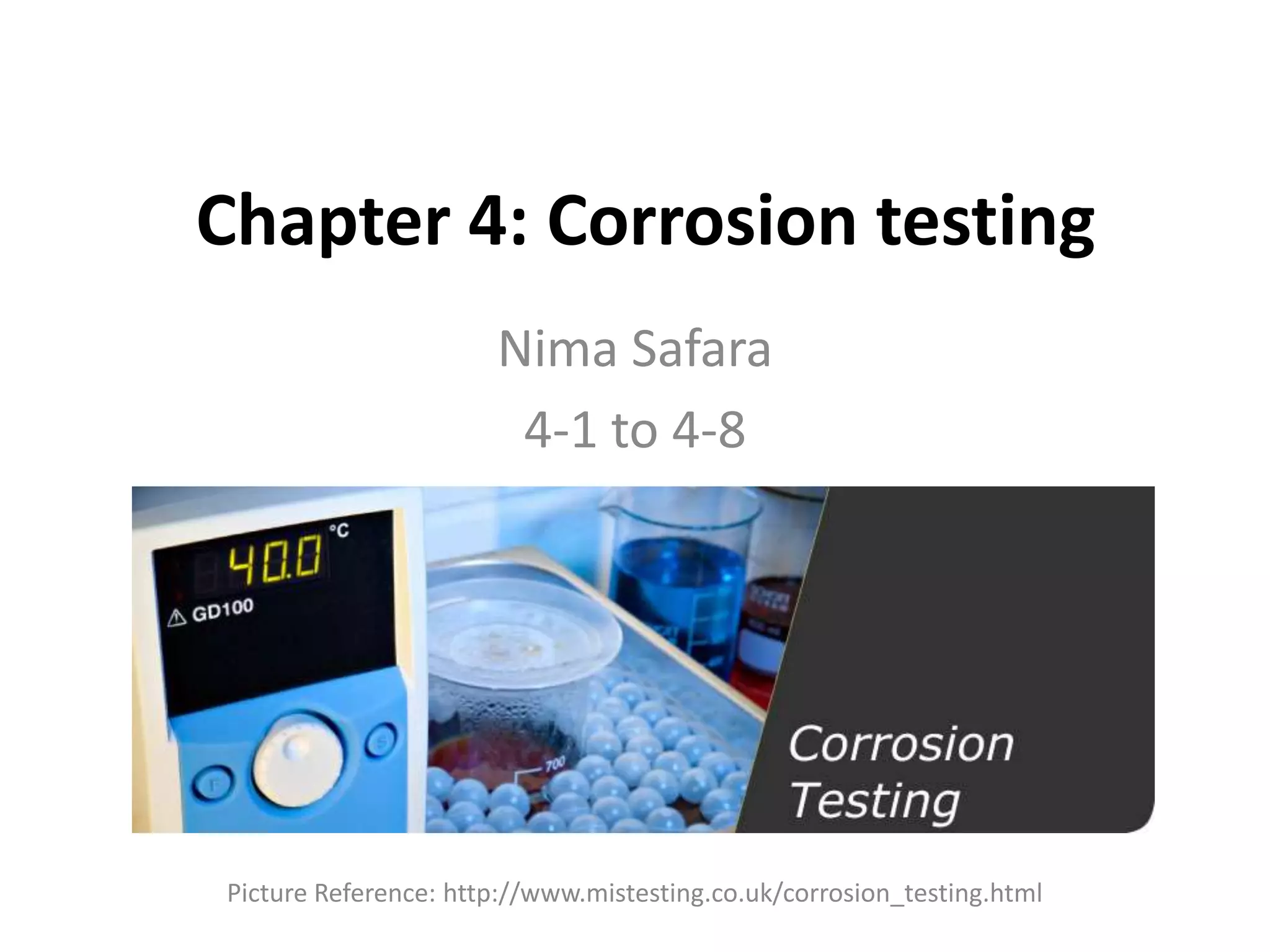
Chapter 4: Corrosion testing
                      Nima Safara
                       4-1 to 4-8


Picture Reference: http://www.mistesting.co.uk/corrosion_testing.html
Introduction
• Many tests are made every year but the value
  and reliability of the data obtained depend on
  details involved.
• Most tests are made with a specific objective in
  mind, some are educational and some are made
  for practical proposes.
• well-planned and executed tests usually result in
  reproducibility and reliability.
• Corrosion tests and application of the results are
  considered to be a most important aspect of
  corrosion engineering.
Classification
1.   Laboratory tests.
2.   Pilot-plant or semi works tests.
3.   Plant or actual service test.
4.   Field tests.
1-Laboratory tests, including
      acceptance or qualifying tests

• These tests are characterized by small
  specimens and small volumes of solutions
• Best that can be done is the use of actual
  plant solutions or environment
• It is not good idea to build a plant just based
  on laboratory tests
2-Pilot-plant or semi works tests
• These tests are usually the best and the most
  desirable
• Tests are made in small-scale plant that
  essentially duplicates the intended large-scale
  operation
• Pilot plants are usually run long enough to ensure
  good results
• One possible disadvantage is that conditions of
  operation may be widely varied in attempting to
  determine optimum operation
3-Plant or actual service test
• Involves in a particular service or a given plant
4-Field tests
• Involves field tests designed to obtain more
  general information
• Example of field tests are atmospheric
  exposure of a large number of specimens in
  racks at one or more geographical locations
  and similar tests in soils or seawater.
Purposes:
main justification for corrosion testing
1. Evaluation and selection of materials for a
   specific environment or a given definite
   application
2. Evaluation of new or old metals or alloys to
   determine the environments in which they are
   suitable
3. Control of corrosion resistance of the material or
   corrosiveness of the environment
4. Study of the mechanisms of corrosion or other
   research and development purposes
Materials and Specimens
• First step in corrosion testing concerns the
  specimens themselves.
• If complete information on the materials is
  not known, the data obtained may be
  practically useless.
• If particular shapes are involved,
  representative material should be tested.
Size and shape of specimen
• Flat samples are usually preferred because of
  easier handling and surface preparation.
• Specimens 1/16 to ¼ inch thick, 1 inch wide, and
  2 inch long are commonly employed in laboratory
  tests.
• For wrought specimens, a large ratio of rolled
  area is desirable.
• one reason of using thin specimens is,
  experiment shows the cut edge might corrode
  twice as fast as the rolled surface and accordingly
  results in misleading answers.
Small specimens
• Small samples permit more accurate weighing
  and measuring of dimensions
• Short time tests
• Low corrosion rate
Large Samples
• Large sample are desirable when studying
  pitting corrosion because of the probability
  factor involved
Surface preparation
• Surface of the test specimen should be
  identical with the surface of the actual
  equipment to be used in the plant.
• A common and widely used surface finish is
  produced by polishing with No. 120 abrasive
  cloth or paper or its approximate equivalent.
• This is not a smooth surface, but it is not
  rough.
Surface preparation
• Excessive heating of the specimen should be
  avoided, a good general rule is that the
  specimen could at all time be held by naked
  hand
• The edges must be machined, filed, or ground
  to remove the severely cold-worked metal and
  subsequently finished similarly to the
  remainder of the specimen.
Surface preparation
• For soft metals like lead and lead alloys
  rubbing with a hard eraser until obtaining a
  bright surface is recommended.
• Scrubbing with pumice powder and other fine
  abrasives is sometimes used on magnesium,
  aluminum and their alloys.
Measuring and Weighing
• Since surface area enters in the formula for
  calculation of the corrosion rate, the results
  can be no more accurate than the accuracy of
  measurement of surface area.
• After measuring, the specimen is degreased,
  dried and weighted to nearest 0.1 mg
Consideration on Exposure Techniques
1. The corrosive should have easy access to the
   specimen.
2. The support should not fail during the test.
3. Specimens should be insulated or isolated
   electrically from contact with another metal
   unless galvanic effects are intended
Consideration on Exposure Techniques
4. The specimen should be properly positioned
if effects of complete immersion, partial
immersion, or vapor phase are being studied
5. For plants tests, the specimens should be as
readily accessible as possible.
Corrosion tests: Boiling tests
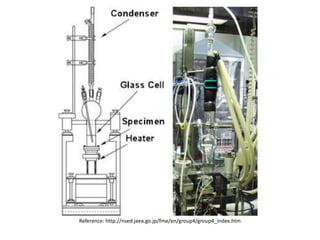
• The specimen is held in a glass cradle to
  permit circulation of the corrosion.
• The flask is an ordinary 1000 ml wide-mouth
  Erlenmeyer.
• The condenser is called an acorn or finger type
  condenser.
• An important consideration for boiling tests is
  to be sure that sufficient heat is available to
  cause boiling is all the flasks.
Reference: http://nsed.jaea.go.jp/fme/en/group4/group4_index.htm
Sea water test movie
• http://www.youtube.com/watch?v=TV1wBcq
  8QcU&feature=related
• http://www.youtube.com/watch?NR=1&v=M
  OtsLCsPDho

Chapter 4: Corrosion testing (shared using VisualBee)

  • 1.
    Chapter 4: Corrosiontesting Nima Safara 4-1 to 4-8 Picture Reference: http://www.mistesting.co.uk/corrosion_testing.html
  • 2.
    Introduction • Many testsare made every year but the value and reliability of the data obtained depend on details involved. • Most tests are made with a specific objective in mind, some are educational and some are made for practical proposes. • well-planned and executed tests usually result in reproducibility and reliability. • Corrosion tests and application of the results are considered to be a most important aspect of corrosion engineering.
  • 3.
    Classification 1. Laboratory tests. 2. Pilot-plant or semi works tests. 3. Plant or actual service test. 4. Field tests.
  • 4.
    1-Laboratory tests, including acceptance or qualifying tests • These tests are characterized by small specimens and small volumes of solutions • Best that can be done is the use of actual plant solutions or environment • It is not good idea to build a plant just based on laboratory tests
  • 5.
    2-Pilot-plant or semiworks tests • These tests are usually the best and the most desirable • Tests are made in small-scale plant that essentially duplicates the intended large-scale operation • Pilot plants are usually run long enough to ensure good results • One possible disadvantage is that conditions of operation may be widely varied in attempting to determine optimum operation
  • 6.
    3-Plant or actualservice test • Involves in a particular service or a given plant
  • 7.
    4-Field tests • Involvesfield tests designed to obtain more general information • Example of field tests are atmospheric exposure of a large number of specimens in racks at one or more geographical locations and similar tests in soils or seawater.
  • 8.
    Purposes: main justification forcorrosion testing 1. Evaluation and selection of materials for a specific environment or a given definite application 2. Evaluation of new or old metals or alloys to determine the environments in which they are suitable 3. Control of corrosion resistance of the material or corrosiveness of the environment 4. Study of the mechanisms of corrosion or other research and development purposes
  • 9.
    Materials and Specimens •First step in corrosion testing concerns the specimens themselves. • If complete information on the materials is not known, the data obtained may be practically useless. • If particular shapes are involved, representative material should be tested.
  • 10.
    Size and shapeof specimen • Flat samples are usually preferred because of easier handling and surface preparation. • Specimens 1/16 to ¼ inch thick, 1 inch wide, and 2 inch long are commonly employed in laboratory tests. • For wrought specimens, a large ratio of rolled area is desirable. • one reason of using thin specimens is, experiment shows the cut edge might corrode twice as fast as the rolled surface and accordingly results in misleading answers.
  • 11.
    Small specimens • Smallsamples permit more accurate weighing and measuring of dimensions • Short time tests • Low corrosion rate
  • 12.
    Large Samples • Largesample are desirable when studying pitting corrosion because of the probability factor involved
  • 13.
    Surface preparation • Surfaceof the test specimen should be identical with the surface of the actual equipment to be used in the plant. • A common and widely used surface finish is produced by polishing with No. 120 abrasive cloth or paper or its approximate equivalent. • This is not a smooth surface, but it is not rough.
  • 14.
    Surface preparation • Excessiveheating of the specimen should be avoided, a good general rule is that the specimen could at all time be held by naked hand • The edges must be machined, filed, or ground to remove the severely cold-worked metal and subsequently finished similarly to the remainder of the specimen.
  • 15.
    Surface preparation • Forsoft metals like lead and lead alloys rubbing with a hard eraser until obtaining a bright surface is recommended. • Scrubbing with pumice powder and other fine abrasives is sometimes used on magnesium, aluminum and their alloys.
  • 16.
    Measuring and Weighing •Since surface area enters in the formula for calculation of the corrosion rate, the results can be no more accurate than the accuracy of measurement of surface area. • After measuring, the specimen is degreased, dried and weighted to nearest 0.1 mg
  • 17.
    Consideration on ExposureTechniques 1. The corrosive should have easy access to the specimen. 2. The support should not fail during the test. 3. Specimens should be insulated or isolated electrically from contact with another metal unless galvanic effects are intended
  • 18.
    Consideration on ExposureTechniques 4. The specimen should be properly positioned if effects of complete immersion, partial immersion, or vapor phase are being studied 5. For plants tests, the specimens should be as readily accessible as possible.
  • 19.
    Corrosion tests: Boilingtests • The specimen is held in a glass cradle to permit circulation of the corrosion. • The flask is an ordinary 1000 ml wide-mouth Erlenmeyer. • The condenser is called an acorn or finger type condenser. • An important consideration for boiling tests is to be sure that sufficient heat is available to cause boiling is all the flasks.
  • 20.
  • 21.
    Sea water testmovie • http://www.youtube.com/watch?v=TV1wBcq 8QcU&feature=related • http://www.youtube.com/watch?NR=1&v=M OtsLCsPDho