Designation: G 1 – 90 (Reapproved 1999)e1
Standard Practice for
Preparing, Cleaning, and Evaluating Corrosion Test
Specimens1
This standard is issued under the fixed designation G 1; the number immediately following the designation indicates the year of original
adoption or, in the case of revision, the year of last revision. A number in parentheses indicates the year of last reapproval. A superscript
epsilon (e) indicates an editorial change since the last revision or reapproval.
e1
NOTE—Editorial corrections were made throughout in January 1999.
1. Scope
1.1 This practice covers suggested procedures for preparing
bare, solid metal specimens for tests, for removing corrosion
products after the test has been completed, and for evaluating
the corrosion damage that has occurred. Emphasis is placed on
procedures related to the evaluation of corrosion by mass loss
and pitting measurements.
NOTE 1—Caution: In many cases the corrosion product on the reactive
metals titanium and zirconium is a hard and tightly bonded oxide that
defies removal by chemical or ordinary mechanical means. In many such
cases, corrosion rates are established by mass gain rather than mass loss.
1.2 This standard does not purport to address all of the
safety concerns, if any, associated with its use. It is the
responsibility of the user of this standard to establish appro-
priate safety and health practices and determine the applica-
bility of regulatory limitations prior to use. For specific
precautionary statements, see Note 1 and Note 6.
2. Referenced Documents
2.1 ASTM Standards:
A 262 Practices for Detecting Susceptibility to Intergranu-
lar Attack in Austenitic Stainless Steels2
D 1193 Specification for Reagent Water3
D 1384 Test Method for Corrosion Test for Engine Coolants
in Glassware4
D 2776 Test Methods for Corrosivity of Water in the Ab-
sence of Heat Transfer (Electrical Methods)5
G 15 Terminology Relating to Corrosion and Corrosion
Testing6
G 16 Guide for Applying Statistics to Analysis of Corrosion
Data6
G 31 Practice for Laboratory Immersion Corrosion Testing
of Metals6
G 33 Practice for Recording Data from Atmospheric Cor-
rosion Tests of Metallic-Coated Steel Specimens6
G 46 Guide for Examination and Evaluation of Pitting
Corrosion6
G 50 Practice for Conducting Atmospheric Corrosion Tests
on Metals6
G 78 Guide for Crevice Corrosion Testing of Iron Base and
Nickel Base Stainless Alloys in Seawater and Other
Chloride-Containing Aqueous Environments6
3. Terminology
3.1 See Terminology G 15 for terms used in this practice.
4. Significance and Use
4.1 The procedures given are designed to remove corrosion
products without significant removal of base metal. This allows
an accurate determination of the mass loss of the metal or alloy
that occurred during exposure to the corrosive environment.
4.2 These procedures, in some cases, may apply to metal
coatings. However, possible effects from the substrate must be
considered.
5. Reagents and Materials
5.1 Purity of Reagents—Reagent grade chemicals shall be
used in all tests. Unless otherwise indicated, it is intended that
all reagents conform to the specifications of the Committee on
Analytical Reagents of the American Chemical Society where
such specifications are available.7
Other grades may be used,
provided it is first ascertained that the reagent is of sufficiently
high purity to permit its use without lessening the accuracy of
the determination.
5.2 Purity of Water—Unless otherwise indicated, references
to water shall be understood to mean reagent water as defined
by Type IV of Specification D 1193.
1
This practice is under the jurisdiction of ASTM Committee G-1 on Corrosion
of Metals and is the direct responsibility of Subcommittee G01.05 on Laboratory
Corrosion Tests.
Current edition approved March 30, 1990. Published May 1990. Originally
published as G 1 – 67. Last previous edition G 1 – 88.
2
Annual Book of ASTM Standards, Vol 01.03.
3
Annual Book of ASTM Standards, Vol 11.01.
4
Annual Book of ASTM Standards, Vol 15.05.
5
Discontinued—Replaced by Guide G 96. See 1990 Annual Book of ASTM
Standards, Vol 03.02.
6
Annual Book of ASTM Standards, Vol 03.02.
7
Reagent Chemicals, American Chemical Society Specifications, American
Chemical Society, Washington, DC. For suggestions on the testing of reagents not
listed by the American Chemical Society, see Analar Standards for Laboratory
Chemicals, BDH Ltd., Poole, Dorset, U.K., and the United States Pharmacopeia
and National Formulary, U.S. Pharmacopeial Convention, Inc. (USPC), Rockville,
MD.
1
AMERICAN SOCIETY FOR TESTING AND MATERIALS
100 Barr Harbor Dr., West Conshohocken, PA 19428
Reprinted from the Annual Book of ASTM Standards. Copyright ASTM
Copyright ASTM International
Reproduced by IHS under license with ASTM Licensee=BP Amoco/5928366101
Not for Resale, 01/23/2006 06:50:45 MST
No reproduction or networking permitted without license from IHS
--`,,,,,,````,`,```,`,,,`,,,```-`-`,,`,,`,`,,`---
6. Methods for Preparing Specimens for Test
6.1 For laboratory corrosion tests that simulate exposure to
service environments, a commercial surface, closely resem-
bling the one that would be used in service, will yield the most
meaningful results.
6.2 It is desirable to mark specimens used in corrosion tests
with a unique designation during preparation. Several tech-
niques may be used depending on the type of specimen and
test.
6.2.1 Stencil or Stamp—Most metallic specimens may be
marked by stenciling, that is, imprinting the designation code
into the metal surface using hardened steel stencil stamps hit
with a hammer. The resulting imprint will be visible even after
substantial corrosion has occurred. However, this procedure
introduces localized strained regions and the possibility of
superficial iron contamination in the marked area.
6.2.2 Electric engraving by means of a vibratory marking
tool may be used when the extent of corrosion damage is
known to be small. However, this approach to marking is much
more susceptible to having the marks lost as a result of
corrosion damage during testing.
6.2.3 Edge notching is especially applicable when extensive
corrosion and accumulation of corrosion products is antici-
pated. Long term atmospheric tests and sea water immersion
tests on steel alloys are examples where this approach is
applicable. It is necessary to develop a code system when using
edge notches.
6.2.4 Drilled holes may also be used to identify specimens
when extensive metal loss, accumulation of corrosion products,
or heavy scaling is anticipated. Drilled holes may be simpler
and less costly than edge notching. A code system must be
developed when using drilled holes. Punched holes should not
be used as they introduce residual strain.
6.2.5 When it is undesirable to deform the surface of
specimens after preparation procedures, for example, when
testing coated surfaces, tags may be used for specimen identi-
fication. A metal or plastic wire can be used to attach the tag to
the specimen and the specimen identification can be stamped
on the tag. It is important to ensure that neither the tag nor the
wire will corrode or degrade in the test environment. It is also
important to be sure that there are no galvanic interactions
between the tag, wire, and specimen.
6.3 For more searching tests of either the metal or the
environment, standard surface finishes may be preferred. A
suitable procedure might be:
6.3.1 Degrease in an organic solvent or hot alkaline cleaner.
(See also Practice G 31.)
NOTE 2—Hot alkalies and chlorinated solvents may attack some metals.
NOTE 3—Ultrasonic cleaning may be beneficial in both pre-test and
post-test cleaning procedures.
6.3.2 Pickle in an appropriate solution if oxides or tarnish
are present. In some cases the chemical cleaners described in
Section 6 will suffice.
NOTE 4—Pickling may cause localized corrosion on some materials.
6.3.3 Abrade with a slurry of an appropriate abrasive or with
an abrasive paper (see Practices A 262 and Test Method
D 1384). The edges as well as the faces of the specimens
should be abraded to remove burrs.
6.3.4 Rinse thoroughly, hot air dry, and store in desiccator.
6.4 When specimen preparation changes the metallurgical
condition of the metal, other methods should be chosen or the
metallurgical condition must be corrected by subsequent treat-
ment. For example, shearing a specimen to size will cold work
and may possibly fracture the edges. Edges should be ma-
chined.
6.5 The clean, dry specimens should be measured and
weighed. Dimensions determined to the third significant figure
and mass determined to the fifth significant figure are sug-
gested. When more significant figures are available on the
measuring instruments, they should be recorded.
7. Methods for Cleaning After Testing
7.1 Corrosion product removal procedures can be divided
into three general categories: mechanical, chemical, and elec-
trolytic.
7.1.1 An ideal procedure should remove only corrosion
products and not result in removal of any base metal. To
determine the mass loss of the base metal when removing
corrosion products, replicate uncorroded control specimens
should be cleaned by the same procedure being used on the test
specimen. By weighing the control specimen before and after
cleaning, the extent of metal loss resulting from cleaning can
be utilized to correct the corrosion mass loss.
NOTE 5—It is desirable to scrape samples of corrosion products before
using any chemical techniques to remove them. These scrapings can then
be subjected to various forms of analyses, including perhaps X-ray
diffraction to determine crystal forms as well as chemical analyses to look
for specific corrodants, such as chlorides. All of the chemical techniques
that are discussed in Section 7 tend to destroy the corrosion products and
thereby lose the information contained in these corrosion products. Care
may be required so that uncorroded metal is not removed with the
corrosion products.
7.1.2 The procedure given in 7.1.1 may not be reliable when
heavily corroded specimens are to be cleaned. The application
of replicate cleaning procedures to specimens with corroded
surfaces will often, even in the absence of corrosion products,
result in continuing mass losses. This is because a corroded
surface, particularly of a multiphase alloy, is often more
susceptible than a freshly machined or polished surface to
corrosion by the cleaning procedure. In such cases, the
following method of determining the mass loss due to the
cleaning procedure is preferred.
7.1.2.1 The cleaning procedure should be repeated on speci-
mens several times. The mass loss should be determined after
each cleaning by weighing the specimen.
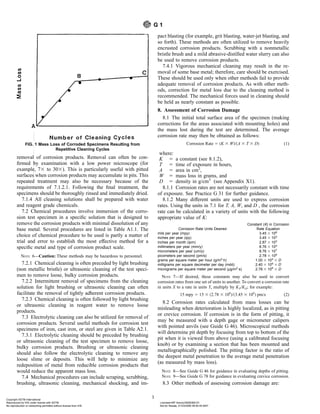
7.1.2.2 The mass loss should be graphed as a function of the
number of equal cleaning cycles as shown in Fig. 1. Two lines
will be obtained: AB and BC. The latter will correspond to
corrosion of the metal after removal of corrosion products. The
mass loss due to corrosion will correspond approximately to
point B.
7.1.2.3 To minimize uncertainty associated with corrosion
of the metal by the cleaning method, a method should be
chosen to provide the lowest slope (near to horizontal) of line
BC.
7.1.3 Repeated treatment may be required for complete
G 1
2
Copyright ASTM International
Reproduced by IHS under license with ASTM Licensee=BP Amoco/5928366101
Not for Resale, 01/23/2006 06:50:45 MST
No reproduction or networking permitted without license from IHS
--`,,,,,,````,`,```,`,,,`,,,```-`-`,,`,,`,`,,`---
removal of corrosion products. Removal can often be con-
firmed by examination with a low power microscope (for
example, 73 to 303). This is particularly useful with pitted
surfaces when corrosion products may accumulate in pits. This
repeated treatment may also be necessary because of the
requirements of 7.1.2.1. Following the final treatment, the
specimens should be thoroughly rinsed and immediately dried.
7.1.4 All cleaning solutions shall be prepared with water
and reagent grade chemicals.
7.2 Chemical procedures involve immersion of the corro-
sion test specimen in a specific solution that is designed to
remove the corrosion products with minimal dissolution of any
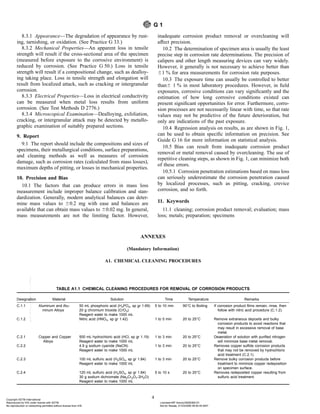
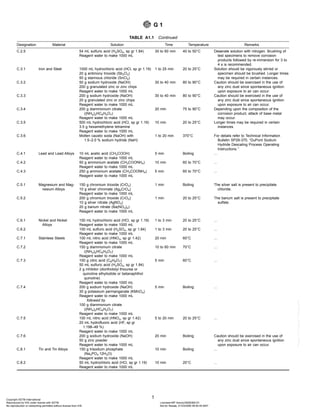
base metal. Several procedures are listed in Table A1.1. The
choice of chemical procedure to be used is partly a matter of
trial and error to establish the most effective method for a
specific metal and type of corrosion product scale.
NOTE 6—Caution: These methods may be hazardous to personnel.
7.2.1 Chemical cleaning is often preceded by light brushing
(non metallic bristle) or ultrasonic cleaning of the test speci-
men to remove loose, bulky corrosion products.
7.2.2 Intermittent removal of specimens from the cleaning
solution for light brushing or ultrasonic cleaning can often
facilitate the removal of tightly adherent corrosion products.
7.2.3 Chemical cleaning is often followed by light brushing
or ultrasonic cleaning in reagent water to remove loose
products.
7.3 Electrolytic cleaning can also be utilized for removal of
corrosion products. Several useful methods for corrosion test
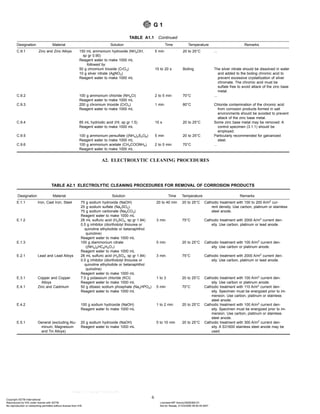
specimens of iron, cast iron, or steel are given in Table A2.1.
7.3.1 Electrolytic cleaning should be preceded by brushing
or ultrasonic cleaning of the test specimen to remove loose,
bulky corrosion products. Brushing or ultrasonic cleaning
should also follow the electrolytic cleaning to remove any
loose slime or deposits. This will help to minimize any
redeposition of metal from reducible corrosion products that
would reduce the apparent mass loss.
7.4 Mechanical procedures can include scraping, scrubbing,
brushing, ultrasonic cleaning, mechanical shocking, and im-
pact blasting (for example, grit blasting, water-jet blasting, and
so forth). These methods are often utilized to remove heavily
encrusted corrosion products. Scrubbing with a nonmetallic
bristle brush and a mild abrasive-distilled water slurry can also
be used to remove corrosion products.
7.4.1 Vigorous mechanical cleaning may result in the re-
moval of some base metal; therefore, care should be exercised.
These should be used only when other methods fail to provide
adequate removal of corrosion products. As with other meth-
ods, correction for metal loss due to the cleaning method is
recommended. The mechanical forces used in cleaning should
be held as nearly constant as possible.
8. Assessment of Corrosion Damage
8.1 The initial total surface area of the specimen (making
corrections for the areas associated with mounting holes) and
the mass lost during the test are determined. The average
corrosion rate may then be obtained as follows:
Corrosion Rate 5 ~K 3 W!/~A 3 T 3 D! (1)
where:
K 5 a constant (see 8.1.2),
T 5 time of exposure in hours,
A 5 area in cm2
,
W 5 mass loss in grams, and
D 5 density in g/cm3
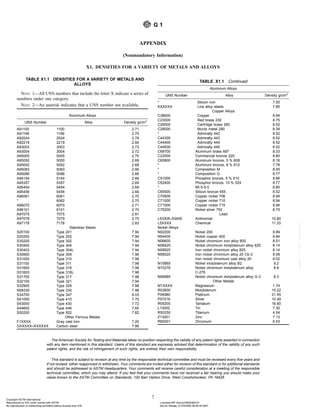
(see Appendix X1).
8.1.1 Corrosion rates are not necessarily constant with time
of exposure. See Practice G 31 for further guidance.
8.1.2 Many different units are used to express corrosion
rates. Using the units in 7.1 for T, A, W, and D , the corrosion
rate can be calculated in a variety of units with the following
appropriate value of K:
Corrosion Rate Units Desired
Constant (K) in Corrosion
Rate Equation
mils per year (mpy) 3.45 3 106
inches per year (ipy) 3.45 3 103
inches per month (ipm) 2.87 3 102
millimeters per year (mm/y) 8.76 3 104
micrometers per year (um/y) 8.76 3 107
picometers per second (pm/s) 2.78 3 106
grams per square meter per hour (g/m2
·h) 1.00 3 104
3 D
milligrams per square decimeter per day (mdd) 2.40 3 106
3 D
micrograms per square meter per second (µg/m2
·s) 2.78 3 106
3 D
NOTE 7—If desired, these constants may also be used to convert
corrosion rates from one set of units to another. To convert a corrosion rate
in units X to a rate in units Y, multiply by KY/KX; for example:
15 mpy 5 15 3 ~2.78 3 106
!/~3.45 3 106
! pm/s (2)
8.2 Corrosion rates calculated from mass losses can be
misleading when deterioration is highly localized, as in pitting
or crevice corrosion. If corrosion is in the form of pitting, it
may be measured with a depth gage or micrometer calipers
with pointed anvils (see Guide G 46). Microscopical methods
will determine pit depth by focusing from top to bottom of the
pit when it is viewed from above (using a calibrated focusing
knob) or by examining a section that has been mounted and
metallographically polished. The pitting factor is the ratio of
the deepest metal penetration to the average metal penetration
(as measured by mass loss).
NOTE 8—See Guide G 46 for guidance in evaluating depths of pitting.
NOTE 9—See Guide G 78 for guidance in evaluating crevice corrosion.
8.3 Other methods of assessing corrosion damage are:
FIG. 1 Mass Loss of Corroded Specimens Resulting from
Repetitive Cleaning Cycles
G 1
3
Copyright ASTM International
Reproduced by IHS under license with ASTM Licensee=BP Amoco/5928366101
Not for Resale, 01/23/2006 06:50:45 MST
No reproduction or networking permitted without license from IHS
--`,,,,,,````,`,```,`,,,`,,,```-`-`,,`,,`,`,,`---
8.3.1 Appearance—The degradation of appearance by rust-
ing, tarnishing, or oxidation. (See Practice G 33.)
8.3.2 Mechanical Properties—An apparent loss in tensile
strength will result if the cross-sectional area of the specimen
(measured before exposure to the corrosive environment) is
reduced by corrosion. (See Practice G 50.) Loss in tensile
strength will result if a compositional change, such as dealloy-
ing taking place. Loss in tensile strength and elongation will
result from localized attack, such as cracking or intergranular
corrosion.
8.3.3 Electrical Properties—Loss in electrical conductivity
can be measured when metal loss results from uniform
corrosion. (See Test Methods D 2776.)
8.3.4 Microscopical Examination—Dealloying, exfoliation,
cracking, or intergranular attack may be detected by metallo-
graphic examination of suitably prepared sections.
9. Report
9.1 The report should include the compositions and sizes of
specimens, their metallurgical conditions, surface preparations,
and cleaning methods as well as measures of corrosion
damage, such as corrosion rates (calculated from mass losses),
maximum depths of pitting, or losses in mechanical properties.
10. Precision and Bias
10.1 The factors that can produce errors in mass loss
measurement include improper balance calibration and stan-
dardization. Generally, modern analytical balances can deter-
mine mass values to 60.2 mg with ease and balances are
available that can obtain mass values to 60.02 mg. In general,
mass measurements are not the limiting factor. However,
inadequate corrosion product removal or overcleaning will
affect precision.
10.2 The determination of specimen area is usually the least
precise step in corrosion rate determinations. The precision of
calipers and other length measuring devices can vary widely.
However, it generally is not necessary to achieve better than
61 % for area measurements for corrosion rate purposes.
10.3 The exposure time can usually be controlled to better
than6 1 % in most laboratory procedures. However, in field
exposures, corrosive conditions can vary significantly and the
estimation of how long corrosive conditions existed can
present significant opportunities for error. Furthermore, corro-
sion processes are not necessarily linear with time, so that rate
values may not be predictive of the future deterioration, but
only are indications of the past exposure.
10.4 Regression analysis on results, as are shown in Fig. 1,
can be used to obtain specific information on precision. See
Guide G 16 for more information on statistical analysis.
10.5 Bias can result from inadequate corrosion product
removal or metal removal caused by overcleaning. The use of
repetitive cleaning steps, as shown in Fig. 1, can minimize both
of these errors.
10.5.1 Corrosion penetration estimations based on mass loss
can seriously underestimate the corrosion penetration caused
by localized processes, such as pitting, cracking, crevice
corrosion, and so forth.
11. Keywords
11.1 cleaning; corrosion product removal; evaluation; mass
loss; metals; preparation; specimens
ANNEXES
(Mandatory Information)
A1. CHEMICAL CLEANING PROCEDURES
TABLE A1.1 CHEMICAL CLEANING PROCEDURES FOR REMOVAL OF CORROSION PRODUCTS
Designation Material Solution Time Temperature Remarks
C.1.1 Aluminum and Alu-
minum Alloys
50 mL phosphoric acid (H3PO4, sp gr 1.69)
20 g chromium trioxide (CrO3)
Reagent water to make 1000 mL
5 to 10 min 90°C to Boiling If corrosion product films remain, rinse, then
follow with nitric acid procedure (C.1.2).
C.1.2 Nitric acid (HNO3, sp gr 1.42) 1 to 5 min 20 to 25°C Remove extraneous deposits and bulky
corrosion products to avoid reactions that
may result in excessive removal of base
metal.
C.2.1 Copper and Copper
Alloys
500 mL hydrochloric acid (HCl, sp gr 1.19)
Reagent water to make 1000 mL
1 to 3 min 20 to 25°C Deaeration of solution with purified nitrogen
will minimize base metal removal.
C.2.2 4.9 g sodium cyanide (NaCN)
Reagent water to make 1000 mL
1 to 3 min 20 to 25°C Removes copper sulfide corrosion products
that may not be removed by hydrochloric
acid treatment (C.2.1).
C.2.3 100 mL sulfuric acid (H2SO4, sp gr 1.84)
Reagent water to make 1000 mL
1 to 3 min 20 to 25°C Remove bulky corrosion products before
treatment to minimize copper redeposition
on specimen surface.
C.2.4 120 mL sulfuric acid (H2SO4, sp gr 1.84)
30 g sodium dichromate (Na2Cr2O7·2H2O)
Reagent water to make 1000 mL
5 to 10 s 20 to 25°C Removes redeposited copper resulting from
sulfuric acid treatment.
G 1
4
Copyright ASTM International
Reproduced by IHS under license with ASTM Licensee=BP Amoco/5928366101
Not for Resale, 01/23/2006 06:50:45 MST
No reproduction or networking permitted without license from IHS
--`,,,,,,````,`,```,`,,,`,,,```-`-`,,`,,`,`,,`---
TABLE A1.1 Continued
Designation Material Solution Time Temperature Remarks
C.2.5 54 mL sulfuric acid (H2SO4, sp gr 1.84)
Reagent water to make 1000 mL
30 to 60 min 40 to 50°C Deaerate solution with nitrogen. Brushing of
test specimens to remove corrosion
products followed by re-immersion for 3 to
4 s is recommended.
C.3.1 Iron and Steel 1000 mL hydrochloric acid (HCl, sp gr 1.19)
20 g antimony trioxide (Sb2O3)
50 g stannous chloride (SnCl2)
1 to 25 min 20 to 25°C Solution should be vigorously stirred or
specimen should be brushed. Longer times
may be required in certain instances.
C.3.2 50 g sodium hydroxide (NaOH)
200 g granulated zinc or zinc chips
Reagent water to make 1000 mL
30 to 40 min 80 to 90°C Caution should be exercised in the use of
any zinc dust since spontaneous ignition
upon exposure to air can occur.
C.3.3 200 g sodium hydroxide (NaOH)
20 g granulated zinc or zinc chips
Reagent water to make 1000 mL
30 to 40 min 80 to 90°C Caution should be exercised in the use of
any zinc dust since spontaneous ignition
upon exposure to air can occur.
C.3.4 200 g diammonium citrate
((NH4)2HC6H5O7)
Reagent water to make 1000 mL
20 min 75 to 90°C Depending upon the composition of the
corrosion product, attack of base metal
may occur.
C.3.5 500 mL hydrochloric acid (HCl, sp gr 1.19)
3.5 g hexamethylene tetramine
Reagent water to make 1000 mL
10 min 20 to 25°C Longer times may be required in certain
instances.
C.3.6 Molten caustic soda (NaOH) with
1.5–2.0 % sodium hydride (NaH)
1 to 20 min 370°C For details refer to Technical Information
Bulletin SP29-370, “DuPont Sodium
Hydride Descaling Process Operating
Instructions.’’
C.4.1 Lead and Lead Alloys 10 mL acetic acid (CH3COOH)
Reagent water to make 1000 mL
5 min Boiling ...
C.4.2 50 g ammonium acetate (CH3COONH4)
Reagent water to make 1000 mL
10 min 60 to 70°C ...
C.4.3 250 g ammonium acetate (CH3COONH4)
Reagent water to make 1000 mL
5 min 60 to 70°C ...
C.5.1 Magnesium and Mag-
nesium Alloys
150 g chromium trioxide (CrO3)
10 g silver chromate (Ag2CrO4)
Reagent water to make 1000 mL
1 min Boiling The silver salt is present to precipitate
chloride.
C.5.2 200 g chromium trioxide (CrO3)
10 g silver nitrate (AgNO3)
20 g barium nitrate (Ba(NO3)2)
Reagent water to make 1000 mL
1 min 20 to 25°C The barium salt is present to precipitate
sulfate.
C.6.1 Nickel and Nickel
Alloys
150 mL hydrochloric acid (HCl, sp gr 1.19)
Reagent water to make 1000 mL
1 to 3 min 20 to 25°C ...
C.6.2 100 mL sulfuric acid (H2SO4, sp gr 1.84)
Reagent water to make 1000 mL
1 to 3 min 20 to 25°C ...
C.7.1 Stainless Steels 100 mL nitric acid (HNO3, sp gr 1.42)
Reagent water to make 1000 mL
20 min 60°C ...
C.7.2 150 g diammonium citrate
((NH4)2HC6H5O7)
Reagent water to make 1000 mL
10 to 60 min 70°C ...
C.7.3 100 g citric acid (C6H8O7)
50 mL sulfuric acid (H2SO4, sp gr 1.84)
2 g inhibitor (diorthotolyl thiourea or
quinoline ethyliodide or betanaphthol
quinoline)
Reagent water to make 1000 mL
5 min 60°C ...
C.7.4 200 g sodium hydroxide (NaOH)
30 g potassium permanganate (KMnO4)
Reagent water to make 1000 mL
followed by
100 g diammonium citrate
((NH4)2HC6H5O7)
Reagent water to make 1000 mL
5 min Boiling ...
C.7.5 100 mL nitric acid (HNO3, sp gr 1.42)
20 mL hydrofluoric acid (HF, sp gr
1.198–48 %)
Reagent water to make 1000 mL
5 to 20 min 20 to 25°C ...
C.7.6 200 g sodium hydroxide (NaOH)
50 g zinc powder
Reagent water to make 1000 mL
20 min Boiling Caution should be exercised in the use of
any zinc dust since spontaneous ignition
upon exposure to air can occur.
C.8.1 Tin and Tin Alloys 150 g trisodium phosphate
(Na3PO4·12H2O)
Reagent water to make 1000 mL
10 min Boiling ...
C.8.2 50 mL hydrochloric acid (HCl, sp gr 1.19)
Reagent water to make 1000 mL
10 min 20°C ...
G 1
5
Copyright ASTM International
Reproduced by IHS under license with ASTM Licensee=BP Amoco/5928366101
Not for Resale, 01/23/2006 06:50:45 MST
No reproduction or networking permitted without license from IHS
--`,,,,,,````,`,```,`,,,`,,,```-`-`,,`,,`,`,,`---
TABLE A1.1 Continued
Designation Material Solution Time Temperature Remarks
C.9.1 Zinc and Zinc Alloys 150 mL ammonium hydroxide (NH4OH,
sp gr 0.90)
Reagent water to make 1000 mL
followed by
5 min 20 to 25°C ...
50 g chromium trioxide (CrO3)
10 g silver nitrate (AgNO3)
Reagent water to make 1000 mL
15 to 20 s Boiling The silver nitrate should be dissolved in water
and added to the boiling chromic acid to
prevent excessive crystallization of silver
chromate. The chromic acid must be
sulfate free to avoid attack of the zinc base
metal.
C.9.2 100 g ammonium chloride (NH4Cl)
Reagent water to make 1000 mL
2 to 5 min 70°C ...
C.9.3 200 g chromium trioxide (CrO3)
Reagent water to make 1000 mL
1 min 80°C Chloride contamination of the chromic acid
from corrosion products formed in salt
environments should be avoided to prevent
attack of the zinc base metal.
C.9.4 85 mL hydriodic acid (HI, sp gr 1.5)
Reagent water to make 1000 mL
15 s 20 to 25°C Some zinc base metal may be removed. A
control specimen (3.1.1) should be
employed.
C.9.5 100 g ammonium persulfate ((NH4)2S2O8)
Reagent water to make 1000 mL
5 min 20 to 25°C Particularly recommended for galvanized
steel.
C.9.6 100 g ammonium acetate (CH3COONH4)
Reagent water to make 1000 mL
2 to 5 min 70°C ...
A2. ELECTROLYTIC CLEANING PROCEDURES
TABLE A2.1 ELECTROLYTIC CLEANING PROCEDURES FOR REMOVAL OF CORROSION PRODUCTS
Designation Material Solution Time Temperature Remarks
E.1.1 Iron, Cast Iron, Steel 75 g sodium hydroxide (NaOH)
25 g sodium sulfate (Na2SO4)
75 g sodium carbonate (Na2CO3)
Reagent water to make 1000 mL
20 to 40 min 20 to 25°C Cathodic treatment with 100 to 200 A/m2
cur-
rent density. Use carbon, platinum or stainless
steel anode.
E.1.2 28 mL sulfuric acid (H2SO4, sp gr 1.84)
0.5 g inhibitor (diorthotolyl thiourea or
quinoline ethyliodide or betanaphthol
quinoline)
Reagent water to make 1000 mL
3 min 75°C Cathodic treatment with 2000 A/m2
current den-
sity. Use carbon, platinum or lead anode.
E.1.3 100 g diammonium citrate
((NH4)2HC6H5O7)
Reagent water to make 1000 mL
5 min 20 to 25°C Cathodic treatment with 100 A/m2
current den-
sity. Use carbon or platinum anode.
E.2.1 Lead and Lead Alloys 28 mL sulfuric acid (H2SO4, sp gr 1.84)
0.5 g inhibitor (diorthotolyl thiourea or
quinoline ethyliodide or betanaphthol
quinoline)
Reagent water to make 1000 mL
3 min 75°C Cathodic treatment with 2000 A/m2
current den-
sity. Use carbon, platinum or lead anode.
E.3.1 Copper and Copper
Alloys
7.5 g potassium chloride (KCl)
Reagent water to make 1000 mL
1 to 3 20 to 25°C Cathodic treatment with 100 A/m2
current den-
sity. Use carbon or platinum anode.
E.4.1 Zinc and Cadmium 50 g dibasic sodium phosphate (Na2HPO4)
Reagent water to make 1000 mL
5 min 70°C Cathodic treatment with 110 A/m2
current den-
sity. Specimen must be energized prior to im-
mersion. Use carbon, platinum or stainless
steel anode.
E.4.2 100 g sodium hydroxide (NaOH)
Reagent water to make 1000 mL
1 to 2 min 20 to 25°C Cathodic treatment with 100 A/m2
current den-
sity. Specimen must be energized prior to im-
mersion. Use carbon, platinum or stainless
steel anode.
E.5.1 General (excluding Alu-
minum, Magnesium
and Tin Alloys)
20 g sodium hydroxide (NaOH)
Reagent water to make 1000 mL
5 to 10 min 20 to 25°C Cathodic treatment with 300 A/m2
current den-
sity. A S31600 stainless steel anode may be
used.
G 1
6
Copyright ASTM International
Reproduced by IHS under license with ASTM Licensee=BP Amoco/5928366101
Not for Resale, 01/23/2006 06:50:45 MST
No reproduction or networking permitted without license from IHS
--`,,,,,,````,`,```,`,,,`,,,```-`-`,,`,,`,`,,`---
APPENDIX
(Nonmandatory Information)
X1. DENSITIES FOR A VARIETY OF METALS AND ALLOYS
TABLE X1.1 DENSITIES FOR A VARIETY OF METALS AND
ALLOYS
NOTE 1—All UNS numbers that include the letter X indicate a series of
numbers under one category.
NOTE 2—An asterisk indicates that a UNS number not available.
Aluminum Alloys
UNS Number Alloy Density g/cm3
A91100 1100 2.71
A91199 1199 2.70
A92024 2024 2.78
A92219 2219 2.84
A93003 3003 2.73
A93004 3004 2.72
A95005 5005 2.70
A95050 5050 2.69
A95052 5052 2.68
A95083 5083 2.66
A95086 5086 2.66
A95154 5154 2.66
A95357 5357 2.69
A95454 5454 2.69
A95456 5456 2.66
A96061 6061 2.70
* 6062 2.70
A96070 6070 2.71
A96101 6101 2.70
A97075 7075 2.81
A97079 7079 2.75
A97178 7178 2.83
Stainless Steels
S20100 Type 201 7.94
S20200 Type 202 7.94
S30200 Type 302 7.94
S30400 Type 304 7.94
S30403 Type 304L 7.94
S30900 Type 309 7.98
S31000 Type 310 7.98
S31100 Type 311 7.98
S31600 Type 316 7.98
S31603 Type 316L 7.98
S31700 Type 317 7.98
S32100 Type 321 7.94
S32900 Type 329 7.98
N08330 Type 330 7.98
S34700 Type 347 8.03
S41000 Type 410 7.70
S43000 Type 430 7.72
S44600 Type 446 7.65
S50200 Type 502 7.82
Other Ferrous Metals
F1XXXX Gray cast iron 7.20
GXXXXX–KXXXXX Carbon steel 7.86
TABLE X1.1 Continued
Aluminum Alloys
UNS Number Alloy Density g/cm3
* Silicon iron 7.00
KXXXXX Low alloy steels 7.85
Copper Alloys
C38600 Copper 8.94
C23000 Red brass 230 8.75
C26000 Cartridge brass 260 8.52
C28000 Muntz metal 280 8.39
* Admiralty 442 8.52
C44300 Admiralty 443 8.52
C44400 Admiralty 444 8.52
C44500 Admiralty 445 8.52
C68700 Aluminum brass 687 8.33
C22000 Commercial bronze 220 8.80
C60800 Aluminum bronze, 5 % 608 8.16
* Aluminum bronze, 8 % 612 7.78
* Composition M 8.45
* Composition G 8.77
C51000 Phosphor bronze, 5 % 510 8.86
C52400 Phosphor bronze, 10 % 524 8.77
* 85-5-5-5 8.80
C65500 Silicon bronze 655 8.52
C70600 Copper nickel 706 8.94
C71000 Copper nickel 710 8.94
C71500 Copper nickel 715 8.94
C75200 Nickel silver 752 8.75
Lead
L53305–53405 Antimonial 10.80
L5XXXX Chemical 11.33
Nickel Alloys
N02200 Nickel 200 8.89
N04400 Nickel copper 400 8.84
N06600 Nickel chromium iron alloy 600 8.51
N06625 Nickel chromium molybdenum alloy 625 8.14
N08825 Iron nickel chromium alloy 825 8.14
N08020 Iron nickel chromium alloy 20 Cb-3 8.08
* Iron nickel chromium cast alloy 20 8.02
N10665 Nickel molybdenum alloy B2 9.2
N10276 Nickel chromium molybdenum alloy
C-276
8.8
N06985 Nickel chromium molybdenum alloy G-3 8.3
Other Metals
M1XXXX Magnesium 1.74
R03600 Molybdenum 10.22
P04980 Platinum 21.45
P07016 Silver 10.49
R05200 Tantalum 16.60
L13002 Tin 7.30
R50250 Titanium 4.54
Z13001 Zinc 7.13
R60001 Zirconium 6.53
The American Society for Testing and Materials takes no position respecting the validity of any patent rights asserted in connection
with any item mentioned in this standard. Users of this standard are expressly advised that determination of the validity of any such
patent rights, and the risk of infringement of such rights, are entirely their own responsibility.
This standard is subject to revision at any time by the responsible technical committee and must be reviewed every five years and
if not revised, either reapproved or withdrawn. Your comments are invited either for revision of this standard or for additional standards
and should be addressed to ASTM Headquarters. Your comments will receive careful consideration at a meeting of the responsible
technical committee, which you may attend. If you feel that your comments have not received a fair hearing you should make your
views known to the ASTM Committee on Standards, 100 Barr Harbor Drive, West Conshohocken, PA 19428.
G 1
7
Copyright ASTM International
Reproduced by IHS under license with ASTM Licensee=BP Amoco/5928366101
Not for Resale, 01/23/2006 06:50:45 MST
No reproduction or networking permitted without license from IHS
--`,,,,,,````,`,```,`,,,`,,,```-`-`,,`,,`,`,,`---

G-1.pdf

  • 1.
    Designation: G 1– 90 (Reapproved 1999)e1 Standard Practice for Preparing, Cleaning, and Evaluating Corrosion Test Specimens1 This standard is issued under the fixed designation G 1; the number immediately following the designation indicates the year of original adoption or, in the case of revision, the year of last revision. A number in parentheses indicates the year of last reapproval. A superscript epsilon (e) indicates an editorial change since the last revision or reapproval. e1 NOTE—Editorial corrections were made throughout in January 1999. 1. Scope 1.1 This practice covers suggested procedures for preparing bare, solid metal specimens for tests, for removing corrosion products after the test has been completed, and for evaluating the corrosion damage that has occurred. Emphasis is placed on procedures related to the evaluation of corrosion by mass loss and pitting measurements. NOTE 1—Caution: In many cases the corrosion product on the reactive metals titanium and zirconium is a hard and tightly bonded oxide that defies removal by chemical or ordinary mechanical means. In many such cases, corrosion rates are established by mass gain rather than mass loss. 1.2 This standard does not purport to address all of the safety concerns, if any, associated with its use. It is the responsibility of the user of this standard to establish appro- priate safety and health practices and determine the applica- bility of regulatory limitations prior to use. For specific precautionary statements, see Note 1 and Note 6. 2. Referenced Documents 2.1 ASTM Standards: A 262 Practices for Detecting Susceptibility to Intergranu- lar Attack in Austenitic Stainless Steels2 D 1193 Specification for Reagent Water3 D 1384 Test Method for Corrosion Test for Engine Coolants in Glassware4 D 2776 Test Methods for Corrosivity of Water in the Ab- sence of Heat Transfer (Electrical Methods)5 G 15 Terminology Relating to Corrosion and Corrosion Testing6 G 16 Guide for Applying Statistics to Analysis of Corrosion Data6 G 31 Practice for Laboratory Immersion Corrosion Testing of Metals6 G 33 Practice for Recording Data from Atmospheric Cor- rosion Tests of Metallic-Coated Steel Specimens6 G 46 Guide for Examination and Evaluation of Pitting Corrosion6 G 50 Practice for Conducting Atmospheric Corrosion Tests on Metals6 G 78 Guide for Crevice Corrosion Testing of Iron Base and Nickel Base Stainless Alloys in Seawater and Other Chloride-Containing Aqueous Environments6 3. Terminology 3.1 See Terminology G 15 for terms used in this practice. 4. Significance and Use 4.1 The procedures given are designed to remove corrosion products without significant removal of base metal. This allows an accurate determination of the mass loss of the metal or alloy that occurred during exposure to the corrosive environment. 4.2 These procedures, in some cases, may apply to metal coatings. However, possible effects from the substrate must be considered. 5. Reagents and Materials 5.1 Purity of Reagents—Reagent grade chemicals shall be used in all tests. Unless otherwise indicated, it is intended that all reagents conform to the specifications of the Committee on Analytical Reagents of the American Chemical Society where such specifications are available.7 Other grades may be used, provided it is first ascertained that the reagent is of sufficiently high purity to permit its use without lessening the accuracy of the determination. 5.2 Purity of Water—Unless otherwise indicated, references to water shall be understood to mean reagent water as defined by Type IV of Specification D 1193. 1 This practice is under the jurisdiction of ASTM Committee G-1 on Corrosion of Metals and is the direct responsibility of Subcommittee G01.05 on Laboratory Corrosion Tests. Current edition approved March 30, 1990. Published May 1990. Originally published as G 1 – 67. Last previous edition G 1 – 88. 2 Annual Book of ASTM Standards, Vol 01.03. 3 Annual Book of ASTM Standards, Vol 11.01. 4 Annual Book of ASTM Standards, Vol 15.05. 5 Discontinued—Replaced by Guide G 96. See 1990 Annual Book of ASTM Standards, Vol 03.02. 6 Annual Book of ASTM Standards, Vol 03.02. 7 Reagent Chemicals, American Chemical Society Specifications, American Chemical Society, Washington, DC. For suggestions on the testing of reagents not listed by the American Chemical Society, see Analar Standards for Laboratory Chemicals, BDH Ltd., Poole, Dorset, U.K., and the United States Pharmacopeia and National Formulary, U.S. Pharmacopeial Convention, Inc. (USPC), Rockville, MD. 1 AMERICAN SOCIETY FOR TESTING AND MATERIALS 100 Barr Harbor Dr., West Conshohocken, PA 19428 Reprinted from the Annual Book of ASTM Standards. Copyright ASTM Copyright ASTM International Reproduced by IHS under license with ASTM Licensee=BP Amoco/5928366101 Not for Resale, 01/23/2006 06:50:45 MST No reproduction or networking permitted without license from IHS --`,,,,,,````,`,```,`,,,`,,,```-`-`,,`,,`,`,,`---
  • 2.
    6. Methods forPreparing Specimens for Test 6.1 For laboratory corrosion tests that simulate exposure to service environments, a commercial surface, closely resem- bling the one that would be used in service, will yield the most meaningful results. 6.2 It is desirable to mark specimens used in corrosion tests with a unique designation during preparation. Several tech- niques may be used depending on the type of specimen and test. 6.2.1 Stencil or Stamp—Most metallic specimens may be marked by stenciling, that is, imprinting the designation code into the metal surface using hardened steel stencil stamps hit with a hammer. The resulting imprint will be visible even after substantial corrosion has occurred. However, this procedure introduces localized strained regions and the possibility of superficial iron contamination in the marked area. 6.2.2 Electric engraving by means of a vibratory marking tool may be used when the extent of corrosion damage is known to be small. However, this approach to marking is much more susceptible to having the marks lost as a result of corrosion damage during testing. 6.2.3 Edge notching is especially applicable when extensive corrosion and accumulation of corrosion products is antici- pated. Long term atmospheric tests and sea water immersion tests on steel alloys are examples where this approach is applicable. It is necessary to develop a code system when using edge notches. 6.2.4 Drilled holes may also be used to identify specimens when extensive metal loss, accumulation of corrosion products, or heavy scaling is anticipated. Drilled holes may be simpler and less costly than edge notching. A code system must be developed when using drilled holes. Punched holes should not be used as they introduce residual strain. 6.2.5 When it is undesirable to deform the surface of specimens after preparation procedures, for example, when testing coated surfaces, tags may be used for specimen identi- fication. A metal or plastic wire can be used to attach the tag to the specimen and the specimen identification can be stamped on the tag. It is important to ensure that neither the tag nor the wire will corrode or degrade in the test environment. It is also important to be sure that there are no galvanic interactions between the tag, wire, and specimen. 6.3 For more searching tests of either the metal or the environment, standard surface finishes may be preferred. A suitable procedure might be: 6.3.1 Degrease in an organic solvent or hot alkaline cleaner. (See also Practice G 31.) NOTE 2—Hot alkalies and chlorinated solvents may attack some metals. NOTE 3—Ultrasonic cleaning may be beneficial in both pre-test and post-test cleaning procedures. 6.3.2 Pickle in an appropriate solution if oxides or tarnish are present. In some cases the chemical cleaners described in Section 6 will suffice. NOTE 4—Pickling may cause localized corrosion on some materials. 6.3.3 Abrade with a slurry of an appropriate abrasive or with an abrasive paper (see Practices A 262 and Test Method D 1384). The edges as well as the faces of the specimens should be abraded to remove burrs. 6.3.4 Rinse thoroughly, hot air dry, and store in desiccator. 6.4 When specimen preparation changes the metallurgical condition of the metal, other methods should be chosen or the metallurgical condition must be corrected by subsequent treat- ment. For example, shearing a specimen to size will cold work and may possibly fracture the edges. Edges should be ma- chined. 6.5 The clean, dry specimens should be measured and weighed. Dimensions determined to the third significant figure and mass determined to the fifth significant figure are sug- gested. When more significant figures are available on the measuring instruments, they should be recorded. 7. Methods for Cleaning After Testing 7.1 Corrosion product removal procedures can be divided into three general categories: mechanical, chemical, and elec- trolytic. 7.1.1 An ideal procedure should remove only corrosion products and not result in removal of any base metal. To determine the mass loss of the base metal when removing corrosion products, replicate uncorroded control specimens should be cleaned by the same procedure being used on the test specimen. By weighing the control specimen before and after cleaning, the extent of metal loss resulting from cleaning can be utilized to correct the corrosion mass loss. NOTE 5—It is desirable to scrape samples of corrosion products before using any chemical techniques to remove them. These scrapings can then be subjected to various forms of analyses, including perhaps X-ray diffraction to determine crystal forms as well as chemical analyses to look for specific corrodants, such as chlorides. All of the chemical techniques that are discussed in Section 7 tend to destroy the corrosion products and thereby lose the information contained in these corrosion products. Care may be required so that uncorroded metal is not removed with the corrosion products. 7.1.2 The procedure given in 7.1.1 may not be reliable when heavily corroded specimens are to be cleaned. The application of replicate cleaning procedures to specimens with corroded surfaces will often, even in the absence of corrosion products, result in continuing mass losses. This is because a corroded surface, particularly of a multiphase alloy, is often more susceptible than a freshly machined or polished surface to corrosion by the cleaning procedure. In such cases, the following method of determining the mass loss due to the cleaning procedure is preferred. 7.1.2.1 The cleaning procedure should be repeated on speci- mens several times. The mass loss should be determined after each cleaning by weighing the specimen. 7.1.2.2 The mass loss should be graphed as a function of the number of equal cleaning cycles as shown in Fig. 1. Two lines will be obtained: AB and BC. The latter will correspond to corrosion of the metal after removal of corrosion products. The mass loss due to corrosion will correspond approximately to point B. 7.1.2.3 To minimize uncertainty associated with corrosion of the metal by the cleaning method, a method should be chosen to provide the lowest slope (near to horizontal) of line BC. 7.1.3 Repeated treatment may be required for complete G 1 2 Copyright ASTM International Reproduced by IHS under license with ASTM Licensee=BP Amoco/5928366101 Not for Resale, 01/23/2006 06:50:45 MST No reproduction or networking permitted without license from IHS --`,,,,,,````,`,```,`,,,`,,,```-`-`,,`,,`,`,,`---
  • 3.
    removal of corrosionproducts. Removal can often be con- firmed by examination with a low power microscope (for example, 73 to 303). This is particularly useful with pitted surfaces when corrosion products may accumulate in pits. This repeated treatment may also be necessary because of the requirements of 7.1.2.1. Following the final treatment, the specimens should be thoroughly rinsed and immediately dried. 7.1.4 All cleaning solutions shall be prepared with water and reagent grade chemicals. 7.2 Chemical procedures involve immersion of the corro- sion test specimen in a specific solution that is designed to remove the corrosion products with minimal dissolution of any base metal. Several procedures are listed in Table A1.1. The choice of chemical procedure to be used is partly a matter of trial and error to establish the most effective method for a specific metal and type of corrosion product scale. NOTE 6—Caution: These methods may be hazardous to personnel. 7.2.1 Chemical cleaning is often preceded by light brushing (non metallic bristle) or ultrasonic cleaning of the test speci- men to remove loose, bulky corrosion products. 7.2.2 Intermittent removal of specimens from the cleaning solution for light brushing or ultrasonic cleaning can often facilitate the removal of tightly adherent corrosion products. 7.2.3 Chemical cleaning is often followed by light brushing or ultrasonic cleaning in reagent water to remove loose products. 7.3 Electrolytic cleaning can also be utilized for removal of corrosion products. Several useful methods for corrosion test specimens of iron, cast iron, or steel are given in Table A2.1. 7.3.1 Electrolytic cleaning should be preceded by brushing or ultrasonic cleaning of the test specimen to remove loose, bulky corrosion products. Brushing or ultrasonic cleaning should also follow the electrolytic cleaning to remove any loose slime or deposits. This will help to minimize any redeposition of metal from reducible corrosion products that would reduce the apparent mass loss. 7.4 Mechanical procedures can include scraping, scrubbing, brushing, ultrasonic cleaning, mechanical shocking, and im- pact blasting (for example, grit blasting, water-jet blasting, and so forth). These methods are often utilized to remove heavily encrusted corrosion products. Scrubbing with a nonmetallic bristle brush and a mild abrasive-distilled water slurry can also be used to remove corrosion products. 7.4.1 Vigorous mechanical cleaning may result in the re- moval of some base metal; therefore, care should be exercised. These should be used only when other methods fail to provide adequate removal of corrosion products. As with other meth- ods, correction for metal loss due to the cleaning method is recommended. The mechanical forces used in cleaning should be held as nearly constant as possible. 8. Assessment of Corrosion Damage 8.1 The initial total surface area of the specimen (making corrections for the areas associated with mounting holes) and the mass lost during the test are determined. The average corrosion rate may then be obtained as follows: Corrosion Rate 5 ~K 3 W!/~A 3 T 3 D! (1) where: K 5 a constant (see 8.1.2), T 5 time of exposure in hours, A 5 area in cm2 , W 5 mass loss in grams, and D 5 density in g/cm3 (see Appendix X1). 8.1.1 Corrosion rates are not necessarily constant with time of exposure. See Practice G 31 for further guidance. 8.1.2 Many different units are used to express corrosion rates. Using the units in 7.1 for T, A, W, and D , the corrosion rate can be calculated in a variety of units with the following appropriate value of K: Corrosion Rate Units Desired Constant (K) in Corrosion Rate Equation mils per year (mpy) 3.45 3 106 inches per year (ipy) 3.45 3 103 inches per month (ipm) 2.87 3 102 millimeters per year (mm/y) 8.76 3 104 micrometers per year (um/y) 8.76 3 107 picometers per second (pm/s) 2.78 3 106 grams per square meter per hour (g/m2 ·h) 1.00 3 104 3 D milligrams per square decimeter per day (mdd) 2.40 3 106 3 D micrograms per square meter per second (µg/m2 ·s) 2.78 3 106 3 D NOTE 7—If desired, these constants may also be used to convert corrosion rates from one set of units to another. To convert a corrosion rate in units X to a rate in units Y, multiply by KY/KX; for example: 15 mpy 5 15 3 ~2.78 3 106 !/~3.45 3 106 ! pm/s (2) 8.2 Corrosion rates calculated from mass losses can be misleading when deterioration is highly localized, as in pitting or crevice corrosion. If corrosion is in the form of pitting, it may be measured with a depth gage or micrometer calipers with pointed anvils (see Guide G 46). Microscopical methods will determine pit depth by focusing from top to bottom of the pit when it is viewed from above (using a calibrated focusing knob) or by examining a section that has been mounted and metallographically polished. The pitting factor is the ratio of the deepest metal penetration to the average metal penetration (as measured by mass loss). NOTE 8—See Guide G 46 for guidance in evaluating depths of pitting. NOTE 9—See Guide G 78 for guidance in evaluating crevice corrosion. 8.3 Other methods of assessing corrosion damage are: FIG. 1 Mass Loss of Corroded Specimens Resulting from Repetitive Cleaning Cycles G 1 3 Copyright ASTM International Reproduced by IHS under license with ASTM Licensee=BP Amoco/5928366101 Not for Resale, 01/23/2006 06:50:45 MST No reproduction or networking permitted without license from IHS --`,,,,,,````,`,```,`,,,`,,,```-`-`,,`,,`,`,,`---
  • 4.
    8.3.1 Appearance—The degradationof appearance by rust- ing, tarnishing, or oxidation. (See Practice G 33.) 8.3.2 Mechanical Properties—An apparent loss in tensile strength will result if the cross-sectional area of the specimen (measured before exposure to the corrosive environment) is reduced by corrosion. (See Practice G 50.) Loss in tensile strength will result if a compositional change, such as dealloy- ing taking place. Loss in tensile strength and elongation will result from localized attack, such as cracking or intergranular corrosion. 8.3.3 Electrical Properties—Loss in electrical conductivity can be measured when metal loss results from uniform corrosion. (See Test Methods D 2776.) 8.3.4 Microscopical Examination—Dealloying, exfoliation, cracking, or intergranular attack may be detected by metallo- graphic examination of suitably prepared sections. 9. Report 9.1 The report should include the compositions and sizes of specimens, their metallurgical conditions, surface preparations, and cleaning methods as well as measures of corrosion damage, such as corrosion rates (calculated from mass losses), maximum depths of pitting, or losses in mechanical properties. 10. Precision and Bias 10.1 The factors that can produce errors in mass loss measurement include improper balance calibration and stan- dardization. Generally, modern analytical balances can deter- mine mass values to 60.2 mg with ease and balances are available that can obtain mass values to 60.02 mg. In general, mass measurements are not the limiting factor. However, inadequate corrosion product removal or overcleaning will affect precision. 10.2 The determination of specimen area is usually the least precise step in corrosion rate determinations. The precision of calipers and other length measuring devices can vary widely. However, it generally is not necessary to achieve better than 61 % for area measurements for corrosion rate purposes. 10.3 The exposure time can usually be controlled to better than6 1 % in most laboratory procedures. However, in field exposures, corrosive conditions can vary significantly and the estimation of how long corrosive conditions existed can present significant opportunities for error. Furthermore, corro- sion processes are not necessarily linear with time, so that rate values may not be predictive of the future deterioration, but only are indications of the past exposure. 10.4 Regression analysis on results, as are shown in Fig. 1, can be used to obtain specific information on precision. See Guide G 16 for more information on statistical analysis. 10.5 Bias can result from inadequate corrosion product removal or metal removal caused by overcleaning. The use of repetitive cleaning steps, as shown in Fig. 1, can minimize both of these errors. 10.5.1 Corrosion penetration estimations based on mass loss can seriously underestimate the corrosion penetration caused by localized processes, such as pitting, cracking, crevice corrosion, and so forth. 11. Keywords 11.1 cleaning; corrosion product removal; evaluation; mass loss; metals; preparation; specimens ANNEXES (Mandatory Information) A1. CHEMICAL CLEANING PROCEDURES TABLE A1.1 CHEMICAL CLEANING PROCEDURES FOR REMOVAL OF CORROSION PRODUCTS Designation Material Solution Time Temperature Remarks C.1.1 Aluminum and Alu- minum Alloys 50 mL phosphoric acid (H3PO4, sp gr 1.69) 20 g chromium trioxide (CrO3) Reagent water to make 1000 mL 5 to 10 min 90°C to Boiling If corrosion product films remain, rinse, then follow with nitric acid procedure (C.1.2). C.1.2 Nitric acid (HNO3, sp gr 1.42) 1 to 5 min 20 to 25°C Remove extraneous deposits and bulky corrosion products to avoid reactions that may result in excessive removal of base metal. C.2.1 Copper and Copper Alloys 500 mL hydrochloric acid (HCl, sp gr 1.19) Reagent water to make 1000 mL 1 to 3 min 20 to 25°C Deaeration of solution with purified nitrogen will minimize base metal removal. C.2.2 4.9 g sodium cyanide (NaCN) Reagent water to make 1000 mL 1 to 3 min 20 to 25°C Removes copper sulfide corrosion products that may not be removed by hydrochloric acid treatment (C.2.1). C.2.3 100 mL sulfuric acid (H2SO4, sp gr 1.84) Reagent water to make 1000 mL 1 to 3 min 20 to 25°C Remove bulky corrosion products before treatment to minimize copper redeposition on specimen surface. C.2.4 120 mL sulfuric acid (H2SO4, sp gr 1.84) 30 g sodium dichromate (Na2Cr2O7·2H2O) Reagent water to make 1000 mL 5 to 10 s 20 to 25°C Removes redeposited copper resulting from sulfuric acid treatment. G 1 4 Copyright ASTM International Reproduced by IHS under license with ASTM Licensee=BP Amoco/5928366101 Not for Resale, 01/23/2006 06:50:45 MST No reproduction or networking permitted without license from IHS --`,,,,,,````,`,```,`,,,`,,,```-`-`,,`,,`,`,,`---
  • 5.
    TABLE A1.1 Continued DesignationMaterial Solution Time Temperature Remarks C.2.5 54 mL sulfuric acid (H2SO4, sp gr 1.84) Reagent water to make 1000 mL 30 to 60 min 40 to 50°C Deaerate solution with nitrogen. Brushing of test specimens to remove corrosion products followed by re-immersion for 3 to 4 s is recommended. C.3.1 Iron and Steel 1000 mL hydrochloric acid (HCl, sp gr 1.19) 20 g antimony trioxide (Sb2O3) 50 g stannous chloride (SnCl2) 1 to 25 min 20 to 25°C Solution should be vigorously stirred or specimen should be brushed. Longer times may be required in certain instances. C.3.2 50 g sodium hydroxide (NaOH) 200 g granulated zinc or zinc chips Reagent water to make 1000 mL 30 to 40 min 80 to 90°C Caution should be exercised in the use of any zinc dust since spontaneous ignition upon exposure to air can occur. C.3.3 200 g sodium hydroxide (NaOH) 20 g granulated zinc or zinc chips Reagent water to make 1000 mL 30 to 40 min 80 to 90°C Caution should be exercised in the use of any zinc dust since spontaneous ignition upon exposure to air can occur. C.3.4 200 g diammonium citrate ((NH4)2HC6H5O7) Reagent water to make 1000 mL 20 min 75 to 90°C Depending upon the composition of the corrosion product, attack of base metal may occur. C.3.5 500 mL hydrochloric acid (HCl, sp gr 1.19) 3.5 g hexamethylene tetramine Reagent water to make 1000 mL 10 min 20 to 25°C Longer times may be required in certain instances. C.3.6 Molten caustic soda (NaOH) with 1.5–2.0 % sodium hydride (NaH) 1 to 20 min 370°C For details refer to Technical Information Bulletin SP29-370, “DuPont Sodium Hydride Descaling Process Operating Instructions.’’ C.4.1 Lead and Lead Alloys 10 mL acetic acid (CH3COOH) Reagent water to make 1000 mL 5 min Boiling ... C.4.2 50 g ammonium acetate (CH3COONH4) Reagent water to make 1000 mL 10 min 60 to 70°C ... C.4.3 250 g ammonium acetate (CH3COONH4) Reagent water to make 1000 mL 5 min 60 to 70°C ... C.5.1 Magnesium and Mag- nesium Alloys 150 g chromium trioxide (CrO3) 10 g silver chromate (Ag2CrO4) Reagent water to make 1000 mL 1 min Boiling The silver salt is present to precipitate chloride. C.5.2 200 g chromium trioxide (CrO3) 10 g silver nitrate (AgNO3) 20 g barium nitrate (Ba(NO3)2) Reagent water to make 1000 mL 1 min 20 to 25°C The barium salt is present to precipitate sulfate. C.6.1 Nickel and Nickel Alloys 150 mL hydrochloric acid (HCl, sp gr 1.19) Reagent water to make 1000 mL 1 to 3 min 20 to 25°C ... C.6.2 100 mL sulfuric acid (H2SO4, sp gr 1.84) Reagent water to make 1000 mL 1 to 3 min 20 to 25°C ... C.7.1 Stainless Steels 100 mL nitric acid (HNO3, sp gr 1.42) Reagent water to make 1000 mL 20 min 60°C ... C.7.2 150 g diammonium citrate ((NH4)2HC6H5O7) Reagent water to make 1000 mL 10 to 60 min 70°C ... C.7.3 100 g citric acid (C6H8O7) 50 mL sulfuric acid (H2SO4, sp gr 1.84) 2 g inhibitor (diorthotolyl thiourea or quinoline ethyliodide or betanaphthol quinoline) Reagent water to make 1000 mL 5 min 60°C ... C.7.4 200 g sodium hydroxide (NaOH) 30 g potassium permanganate (KMnO4) Reagent water to make 1000 mL followed by 100 g diammonium citrate ((NH4)2HC6H5O7) Reagent water to make 1000 mL 5 min Boiling ... C.7.5 100 mL nitric acid (HNO3, sp gr 1.42) 20 mL hydrofluoric acid (HF, sp gr 1.198–48 %) Reagent water to make 1000 mL 5 to 20 min 20 to 25°C ... C.7.6 200 g sodium hydroxide (NaOH) 50 g zinc powder Reagent water to make 1000 mL 20 min Boiling Caution should be exercised in the use of any zinc dust since spontaneous ignition upon exposure to air can occur. C.8.1 Tin and Tin Alloys 150 g trisodium phosphate (Na3PO4·12H2O) Reagent water to make 1000 mL 10 min Boiling ... C.8.2 50 mL hydrochloric acid (HCl, sp gr 1.19) Reagent water to make 1000 mL 10 min 20°C ... G 1 5 Copyright ASTM International Reproduced by IHS under license with ASTM Licensee=BP Amoco/5928366101 Not for Resale, 01/23/2006 06:50:45 MST No reproduction or networking permitted without license from IHS --`,,,,,,````,`,```,`,,,`,,,```-`-`,,`,,`,`,,`---
  • 6.
    TABLE A1.1 Continued DesignationMaterial Solution Time Temperature Remarks C.9.1 Zinc and Zinc Alloys 150 mL ammonium hydroxide (NH4OH, sp gr 0.90) Reagent water to make 1000 mL followed by 5 min 20 to 25°C ... 50 g chromium trioxide (CrO3) 10 g silver nitrate (AgNO3) Reagent water to make 1000 mL 15 to 20 s Boiling The silver nitrate should be dissolved in water and added to the boiling chromic acid to prevent excessive crystallization of silver chromate. The chromic acid must be sulfate free to avoid attack of the zinc base metal. C.9.2 100 g ammonium chloride (NH4Cl) Reagent water to make 1000 mL 2 to 5 min 70°C ... C.9.3 200 g chromium trioxide (CrO3) Reagent water to make 1000 mL 1 min 80°C Chloride contamination of the chromic acid from corrosion products formed in salt environments should be avoided to prevent attack of the zinc base metal. C.9.4 85 mL hydriodic acid (HI, sp gr 1.5) Reagent water to make 1000 mL 15 s 20 to 25°C Some zinc base metal may be removed. A control specimen (3.1.1) should be employed. C.9.5 100 g ammonium persulfate ((NH4)2S2O8) Reagent water to make 1000 mL 5 min 20 to 25°C Particularly recommended for galvanized steel. C.9.6 100 g ammonium acetate (CH3COONH4) Reagent water to make 1000 mL 2 to 5 min 70°C ... A2. ELECTROLYTIC CLEANING PROCEDURES TABLE A2.1 ELECTROLYTIC CLEANING PROCEDURES FOR REMOVAL OF CORROSION PRODUCTS Designation Material Solution Time Temperature Remarks E.1.1 Iron, Cast Iron, Steel 75 g sodium hydroxide (NaOH) 25 g sodium sulfate (Na2SO4) 75 g sodium carbonate (Na2CO3) Reagent water to make 1000 mL 20 to 40 min 20 to 25°C Cathodic treatment with 100 to 200 A/m2 cur- rent density. Use carbon, platinum or stainless steel anode. E.1.2 28 mL sulfuric acid (H2SO4, sp gr 1.84) 0.5 g inhibitor (diorthotolyl thiourea or quinoline ethyliodide or betanaphthol quinoline) Reagent water to make 1000 mL 3 min 75°C Cathodic treatment with 2000 A/m2 current den- sity. Use carbon, platinum or lead anode. E.1.3 100 g diammonium citrate ((NH4)2HC6H5O7) Reagent water to make 1000 mL 5 min 20 to 25°C Cathodic treatment with 100 A/m2 current den- sity. Use carbon or platinum anode. E.2.1 Lead and Lead Alloys 28 mL sulfuric acid (H2SO4, sp gr 1.84) 0.5 g inhibitor (diorthotolyl thiourea or quinoline ethyliodide or betanaphthol quinoline) Reagent water to make 1000 mL 3 min 75°C Cathodic treatment with 2000 A/m2 current den- sity. Use carbon, platinum or lead anode. E.3.1 Copper and Copper Alloys 7.5 g potassium chloride (KCl) Reagent water to make 1000 mL 1 to 3 20 to 25°C Cathodic treatment with 100 A/m2 current den- sity. Use carbon or platinum anode. E.4.1 Zinc and Cadmium 50 g dibasic sodium phosphate (Na2HPO4) Reagent water to make 1000 mL 5 min 70°C Cathodic treatment with 110 A/m2 current den- sity. Specimen must be energized prior to im- mersion. Use carbon, platinum or stainless steel anode. E.4.2 100 g sodium hydroxide (NaOH) Reagent water to make 1000 mL 1 to 2 min 20 to 25°C Cathodic treatment with 100 A/m2 current den- sity. Specimen must be energized prior to im- mersion. Use carbon, platinum or stainless steel anode. E.5.1 General (excluding Alu- minum, Magnesium and Tin Alloys) 20 g sodium hydroxide (NaOH) Reagent water to make 1000 mL 5 to 10 min 20 to 25°C Cathodic treatment with 300 A/m2 current den- sity. A S31600 stainless steel anode may be used. G 1 6 Copyright ASTM International Reproduced by IHS under license with ASTM Licensee=BP Amoco/5928366101 Not for Resale, 01/23/2006 06:50:45 MST No reproduction or networking permitted without license from IHS --`,,,,,,````,`,```,`,,,`,,,```-`-`,,`,,`,`,,`---
  • 7.
    APPENDIX (Nonmandatory Information) X1. DENSITIESFOR A VARIETY OF METALS AND ALLOYS TABLE X1.1 DENSITIES FOR A VARIETY OF METALS AND ALLOYS NOTE 1—All UNS numbers that include the letter X indicate a series of numbers under one category. NOTE 2—An asterisk indicates that a UNS number not available. Aluminum Alloys UNS Number Alloy Density g/cm3 A91100 1100 2.71 A91199 1199 2.70 A92024 2024 2.78 A92219 2219 2.84 A93003 3003 2.73 A93004 3004 2.72 A95005 5005 2.70 A95050 5050 2.69 A95052 5052 2.68 A95083 5083 2.66 A95086 5086 2.66 A95154 5154 2.66 A95357 5357 2.69 A95454 5454 2.69 A95456 5456 2.66 A96061 6061 2.70 * 6062 2.70 A96070 6070 2.71 A96101 6101 2.70 A97075 7075 2.81 A97079 7079 2.75 A97178 7178 2.83 Stainless Steels S20100 Type 201 7.94 S20200 Type 202 7.94 S30200 Type 302 7.94 S30400 Type 304 7.94 S30403 Type 304L 7.94 S30900 Type 309 7.98 S31000 Type 310 7.98 S31100 Type 311 7.98 S31600 Type 316 7.98 S31603 Type 316L 7.98 S31700 Type 317 7.98 S32100 Type 321 7.94 S32900 Type 329 7.98 N08330 Type 330 7.98 S34700 Type 347 8.03 S41000 Type 410 7.70 S43000 Type 430 7.72 S44600 Type 446 7.65 S50200 Type 502 7.82 Other Ferrous Metals F1XXXX Gray cast iron 7.20 GXXXXX–KXXXXX Carbon steel 7.86 TABLE X1.1 Continued Aluminum Alloys UNS Number Alloy Density g/cm3 * Silicon iron 7.00 KXXXXX Low alloy steels 7.85 Copper Alloys C38600 Copper 8.94 C23000 Red brass 230 8.75 C26000 Cartridge brass 260 8.52 C28000 Muntz metal 280 8.39 * Admiralty 442 8.52 C44300 Admiralty 443 8.52 C44400 Admiralty 444 8.52 C44500 Admiralty 445 8.52 C68700 Aluminum brass 687 8.33 C22000 Commercial bronze 220 8.80 C60800 Aluminum bronze, 5 % 608 8.16 * Aluminum bronze, 8 % 612 7.78 * Composition M 8.45 * Composition G 8.77 C51000 Phosphor bronze, 5 % 510 8.86 C52400 Phosphor bronze, 10 % 524 8.77 * 85-5-5-5 8.80 C65500 Silicon bronze 655 8.52 C70600 Copper nickel 706 8.94 C71000 Copper nickel 710 8.94 C71500 Copper nickel 715 8.94 C75200 Nickel silver 752 8.75 Lead L53305–53405 Antimonial 10.80 L5XXXX Chemical 11.33 Nickel Alloys N02200 Nickel 200 8.89 N04400 Nickel copper 400 8.84 N06600 Nickel chromium iron alloy 600 8.51 N06625 Nickel chromium molybdenum alloy 625 8.14 N08825 Iron nickel chromium alloy 825 8.14 N08020 Iron nickel chromium alloy 20 Cb-3 8.08 * Iron nickel chromium cast alloy 20 8.02 N10665 Nickel molybdenum alloy B2 9.2 N10276 Nickel chromium molybdenum alloy C-276 8.8 N06985 Nickel chromium molybdenum alloy G-3 8.3 Other Metals M1XXXX Magnesium 1.74 R03600 Molybdenum 10.22 P04980 Platinum 21.45 P07016 Silver 10.49 R05200 Tantalum 16.60 L13002 Tin 7.30 R50250 Titanium 4.54 Z13001 Zinc 7.13 R60001 Zirconium 6.53 The American Society for Testing and Materials takes no position respecting the validity of any patent rights asserted in connection with any item mentioned in this standard. Users of this standard are expressly advised that determination of the validity of any such patent rights, and the risk of infringement of such rights, are entirely their own responsibility. This standard is subject to revision at any time by the responsible technical committee and must be reviewed every five years and if not revised, either reapproved or withdrawn. Your comments are invited either for revision of this standard or for additional standards and should be addressed to ASTM Headquarters. Your comments will receive careful consideration at a meeting of the responsible technical committee, which you may attend. If you feel that your comments have not received a fair hearing you should make your views known to the ASTM Committee on Standards, 100 Barr Harbor Drive, West Conshohocken, PA 19428. G 1 7 Copyright ASTM International Reproduced by IHS under license with ASTM Licensee=BP Amoco/5928366101 Not for Resale, 01/23/2006 06:50:45 MST No reproduction or networking permitted without license from IHS --`,,,,,,````,`,```,`,,,`,,,```-`-`,,`,,`,`,,`---