Becoming a Teacher
Ebert, E., & Culyer III, R. (2014).
Becoming a Teacher. In School: An
introduction to education. Wadsworth.
Ice Breaker
• Complete the Ice Breaker on p. 99
• What do you know about requirements for
becoming a teacher?
• Who is responsible for licensing public school
teachers?
• More specifically, what are our requirements
in our state for teacher training? For lateral
entry teachers?
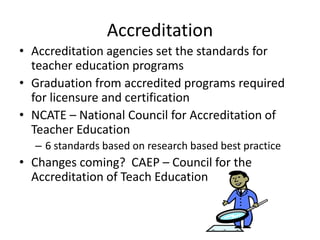
Accreditation
• Accreditation agencies set the standards for
teacher education programs
• Graduation from accredited programs required
for licensure and certification
• NCATE – National Council for Accreditation of
Teacher Education
– 6 standards based on research based best practice
• Changes coming? CAEP – Council for the
Accreditation of Teach Education
Accreditation (cont.)
• INTASC – Interstate Teacher Assessment and
Support Consortium – developed performance
standards for new teachers that has since
changed to include all teachers.
• NCLB – No Child Left Behind – Federal Law (PL
107-110)
– All teachers are to be “highly qualified”
– Additional coursework required for renewal or add-on
certification(s)
Traditional Teacher Education
• Teacher requirements are established by the
states
• Teaching license- authorizes someone to teach
• Teaching certification- indicates the program
in which a teacher is qualified to teach.
Required Education
• Required general education and content
related coursework
• Professional coursework
• Field experiences and clinical internships
(student teaching)
• Are you able to relate your “book learning” to
the reality of a classroom?
Alternative Teacher Education
• Lateral entry– for teachers who did not major
in education
• Praxis exams
• Pearson exams now in NC
• Teach for America success?
Where We Teach
• Public Schools
• Private Schools
• Charter Schools
• Alternatives to Classrooms
Job Market for Teachers?
• High turnover rate
• Especially needed in math, science, special
education
• Resumes, applications, portfolios, networking,
interviewing
What to Expect
• Create a list of problems you think are most likely
to plague new teachers.
• Create a list of solutions for helping new teachers
survive.
• Review Teachers as Professionals
– Performance appraisals
– Mentoring
– Additional coursework and degrees
– National Boards
– Professional organizations

Chapter 4 becoming a teacher

  • 1.
    Becoming a Teacher Ebert,E., & Culyer III, R. (2014). Becoming a Teacher. In School: An introduction to education. Wadsworth.
  • 2.
    Ice Breaker • Completethe Ice Breaker on p. 99 • What do you know about requirements for becoming a teacher? • Who is responsible for licensing public school teachers? • More specifically, what are our requirements in our state for teacher training? For lateral entry teachers?
  • 3.
    Accreditation • Accreditation agenciesset the standards for teacher education programs • Graduation from accredited programs required for licensure and certification • NCATE – National Council for Accreditation of Teacher Education – 6 standards based on research based best practice • Changes coming? CAEP – Council for the Accreditation of Teach Education
  • 4.
    Accreditation (cont.) • INTASC– Interstate Teacher Assessment and Support Consortium – developed performance standards for new teachers that has since changed to include all teachers. • NCLB – No Child Left Behind – Federal Law (PL 107-110) – All teachers are to be “highly qualified” – Additional coursework required for renewal or add-on certification(s)
  • 5.
    Traditional Teacher Education •Teacher requirements are established by the states • Teaching license- authorizes someone to teach • Teaching certification- indicates the program in which a teacher is qualified to teach.
  • 6.
    Required Education • Requiredgeneral education and content related coursework • Professional coursework • Field experiences and clinical internships (student teaching) • Are you able to relate your “book learning” to the reality of a classroom?
  • 7.
    Alternative Teacher Education •Lateral entry– for teachers who did not major in education • Praxis exams • Pearson exams now in NC • Teach for America success?
  • 8.
    Where We Teach •Public Schools • Private Schools • Charter Schools • Alternatives to Classrooms
  • 9.
    Job Market forTeachers? • High turnover rate • Especially needed in math, science, special education • Resumes, applications, portfolios, networking, interviewing
  • 10.
    What to Expect •Create a list of problems you think are most likely to plague new teachers. • Create a list of solutions for helping new teachers survive. • Review Teachers as Professionals – Performance appraisals – Mentoring – Additional coursework and degrees – National Boards – Professional organizations