Foundations for Reading and
Writing
North Carolina Foundations Task Force. (2013). North Carolina
foundations for early learning and development. Raleigh: Author.
Foundations for Reading Goals
• LDC-8: Children develop interest in books and motivation to read
• LDC-9: Children comprehend and use information presented in books
and other print media.
• LDC-10: Children develop book knowledge and print awareness
• LDC-11: Children develop phonological awareness.
• LDC-12: Children begin to develop knowledge of the alphabet and the
alphabetic principle.
Developmental Indicators
• Note the progressive developmental indicators for each goal.
• Early skills begin with infants and progress sequentially through
preschool aged children.
• Some skills related to comprehension and the alphabet are
considered emerging for infants; we cannot yet measure or observe
behaviors that indicate related skills associated with those goals.
Encouraging Interest in Books
• Model reading with a various types of books
• Choose appropriate length books, stories, poems, and finger plays for
the age and interest level of the child
• Provide a variety of books (fiction and non-fiction) and print materials
for children to use in all areas of the room
• When children want to hear the same book repeatedly, accommodate
that interest. This is an indication of their interest.
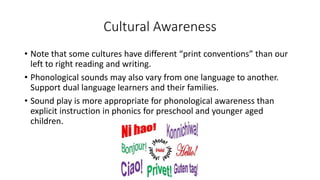
Cultural Awareness
• Note that some cultures have different “print conventions” than our
left to right reading and writing.
• Phonological sounds may also vary from one language to another.
Support dual language learners and their families.
• Sound play is more appropriate for phonological awareness than
explicit instruction in phonics for preschool and younger aged
children.
Strategies for Infants and Toddlers
• Provide lap time for individual children daily. Read, play with sounds,
and mimic sounds babies make.
• Have books available daily. Choose books that can be easily
manipulated and may be cleaned as needed.
• Make books of children’s families, experiences, and familiar objects
• Place pictures, signs, posters, and print at children’s eye level.
• Model reading and care for books
Strategies for Preschoolers
• Provide both fiction and non-fiction books that reflect children’s
interests
• Allow children to choose books for you to read
• Provide books for children to take home
• Share reading and word games ideas with parents
• Provide reading skills throughout room using a variety of delivery
methods and multiple senses
• Provide materials for retelling and acting out stories both indoors and
outdoors
Strategies for Preschoolers (2)
• Provide books and stories in child’s home language
• Reflect home cultures of children
• Promote natural opportunities for phonological awareness rather
than formal instruction
• Increase letter awareness in natural occurrences rather than through
formal instruction
• Provide opportunities for all children to participate in reading
activities at their level
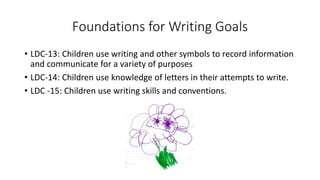
Foundations for Writing Goals
• LDC-13: Children use writing and other symbols to record information
and communicate for a variety of purposes
• LDC-14: Children use knowledge of letters in their attempts to write.
• LDC -15: Children use writing skills and conventions.
Early Writing
• Emerging writing skills may not look like writing as we know it, but
lines and squiggles represent those emerging skills.
• Random letters will begin to show up, but they may be upside down
or backwards. That is typical and does not indicate dysgraphia or
other learning disability at this stage.
• Provide multiple opportunities to draw and write using a variety of
methods, writing materials, and natural experiences.
• Avoid worksheets and formal instruction of letter writing!
• Some adaptive equipment may be necessary for children with fine
motor delays – larger pencils and crayons, special grips, methods for
holding paper
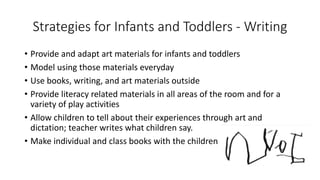
Strategies for Infants and Toddlers - Writing
• Provide and adapt art materials for infants and toddlers
• Model using those materials everyday
• Use books, writing, and art materials outside
• Provide literacy related materials in all areas of the room and for a
variety of play activities
• Allow children to tell about their experiences through art and
dictation; teacher writes what children say.
• Make individual and class books with the children
Strategies for Preschoolers - Writing
• Provide multiple opportunities for art, drawing, and writing with a
variety of methods, materials, and experiences.
• Encourage play activities that make use of literacy related materials
• Support children in writing at their request and based on their
interest levels; avoid formal instruction in writing
• Write what children dictate about their pictures or experiences
• Help children make individual and class books
• Display children’s writing
• Provide unlined paper rather than worksheets or lined paper

Foundations for reading and writing

  • 1.
    Foundations for Readingand Writing North Carolina Foundations Task Force. (2013). North Carolina foundations for early learning and development. Raleigh: Author.
  • 2.
    Foundations for ReadingGoals • LDC-8: Children develop interest in books and motivation to read • LDC-9: Children comprehend and use information presented in books and other print media. • LDC-10: Children develop book knowledge and print awareness • LDC-11: Children develop phonological awareness. • LDC-12: Children begin to develop knowledge of the alphabet and the alphabetic principle.
  • 3.
    Developmental Indicators • Notethe progressive developmental indicators for each goal. • Early skills begin with infants and progress sequentially through preschool aged children. • Some skills related to comprehension and the alphabet are considered emerging for infants; we cannot yet measure or observe behaviors that indicate related skills associated with those goals.
  • 4.
    Encouraging Interest inBooks • Model reading with a various types of books • Choose appropriate length books, stories, poems, and finger plays for the age and interest level of the child • Provide a variety of books (fiction and non-fiction) and print materials for children to use in all areas of the room • When children want to hear the same book repeatedly, accommodate that interest. This is an indication of their interest.
  • 5.
    Cultural Awareness • Notethat some cultures have different “print conventions” than our left to right reading and writing. • Phonological sounds may also vary from one language to another. Support dual language learners and their families. • Sound play is more appropriate for phonological awareness than explicit instruction in phonics for preschool and younger aged children.
  • 6.
    Strategies for Infantsand Toddlers • Provide lap time for individual children daily. Read, play with sounds, and mimic sounds babies make. • Have books available daily. Choose books that can be easily manipulated and may be cleaned as needed. • Make books of children’s families, experiences, and familiar objects • Place pictures, signs, posters, and print at children’s eye level. • Model reading and care for books
  • 7.
    Strategies for Preschoolers •Provide both fiction and non-fiction books that reflect children’s interests • Allow children to choose books for you to read • Provide books for children to take home • Share reading and word games ideas with parents • Provide reading skills throughout room using a variety of delivery methods and multiple senses • Provide materials for retelling and acting out stories both indoors and outdoors
  • 8.
    Strategies for Preschoolers(2) • Provide books and stories in child’s home language • Reflect home cultures of children • Promote natural opportunities for phonological awareness rather than formal instruction • Increase letter awareness in natural occurrences rather than through formal instruction • Provide opportunities for all children to participate in reading activities at their level
  • 9.
    Foundations for WritingGoals • LDC-13: Children use writing and other symbols to record information and communicate for a variety of purposes • LDC-14: Children use knowledge of letters in their attempts to write. • LDC -15: Children use writing skills and conventions.
  • 10.
    Early Writing • Emergingwriting skills may not look like writing as we know it, but lines and squiggles represent those emerging skills. • Random letters will begin to show up, but they may be upside down or backwards. That is typical and does not indicate dysgraphia or other learning disability at this stage. • Provide multiple opportunities to draw and write using a variety of methods, writing materials, and natural experiences. • Avoid worksheets and formal instruction of letter writing! • Some adaptive equipment may be necessary for children with fine motor delays – larger pencils and crayons, special grips, methods for holding paper
  • 11.
    Strategies for Infantsand Toddlers - Writing • Provide and adapt art materials for infants and toddlers • Model using those materials everyday • Use books, writing, and art materials outside • Provide literacy related materials in all areas of the room and for a variety of play activities • Allow children to tell about their experiences through art and dictation; teacher writes what children say. • Make individual and class books with the children
  • 12.
    Strategies for Preschoolers- Writing • Provide multiple opportunities for art, drawing, and writing with a variety of methods, materials, and experiences. • Encourage play activities that make use of literacy related materials • Support children in writing at their request and based on their interest levels; avoid formal instruction in writing • Write what children dictate about their pictures or experiences • Help children make individual and class books • Display children’s writing • Provide unlined paper rather than worksheets or lined paper