Alternative Certification
The Difference Between What You See and What
                  You Hear
Marketing Genius
Want to Teach?
When Can You Start?
We’ve all seen this billboard
from a certain alternative
certification program (ACP),
which boasts that aspiring
teachers will quickly get a job
and be teaching in a
classroom.
Marketing Genius
In fact, the billboard and
marketing tools of this
ACP and the ACP’s
success at building their
“brand” (the number of
web hits and
applications submitted)
make it a “success” story
for their marketing firm!
Professional Opinions
A high school principal commented, “I know I’ve passed on
good teachers before, but I will not consider a resume from an
alternatively certified teacher.” (Bradley, K, personal communication, 20
Oct, 2010).

A local high school teacher commented, “We want our
teachers to student teach. We’ve had too many bad
experiences with unprepared alternatively certified teachers
to consider hiring an alternatively certified teacher who has
not done student teaching.” (L. Waters, personal communication, 18 Nov,
2010).
Problem Statement

As many parties seem to have a strong opinion on
alternatively certified teachers, the purpose of this
study is to determine the perceived effectiveness of
secondary alternative certification teachers in their first
year of teaching.
Terminology
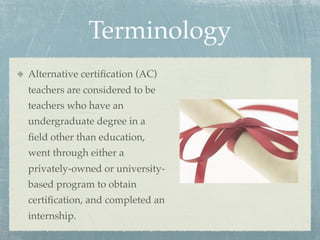
Alternative certification (AC)
teachers are considered to be
teachers who have an
undergraduate degree in a
field other than education,
went through either a
privately-owned or university-
based program to obtain
certification, and completed an
internship.
Terminology
Effectiveness is based on
self-perceptions of:
classroom management,
curriculum knowledge,
ability to create lesson plans
and teach those plans, and
time management.

Effectiveness is not
measured by TAKS scores.
Increase of Alternatively
     Certified Teachers
“A business called I-Teach Texas recently churned out
more than 1,400 new teachers through an Internet-
based program that requires no observation or
teaching in schools. During the same period, the
University of Texas at Austin prepared 142 new
teachers, or approximately 10 percent the number
produced by I-Teach Texas (U.S. Department of
Education 2009)” (Baines, 2010).
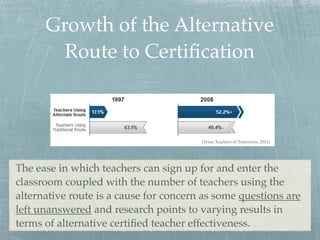
Growth of the Alternative
        Route to Certification


                                        (Texas Teachers of Tomorrow, 2011).


The ease in which teachers can sign up for and enter the
classroom coupled with the number of teachers using the
alternative route is a cause for concern as some questions are
left unanswered and research points to varying results in
terms of alternative certified teacher effectiveness.
Why is this Important?
According to Sokal, Smith and Mowat (2003), “research
shows that teacher education is a necessary aspect of quality
instruction... some researchers claim that AC teachers have
more difficulty learning to teach than do traditionally trained
teachers (Barry, 2001; Shen, 1997).”

According to pre-service teachers, “their frustration with their
inability to manage student behavior is left unaddressed by
their co-operating teachers... as well as by their faculty
advisors” (Sokal, Smith and Mowat, 2003).
Purpose for Investigating Self-
 Perceptions of AC Teachers


This study aims to explore the perceived effectiveness
of secondary alternative certification teachers, and in
turn, shed new light on the measures that must be
incorporated into alternative certification programs.
Significance

This study is significant in that it identifies an accurate
self-perception of the effectiveness of AC teachers in
the state of Texas and allows programs to equip
potential teacher candidates with the knowledge they
need most to be an effective educator.
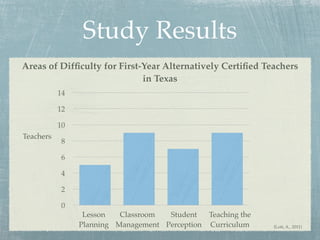
Study Results
Areas of Difficulty for First-Year Alternatively Certified Teachers
                             in Texas
           14

           12

           10
Teachers
            8

            6

            4

            2

            0
                 Lesson   Classroom  Student   Teaching the
                Planning Management Perception Curriculum     (Lott, A., 2011)
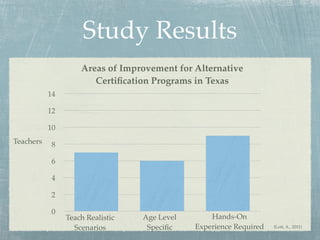
Study Results
                    Areas of Improvement for Alternative
                       Certification Programs in Texas
           14

           12

           10
Teachers    8

            6

            4

            2

            0
                Teach Realistic   Age Level       Hands-On
                  Scenarios        Specific    Experience Required   (Lott, A., 2011)
Conclusions
The teachers identified that they struggled most in knowing
what and how to teach their students. Even though teachers
passed the content area test, they didn’t know what they were
supposed to teach once they got into the classroom.

About half of the teachers had an inaccurate perception of
their students and this caused some classroom management
issues. These teachers repeatedly mentioned that they were
surprised by the immaturity of their students or how
irresponsible their students were.
Implications for ACPs
The teachers repeatedly said that observations (before they
actually had their own classroom) did not work.

Potential teachers need to have the experience dealing with
the everyday classroom management issues, have an
understanding of all of the different types of students that are
in the classroom and instructional content, which can only be
gained through hands-on classroom experience. Additional
research is needed to gather information on how to
accomplish this feat.
Works Cited
ACT Houston. (2011). ACT Houston. Retrieved from http://www.acthouston.com/

Baines, L. (2010). The disintegration of teacher preparation. Educational Horizons,
   88(3), 152-163. Retrieved from ERIC database (EJ887226).

Hawkins, B. (22, Feb. 2011). Texas offers reasons for caution as Minnesota debates
  alternative teacher licensure. MinnPost.com. Retrieved from http://
  www.minnpost.com/learningcurve/2011/02/22/26007/
  texas_offers_reasons_for_caution_as_minnesota_debates_alternative_teacher_licen
  sure

LevelTen Interactive. (2007). Texas teachers. Retrieved from http://
   www.leveltendesign.com/portfolio/success-story/texas-teachers

Lott, A. (2011). Reflections of an alternatively certified first-year teacher and recommendations
   to improve alternative certification programs. Unpublished manuscript, College of
   Education, Sam Houston State University, Huntsville, Texas.
Works Cited
Ott, Adrian. (2010). TAKS: Texas assessment of knowledge and skills. A history of high
   stakes testing in Texas. Retrieved from https://classes.lt.unt.edu/Spring_2010/
   CECS_5420_020/lao0041/Assign%203/taks.html

Sokal, L., Smith, D.G., & Mowat, H. (2003). Alternative certification teachers’ attitudes
   toward classroom management. High School Journal, 86(3), 8-16.

Texas Teachers of Tomorrow. (2011). Our company’s history and overview. Retrieved from
   http://www.texasteachers.org/our-company/program-history/

Texas Teaching Fellows. (2009). Texas teaching fellows. Retrieved from http://
   www.texasteachingfellows.org/

Alternative Certification Research

  • 1.
    Alternative Certification The DifferenceBetween What You See and What You Hear
  • 2.
    Marketing Genius Want toTeach? When Can You Start? We’ve all seen this billboard from a certain alternative certification program (ACP), which boasts that aspiring teachers will quickly get a job and be teaching in a classroom.
  • 3.
    Marketing Genius In fact,the billboard and marketing tools of this ACP and the ACP’s success at building their “brand” (the number of web hits and applications submitted) make it a “success” story for their marketing firm!
  • 4.
    Professional Opinions A highschool principal commented, “I know I’ve passed on good teachers before, but I will not consider a resume from an alternatively certified teacher.” (Bradley, K, personal communication, 20 Oct, 2010). A local high school teacher commented, “We want our teachers to student teach. We’ve had too many bad experiences with unprepared alternatively certified teachers to consider hiring an alternatively certified teacher who has not done student teaching.” (L. Waters, personal communication, 18 Nov, 2010).
  • 5.
    Problem Statement As manyparties seem to have a strong opinion on alternatively certified teachers, the purpose of this study is to determine the perceived effectiveness of secondary alternative certification teachers in their first year of teaching.
  • 6.
    Terminology Alternative certification (AC) teachersare considered to be teachers who have an undergraduate degree in a field other than education, went through either a privately-owned or university- based program to obtain certification, and completed an internship.
  • 7.
    Terminology Effectiveness is basedon self-perceptions of: classroom management, curriculum knowledge, ability to create lesson plans and teach those plans, and time management. Effectiveness is not measured by TAKS scores.
  • 8.
    Increase of Alternatively Certified Teachers “A business called I-Teach Texas recently churned out more than 1,400 new teachers through an Internet- based program that requires no observation or teaching in schools. During the same period, the University of Texas at Austin prepared 142 new teachers, or approximately 10 percent the number produced by I-Teach Texas (U.S. Department of Education 2009)” (Baines, 2010).
  • 9.
    Growth of theAlternative Route to Certification (Texas Teachers of Tomorrow, 2011). The ease in which teachers can sign up for and enter the classroom coupled with the number of teachers using the alternative route is a cause for concern as some questions are left unanswered and research points to varying results in terms of alternative certified teacher effectiveness.
  • 10.
    Why is thisImportant? According to Sokal, Smith and Mowat (2003), “research shows that teacher education is a necessary aspect of quality instruction... some researchers claim that AC teachers have more difficulty learning to teach than do traditionally trained teachers (Barry, 2001; Shen, 1997).” According to pre-service teachers, “their frustration with their inability to manage student behavior is left unaddressed by their co-operating teachers... as well as by their faculty advisors” (Sokal, Smith and Mowat, 2003).
  • 11.
    Purpose for InvestigatingSelf- Perceptions of AC Teachers This study aims to explore the perceived effectiveness of secondary alternative certification teachers, and in turn, shed new light on the measures that must be incorporated into alternative certification programs.
  • 12.
    Significance This study issignificant in that it identifies an accurate self-perception of the effectiveness of AC teachers in the state of Texas and allows programs to equip potential teacher candidates with the knowledge they need most to be an effective educator.
  • 13.
    Study Results Areas ofDifficulty for First-Year Alternatively Certified Teachers in Texas 14 12 10 Teachers 8 6 4 2 0 Lesson Classroom Student Teaching the Planning Management Perception Curriculum (Lott, A., 2011)
  • 14.
    Study Results Areas of Improvement for Alternative Certification Programs in Texas 14 12 10 Teachers 8 6 4 2 0 Teach Realistic Age Level Hands-On Scenarios Specific Experience Required (Lott, A., 2011)
  • 15.
    Conclusions The teachers identifiedthat they struggled most in knowing what and how to teach their students. Even though teachers passed the content area test, they didn’t know what they were supposed to teach once they got into the classroom. About half of the teachers had an inaccurate perception of their students and this caused some classroom management issues. These teachers repeatedly mentioned that they were surprised by the immaturity of their students or how irresponsible their students were.
  • 16.
    Implications for ACPs Theteachers repeatedly said that observations (before they actually had their own classroom) did not work. Potential teachers need to have the experience dealing with the everyday classroom management issues, have an understanding of all of the different types of students that are in the classroom and instructional content, which can only be gained through hands-on classroom experience. Additional research is needed to gather information on how to accomplish this feat.
  • 17.
    Works Cited ACT Houston.(2011). ACT Houston. Retrieved from http://www.acthouston.com/ Baines, L. (2010). The disintegration of teacher preparation. Educational Horizons, 88(3), 152-163. Retrieved from ERIC database (EJ887226). Hawkins, B. (22, Feb. 2011). Texas offers reasons for caution as Minnesota debates alternative teacher licensure. MinnPost.com. Retrieved from http:// www.minnpost.com/learningcurve/2011/02/22/26007/ texas_offers_reasons_for_caution_as_minnesota_debates_alternative_teacher_licen sure LevelTen Interactive. (2007). Texas teachers. Retrieved from http:// www.leveltendesign.com/portfolio/success-story/texas-teachers Lott, A. (2011). Reflections of an alternatively certified first-year teacher and recommendations to improve alternative certification programs. Unpublished manuscript, College of Education, Sam Houston State University, Huntsville, Texas.
  • 18.
    Works Cited Ott, Adrian.(2010). TAKS: Texas assessment of knowledge and skills. A history of high stakes testing in Texas. Retrieved from https://classes.lt.unt.edu/Spring_2010/ CECS_5420_020/lao0041/Assign%203/taks.html Sokal, L., Smith, D.G., & Mowat, H. (2003). Alternative certification teachers’ attitudes toward classroom management. High School Journal, 86(3), 8-16. Texas Teachers of Tomorrow. (2011). Our company’s history and overview. Retrieved from http://www.texasteachers.org/our-company/program-history/ Texas Teaching Fellows. (2009). Texas teaching fellows. Retrieved from http:// www.texasteachingfellows.org/