Curiosity, Information-
Seeking, and Eagerness
North Carolina Foundations Task Force. (2013). North Carolina
foundations for early learning and development. Raleigh: Author.
Developmental Indicators
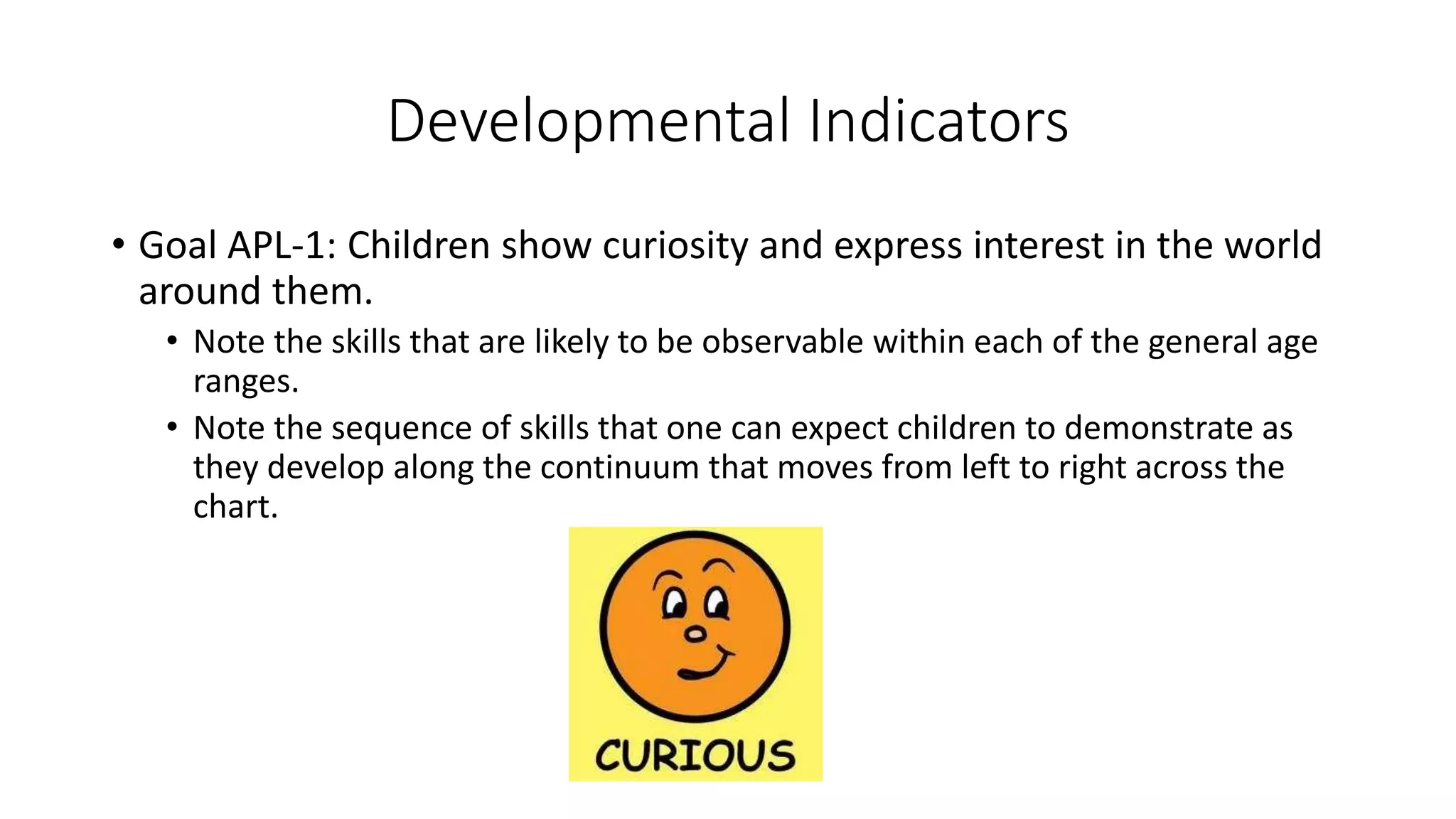
• Goal APL-1: Children show curiosity and express interest in the world
around them.
• Note the skills that are likely to be observable within each of the general age
ranges.
• Note the sequence of skills that one can expect children to demonstrate as
they develop along the continuum that moves from left to right across the
chart.
Developmental Indicators 2
• Goal APL-2: Children actively seek to understand the world around
them.
• Note the skills that are likely to be observable within each of the general age
ranges.
• Note the sequence of skills that one can expect children to demonstrate as
they develop along the continuum that moves from left to right across the
chart.
Our Skills
• These developmental indicators can be used to help us
• Assess, observe, and document what the children in our care are able to do
and need to do next (NAEYC 3a, 3b, 3c)
• Communicate with parents and other professionals (NAEYC 3d)
• Design, implement, and evaluate meaningful, challenging curricula for each
child (NAEYC 5c)
• How can you specifically use this information? How might you
document these skills and emerging skills in the children in your care?
Curiosity, Information-Seeking, and Eagerness
for Infants and Toddlers
• P. 32 offers 10 suggestions for supporting curiosity, information-
seeking, and eagerness in infants and toddlers
• The suggestions include ideas for creating an inviting environment,
providing challenging and multi-sensory materials and experiences,
enhancing language and communication, encouraging child to child
and adult to child interactions, and modeling skills and thinking
(mental modeling)
Infants and Toddlers (cont.)
• Provide safe and inviting classroom
• Have variety of materials and medium that appeal to all the senses
• Avoid overwhelming and over-stimulating children – know their
varying temperaments and personalities – by providing quiet spaces
• Model things to do with materials children show interest in
• Allow children to make choices, support their learning, and follow
their signals
• Be enthusiastic and talk with them about their discoveries. Help
them notice what others are doing
More Infant and Toddler Strategies
• Vary experiences available and add new materials and experiences to
the familiar
• Talk about your interests and enthusiasm, use extended vocabulary,
and model curiosity and wonder
• Model problem-solving through mental modeling – talk about the
steps to your thinking as demonstrate figuring out how to do
something.
• Support children’s efforts to communicate with active listening,
extending their efforts to communicate, acknowledging and modeling
body language and facial expressions
Curiosity, Information-Seeking, and Eagerness
in Preschoolers
• P. 33 offers 10 suggestions for supporting curiosity, information-seeking,
and eagerness in preschoolers
• The suggestions include similar ideas like those for infants and toddlers.
• Some suggestions include: providing a variety of experiences and
materials, both familiar and new; adapting materials as needed so that all
children can be included in activities; being responsive to children and
their interests; allowing ample time and opportunity for children to extend
their play; encouraging meaningful child to child, child to adult, and adult
to child communication and interactions; providing aesthetic and
multisensory experiences; planning various field trip experiences; sharing
interests, enthusiasm, and mental modeling; practicing good
communication skills.
Curiosity, Information-Seeking, and Eagerness
in Preschoolers (cont. 1)
• Provide materials and experiences for extensive exploration and
discovery
• Provide both new and familiar
• Make materials and experiences accessible for independent use and
extended play
• Adapt materials and experiences as necessary for inclusion of all children
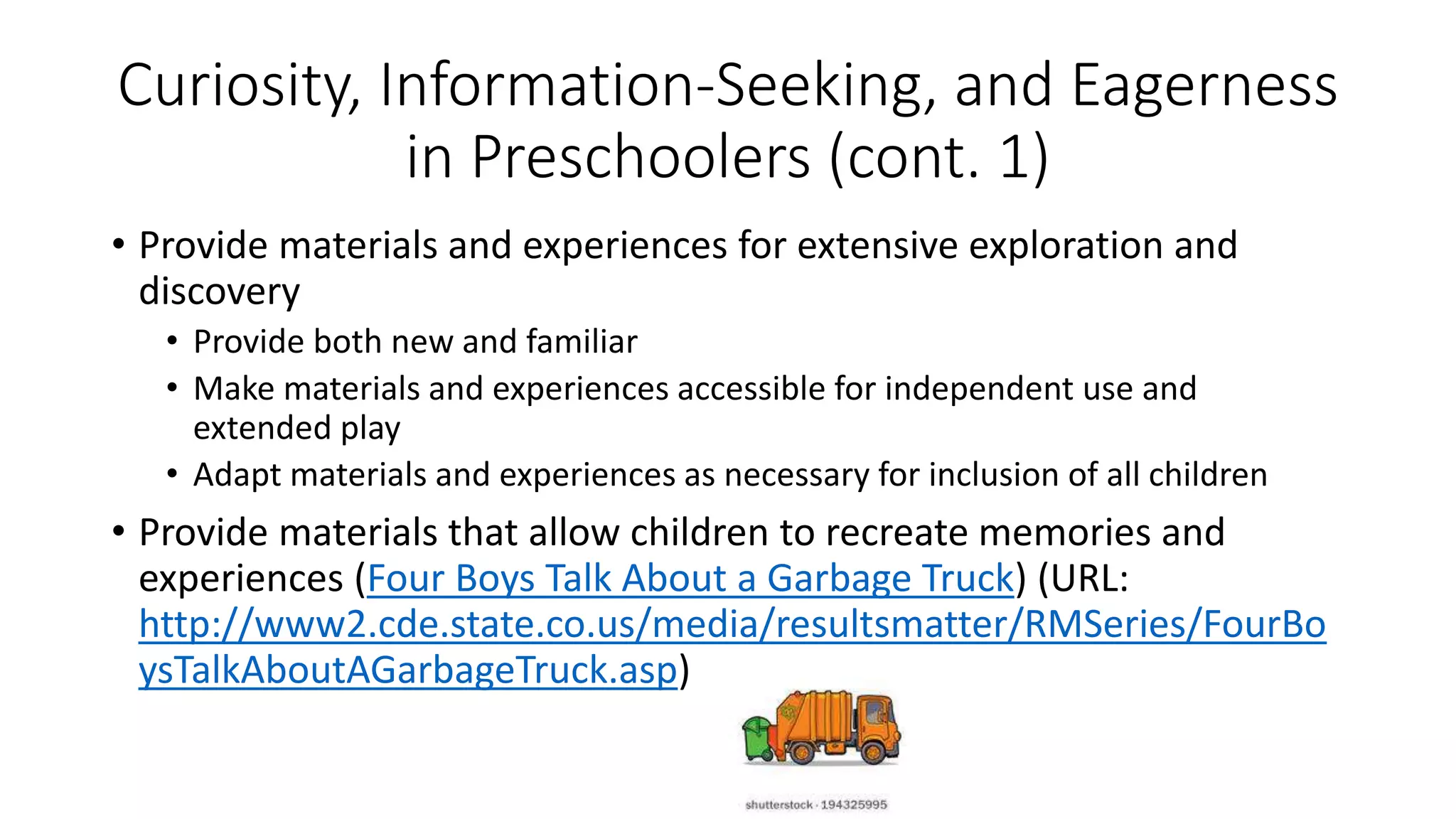
• Provide materials that allow children to recreate memories and
experiences (Four Boys Talk About a Garbage Truck) (URL:
http://www2.cde.state.co.us/media/resultsmatter/RMSeries/FourBo
ysTalkAboutAGarbageTruck.asp)
Curiosity, Information-Seeking, and Eagerness
in Preschoolers (cont. 2)
• Use active listening and communication with preschoolers
• Provide additional props and pictures to help children with limited vocabulary
or who speak another language at home.
• Allow ample time and opportunity for extended play, both indoors
and outdoors
• Provide reminders as time to transition nears
• Allow children to save projects to complete another day rather than always
requiring everything be put up.
Curiosity, Information-Seeking, and Eagerness
in Preschoolers (cont. 3)
• Extend curiosity, information-seeking, and eagerness through asking
open-ended questions and encouraging children to share ideas.
• Provide aesthetic and multi-sensory experiences and materials.
• Provide and call attention to multi-sensory experiences (remember the boys
talking about the stinking trash?)
• Play in the rain and mud
• Provide a variety of substances in the sand and water table throughout the year
• Go on nature walks and discuss the colors, patterns, smells, etc.
• Provide books and pictures that are aesthetically pleasing that are available to
the children
• Plan a variety of field trips
• Follow all safety rules and regulations, including car seat laws and having
adequate number of adult helpers.
• Model “love of learning”, curiosity, wonder, and your enthusiasm for
things that interest you.
• Demonstrate mental modeling
• Talk out loud about your thinking through problems
• Use words that help articulate the steps to the process
• Use various means of communication (words, expressions, body
language) and help children communicate their ideas, feelings, and
interests using similar communication strategies.
Curiosity, Information-Seeking, and Eagerness
in Preschoolers (cont. 4)

Curiosity, information seeking, and eagerness

  • 1.
    Curiosity, Information- Seeking, andEagerness North Carolina Foundations Task Force. (2013). North Carolina foundations for early learning and development. Raleigh: Author.
  • 2.
    Developmental Indicators • GoalAPL-1: Children show curiosity and express interest in the world around them. • Note the skills that are likely to be observable within each of the general age ranges. • Note the sequence of skills that one can expect children to demonstrate as they develop along the continuum that moves from left to right across the chart.
  • 3.
    Developmental Indicators 2 •Goal APL-2: Children actively seek to understand the world around them. • Note the skills that are likely to be observable within each of the general age ranges. • Note the sequence of skills that one can expect children to demonstrate as they develop along the continuum that moves from left to right across the chart.
  • 4.
    Our Skills • Thesedevelopmental indicators can be used to help us • Assess, observe, and document what the children in our care are able to do and need to do next (NAEYC 3a, 3b, 3c) • Communicate with parents and other professionals (NAEYC 3d) • Design, implement, and evaluate meaningful, challenging curricula for each child (NAEYC 5c) • How can you specifically use this information? How might you document these skills and emerging skills in the children in your care?
  • 5.
    Curiosity, Information-Seeking, andEagerness for Infants and Toddlers • P. 32 offers 10 suggestions for supporting curiosity, information- seeking, and eagerness in infants and toddlers • The suggestions include ideas for creating an inviting environment, providing challenging and multi-sensory materials and experiences, enhancing language and communication, encouraging child to child and adult to child interactions, and modeling skills and thinking (mental modeling)
  • 6.
    Infants and Toddlers(cont.) • Provide safe and inviting classroom • Have variety of materials and medium that appeal to all the senses • Avoid overwhelming and over-stimulating children – know their varying temperaments and personalities – by providing quiet spaces • Model things to do with materials children show interest in • Allow children to make choices, support their learning, and follow their signals • Be enthusiastic and talk with them about their discoveries. Help them notice what others are doing
  • 7.
    More Infant andToddler Strategies • Vary experiences available and add new materials and experiences to the familiar • Talk about your interests and enthusiasm, use extended vocabulary, and model curiosity and wonder • Model problem-solving through mental modeling – talk about the steps to your thinking as demonstrate figuring out how to do something. • Support children’s efforts to communicate with active listening, extending their efforts to communicate, acknowledging and modeling body language and facial expressions
  • 8.
    Curiosity, Information-Seeking, andEagerness in Preschoolers • P. 33 offers 10 suggestions for supporting curiosity, information-seeking, and eagerness in preschoolers • The suggestions include similar ideas like those for infants and toddlers. • Some suggestions include: providing a variety of experiences and materials, both familiar and new; adapting materials as needed so that all children can be included in activities; being responsive to children and their interests; allowing ample time and opportunity for children to extend their play; encouraging meaningful child to child, child to adult, and adult to child communication and interactions; providing aesthetic and multisensory experiences; planning various field trip experiences; sharing interests, enthusiasm, and mental modeling; practicing good communication skills.
  • 9.
    Curiosity, Information-Seeking, andEagerness in Preschoolers (cont. 1) • Provide materials and experiences for extensive exploration and discovery • Provide both new and familiar • Make materials and experiences accessible for independent use and extended play • Adapt materials and experiences as necessary for inclusion of all children • Provide materials that allow children to recreate memories and experiences (Four Boys Talk About a Garbage Truck) (URL: http://www2.cde.state.co.us/media/resultsmatter/RMSeries/FourBo ysTalkAboutAGarbageTruck.asp)
  • 10.
    Curiosity, Information-Seeking, andEagerness in Preschoolers (cont. 2) • Use active listening and communication with preschoolers • Provide additional props and pictures to help children with limited vocabulary or who speak another language at home. • Allow ample time and opportunity for extended play, both indoors and outdoors • Provide reminders as time to transition nears • Allow children to save projects to complete another day rather than always requiring everything be put up.
  • 11.
    Curiosity, Information-Seeking, andEagerness in Preschoolers (cont. 3) • Extend curiosity, information-seeking, and eagerness through asking open-ended questions and encouraging children to share ideas. • Provide aesthetic and multi-sensory experiences and materials. • Provide and call attention to multi-sensory experiences (remember the boys talking about the stinking trash?) • Play in the rain and mud • Provide a variety of substances in the sand and water table throughout the year • Go on nature walks and discuss the colors, patterns, smells, etc. • Provide books and pictures that are aesthetically pleasing that are available to the children
  • 12.
    • Plan avariety of field trips • Follow all safety rules and regulations, including car seat laws and having adequate number of adult helpers. • Model “love of learning”, curiosity, wonder, and your enthusiasm for things that interest you. • Demonstrate mental modeling • Talk out loud about your thinking through problems • Use words that help articulate the steps to the process • Use various means of communication (words, expressions, body language) and help children communicate their ideas, feelings, and interests using similar communication strategies. Curiosity, Information-Seeking, and Eagerness in Preschoolers (cont. 4)